G.I.S and GPS
BAPPA SARKAR
Assistant Professor, Dinhata College.
Certificate course(RS &G.I.S) from NRSC, Hydrabad
Short Term Course( R.S)- IIRS, Dehradun.
Certificate course from IIRS(G.I.S), Dehradun.
GPS
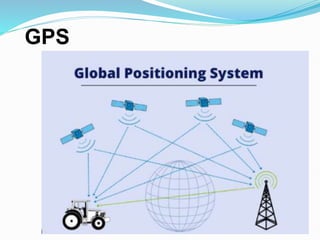
How GPS Work
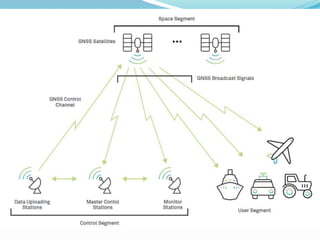
Space Segment
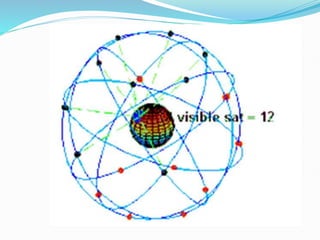
The GPS space segment includes over 30 satellites in orbit operated and maintained
by the U.S. Space Force. These satellites broadcast radio signals to control and
monitoring stations on Earth and directly to users requiring highly precise satellite
positioning.
Control segment -The U.S. Space Force also oversees the GPS control segment. It
includes master control and backup control stations, dedicated ground antennas and
several monitor stations located worldwide. These stations work to ensure GPS
satellites are healthy, orbiting in the correct locations and have accurate atomic
clocks on board. These stations are integral to the overall health and accuracy of the
GPS constellation.
User Segment-
The user segment includes everyone relying upon GPS satellites for PNT
measurements. From a mobile phone providing directions to autonomous vehicles
requiring lane-level positioning accuracy; from a farmer tracking planting and harvesting
routes year-over-year to a UAV mapping a rainforest, many applications use GPS for
high precision positioning and accuracy around the world.
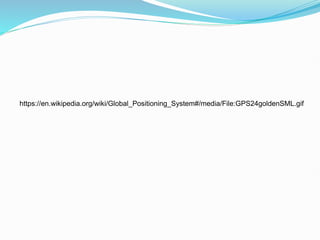
https://en.wikipedia.org/wiki/Global_Positioning_System#/media/File:GPS24goldenSML.gif
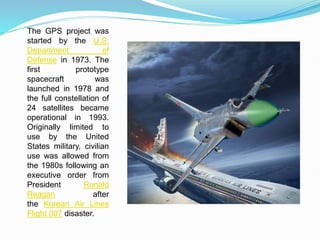
The GPS project was
started by the U.S.
Department of
Defense in 1973. The
first prototype
spacecraft was
launched in 1978 and
the full constellation of
24 satellites became
operational in 1993.
Originally limited to
use by the United
States military, civilian
use was allowed from
the 1980s following an
executive order from
President Ronald
Reagan after
the Korean Air Lines
Flight 007 disaster.
From the early
1990s, GPS
positional
accuracy was
degraded by the
United States
government by a
program
called Selective
Availability, which
could selectively
degrade or deny
access to the
system at any
time,[8] as
happened to the
Indian military in
1999 during
the Kargil War.
2013
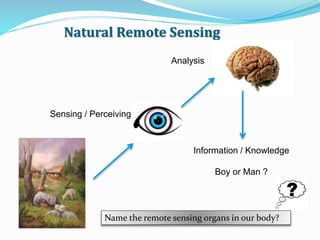
Natural Remote Sensing
Sensing / Perceiving
Analysis
Information / Knowledge
Boy or Man ?
Name the remote sensing organs in our body?
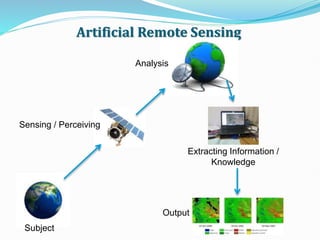
Artificial Remote Sensing
Sensing / Perceiving
Analysis
Extracting Information /
Knowledge
Output
Subject
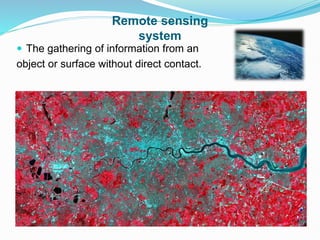
Remote sensing
system
 The gathering of information from an
object or surface without direct contact.
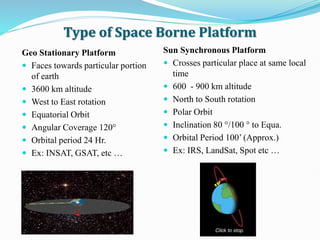
Type of Space Borne Platform
Geo Stationary Platform
 Faces towards particular portion
of earth
 3600 km altitude
 West to East rotation
 Equatorial Orbit
 Angular Coverage 120°
 Orbital period 24 Hr.
 Ex: INSAT, GSAT, etc …
Sun Synchronous Platform
 Crosses particular place at same local
time
 600 - 900 km altitude
 North to South rotation
 Polar Orbit
 Inclination 80 °/100 ° to Equa.
 Orbital Period 100’ (Approx.)
 Ex: IRS, LandSat, Spot etc …
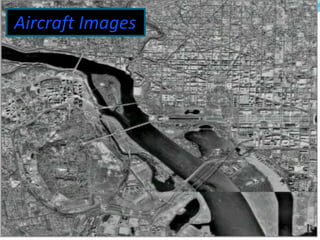
Aircraft Images
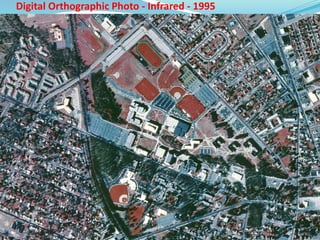
Digital Orthographic Photo - Infrared - 1995
Rowan University
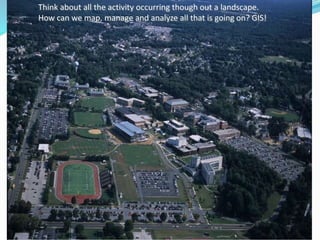
Think about all the activity occurring though out a landscape.
How can we map, manage and analyze all that is going on? GIS!
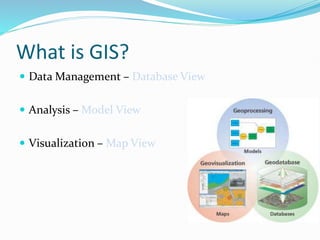
What is GIS?
1. Data Management
 Manages various kinds of GIS data including vector,
raster, images, tables, other data files
 Data models and architectures
 Conversion between formats
 Import/export utilities
 Interacts with RDBMS (SQL Server, Oracle, etc…)
What is GIS?
2. Analysis
 Spatially aware data
 Attribute and spatial query
 Proximity and Overlay
 Advanced geoprocessing techniques
 Decision support
 Flexible, customization
 Programming, scripting (to perform analysis)
What is GIS?
3. Visualization
 Maps! Maps! Maps!
 If a picture is worth a 1000 words…
 Professional cartographic tool
 Charts, graphs, tables, etc…
 Various coordinate systems
 2D and 3D
 Web, desktop, handheld, etc…
What is GIS?
 Data Management – Database View
 Analysis – Model View
 Visualization – Map View
The “G”
 “G” = Geographic
 Denotes the concept of spatial location on Earth’s
surface
 Importance of relative location (not just where you
are but where you are in relation to everything else)
 Theories and techniques in Geography form the
basis of GIS
The “I”
 “I” = Information
 Substance (knowledge) about location
 Factual and interpretative
 Tables + Maps + Analysis
 Transformation of table information into spatial
context for analysis
 Technology and computer systems
What About the “S” in GIS?
 Systems
 Science
 Studies
 Services
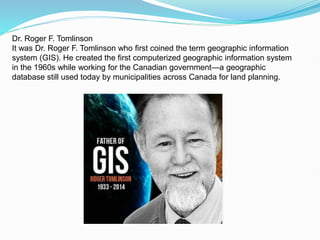
Dr. Roger F. Tomlinson
It was Dr. Roger F. Tomlinson who first coined the term geographic information
system (GIS). He created the first computerized geographic information system
in the 1960s while working for the Canadian government—a geographic
database still used today by municipalities across Canada for land planning.
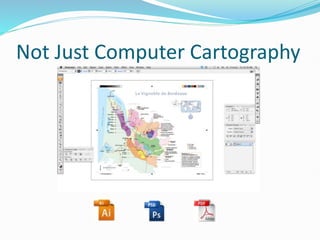
Not Just Computer Cartography
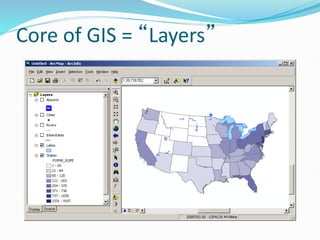
Core of GIS = “Layers”
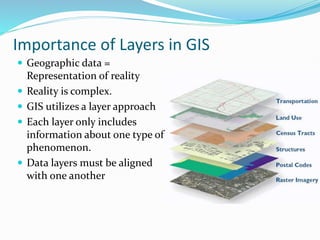
Importance of Layers in GIS
 Geographic data =
Representation of reality
 Reality is complex.
 GIS utilizes a layer approach
 Each layer only includes
information about one type of
phenomenon.
 Data layers must be aligned
with one another
Families of GIS Data
 Vector mode or coordinate based
 Three vector objects exist—points, lines, polygons;
these are called “features.”
 They are represented by X,Y coordinates
 sometimes Z (3D), sometimes M (linear reference)
 Information about features is (are) called “attributes.”
 Two types of vector models—topological and object
 Topological means the data models stores relationships
between vectors
 Vector objects exist independent of any other nearby
features
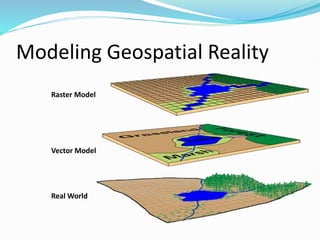
Modeling Geospatial Reality
Real World
Vector Model
Raster Model
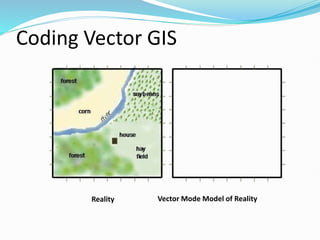
Coding Vector GIS
Reality Vector Mode Model of Reality
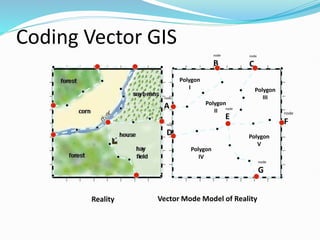
Coding Vector GIS
Polygon
I
Polygon
II
Polygon
III
Polygon
V
Polygon
IV
node
A
node
B
node
C
node
E
node
F
node
G
node
D
Reality Vector Mode Model of Reality
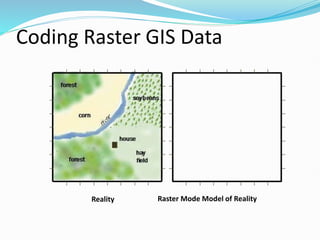
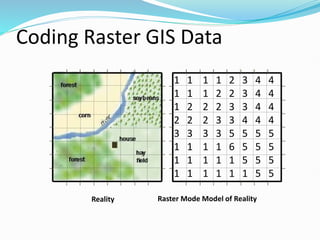
Coding Raster GIS Data
Reality Raster Mode Model of Reality
Coding Raster GIS Data
1 1 1 1 2 3 4 4
1 1 1 2 2 3 4 4
1 2 2 2 3 3 4 4
2 2 2 3 3 4 4 4
3 3 3 3 5 5 5 5
1 1 1 1 6 5 5 5
1 1 1 1 1 5 5 5
1 1 1 1 1 1 5 5
Reality Raster Mode Model of Reality
Advantages of Vector
 Vector data make maps that look more like
maps we are use to seeing on paper.
 The shapes of features are accurately
represented.
 Vector data can have topology
 Vector data is good for managing attributes
 Vector data has smaller storage requirement
 Only the objects need to be represented in the
database (empty space in-between is not captured)
Disadvantages of Vector
 Complicated data structure
 Software must manage many data tables
 Not good at representing geographic features that
gradually change over location
 For example elevation or moisture in soil
 Slower processing time
Advantages of Raster
 Good at depicting continuously changing surfaces
such as elevation or soil moisture
 Grid format is simple data structure
 Easier for computer to make analytical calculations
 Ideal for utilizing remote sensing images
Disadvantages of Raster
• Maps can be blocky looking (depending on the size
of the grid cells)
• Cells can only be coded for one attribute when
there may be more than one attribute at each
location
• Can have very large datasets (depending on the size
of the grid cell)
• Not topological: adjacency data structure
40
Application of GIS
Urban Planning
3D Modelling
Environmental Analysis
Hydrocarbon Exploration
Asset and Security Management
. . . . .
. . . the application of GIS is limited only by the imagination of those who use it. – Jack Dangermond
41
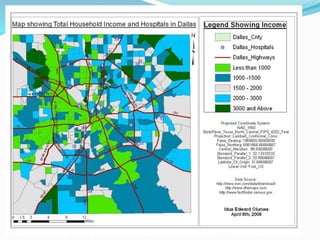
Aspects and Impacts of Urban Planning
 The Physical aspects (Spatial)
–includes environmental – vegetation, land ownership,
mosques/churches, recreation, public transport, boundary/county lines,
surface water; physical infrastructure – roads, pipelines, hospitals,
schools; and topographic data – elevation, scale);
 Demographic (Attribute)
 The population and their characteristics such as include sex, race, age,
income, disabilities, mobility (in terms of travel time to work or
number of vehicles available), educational attainment, home
ownership, employment status, and even location .
Urban Planning
42
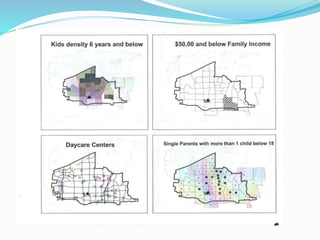
Socio-Economic Data
 Services and Facilities data (education, health, child care,
emergency services, mosques/churches, recreation, public transport);
 Land Use data (current land use, open space, industrial locations,
retail locations);
 Population data (demographic characteristics, population
projections);
 Land and Housing data (# of dwellings, age and type of dwellings,
available allotments, broad area land, forecast allotment demand).
Census:-
Integration of GIS technology in Census Mapping
 GIS introduced in Indian Census in 1992.
 Such software, as, ArcInfo, ArcView and ArcGIS have
been extensively used.
 About 60 skilled professionals are engaged in GIS
related work in 17 centers located in different parts of
the country.
46
Applications of Urban Planning
 Analysis of development trends;
 Population growth;
 Analysis and monitoring of land and housing markets;
 Development of regional strategic plans;
 Development of community plans;
 Analysis of school bus transport systems;
 Modelling of accessibility to public transport.
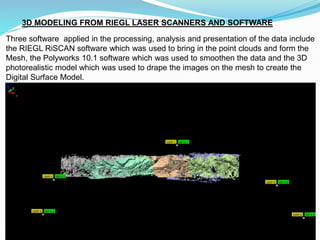
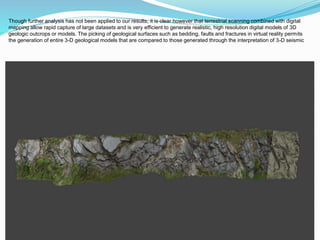
3D MODELING FROM RIEGL LASER SCANNERS AND SOFTWARE
Three software applied in the processing, analysis and presentation of the data include
the RIEGL RiSCAN software which was used to bring in the point clouds and form the
Mesh, the Polyworks 10.1 software which was used to smoothen the data and the 3D
photorealistic model which was used to drape the images on the mesh to create the
Digital Surface Model.
Though further analysis has not been applied to our results, it is clear however that terrestrial scanning combined with digital
mapping allow rapid capture of large datasets and is very efficient to generate realistic, high resolution digital models of 3D
geologic outcrops or models. The picking of geological surfaces such as bedding, faults and fractures in virtual reality permits
the generation of entire 3-D geological models that are compared to those generated through the interpretation of 3-D seismic
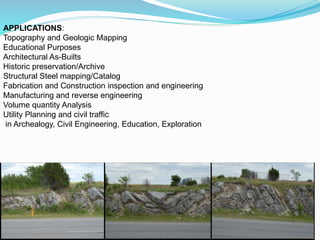
APPLICATIONS:
Topography and Geologic Mapping
Educational Purposes
Architectural As-Builts
Historic preservation/Archive
Structural Steel mapping/Catalog
Fabrication and Construction inspection and engineering
Manufacturing and reverse engineering
Volume quantity Analysis
Utility Planning and civil traffic
in Archealogy, Civil Engineering, Education, Exploration
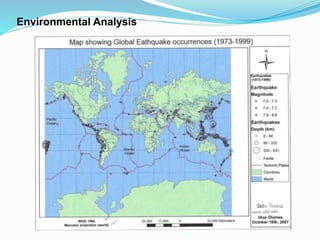
Environmental Analysis
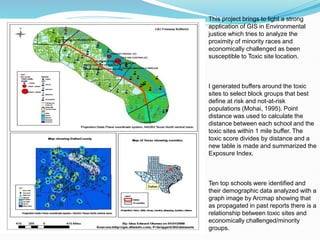
This project brings to light a strong
application of GIS in Environmental
justice which tries to analyze the
proximity of minority races and
economically challenged as been
susceptible to Toxic site location.
I generated buffers around the toxic
sites to select block groups that best
define at risk and not-at-risk
populations (Mohai, 1995). Point
distance was used to calculate the
distance between each school and the
toxic sites within 1 mile buffer. The
toxic score divides by distance and a
new table is made and summarized the
Exposure Index.
Ten top schools were identified and
their demographic data analyzed with a
graph image by Arcmap showing that
as propagated in past reports there is a
relationship between toxic sites and
economically challenged/minority
groups.
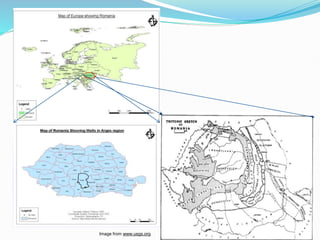
Image from www.usgs.org
53
Geology
 Izvoru field is mainly underlaid by clastic reservoirs with stratigraphic traps, The field is a monocline structure
that does not appear to have a time or depth closure. There were 34 wells drilled in the field, 16 were abandoned
either during drilling or after testing, and 18 wells were productive. . Several wells on the southern flank (up dip
side) of the field were non-productive, even though the log response is similar to successful wells in the field.
The interpretation is that some of the wells were drilled (drilling problems or overbalanced) or tested improperly
(bad casing and / or cement problems) and that there is some type of porosity limit to the south.
 Below the Sarmatian there are two additional targets: the Upper Cretaceous Senonian carbonates, and the
Albian carbonates. The Senonian is directly beneath the Sarmatian and has a similar geometry. Based on third
party engineering studies, the combined Sarmatian and Albian formations contained original resources in place
of approximately 22 million barrels of oil (2.8 million tons). Completion difficulties and water production
resulted in limited flow rates and recoveries leading to field abandonment in 1998.
Petroleum Development
•First country registered in world statistics with a commercial production of 275
metric tones of crude oil in 1857 (Ionescu, 1994).
• The first place Crude oil was exploited from wells dug manually drilled as early as
the 17th and 18th centuries (Dinu et al, 1996). first well was drilled mechanically was
done in Moldavia down to 150m depth in 1861, while in 1862, oil was discovered in
Ploiesti district.
•The first gas field was discovered in 1909 at Sarmasel in the Transylvania Basin
and the first European gas piping system was built in Transylvania in 1913.
•Since then, more than 23,600 geological wells have been drilled onshore and 50
offshore Romania and they have discovered 19.2 billion barrels of oil-in-place and
23.7 trillion ft3 of gas-in-place, and located 473 oil and 201 gas reservoirs. More than
400 of the wells are deeper than 3500m
•According to well classification used in Romania, ‘geological wells’ are understood
to be wells which have contributed to the discovery and the delineation of oil and gas
fields (Ionescu, 1994).
55
 Aerial photo interpretation with such image made smaller features like
electrical poles difficult to identify, however, some major features of interest
were covered. Commercial areas were identified from residential areas with
paved floors and large parking lot and cars while forest areas differed from
farmland due to uneven arrangements while rivers ere differentiated from
canals based on paths and proximity to farmlands
 Roads, Homes, canals forests were digitized in ArcView. Well points were
converting from lat/long to x,y coordinates. Surface well locations were picked
over bottom well locations from SMT Kingdom, these were in X,Y coordinates
and were input into Notepad and imported as a table into the file
geodatabase. Tables and attributes follow.
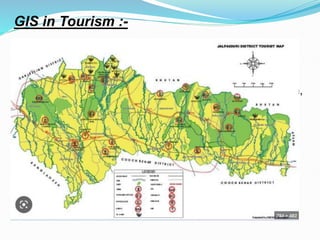
GIS in Tourism :-
• Visualization of tourist sites through digital images or
videos
• Valuable information on tourist locations
• Selective information like route planning, accommodation,
cultural events, special attractions etc.
• Easily accessible information over the internet.
• Interactive maps that respond to user queries.
• They will find all information on click, measure distance,
find hotels and restaurants and even navigate to their
respective links.
THANK YOU

GIS_Geographical Information System & Global Positioning System in Geography

  • 1.
    G.I.S and GPS BAPPASARKAR Assistant Professor, Dinhata College. Certificate course(RS &G.I.S) from NRSC, Hydrabad Short Term Course( R.S)- IIRS, Dehradun. Certificate course from IIRS(G.I.S), Dehradun.
  • 2.
  • 4.
    How GPS Work SpaceSegment The GPS space segment includes over 30 satellites in orbit operated and maintained by the U.S. Space Force. These satellites broadcast radio signals to control and monitoring stations on Earth and directly to users requiring highly precise satellite positioning. Control segment -The U.S. Space Force also oversees the GPS control segment. It includes master control and backup control stations, dedicated ground antennas and several monitor stations located worldwide. These stations work to ensure GPS satellites are healthy, orbiting in the correct locations and have accurate atomic clocks on board. These stations are integral to the overall health and accuracy of the GPS constellation. User Segment- The user segment includes everyone relying upon GPS satellites for PNT measurements. From a mobile phone providing directions to autonomous vehicles requiring lane-level positioning accuracy; from a farmer tracking planting and harvesting routes year-over-year to a UAV mapping a rainforest, many applications use GPS for high precision positioning and accuracy around the world.
  • 7.
  • 8.
    The GPS projectwas started by the U.S. Department of Defense in 1973. The first prototype spacecraft was launched in 1978 and the full constellation of 24 satellites became operational in 1993. Originally limited to use by the United States military, civilian use was allowed from the 1980s following an executive order from President Ronald Reagan after the Korean Air Lines Flight 007 disaster.
  • 9.
    From the early 1990s,GPS positional accuracy was degraded by the United States government by a program called Selective Availability, which could selectively degrade or deny access to the system at any time,[8] as happened to the Indian military in 1999 during the Kargil War.
  • 10.
  • 12.
    Natural Remote Sensing Sensing/ Perceiving Analysis Information / Knowledge Boy or Man ? Name the remote sensing organs in our body?
  • 13.
    Artificial Remote Sensing Sensing/ Perceiving Analysis Extracting Information / Knowledge Output Subject
  • 14.
    Remote sensing system  Thegathering of information from an object or surface without direct contact.
  • 15.
    Type of SpaceBorne Platform Geo Stationary Platform  Faces towards particular portion of earth  3600 km altitude  West to East rotation  Equatorial Orbit  Angular Coverage 120°  Orbital period 24 Hr.  Ex: INSAT, GSAT, etc … Sun Synchronous Platform  Crosses particular place at same local time  600 - 900 km altitude  North to South rotation  Polar Orbit  Inclination 80 °/100 ° to Equa.  Orbital Period 100’ (Approx.)  Ex: IRS, LandSat, Spot etc …
  • 16.
  • 17.
    Digital Orthographic Photo- Infrared - 1995
  • 18.
    Rowan University Think aboutall the activity occurring though out a landscape. How can we map, manage and analyze all that is going on? GIS!
  • 19.
    What is GIS? 1.Data Management  Manages various kinds of GIS data including vector, raster, images, tables, other data files  Data models and architectures  Conversion between formats  Import/export utilities  Interacts with RDBMS (SQL Server, Oracle, etc…)
  • 20.
    What is GIS? 2.Analysis  Spatially aware data  Attribute and spatial query  Proximity and Overlay  Advanced geoprocessing techniques  Decision support  Flexible, customization  Programming, scripting (to perform analysis)
  • 21.
    What is GIS? 3.Visualization  Maps! Maps! Maps!  If a picture is worth a 1000 words…  Professional cartographic tool  Charts, graphs, tables, etc…  Various coordinate systems  2D and 3D  Web, desktop, handheld, etc…
  • 22.
    What is GIS? Data Management – Database View  Analysis – Model View  Visualization – Map View
  • 23.
    The “G”  “G”= Geographic  Denotes the concept of spatial location on Earth’s surface  Importance of relative location (not just where you are but where you are in relation to everything else)  Theories and techniques in Geography form the basis of GIS
  • 24.
    The “I”  “I”= Information  Substance (knowledge) about location  Factual and interpretative  Tables + Maps + Analysis  Transformation of table information into spatial context for analysis  Technology and computer systems
  • 25.
    What About the“S” in GIS?  Systems  Science  Studies  Services
  • 26.
    Dr. Roger F.Tomlinson It was Dr. Roger F. Tomlinson who first coined the term geographic information system (GIS). He created the first computerized geographic information system in the 1960s while working for the Canadian government—a geographic database still used today by municipalities across Canada for land planning.
  • 27.
    Not Just ComputerCartography
  • 28.
    Core of GIS= “Layers”
  • 29.
    Importance of Layersin GIS  Geographic data = Representation of reality  Reality is complex.  GIS utilizes a layer approach  Each layer only includes information about one type of phenomenon.  Data layers must be aligned with one another
  • 30.
    Families of GISData  Vector mode or coordinate based  Three vector objects exist—points, lines, polygons; these are called “features.”  They are represented by X,Y coordinates  sometimes Z (3D), sometimes M (linear reference)  Information about features is (are) called “attributes.”  Two types of vector models—topological and object  Topological means the data models stores relationships between vectors  Vector objects exist independent of any other nearby features
  • 31.
    Modeling Geospatial Reality RealWorld Vector Model Raster Model
  • 32.
    Coding Vector GIS RealityVector Mode Model of Reality
  • 33.
  • 34.
    Coding Raster GISData Reality Raster Mode Model of Reality
  • 35.
    Coding Raster GISData 1 1 1 1 2 3 4 4 1 1 1 2 2 3 4 4 1 2 2 2 3 3 4 4 2 2 2 3 3 4 4 4 3 3 3 3 5 5 5 5 1 1 1 1 6 5 5 5 1 1 1 1 1 5 5 5 1 1 1 1 1 1 5 5 Reality Raster Mode Model of Reality
  • 36.
    Advantages of Vector Vector data make maps that look more like maps we are use to seeing on paper.  The shapes of features are accurately represented.  Vector data can have topology  Vector data is good for managing attributes  Vector data has smaller storage requirement  Only the objects need to be represented in the database (empty space in-between is not captured)
  • 37.
    Disadvantages of Vector Complicated data structure  Software must manage many data tables  Not good at representing geographic features that gradually change over location  For example elevation or moisture in soil  Slower processing time
  • 38.
    Advantages of Raster Good at depicting continuously changing surfaces such as elevation or soil moisture  Grid format is simple data structure  Easier for computer to make analytical calculations  Ideal for utilizing remote sensing images
  • 39.
    Disadvantages of Raster •Maps can be blocky looking (depending on the size of the grid cells) • Cells can only be coded for one attribute when there may be more than one attribute at each location • Can have very large datasets (depending on the size of the grid cell) • Not topological: adjacency data structure
  • 40.
    40 Application of GIS UrbanPlanning 3D Modelling Environmental Analysis Hydrocarbon Exploration Asset and Security Management . . . . . . . . the application of GIS is limited only by the imagination of those who use it. – Jack Dangermond
  • 41.
    41 Aspects and Impactsof Urban Planning  The Physical aspects (Spatial) –includes environmental – vegetation, land ownership, mosques/churches, recreation, public transport, boundary/county lines, surface water; physical infrastructure – roads, pipelines, hospitals, schools; and topographic data – elevation, scale);  Demographic (Attribute)  The population and their characteristics such as include sex, race, age, income, disabilities, mobility (in terms of travel time to work or number of vehicles available), educational attainment, home ownership, employment status, and even location . Urban Planning
  • 42.
    42 Socio-Economic Data  Servicesand Facilities data (education, health, child care, emergency services, mosques/churches, recreation, public transport);  Land Use data (current land use, open space, industrial locations, retail locations);  Population data (demographic characteristics, population projections);  Land and Housing data (# of dwellings, age and type of dwellings, available allotments, broad area land, forecast allotment demand).
  • 44.
    Census:- Integration of GIStechnology in Census Mapping  GIS introduced in Indian Census in 1992.  Such software, as, ArcInfo, ArcView and ArcGIS have been extensively used.  About 60 skilled professionals are engaged in GIS related work in 17 centers located in different parts of the country.
  • 46.
    46 Applications of UrbanPlanning  Analysis of development trends;  Population growth;  Analysis and monitoring of land and housing markets;  Development of regional strategic plans;  Development of community plans;  Analysis of school bus transport systems;  Modelling of accessibility to public transport.
  • 47.
    3D MODELING FROMRIEGL LASER SCANNERS AND SOFTWARE Three software applied in the processing, analysis and presentation of the data include the RIEGL RiSCAN software which was used to bring in the point clouds and form the Mesh, the Polyworks 10.1 software which was used to smoothen the data and the 3D photorealistic model which was used to drape the images on the mesh to create the Digital Surface Model.
  • 48.
    Though further analysishas not been applied to our results, it is clear however that terrestrial scanning combined with digital mapping allow rapid capture of large datasets and is very efficient to generate realistic, high resolution digital models of 3D geologic outcrops or models. The picking of geological surfaces such as bedding, faults and fractures in virtual reality permits the generation of entire 3-D geological models that are compared to those generated through the interpretation of 3-D seismic
  • 49.
    APPLICATIONS: Topography and GeologicMapping Educational Purposes Architectural As-Builts Historic preservation/Archive Structural Steel mapping/Catalog Fabrication and Construction inspection and engineering Manufacturing and reverse engineering Volume quantity Analysis Utility Planning and civil traffic in Archealogy, Civil Engineering, Education, Exploration
  • 50.
  • 51.
    This project bringsto light a strong application of GIS in Environmental justice which tries to analyze the proximity of minority races and economically challenged as been susceptible to Toxic site location. I generated buffers around the toxic sites to select block groups that best define at risk and not-at-risk populations (Mohai, 1995). Point distance was used to calculate the distance between each school and the toxic sites within 1 mile buffer. The toxic score divides by distance and a new table is made and summarized the Exposure Index. Ten top schools were identified and their demographic data analyzed with a graph image by Arcmap showing that as propagated in past reports there is a relationship between toxic sites and economically challenged/minority groups.
  • 52.
  • 53.
    53 Geology  Izvoru fieldis mainly underlaid by clastic reservoirs with stratigraphic traps, The field is a monocline structure that does not appear to have a time or depth closure. There were 34 wells drilled in the field, 16 were abandoned either during drilling or after testing, and 18 wells were productive. . Several wells on the southern flank (up dip side) of the field were non-productive, even though the log response is similar to successful wells in the field. The interpretation is that some of the wells were drilled (drilling problems or overbalanced) or tested improperly (bad casing and / or cement problems) and that there is some type of porosity limit to the south.  Below the Sarmatian there are two additional targets: the Upper Cretaceous Senonian carbonates, and the Albian carbonates. The Senonian is directly beneath the Sarmatian and has a similar geometry. Based on third party engineering studies, the combined Sarmatian and Albian formations contained original resources in place of approximately 22 million barrels of oil (2.8 million tons). Completion difficulties and water production resulted in limited flow rates and recoveries leading to field abandonment in 1998.
  • 54.
    Petroleum Development •First countryregistered in world statistics with a commercial production of 275 metric tones of crude oil in 1857 (Ionescu, 1994). • The first place Crude oil was exploited from wells dug manually drilled as early as the 17th and 18th centuries (Dinu et al, 1996). first well was drilled mechanically was done in Moldavia down to 150m depth in 1861, while in 1862, oil was discovered in Ploiesti district. •The first gas field was discovered in 1909 at Sarmasel in the Transylvania Basin and the first European gas piping system was built in Transylvania in 1913. •Since then, more than 23,600 geological wells have been drilled onshore and 50 offshore Romania and they have discovered 19.2 billion barrels of oil-in-place and 23.7 trillion ft3 of gas-in-place, and located 473 oil and 201 gas reservoirs. More than 400 of the wells are deeper than 3500m •According to well classification used in Romania, ‘geological wells’ are understood to be wells which have contributed to the discovery and the delineation of oil and gas fields (Ionescu, 1994).
  • 55.
    55  Aerial photointerpretation with such image made smaller features like electrical poles difficult to identify, however, some major features of interest were covered. Commercial areas were identified from residential areas with paved floors and large parking lot and cars while forest areas differed from farmland due to uneven arrangements while rivers ere differentiated from canals based on paths and proximity to farmlands  Roads, Homes, canals forests were digitized in ArcView. Well points were converting from lat/long to x,y coordinates. Surface well locations were picked over bottom well locations from SMT Kingdom, these were in X,Y coordinates and were input into Notepad and imported as a table into the file geodatabase. Tables and attributes follow.
  • 56.
    GIS in Tourism:- • Visualization of tourist sites through digital images or videos • Valuable information on tourist locations • Selective information like route planning, accommodation, cultural events, special attractions etc. • Easily accessible information over the internet. • Interactive maps that respond to user queries. • They will find all information on click, measure distance, find hotels and restaurants and even navigate to their respective links.
  • 57.