United Nations/Turkey/ESA Workshop on
“Space Technology Applications for Socio-Economic Benefits”
BUILDING A ROBUST CAPACITY
FOR SPACE IN TURKEY
Dr. Tamer ÖZALP
14-17 September 2010
İstanbul, Turkey
1. BACKGROUND
Turkey in General
Principles and Basic Elements for Capacity Building
Space Potential, Investments
2. Policy, Program and Plan
3. Coordination Mechanism
4. Primary Actions for Building a Space Capacity
Research Support, Case Leading Projects, Training,
Scholars, Networking, International Cooperation, New
Establishments, Events, Societal Awareness
5. CONCLUSION
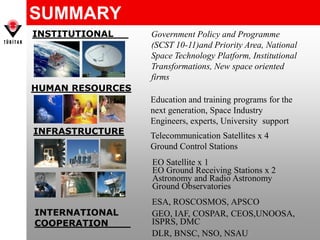
6. SUMMARY
Contents
Background – Turkey in General
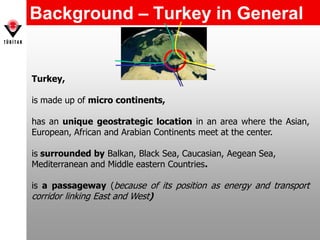
Turkey,
is made up of micro continents,
has an unique geostrategic location in an area where the Asian,
European, African and Arabian Continents meet at the center.
is surrounded by Balkan, Black Sea, Caucasian, Aegean Sea,
Mediterranean and Middle eastern Countries.
is a passageway (because of its position as energy and transport
corridor linking East and West)
Turkey in General
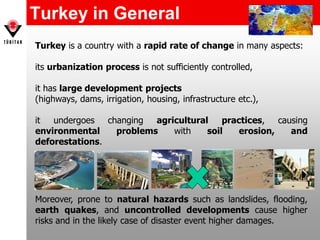
Turkey is a country with a rapid rate of change in many aspects:
its urbanization process is not sufficiently controlled,
it has large development projects
(highways, dams, irrigation, housing, infrastructure etc.),
it undergoes changing agricultural practices, causing
environmental problems with soil erosion, and
deforestations.
Moreover, prone to natural hazards such as landslides, flooding,
earth quakes, and uncontrolled developments cause higher
risks and in the likely case of disaster event higher damages.
Capacity Building – Principles & Elements
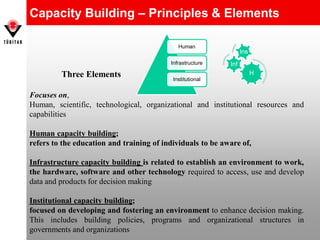
Three Elements
Focuses on,
Human, scientific, technological, organizational and institutional resources and
capabilities
Human capacity building;
refers to the education and training of individuals to be aware of,
Infrastructure capacity building is related to establish an environment to work,
the hardware, software and other technology required to access, use and develop
data and products for decision making
Institutional capacity building;
focused on developing and fostering an environment to enhance decision making.
This includes building policies, programs and organizational structures in
governments and organizations
Human
Infrastructure
Institutional
H
Inf
Ins
Capacity Building – Principles & Elements
To reach a Robust Capacity
Country’s goal, main job
Need support mechanisms for R&D and interface tools
Sustaining Budget and secure funding
Long term Policy and Plans
International cooperation activities
Establish a critical mass
Background – Space Potential
Turkey has an important potential (unique, worldwide,
characteristicsNATURAL-CULTURAL-HUMAN resources)
and a growing interest and investment in the fields of space.
The Industrial and scientific capabilities are to be of very
high standard and able to support participation in
International activities. Worldwide Cooperation Culture
The fundamental engineering competencies, company
cultures and international quality standards are to enable
aerospace hardware and software development and pursuance
of space sub systems /satellite projects.
Established well designed worldwide facilities and on going
system projects.
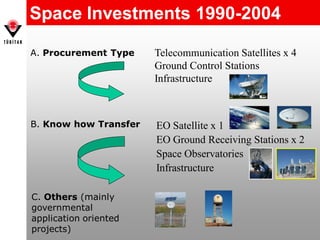
Space Investments 1990-2004
A. Procurement Type Telecommunication Satellites x 4
Ground Control Stations
Infrastructure
B. Know how Transfer EO Satellite x 1
EO Ground Receiving Stations x 2
Space Observatories
Infrastructure
C. Others (mainly
governmental
application oriented
projects)
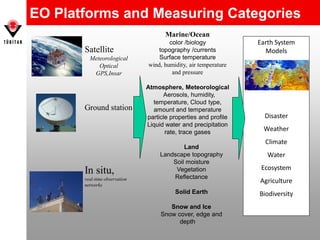
EO Platforms and Measuring Categories
Satellite
Meteorological
Optical
GPS,Insar
Ground station
In situ,
real-time observation
networks
Marine/Ocean
color /biology
topography /currents
Surface temperature
wind, humidity, air temperature
and pressure
Atmosphere, Meteorological
Aerosols, humidity,
temperature, Cloud type,
amount and temperature
particle properties and profile
Liquid water and precipitation
rate, trace gases
Land
Landscape topography
Soil moisture
Vegetation
Reflectance
Solid Earth
Snow and Ice
Snow cover, edge and
depth
Earth System
Models
Disaster
Weather
Climate
Water
Ecosystem
Agriculture
Biodiversity
Policy, Programme and Plan
The Supreme Council for Science and Technology (SCST) has
taken an important leap decision towards opening NEW
AREAS and reaching high development standards by raising
R&D expenses in our country, at its 10th meeting in 8
September 2004.
In accordance to this target the main priority areas, to be
realized under the custody of Prime Minister, have been
determined. One of these priority areas is “Space Research”
“National Space Research Program” has been prepared
entirely considering our original country structure and the
capability, capacity, infrastructure and culture that we have.
The plan was launched in March 2005 for a 10-year period.
Coordination
Role and Governance
TÜBİTAK will coordinate the National Space Research
Programme together with the harmony of Turkish space
stakeholders.
TÜBİTAK is responsible for the coordination of the 10
year implementation plan of the programme.
Coordination – Civil Stake holders
TUBITAK - Research centers and institutions (Space,
Mam, Ume, Uekae, Sage, Tug, Ulakbim )
Turkish Research Area
Government Agencies (Defence, Transportation, Public
Works and Settlement (Spatial Planning) , Environment and
Forestry, Agriculture, Energy and Natural resources,
Meteorology),
Universities (Aeronautics and Space Engineering,
Electronics, Informatics, Physics, Earth Sciences, Space
Science and Astronomy), Research Centers (METU-ITU-
Bilkent)
Industrial firms (TAI, Roketsan, Aselsan, SMEs etc)
Service oriented private sectors
Goal and Objectives
to establish a space R&D infrastructure and to create the necessary national
mechanisms to maintain it
mobilize and strengthen Turkish space industry by improving their capacity and
capability;
encourage and support research and technological development in space science,
life sciences and Earth sciences;
share these studies with society, and spread space applications across society;
develop new technologies and integrated systems,
form a knowledge infrastructure and use all these as decision support mechanisms
and decision generation processes;
form a ‘space culture’, develop education programmes, encourage the participation
especially of children and young people, and make society aware of space;
generalize the use of space technologies and space-based services in society and
create opportunities for industry, trade and service sectors
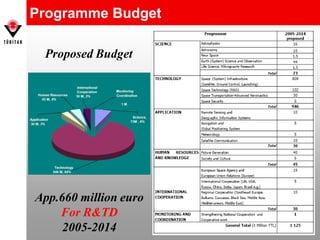
Programme Budget
Proposed Budget
App.660 million euro
For R&TD
2005-2014
Primary Actions
In the last four years since the National Space Research
Programme was adopted around 350 R&D projects have
been proposed by Turkish organizations, costing in the region
of 125 Million Euro and the interest of Turkish institutions
in space continues to increase.
The Turkish military forces, Ministries, Universities, Public
and Private institutions have all been developing and offering
projects to be supported by the State Planning Organization
of Turkey (DPT), TUBITAK and other institutions .
They basically aim to form a research-university-industry-
public society chain to benefit the country’s development
Case Leading Highlights, 2005-2009
SCIENCE, Projects
Astrophysics research, X and Gamma Ray studies,
renewal of telescopes,
Establishment of radio astronomy observatory,
Solar-Earth interactions and magnetic field researches, Space
weather, Ionosphere
Early-warning systems, geological, geophysics and geodesy
research,
Climate change and global warming, meteorological
estimation models
Highlights, 2005-2009
TECHNOLOGY Projects
Developing an earth observation research and demonstration
satellite (2.5 m pixel resolution),
Designing and developing low-cost satellite types,
cubesats(ITUpSAT), nanosats
Developing space launch systems,
Sensor design and development (Optic-SAR),
Developing gyroscope technology,
Designing and developing satellite communication systems.
Highlights, 2005-2009
HUMAN AND KNOWLEDGE Projects
Education and training programs for the next generation
Forming a space culture in society.
Share and exchange of information among schools
Scholarships
Symposium and conferences, workshops and information
days
Highlights, 2005-2009
INTERNATIONAL COOPERATION
Turkey’s participation in international space-related activities
has in the past been limited to membership in one or two
international space organizations.
Since 2005, however, TUBITAK has taken a significant role
in international space activities,
Increasing and strengthening cooperation, participation in global
programs and international space programs and initiating regional
cooperation networks.
ESA , ROSCOSMOS, APSCO
EURISY ,GEO, IAF, COSPAR, CEOS, UNOOSA,
UN SPIDER ,ISPRS, DMC
DLR, BNSC, NSO, NSAU
Highlights, 2005-2009
APPLICATION Projects
Remote Sensing and Geographic Information Systems
Navigation and Global Positioning System
Meteorology
Satellite Communication and Telecommunication
Data harmonization and improving the country’s spatial data standards,
e-government applications, CBS-based web presentations,
tele-education, telemedicine,
natural hazard risks and mitigation,
land cover change and spatial planning,
environmental risk management and protection of biodiversity
SUMMARY
INFRASTRUCTURE Telecommunication Satellites x 4
Ground Control Stations
HUMAN RESOURCES
EO Satellite x 1
EO Ground Receiving Stations x 2
Astronomy and Radio Astronomy
Ground Observatories
Government Policy and Programme
(SCST 10-11)and Priority Area, National
Space Technology Platform, Institutional
Transformations, New space oriented
firms
INSTITUTIONAL
INTERNATIONAL
COOPERATION
Education and training programs for the
next generation, Space Industry
Engineers, experts, University support
ESA, ROSCOSMOS, APSCO
GEO, IAF, COSPAR, CEOS,UNOOSA,
ISPRS, DMC
DLR, BNSC, NSO, NSAU
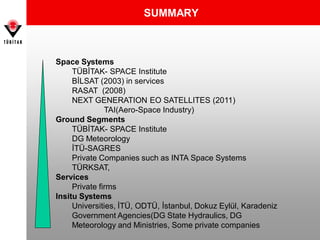
SUMMARY
Space Systems
TÜBİTAK- SPACE Institute
BİLSAT (2003) in services
RASAT (2008)
NEXT GENERATION EO SATELLITES (2011)
TAI(Aero-Space Industry)
Ground Segments
TÜBİTAK- SPACE Institute
DG Meteorology
İTÜ-SAGRES
Private Companies such as INTA Space Systems
TÜRKSAT,
Services
Private firms
Insitu Systems
Universities, İTÜ, ODTÜ, İstanbul, Dokuz Eylül, Karadeniz
Government Agencies(DG State Hydraulics, DG
Meteorology and Ministries, Some private companies
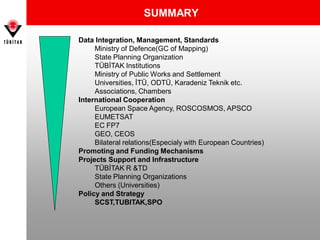
SUMMARY
Data Integration, Management, Standards
Ministry of Defence(GC of Mapping)
State Planning Organization
TÜBİTAK Institutions
Ministry of Public Works and Settlement
Universities, İTÜ, ODTÜ, Karadeniz Teknik etc.
Associations, Chambers
International Cooperation
European Space Agency, ROSCOSMOS, APSCO
EUMETSAT
EC FP7
GEO, CEOS
Bilateral relations(Especialy with European Countries)
Promoting and Funding Mechanisms
Projects Support and Infrastructure
TÜBİTAK R &TD
State Planning Organizations
Others (Universities)
Policy and Strategy
SCST,TUBITAK,SPO
THANK YOU

UNTurkeyESAWorkshop-TamerÖzalp

  • 1.
    United Nations/Turkey/ESA Workshopon “Space Technology Applications for Socio-Economic Benefits” BUILDING A ROBUST CAPACITY FOR SPACE IN TURKEY Dr. Tamer ÖZALP 14-17 September 2010 İstanbul, Turkey
  • 2.
    1. BACKGROUND Turkey inGeneral Principles and Basic Elements for Capacity Building Space Potential, Investments 2. Policy, Program and Plan 3. Coordination Mechanism 4. Primary Actions for Building a Space Capacity Research Support, Case Leading Projects, Training, Scholars, Networking, International Cooperation, New Establishments, Events, Societal Awareness 5. CONCLUSION 6. SUMMARY Contents
  • 3.
    Background – Turkeyin General Turkey, is made up of micro continents, has an unique geostrategic location in an area where the Asian, European, African and Arabian Continents meet at the center. is surrounded by Balkan, Black Sea, Caucasian, Aegean Sea, Mediterranean and Middle eastern Countries. is a passageway (because of its position as energy and transport corridor linking East and West)
  • 4.
    Turkey in General Turkeyis a country with a rapid rate of change in many aspects: its urbanization process is not sufficiently controlled, it has large development projects (highways, dams, irrigation, housing, infrastructure etc.), it undergoes changing agricultural practices, causing environmental problems with soil erosion, and deforestations. Moreover, prone to natural hazards such as landslides, flooding, earth quakes, and uncontrolled developments cause higher risks and in the likely case of disaster event higher damages.
  • 5.
    Capacity Building –Principles & Elements Three Elements Focuses on, Human, scientific, technological, organizational and institutional resources and capabilities Human capacity building; refers to the education and training of individuals to be aware of, Infrastructure capacity building is related to establish an environment to work, the hardware, software and other technology required to access, use and develop data and products for decision making Institutional capacity building; focused on developing and fostering an environment to enhance decision making. This includes building policies, programs and organizational structures in governments and organizations Human Infrastructure Institutional H Inf Ins
  • 6.
    Capacity Building –Principles & Elements To reach a Robust Capacity Country’s goal, main job Need support mechanisms for R&D and interface tools Sustaining Budget and secure funding Long term Policy and Plans International cooperation activities Establish a critical mass
  • 7.
    Background – SpacePotential Turkey has an important potential (unique, worldwide, characteristicsNATURAL-CULTURAL-HUMAN resources) and a growing interest and investment in the fields of space. The Industrial and scientific capabilities are to be of very high standard and able to support participation in International activities. Worldwide Cooperation Culture The fundamental engineering competencies, company cultures and international quality standards are to enable aerospace hardware and software development and pursuance of space sub systems /satellite projects. Established well designed worldwide facilities and on going system projects.
  • 8.
    Space Investments 1990-2004 A.Procurement Type Telecommunication Satellites x 4 Ground Control Stations Infrastructure B. Know how Transfer EO Satellite x 1 EO Ground Receiving Stations x 2 Space Observatories Infrastructure C. Others (mainly governmental application oriented projects)
  • 9.
    EO Platforms andMeasuring Categories Satellite Meteorological Optical GPS,Insar Ground station In situ, real-time observation networks Marine/Ocean color /biology topography /currents Surface temperature wind, humidity, air temperature and pressure Atmosphere, Meteorological Aerosols, humidity, temperature, Cloud type, amount and temperature particle properties and profile Liquid water and precipitation rate, trace gases Land Landscape topography Soil moisture Vegetation Reflectance Solid Earth Snow and Ice Snow cover, edge and depth Earth System Models Disaster Weather Climate Water Ecosystem Agriculture Biodiversity
  • 10.
    Policy, Programme andPlan The Supreme Council for Science and Technology (SCST) has taken an important leap decision towards opening NEW AREAS and reaching high development standards by raising R&D expenses in our country, at its 10th meeting in 8 September 2004. In accordance to this target the main priority areas, to be realized under the custody of Prime Minister, have been determined. One of these priority areas is “Space Research” “National Space Research Program” has been prepared entirely considering our original country structure and the capability, capacity, infrastructure and culture that we have. The plan was launched in March 2005 for a 10-year period.
  • 11.
    Coordination Role and Governance TÜBİTAKwill coordinate the National Space Research Programme together with the harmony of Turkish space stakeholders. TÜBİTAK is responsible for the coordination of the 10 year implementation plan of the programme.
  • 12.
    Coordination – CivilStake holders TUBITAK - Research centers and institutions (Space, Mam, Ume, Uekae, Sage, Tug, Ulakbim ) Turkish Research Area Government Agencies (Defence, Transportation, Public Works and Settlement (Spatial Planning) , Environment and Forestry, Agriculture, Energy and Natural resources, Meteorology), Universities (Aeronautics and Space Engineering, Electronics, Informatics, Physics, Earth Sciences, Space Science and Astronomy), Research Centers (METU-ITU- Bilkent) Industrial firms (TAI, Roketsan, Aselsan, SMEs etc) Service oriented private sectors
  • 13.
    Goal and Objectives toestablish a space R&D infrastructure and to create the necessary national mechanisms to maintain it mobilize and strengthen Turkish space industry by improving their capacity and capability; encourage and support research and technological development in space science, life sciences and Earth sciences; share these studies with society, and spread space applications across society; develop new technologies and integrated systems, form a knowledge infrastructure and use all these as decision support mechanisms and decision generation processes; form a ‘space culture’, develop education programmes, encourage the participation especially of children and young people, and make society aware of space; generalize the use of space technologies and space-based services in society and create opportunities for industry, trade and service sectors
  • 14.
    Programme Budget Proposed Budget App.660million euro For R&TD 2005-2014
  • 15.
    Primary Actions In thelast four years since the National Space Research Programme was adopted around 350 R&D projects have been proposed by Turkish organizations, costing in the region of 125 Million Euro and the interest of Turkish institutions in space continues to increase. The Turkish military forces, Ministries, Universities, Public and Private institutions have all been developing and offering projects to be supported by the State Planning Organization of Turkey (DPT), TUBITAK and other institutions . They basically aim to form a research-university-industry- public society chain to benefit the country’s development
  • 16.
    Case Leading Highlights,2005-2009 SCIENCE, Projects Astrophysics research, X and Gamma Ray studies, renewal of telescopes, Establishment of radio astronomy observatory, Solar-Earth interactions and magnetic field researches, Space weather, Ionosphere Early-warning systems, geological, geophysics and geodesy research, Climate change and global warming, meteorological estimation models
  • 17.
    Highlights, 2005-2009 TECHNOLOGY Projects Developingan earth observation research and demonstration satellite (2.5 m pixel resolution), Designing and developing low-cost satellite types, cubesats(ITUpSAT), nanosats Developing space launch systems, Sensor design and development (Optic-SAR), Developing gyroscope technology, Designing and developing satellite communication systems.
  • 18.
    Highlights, 2005-2009 HUMAN ANDKNOWLEDGE Projects Education and training programs for the next generation Forming a space culture in society. Share and exchange of information among schools Scholarships Symposium and conferences, workshops and information days
  • 19.
    Highlights, 2005-2009 INTERNATIONAL COOPERATION Turkey’sparticipation in international space-related activities has in the past been limited to membership in one or two international space organizations. Since 2005, however, TUBITAK has taken a significant role in international space activities, Increasing and strengthening cooperation, participation in global programs and international space programs and initiating regional cooperation networks. ESA , ROSCOSMOS, APSCO EURISY ,GEO, IAF, COSPAR, CEOS, UNOOSA, UN SPIDER ,ISPRS, DMC DLR, BNSC, NSO, NSAU
  • 20.
    Highlights, 2005-2009 APPLICATION Projects RemoteSensing and Geographic Information Systems Navigation and Global Positioning System Meteorology Satellite Communication and Telecommunication Data harmonization and improving the country’s spatial data standards, e-government applications, CBS-based web presentations, tele-education, telemedicine, natural hazard risks and mitigation, land cover change and spatial planning, environmental risk management and protection of biodiversity
  • 21.
    SUMMARY INFRASTRUCTURE Telecommunication Satellitesx 4 Ground Control Stations HUMAN RESOURCES EO Satellite x 1 EO Ground Receiving Stations x 2 Astronomy and Radio Astronomy Ground Observatories Government Policy and Programme (SCST 10-11)and Priority Area, National Space Technology Platform, Institutional Transformations, New space oriented firms INSTITUTIONAL INTERNATIONAL COOPERATION Education and training programs for the next generation, Space Industry Engineers, experts, University support ESA, ROSCOSMOS, APSCO GEO, IAF, COSPAR, CEOS,UNOOSA, ISPRS, DMC DLR, BNSC, NSO, NSAU
  • 22.
    SUMMARY Space Systems TÜBİTAK- SPACEInstitute BİLSAT (2003) in services RASAT (2008) NEXT GENERATION EO SATELLITES (2011) TAI(Aero-Space Industry) Ground Segments TÜBİTAK- SPACE Institute DG Meteorology İTÜ-SAGRES Private Companies such as INTA Space Systems TÜRKSAT, Services Private firms Insitu Systems Universities, İTÜ, ODTÜ, İstanbul, Dokuz Eylül, Karadeniz Government Agencies(DG State Hydraulics, DG Meteorology and Ministries, Some private companies
  • 23.
    SUMMARY Data Integration, Management,Standards Ministry of Defence(GC of Mapping) State Planning Organization TÜBİTAK Institutions Ministry of Public Works and Settlement Universities, İTÜ, ODTÜ, Karadeniz Teknik etc. Associations, Chambers International Cooperation European Space Agency, ROSCOSMOS, APSCO EUMETSAT EC FP7 GEO, CEOS Bilateral relations(Especialy with European Countries) Promoting and Funding Mechanisms Projects Support and Infrastructure TÜBİTAK R &TD State Planning Organizations Others (Universities) Policy and Strategy SCST,TUBITAK,SPO
  • 24.