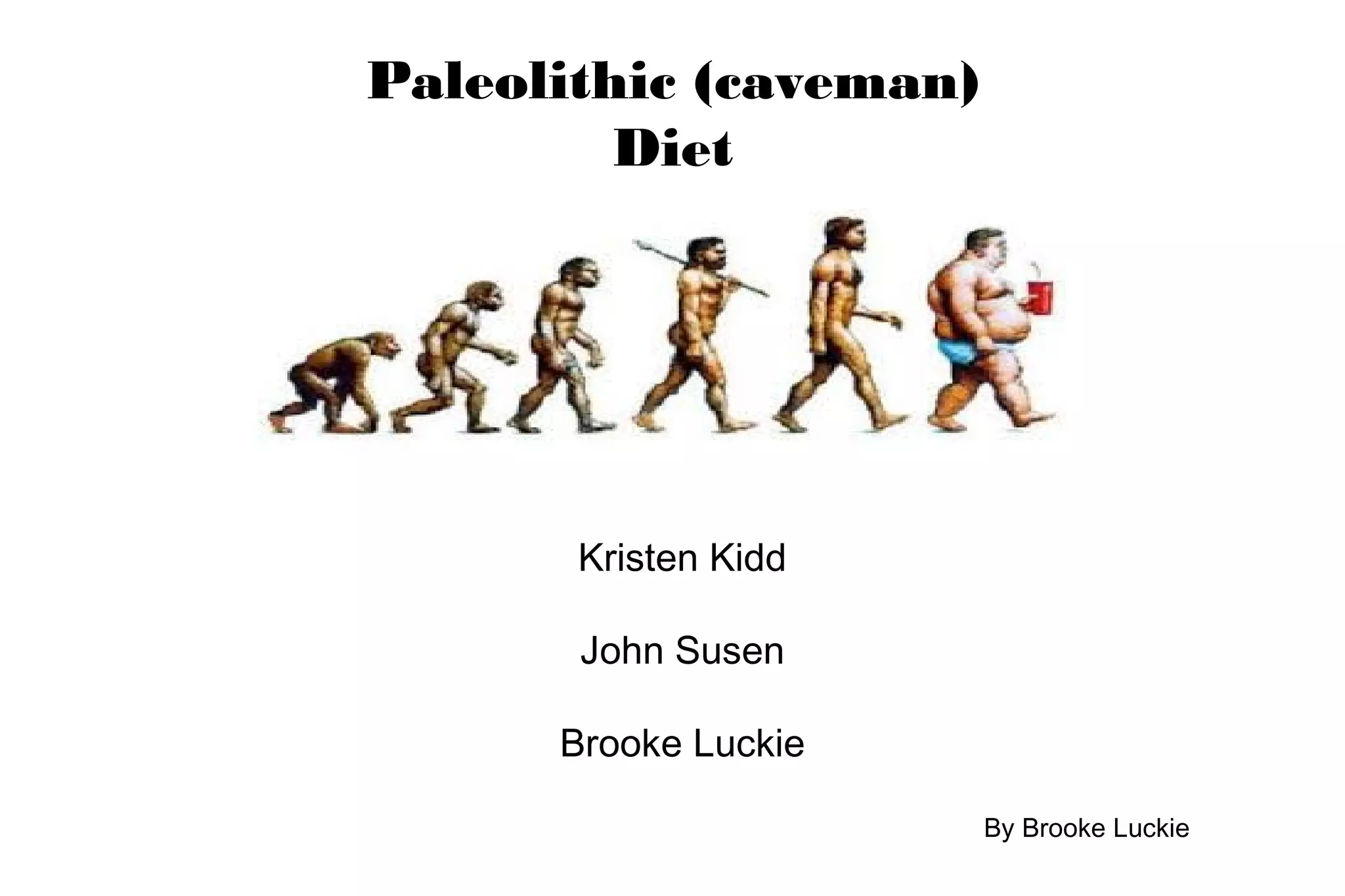
Paleolithic (caveman)
Diet
Kristen Kidd
John Susen
Brooke Luckie
By Brooke Luckie
Literature Review
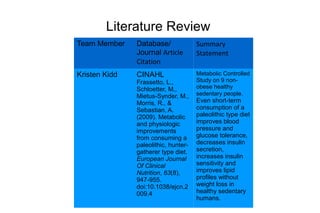
Team Member Database/
Journal Article
Citation
Summary
Statement
Kristen Kidd CINAHL
Frassetto, L.,
Schloetter, M.,
Mietus-Synder, M.,
Morris, R., &
Sebastian, A.
(2009). Metabolic
and physiologic
improvements
from consuming a
paleolithic, hunter-
gatherer type diet.
European Journal
Of Clinical
Nutrition, 63(8),
947-955.
doi:10.1038/ejcn.2
009.4
Metabolic Controlled
Study on 9 non-
obese healthy
sedentary people.
Even short-term
consumption of a
paleolithic type diet
improves blood
pressure and
glucose tolerance,
decreases insulin
secretion,
increases insulin
sensitivity and
improves lipid
profiles without
weight loss in
healthy sedentary
humans.
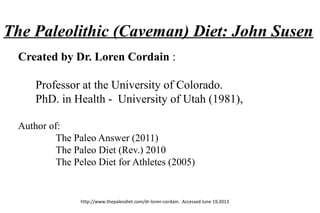
The Paleolithic (Caveman) Diet: John Susen
Created by Dr. Loren Cordain :
Professor at the University of Colorado.
PhD. in Health - University of Utah (1981),
Author of:
The Paleo Answer (2011)
The Paleo Diet (Rev.) 2010
The Peleo Diet for Athletes (2005)
http://www.thepaleodiet.com/dr-loren-cordain. Accessed June 19,2013
What is the Paleolithic Diet?
Summary Statement John Susen
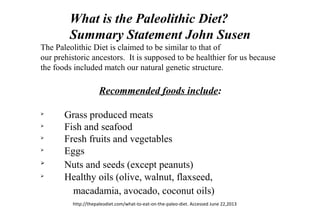
The Paleolithic Diet is claimed to be similar to that of
our prehistoric ancestors. It is supposed to be healthier for us because
the foods included match our natural genetic structure.
Recommended foods include:
Ø
Grass produced meats
Ø
Fish and seafood
Ø
Fresh fruits and vegetables
Ø
Eggs
Ø
Nuts and seeds (except peanuts)
Ø
Healthy oils (olive, walnut, flaxseed,
macadamia, avocado, coconut oils)
http://thepaleodiet.com/what-to-eat-on-the-paleo-diet. Accessed June 22,2013
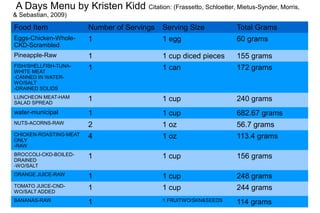
A Days Menu by Kristen Kidd Citation: (Frassetto, Schloetter, Mietus-Synder, Morris,
& Sebastian, 2009)
Food Item Number of Servings Serving Size Total Grams
Eggs-Chicken-Whole-
CKD-Scrambled
1 1 egg 60 grams
Pineapple-Raw 1 1 cup diced pieces 155 grams
FISH/SHELLFISH-TUNA-
WHITE MEAT
-CANNED IN WATER-
WO/SALT
-DRAINED SOLIDS
1 1 can 172 grams
LUNCHEON MEAT-HAM
SALAD SPREAD
1 1 cup 240 grams
water-municipal 1 1 cup 682.67 grams
NUTS-ACORNS-RAW 2 1 oz 56.7 grams
CHICKEN-ROASTING-MEAT
ONLY
-RAW
4 1 oz 113.4 grams
BROCCOLI-CKD-BOILED-
DRAINED
-WO/SALT
1 1 cup 156 grams
ORANGE JUICE-RAW 1 1 cup 248 grams
TOMATO JUICE-CND-
WO/SALT ADDED
1 1 cup 244 grams
BANANAS-RAW 1 1 FRUITWO/SKN&SEEDS 114 grams
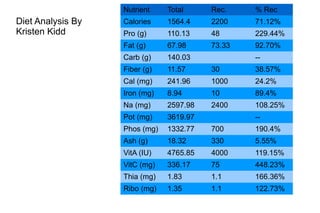
Diet Analysis By
Kristen Kidd
Nutrient Total Rec. % Rec
Calories 1564.4 2200 71.12%
Pro (g) 110.13 48 229.44%
Fat (g) 67.98 73.33 92.70%
Carb (g) 140.03 --
Fiber (g) 11.57 30 38.57%
Cal (mg) 241.96 1000 24.2%
Iron (mg) 8.94 10 89.4%
Na (mg) 2597.98 2400 108.25%
Pot (mg) 3619.97 --
Phos (mg) 1332.77 700 190.4%
Ash (g) 18.32 330 5.55%
VitA (IU) 4765.85 4000 119.15%
VitC (mg) 336.17 75 448.23%
Thia (mg) 1.83 1.1 166.36%
Ribo (mg) 1.35 1.1 122.73%
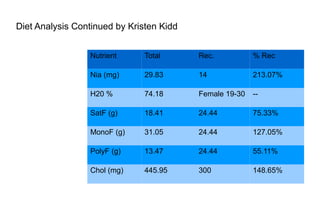
Diet Analysis Continued by Kristen Kidd
Nutrient Total Rec. % Rec
Nia (mg) 29.83 14 213.07%
H20 % 74.18 Female 19-30 --
SatF (g) 18.41 24.44 75.33%
MonoF (g) 31.05 24.44 127.05%
PolyF (g) 13.47 24.44 55.11%
Chol (mg) 445.95 300 148.65%
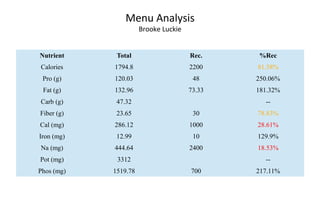
Menu Analysis
Brooke Luckie
Nutrient Total Rec. %Rec
Calories 1794.8 2200 81.58%
Pro (g) 120.03 48 250.06%
Fat (g) 132.96 73.33 181.32%
Carb (g) 47.32 --
Fiber (g) 23.65 30 78.83%
Cal (mg) 286.12 1000 28.61%
Iron (mg) 12.99 10 129.9%
Na (mg) 444.64 2400 18.53%
Pot (mg) 3312 --
Phos (mg) 1519.78 700 217.11%
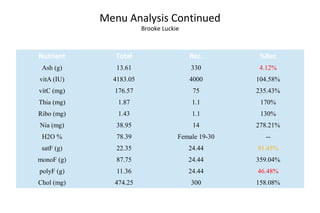
Menu Analysis Continued
Brooke Luckie
Nutrient Total Rec. %Rec
Ash (g) 13.61 330 4.12%
vitA (IU) 4183.05 4000 104.58%
vitC (mg) 176.57 75 235.43%
Thia (mg) 1.87 1.1 170%
Ribo (mg) 1.43 1.1 130%
Nia (mg) 38.95 14 278.21%
H2O % 78.39 Female 19-30 --
satF (g) 22.35 24.44 91.45%
monoF (g) 87.75 24.44 359.04%
polyF (g) 11.36 24.44 46.48%
Chol (mg) 474.25 300 158.08%
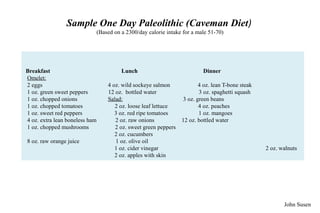
Breakfast Lunch Dinner
Omelet:
2 eggs 4 oz. wild sockeye salmon 4 oz. lean T-bone steak
1 oz. green sweet peppers 12 oz. bottled water 3 oz. spaghetti squash
1 oz. chopped onions Salad: 3 oz. green beans
1 oz. chopped tomatoes 2 oz. loose leaf lettuce 4 oz. peaches
1 oz. sweet red peppers 3 oz. red ripe tomatoes 1 oz. mangoes
4 oz. extra lean boneless ham 2 oz. raw onions 12 oz. bottled water
1 oz. chopped mushrooms 2 oz. sweet green peppers
2 oz. cucumbers
8 oz. raw orange juice 1 oz. olive oil
1 oz. cider vinegar 2 oz. walnuts
2 oz. apples with skin
John Susen
Sample One Day Paleolithic (Caveman Diet)
(Based on a 2300/day calorie intake for a male 51-70)
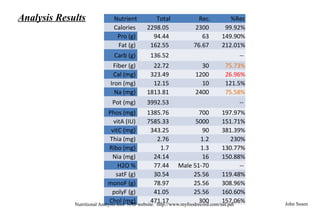
Nutrient Total Rec. %Rec
Calories 2298.05 2300 99.92%
Pro (g) 94.44 63 149.90%
Fat (g) 162.55 76.67 212.01%
Carb (g) 136.52 --
Fiber (g) 22.72 30 75.73%
Cal (mg) 323.49 1200 26.96%
Iron (mg) 12.15 10 121.5%
Na (mg) 1813.81 2400 75.58%
Pot (mg) 3992.53 --
Phos (mg) 1385.76 700 197.97%
vitA (IU) 7585.33 5000 151.71%
vitC (mg) 343.25 90 381.39%
Thia (mg) 2.76 1.2 230%
Ribo (mg) 1.7 1.3 130.77%
Nia (mg) 24.14 16 150.88%
H2O % 77.44 Male 51-70 --
satF (g) 30.54 25.56 119.48%
monoF (g) 78.97 25.56 308.96%
polyF (g) 41.05 25.56 160.60%
Chol (mg) 471.17 300 157.06%
Analysis Results
Nutritional Analysis tool. NAT website. http://www.myfoodrecord.com/nat.pdl John Susen
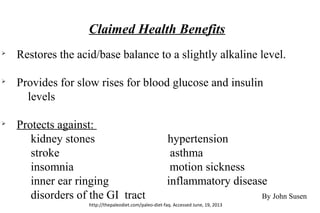
Claimed Health Benefits
Ø
Restores the acid/base balance to a slightly alkaline level.
Ø
Provides for slow rises for blood glucose and insulin
levels
Ø
Protects against:
kidney stones hypertension
stroke asthma
insomnia motion sickness
inner ear ringing inflammatory disease
disorders of the GI tract By John Susen
http://thepaleodiet.com/paleo-diet-faq. Accessed June, 19, 2013
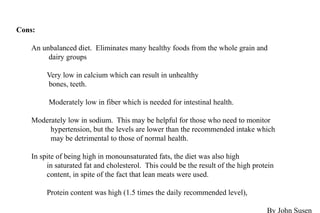
Cons:
An unbalanced diet. Eliminates many healthy foods from the whole grain and
dairy groups
Very low in calcium which can result in unhealthy
bones, teeth.
Moderately low in fiber which is needed for intestinal health.
Moderately low in sodium. This may be helpful for those who need to monitor
hypertension, but the levels are lower than the recommended intake which
may be detrimental to those of normal health.
In spite of being high in monounsaturated fats, the diet was also high
in saturated fat and cholesterol. This could be the result of the high protein
content, in spite of the fact that lean meats were used.
Protein content was high (1.5 times the daily recommended level),
By John Susen
Consensus Statement
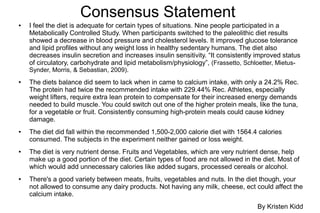
● I feel the diet is adequate for certain types of situations. Nine people participated in a
Metabolically Controlled Study. When participants switched to the paleolithic diet results
showed a decrease in blood pressure and cholesterol levels. It improved glucose tolerance
and lipid profiles without any weight loss in healthy sedentary humans. The diet also
decreases insulin secretion and increases insulin sensitivity. “It consistently improved status
of circulatory, carbohydrate and lipid metabolism/physiology”, (Frassetto, Schloetter, Mietus-
Synder, Morris, & Sebastian, 2009).
● The diets balance did seem to lack when in came to calcium intake, with only a 24.2% Rec.
The protein had twice the recommended intake with 229.44% Rec. Athletes, especially
weight lifters, require extra lean protein to compensate for their increased energy demands
needed to build muscle. You could switch out one of the higher protein meals, like the tuna,
for a vegetable or fruit. Consistently consuming high-protein meals could cause kidney
damage.
● The diet did fall within the recommended 1,500-2,000 calorie diet with 1564.4 calories
consumed. The subjects in the experiment neither gained or loss weight.
● The diet is very nutrient dense. Fruits and Vegetables, which are very nutrient dense, help
make up a good portion of the diet. Certain types of food are not allowed in the diet. Most of
which would add unnecessary calories like added sugars, processed cereals or alcohol.
● There's a good variety between meats, fruits, vegetables and nuts. In the diet though, your
not allowed to consume any dairy products. Not having any milk, cheese, ect could affect the
calcium intake.
By Kristen Kidd
Consensus Statement Continued...
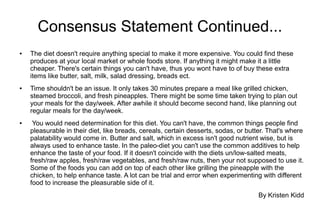
● The diet doesn't require anything special to make it more expensive. You could find these
produces at your local market or whole foods store. If anything it might make it a little
cheaper. There's certain things you can't have, thus you wont have to of buy these extra
items like butter, salt, milk, salad dressing, breads ect.
● Time shouldn't be an issue. It only takes 30 minutes prepare a meal like grilled chicken,
steamed broccoli, and fresh pineapples. There might be some time taken trying to plan out
your meals for the day/week. After awhile it should become second hand, like planning out
regular meals for the day/week.
● You would need determination for this diet. You can't have, the common things people find
pleasurable in their diet, like breads, cereals, certain desserts, sodas, or butter. That's where
palatability would come in. Butter and salt, which in excess isn't good nutrient wise, but is
always used to enhance taste. In the paleo-diet you can't use the common additives to help
enhance the taste of your food. If it doesn't coincide with the diets un/low-salted meats,
fresh/raw apples, fresh/raw vegetables, and fresh/raw nuts, then your not supposed to use it.
Some of the foods you can add on top of each other like grilling the pineapple with the
chicken, to help enhance taste. A lot can be trial and error when experimenting with different
food to increase the pleasurable side of it.
By Kristen Kidd
Consensus Statement Continued..
In order to improve the Paleo Diet two changes could be of some benefit. First, calcium
supplements can be included to help maintain healthy bones.Second, although this diet does not
include potatoes, people living in paleolithic times included root vegetables in their diets. Eating
potatoes would help offset any deficiencies of fiber in the diet. However being high in carbs, they
would most likely take away from the claimed benefits of this diet by interfering with the
predominance of low glycemic foods.
In contrast, the glycemic index has been a subject of questionable value anyway. Rather than
partake in the Paleolithic (Caveman) Diet, I would recommend following the advice presented
in out text. Eat a healthy and balanced diet consisting of foods from “all” of the food groups
accompanied by regular exercise. If anyone needs to watch their intake of carbohydrates (for
diabetes) or sodium/fat (for heart related conditions), etc., they get all the help they need by
following the guidelines provided by programs such as the Exchange System and
ChooseMyPlate.gov
John Susen

Paleo diet

  • 1.
    Paleolithic (caveman) Diet Kristen Kidd JohnSusen Brooke Luckie By Brooke Luckie
  • 2.
    Literature Review Team MemberDatabase/ Journal Article Citation Summary Statement Kristen Kidd CINAHL Frassetto, L., Schloetter, M., Mietus-Synder, M., Morris, R., & Sebastian, A. (2009). Metabolic and physiologic improvements from consuming a paleolithic, hunter- gatherer type diet. European Journal Of Clinical Nutrition, 63(8), 947-955. doi:10.1038/ejcn.2 009.4 Metabolic Controlled Study on 9 non- obese healthy sedentary people. Even short-term consumption of a paleolithic type diet improves blood pressure and glucose tolerance, decreases insulin secretion, increases insulin sensitivity and improves lipid profiles without weight loss in healthy sedentary humans.
  • 3.
    The Paleolithic (Caveman)Diet: John Susen Created by Dr. Loren Cordain : Professor at the University of Colorado. PhD. in Health - University of Utah (1981), Author of: The Paleo Answer (2011) The Paleo Diet (Rev.) 2010 The Peleo Diet for Athletes (2005) http://www.thepaleodiet.com/dr-loren-cordain. Accessed June 19,2013
  • 4.
    What is thePaleolithic Diet? Summary Statement John Susen The Paleolithic Diet is claimed to be similar to that of our prehistoric ancestors. It is supposed to be healthier for us because the foods included match our natural genetic structure. Recommended foods include: Ø Grass produced meats Ø Fish and seafood Ø Fresh fruits and vegetables Ø Eggs Ø Nuts and seeds (except peanuts) Ø Healthy oils (olive, walnut, flaxseed, macadamia, avocado, coconut oils) http://thepaleodiet.com/what-to-eat-on-the-paleo-diet. Accessed June 22,2013
  • 5.
    A Days Menuby Kristen Kidd Citation: (Frassetto, Schloetter, Mietus-Synder, Morris, & Sebastian, 2009) Food Item Number of Servings Serving Size Total Grams Eggs-Chicken-Whole- CKD-Scrambled 1 1 egg 60 grams Pineapple-Raw 1 1 cup diced pieces 155 grams FISH/SHELLFISH-TUNA- WHITE MEAT -CANNED IN WATER- WO/SALT -DRAINED SOLIDS 1 1 can 172 grams LUNCHEON MEAT-HAM SALAD SPREAD 1 1 cup 240 grams water-municipal 1 1 cup 682.67 grams NUTS-ACORNS-RAW 2 1 oz 56.7 grams CHICKEN-ROASTING-MEAT ONLY -RAW 4 1 oz 113.4 grams BROCCOLI-CKD-BOILED- DRAINED -WO/SALT 1 1 cup 156 grams ORANGE JUICE-RAW 1 1 cup 248 grams TOMATO JUICE-CND- WO/SALT ADDED 1 1 cup 244 grams BANANAS-RAW 1 1 FRUITWO/SKN&SEEDS 114 grams
  • 6.
    Diet Analysis By KristenKidd Nutrient Total Rec. % Rec Calories 1564.4 2200 71.12% Pro (g) 110.13 48 229.44% Fat (g) 67.98 73.33 92.70% Carb (g) 140.03 -- Fiber (g) 11.57 30 38.57% Cal (mg) 241.96 1000 24.2% Iron (mg) 8.94 10 89.4% Na (mg) 2597.98 2400 108.25% Pot (mg) 3619.97 -- Phos (mg) 1332.77 700 190.4% Ash (g) 18.32 330 5.55% VitA (IU) 4765.85 4000 119.15% VitC (mg) 336.17 75 448.23% Thia (mg) 1.83 1.1 166.36% Ribo (mg) 1.35 1.1 122.73%
  • 7.
    Diet Analysis Continuedby Kristen Kidd Nutrient Total Rec. % Rec Nia (mg) 29.83 14 213.07% H20 % 74.18 Female 19-30 -- SatF (g) 18.41 24.44 75.33% MonoF (g) 31.05 24.44 127.05% PolyF (g) 13.47 24.44 55.11% Chol (mg) 445.95 300 148.65%
  • 8.
    Menu Analysis Brooke Luckie NutrientTotal Rec. %Rec Calories 1794.8 2200 81.58% Pro (g) 120.03 48 250.06% Fat (g) 132.96 73.33 181.32% Carb (g) 47.32 -- Fiber (g) 23.65 30 78.83% Cal (mg) 286.12 1000 28.61% Iron (mg) 12.99 10 129.9% Na (mg) 444.64 2400 18.53% Pot (mg) 3312 -- Phos (mg) 1519.78 700 217.11%
  • 9.
    Menu Analysis Continued BrookeLuckie Nutrient Total Rec. %Rec Ash (g) 13.61 330 4.12% vitA (IU) 4183.05 4000 104.58% vitC (mg) 176.57 75 235.43% Thia (mg) 1.87 1.1 170% Ribo (mg) 1.43 1.1 130% Nia (mg) 38.95 14 278.21% H2O % 78.39 Female 19-30 -- satF (g) 22.35 24.44 91.45% monoF (g) 87.75 24.44 359.04% polyF (g) 11.36 24.44 46.48% Chol (mg) 474.25 300 158.08%
  • 10.
    Breakfast Lunch Dinner Omelet: 2eggs 4 oz. wild sockeye salmon 4 oz. lean T-bone steak 1 oz. green sweet peppers 12 oz. bottled water 3 oz. spaghetti squash 1 oz. chopped onions Salad: 3 oz. green beans 1 oz. chopped tomatoes 2 oz. loose leaf lettuce 4 oz. peaches 1 oz. sweet red peppers 3 oz. red ripe tomatoes 1 oz. mangoes 4 oz. extra lean boneless ham 2 oz. raw onions 12 oz. bottled water 1 oz. chopped mushrooms 2 oz. sweet green peppers 2 oz. cucumbers 8 oz. raw orange juice 1 oz. olive oil 1 oz. cider vinegar 2 oz. walnuts 2 oz. apples with skin John Susen Sample One Day Paleolithic (Caveman Diet) (Based on a 2300/day calorie intake for a male 51-70)
  • 11.
    Nutrient Total Rec.%Rec Calories 2298.05 2300 99.92% Pro (g) 94.44 63 149.90% Fat (g) 162.55 76.67 212.01% Carb (g) 136.52 -- Fiber (g) 22.72 30 75.73% Cal (mg) 323.49 1200 26.96% Iron (mg) 12.15 10 121.5% Na (mg) 1813.81 2400 75.58% Pot (mg) 3992.53 -- Phos (mg) 1385.76 700 197.97% vitA (IU) 7585.33 5000 151.71% vitC (mg) 343.25 90 381.39% Thia (mg) 2.76 1.2 230% Ribo (mg) 1.7 1.3 130.77% Nia (mg) 24.14 16 150.88% H2O % 77.44 Male 51-70 -- satF (g) 30.54 25.56 119.48% monoF (g) 78.97 25.56 308.96% polyF (g) 41.05 25.56 160.60% Chol (mg) 471.17 300 157.06% Analysis Results Nutritional Analysis tool. NAT website. http://www.myfoodrecord.com/nat.pdl John Susen
  • 12.
    Claimed Health Benefits Ø Restoresthe acid/base balance to a slightly alkaline level. Ø Provides for slow rises for blood glucose and insulin levels Ø Protects against: kidney stones hypertension stroke asthma insomnia motion sickness inner ear ringing inflammatory disease disorders of the GI tract By John Susen http://thepaleodiet.com/paleo-diet-faq. Accessed June, 19, 2013
  • 13.
    Cons: An unbalanced diet.Eliminates many healthy foods from the whole grain and dairy groups Very low in calcium which can result in unhealthy bones, teeth. Moderately low in fiber which is needed for intestinal health. Moderately low in sodium. This may be helpful for those who need to monitor hypertension, but the levels are lower than the recommended intake which may be detrimental to those of normal health. In spite of being high in monounsaturated fats, the diet was also high in saturated fat and cholesterol. This could be the result of the high protein content, in spite of the fact that lean meats were used. Protein content was high (1.5 times the daily recommended level), By John Susen
  • 14.
    Consensus Statement ● Ifeel the diet is adequate for certain types of situations. Nine people participated in a Metabolically Controlled Study. When participants switched to the paleolithic diet results showed a decrease in blood pressure and cholesterol levels. It improved glucose tolerance and lipid profiles without any weight loss in healthy sedentary humans. The diet also decreases insulin secretion and increases insulin sensitivity. “It consistently improved status of circulatory, carbohydrate and lipid metabolism/physiology”, (Frassetto, Schloetter, Mietus- Synder, Morris, & Sebastian, 2009). ● The diets balance did seem to lack when in came to calcium intake, with only a 24.2% Rec. The protein had twice the recommended intake with 229.44% Rec. Athletes, especially weight lifters, require extra lean protein to compensate for their increased energy demands needed to build muscle. You could switch out one of the higher protein meals, like the tuna, for a vegetable or fruit. Consistently consuming high-protein meals could cause kidney damage. ● The diet did fall within the recommended 1,500-2,000 calorie diet with 1564.4 calories consumed. The subjects in the experiment neither gained or loss weight. ● The diet is very nutrient dense. Fruits and Vegetables, which are very nutrient dense, help make up a good portion of the diet. Certain types of food are not allowed in the diet. Most of which would add unnecessary calories like added sugars, processed cereals or alcohol. ● There's a good variety between meats, fruits, vegetables and nuts. In the diet though, your not allowed to consume any dairy products. Not having any milk, cheese, ect could affect the calcium intake. By Kristen Kidd
  • 15.
    Consensus Statement Continued... ●The diet doesn't require anything special to make it more expensive. You could find these produces at your local market or whole foods store. If anything it might make it a little cheaper. There's certain things you can't have, thus you wont have to of buy these extra items like butter, salt, milk, salad dressing, breads ect. ● Time shouldn't be an issue. It only takes 30 minutes prepare a meal like grilled chicken, steamed broccoli, and fresh pineapples. There might be some time taken trying to plan out your meals for the day/week. After awhile it should become second hand, like planning out regular meals for the day/week. ● You would need determination for this diet. You can't have, the common things people find pleasurable in their diet, like breads, cereals, certain desserts, sodas, or butter. That's where palatability would come in. Butter and salt, which in excess isn't good nutrient wise, but is always used to enhance taste. In the paleo-diet you can't use the common additives to help enhance the taste of your food. If it doesn't coincide with the diets un/low-salted meats, fresh/raw apples, fresh/raw vegetables, and fresh/raw nuts, then your not supposed to use it. Some of the foods you can add on top of each other like grilling the pineapple with the chicken, to help enhance taste. A lot can be trial and error when experimenting with different food to increase the pleasurable side of it. By Kristen Kidd
  • 16.
    Consensus Statement Continued.. Inorder to improve the Paleo Diet two changes could be of some benefit. First, calcium supplements can be included to help maintain healthy bones.Second, although this diet does not include potatoes, people living in paleolithic times included root vegetables in their diets. Eating potatoes would help offset any deficiencies of fiber in the diet. However being high in carbs, they would most likely take away from the claimed benefits of this diet by interfering with the predominance of low glycemic foods. In contrast, the glycemic index has been a subject of questionable value anyway. Rather than partake in the Paleolithic (Caveman) Diet, I would recommend following the advice presented in out text. Eat a healthy and balanced diet consisting of foods from “all” of the food groups accompanied by regular exercise. If anyone needs to watch their intake of carbohydrates (for diabetes) or sodium/fat (for heart related conditions), etc., they get all the help they need by following the guidelines provided by programs such as the Exchange System and ChooseMyPlate.gov John Susen