Managing Your  Type 2 Diabetes With a Healthy Diet
Objectives Understand the importance of nutrition to diabetes management Outline current nutrition guidelines for diabetes management
Why is Good Nutrition Important? Eating a healthy diet can: Help you control your blood sugars and blood lipids Help you maintain a healthy weight or lose weight if you are overweight Allow you to take less medication or avoid taking medication for your diabetes
Why is Good Nutrition Important? Eating a healthy diet can: Prevent complications from high blood sugars like nerve problems, kidney problems, and vision problems Prevent other complications like heart disease and circulatory problems
Each Person With Diabetes is Different! Every person with diabetes should receive medical nutrition therapy based on his/her medical needs Your dietitian may suggest very specific goals for your weight, diet, and exercise depending on your health status
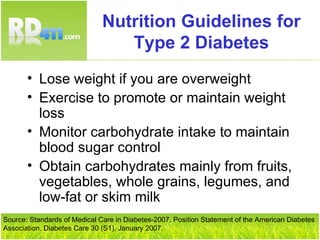
Nutrition Guidelines for Type 2 Diabetes Lose weight if you are overweight Exercise to promote or maintain weight loss Monitor carbohydrate intake to maintain blood sugar control Obtain carbohydrates mainly from fruits, vegetables, whole grains, legumes, and low-fat or skim milk Source: Standards of Medical Care in Diabetes-2007. Position Statement of the American Diabetes Association. Diabetes Care 30 (S1), January 2007.
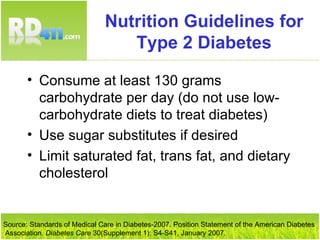
Nutrition Guidelines for Type 2 Diabetes Consume at least 130 grams carbohydrate per day (do not use low-carbohydrate diets to treat diabetes) Use sugar substitutes if desired Limit saturated fat, trans fat, and dietary cholesterol Source: Standards of Medical Care in Diabetes-2007. Position Statement of the American Diabetes Association.  Diabetes Care  30(Supplement 1): S4-S41, January 2007.
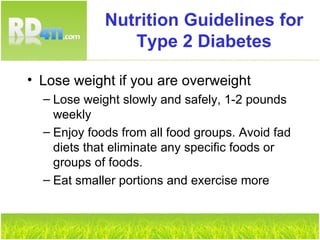
Nutrition Guidelines for Type 2 Diabetes Lose weight if you are overweight Lose weight slowly and safely, 1-2 pounds weekly Enjoy foods from all food groups. Avoid fad diets that eliminate any specific foods or groups of foods. Eat smaller portions and exercise more
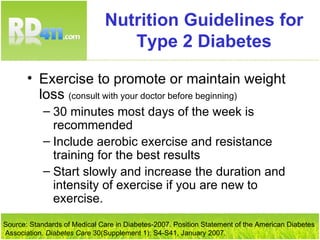
Nutrition Guidelines for Type 2 Diabetes Exercise to promote or maintain weight loss  (consult with your doctor before beginning) 30 minutes most days of the week is recommended Include aerobic exercise and resistance training for the best results Start slowly and increase the duration and intensity of exercise if you are new to exercise. Source: Standards of Medical Care in Diabetes-2007. Position Statement of the American Diabetes Association.  Diabetes Care  30(Supplement 1): S4-S41, January 2007.
Nutrition Guidelines for Type 2 Diabetes Monitor carbohydrate intake to maintain blood sugar control Limit your carbohydrate intake to what is suggested by your dietitian Use carbohydrate counting, the exchange system, or other methods to estimate your carbohydrate intake Source: Nutrition Recommendations and Interventions for Diabetes. A Position Statement of the American Diabetes Association.  Diabetes Care  30 (Supplement 1):S48-S63, January 2007.
Nutrition Guidelines for Type 2 Diabetes Obtain carbohydrates mainly from fruits, vegetables, whole grains, legumes, and low-fat or skim milk. These foods are the best carbohydrate sources They are usually high in fiber and high in nutrients your body needs Source: Nutrition Recommendations and Interventions for Diabetes. A Position Statement of the American Diabetes Association.  Diabetes Care  30 (Supplement 1):S48-S63, January 2007.
Nutrition Guidelines for Type 2 Diabetes Carbohydrate sources Even sugar and sweetened foods can be included in your diet when you have diabetes. Substitute them for another carbohydrate in your diet now and then These food are “empty calories” so should be limited Source: Nutrition Recommendations and Interventions for Diabetes. A Position Statement of the American Diabetes Association.  Diabetes Care  30 (Supplement 1):S48-S63, January 2007.
Nutrition Guidelines for Type 2 Diabetes Consume at least 130 grams of carbohydrate each day Low-carbohydrate diets are not recommended for diabetes management Carbohydrates contain important nutrients Choose most of your carbohydrates from fruits, vegetables, and whole grains. Source: Nutrition Recommendations and Interventions for Diabetes. A Position Statement of the American Diabetes Association.  Diabetes Care  30 (Supplement 1):S48-S63, January 2007.
Nutrition Guidelines for Type 2 Diabetes Use sugar substitutes if desired Use only sugar substitutes that are approved by the FDA Sugar substitutes can help you enjoy sweet treats more often Sugar substitutes don’t appear to cause weight loss or control blood sugars Source: Nutrition Recommendations and Interventions for Diabetes. A Position Statement of the American Diabetes Association.  Diabetes Care  30 (Supplement 1):S48-S63, January 2007.
Nutrition Guidelines for Type 2 Diabetes Limit saturated fats,  trans  fat, and dietary cholesterol These types of dietary fats and cholesterol can contribute to heart disease, which is related to diabetes When you use fats, use liquid oils instead of solid fats when possible .
Nutrition Guidelines for Type 2 Diabetes Trans  fat are produced by the food industry by taking liquid oils and changing them into solid fats. This process improves the shelf life and stability of flavors of processed foods
Nutrition Guidelines for Type 2 Diabetes Trans  fats are found mainly in packaged and processed foods. To limit  trans  fats Limit use of packaged crackers and cookies Limit use of commercial bakery products like cakes, cookies, etc Use soft margarine instead of stick margarine Read food labels for  trans  fats
Nutrition Guidelines for Type 2 Diabetes Dietary cholesterol is found mainly in animal foods. By limiting saturated fats you will also limit dietary cholesterol
Nutrition Guidelines for Type 2 Diabetes Fats are higher in calories than carbohydrates, so eating less fat can help you lose weight. Use lean meats and poultry and include fish, nuts, and legumes to help reduce your intake of saturated fats and cholesterol
Nutrition Guidelines for Type 2 Diabetes Where do I start? Talk to your doctor, dietitian, and diabetes educator about which changes are most important for you Start slowly by changing your habits one at a time Seek support from your dietitian and/or diabetes support group
Summary Good nutrition is one of the keys to managing Type 2 Diabetes Nutrition guidelines for Type 2 Diabetes focus on controlling carbohydrate and fat intake Weight management and exercise are also key Seek help to set and reach your nutrition and exercise goals

Managing Diabetes Through a Healthy Diet

  • 1.
    Managing Your Type 2 Diabetes With a Healthy Diet
  • 2.
    Objectives Understand theimportance of nutrition to diabetes management Outline current nutrition guidelines for diabetes management
  • 3.
    Why is GoodNutrition Important? Eating a healthy diet can: Help you control your blood sugars and blood lipids Help you maintain a healthy weight or lose weight if you are overweight Allow you to take less medication or avoid taking medication for your diabetes
  • 4.
    Why is GoodNutrition Important? Eating a healthy diet can: Prevent complications from high blood sugars like nerve problems, kidney problems, and vision problems Prevent other complications like heart disease and circulatory problems
  • 5.
    Each Person WithDiabetes is Different! Every person with diabetes should receive medical nutrition therapy based on his/her medical needs Your dietitian may suggest very specific goals for your weight, diet, and exercise depending on your health status
  • 6.
    Nutrition Guidelines forType 2 Diabetes Lose weight if you are overweight Exercise to promote or maintain weight loss Monitor carbohydrate intake to maintain blood sugar control Obtain carbohydrates mainly from fruits, vegetables, whole grains, legumes, and low-fat or skim milk Source: Standards of Medical Care in Diabetes-2007. Position Statement of the American Diabetes Association. Diabetes Care 30 (S1), January 2007.
  • 7.
    Nutrition Guidelines forType 2 Diabetes Consume at least 130 grams carbohydrate per day (do not use low-carbohydrate diets to treat diabetes) Use sugar substitutes if desired Limit saturated fat, trans fat, and dietary cholesterol Source: Standards of Medical Care in Diabetes-2007. Position Statement of the American Diabetes Association. Diabetes Care 30(Supplement 1): S4-S41, January 2007.
  • 8.
    Nutrition Guidelines forType 2 Diabetes Lose weight if you are overweight Lose weight slowly and safely, 1-2 pounds weekly Enjoy foods from all food groups. Avoid fad diets that eliminate any specific foods or groups of foods. Eat smaller portions and exercise more
  • 9.
    Nutrition Guidelines forType 2 Diabetes Exercise to promote or maintain weight loss (consult with your doctor before beginning) 30 minutes most days of the week is recommended Include aerobic exercise and resistance training for the best results Start slowly and increase the duration and intensity of exercise if you are new to exercise. Source: Standards of Medical Care in Diabetes-2007. Position Statement of the American Diabetes Association. Diabetes Care 30(Supplement 1): S4-S41, January 2007.
  • 10.
    Nutrition Guidelines forType 2 Diabetes Monitor carbohydrate intake to maintain blood sugar control Limit your carbohydrate intake to what is suggested by your dietitian Use carbohydrate counting, the exchange system, or other methods to estimate your carbohydrate intake Source: Nutrition Recommendations and Interventions for Diabetes. A Position Statement of the American Diabetes Association. Diabetes Care 30 (Supplement 1):S48-S63, January 2007.
  • 11.
    Nutrition Guidelines forType 2 Diabetes Obtain carbohydrates mainly from fruits, vegetables, whole grains, legumes, and low-fat or skim milk. These foods are the best carbohydrate sources They are usually high in fiber and high in nutrients your body needs Source: Nutrition Recommendations and Interventions for Diabetes. A Position Statement of the American Diabetes Association. Diabetes Care 30 (Supplement 1):S48-S63, January 2007.
  • 12.
    Nutrition Guidelines forType 2 Diabetes Carbohydrate sources Even sugar and sweetened foods can be included in your diet when you have diabetes. Substitute them for another carbohydrate in your diet now and then These food are “empty calories” so should be limited Source: Nutrition Recommendations and Interventions for Diabetes. A Position Statement of the American Diabetes Association. Diabetes Care 30 (Supplement 1):S48-S63, January 2007.
  • 13.
    Nutrition Guidelines forType 2 Diabetes Consume at least 130 grams of carbohydrate each day Low-carbohydrate diets are not recommended for diabetes management Carbohydrates contain important nutrients Choose most of your carbohydrates from fruits, vegetables, and whole grains. Source: Nutrition Recommendations and Interventions for Diabetes. A Position Statement of the American Diabetes Association. Diabetes Care 30 (Supplement 1):S48-S63, January 2007.
  • 14.
    Nutrition Guidelines forType 2 Diabetes Use sugar substitutes if desired Use only sugar substitutes that are approved by the FDA Sugar substitutes can help you enjoy sweet treats more often Sugar substitutes don’t appear to cause weight loss or control blood sugars Source: Nutrition Recommendations and Interventions for Diabetes. A Position Statement of the American Diabetes Association. Diabetes Care 30 (Supplement 1):S48-S63, January 2007.
  • 15.
    Nutrition Guidelines forType 2 Diabetes Limit saturated fats, trans fat, and dietary cholesterol These types of dietary fats and cholesterol can contribute to heart disease, which is related to diabetes When you use fats, use liquid oils instead of solid fats when possible .
  • 16.
    Nutrition Guidelines forType 2 Diabetes Trans fat are produced by the food industry by taking liquid oils and changing them into solid fats. This process improves the shelf life and stability of flavors of processed foods
  • 17.
    Nutrition Guidelines forType 2 Diabetes Trans fats are found mainly in packaged and processed foods. To limit trans fats Limit use of packaged crackers and cookies Limit use of commercial bakery products like cakes, cookies, etc Use soft margarine instead of stick margarine Read food labels for trans fats
  • 18.
    Nutrition Guidelines forType 2 Diabetes Dietary cholesterol is found mainly in animal foods. By limiting saturated fats you will also limit dietary cholesterol
  • 19.
    Nutrition Guidelines forType 2 Diabetes Fats are higher in calories than carbohydrates, so eating less fat can help you lose weight. Use lean meats and poultry and include fish, nuts, and legumes to help reduce your intake of saturated fats and cholesterol
  • 20.
    Nutrition Guidelines forType 2 Diabetes Where do I start? Talk to your doctor, dietitian, and diabetes educator about which changes are most important for you Start slowly by changing your habits one at a time Seek support from your dietitian and/or diabetes support group
  • 21.
    Summary Good nutritionis one of the keys to managing Type 2 Diabetes Nutrition guidelines for Type 2 Diabetes focus on controlling carbohydrate and fat intake Weight management and exercise are also key Seek help to set and reach your nutrition and exercise goals