BECOMING A FAT ADAPTED
ATHLETE
 * Fat Adapted means that you have taught your body
to use fatty acids as a primary source of energy/fuel
instead of sugars and carbohydrates. So, all that FAT
on your body can be put to good use!
 *Most people have, at most, about 2000 calories of
glucose (muscle) and glycogen (liver) sugars
available for energy.
 *Most people have around 80,000 calories of fat
stored on their bodies
What Does “Fat Adapted” even mean??
WHO should Choose to Become Fat Adapted?
 1) Athletes trying to LOSE weight.
 Research shows a higher fat, lower carb diet causes
faster and more permanent weight loss than a low fat
diet.
WHO should Choose to Become Fat Adapted
 2.) Athletes wanting to improve health and
longevity.
 Burning Glucose creates free radical damage to cells.
 Burning Fat does not create the same cellular
damage.
 In addition a high carbohydrate diet can be
associated with nerve damage, high
morbidity, bacterial infection, cancer progression
and Alzheimers.
WHO should Choose to Become Fat Adapted
 3) Athletes who have consistently poor
performances or gastrointestinal distress
(GI) while training or racing.
 Some athletes are more sensitive to fluctuations in
blood sugar caused by carb intake. Uncomfortable
gas and bloating can also be due to the high rate of
bacteria caused by carb fermentation in the digestive
tract.
 Many athletes might also have food allergies or
intolerances common in carb sources (wheat, etc.)
Benefits to being “Fat Adapted”
 Fat-adaptation is the normal, preferred metabolic
state of the human body. Sugar-dependency is an
abnormal metabolic state that inevitably leads to
insulin resistance and chronic disease
 Once you are fat-adapted, your body can effectively
burn stored fat for energy throughout the day, and
can effectively oxidize dietary fat for energy. Hence
less fat will be stored in adipose tissue
More Benefits for Being Fat Adapted
 Fat adapted people essentially reprogram their
bodies, allowing genes associated with lipid (fat)
metabolism to be upregulated (put to work!)
 We want to be burning fat for fuel when we are
sleeping, working, resting and participating in
endurance exercise. How are we to become a fat
burning machine if we are taught to eat three meals a
day plus two snacks as well as make sure we are
eating every 2-3 hours to keep the “metabolism”
working?
And…More Benefits for Being Fat Adapted
 Since weight loss ultimately comes down to calories
stored versus calories burned, and when you’re a fat-
burner you’re both burning the stuff you want to get
rid of (body fat) and taking in less energy and
experiencing less hunger (because you’re eating body
fat), being fat-adapted just makes losing unwanted
weight easier.
Are you “Fat Adapted”??
 1. Can you go 3 hours without eating? Or is that
extremely difficult for you?
 2. Do you enjoy steady, even energy throughout the
day?
 3. Do you NEED to take naps during the day?
 4. Can you exercise without carb loading?
 5. Do you have headaches or brain fuzziness?
HOW to Become Fat Adapted
 1) Ramp up your fat intake. This will spur your
body to increase fat-digesting enzymes that have
likely laid rather dormant. Rather than consuming
any old fat you can get your hands on, stick to high-
nutrient fat – from pastured animals, pastured egg
yolks, butter from truly grass-fed cows, red palm
oil, extra virgin olive oil– and fat with interesting
properties, like MCT and coconut oil which will also
“train” your mitochondria to start burning fat for
fuel.
HOW to Become Fat Adapted
 2) Reduce your daily carb intake to about 50
grams if sedentary, 100-150 if you are highly
active. Basically, you want to reduce your carb
intake relative to your body’s demands.
 3) Avoid lean protein. Eat protein that has fat
attached, as a focus on protein (rather than
meat, which has both fat and protein) could lead to
your body converting excess amino acids to glucose.
HOW to Become Fat Adapted
 Reduce your workout intensity. Don’t try to get fat-
adapted while you try to make the CrossFit games, do
a triathlon, or engage in anything that demands a ton of
glucose. It will end badly. Instead, walk a bunch and
occasionally lift heavy things. Once you’re fat-
adapted, your desire to be active will likely spontaneously
increase.
 Be nutritionally replete. Make sure you’re not
missing out on any of the common nutrient deficiencies
listed below:

HOW to Become Fat Adapted
 Get in your Nutrients!
Some common
deficencies are:
 1) Iodione
 2) Selenium
 3) Magnesium
 4) Vitamin K2
 5) Vitamin B12
 6) Manganese
 7) Choline
 For more Info Go To:
 http://www.marksdailyapple.com/5-
common-nutrient-deficiencies-and-what-
to-do-about-them/#axzz2TIgWRUBo
Carb Cycling To Become Fat Adapted
 Carb Cycling:
 Storage Carbs should be “re-loaded” once per week
(on a higher volume training day)
 If long term carbs are too low with high bouts of
training, the immune systenm can become
depressed, physical performance and mood can
decline, and risk of overtraining can increase.
How LONG until I Am Fat Adapted??
 It usually takes about 2 weeks…but, can take longer
(3 or 4 weeks) depending on the individual.
Carb Effects on Insulin and Metabolic Pathways
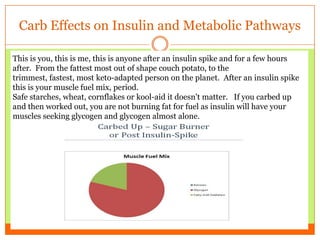
This is you, this is me, this is anyone after an insulin spike and for a few hours
after. From the fattest most out of shape couch potato, to the
trimmest, fastest, most keto-adapted person on the planet. After an insulin spike
this is your muscle fuel mix, period.
Safe starches, wheat, cornflakes or kool-aid it doesn't matter. If you carbed up
and then worked out, you are not burning fat for fuel as insulin will have your
muscles seeking glycogen and glycogen almost alone.
Fat Adapted Effects on Training Metabolic
Pathways
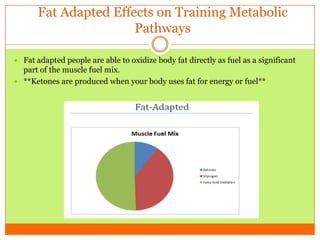
 Fat adapted people are able to oxidize body fat directly as fuel as a significant
part of the muscle fuel mix.
 **Ketones are produced when your body uses fat for energy or fuel**
WHY Fat over Glucose/Glycogen?
 After half an hour, triglycerides (fats) begin to contribute almost
as much (~50%) as carbohydrates to the body's energy
production, and after another hour, protein begins to make a
substantial contribution as well (up to 15%). We USE fat in our
training and racing.
 The fatty acid oxidation system is the most efficient energy
system in the body able to produce 100 units of ATP for
one gram of fat. So you can see ramping this energy
system up to assist the aerobic system which produces just
over 30 units of ATP per gram of sugar or
ketones, would be of great advantage to all endurance
athletes and even anaerobic athletes like boxers and mixed
martial artists. It is DENSE in ENERGY!
Carb intake shuts down Fat use
 "Fatty Acid Oxidation" shuts down a
considerable amount in the presence of
insulin and for hours after. That morning carb
feed many runners partake of prior to the big race
pretty much forces their body to rely solely on
glycogen the entire 2 to 3 hour race thanks to the
initial insulin spike that shut down fatty acid
oxidation by the muscles.
Why Carbs are Bad
 Excess carbohydrates are addictive, create
unstable blood sugar levels, increase appetite
and decrease ability to activate the “feel full
button”.
 "Fatty Acid Oxidation" shuts down a
considerable amount in the presence of insulin
and for hours after. That morning carb feed many
runners partake of prior to the big race pretty much
forces their body to rely solely on glycogen the entire 2 to
3 hour race thanks to the initial insulin spike that shut
down fatty acid oxidation by the muscles.
THE NITTY GRITTY: SUPERHUMAN FOOD
PYRAMID
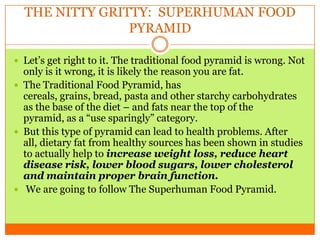
 Let’s get right to it. The traditional food pyramid is wrong. Not
only is it wrong, it is likely the reason you are fat.
 The Traditional Food Pyramid, has
cereals, grains, bread, pasta and other starchy carbohydrates
as the base of the diet – and fats near the top of the
pyramid, as a “use sparingly” category.
 But this type of pyramid can lead to health problems. After
all, dietary fat from healthy sources has been shown in studies
to actually help to increase weight loss, reduce heart
disease risk, lower blood sugars, lower cholesterol
and maintain proper brain function.
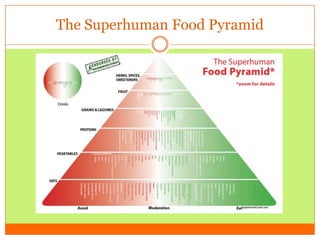
 We are going to follow The Superhuman Food Pyramid.
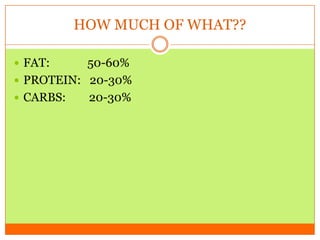
HOW MUCH OF WHAT??
 FAT: 50-60%
 PROTEIN: 20-30%
 CARBS: 20-30%
The Superhuman Food Pyramid
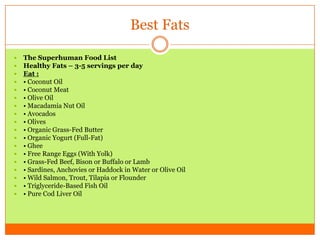
Best Fats
 The Superhuman Food List
 Healthy Fats – 3-5 servings per day
 Eat :
 • Coconut Oil
 • Coconut Meat
 • Olive Oil
 • Macadamia Nut Oil
 • Avocados
 • Olives
 • Organic Grass-Fed Butter
 • Organic Yogurt (Full-Fat)
 • Ghee
 • Free Range Eggs (With Yolk)
 • Grass-Fed Beef, Bison or Buffalo or Lamb
 • Sardines, Anchovies or Haddock in Water or Olive Oil
 • Wild Salmon, Trout, Tilapia or Flounder
 • Triglyceride-Based Fish Oil
 • Pure Cod Liver Oil
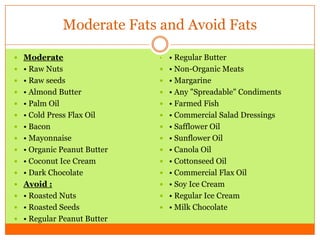
Moderate Fats and Avoid Fats
 Moderate
 • Raw Nuts
 • Raw seeds
 • Almond Butter
 • Palm Oil
 • Cold Press Flax Oil
 • Bacon
 • Mayonnaise
 • Organic Peanut Butter
 • Coconut Ice Cream
 • Dark Chocolate
 Avoid :
 • Roasted Nuts
 • Roasted Seeds
 • Regular Peanut Butter
• • Regular Butter
 • Non-Organic Meats
 • Margarine
 • Any "Spreadable" Condiments
 • Farmed Fish
 • Commercial Salad Dressings
 • Safflower Oil
 • Sunflower Oil
 • Canola Oil
 • Cottonseed Oil
 • Commercial Flax Oil
 • Soy Ice Cream
 • Regular Ice Cream
 • Milk Chocolate
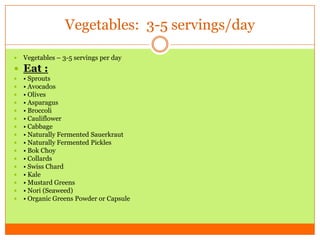
Vegetables: 3-5 servings/day
 Vegetables – 3-5 servings per day
 Eat :
 • Sprouts
 • Avocados
 • Olives
 • Asparagus
 • Broccoli
 • Cauliflower
 • Cabbage
 • Naturally Fermented Sauerkraut
 • Naturally Fermented Pickles
 • Bok Choy
 • Collards
 • Swiss Chard
 • Kale
 • Mustard Greens
 • Nori (Seaweed)
 • Organic Greens Powder or Capsule
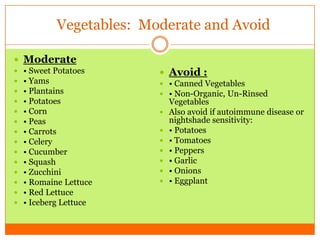
Vegetables: Moderate and Avoid
 Moderate
 • Sweet Potatoes
 • Yams
 • Plantains
 • Potatoes
 • Corn
 • Peas
 • Carrots
 • Celery
 • Cucumber
 • Squash
 • Zucchini
 • Romaine Lettuce
 • Red Lettuce
 • Iceberg Lettuce
 Avoid :
 • Canned Vegetables
 • Non-Organic, Un-Rinsed
Vegetables
 Also avoid if autoimmune disease or
nightshade sensitivity:
 • Potatoes
 • Tomatoes
 • Peppers
 • Garlic
 • Onions
 • Eggplant
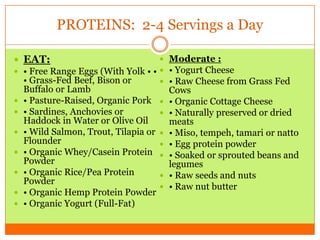
PROTEINS: 2-4 Servings a Day
 EAT:
 • Free Range Eggs (With Yolk • •
• Grass-Fed Beef, Bison or
Buffalo or Lamb
 • Pasture-Raised, Organic Pork
 • Sardines, Anchovies or
Haddock in Water or Olive Oil
 • Wild Salmon, Trout, Tilapia or
Flounder
 • Organic Whey/Casein Protein
Powder
 • Organic Rice/Pea Protein
Powder
 • Organic Hemp Protein Powder
 • Organic Yogurt (Full-Fat)
 Moderate :
 • Yogurt Cheese
 • Raw Cheese from Grass Fed
Cows
 • Organic Cottage Cheese
 • Naturally preserved or dried
meats
 • Miso, tempeh, tamari or natto
 • Egg protein powder
 • Soaked or sprouted beans and
legumes
 • Raw seeds and nuts
 • Raw nut butter
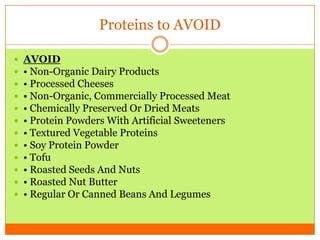
Proteins to AVOID
 AVOID
 • Non-Organic Dairy Products
 • Processed Cheeses
 • Non-Organic, Commercially Processed Meat
 • Chemically Preserved Or Dried Meats
 • Protein Powders With Artificial Sweeteners
 • Textured Vegetable Proteins
 • Soy Protein Powder
 • Tofu
 • Roasted Seeds And Nuts
 • Roasted Nut Butter
 • Regular Or Canned Beans And Legumes
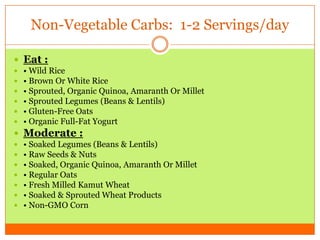
Non-Vegetable Carbs: 1-2 Servings/day
 Eat :
 • Wild Rice
 • Brown Or White Rice
 • Sprouted, Organic Quinoa, Amaranth Or Millet
 • Sprouted Legumes (Beans & Lentils)
 • Gluten-Free Oats
 • Organic Full-Fat Yogurt
 Moderate :
 • Soaked Legumes (Beans & Lentils)
 • Raw Seeds & Nuts
 • Soaked, Organic Quinoa, Amaranth Or Millet
 • Regular Oats
 • Fresh Milled Kamut Wheat
 • Soaked & Sprouted Wheat Products
 • Non-GMO Corn
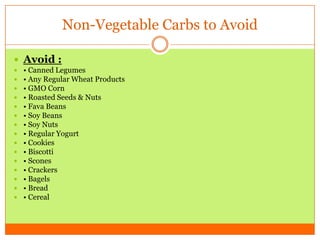
Non-Vegetable Carbs to Avoid
 Avoid :
 • Canned Legumes
 • Any Regular Wheat Products
 • GMO Corn
 • Roasted Seeds & Nuts
 • Fava Beans
 • Soy Beans
 • Soy Nuts
 • Regular Yogurt
 • Cookies
 • Biscotti
 • Scones
 • Crackers
 • Bagels
 • Bread
 • Cereal
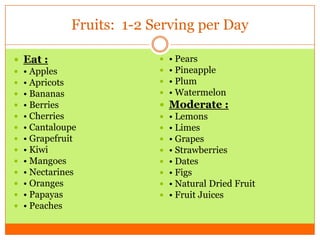
Fruits: 1-2 Serving per Day
 Eat :
 • Apples
 • Apricots
 • Bananas
 • Berries
 • Cherries
 • Cantaloupe
 • Grapefruit
 • Kiwi
 • Mangoes
 • Nectarines
 • Oranges
 • Papayas
 • Peaches
 • Pears
 • Pineapple
 • Plum
 • Watermelon
 Moderate :
 • Lemons
 • Limes
 • Grapes
 • Strawberries
 • Dates
 • Figs
 • Natural Dried Fruit
 • Fruit Juices
Fruits to AVOID
 Avoid :
 • Canned Fruit
 • Fruit in Syrup
 • Fruit Candy
 • Sugar Coated Dried Fruit
 • Packaged Dried Fruit
Herbs, Spices & Sweeteners:
 Eat :
 • Cinnamon
 • Cloves
 • All-spice
 • Stevia
 • Xylitol
 • Maltitol
 • Turmeric
 • Curry
 • Cumin
 • Fennel
 • Star Anise
 • Garlic
 • Ginger
 Moderate :
 • Raw, Pollinated Honey
 • Organic Maple Syrup
 • Natural Fruit Sweeteners
 • Blackstrap Molasses
 • Sucanat
 • Truvia
 • Regular Table Salt
 • Red Pepper
 • Black Pepper
 • Fermented Soy Sauce
 • Apple Cider Vinegar
 • Brewer's Yeast
Herbs, Spices and Sweeteners to AVOID
 Avoid :
 • Processed Sugar
 • Candy
 • High Fructose Corn Syrup
 • Regular Honey
 • Agave Syrup
 • Aspartame
 • Sucralose
 • Acesulfame
 • MSG
RESOURCES:
 http://nutritiondata.self.com
 www.bengreenfieldfitness.com
 www.lowcarbtriathlete.com
Training and Racing Fat Adapted
 Two Options:
 1) Train low-race high: Train low carb most of the
time, but actually a larger number of carbs during
the actual race. Every two weeks or so (on a long
workout) you will need to use what you plan to race
with: gels, sports drinks, bars, etc.
 (Males: 300-450 cal/hour on bike and 200-300 cal/hour on run)
 Females: 250-400 cal/hour on bike and 150-250 cal/hour on run)
 **Do NOT fuel on any workouts less than an hour**
Training and Racing Fat Adapted
 TWO Options:
 2) Train low-race low. Train and race with minimal
carb utilization.
 Advantage is it is a good solution if you trouble with
“energy highs and lows” or GI distress from all the
fermentable simple carbs.
 Disadvantage is that it can be hard to push your
intensity without enough quick burning carbs.
Pre-Race Fueling:
 Breakfast 2-3 hours before race and drink 20-24 oz
of water per hour (start tapering off about 30 min
pre race)
 30-60 min before race take any supplements you
have already tried before race day
 5-10 min before race consume a gel (or similar)
DURING The Race Fueling
 POST SWIM: Consume 15-20 oz. water along with
2-3 electrolytes and 100-200 additional calories
 BIKE: Consume 24-32 oz of water per hour (volume
depends on race conditions and athlete), 2-4
electrolytes and 250-400 calories of amino acid
containing gel or solids per hour (your choice)
 RUN: Consume 15-20 oz of water per hour as well as
200-300 calories per hour and 2-4 electrolytes per
hour.
SUPPLEMENTS
 UCAN SuperStarch:
 slowly metabolized high molecular weight, corn-
derived starch that is metabolized differently than
simple sugars (fructose, maltodextrin) Less insulin
production and less blood sugar spiking. Thus it
allows your body to tap into its own storage fat for
fuel
SUPPLEMENTS
 MAP Amino Acids:
 1) Help reduce your rating of perceived
exertion, allowing you to work harder
 2) Keeps your body from cannibalizing your own
lean muscle during exercise…thus limiting post-
workout and post-race soreness.
SUPPLEMENTS
 Energy 28:
 Adds flavor to UCAN
 Contains several natural components that aid in
stimulating the nervous system, resist
fatigue, stabilize cortisol, high in
vitamins, calcium, magnesium, potassium and other
minerals.
SUPPLEMENTS
 3FUEL:
 Ingredients:
 *Whey Protein Hydrolysate
 * Coconut Milk (oil)
 *Waxy maize (high molecular weight, low G.I.
carb that improves fat utilization)
 *Betaine (increases intracellular
hydration, decreases lactic acid increases power)
 http://3fu3l.com/science.htm

Low Carb High Fat Diet Brief

  • 1.
    BECOMING A FATADAPTED ATHLETE
  • 2.
     * FatAdapted means that you have taught your body to use fatty acids as a primary source of energy/fuel instead of sugars and carbohydrates. So, all that FAT on your body can be put to good use!  *Most people have, at most, about 2000 calories of glucose (muscle) and glycogen (liver) sugars available for energy.  *Most people have around 80,000 calories of fat stored on their bodies What Does “Fat Adapted” even mean??
  • 3.
    WHO should Chooseto Become Fat Adapted?  1) Athletes trying to LOSE weight.  Research shows a higher fat, lower carb diet causes faster and more permanent weight loss than a low fat diet.
  • 4.
    WHO should Chooseto Become Fat Adapted  2.) Athletes wanting to improve health and longevity.  Burning Glucose creates free radical damage to cells.  Burning Fat does not create the same cellular damage.  In addition a high carbohydrate diet can be associated with nerve damage, high morbidity, bacterial infection, cancer progression and Alzheimers.
  • 5.
    WHO should Chooseto Become Fat Adapted  3) Athletes who have consistently poor performances or gastrointestinal distress (GI) while training or racing.  Some athletes are more sensitive to fluctuations in blood sugar caused by carb intake. Uncomfortable gas and bloating can also be due to the high rate of bacteria caused by carb fermentation in the digestive tract.  Many athletes might also have food allergies or intolerances common in carb sources (wheat, etc.)
  • 6.
    Benefits to being“Fat Adapted”  Fat-adaptation is the normal, preferred metabolic state of the human body. Sugar-dependency is an abnormal metabolic state that inevitably leads to insulin resistance and chronic disease  Once you are fat-adapted, your body can effectively burn stored fat for energy throughout the day, and can effectively oxidize dietary fat for energy. Hence less fat will be stored in adipose tissue
  • 7.
    More Benefits forBeing Fat Adapted  Fat adapted people essentially reprogram their bodies, allowing genes associated with lipid (fat) metabolism to be upregulated (put to work!)  We want to be burning fat for fuel when we are sleeping, working, resting and participating in endurance exercise. How are we to become a fat burning machine if we are taught to eat three meals a day plus two snacks as well as make sure we are eating every 2-3 hours to keep the “metabolism” working?
  • 8.
    And…More Benefits forBeing Fat Adapted  Since weight loss ultimately comes down to calories stored versus calories burned, and when you’re a fat- burner you’re both burning the stuff you want to get rid of (body fat) and taking in less energy and experiencing less hunger (because you’re eating body fat), being fat-adapted just makes losing unwanted weight easier.

  • 9.
    Are you “FatAdapted”??  1. Can you go 3 hours without eating? Or is that extremely difficult for you?  2. Do you enjoy steady, even energy throughout the day?  3. Do you NEED to take naps during the day?  4. Can you exercise without carb loading?  5. Do you have headaches or brain fuzziness?
  • 10.
    HOW to BecomeFat Adapted  1) Ramp up your fat intake. This will spur your body to increase fat-digesting enzymes that have likely laid rather dormant. Rather than consuming any old fat you can get your hands on, stick to high- nutrient fat – from pastured animals, pastured egg yolks, butter from truly grass-fed cows, red palm oil, extra virgin olive oil– and fat with interesting properties, like MCT and coconut oil which will also “train” your mitochondria to start burning fat for fuel.
  • 11.
    HOW to BecomeFat Adapted  2) Reduce your daily carb intake to about 50 grams if sedentary, 100-150 if you are highly active. Basically, you want to reduce your carb intake relative to your body’s demands.  3) Avoid lean protein. Eat protein that has fat attached, as a focus on protein (rather than meat, which has both fat and protein) could lead to your body converting excess amino acids to glucose.
  • 12.
    HOW to BecomeFat Adapted  Reduce your workout intensity. Don’t try to get fat- adapted while you try to make the CrossFit games, do a triathlon, or engage in anything that demands a ton of glucose. It will end badly. Instead, walk a bunch and occasionally lift heavy things. Once you’re fat- adapted, your desire to be active will likely spontaneously increase.  Be nutritionally replete. Make sure you’re not missing out on any of the common nutrient deficiencies listed below: 
  • 13.
    HOW to BecomeFat Adapted  Get in your Nutrients! Some common deficencies are:  1) Iodione  2) Selenium  3) Magnesium  4) Vitamin K2  5) Vitamin B12  6) Manganese  7) Choline  For more Info Go To:  http://www.marksdailyapple.com/5- common-nutrient-deficiencies-and-what- to-do-about-them/#axzz2TIgWRUBo
  • 14.
    Carb Cycling ToBecome Fat Adapted  Carb Cycling:  Storage Carbs should be “re-loaded” once per week (on a higher volume training day)  If long term carbs are too low with high bouts of training, the immune systenm can become depressed, physical performance and mood can decline, and risk of overtraining can increase.
  • 15.
    How LONG untilI Am Fat Adapted??  It usually takes about 2 weeks…but, can take longer (3 or 4 weeks) depending on the individual.
  • 16.
    Carb Effects onInsulin and Metabolic Pathways This is you, this is me, this is anyone after an insulin spike and for a few hours after. From the fattest most out of shape couch potato, to the trimmest, fastest, most keto-adapted person on the planet. After an insulin spike this is your muscle fuel mix, period. Safe starches, wheat, cornflakes or kool-aid it doesn't matter. If you carbed up and then worked out, you are not burning fat for fuel as insulin will have your muscles seeking glycogen and glycogen almost alone.
  • 17.
    Fat Adapted Effectson Training Metabolic Pathways  Fat adapted people are able to oxidize body fat directly as fuel as a significant part of the muscle fuel mix.  **Ketones are produced when your body uses fat for energy or fuel**
  • 18.
    WHY Fat overGlucose/Glycogen?  After half an hour, triglycerides (fats) begin to contribute almost as much (~50%) as carbohydrates to the body's energy production, and after another hour, protein begins to make a substantial contribution as well (up to 15%). We USE fat in our training and racing.  The fatty acid oxidation system is the most efficient energy system in the body able to produce 100 units of ATP for one gram of fat. So you can see ramping this energy system up to assist the aerobic system which produces just over 30 units of ATP per gram of sugar or ketones, would be of great advantage to all endurance athletes and even anaerobic athletes like boxers and mixed martial artists. It is DENSE in ENERGY!
  • 19.
    Carb intake shutsdown Fat use  "Fatty Acid Oxidation" shuts down a considerable amount in the presence of insulin and for hours after. That morning carb feed many runners partake of prior to the big race pretty much forces their body to rely solely on glycogen the entire 2 to 3 hour race thanks to the initial insulin spike that shut down fatty acid oxidation by the muscles.
  • 20.
    Why Carbs areBad  Excess carbohydrates are addictive, create unstable blood sugar levels, increase appetite and decrease ability to activate the “feel full button”.  "Fatty Acid Oxidation" shuts down a considerable amount in the presence of insulin and for hours after. That morning carb feed many runners partake of prior to the big race pretty much forces their body to rely solely on glycogen the entire 2 to 3 hour race thanks to the initial insulin spike that shut down fatty acid oxidation by the muscles.
  • 21.
    THE NITTY GRITTY:SUPERHUMAN FOOD PYRAMID  Let’s get right to it. The traditional food pyramid is wrong. Not only is it wrong, it is likely the reason you are fat.  The Traditional Food Pyramid, has cereals, grains, bread, pasta and other starchy carbohydrates as the base of the diet – and fats near the top of the pyramid, as a “use sparingly” category.  But this type of pyramid can lead to health problems. After all, dietary fat from healthy sources has been shown in studies to actually help to increase weight loss, reduce heart disease risk, lower blood sugars, lower cholesterol and maintain proper brain function.  We are going to follow The Superhuman Food Pyramid.
  • 22.
    HOW MUCH OFWHAT??  FAT: 50-60%  PROTEIN: 20-30%  CARBS: 20-30%
  • 23.
  • 24.
    Best Fats  TheSuperhuman Food List  Healthy Fats – 3-5 servings per day  Eat :  • Coconut Oil  • Coconut Meat  • Olive Oil  • Macadamia Nut Oil  • Avocados  • Olives  • Organic Grass-Fed Butter  • Organic Yogurt (Full-Fat)  • Ghee  • Free Range Eggs (With Yolk)  • Grass-Fed Beef, Bison or Buffalo or Lamb  • Sardines, Anchovies or Haddock in Water or Olive Oil  • Wild Salmon, Trout, Tilapia or Flounder  • Triglyceride-Based Fish Oil  • Pure Cod Liver Oil
  • 25.
    Moderate Fats andAvoid Fats  Moderate  • Raw Nuts  • Raw seeds  • Almond Butter  • Palm Oil  • Cold Press Flax Oil  • Bacon  • Mayonnaise  • Organic Peanut Butter  • Coconut Ice Cream  • Dark Chocolate  Avoid :  • Roasted Nuts  • Roasted Seeds  • Regular Peanut Butter • • Regular Butter  • Non-Organic Meats  • Margarine  • Any "Spreadable" Condiments  • Farmed Fish  • Commercial Salad Dressings  • Safflower Oil  • Sunflower Oil  • Canola Oil  • Cottonseed Oil  • Commercial Flax Oil  • Soy Ice Cream  • Regular Ice Cream  • Milk Chocolate
  • 26.
    Vegetables: 3-5 servings/day Vegetables – 3-5 servings per day  Eat :  • Sprouts  • Avocados  • Olives  • Asparagus  • Broccoli  • Cauliflower  • Cabbage  • Naturally Fermented Sauerkraut  • Naturally Fermented Pickles  • Bok Choy  • Collards  • Swiss Chard  • Kale  • Mustard Greens  • Nori (Seaweed)  • Organic Greens Powder or Capsule
  • 27.
    Vegetables: Moderate andAvoid  Moderate  • Sweet Potatoes  • Yams  • Plantains  • Potatoes  • Corn  • Peas  • Carrots  • Celery  • Cucumber  • Squash  • Zucchini  • Romaine Lettuce  • Red Lettuce  • Iceberg Lettuce  Avoid :  • Canned Vegetables  • Non-Organic, Un-Rinsed Vegetables  Also avoid if autoimmune disease or nightshade sensitivity:  • Potatoes  • Tomatoes  • Peppers  • Garlic  • Onions  • Eggplant
  • 28.
    PROTEINS: 2-4 Servingsa Day  EAT:  • Free Range Eggs (With Yolk • • • Grass-Fed Beef, Bison or Buffalo or Lamb  • Pasture-Raised, Organic Pork  • Sardines, Anchovies or Haddock in Water or Olive Oil  • Wild Salmon, Trout, Tilapia or Flounder  • Organic Whey/Casein Protein Powder  • Organic Rice/Pea Protein Powder  • Organic Hemp Protein Powder  • Organic Yogurt (Full-Fat)  Moderate :  • Yogurt Cheese  • Raw Cheese from Grass Fed Cows  • Organic Cottage Cheese  • Naturally preserved or dried meats  • Miso, tempeh, tamari or natto  • Egg protein powder  • Soaked or sprouted beans and legumes  • Raw seeds and nuts  • Raw nut butter
  • 29.
    Proteins to AVOID AVOID  • Non-Organic Dairy Products  • Processed Cheeses  • Non-Organic, Commercially Processed Meat  • Chemically Preserved Or Dried Meats  • Protein Powders With Artificial Sweeteners  • Textured Vegetable Proteins  • Soy Protein Powder  • Tofu  • Roasted Seeds And Nuts  • Roasted Nut Butter  • Regular Or Canned Beans And Legumes
  • 30.
    Non-Vegetable Carbs: 1-2Servings/day  Eat :  • Wild Rice  • Brown Or White Rice  • Sprouted, Organic Quinoa, Amaranth Or Millet  • Sprouted Legumes (Beans & Lentils)  • Gluten-Free Oats  • Organic Full-Fat Yogurt  Moderate :  • Soaked Legumes (Beans & Lentils)  • Raw Seeds & Nuts  • Soaked, Organic Quinoa, Amaranth Or Millet  • Regular Oats  • Fresh Milled Kamut Wheat  • Soaked & Sprouted Wheat Products  • Non-GMO Corn
  • 31.
    Non-Vegetable Carbs toAvoid  Avoid :  • Canned Legumes  • Any Regular Wheat Products  • GMO Corn  • Roasted Seeds & Nuts  • Fava Beans  • Soy Beans  • Soy Nuts  • Regular Yogurt  • Cookies  • Biscotti  • Scones  • Crackers  • Bagels  • Bread  • Cereal
  • 32.
    Fruits: 1-2 Servingper Day  Eat :  • Apples  • Apricots  • Bananas  • Berries  • Cherries  • Cantaloupe  • Grapefruit  • Kiwi  • Mangoes  • Nectarines  • Oranges  • Papayas  • Peaches  • Pears  • Pineapple  • Plum  • Watermelon  Moderate :  • Lemons  • Limes  • Grapes  • Strawberries  • Dates  • Figs  • Natural Dried Fruit  • Fruit Juices
  • 33.
    Fruits to AVOID Avoid :  • Canned Fruit  • Fruit in Syrup  • Fruit Candy  • Sugar Coated Dried Fruit  • Packaged Dried Fruit
  • 34.
    Herbs, Spices &Sweeteners:  Eat :  • Cinnamon  • Cloves  • All-spice  • Stevia  • Xylitol  • Maltitol  • Turmeric  • Curry  • Cumin  • Fennel  • Star Anise  • Garlic  • Ginger  Moderate :  • Raw, Pollinated Honey  • Organic Maple Syrup  • Natural Fruit Sweeteners  • Blackstrap Molasses  • Sucanat  • Truvia  • Regular Table Salt  • Red Pepper  • Black Pepper  • Fermented Soy Sauce  • Apple Cider Vinegar  • Brewer's Yeast
  • 35.
    Herbs, Spices andSweeteners to AVOID  Avoid :  • Processed Sugar  • Candy  • High Fructose Corn Syrup  • Regular Honey  • Agave Syrup  • Aspartame  • Sucralose  • Acesulfame  • MSG
  • 36.
  • 37.
    Training and RacingFat Adapted  Two Options:  1) Train low-race high: Train low carb most of the time, but actually a larger number of carbs during the actual race. Every two weeks or so (on a long workout) you will need to use what you plan to race with: gels, sports drinks, bars, etc.  (Males: 300-450 cal/hour on bike and 200-300 cal/hour on run)  Females: 250-400 cal/hour on bike and 150-250 cal/hour on run)  **Do NOT fuel on any workouts less than an hour**
  • 38.
    Training and RacingFat Adapted  TWO Options:  2) Train low-race low. Train and race with minimal carb utilization.  Advantage is it is a good solution if you trouble with “energy highs and lows” or GI distress from all the fermentable simple carbs.  Disadvantage is that it can be hard to push your intensity without enough quick burning carbs.
  • 39.
    Pre-Race Fueling:  Breakfast2-3 hours before race and drink 20-24 oz of water per hour (start tapering off about 30 min pre race)  30-60 min before race take any supplements you have already tried before race day  5-10 min before race consume a gel (or similar)
  • 40.
    DURING The RaceFueling  POST SWIM: Consume 15-20 oz. water along with 2-3 electrolytes and 100-200 additional calories  BIKE: Consume 24-32 oz of water per hour (volume depends on race conditions and athlete), 2-4 electrolytes and 250-400 calories of amino acid containing gel or solids per hour (your choice)  RUN: Consume 15-20 oz of water per hour as well as 200-300 calories per hour and 2-4 electrolytes per hour.
  • 41.
    SUPPLEMENTS  UCAN SuperStarch: slowly metabolized high molecular weight, corn- derived starch that is metabolized differently than simple sugars (fructose, maltodextrin) Less insulin production and less blood sugar spiking. Thus it allows your body to tap into its own storage fat for fuel
  • 42.
    SUPPLEMENTS  MAP AminoAcids:  1) Help reduce your rating of perceived exertion, allowing you to work harder  2) Keeps your body from cannibalizing your own lean muscle during exercise…thus limiting post- workout and post-race soreness.
  • 43.
    SUPPLEMENTS  Energy 28: Adds flavor to UCAN  Contains several natural components that aid in stimulating the nervous system, resist fatigue, stabilize cortisol, high in vitamins, calcium, magnesium, potassium and other minerals.
  • 44.
    SUPPLEMENTS  3FUEL:  Ingredients: *Whey Protein Hydrolysate  * Coconut Milk (oil)  *Waxy maize (high molecular weight, low G.I. carb that improves fat utilization)  *Betaine (increases intracellular hydration, decreases lactic acid increases power)  http://3fu3l.com/science.htm