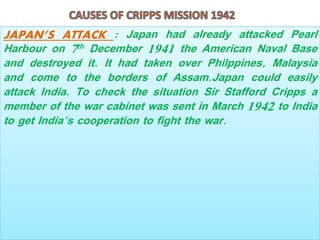
JAPAN’S ATTACK : Japan had already attacked Pearl
Harbour on 7th December 1941 the American Naval Base
and destroyed it. It had taken over Philppines, Malaysia
and come to the borders of Assam.Japan could easily
attack India. To check the situation Sir Stafford Cripps a
member of the war cabinet was sent in March 1942 to India
to get India’s cooperation to fight the war.
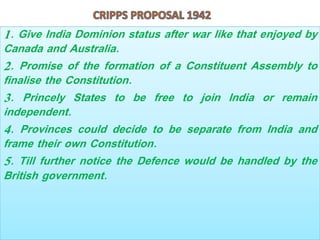
1. Give India Dominion status after war like that enjoyed by
Canada and Australia.
2. Promise of the formation of a Constituent Assembly to
finalise the Constitution.
3. Princely States to be free to join India or remain
independent.
4. Provinces could decide to be separate from India and
frame their own Constitution.
5. Till further notice the Defence would be handled by the
British government.
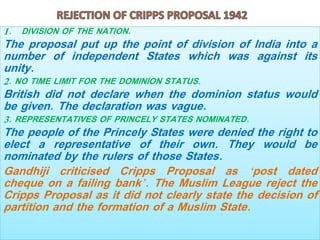
1. DIVISION OF THE NATION.
The proposal put up the point of division of India into a
number of independent States which was against its
unity.
2. NO TIME LIMIT FOR THE DOMINION STATUS.
British did not declare when the dominion status would
be given. The declaration was vague.
3. REPRESENTATIVES OF PRINCELY STATES NOMINATED.
The people of the Princely States were denied the right to
elect a representative of their own. They would be
nominated by the rulers of those States.
Gandhiji criticised Cripps Proposal as ‘post dated
cheque on a failing bank’. The Muslim League reject the
Cripps Proposal as it did not clearly state the decision of
partition and the formation of a Muslim State.

Cripps mission

  • 1.
    JAPAN’S ATTACK :Japan had already attacked Pearl Harbour on 7th December 1941 the American Naval Base and destroyed it. It had taken over Philppines, Malaysia and come to the borders of Assam.Japan could easily attack India. To check the situation Sir Stafford Cripps a member of the war cabinet was sent in March 1942 to India to get India’s cooperation to fight the war.
  • 2.
    1. Give IndiaDominion status after war like that enjoyed by Canada and Australia. 2. Promise of the formation of a Constituent Assembly to finalise the Constitution. 3. Princely States to be free to join India or remain independent. 4. Provinces could decide to be separate from India and frame their own Constitution. 5. Till further notice the Defence would be handled by the British government.
  • 3.
    1. DIVISION OFTHE NATION. The proposal put up the point of division of India into a number of independent States which was against its unity. 2. NO TIME LIMIT FOR THE DOMINION STATUS. British did not declare when the dominion status would be given. The declaration was vague. 3. REPRESENTATIVES OF PRINCELY STATES NOMINATED. The people of the Princely States were denied the right to elect a representative of their own. They would be nominated by the rulers of those States. Gandhiji criticised Cripps Proposal as ‘post dated cheque on a failing bank’. The Muslim League reject the Cripps Proposal as it did not clearly state the decision of partition and the formation of a Muslim State.