FOUNDATION OF ALL INDIA MUSLIM
LEAGUE:
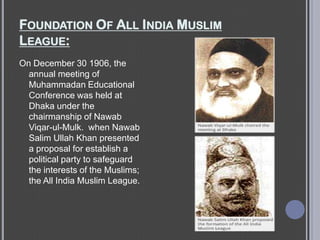
On December 30 1906, the
annual meeting of
Muhammadan Educational
Conference was held at
Dhaka under the
chairmanship of Nawab
Viqar-ul-Mulk. when Nawab
Salim Ullah Khan presented
a proposal for establish a
political party to safeguard
the interests of the Muslims;
the All India Muslim League.
FOUNDATION OF ALL INDIA MUSLIM
LEAGUE:
Sir Muhammad Shafi suggest
the name of party “ALL
INDIA MUSLIM LEAGUE”.
Salim Ullah Khan wanted to
suggest the name “ALL
INDIA MUSLIM
CONFEDERATION”.
Nawab Waqar-ul-Malik and
Nawab Mohsin-ul-Malik was
the first joint secretery of
ALL INDIA MUSLIM
LEAGUE.
SIR MIAN MUHAMMAD
SHAFI
NAWAB MOHSIN-
UL-MALIK
OBJECTIVE OF ALL INDIA MUSLIM
LEAGUE:
 To inculcate among Muslims a feeling of loyalty to
the government and to disabuse their minds of
misunderstandings and misconceptions of its
actions and intentions.
 To protect and advance the political rights and
interests of the Muslims of India and to represent
their needs and aspirations to the government from
time to time.
 To prevent the growth of ill will between Muslims
and other nationalities without compromising to it‟s
own purposes.
CONFERENCES OF ALL INDIA MUSLIM
LEAGUE:
Fisrt conference of ALL INDIA MUSLIM LEAGUE was held
in KARACHI in 30 december 1907 in the chairmanship
of Sir Adamjee Peer Bhai.
Second conference of ALL INDIA MUSLIM LEAGUE was
held ALIGARH in 18 march 1908 in the chairmanship of
Justice Shadeen
“Sir Aga Khan was appointed the first Honorary President
of the Muslim League.”
“ Major Syed Ali Hasan Bilgirami was appointed the first
secretery of Muslim League.”
“Syed Ameer Ali open Muslim League Branch in LONDON
1908”.
“QUAID-E-AZAM joined the muslim league in 1913”.
ALL INDIA MUSLIM LEAGUE EVENTS:
 Minto Marley Reforms1909
 Lucknow Pact 1916
 Simon Commision 1927
 Muhammad Ali Jinnah‟s 14 points 1929
 Allama Iqbal Address 1930
 Pakistan Resolution 1940
 Crips Mission 1942
 General Election 1945-1946
 Cabinet Mission 1946
 3rd June Plan 1947
MINTO MARLEY REFORMS 1909:
The Act of 1909 was important for the following
reasons:
 It effectively allowed the election of Indians to the
various legislative councils in India for the first time.
Previously some Indians had been appointed to
legislative councils. The majorities of the councils
remained British government appointments.
Moreover the electorate was limited to specific
classes of Indian nationals;
 The introduction of the electoral principle laid the
groundwork for a parliamentary system even
though this was contrary to the intent of Morley.
LUCKNOW PACT 1916:
When the All-India Muslim League came into existence, it
was a moderate organization with its basic aim to
establish friendly relations with the Crown. However,
due to the decision of the British government to annul
the partition of Bengal, the Muslim leadership decided to
change its stance. In 1913, a new group of Muslim
leaders entered the folds of the Muslim League with the
aim of bridging the gulf between Muslims and Hindus.
The most prominent among them was Muhammad Ali
Jinnah, who was already a member of Indian National
Congress. The Muslim League changed its major
objective and decided to join hands with the Congress in
order to put pressure on the British government. Lord
Chelmsford's invitation for suggestions from the Indian
politicians for post World War I reforms further helped in
the development of the situation.
SIMON COMMISION 1927:
On 26th Novemeber , 1927 a commission was announced by British
Government under the Chairmenship of Sir John Simon . Commission
consisting of 7 members . The commission was charge in the duty of
investigating Indian constitutional Problem and Drop Recommendation
for future action . All members of commission were white people and no
Indian was Present in the commission . There was Negative Responce
of Indians Towards the commission and they received the commission
with slogan " Simon Go Back , Simon Go Back " . Congress and
Muslim League boycott the commission . It was Published in 1930
namely Simon Report . It had 2 Volumes , first deals with Indian problem
and Second Deals with Recommendation and Proposal .
MEMBERS OF THE COMMISSION :
1 . Sir John Simon ( Chairman )
2 . Clement Attlee
3 . Donald Howard
4 . Vernon Hartshorn
5 . George Lane-Fox
6 . Edward Cadogan
7 . Harry Levy - Lawson.
MUHAMMAD ALI JINNAH’S 14 POINT 1929:
 All the people should be aware of their rights all the people have the freedom of religion freedom of sense.
 All cabinets at central or local level should have at least 1/3 Muslim representation.
 All legislatures in the country and other elected bodies shall be constituted on the definite principle of adequate
and effectiverepresentation of minorities in every province without reducing the majority in any province to a
minority or even equality.
 In the Central Legislature, Muslim representation shall not be less than one third.
 Representation of communal groups shall continue to be by means of separate electorate as at present, provided
it shall be open to any community at any time to abandon its separate electorate in favor of a joint electorate.
 Any territorial distribution that might at any time be necessary shall not in any way affect the Muslim majority.
 Full religious liberty, i.e. liberty of belief, worship and observance, propaganda, association and education, shall
be guaranteed to all communities.
 No bill or any resolution or any part thereof shall be passed in any legislature or any other elected body if three-
fourth of the members of any community in that particular body oppose such a bill resolution.
 Sindh should be separated from the Bombay Presidency.
 Reforms should be introduced in the North West Frontier Province (NWFP) and Baluchistan on the same footing
as in the other provinces.
 Provision should be made in the constitution giving Muslims an adequate share, along with the other Indians, in
all the services of the state and in local self-governing bodies having due regard to the requirements of efficiency.
 The constitution should embody adequate safeguards for the protection of Muslim culture and for the protection
and promotion of Muslim education, language, religion, personal laws and Muslim charitable institution and for
their due share in the grants-in-aid given by the state and by local self-governing bodies.
 No cabinet, either central or provincial, should be formed without there being a proportion of at least one-third
Muslim ministers.
 No change shall be made in the constitution by the Central Legislature except with the concurrence of the State's
contribution of the Indian Federation.
ALLAMA IQBAL ADDRESS 1930:
 The Allahabad Address, notable for Conception of Pakistan, was the
Presidential Address by Allama Iqbal to the 25th Session of the All-India Muslim
League on 29 December 1930, at Allahabad, India. Here he presented the idea of
a separate homeland for Indian Muslims which was ultimately realized in the form
of Pakistan."[1] Iqbal was the first person to officially announce the idea for a
separate Muslim nation. He was the pioneer for all the freedom movements.
 “I would like to see the Punjab, North-West Frontier Province, Sind and
Baluchistan amalgamated into a single State. Self-government within the British
Empire, or without the British Empire, the formation of a consolidated North-West
Indian Muslim State appears to me to be the final destiny of the Muslims, at least
of North-West India.”
 “The principle of European democracy cannot be applied to India without
recognizing the fact of communal groups. The Muslim demand for the creation of a
Muslim India within India is, therefore, perfectly justified. The resolution of the All-
Parties Muslim Conference at Delhi is, to my mind, wholly inspired by this noble
ideal of a harmonious whole which, instead of stifling the respective individualities
of its component wholes, affords them chances of fully working out the possibilities
that may be latent in them. And I have no doubt that this House will emphatically
endorse the Muslim demands embodied in this resolution”.
PAKISTAN RESOLUTION 1940:
 The people of Pakistan celebrate the 23rd of March, every year, with great
keenness and interest, to memorialize the most wonderful success of the Muslims
of South Asia who passed the historic Pakistan Resolution on this day at Lahore in
1940. 23 March holds a significant place in the history of Pakistan. To mark this
day in be relevant manner, an Armed Forces Pakistan Day Parade is held every
year in Islamabad. 23 rd March 1940 carries a significant importance in lives of
every Muslims. It was the day when Muslim were recognized as a separate nation
and basis of independent homeland for Muslim was laid in which they can lead
their lives according to the teaching of Islam, follow their culture traditions and own
way of lives.
 23 March In Pakistan History. March 23, 1940 commemorates the passage of
what was originally the „Lahore Resolution‟ (Qarardad i Lahore) and later
became better known as the „Pakistan Resolution’ (Qarardad i Pakistan). If
there is a single most important founding document of Pakistan, it has to be this
Resolution passed at the annual session of the All India Muslim League at its 1940
meeting (22-24 March) at Minto Park (now called Iqbal Park), Lahore (by the way,
what a wonderful idea – for political parties to have annual, open, meaningful,
annual sessions where real decisions are taken in a transparent and democratic
manner!). In 1941, this Lahore (Pakistan) Resolution became part of the Muslim
League constitution and in 1946 it became the basis of the demand for Pakistan.
CRIPS MISSION 1942:
The British government wanted to get the cooperation of the
Indian people in order to deal with the war situation. The
divergence between the two major representative parties of
the country harassed the British government. It found it
difficult to make the war a success without the cooperation of
both the Hindus and the Muslims.
 On March 22, 1942, Britain sent Sir Stafford Cripps with
constitutional proposals.
 The important points of the declaration were as follows:
 General elections in the provinces would be arranged as soon
as the war ended.
 A new Indian dominion, associated with the United Kingdom
would be created.
 Those provinces not joining the dominion could form their own
separate union.
 Minorities were to be protected.
GENERAL ELECTION 1945-1946:
All the political parties took active role in the election
but results of the election, announced at the end of
Dec,1945, showed the existence of two parties, one
Congress and the other Muslim League.
The result was as follows :
the Congress secured 91.3 p.c. of the votes cast in
non-Muhammadan Constituencies and teh Muslim
League secured 85.6 p.c. of the total votes cast in
Muhammadan Constituencies. the final figures
were ;
Congress-57, Muslim League-30, Independents-
5, Akali Sikhs-2, and Europeans- 8, making a total
of 102 elected seats.
CABINET MISSION 1946:
When the Cabinet mission arrived in Delhi in March, it had
three members, Cripps, A.V. Alexander and Pethick-
Lawrence. They would work in close conjunction with
the Viceroy who was assured that it was not intended
that he should be treated as a lay figure.
 The Mission's task was to try to bring the leaders of the
principle Indian political parties to agreement on two
matters:
 The method of framing a constitution for a self-
governing, independent India
 The setting up of a new Executive Council or interim
government that would hold office while the constitution
was being hammered out.
3RD JUNE PLAN 1947:
Lord Mountbatten became the viceroy of India in
March 1947. He tried his best to keep India United
but of no avail. He concluded that there was no
solution to Indian problems except partition of it.
3rd June Plan and the Creation of Pakistan
On 3rd June 1947 the viceroy announced the
partition plan in a joint conference of Congress and
Muslim League leaders in Delhi. The plan came to
be known as 3rd June Plan.
14TH AUGUST 1947 AND MUSLIM
LEAGUE:
Independence Day: 14 August 1947 is unforgettable
day in the history of Pakistan because on this day,
Muslims people ofthe Subcontinent got Azadi
from British Raj and get independent country
“Pakistan”. Now in Pakistan they can live without
any interference of the British and Hindus. This
independence movement was started after the
revolution in the subcontinent caused by the
disturbances and the fight between the Hindus and
the Muslims. This was the big opportunity for the
Muslims of the sub continent to get their separate
country. While British government looks the
situation of the subcontinent they feel that there is
no way in the subcontinent that the Hindus and the
Muslims live together with peace so they decided
that the area where Muslims are in Majority gives
to the Muslims, Same in the case of the Hindus. In
1940, resolution was passed in Lahore called
Lahore resolution but Hindi newspapers called this
resolution as the Pakistan resolution.
Pak STUDIES

Pak STUDIES

  • 3.
    FOUNDATION OF ALLINDIA MUSLIM LEAGUE: On December 30 1906, the annual meeting of Muhammadan Educational Conference was held at Dhaka under the chairmanship of Nawab Viqar-ul-Mulk. when Nawab Salim Ullah Khan presented a proposal for establish a political party to safeguard the interests of the Muslims; the All India Muslim League.
  • 4.
    FOUNDATION OF ALLINDIA MUSLIM LEAGUE: Sir Muhammad Shafi suggest the name of party “ALL INDIA MUSLIM LEAGUE”. Salim Ullah Khan wanted to suggest the name “ALL INDIA MUSLIM CONFEDERATION”. Nawab Waqar-ul-Malik and Nawab Mohsin-ul-Malik was the first joint secretery of ALL INDIA MUSLIM LEAGUE. SIR MIAN MUHAMMAD SHAFI NAWAB MOHSIN- UL-MALIK
  • 5.
    OBJECTIVE OF ALLINDIA MUSLIM LEAGUE:  To inculcate among Muslims a feeling of loyalty to the government and to disabuse their minds of misunderstandings and misconceptions of its actions and intentions.  To protect and advance the political rights and interests of the Muslims of India and to represent their needs and aspirations to the government from time to time.  To prevent the growth of ill will between Muslims and other nationalities without compromising to it‟s own purposes.
  • 6.
    CONFERENCES OF ALLINDIA MUSLIM LEAGUE: Fisrt conference of ALL INDIA MUSLIM LEAGUE was held in KARACHI in 30 december 1907 in the chairmanship of Sir Adamjee Peer Bhai. Second conference of ALL INDIA MUSLIM LEAGUE was held ALIGARH in 18 march 1908 in the chairmanship of Justice Shadeen “Sir Aga Khan was appointed the first Honorary President of the Muslim League.” “ Major Syed Ali Hasan Bilgirami was appointed the first secretery of Muslim League.” “Syed Ameer Ali open Muslim League Branch in LONDON 1908”. “QUAID-E-AZAM joined the muslim league in 1913”.
  • 7.
    ALL INDIA MUSLIMLEAGUE EVENTS:  Minto Marley Reforms1909  Lucknow Pact 1916  Simon Commision 1927  Muhammad Ali Jinnah‟s 14 points 1929  Allama Iqbal Address 1930  Pakistan Resolution 1940  Crips Mission 1942  General Election 1945-1946  Cabinet Mission 1946  3rd June Plan 1947
  • 8.
    MINTO MARLEY REFORMS1909: The Act of 1909 was important for the following reasons:  It effectively allowed the election of Indians to the various legislative councils in India for the first time. Previously some Indians had been appointed to legislative councils. The majorities of the councils remained British government appointments. Moreover the electorate was limited to specific classes of Indian nationals;  The introduction of the electoral principle laid the groundwork for a parliamentary system even though this was contrary to the intent of Morley.
  • 9.
    LUCKNOW PACT 1916: Whenthe All-India Muslim League came into existence, it was a moderate organization with its basic aim to establish friendly relations with the Crown. However, due to the decision of the British government to annul the partition of Bengal, the Muslim leadership decided to change its stance. In 1913, a new group of Muslim leaders entered the folds of the Muslim League with the aim of bridging the gulf between Muslims and Hindus. The most prominent among them was Muhammad Ali Jinnah, who was already a member of Indian National Congress. The Muslim League changed its major objective and decided to join hands with the Congress in order to put pressure on the British government. Lord Chelmsford's invitation for suggestions from the Indian politicians for post World War I reforms further helped in the development of the situation.
  • 10.
    SIMON COMMISION 1927: On26th Novemeber , 1927 a commission was announced by British Government under the Chairmenship of Sir John Simon . Commission consisting of 7 members . The commission was charge in the duty of investigating Indian constitutional Problem and Drop Recommendation for future action . All members of commission were white people and no Indian was Present in the commission . There was Negative Responce of Indians Towards the commission and they received the commission with slogan " Simon Go Back , Simon Go Back " . Congress and Muslim League boycott the commission . It was Published in 1930 namely Simon Report . It had 2 Volumes , first deals with Indian problem and Second Deals with Recommendation and Proposal . MEMBERS OF THE COMMISSION : 1 . Sir John Simon ( Chairman ) 2 . Clement Attlee 3 . Donald Howard 4 . Vernon Hartshorn 5 . George Lane-Fox 6 . Edward Cadogan 7 . Harry Levy - Lawson.
  • 11.
    MUHAMMAD ALI JINNAH’S14 POINT 1929:  All the people should be aware of their rights all the people have the freedom of religion freedom of sense.  All cabinets at central or local level should have at least 1/3 Muslim representation.  All legislatures in the country and other elected bodies shall be constituted on the definite principle of adequate and effectiverepresentation of minorities in every province without reducing the majority in any province to a minority or even equality.  In the Central Legislature, Muslim representation shall not be less than one third.  Representation of communal groups shall continue to be by means of separate electorate as at present, provided it shall be open to any community at any time to abandon its separate electorate in favor of a joint electorate.  Any territorial distribution that might at any time be necessary shall not in any way affect the Muslim majority.  Full religious liberty, i.e. liberty of belief, worship and observance, propaganda, association and education, shall be guaranteed to all communities.  No bill or any resolution or any part thereof shall be passed in any legislature or any other elected body if three- fourth of the members of any community in that particular body oppose such a bill resolution.  Sindh should be separated from the Bombay Presidency.  Reforms should be introduced in the North West Frontier Province (NWFP) and Baluchistan on the same footing as in the other provinces.  Provision should be made in the constitution giving Muslims an adequate share, along with the other Indians, in all the services of the state and in local self-governing bodies having due regard to the requirements of efficiency.  The constitution should embody adequate safeguards for the protection of Muslim culture and for the protection and promotion of Muslim education, language, religion, personal laws and Muslim charitable institution and for their due share in the grants-in-aid given by the state and by local self-governing bodies.  No cabinet, either central or provincial, should be formed without there being a proportion of at least one-third Muslim ministers.  No change shall be made in the constitution by the Central Legislature except with the concurrence of the State's contribution of the Indian Federation.
  • 12.
    ALLAMA IQBAL ADDRESS1930:  The Allahabad Address, notable for Conception of Pakistan, was the Presidential Address by Allama Iqbal to the 25th Session of the All-India Muslim League on 29 December 1930, at Allahabad, India. Here he presented the idea of a separate homeland for Indian Muslims which was ultimately realized in the form of Pakistan."[1] Iqbal was the first person to officially announce the idea for a separate Muslim nation. He was the pioneer for all the freedom movements.  “I would like to see the Punjab, North-West Frontier Province, Sind and Baluchistan amalgamated into a single State. Self-government within the British Empire, or without the British Empire, the formation of a consolidated North-West Indian Muslim State appears to me to be the final destiny of the Muslims, at least of North-West India.”  “The principle of European democracy cannot be applied to India without recognizing the fact of communal groups. The Muslim demand for the creation of a Muslim India within India is, therefore, perfectly justified. The resolution of the All- Parties Muslim Conference at Delhi is, to my mind, wholly inspired by this noble ideal of a harmonious whole which, instead of stifling the respective individualities of its component wholes, affords them chances of fully working out the possibilities that may be latent in them. And I have no doubt that this House will emphatically endorse the Muslim demands embodied in this resolution”.
  • 13.
    PAKISTAN RESOLUTION 1940: The people of Pakistan celebrate the 23rd of March, every year, with great keenness and interest, to memorialize the most wonderful success of the Muslims of South Asia who passed the historic Pakistan Resolution on this day at Lahore in 1940. 23 March holds a significant place in the history of Pakistan. To mark this day in be relevant manner, an Armed Forces Pakistan Day Parade is held every year in Islamabad. 23 rd March 1940 carries a significant importance in lives of every Muslims. It was the day when Muslim were recognized as a separate nation and basis of independent homeland for Muslim was laid in which they can lead their lives according to the teaching of Islam, follow their culture traditions and own way of lives.  23 March In Pakistan History. March 23, 1940 commemorates the passage of what was originally the „Lahore Resolution‟ (Qarardad i Lahore) and later became better known as the „Pakistan Resolution’ (Qarardad i Pakistan). If there is a single most important founding document of Pakistan, it has to be this Resolution passed at the annual session of the All India Muslim League at its 1940 meeting (22-24 March) at Minto Park (now called Iqbal Park), Lahore (by the way, what a wonderful idea – for political parties to have annual, open, meaningful, annual sessions where real decisions are taken in a transparent and democratic manner!). In 1941, this Lahore (Pakistan) Resolution became part of the Muslim League constitution and in 1946 it became the basis of the demand for Pakistan.
  • 14.
    CRIPS MISSION 1942: TheBritish government wanted to get the cooperation of the Indian people in order to deal with the war situation. The divergence between the two major representative parties of the country harassed the British government. It found it difficult to make the war a success without the cooperation of both the Hindus and the Muslims.  On March 22, 1942, Britain sent Sir Stafford Cripps with constitutional proposals.  The important points of the declaration were as follows:  General elections in the provinces would be arranged as soon as the war ended.  A new Indian dominion, associated with the United Kingdom would be created.  Those provinces not joining the dominion could form their own separate union.  Minorities were to be protected.
  • 15.
    GENERAL ELECTION 1945-1946: Allthe political parties took active role in the election but results of the election, announced at the end of Dec,1945, showed the existence of two parties, one Congress and the other Muslim League. The result was as follows : the Congress secured 91.3 p.c. of the votes cast in non-Muhammadan Constituencies and teh Muslim League secured 85.6 p.c. of the total votes cast in Muhammadan Constituencies. the final figures were ; Congress-57, Muslim League-30, Independents- 5, Akali Sikhs-2, and Europeans- 8, making a total of 102 elected seats.
  • 16.
    CABINET MISSION 1946: Whenthe Cabinet mission arrived in Delhi in March, it had three members, Cripps, A.V. Alexander and Pethick- Lawrence. They would work in close conjunction with the Viceroy who was assured that it was not intended that he should be treated as a lay figure.  The Mission's task was to try to bring the leaders of the principle Indian political parties to agreement on two matters:  The method of framing a constitution for a self- governing, independent India  The setting up of a new Executive Council or interim government that would hold office while the constitution was being hammered out.
  • 17.
    3RD JUNE PLAN1947: Lord Mountbatten became the viceroy of India in March 1947. He tried his best to keep India United but of no avail. He concluded that there was no solution to Indian problems except partition of it. 3rd June Plan and the Creation of Pakistan On 3rd June 1947 the viceroy announced the partition plan in a joint conference of Congress and Muslim League leaders in Delhi. The plan came to be known as 3rd June Plan.
  • 18.
    14TH AUGUST 1947AND MUSLIM LEAGUE: Independence Day: 14 August 1947 is unforgettable day in the history of Pakistan because on this day, Muslims people ofthe Subcontinent got Azadi from British Raj and get independent country “Pakistan”. Now in Pakistan they can live without any interference of the British and Hindus. This independence movement was started after the revolution in the subcontinent caused by the disturbances and the fight between the Hindus and the Muslims. This was the big opportunity for the Muslims of the sub continent to get their separate country. While British government looks the situation of the subcontinent they feel that there is no way in the subcontinent that the Hindus and the Muslims live together with peace so they decided that the area where Muslims are in Majority gives to the Muslims, Same in the case of the Hindus. In 1940, resolution was passed in Lahore called Lahore resolution but Hindi newspapers called this resolution as the Pakistan resolution.