
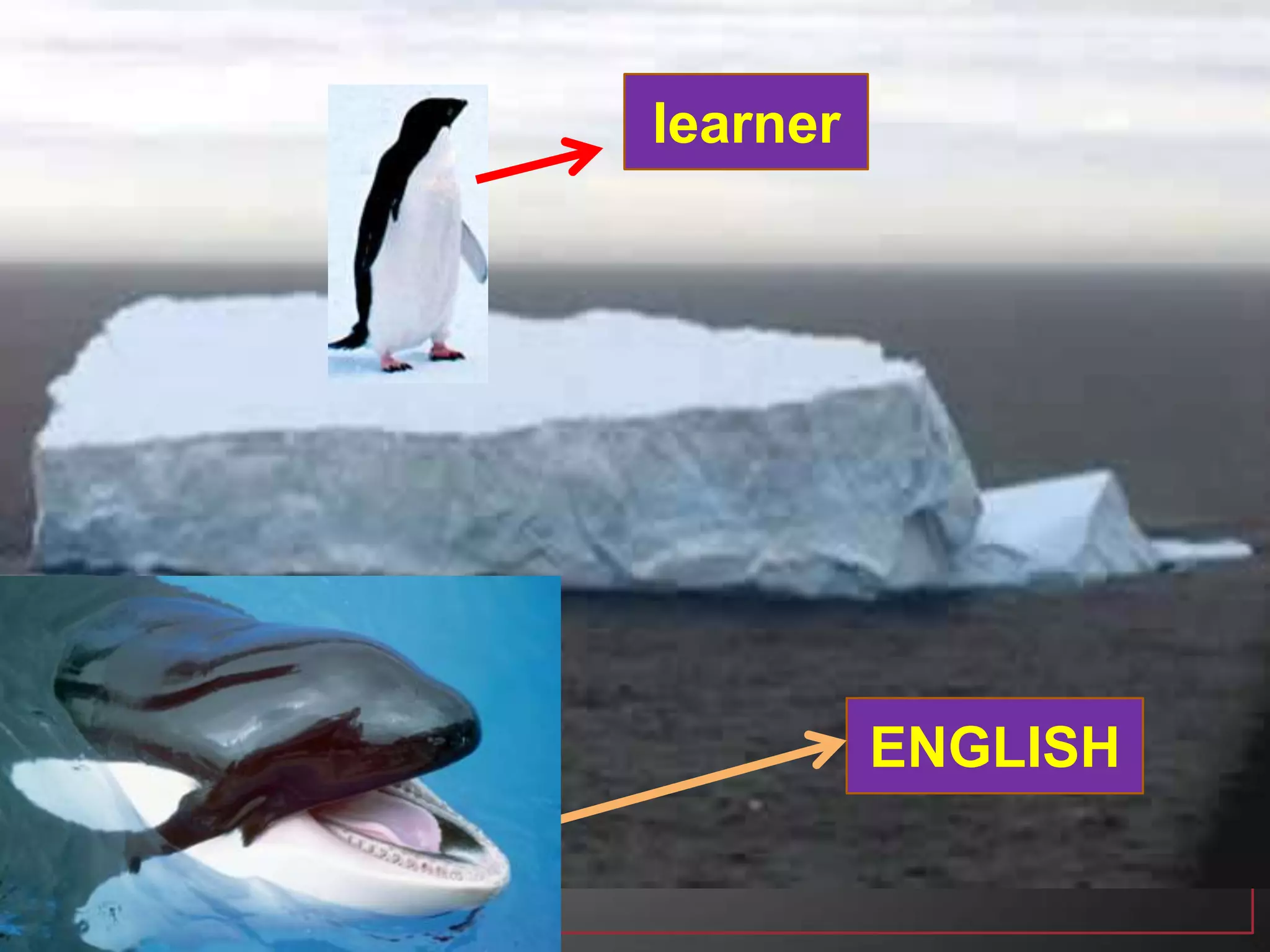






learner
ENGLISH
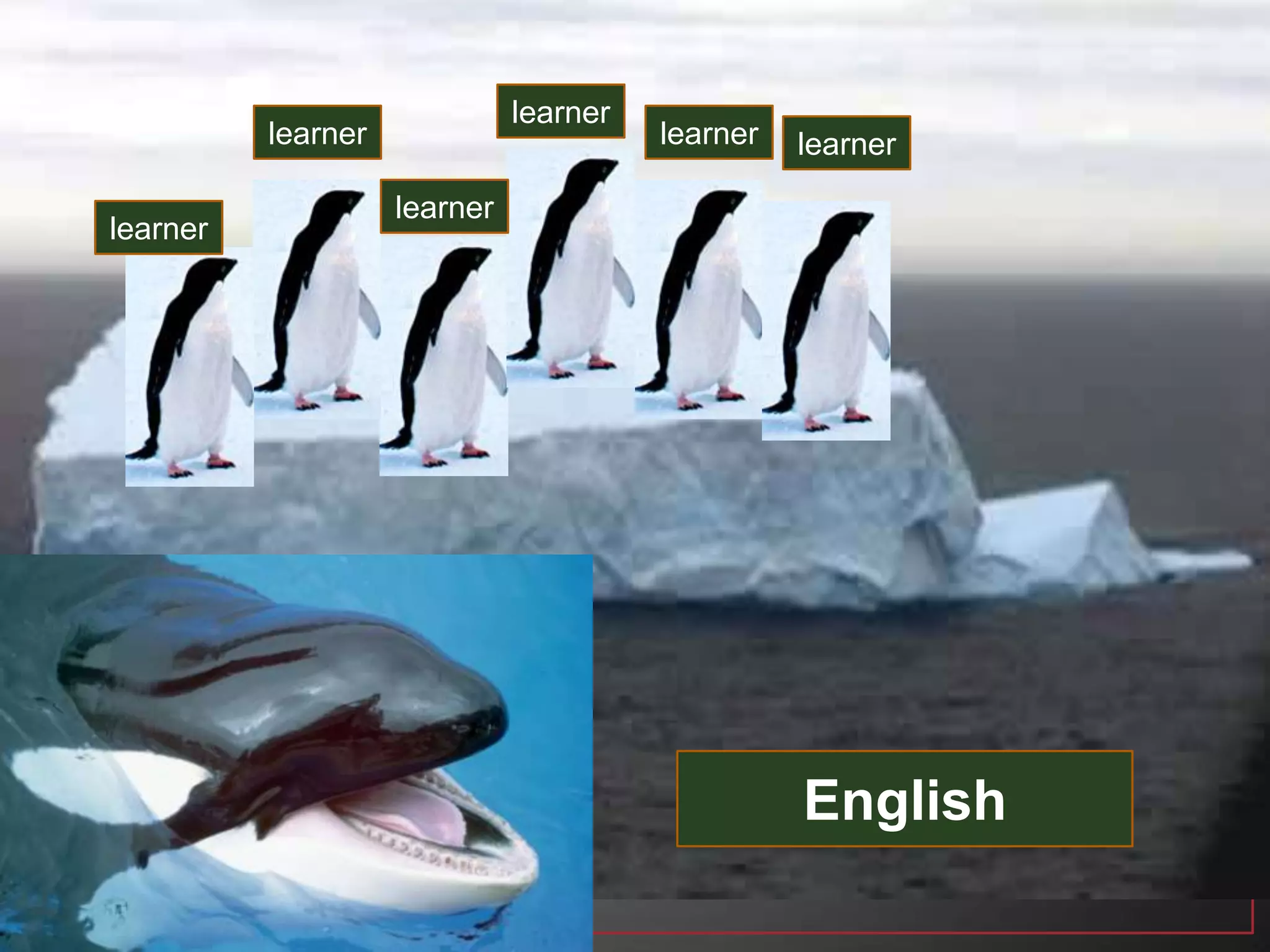
learner
English
learner
learner
learner
learner
learner
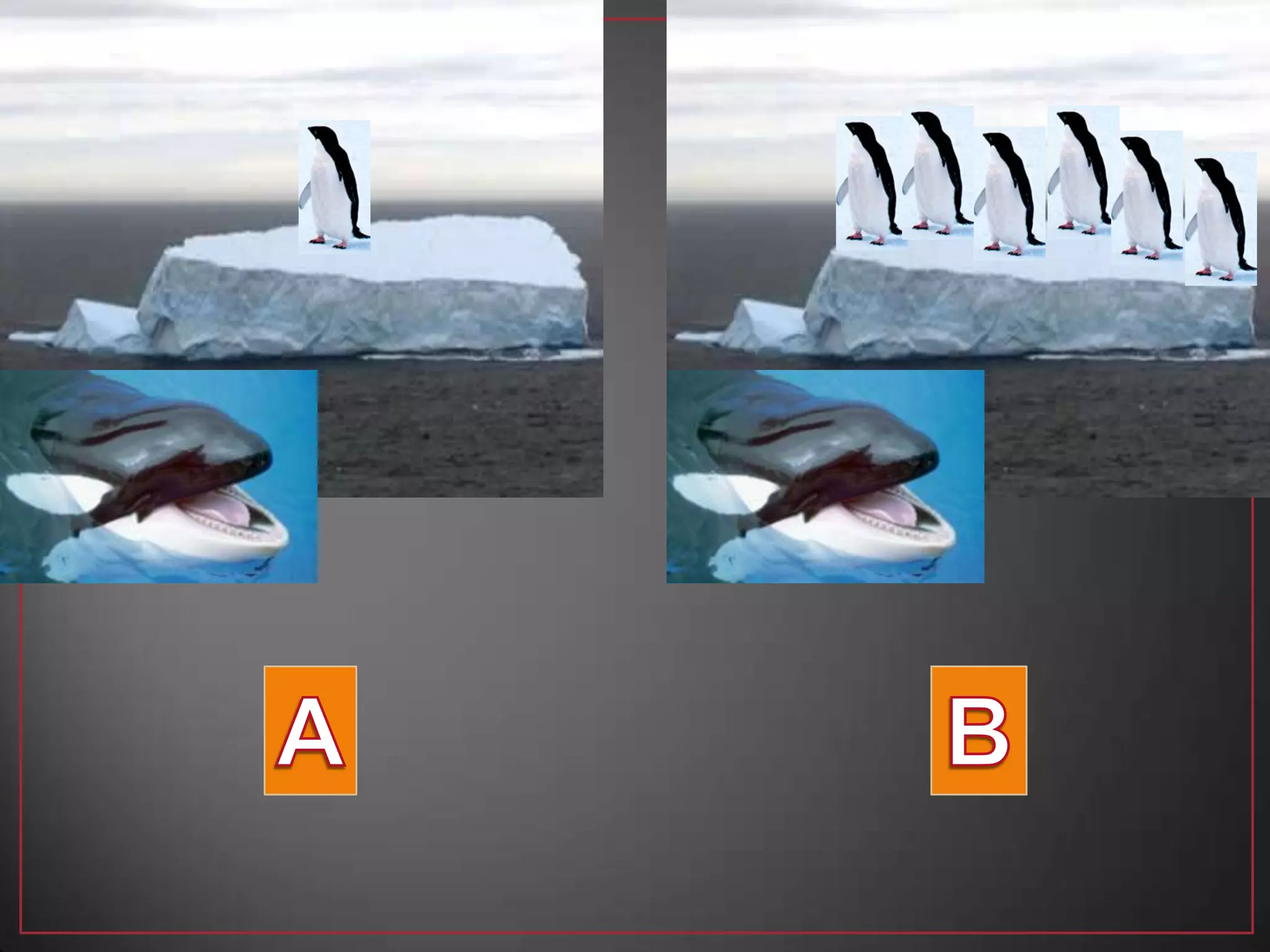
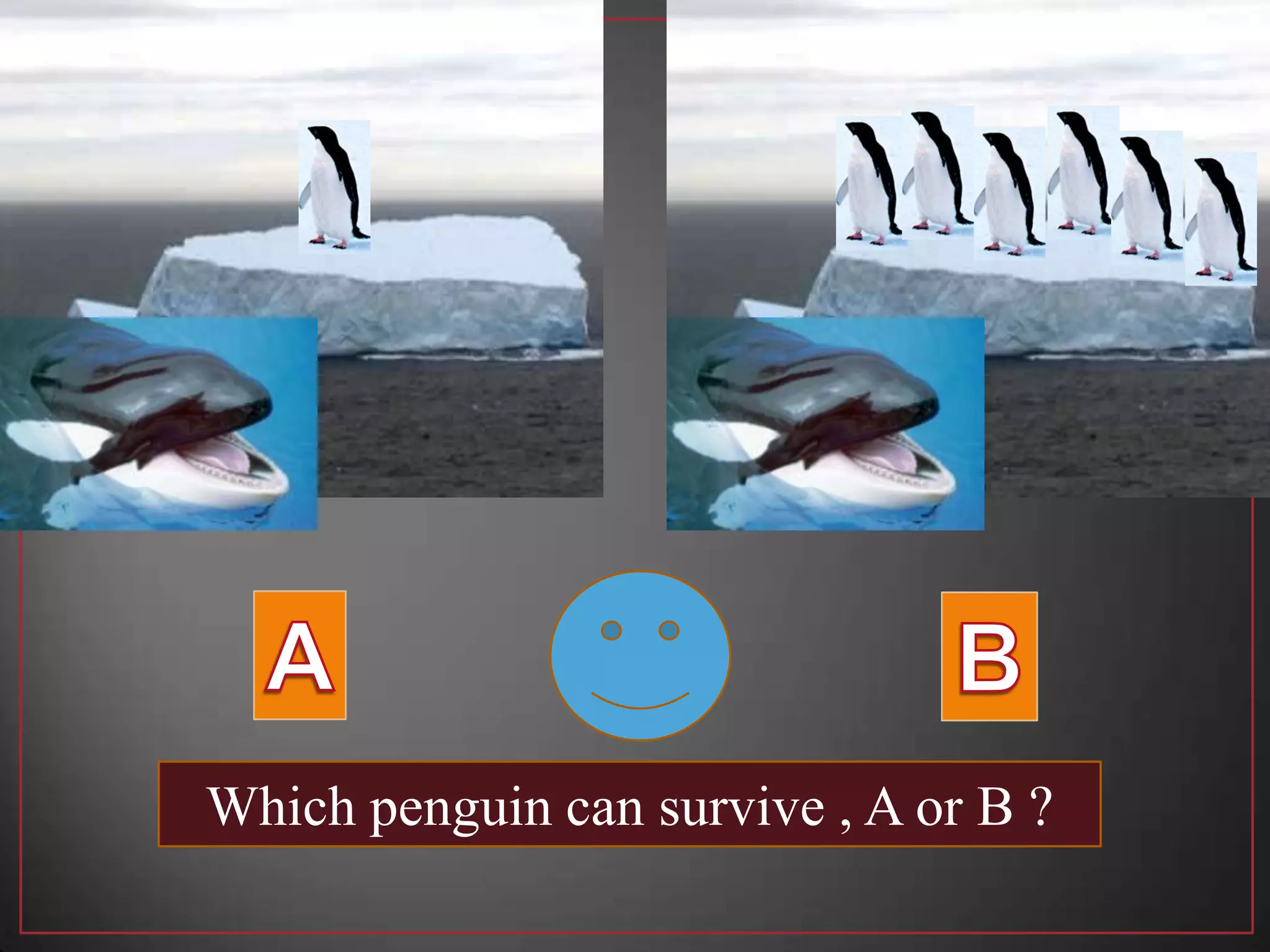
Which penguin can survive , A or B ?
CONTENTS :
-Why need pair and
group work?
-Advantages
-Disadvantages
-How to organize
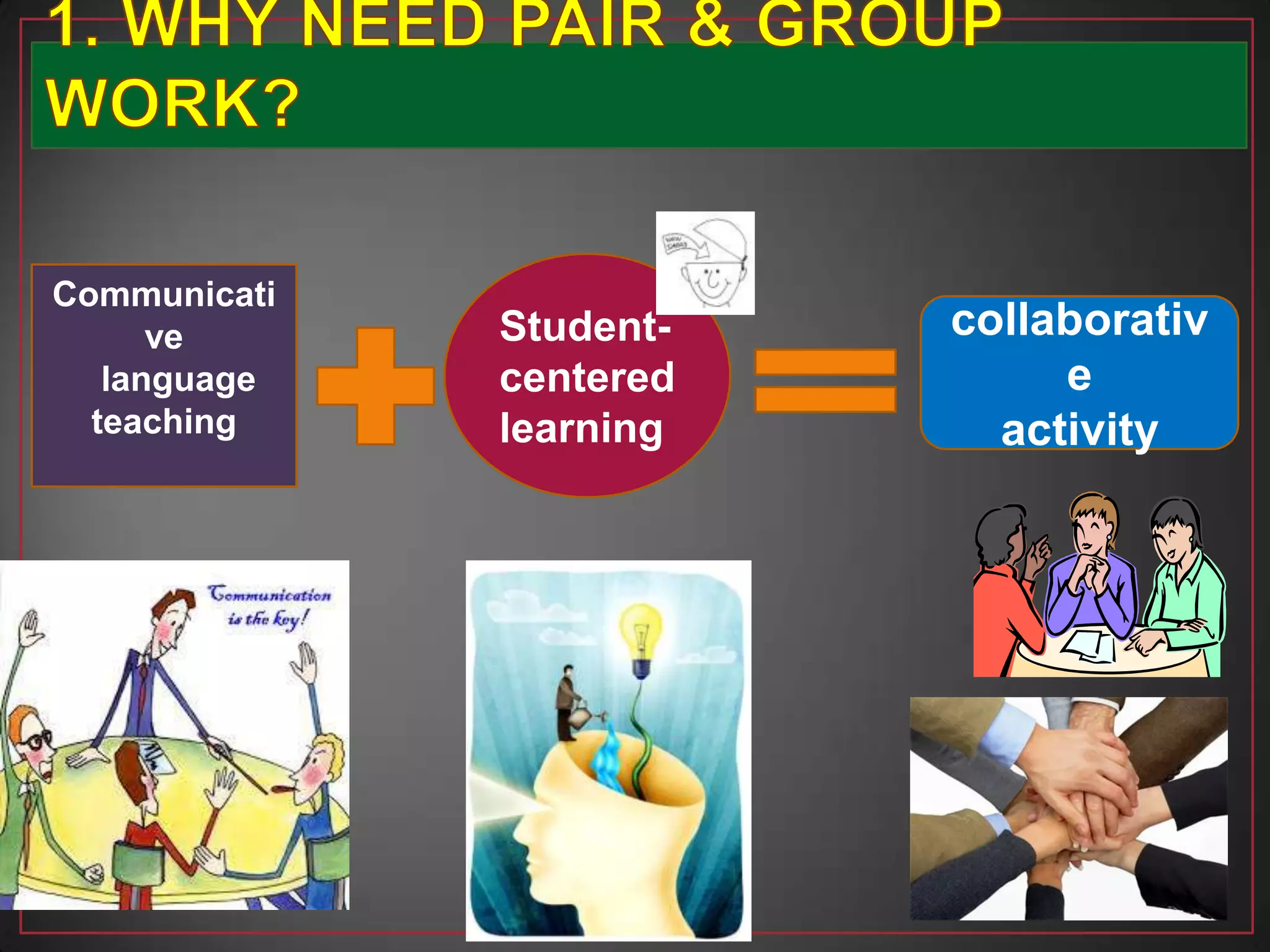
collaborativ
e
activity
Student-
centered
learning
Communicati
ve
language
teaching
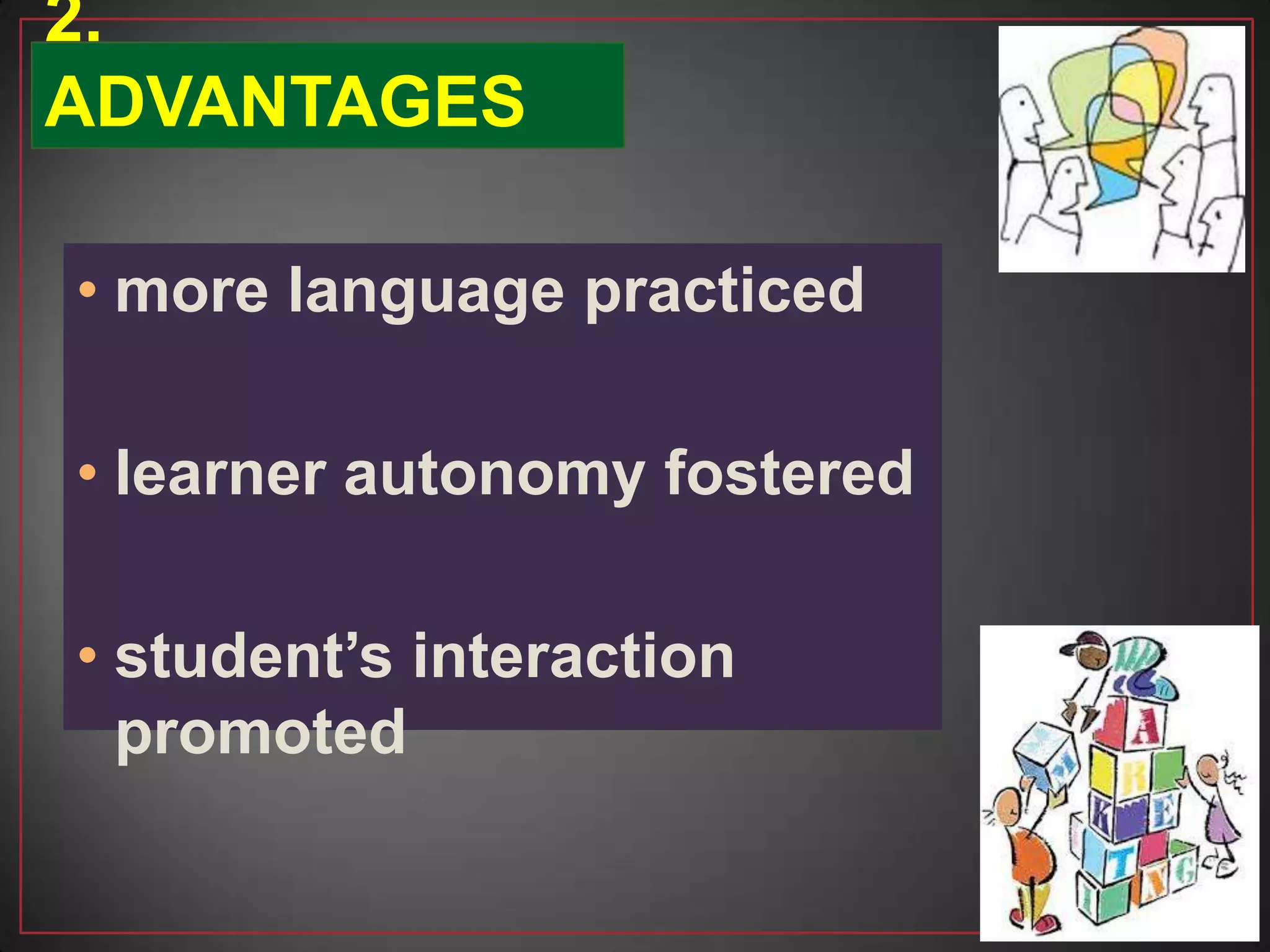
• more language practiced
• learner autonomy fostered
• student’s interaction
promoted
2.
ADVANTAGES
• more language practiced
 students feel more secure
 amount of speaking time
increased
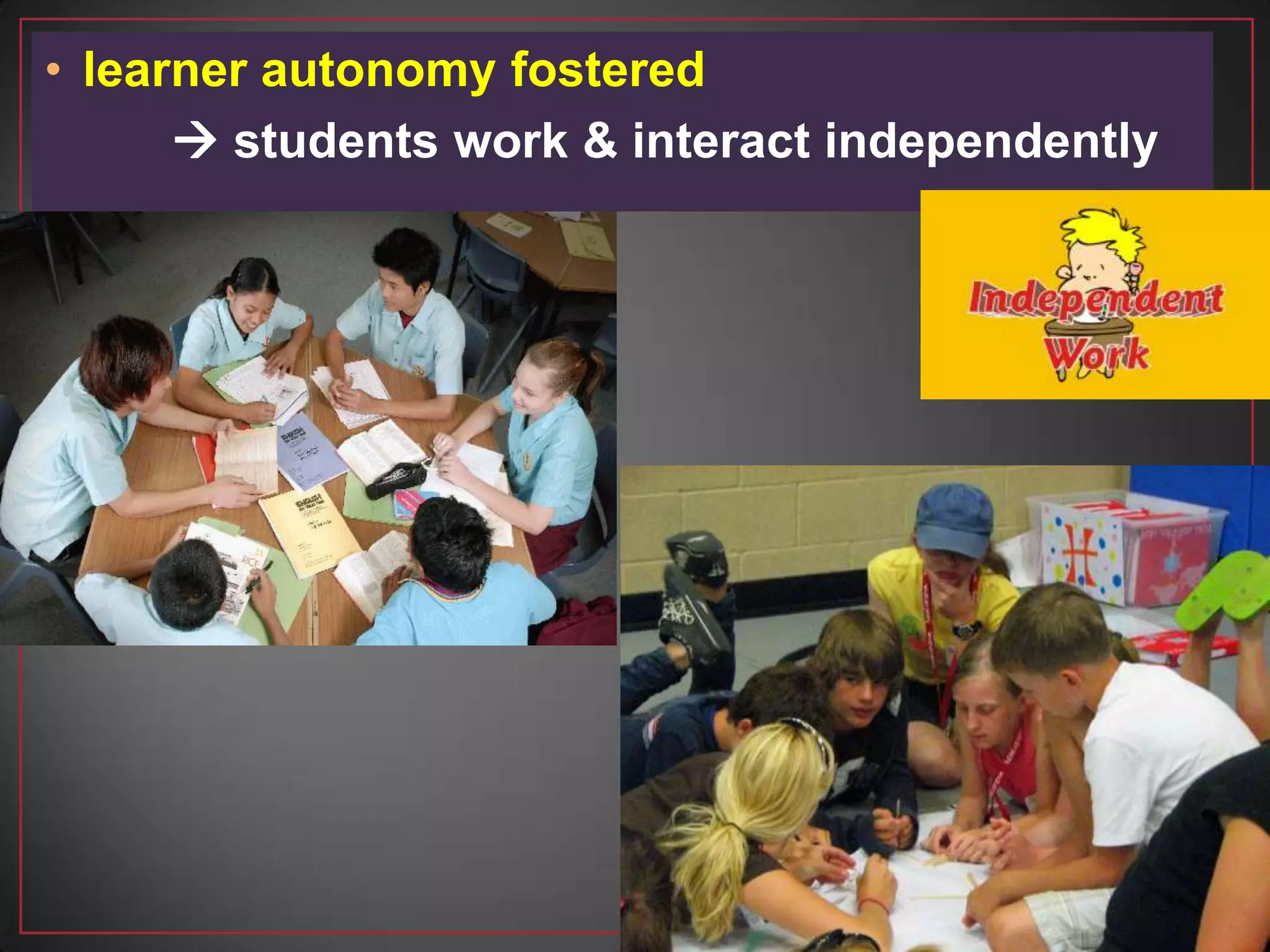
• learner autonomy fostered
 students work & interact independently
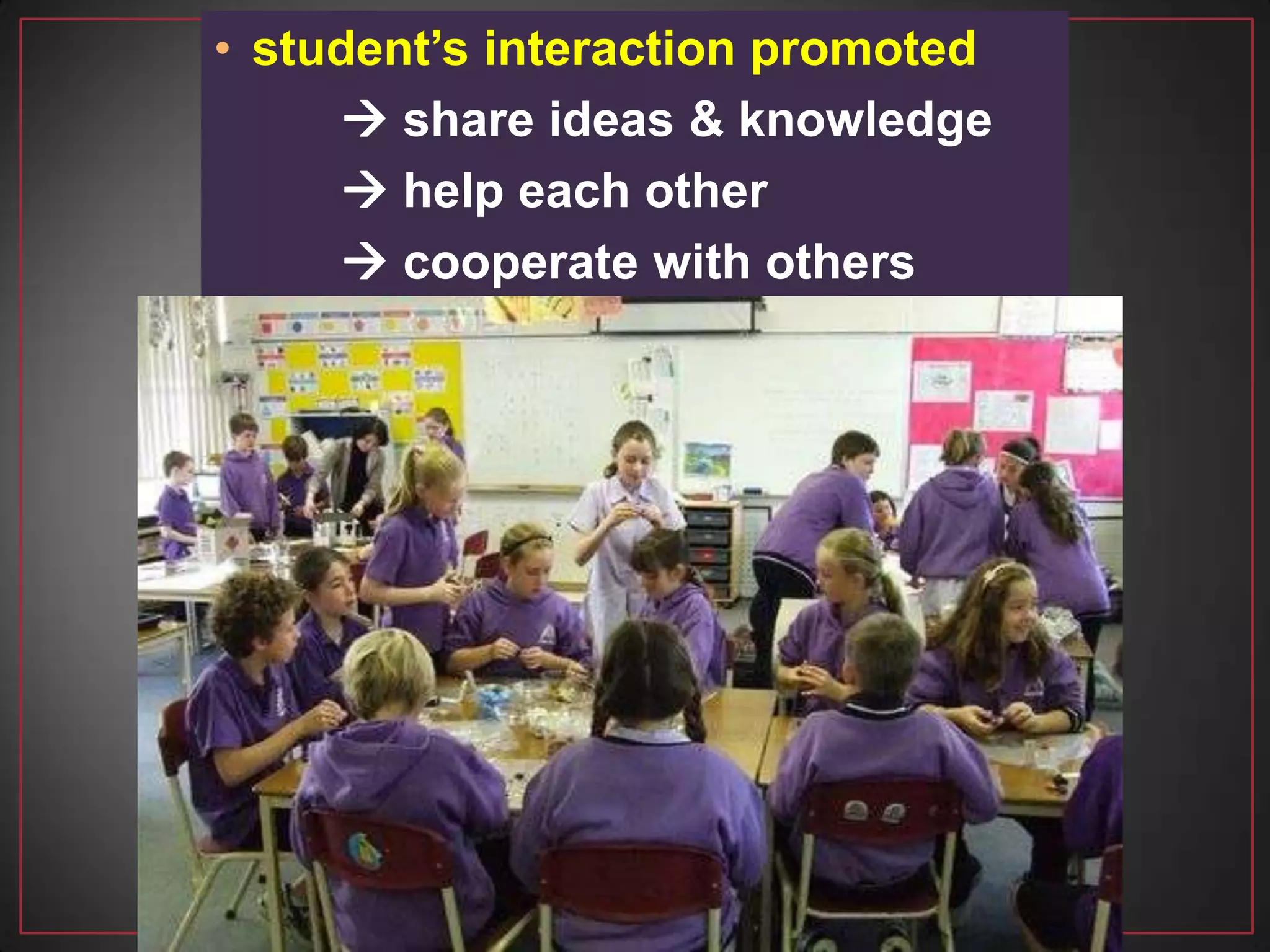
• student’s interaction promoted
 share ideas & knowledge
 help each other
 cooperate with others
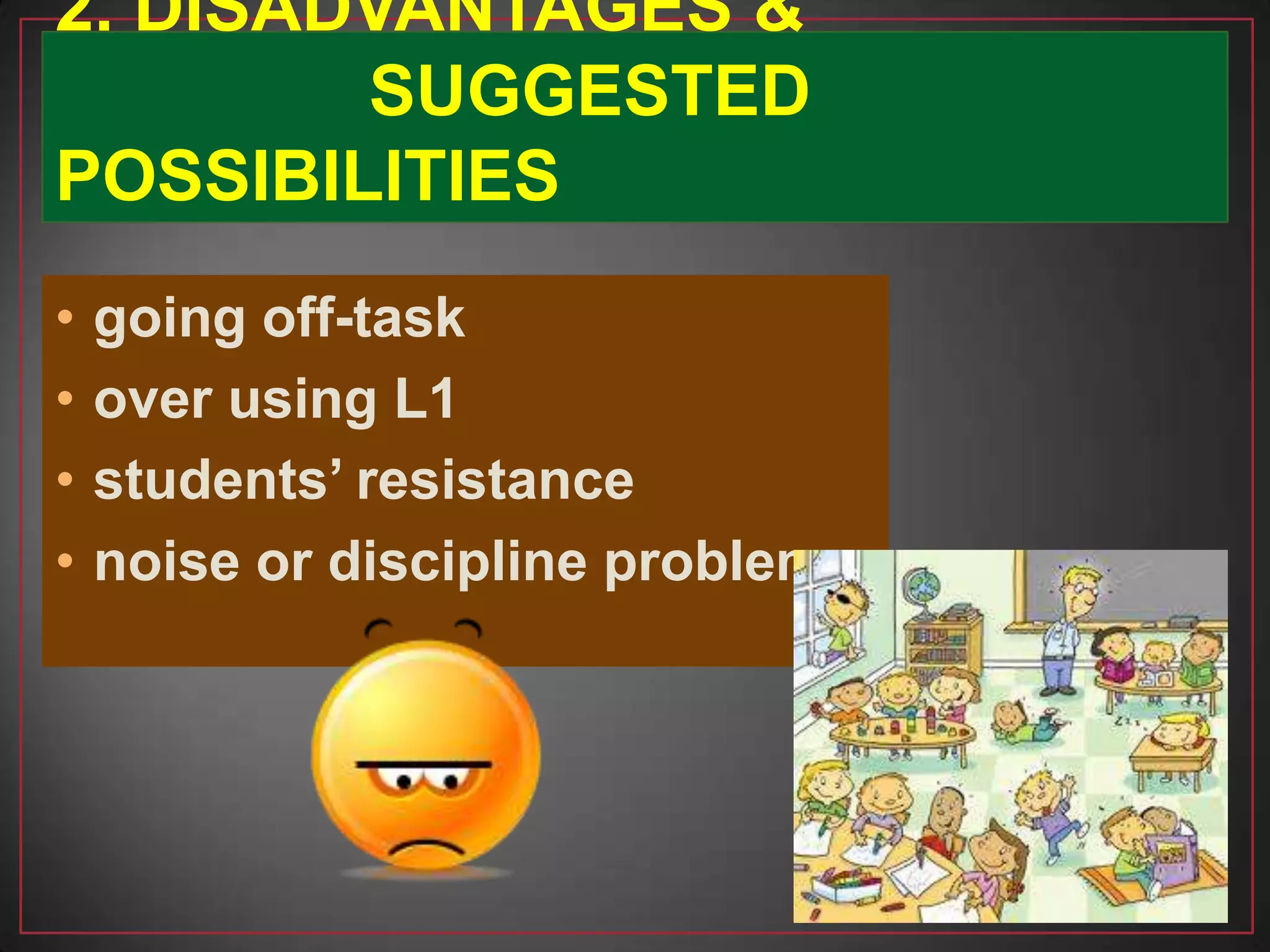
• going off-task
• over using L1
• students’ resistance
• noise or discipline problems
2. DISADVANTAGES &
SUGGESTED
POSSIBILITIES
•friendship
•streaming
•chance
Formation (Hammer 2007)
:
PAIRWORK &
GROUPWORK?
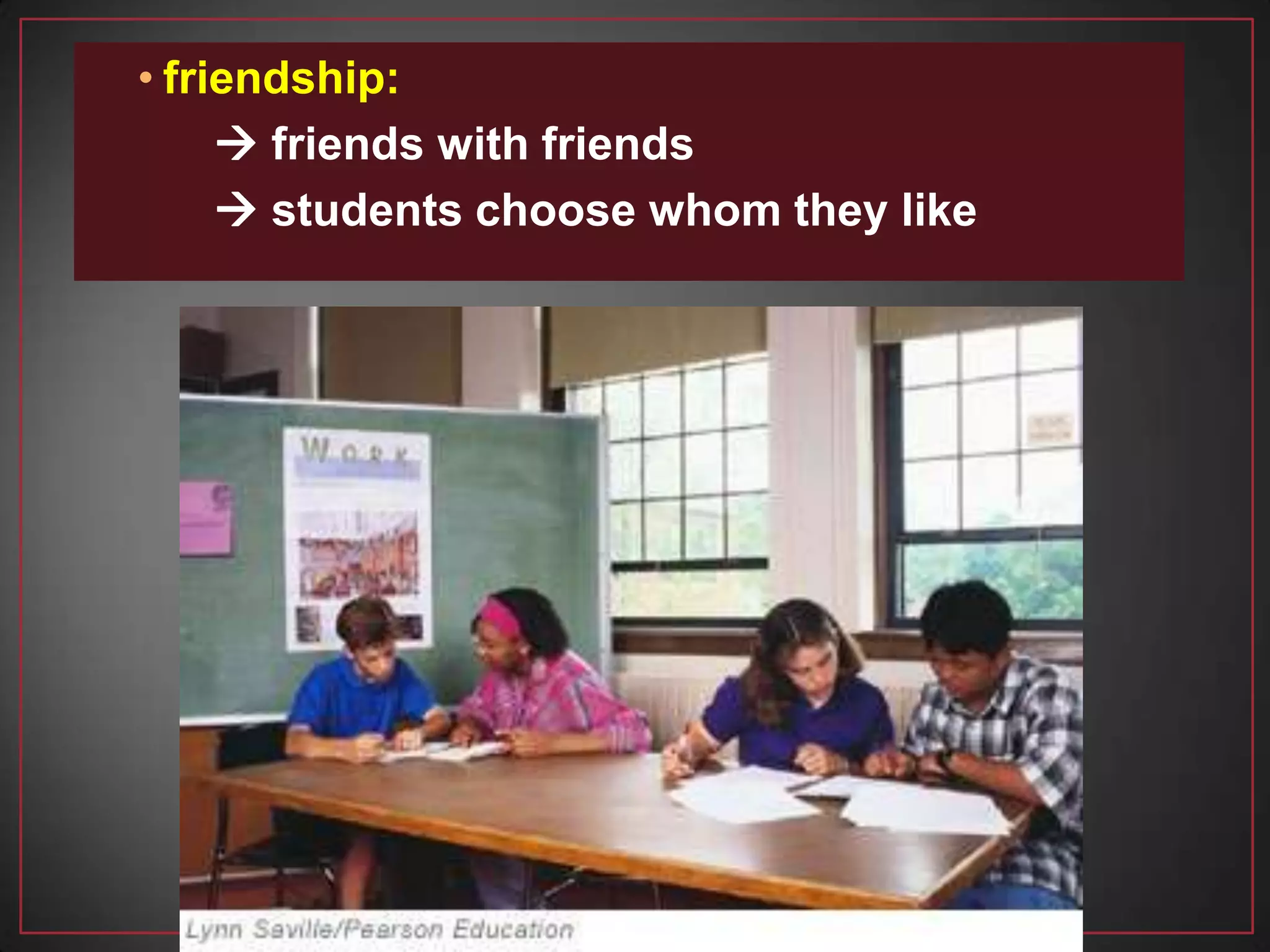
• friendship:
 friends with friends
 students choose whom they like
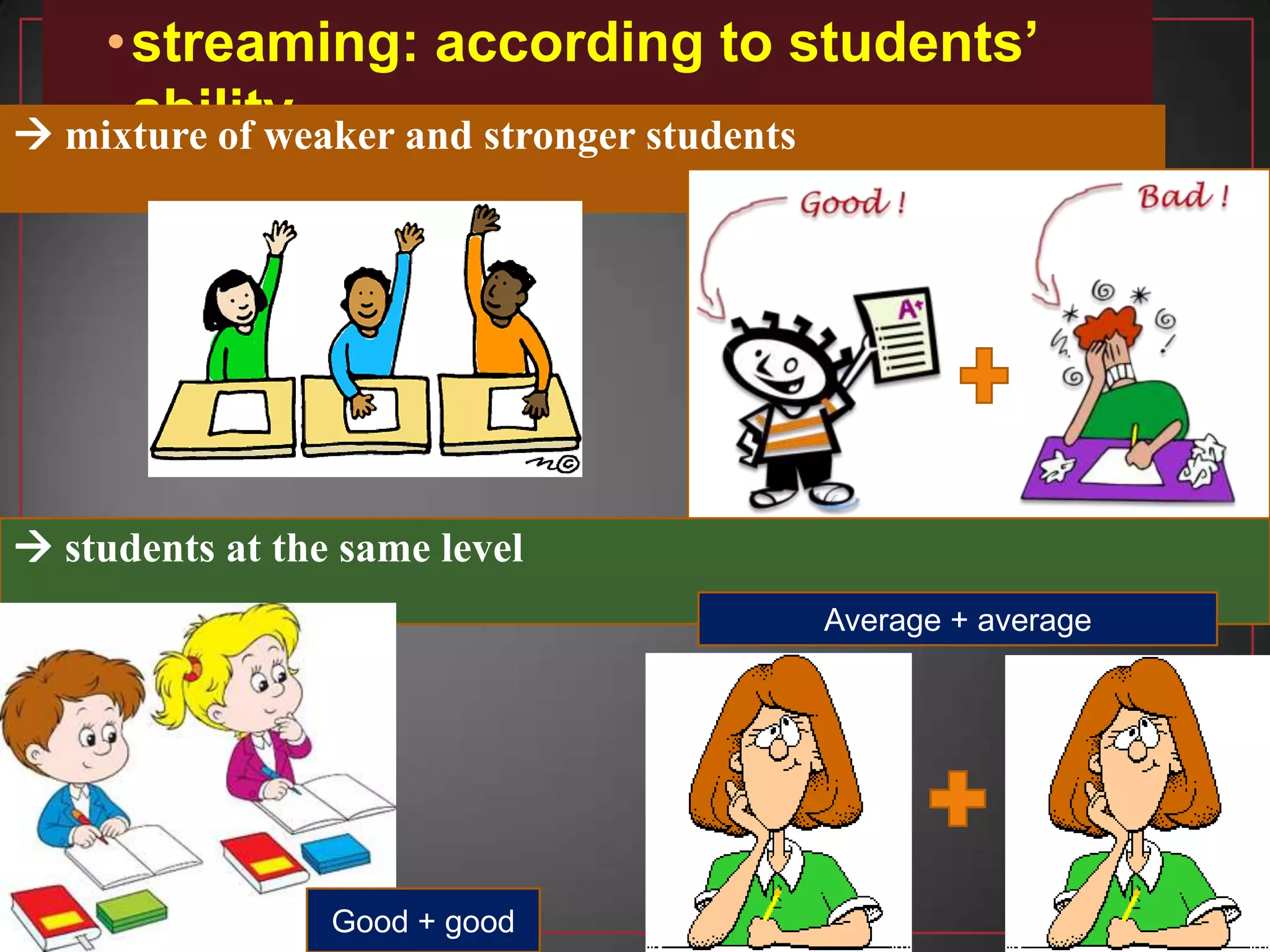
 students at the same level
•streaming: according to students’
ability mixture of weaker and stronger students
Average + average
Good + good
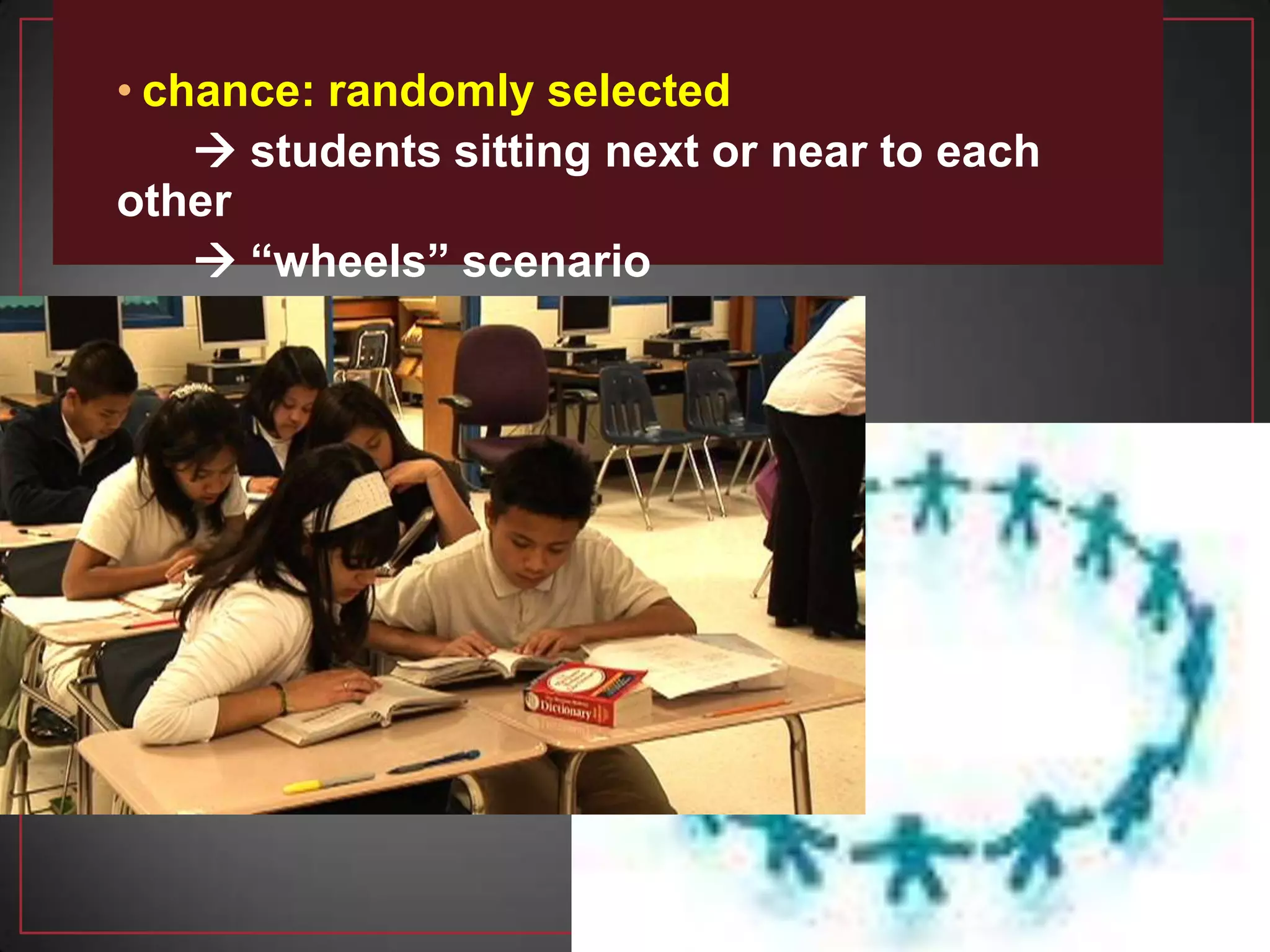
• chance: randomly selected
 students sitting next or near to each
other
 “wheels” scenario
Procedures :
4. HOW TO ORGANIZE PAIR &
GROUPWORK?
Demonstration
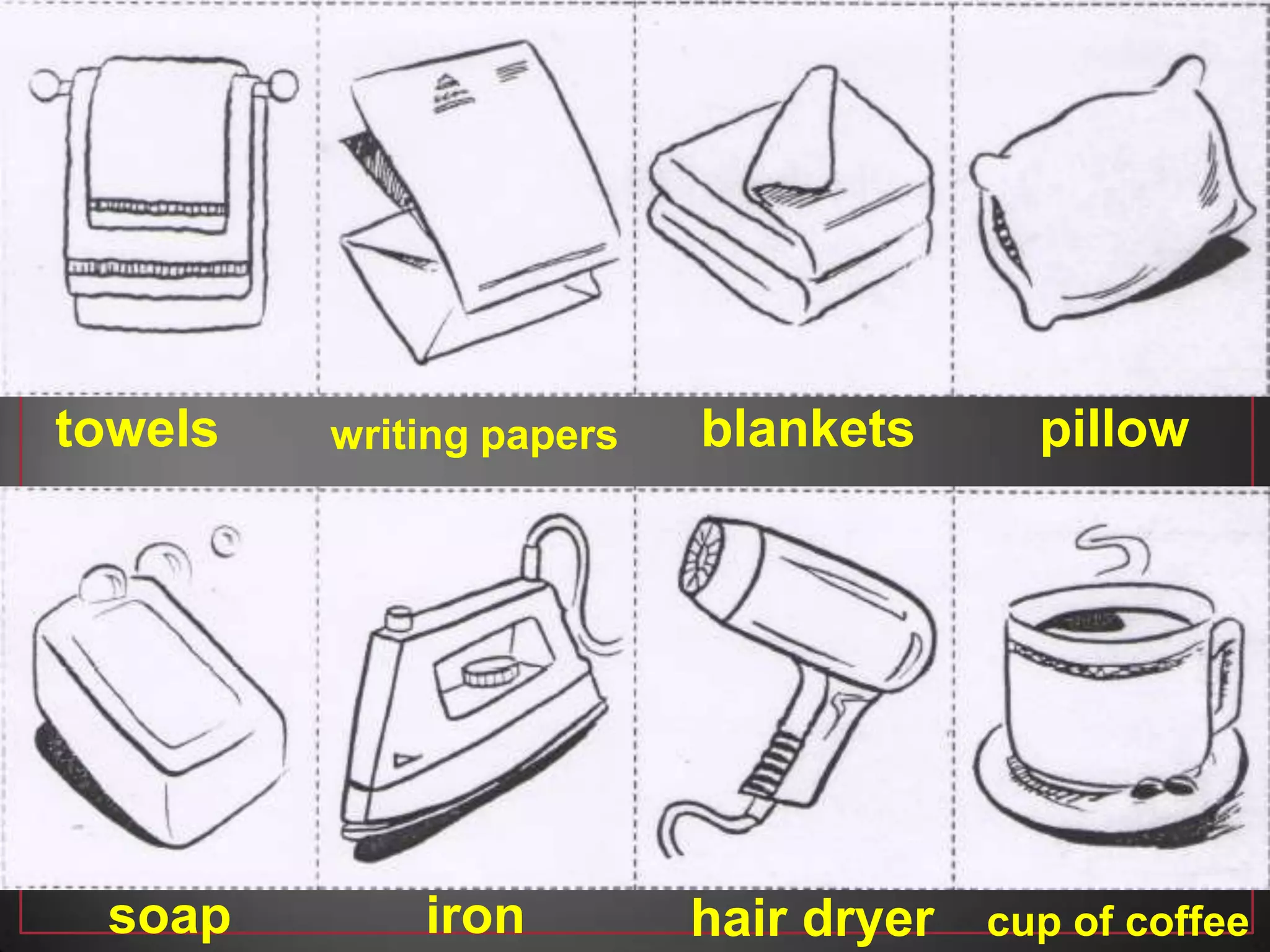
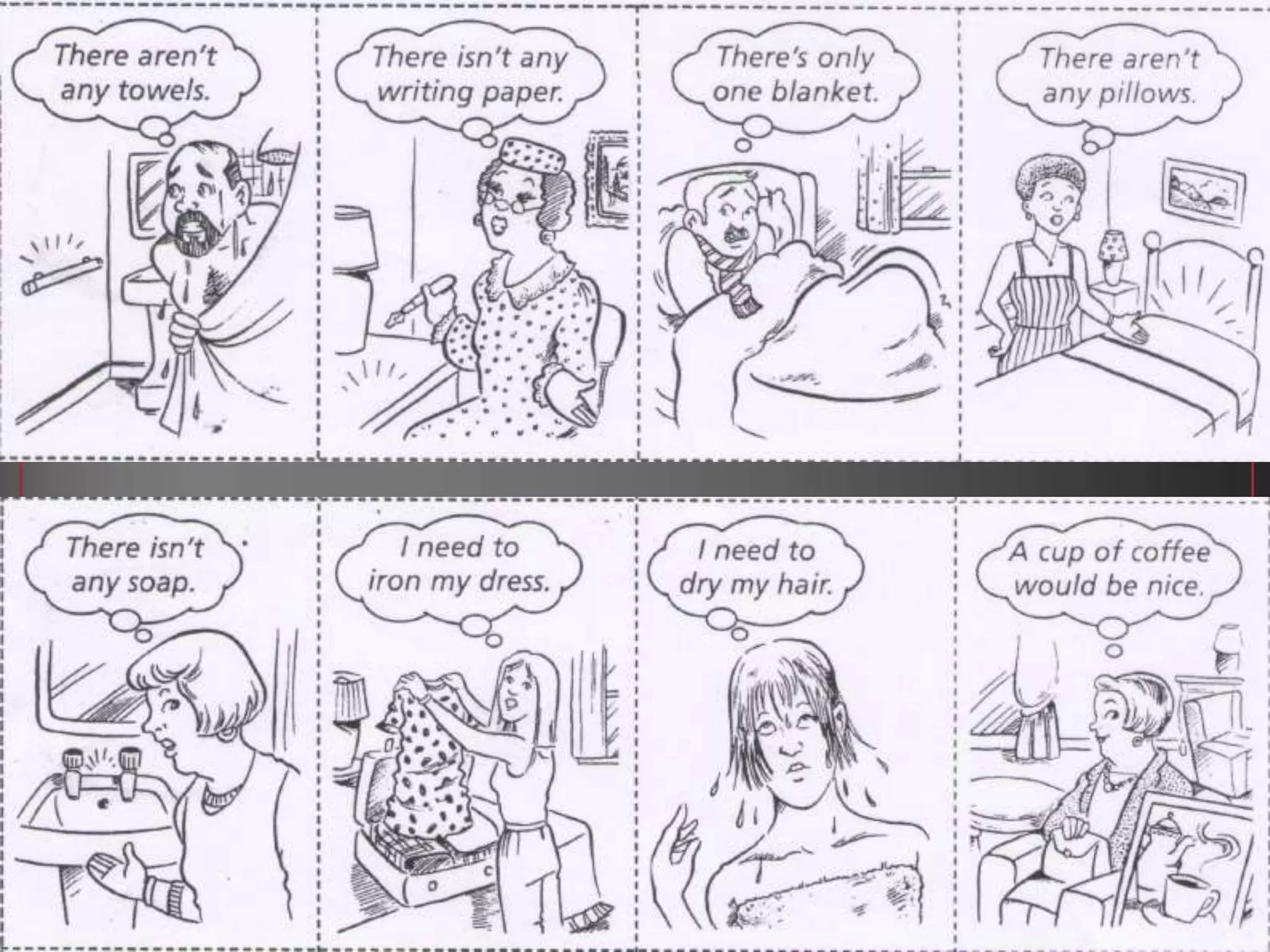
-Object cards
-Situation
cards
blankets
hair dryerironsoap
pillowwriting paperstowels
cup of coffee
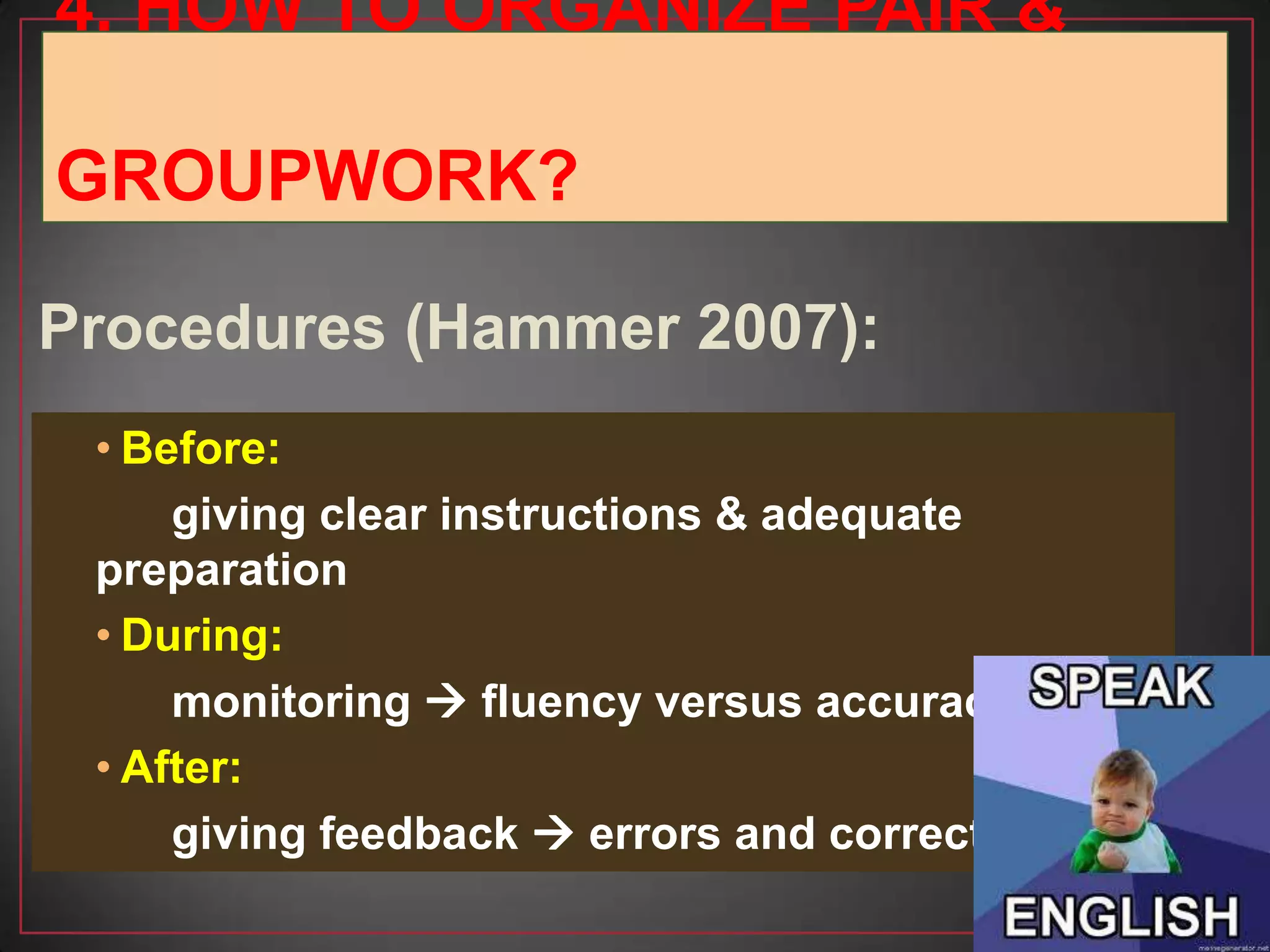
• Before:
giving clear instructions & adequate
preparation
• During:
monitoring  fluency versus accuracy
• After:
giving feedback  errors and correction
Procedures (Hammer 2007):
4. HOW TO ORGANIZE PAIR &
GROUPWORK?
Thank for
your cooperation!
DISCUSSION /
Q&A
Q & A
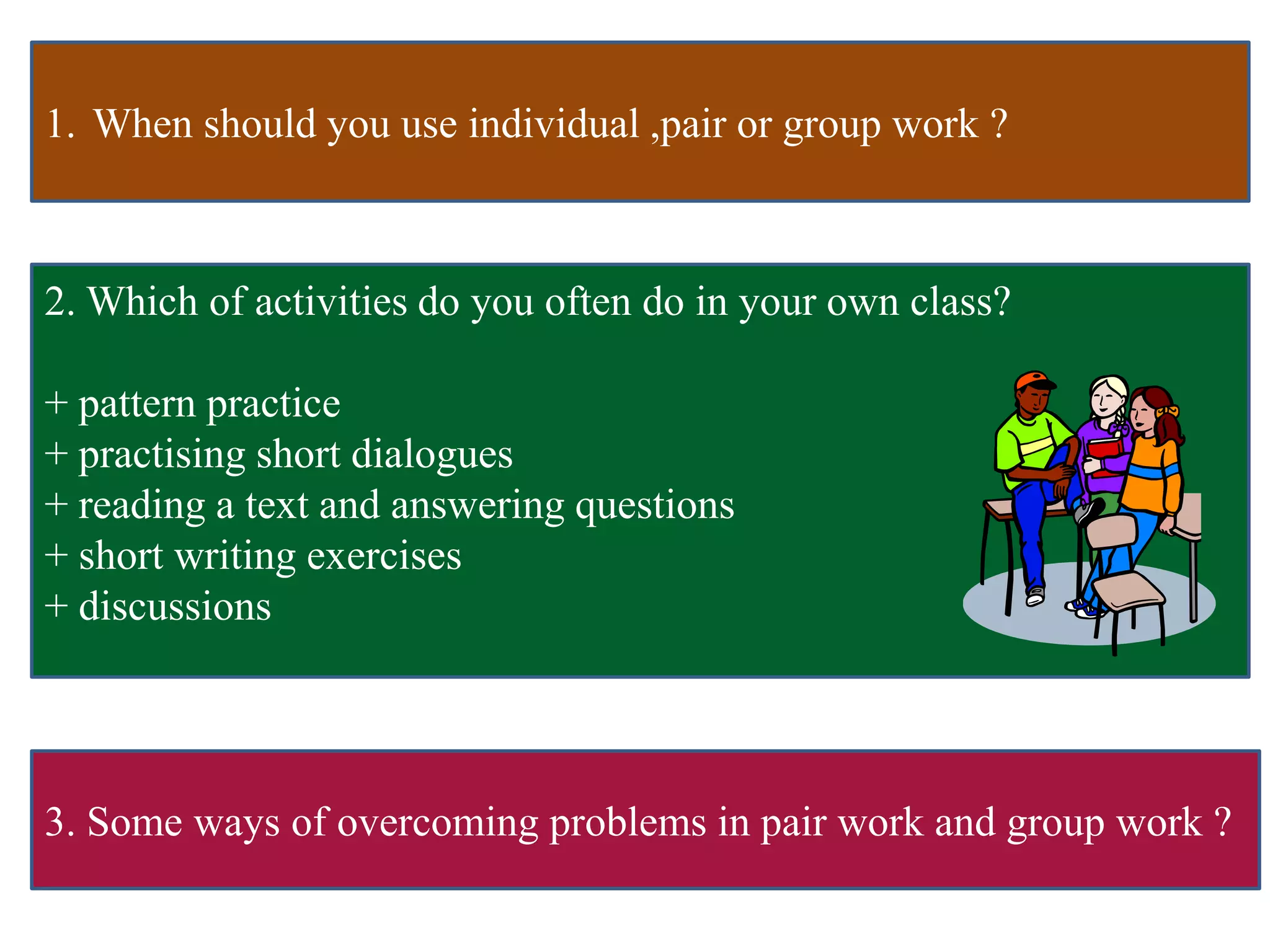
1. When should you use individual ,pair or group work ?
2. Which of activities do you often do in your own class?
+ pattern practice
+ practising short dialogues
+ reading a text and answering questions
+ short writing exercises
+ discussions
3. Some ways of overcoming problems in pair work and group work ?
1.When should
you use
individual, pair
or group work ?
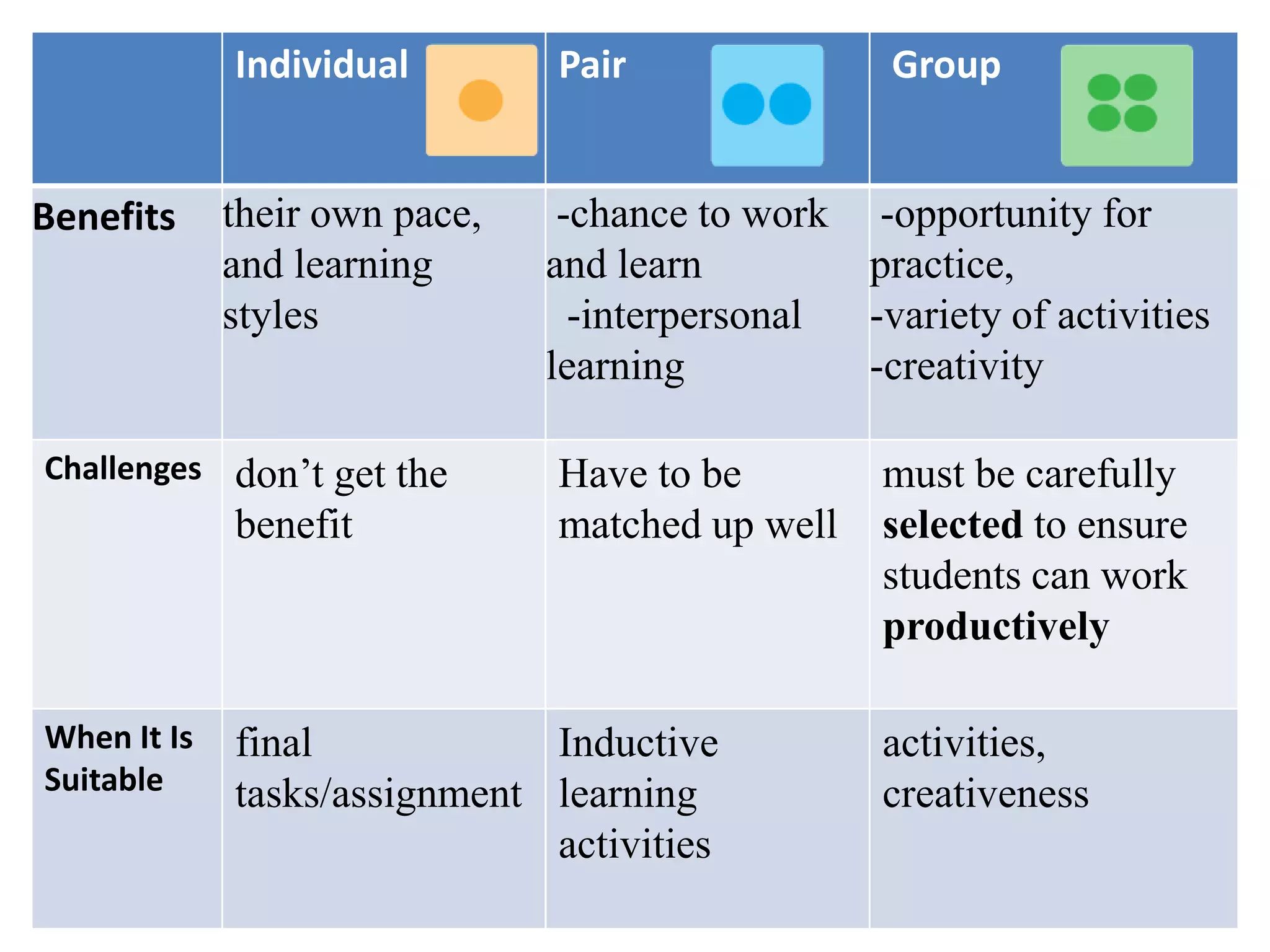
Individual Pair Group
Benefits their own pace,
and learning
styles
-chance to work
and learn
-interpersonal
learning
-opportunity for
practice,
-variety of activities
-creativity
Challenges don’t get the
benefit
Have to be
matched up well
must be carefully
selected to ensure
students can work
productively
When It Is
Suitable
final
tasks/assignment
Inductive
learning
activities
activities,
creativeness
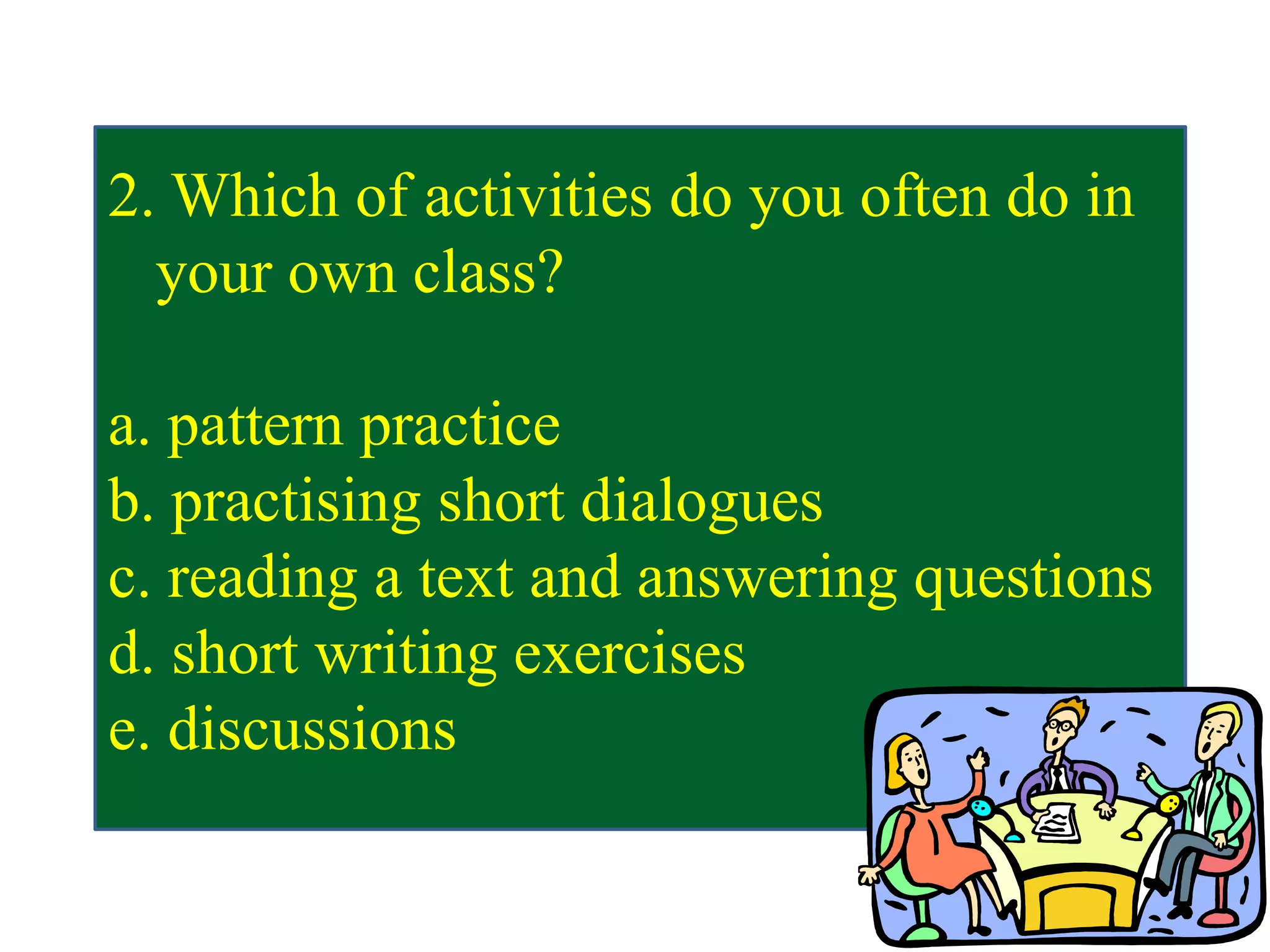
2. Which of activities do you often do in
your own class?
a. pattern practice
b. practising short dialogues
c. reading a text and answering questions
d. short writing exercises
e. discussions
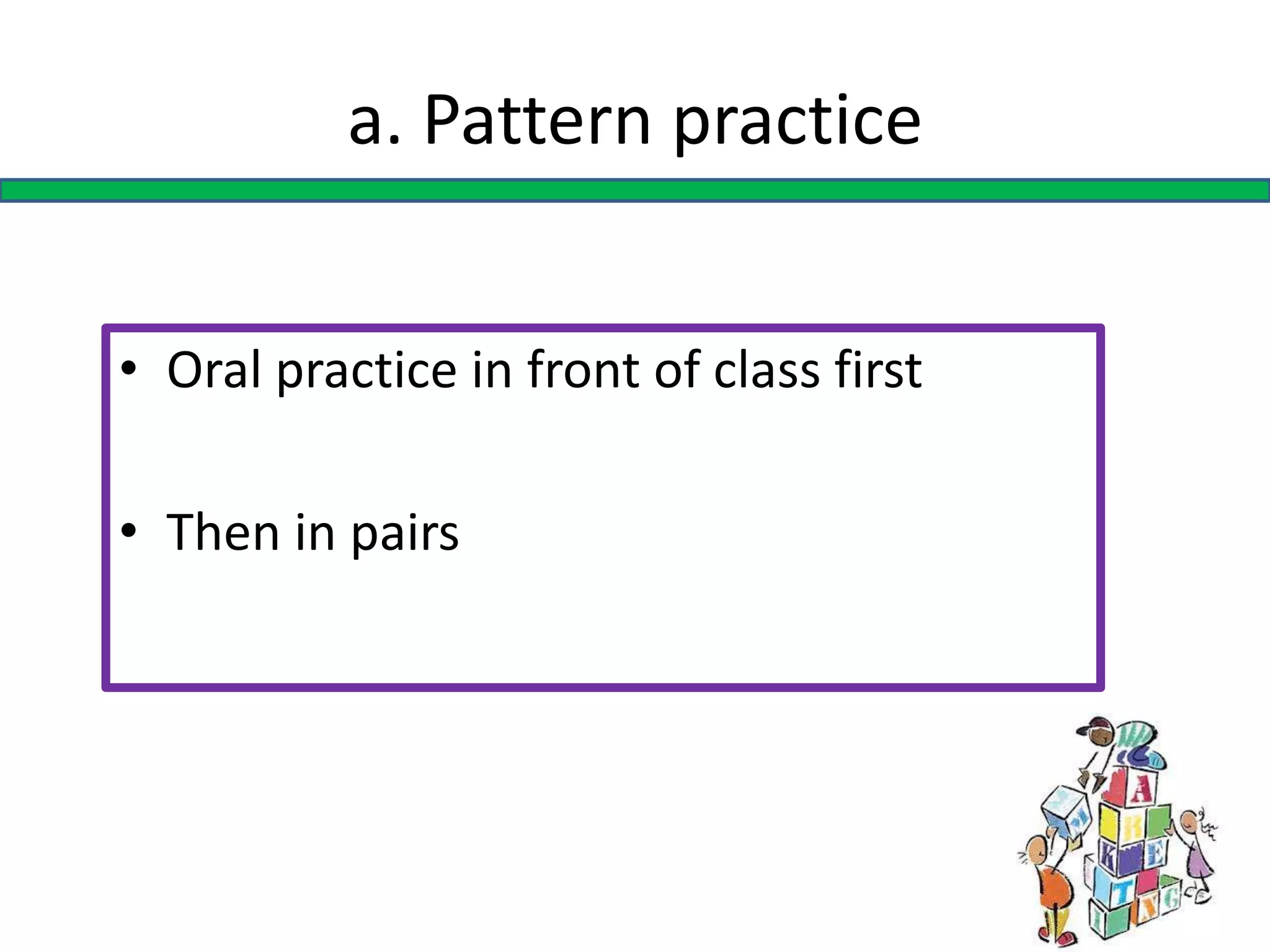
a. Pattern practice
• Oral practice in front of class first
• Then in pairs
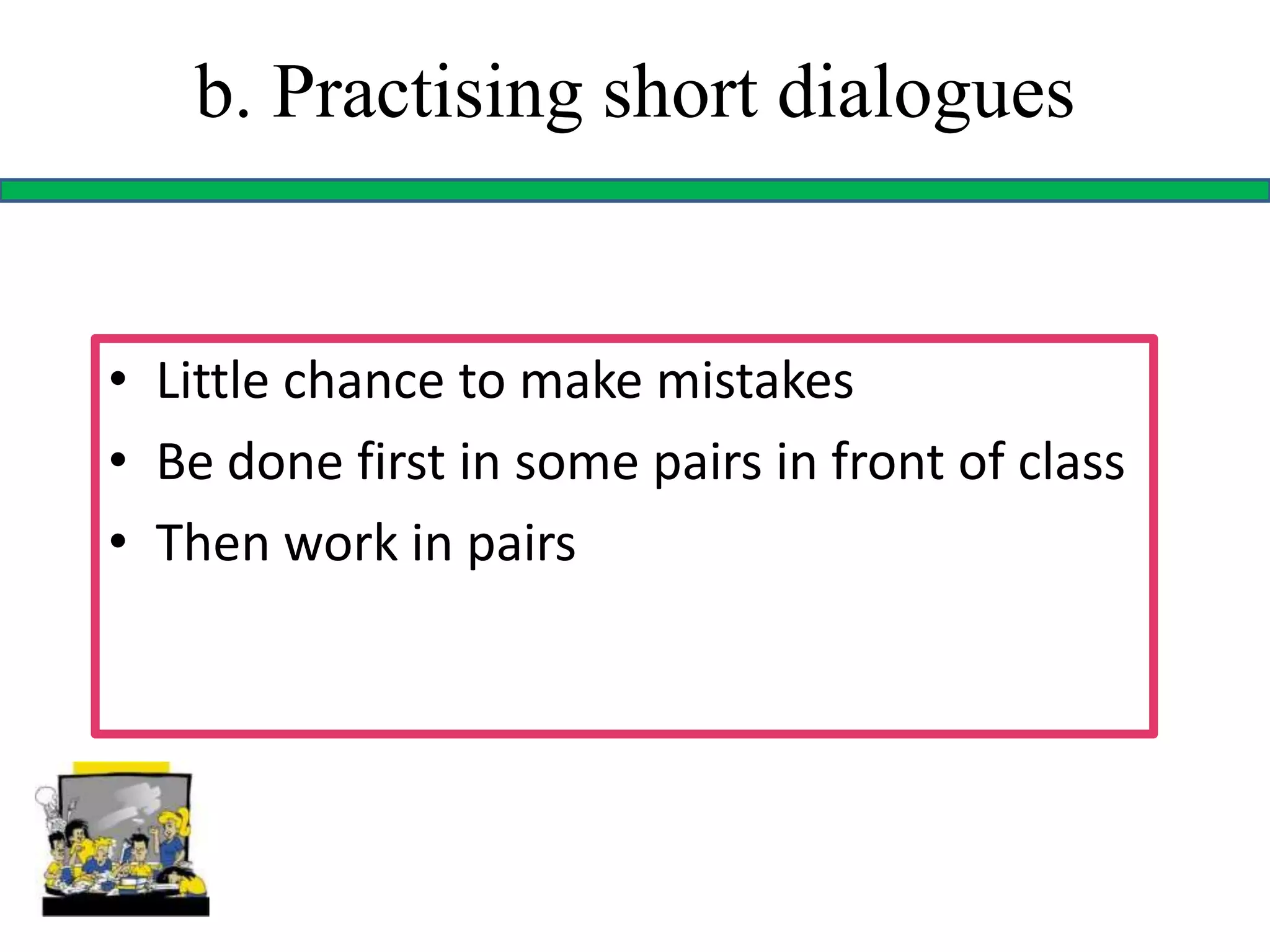
b. Practising short dialogues
• Little chance to make mistakes
• Be done first in some pairs in front of class
• Then work in pairs
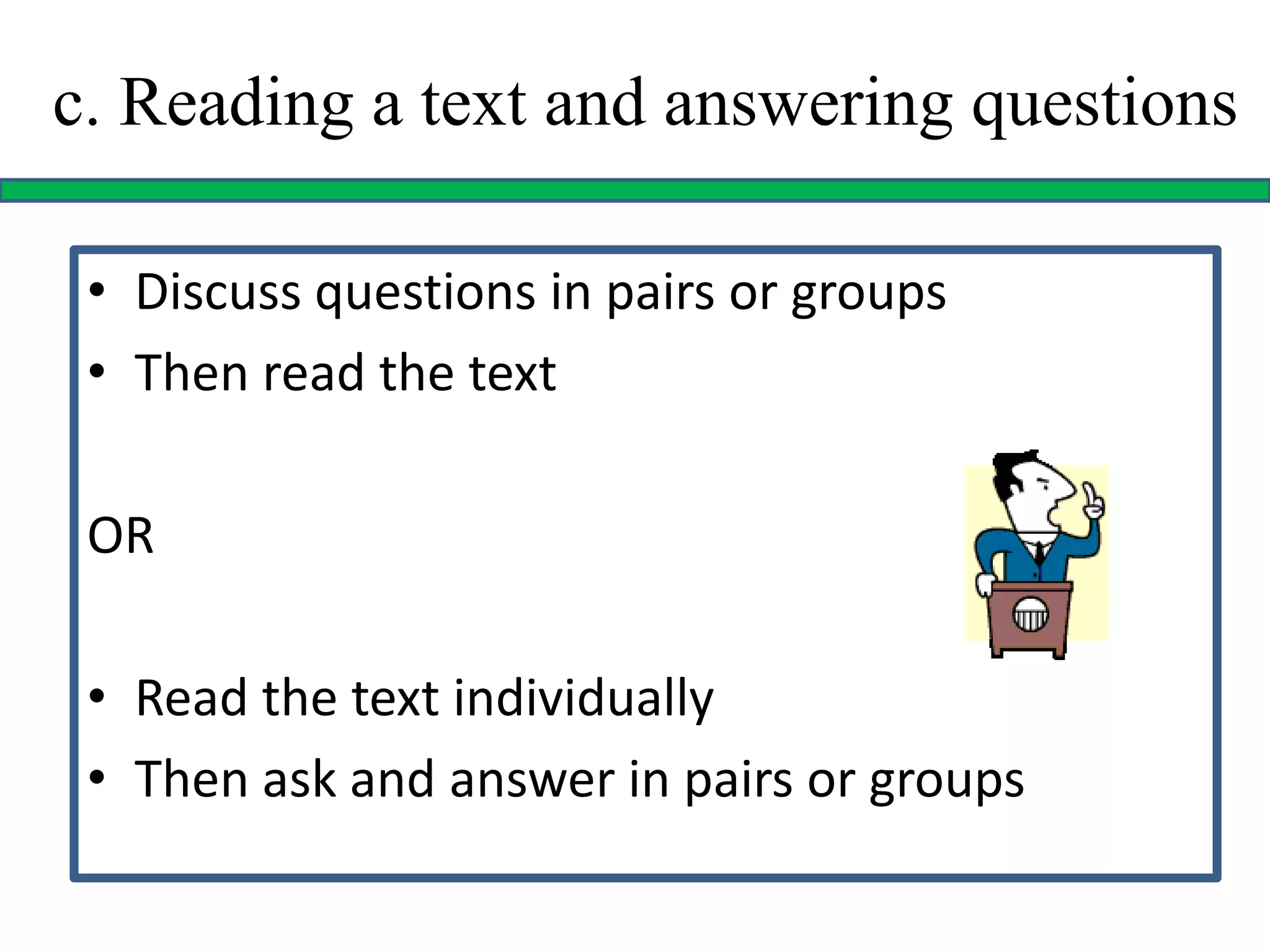
c. Reading a text and answering questions
• Discuss questions in pairs or groups
• Then read the text
OR
• Read the text individually
• Then ask and answer in pairs or groups
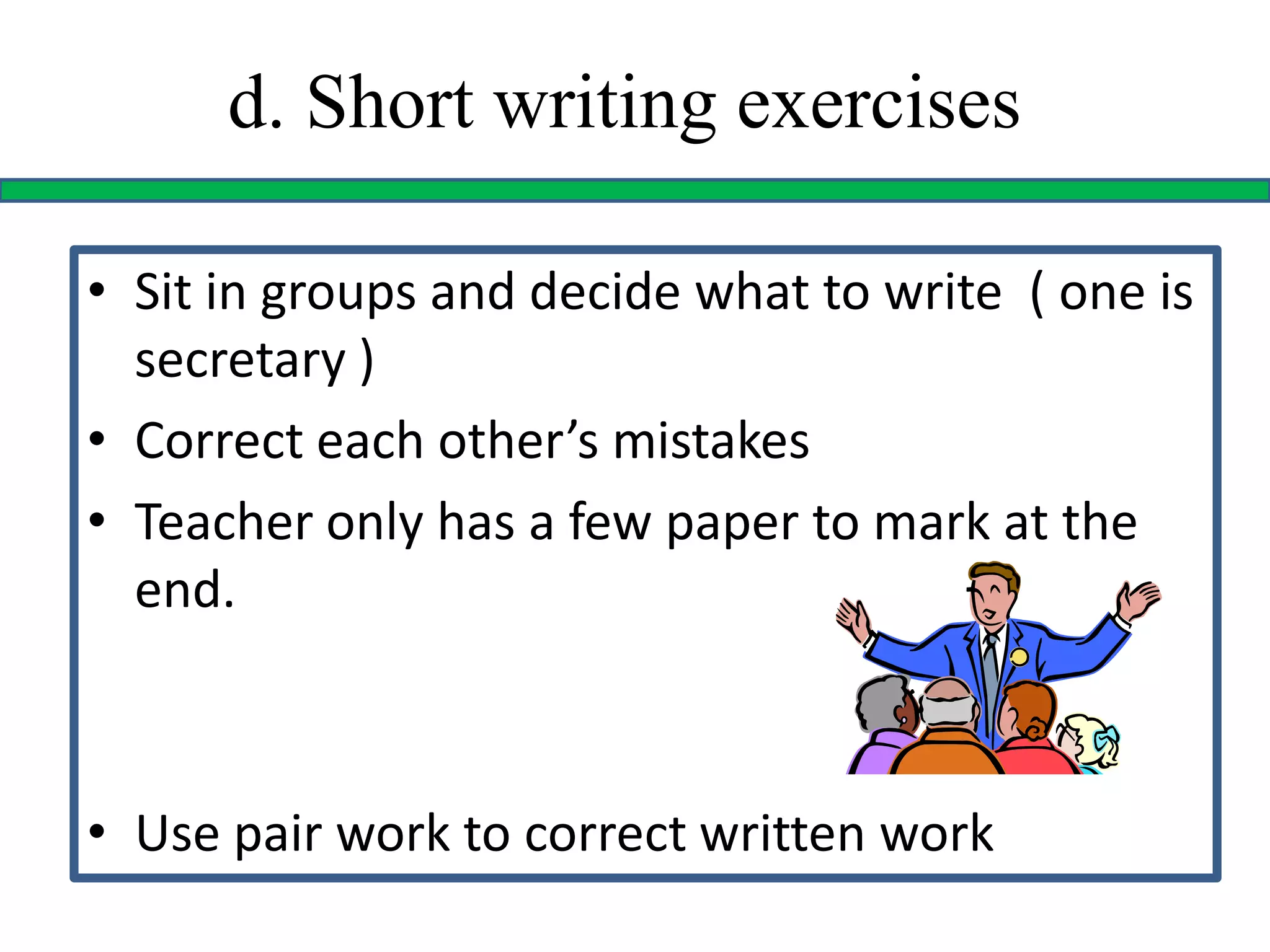
d. Short writing exercises
• Sit in groups and decide what to write ( one is
secretary )
• Correct each other’s mistakes
• Teacher only has a few paper to mark at the
end.
• Use pair work to correct written work
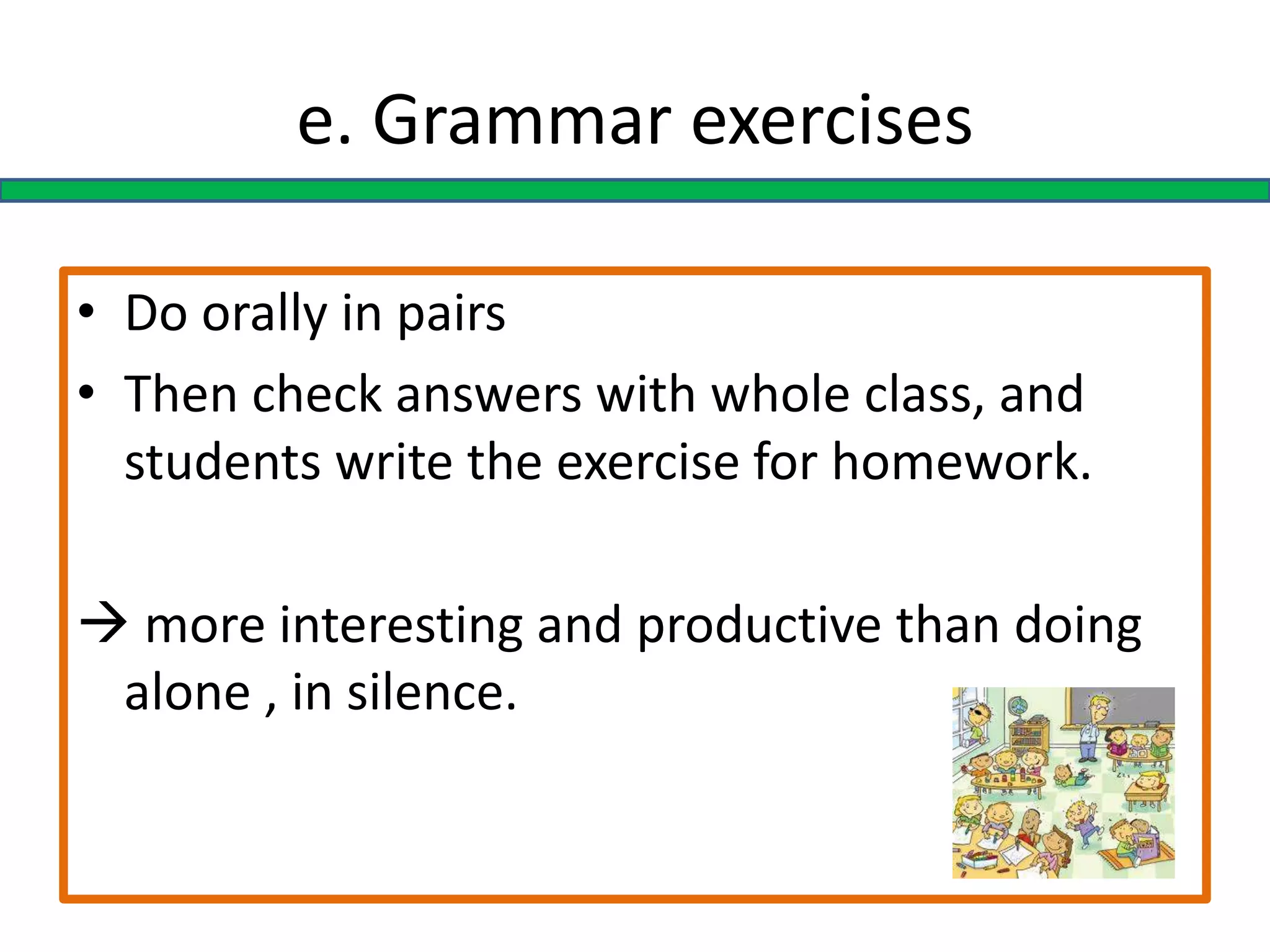
e. Grammar exercises
• Do orally in pairs
• Then check answers with whole class, and
students write the exercise for homework.
 more interesting and productive than doing
alone , in silence.
3. Some ways of
overcoming problems
in pair work and
group work ?
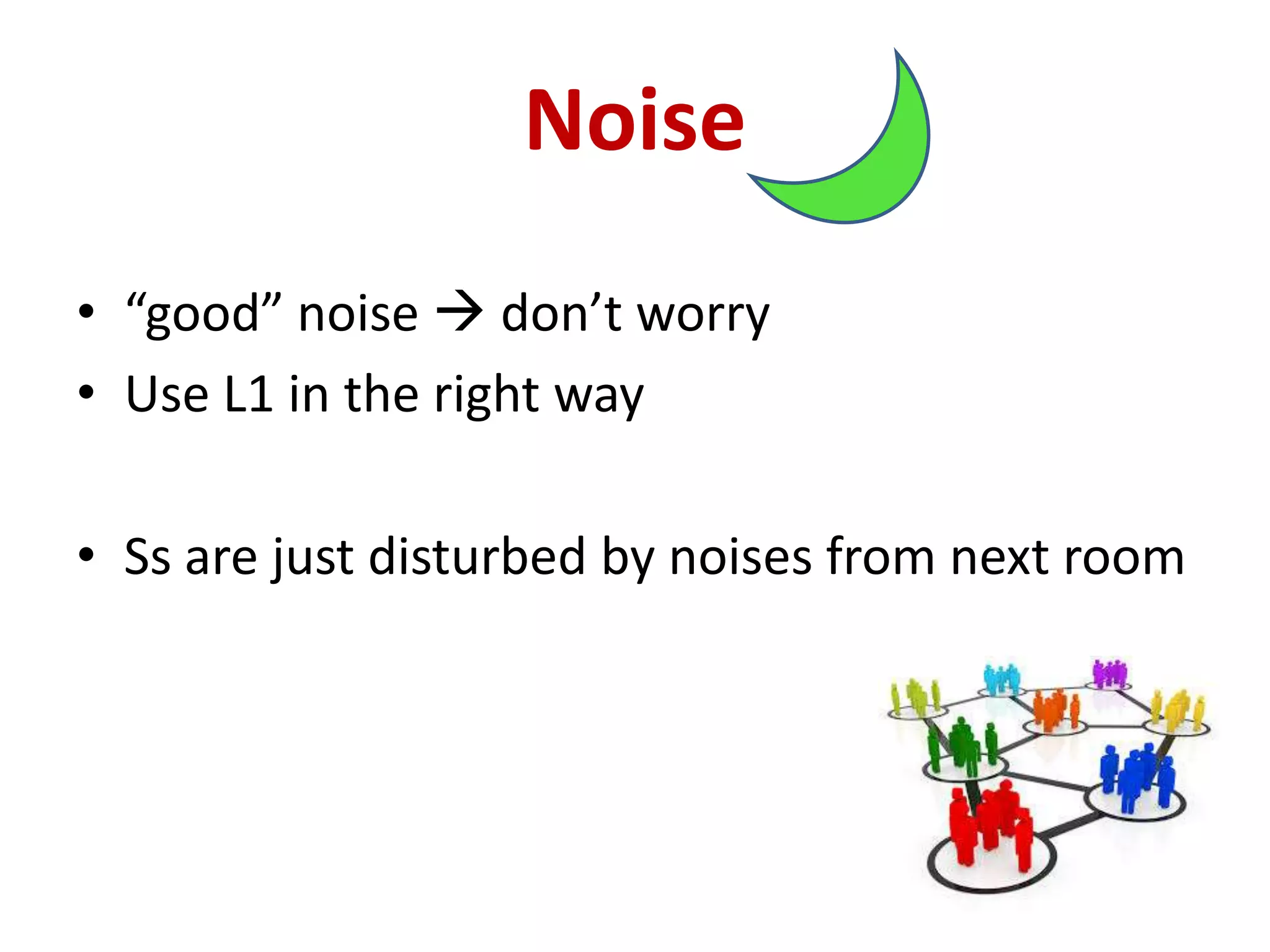
Noise
• “good” noise  don’t worry
• Use L1 in the right way
• Ss are just disturbed by noises from next room
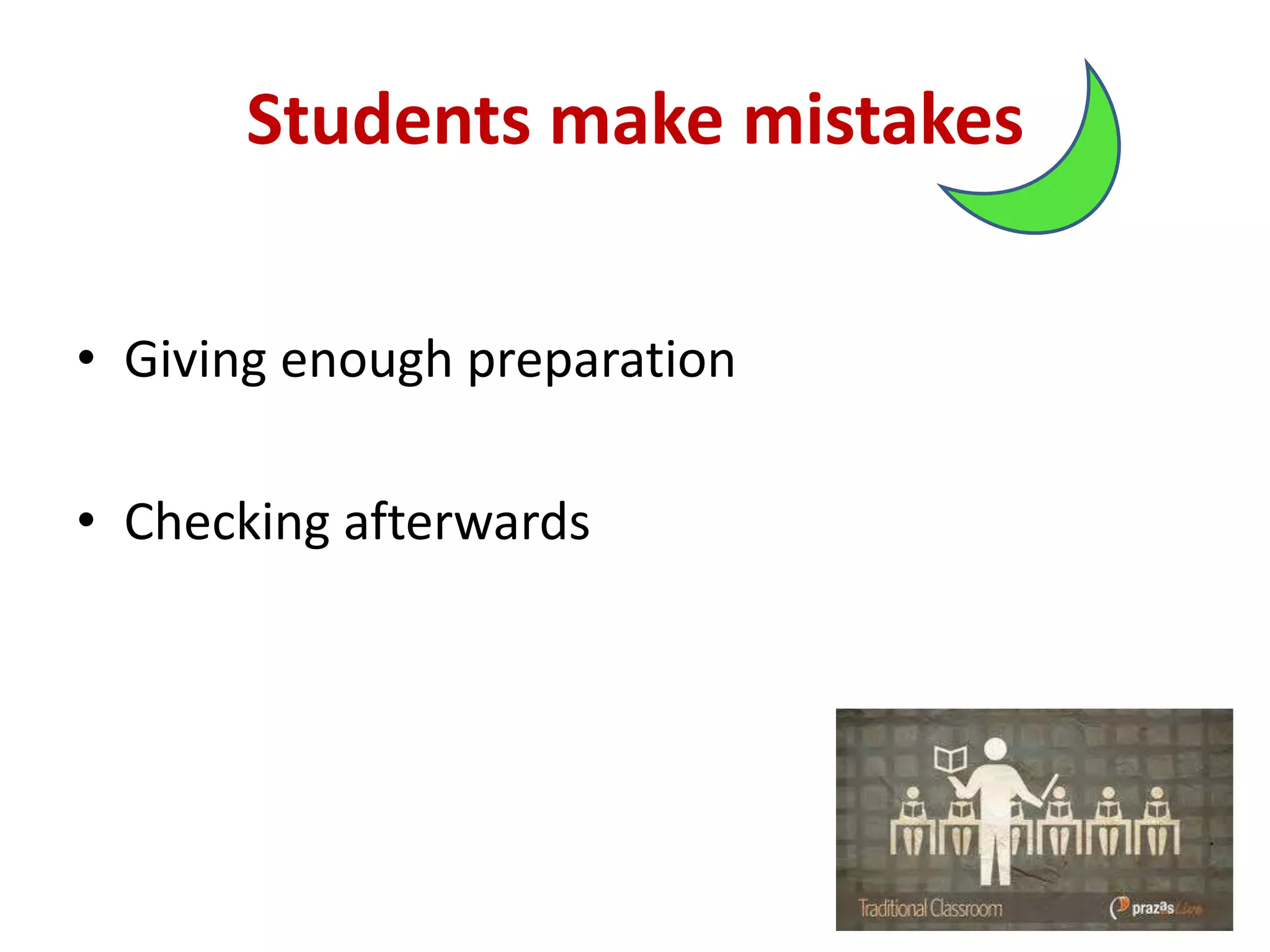
Students make mistakes
• Giving enough preparation
• Checking afterwards
Difficult to control
• Give clear instructions (when to start,
what to do, when to stop)
• Give clearly defined tasks ( not too long
task)
• Set up a routine
• Doff, A. (1988). Teach English - A training course
for teachers. Cambridge University Press.
• Harmer, J. (2007). The Practice of English
Language Teaching. Longman Press.
• Jones, L. (2007). The Student-Centered
Classroom. Cambridge University Press.
• Ur, P. (2012). A Course in English Language
Teaching. Cambridge University Press.

Pairing & grouping (pp)

  • 3.
  • 4.
  • 5.
    Which penguin cansurvive , A or B ?
  • 6.
    CONTENTS : -Why needpair and group work? -Advantages -Disadvantages -How to organize
  • 7.
  • 8.
    • more languagepracticed • learner autonomy fostered • student’s interaction promoted 2. ADVANTAGES
  • 9.
    • more languagepracticed  students feel more secure  amount of speaking time increased
  • 10.
    • learner autonomyfostered  students work & interact independently
  • 11.
    • student’s interactionpromoted  share ideas & knowledge  help each other  cooperate with others
  • 12.
    • going off-task •over using L1 • students’ resistance • noise or discipline problems 2. DISADVANTAGES & SUGGESTED POSSIBILITIES
  • 13.
  • 14.
    • friendship:  friendswith friends  students choose whom they like
  • 15.
     students atthe same level •streaming: according to students’ ability mixture of weaker and stronger students Average + average Good + good
  • 16.
    • chance: randomlyselected  students sitting next or near to each other  “wheels” scenario
  • 17.
    Procedures : 4. HOWTO ORGANIZE PAIR & GROUPWORK? Demonstration -Object cards -Situation cards
  • 18.
  • 20.
    • Before: giving clearinstructions & adequate preparation • During: monitoring  fluency versus accuracy • After: giving feedback  errors and correction Procedures (Hammer 2007): 4. HOW TO ORGANIZE PAIR & GROUPWORK?
  • 22.
  • 23.
  • 24.
  • 25.
    1. When shouldyou use individual ,pair or group work ? 2. Which of activities do you often do in your own class? + pattern practice + practising short dialogues + reading a text and answering questions + short writing exercises + discussions 3. Some ways of overcoming problems in pair work and group work ?
  • 26.
  • 27.
    Individual Pair Group Benefitstheir own pace, and learning styles -chance to work and learn -interpersonal learning -opportunity for practice, -variety of activities -creativity Challenges don’t get the benefit Have to be matched up well must be carefully selected to ensure students can work productively When It Is Suitable final tasks/assignment Inductive learning activities activities, creativeness
  • 28.
    2. Which ofactivities do you often do in your own class? a. pattern practice b. practising short dialogues c. reading a text and answering questions d. short writing exercises e. discussions
  • 29.
    a. Pattern practice •Oral practice in front of class first • Then in pairs
  • 30.
    b. Practising shortdialogues • Little chance to make mistakes • Be done first in some pairs in front of class • Then work in pairs
  • 31.
    c. Reading atext and answering questions • Discuss questions in pairs or groups • Then read the text OR • Read the text individually • Then ask and answer in pairs or groups
  • 32.
    d. Short writingexercises • Sit in groups and decide what to write ( one is secretary ) • Correct each other’s mistakes • Teacher only has a few paper to mark at the end. • Use pair work to correct written work
  • 33.
    e. Grammar exercises •Do orally in pairs • Then check answers with whole class, and students write the exercise for homework.  more interesting and productive than doing alone , in silence.
  • 34.
    3. Some waysof overcoming problems in pair work and group work ?
  • 35.
    Noise • “good” noise don’t worry • Use L1 in the right way • Ss are just disturbed by noises from next room
  • 36.
    Students make mistakes •Giving enough preparation • Checking afterwards
  • 37.
    Difficult to control •Give clear instructions (when to start, what to do, when to stop) • Give clearly defined tasks ( not too long task) • Set up a routine
  • 38.
    • Doff, A.(1988). Teach English - A training course for teachers. Cambridge University Press. • Harmer, J. (2007). The Practice of English Language Teaching. Longman Press. • Jones, L. (2007). The Student-Centered Classroom. Cambridge University Press. • Ur, P. (2012). A Course in English Language Teaching. Cambridge University Press.