Dr. Ravi Shankar Sharma
Fellow(Daradia )
Three keystones:-
 History
 Clinical examination
 Investigations(diagnostic interventions/diagnostic
nerve block)
A: Quantity or severity or intensity of pain
 Numerous pain scales for practical assessment of pain intensity in
clinical studies have been developed
Instruments for intensity assessment:
Unidimensional Multi dimensional
1.Verbal rating scales 1.Mc Gill pain questionnaire
2.Binary scale 2. Brief pain inventory
3.Numerical rating scale 3. West Haven –Yale multidimensional
4.Faces rating scale pain inventory
5.Visual analog scale 4. Medical outcome study 36 item short
form(SF-36)health survey
Unidimensional instruments:
1.Verbal rating scales(VRS)
 Response is noted as None, mild ,moderate or severe
 Advantage-short, easy to express and understand
especially in elderly
 Disadvantage-lack of reproducibility
2. The binary scale
e.g. do you have a 60% reduction in your pain?
“Yes/no”
 Advantage-short, easy to express and understand.
 Disadvantage-lack of reproducibility
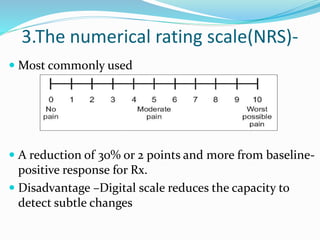
3.The numerical rating scale(NRS)-
 Most commonly used
 A reduction of 30% or 2 points and more from baseline-
positive response for Rx.
 Disadvantage –Digital scale reduces the capacity to
detect subtle changes
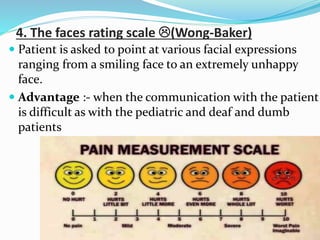
4. The faces rating scale (Wong-Baker)
 Patient is asked to point at various facial expressions
ranging from a smiling face to an extremely unhappy
face.
 Advantage :- when the communication with the patient
is difficult as with the pediatric and deaf and dumb
patients
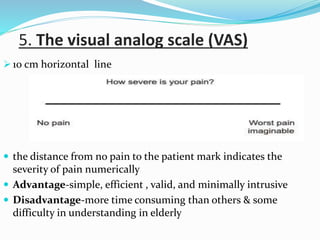
5. The visual analog scale (VAS)
 10 cm horizontal line
 the distance from no pain to the patient mark indicates the
severity of pain numerically
 Advantage-simple, efficient , valid, and minimally intrusive
 Disadvantage-more time consuming than others & some
difficulty in understanding in elderly
Multi dimensional instruments:
1.The Mc Gill pain questionnaire(MPQ)- Melzack and Torgerson-
1971
 Defines pain in 3 major dimensions by 20 set of descriptive words
divided as-
a. 10 sets describes sensory- discriminative (nociceptive pathway)
b. 5 sets describe motivational –affective (reticular and limbic
structure)
c. 1 set describe cognitive evaluative
d. 4 sets describe miscellaneous dimensions.
Advantage- helps in diagnosis as choice of descriptive words that
characterize the pain correlates well with pain syndromes.
Disadvantage – high level of anxiety and psychological
disturbances can obscure the MPQ discriminative capacity.
2. Brief pain inventory(BPI):
Measures both the intensity of pain (sensory dimension)
and its interference with the patient life(reactive
dimension)
 Advantage-
 valid for cancer pain and various pain syndromes
 shows good sensitivity to T/t.
 helps in comparing international trials with different
culture and population
Memorial Pain Assessment Card
 Pain assessment tool for cancer patients
 Consists of three separate visual analog scales and
assesses pain , pain relief and mood.
 Card includes a set of adjectives to describe pain
intensity
B:Assesment of Quality or nature of pain
 Important for diagnosing the nature or character of pain
whether it is nociceptive or neuropathic or a mixed
nature.
Screening tools for Neuropathic pain:
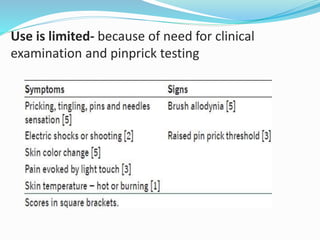
1.Leeds assesment of neuropathic symptoms and signs:
 It has two components in form of symptoms and signs
 For Each item binary response is noted-yes/no
 Scores ≥12/24 indicates pain is likely to be neuropathic
Use is limited- because of need for clinical
examination and pinprick testing
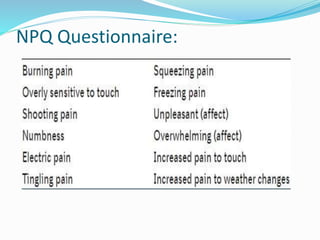
2. Neuropathic pain questionnaire(NPQ)
 The NPQ is a self questionnaire consisting of
12 items :
10 related to sensations or sensory responses
 2 related to affect
Each item is scored on a scale of 0(no pain ) to
100(worst possible pain)
NPQ Questionnaire:
3.Douleur Neuropathique en 4(DN 4) questions:
Consists of 7 items related to symptoms and 3 items
related to physical examination
 Each item is scored 1(yes) or 0(no)
 sum of all ten items is taken as total score
 score of ≥ 4 as neuropathic pain
Douleur Neuropathique en 4(DN 4) questions
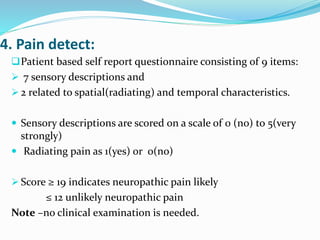
4. Pain detect:
Patient based self report questionnaire consisting of 9 items:
 7 sensory descriptions and
 2 related to spatial(radiating) and temporal characteristics.
 Sensory descriptions are scored on a scale of 0 (no) to 5(very
strongly)
 Radiating pain as 1(yes) or 0(no)
 Score ≥ 19 indicates neuropathic pain likely
≤ 12 unlikely neuropathic pain
Note –no clinical examination is needed.
Pain detect questionnaire:
5. ID -Pain
 It is a self questionnaire consisting of 5 sensory
description and 1 item regarding pain located in the
joints.
 Higher scores indicates neuropathic pain
ID –pain
- Pins and needles - Electric shocks
- Hot/ burning -Numb
- Is the pain made worse with touch of clothing or bed
sheets?
- Is the pain limited to your joints?(-1)
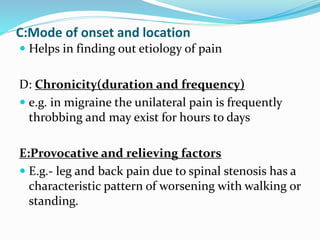
C:Mode of onset and location
 Helps in finding out etiology of pain
D: Chronicity(duration and frequency)
 e.g. in migraine the unilateral pain is frequently
throbbing and may exist for hours to days
E:Provocative and relieving factors
 E.g.- leg and back pain due to spinal stenosis has a
characteristic pattern of worsening with walking or
standing.
F: Special character
 e.g. – cluster headache- pain is deep , boring,
wrenching, and severe in intensity
G: Timing of pain
 Pain and stiffness felt in morning hours for> hours- d/t
inflammatory arthropathy
 < half hour – degenerative arthropathy
H: Relation to posture
Eg. Pain on sitting cross legged –Piriformis syndrome
Other :
 Past history
 Personal history
 Family history
 Treatment history
 Ruling out red flags
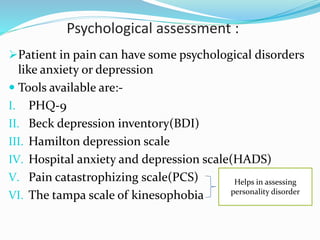
Psychological assessment :
Patient in pain can have some psychological disorders
like anxiety or depression
 Tools available are:-
I. PHQ-9
II. Beck depression inventory(BDI)
III. Hamilton depression scale
IV. Hospital anxiety and depression scale(HADS)
V. Pain catastrophizing scale(PCS)
VI. The tampa scale of kinesophobia
Helps in assessing
personality disorder
Becks depression inventory:
 21 parameters and each are graded from 0 to 3 ,so total
score of -63
 Results –
1-10-normal
11-16-mild mood disturbance
17-20-borderline
21-30-moderate depression
31-40-severe depression
>40-extreme depression
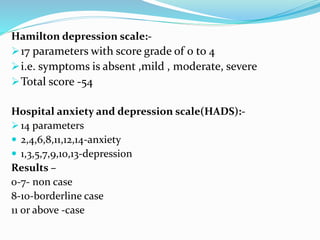
Hamilton depression scale:-
17 parameters with score grade of 0 to 4
i.e. symptoms is absent ,mild , moderate, severe
Total score -54
Hospital anxiety and depression scale(HADS):-
 14 parameters
 2,4,6,8,11,12,14-anxiety
 1,3,5,7,9,10,13-depression
Results –
0-7- non case
8-10-borderline case
11 or above -case
Hamilton,s parameter:-
HADS parameters:-
Pain assesment

Pain assesment

  • 1.
    Dr. Ravi ShankarSharma Fellow(Daradia )
  • 2.
    Three keystones:-  History Clinical examination  Investigations(diagnostic interventions/diagnostic nerve block)
  • 3.
    A: Quantity orseverity or intensity of pain  Numerous pain scales for practical assessment of pain intensity in clinical studies have been developed Instruments for intensity assessment: Unidimensional Multi dimensional 1.Verbal rating scales 1.Mc Gill pain questionnaire 2.Binary scale 2. Brief pain inventory 3.Numerical rating scale 3. West Haven –Yale multidimensional 4.Faces rating scale pain inventory 5.Visual analog scale 4. Medical outcome study 36 item short form(SF-36)health survey
  • 4.
    Unidimensional instruments: 1.Verbal ratingscales(VRS)  Response is noted as None, mild ,moderate or severe  Advantage-short, easy to express and understand especially in elderly  Disadvantage-lack of reproducibility 2. The binary scale e.g. do you have a 60% reduction in your pain? “Yes/no”  Advantage-short, easy to express and understand.  Disadvantage-lack of reproducibility
  • 5.
    3.The numerical ratingscale(NRS)-  Most commonly used  A reduction of 30% or 2 points and more from baseline- positive response for Rx.  Disadvantage –Digital scale reduces the capacity to detect subtle changes
  • 6.
    4. The facesrating scale (Wong-Baker)  Patient is asked to point at various facial expressions ranging from a smiling face to an extremely unhappy face.  Advantage :- when the communication with the patient is difficult as with the pediatric and deaf and dumb patients
  • 7.
    5. The visualanalog scale (VAS)  10 cm horizontal line  the distance from no pain to the patient mark indicates the severity of pain numerically  Advantage-simple, efficient , valid, and minimally intrusive  Disadvantage-more time consuming than others & some difficulty in understanding in elderly
  • 8.
    Multi dimensional instruments: 1.TheMc Gill pain questionnaire(MPQ)- Melzack and Torgerson- 1971  Defines pain in 3 major dimensions by 20 set of descriptive words divided as- a. 10 sets describes sensory- discriminative (nociceptive pathway) b. 5 sets describe motivational –affective (reticular and limbic structure) c. 1 set describe cognitive evaluative d. 4 sets describe miscellaneous dimensions. Advantage- helps in diagnosis as choice of descriptive words that characterize the pain correlates well with pain syndromes. Disadvantage – high level of anxiety and psychological disturbances can obscure the MPQ discriminative capacity.
  • 10.
    2. Brief paininventory(BPI): Measures both the intensity of pain (sensory dimension) and its interference with the patient life(reactive dimension)  Advantage-  valid for cancer pain and various pain syndromes  shows good sensitivity to T/t.  helps in comparing international trials with different culture and population
  • 11.
    Memorial Pain AssessmentCard  Pain assessment tool for cancer patients  Consists of three separate visual analog scales and assesses pain , pain relief and mood.  Card includes a set of adjectives to describe pain intensity
  • 12.
    B:Assesment of Qualityor nature of pain  Important for diagnosing the nature or character of pain whether it is nociceptive or neuropathic or a mixed nature. Screening tools for Neuropathic pain: 1.Leeds assesment of neuropathic symptoms and signs:  It has two components in form of symptoms and signs  For Each item binary response is noted-yes/no  Scores ≥12/24 indicates pain is likely to be neuropathic
  • 13.
    Use is limited-because of need for clinical examination and pinprick testing
  • 14.
    2. Neuropathic painquestionnaire(NPQ)  The NPQ is a self questionnaire consisting of 12 items : 10 related to sensations or sensory responses  2 related to affect Each item is scored on a scale of 0(no pain ) to 100(worst possible pain)
  • 15.
  • 16.
    3.Douleur Neuropathique en4(DN 4) questions: Consists of 7 items related to symptoms and 3 items related to physical examination  Each item is scored 1(yes) or 0(no)  sum of all ten items is taken as total score  score of ≥ 4 as neuropathic pain
  • 17.
    Douleur Neuropathique en4(DN 4) questions
  • 18.
    4. Pain detect: Patientbased self report questionnaire consisting of 9 items:  7 sensory descriptions and  2 related to spatial(radiating) and temporal characteristics.  Sensory descriptions are scored on a scale of 0 (no) to 5(very strongly)  Radiating pain as 1(yes) or 0(no)  Score ≥ 19 indicates neuropathic pain likely ≤ 12 unlikely neuropathic pain Note –no clinical examination is needed.
  • 19.
  • 20.
    5. ID -Pain It is a self questionnaire consisting of 5 sensory description and 1 item regarding pain located in the joints.  Higher scores indicates neuropathic pain ID –pain - Pins and needles - Electric shocks - Hot/ burning -Numb - Is the pain made worse with touch of clothing or bed sheets? - Is the pain limited to your joints?(-1)
  • 22.
    C:Mode of onsetand location  Helps in finding out etiology of pain D: Chronicity(duration and frequency)  e.g. in migraine the unilateral pain is frequently throbbing and may exist for hours to days E:Provocative and relieving factors  E.g.- leg and back pain due to spinal stenosis has a characteristic pattern of worsening with walking or standing.
  • 23.
    F: Special character e.g. – cluster headache- pain is deep , boring, wrenching, and severe in intensity G: Timing of pain  Pain and stiffness felt in morning hours for> hours- d/t inflammatory arthropathy  < half hour – degenerative arthropathy H: Relation to posture Eg. Pain on sitting cross legged –Piriformis syndrome
  • 24.
    Other :  Pasthistory  Personal history  Family history  Treatment history  Ruling out red flags
  • 25.
    Psychological assessment : Patientin pain can have some psychological disorders like anxiety or depression  Tools available are:- I. PHQ-9 II. Beck depression inventory(BDI) III. Hamilton depression scale IV. Hospital anxiety and depression scale(HADS) V. Pain catastrophizing scale(PCS) VI. The tampa scale of kinesophobia Helps in assessing personality disorder
  • 27.
    Becks depression inventory: 21 parameters and each are graded from 0 to 3 ,so total score of -63  Results – 1-10-normal 11-16-mild mood disturbance 17-20-borderline 21-30-moderate depression 31-40-severe depression >40-extreme depression
  • 28.
    Hamilton depression scale:- 17parameters with score grade of 0 to 4 i.e. symptoms is absent ,mild , moderate, severe Total score -54 Hospital anxiety and depression scale(HADS):-  14 parameters  2,4,6,8,11,12,14-anxiety  1,3,5,7,9,10,13-depression Results – 0-7- non case 8-10-borderline case 11 or above -case
  • 29.
  • 30.

Editor's Notes

  • #4 For eg temperature can be measured using a thermometer , we don’t have a specific device for measuring pain Unidimensional instruments measures only one dimension of pain – intensity while multidimensional instruments can measure nature and location in addition to intensity of pain.
  • #8 Disadvantage-more time consuming and some difficulty in using and understanding this scale in elderly
  • #9 Disadvantage – high level of anxiety and psychological disturbances can obscure the MPQ discriminative capacity