Management Strategies for Acute and Subacute Pain Julio A. Martinez-Silvestrini, MD Medical Director Baystate Physical Medicine and Rehabilitation
Objectives Compare analgesic management options for acute and subacute pain
Pain Defined as localized sensation of discomfort, distress or agony, resulting from the stimulation of specialized nerve endings after tissue damage. C fibers and A delta fibers  Release of histamine, peptides, prostaglandins and serotonin
Pain generators may be: Muscular Vascular Cutaneous Visceral Osseous Ligamentous Neuropathic Combination of the above
Acute pain Arises from: Acute macrotrauma Chronic repetitive microtrauma  Acute exacerbation of a chronic injury
Inflammation Localized protective response  Elicited by injury or destruction of tissues  The first step of tissue healing Characterized by: Pain (dolor) Increased temperature (calor) Erythema (rubor) Swelling
Why? Coupled with pain, the inflammatory response limits the use of the injured structure Avoiding the possibility of further injury to the affected tissue.
Medications Considerations Compliance 59% in TID medications 84% in Once a day medications
Compliance Significant side effects Complexity and organization of the treatment regimen  Multiple doses or agents Cost Low perceived benefits
Leadbetter  “ If pain and signs of inflammation are persistent, repeated efforts to turn off the body’s alarm is not a substitute for finding the cause of the fire.”
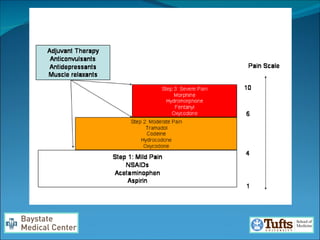
Pain Ladder The World Health Organization (WHO) designed a three-step ‘ladder’ for pain relief in cancer patients  More recently validated for  Nonmalignant pain Musculoskeletal pain  Pediatric population
 
Pain Ladder The administration of medications to control pain consists of scheduled, ‘by the clock’ rather than ‘as needed’ or ‘on demand’ doses.  Considered to be relatively inexpensive and 80 to 90% effective
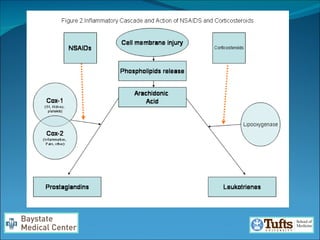
Non-steroidal Anti-inflammatories (NSAIDs) ~30 million people take NSAIDs daily  20 million of prescriptions in the UK yearly May contribute to 2,600 deaths annually  Anti-inflammatory, antipyretic and analgesic effects
 
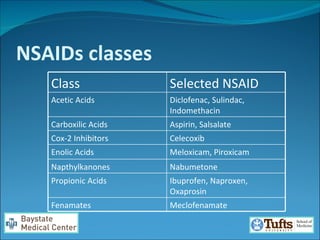
NSAIDs classes Meclofenamate Fenamates Ibuprofen, Naproxen, Oxaprosin Propionic Acids Nabumetone Napthylkanones  Meloxicam, Piroxicam Enolic Acids Celecoxib Cox-2 Inhibitors Aspirin, Salsalate Carboxilic Acids Diclofenac, Sulindac, Indomethacin Acetic Acids Selected NSAID Class
Acetaminophen N-acetyl-P-aminophenol (APAP) No anti-inflammatory effects First line of treatment  Patients allergic to aspirin or NSAIDS Inflammation is not a predominant component of the pain complex
Acetaminophen Poorly understood mechanism of action Central inhibition of prostaglandins
Ceiling effect Doses above a certain level produce no additional analgesia  but may incur additional toxicity
Opiates Gold standard for pain control.  High potency and risk of physical dependence Potential for abuse  Should be limited to moderate to severe pain levels Used for short periods of time
Opiates If a patient requires opiates for more than 3-4 weeks, long acting opiates for pain control should be considered.  Short acting opiates for chronic pain control  Inferior for continuous pain control  Promote “pain behavior”
Opiates The primary objective is to achieve an acceptable balance between analgesia and adverse effects.  In opiate-naive patients: Short acting, low potency agents  Advanced gradually.  Prescribing stool softeners and antiemetics to minimize adverse effects  May jeopardize compliance.
Compounded agents Second step agents in the “pain ladder” are available in combination with APAP or NSAIDs Often over the counter cold remedies contain APAP High risk for surpassing the ceiling level.
Tramadol Central analgesic with binary action  Weak opioid mu receptor agonist Reuptake inhibitor of norepinephrine and serotonin.  Indicated for moderate to severe pain.  It is considered to be more appropriate than NSAIDS for patients with gastrointestinal or renal disease.

Managing Acute Pain

  • 1.
    Management Strategies forAcute and Subacute Pain Julio A. Martinez-Silvestrini, MD Medical Director Baystate Physical Medicine and Rehabilitation
  • 2.
    Objectives Compare analgesicmanagement options for acute and subacute pain
  • 3.
    Pain Defined aslocalized sensation of discomfort, distress or agony, resulting from the stimulation of specialized nerve endings after tissue damage. C fibers and A delta fibers Release of histamine, peptides, prostaglandins and serotonin
  • 4.
    Pain generators maybe: Muscular Vascular Cutaneous Visceral Osseous Ligamentous Neuropathic Combination of the above
  • 5.
    Acute pain Arisesfrom: Acute macrotrauma Chronic repetitive microtrauma Acute exacerbation of a chronic injury
  • 6.
    Inflammation Localized protectiveresponse Elicited by injury or destruction of tissues The first step of tissue healing Characterized by: Pain (dolor) Increased temperature (calor) Erythema (rubor) Swelling
  • 7.
    Why? Coupled withpain, the inflammatory response limits the use of the injured structure Avoiding the possibility of further injury to the affected tissue.
  • 8.
    Medications Considerations Compliance59% in TID medications 84% in Once a day medications
  • 9.
    Compliance Significant sideeffects Complexity and organization of the treatment regimen Multiple doses or agents Cost Low perceived benefits
  • 10.
    Leadbetter “If pain and signs of inflammation are persistent, repeated efforts to turn off the body’s alarm is not a substitute for finding the cause of the fire.”
  • 11.
    Pain Ladder TheWorld Health Organization (WHO) designed a three-step ‘ladder’ for pain relief in cancer patients More recently validated for Nonmalignant pain Musculoskeletal pain Pediatric population
  • 12.
  • 13.
    Pain Ladder Theadministration of medications to control pain consists of scheduled, ‘by the clock’ rather than ‘as needed’ or ‘on demand’ doses. Considered to be relatively inexpensive and 80 to 90% effective
  • 14.
    Non-steroidal Anti-inflammatories (NSAIDs)~30 million people take NSAIDs daily 20 million of prescriptions in the UK yearly May contribute to 2,600 deaths annually Anti-inflammatory, antipyretic and analgesic effects
  • 15.
  • 16.
    NSAIDs classes MeclofenamateFenamates Ibuprofen, Naproxen, Oxaprosin Propionic Acids Nabumetone Napthylkanones Meloxicam, Piroxicam Enolic Acids Celecoxib Cox-2 Inhibitors Aspirin, Salsalate Carboxilic Acids Diclofenac, Sulindac, Indomethacin Acetic Acids Selected NSAID Class
  • 17.
    Acetaminophen N-acetyl-P-aminophenol (APAP)No anti-inflammatory effects First line of treatment Patients allergic to aspirin or NSAIDS Inflammation is not a predominant component of the pain complex
  • 18.
    Acetaminophen Poorly understoodmechanism of action Central inhibition of prostaglandins
  • 19.
    Ceiling effect Dosesabove a certain level produce no additional analgesia but may incur additional toxicity
  • 20.
    Opiates Gold standardfor pain control. High potency and risk of physical dependence Potential for abuse Should be limited to moderate to severe pain levels Used for short periods of time
  • 21.
    Opiates If apatient requires opiates for more than 3-4 weeks, long acting opiates for pain control should be considered. Short acting opiates for chronic pain control Inferior for continuous pain control Promote “pain behavior”
  • 22.
    Opiates The primaryobjective is to achieve an acceptable balance between analgesia and adverse effects. In opiate-naive patients: Short acting, low potency agents Advanced gradually. Prescribing stool softeners and antiemetics to minimize adverse effects May jeopardize compliance.
  • 23.
    Compounded agents Secondstep agents in the “pain ladder” are available in combination with APAP or NSAIDs Often over the counter cold remedies contain APAP High risk for surpassing the ceiling level.
  • 24.
    Tramadol Central analgesicwith binary action Weak opioid mu receptor agonist Reuptake inhibitor of norepinephrine and serotonin. Indicated for moderate to severe pain. It is considered to be more appropriate than NSAIDS for patients with gastrointestinal or renal disease.