PAIN
DefinitionAn unpleasant sensory and emotional experience arising from actual or potential tissue damage--The International Association for the Study of Pain
CLASSIFICATION AND PREVALENCE OF COMMON PAIN CONDITIONS
Reflex responses to painIncreased Sympathetic ToneVasoconstriction producing increased peripheral resistance
Increased cardiac output from increased stroke volume
and heart rate
Increased blood pressure
Increased metabolic rate and oxygen consumption
Decreased gastric tone (delayed gastric emptying; can
progress to ileus)
Decreased urinary tract tone (leads to urinary retention)Endocrine ResponsesDecreased insulin production
Increased cortisol
Increased antidiuretic hormone
Increased growth hormone
Increased renin, angiotensin II, aldosterone
Increased glucagons
Increased catecholaminesRespiratory ResponsesHyperventilationCortical ResponsesAnxiety and fearEndorphin SystemNeuroendocrine system that serves to modulate responses to pain and stress
Acute versus Chronic Pain
Pain Measurement
Sites for pain treatment
TreatmentFour main  treatment  groups:Acute pain,  Chronic painRecurrent pain, and  Chronic pain of malignancy.
TreatmentChronic painPatients should be using acetaminophen if not contraindicated andAn nonsteroidal anti-infammatory drug (NSAID) if it can be tolerated. Tramadol  may  be  helpful  in  certain  cases.Adjuvants appropriate  for  neuropathic  or  central  pain may  be  added  if appropriate.  Opioids  should  not  be  prescribed  until  these other treatments are maximized and should be added in addition to these other therapies rather than as an alternative
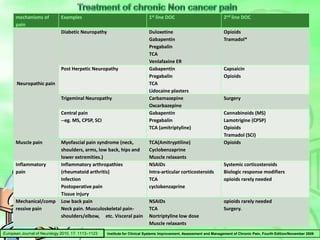
Treatment of chronic Non cancer painEuropean Journal of Neurology 2010, 17: 1113–1123Institute for Clinical Systems Improvement, Assessment and Management of Chronic Pain, Fourth Edition/November 2009
Treatment of chronic Cancer painINCIDENCE OF PAINOver 80% of cancer patients with advanced metastatic disease suffer pain Pain is caused mostly by direct tumor infiltration. Pain undermines quality of life considerably and is a clinically important indicator of tumor progression.
Treatment of chronic Cancer painTreatment of mild pain (NRS: 1–4) (WHO step I analgesics)Annals of Oncology 20 (Supplement 4): iv170–iv173, 2009
Selected non-opioid analgesics (WHO step I)Note : internationally no NSAID is available in injectable form, hence this group is never used for acute post operative pain not because they are not effective but because pts may not have been put on oral medicines or oral diet.Annals of Oncology 20 (Supplement 4): iv170–iv173, 2009
Treatment of chronic Cancer painTreatment of moderate pain (NRS: 5–7) (WHO step II analgesics)The doses of these combination products can be increased until their maximum dose is attained (e.g. 4000 mg of acetaminophen and 240 mg of codeine)Annals of Oncology 20 (Supplement 4): iv170–iv173, 2009
selected Opioids for mild to moderate pain (WHO level II)Again TRAMADOL is also not very commonly available as injectionAnnals of Oncology 20 (Supplement 4): iv170–iv173, 2009
Treatment of chronic Cancer painTreatment of Severe pain (NRS: 8–10) (WHO step III analgesics)Annals of Oncology 20 (Supplement 4): iv170–iv173, 2009
Opioids for moderate to severe pain (WHO step III: may be combined with step I medication)a- The relative effectiveness varies considerably in published literature and between individual patients. Switching to another opiod should therefore be donecautiously with a dose reduction of the newly prescribed opioid.b - The maximal dose depends on tachyphylaxis.c - Calculated with conversion from mg/day to lg/h.d - Not usually used as firstopioid (the 12 lg/h dose corresponds to 30–60 mg of oral morphine sulfate daily).e - Factor 4 for daily morphine doses <90 mg, factor 8 for doses 90–300 mg and 12 for >300 mg.Annals of Oncology 20 (Supplement 4): iv170–iv173, 2009
Non-steroidal anti-inflammatory drugNSAIDs
Application of NSAIDsRheumatoid arthritisOsteoarthritisInflammatory arthropathies (e.g. ankylosingspondylitis, psoriatic arthritis, Reiter's syndrome)Acute goutDysmenorrhoea (menstrual pain)Metastatic bone painHeadache and migrainePostoperative painMild-to-moderate pain due to inflammation and tissue injuryPyrexia (fever)IleusRenal colicThey are also given to neonate infants whose ductusarteriosus is not closed within 24 hours of birthPrevention of colorectal cancer.Treatment of cancer and cardiovascular disease.
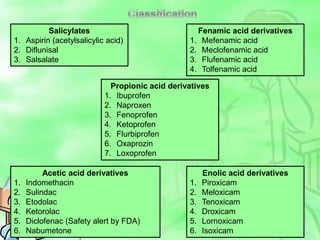
ClassificationSalicylatesAspirin (acetylsalicylic acid)DiflunisalSalsalateFenamic acid derivativesMefenamic acidMeclofenamic acidFlufenamic acidTolfenamic acidPropionic acid derivativesIbuprofenNaproxenFenoprofenKetoprofenFlurbiprofenOxaprozinLoxoprofenAcetic acid derivativesIndomethacinSulindacEtodolacKetorolacDiclofenac (Safety alert by FDA)NabumetoneEnolic acid derivativesPiroxicamMeloxicamTenoxicamDroxicamLornoxicamIsoxicam
ClassificationSelective COX-2 inhibitors (Coxibs)Celecoxib (FDA alert)1Rofecoxib (withdrawn from market)Valdecoxib (withdrawn from market)Parecoxib FDA withdrawn, licenced in the EUEtoricoxib FDA withdrawn, licenced in the EUFirocoxib used in dogs and horsesSulphonanilidesNimesulide (systemic preparations are banned by several countries for the potential risk of hepatotoxicity)OthersLicofelone acts by inhibiting LOX & COX and hence known as 5-LOX/COX inhibitorhttp://www.fda.gov/Drugs/DrugSafety/PostmarketDrugSafetyInformationforPatientsandProvid
Differences between different NSAIDsThere is little difference in clinical efficacy among the NSAIDs when used at equivalent doses1Differences present are with regards to Dosing regimens (related to the compound's elimination half-life), Route of administration, and Tolerability profileRegarding adverse effectsselective COX-2 inhibitors have lower risk of gastrointestinal bleeding, but a substantially more increased risk of myocardial infarction than the increased risk from nonselective inhibitors.[1]partially selective nabumetone is less likely to cause gastrointestinal events.[1] The nonselective naproxen appears to be risk-neutral with regard to cardiovascular events.[1]Comparing NSAIDs - Summaries of key questions from the Drug Effectiveness Review Project (DERP), Oregon Health & Science University. By Laura Dean, National Center of Biotechnology Information (NCBI)
 Patients at increased risk for NSAID GI toxicity1High riskHistory of a previously complicated ulcer, especially recent Multiple (>2) risk factors Moderate risk (1  –  2 risk factors)Age >65 years High dose NSAID therapy A previous history of uncomplicated ulcer Concurrent use of aspirin (including low dose), corticosteroids or  anticoagulantsLow riskNo risk factorsH. pylori It is an independent and additive risk factor and needs to be addressed  separately (see text and recommendations). ACG practice guidelines, Am J gastroenterol  2009; 104:728 – 738
Recommendations for prevention of NSAID-related ulcer complications1 ACG practice guidelines, Am J gastroenterol  2009; 104:728 – 738
Some Questions that need to be answered regarding NSAIDsQuestion 1Are there differences in effectiveness between NSAIDs?Question 2 & 3Are there clinically important differences in short-term (< 6 months) or long-term (≥ 6 months) harms between NSAIDs?Question 4Are there subgroups of patients based on demographics, other medications (e.g., aspirin), socio-economic conditions, co-morbidities (e.g., gastrointestinal disease) for which one medication is more effective or associated with fewer harms?These questions are answered in the document provided.
Tramadol & TapentadolDual Analgesic Mechanisms
TramadolOpioid ActivityTramadol produces antinociception via predominantly, a mu-opioid receptor mechanism.No respiratory depression, sedation, or constipation, as observed with other opiates.No analgesic toleranceNo psychological dependence or euphoric effects in long-term clinical trialsMonoaminergic ActivityNoradrenergic and serotonergic neurons originate in the brainstem and terminate in the dorsal horn of the spinal cordMonoaminergic pathway modulates the spinal processing of nociception through the section of norepinephrine and serotoninTramadol’s novel mechanism of analgesic action is partially due to its adrenergic action and Enhanced secretion of serotonin and inhibits the reuptake of serotonin in the CNS by tramadol.
TramadolCYP2D6 PathwayTramadol is a racemic mixture of a (+)- and a (-)-enantiomer.+ enantiomer is selective agonist of mu-opiate receptors and preferentially inhibits serotonin reuptake.-veenantiomer mainly inhibits noradrenaline reuptakeTramadol is a prodrug that requires transformation by the cytochrome P450 complex to the metabolically active O-desmethyl-tramadol.The parent molecule also produced analgesia via a monoaminergic action
TramadolEfficacyEffective and well-tolerated analgesic in all 3 forms of administration.(PO,IV,PR)Onset of analgesia is within 30 minutesDuration of action from 3 to 7 hoursDrowsiness is the most frequent side effectNo adverse effects were observed in the parturient after labor or in the newborn when given for Labour pain relief
TramadolRoutes of adminsitrationPOIVPRIntra-thecalEpidural
TramadolAdverse EventsDependenceWithdrawal symptoms after abrupt discontinuation or reduction of dose.hallucinations, paranoia, extreme anxiety, panic attacks, confusion, and unusual sensory experiences can occur in rare casesSerotonin SyndromeMinor possibility of this exists with both tramadol and tapentadolAvoid concurrent administration of SSRI’s or selective-norepinephrine reuptake inhibitors, triptans, or tricyclic antidepressants
Tapentadol FDA approved tapentadol hydrochloride in 2008for oral treatment of moderate-to-severe acute pain in patients older than 18 yearsCentrally acting analgesic with 2 mechanisms of action in a single molecule: mu-opioidagonism and norepinephrine reuptake inhibition
Major DifferenceTapentadol is as effective as oxycodone or morphine, with a lower incidence of gastrointestinal adverse side effects
TapentadolPharmacokineticsOral absorption of tapentadol is rapidIs present in the serum in the form of conjugated metabolitesExcretion was exclusively renal (99%: 69% conjugates; 27% other metabolites; 3% in unchanged form)
Skeletal Muscle RelaxantsUse to treat 2 different types of conditionsSpasticityMuscular pain or spasmsupper motor neuron syndromesperipheral musculoskeletal conditionsAssociated with exaggerated cutaneous reflexes, autonomic hyper-reflexia, dystonia,contractures, paresis, and fatigabilityFibromyalgiatension headachesmyofascial pain syndrome, and mechanical low back or neck pain.Involvement of local factors

Pain Management Current & Newer Modalities

  • 1.
  • 2.
    DefinitionAn unpleasant sensoryand emotional experience arising from actual or potential tissue damage--The International Association for the Study of Pain
  • 3.
    CLASSIFICATION AND PREVALENCEOF COMMON PAIN CONDITIONS
  • 5.
    Reflex responses topainIncreased Sympathetic ToneVasoconstriction producing increased peripheral resistance
  • 6.
    Increased cardiac outputfrom increased stroke volume
  • 7.
  • 8.
  • 9.
    Increased metabolic rateand oxygen consumption
  • 10.
    Decreased gastric tone(delayed gastric emptying; can
  • 11.
  • 12.
    Decreased urinary tracttone (leads to urinary retention)Endocrine ResponsesDecreased insulin production
  • 13.
  • 14.
  • 15.
  • 16.
  • 17.
  • 18.
    Increased catecholaminesRespiratory ResponsesHyperventilationCorticalResponsesAnxiety and fearEndorphin SystemNeuroendocrine system that serves to modulate responses to pain and stress
  • 19.
  • 20.
  • 21.
  • 22.
    TreatmentFour main treatment groups:Acute pain, Chronic painRecurrent pain, and Chronic pain of malignancy.
  • 23.
    TreatmentChronic painPatients shouldbe using acetaminophen if not contraindicated andAn nonsteroidal anti-infammatory drug (NSAID) if it can be tolerated. Tramadol may be helpful in certain cases.Adjuvants appropriate for neuropathic or central pain may be added if appropriate. Opioids should not be prescribed until these other treatments are maximized and should be added in addition to these other therapies rather than as an alternative
  • 24.
    Treatment of chronicNon cancer painEuropean Journal of Neurology 2010, 17: 1113–1123Institute for Clinical Systems Improvement, Assessment and Management of Chronic Pain, Fourth Edition/November 2009
  • 26.
    Treatment of chronicCancer painINCIDENCE OF PAINOver 80% of cancer patients with advanced metastatic disease suffer pain Pain is caused mostly by direct tumor infiltration. Pain undermines quality of life considerably and is a clinically important indicator of tumor progression.
  • 27.
    Treatment of chronicCancer painTreatment of mild pain (NRS: 1–4) (WHO step I analgesics)Annals of Oncology 20 (Supplement 4): iv170–iv173, 2009
  • 28.
    Selected non-opioid analgesics(WHO step I)Note : internationally no NSAID is available in injectable form, hence this group is never used for acute post operative pain not because they are not effective but because pts may not have been put on oral medicines or oral diet.Annals of Oncology 20 (Supplement 4): iv170–iv173, 2009
  • 29.
    Treatment of chronicCancer painTreatment of moderate pain (NRS: 5–7) (WHO step II analgesics)The doses of these combination products can be increased until their maximum dose is attained (e.g. 4000 mg of acetaminophen and 240 mg of codeine)Annals of Oncology 20 (Supplement 4): iv170–iv173, 2009
  • 30.
    selected Opioids formild to moderate pain (WHO level II)Again TRAMADOL is also not very commonly available as injectionAnnals of Oncology 20 (Supplement 4): iv170–iv173, 2009
  • 31.
    Treatment of chronicCancer painTreatment of Severe pain (NRS: 8–10) (WHO step III analgesics)Annals of Oncology 20 (Supplement 4): iv170–iv173, 2009
  • 32.
    Opioids for moderateto severe pain (WHO step III: may be combined with step I medication)a- The relative effectiveness varies considerably in published literature and between individual patients. Switching to another opiod should therefore be donecautiously with a dose reduction of the newly prescribed opioid.b - The maximal dose depends on tachyphylaxis.c - Calculated with conversion from mg/day to lg/h.d - Not usually used as firstopioid (the 12 lg/h dose corresponds to 30–60 mg of oral morphine sulfate daily).e - Factor 4 for daily morphine doses <90 mg, factor 8 for doses 90–300 mg and 12 for >300 mg.Annals of Oncology 20 (Supplement 4): iv170–iv173, 2009
  • 33.
  • 34.
    Application of NSAIDsRheumatoidarthritisOsteoarthritisInflammatory arthropathies (e.g. ankylosingspondylitis, psoriatic arthritis, Reiter's syndrome)Acute goutDysmenorrhoea (menstrual pain)Metastatic bone painHeadache and migrainePostoperative painMild-to-moderate pain due to inflammation and tissue injuryPyrexia (fever)IleusRenal colicThey are also given to neonate infants whose ductusarteriosus is not closed within 24 hours of birthPrevention of colorectal cancer.Treatment of cancer and cardiovascular disease.
  • 35.
    ClassificationSalicylatesAspirin (acetylsalicylic acid)DiflunisalSalsalateFenamicacid derivativesMefenamic acidMeclofenamic acidFlufenamic acidTolfenamic acidPropionic acid derivativesIbuprofenNaproxenFenoprofenKetoprofenFlurbiprofenOxaprozinLoxoprofenAcetic acid derivativesIndomethacinSulindacEtodolacKetorolacDiclofenac (Safety alert by FDA)NabumetoneEnolic acid derivativesPiroxicamMeloxicamTenoxicamDroxicamLornoxicamIsoxicam
  • 36.
    ClassificationSelective COX-2 inhibitors(Coxibs)Celecoxib (FDA alert)1Rofecoxib (withdrawn from market)Valdecoxib (withdrawn from market)Parecoxib FDA withdrawn, licenced in the EUEtoricoxib FDA withdrawn, licenced in the EUFirocoxib used in dogs and horsesSulphonanilidesNimesulide (systemic preparations are banned by several countries for the potential risk of hepatotoxicity)OthersLicofelone acts by inhibiting LOX & COX and hence known as 5-LOX/COX inhibitorhttp://www.fda.gov/Drugs/DrugSafety/PostmarketDrugSafetyInformationforPatientsandProvid
  • 37.
    Differences between differentNSAIDsThere is little difference in clinical efficacy among the NSAIDs when used at equivalent doses1Differences present are with regards to Dosing regimens (related to the compound's elimination half-life), Route of administration, and Tolerability profileRegarding adverse effectsselective COX-2 inhibitors have lower risk of gastrointestinal bleeding, but a substantially more increased risk of myocardial infarction than the increased risk from nonselective inhibitors.[1]partially selective nabumetone is less likely to cause gastrointestinal events.[1] The nonselective naproxen appears to be risk-neutral with regard to cardiovascular events.[1]Comparing NSAIDs - Summaries of key questions from the Drug Effectiveness Review Project (DERP), Oregon Health & Science University. By Laura Dean, National Center of Biotechnology Information (NCBI)
  • 38.
    Patients atincreased risk for NSAID GI toxicity1High riskHistory of a previously complicated ulcer, especially recent Multiple (>2) risk factors Moderate risk (1 – 2 risk factors)Age >65 years High dose NSAID therapy A previous history of uncomplicated ulcer Concurrent use of aspirin (including low dose), corticosteroids or anticoagulantsLow riskNo risk factorsH. pylori It is an independent and additive risk factor and needs to be addressed separately (see text and recommendations). ACG practice guidelines, Am J gastroenterol 2009; 104:728 – 738
  • 39.
    Recommendations for preventionof NSAID-related ulcer complications1 ACG practice guidelines, Am J gastroenterol 2009; 104:728 – 738
  • 40.
    Some Questions thatneed to be answered regarding NSAIDsQuestion 1Are there differences in effectiveness between NSAIDs?Question 2 & 3Are there clinically important differences in short-term (< 6 months) or long-term (≥ 6 months) harms between NSAIDs?Question 4Are there subgroups of patients based on demographics, other medications (e.g., aspirin), socio-economic conditions, co-morbidities (e.g., gastrointestinal disease) for which one medication is more effective or associated with fewer harms?These questions are answered in the document provided.
  • 41.
    Tramadol & TapentadolDualAnalgesic Mechanisms
  • 42.
    TramadolOpioid ActivityTramadol producesantinociception via predominantly, a mu-opioid receptor mechanism.No respiratory depression, sedation, or constipation, as observed with other opiates.No analgesic toleranceNo psychological dependence or euphoric effects in long-term clinical trialsMonoaminergic ActivityNoradrenergic and serotonergic neurons originate in the brainstem and terminate in the dorsal horn of the spinal cordMonoaminergic pathway modulates the spinal processing of nociception through the section of norepinephrine and serotoninTramadol’s novel mechanism of analgesic action is partially due to its adrenergic action and Enhanced secretion of serotonin and inhibits the reuptake of serotonin in the CNS by tramadol.
  • 43.
    TramadolCYP2D6 PathwayTramadol isa racemic mixture of a (+)- and a (-)-enantiomer.+ enantiomer is selective agonist of mu-opiate receptors and preferentially inhibits serotonin reuptake.-veenantiomer mainly inhibits noradrenaline reuptakeTramadol is a prodrug that requires transformation by the cytochrome P450 complex to the metabolically active O-desmethyl-tramadol.The parent molecule also produced analgesia via a monoaminergic action
  • 44.
    TramadolEfficacyEffective and well-toleratedanalgesic in all 3 forms of administration.(PO,IV,PR)Onset of analgesia is within 30 minutesDuration of action from 3 to 7 hoursDrowsiness is the most frequent side effectNo adverse effects were observed in the parturient after labor or in the newborn when given for Labour pain relief
  • 45.
  • 46.
    TramadolAdverse EventsDependenceWithdrawal symptomsafter abrupt discontinuation or reduction of dose.hallucinations, paranoia, extreme anxiety, panic attacks, confusion, and unusual sensory experiences can occur in rare casesSerotonin SyndromeMinor possibility of this exists with both tramadol and tapentadolAvoid concurrent administration of SSRI’s or selective-norepinephrine reuptake inhibitors, triptans, or tricyclic antidepressants
  • 47.
    Tapentadol FDA approvedtapentadol hydrochloride in 2008for oral treatment of moderate-to-severe acute pain in patients older than 18 yearsCentrally acting analgesic with 2 mechanisms of action in a single molecule: mu-opioidagonism and norepinephrine reuptake inhibition
  • 48.
    Major DifferenceTapentadol isas effective as oxycodone or morphine, with a lower incidence of gastrointestinal adverse side effects
  • 49.
    TapentadolPharmacokineticsOral absorption oftapentadol is rapidIs present in the serum in the form of conjugated metabolitesExcretion was exclusively renal (99%: 69% conjugates; 27% other metabolites; 3% in unchanged form)
  • 50.
    Skeletal Muscle RelaxantsUseto treat 2 different types of conditionsSpasticityMuscular pain or spasmsupper motor neuron syndromesperipheral musculoskeletal conditionsAssociated with exaggerated cutaneous reflexes, autonomic hyper-reflexia, dystonia,contractures, paresis, and fatigabilityFibromyalgiatension headachesmyofascial pain syndrome, and mechanical low back or neck pain.Involvement of local factors