


Pain and its relation to Periodontics
PAIN
๏‚ง Introduction
๏‚ง Definition
๏‚ง Historical note
๏‚ง Classification of pain
๏‚ง Nervous system
๏‚ง Theories of pain
CONTENTS :
๏‚ง Pain pathway
๏‚ง Assessment of pain
๏‚ง Periodontal pain
๏‚ง Gingival pain
๏‚ง Management of pain
๏‚ง Conclusion
Introduction :
๏‚ด Pain is a sensory experience of special clinical significance to
dentists.
๏‚ด Pain is the commonest symptom which dentist are called upon to
treat.
๏‚ด Pain is intensely subjective experience and is therefore difficult to
describe.
๏ƒ˜First it is unpleasant experience and secondly it is evoked by a
stimulus which is actually or potentially damaging to living tissues.
๏ƒ˜Although it is unpleasant , pain serve as a protective function by
making us aware of actual or impending damage to the body.
๏ƒ˜Apart from its obvious applied value, study of physiology of pain
has taught us a lot about diagnosis and treatment plan in general.
Definition:
โ€ข Pain is an unpleasant sensory and emotional experience associated with
actual or potential tissue damage or described in terms of such damage
(Mersky 1986).
(International Association for Study of Pain)
โ€ข An unpleasant emotional experience usually initiated by noxious stimulus
and transmitted over a specialized neural network to the CNS where it is
interpreted as such
- Monheim
Historical note :
๏ถ The word pain is derived from โ€˜poineโ€™ meaning penalty or payment, which
certain religious segments have translated it s synonyms for punishment.
๏ถ Homer thought that pain was result of arrows shot by god
๏ถ Aristotle was the first to distinguish five physical senses considering โ€œpain
as passion of soulโ€
๏ถ Plato described pain as emotional experience more than a localized body
disturbance
๏ถ John Bonica- father of pain
CLASSIFICATION OF PAIN
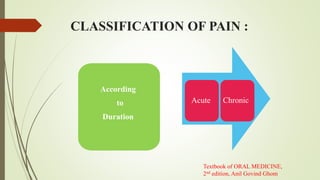
CLASSIFICATION OF PAIN :
According
to
Duration
Acute Chronic
Textbook of ORAL MEDICINE,
2nd edition, Anil Govind Ghom
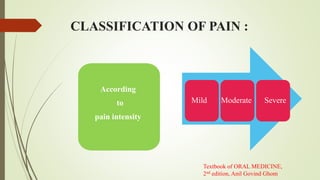
CLASSIFICATION OF PAIN :
According
to
pain intensity
Mild Moderate Severe
Textbook of ORAL MEDICINE,
2nd edition, Anil Govind Ghom
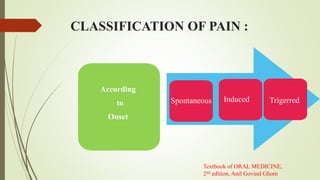
CLASSIFICATION OF PAIN :
According
to
Onset
Spontaneous Induced Trigerred
Textbook of ORAL MEDICINE,
2nd edition, Anil Govind Ghom
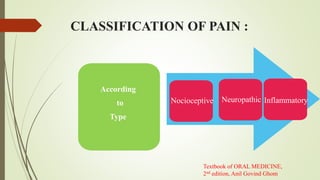
CLASSIFICATION OF PAIN :
According
to
Type
Nocioceptive Neuropathic Inflammatory
Textbook of ORAL MEDICINE,
2nd edition, Anil Govind Ghom
CLASSIFICATION OF PAIN :
According
to
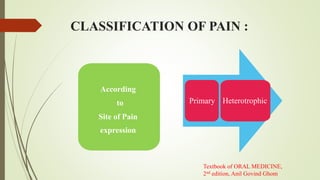
Site of Pain
expression
Primary Heterotrophic
Textbook of ORAL MEDICINE,
2nd edition, Anil Govind Ghom
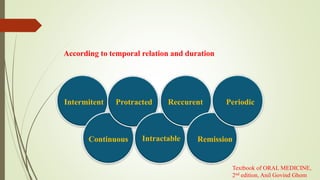
According to temporal relation and duration
Intermitent
Continuous
Protracted
Intractable
Reccurent
Remission
Periodic
Textbook of ORAL MEDICINE,
2nd edition, Anil Govind Ghom
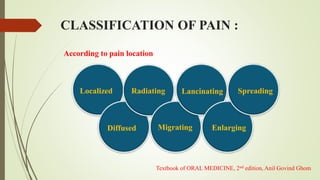
According to pain location
Localized
Diffused
Radiating
Migrating
Lancinating
Enlarging
Spreading
CLASSIFICATION OF PAIN :
Textbook of ORAL MEDICINE, 2nd edition, Anil Govind Ghom
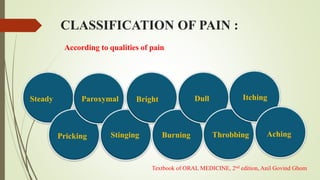
According to qualities of pain
Steady
Pricking
Paroxymal
Stinging
Bright
Burning
Dull
CLASSIFICATION OF PAIN :
Throbbing
Itching
Aching
Textbook of ORAL MEDICINE, 2nd edition, Anil Govind Ghom
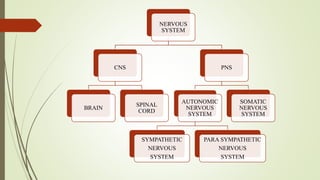
NERVOUS SYSTEM
NERVOUS
SYSTEM
CNS
BRAIN
SPINAL
CORD
PNS
AUTONOMIC
NERVOUS
SYSTEM
SYMPATHETIC
NERVOUS
SYSTEM
PARA SYMPATHETIC
NERVOUS
SYSTEM
SOMATIC
NERVOUS
SYSTEM
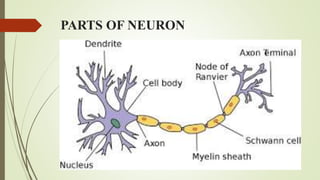
PARTS OF NEURON
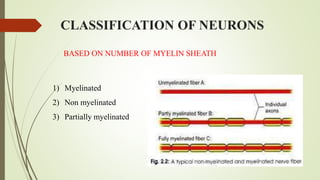
CLASSIFICATION OF NEURONS
BASED ON NUMBER OF MYELIN SHEATH
1) Myelinated
2) Non myelinated
3) Partially myelinated
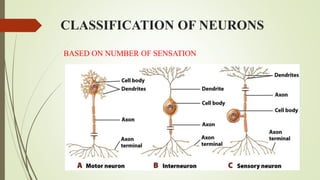
CLASSIFICATION OF NEURONS
BASED ON NUMBER OF SENSATION
CLASSIFICATION OF NEURONS
BASED ON FUNCTION
1) Afferent neuron
2) Efferent neuron
THEORIES OF PAIN
THEORIES OF PAIN MECHANISM
(A) Specificity theory:
๏ƒ˜ 1644, Descartes advocated the concept specific cutaneous receptors pain,
touch, cold, pressure and heat.
๏ƒ˜ He proposed that free nerve endings gave rise to pain sensation in brain.
๏ƒ˜ This theory is concerned primarily with the sensory discrimination aspects
of pain, its quality, location on skin, intensity and duration.
B) Pattern theory
๏‚— Goldschieder 1894
๏‚— He proposed that pain results from over stimulation of other primary
sensations.
๏‚— He proposed that pain resulted when activity exceeded a critical level
due to excessive activation of receptors resulting in convergence and
summation of activity.
C) Gate Control Theory
๏‚— Melzack & Wall 1965
๏‚— Combined the strengths of previous theories and added some of its own.
๏‚— multidimensionality of the pain experience.
๏‚— The term โ€œgateโ€ only refers to the relative amount of inhibition
or facilitation that modulates the activity of the transmission cells carrying
information about noxious stimuli.
๏ƒ˜ Activity in large fibers tends to inhibit transmission (close the gate)
๏ƒ˜ Small fiber activity tends to facilitate transmission (open the gate).
๏ƒ˜ Thus the theory recognizes receptor specificity and mechanisms of
convergence, summation and inhibition.
D) Central Summation Theory (Livingstone)
It proposed that the intense stimulation resulting from the nerve and
tissue damage activates fibers that project to internuncial neuron
pools within the spinal cord creating abnormal reverberating
circuits with self- activating neurons.
E) Intensive Theory (Erb,1874)
Rather, the number of impulses in neurons determines the
intensity of a stimulus.
PAIN PATHWAYS
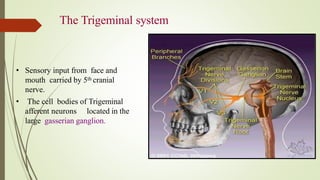
The Trigeminal system
โ€ข Sensory input from face and
mouth carried by 5th cranial
nerve.
โ€ข The cell bodies of Trigeminal
afferent neurons located in the
large gasserian ganglion.
Trigeminal nuclei
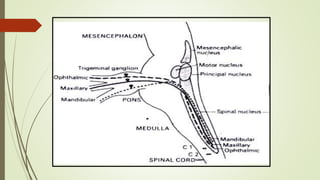
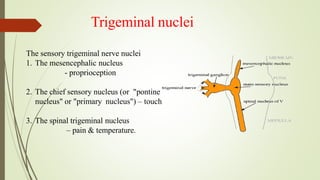
The sensory trigeminal nerve nuclei
1. The mesencephalic nucleus
- proprioception
2. The chief sensory nucleus (or "pontine
nucleus" or "primary nucleus") โ€“ touch
3. The spinal trigeminal nucleus
โ€“ pain & temperature.
SENSORY RECEPTORS
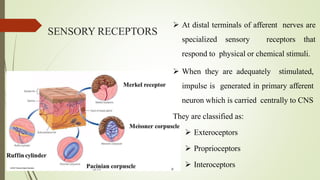
๏ƒ˜ At distal terminals of afferent nerves are
specialized sensory receptors that
respond to physical or chemical stimuli.
๏ƒ˜ When they are adequately stimulated,
impulse is generated in primary afferent
neuron which is carried centrally to CNS
They are classified as:
๏ƒ˜ Exteroceptors
๏ƒ˜ Proprioceptors
๏ƒ˜ Interoceptors
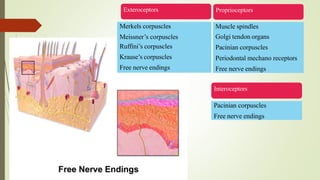
Exteroceptors
Merkels corpuscles
Meissnerโ€™s corpuscles
Ruffiniโ€™s corpuscles
Krauseโ€™s corpuscles
Free nerve endings
Proprioceptors
Muscle spindles
Golgi tendon organs
Pacinian corpuscles
Periodontal mechano receptors
Free nerve endings
Interoceptors
Pacinian corpuscles
Free nerve endings
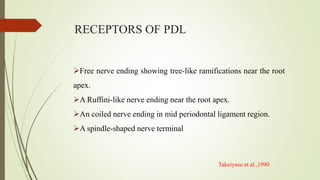
๏ƒ˜Free nerve ending showing tree-like ramifications near the root
apex.
๏ƒ˜A Ruffini-like nerve ending near the root apex.
๏ƒ˜An coiled nerve ending in mid periodontal ligament region.
๏ƒ˜A spindle-shaped nerve terminal
RECEPTORS OF PDL
Takeiyasu et al.,1990
NOCICEPTORS
๏ƒ˜ Sensory receptors for pain, nociceptors, are naked nerve endings
that terminate in the skin and most other tissues of the body.
๏ƒ˜ This โ€˜noxiousโ€™ information is transduced by the receptors into an
electrical signal and transmitted from the periphery to the central
nervous system along axons.
Jacobs et al.,1994
๏ƒ˜ These receptors are generally classified according to the type to
which they respond:
1. Mechanosensitive pain receptors respond to mechanical damage.
2. Thermosensitive pain receptors respond to respond to temperature
extremes.
3. Chemosensitive pain receptors respond to chemicals that occur
with damaged tissues
Jacobs et al.,1994
Chemical pain mediators
๏‚ด Nociceptors activated by
๏‚— Bradykinin
๏‚— Histamine
๏‚— Serotonin
๏‚— Increased potassium
concentration
๏‚— Proteolytic enzymes
๏‚— Acetlycholine
๏‚— Prostaglandins
๏‚— Substance P
๏‚— Interleukins
๏‚— Leukotrienes
Jacobs et al.,1994
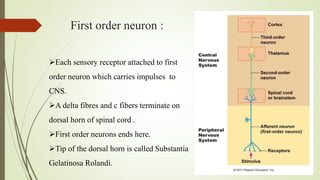
First order neuron :
๏ƒ˜Each sensory receptor attached to first
order neuron which carries impulses to
CNS.
๏ƒ˜A delta fibres and c fibers terminate on
dorsal horn of spinal cord .
๏ƒ˜First order neurons ends here.
๏ƒ˜Tip of the dorsal horn is called Substantia
Gelatinosa Rolandi.
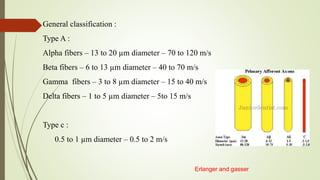
General classification :
Type A :
Alpha fibers โ€“ 13 to 20 ยตm diameter โ€“ 70 to 120 m/s
Beta fibers โ€“ 6 to 13 ยตm diameter โ€“ 40 to 70 m/s
Gamma fibers โ€“ 3 to 8 ยตm diameter โ€“ 15 to 40 m/s
Delta fibers โ€“ 1 to 5 ยตm diameter โ€“ 5to 15 m/s
Type c :
0.5 to 1 ยตm diameter โ€“ 0.5 to 2 m/s
Erlanger and gasser
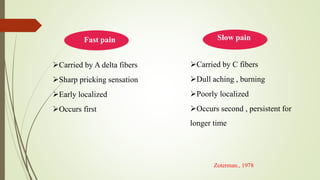
๏ƒ˜Carried by A delta fibers
๏ƒ˜Sharp pricking sensation
๏ƒ˜Early localized
๏ƒ˜Occurs first
๏ƒ˜Carried by C fibers
๏ƒ˜Dull aching , burning
๏ƒ˜Poorly localized
๏ƒ˜Occurs second , persistent for
longer time
Slow painFast pain
Zoterman., 1978
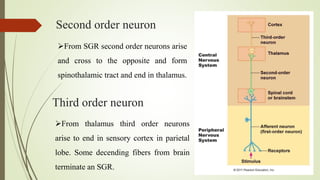
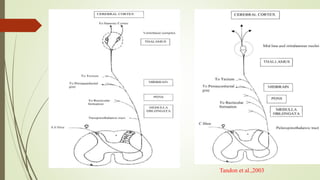
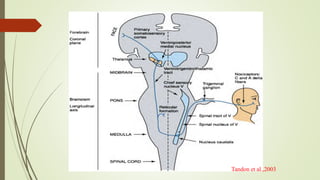
Second order neuron
๏ƒ˜From SGR second order neurons arise
and cross to the opposite and form
spinothalamic tract and end in thalamus.
๏ƒ˜From thalamus third order neurons
arise to end in sensory cortex in parietal
lobe. Some decending fibers from brain
terminate an SGR.
Third order neuron
Tandon et al.,2003
Tandon et al.,2003
Assessment of pain
Assessment of pain
METHOD OF PAIN ASSESSMENT
๏ƒ˜Comprehensive history intake
๏ถ Medical history
๏ถ Physical history
๏ถ Family history
๏ƒ˜Physical exam
๏ƒ˜Questioning on characteristic of pain โ€“ onset, duration, location,
quality, severity & intensity
๏ƒ˜Evaluation of psychological status, functional status, behavior status.
Pain assessment tools
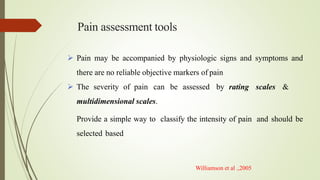
๏ƒ˜ Pain may be accompanied by physiologic signs and symptoms and
there are no reliable objective markers of pain
๏ƒ˜ The severity of pain can be assessed by rating scales &
multidimensional scales.
Provide a simple way to classify the intensity of pain and should be
selected based
Williamson et al .,2005
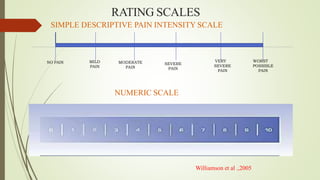
RATING SCALES
SIMPLE DESCRIPTIVE PAIN INTENSITY SCALE
NO PAIN MILD
PAIN
MODERATE
PAIN
SEVERE
PAIN
VERY
SEVERE
PAIN
WORST
POSSIBLE
PAIN
NUMERIC SCALE
Williamson et al .,2005
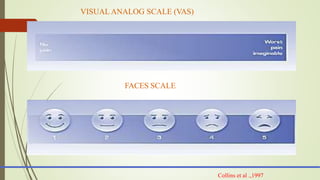
VISUAL ANALOG SCALE (VAS)
FACES SCALE
Collins et al .,1997
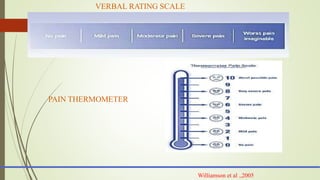
VERBAL RATING SCALE
PAIN THERMOMETER
Williamson et al .,2005
Periodontal pain
International Classification of Orofacial Pain, version 1.0 BETA
Orofacial pain associated with disorders of dentoalveolar and associated structures
Maria Pigg, Sweden (Chair); Alan Law, USA; Donald Nixdorf, USA; Tara Renton,
UK; Yair Sharav, Israel
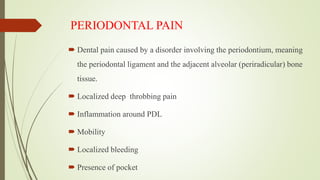
PERIODONTAL PAIN
๏‚ด Dental pain caused by a disorder involving the periodontium, meaning
the periodontal ligament and the adjacent alveolar (periradicular) bone
tissue.
๏‚ด Localized deep throbbing pain
๏‚ด Inflammation around PDL
๏‚ด Mobility
๏‚ด Localized bleeding
๏‚ด Presence of pocket
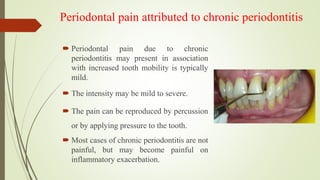
Periodontal pain attributed to chronic periodontitis
๏‚ด Periodontal pain due to chronic
periodontitis may present in association
with increased tooth mobility is typically
mild.
๏‚ด The intensity may be mild to severe.
๏‚ด The pain can be reproduced by percussion
or by applying pressure to the tooth.
๏‚ด Most cases of chronic periodontitis are not
painful, but may become painful on
inflammatory exacerbation.
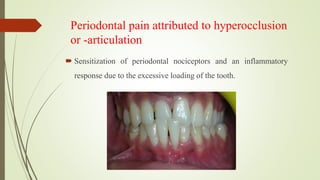
Periodontal pain attributed to hyperocclusion
or -articulation
๏‚ด Sensitization of periodontal nociceptors and an inflammatory
response due to the excessive loading of the tooth.
๏ƒ˜The patient may report that the tooth feels elevated..
๏ƒ˜The pain can be reproduced by percussion or by applying pressure
to the tooth.
๏ƒ˜The tooth may have increased mobility, and if so, radiographic
examination may show widening of the periodontal space.
Diagnostic criteria
๏ƒ˜Periodontal pain has developed in close temporal relation to a
change in occlusal conditions involving the painful tooth
๏ƒ˜Mechanical provocation reproduces the pain
Postoperative periodontal pain
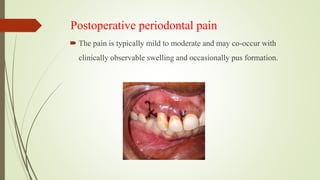
๏‚ด The pain is typically mild to moderate and may co-occur with
clinically observable swelling and occasionally pus formation.
Diagnostic criteria
๏ƒ˜ Periodontal pain has developed in close temporal relation to a surgical
intervention involving the periodontium.
๏ƒ˜If physiologic (primary) healing occurs normally, the pain duration is
typically short (1โ€“2 weeks).
๏ƒ˜Prolonged pain due to secondary healing and/or postoperative infection
is occasionally observed but usually does not exceed 3 months.
Periodontal pain due to accidental dental
trauma
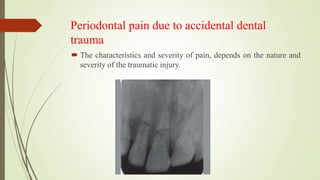
๏‚ด The characteristics and severity of pain, depends on the nature and
severity of the traumatic injury.
Diagnostic criteria
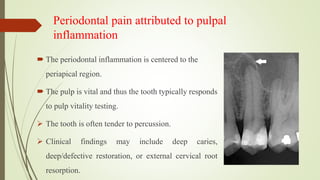
๏ƒ˜Periodontal pain + The history reveals a recent accidental trauma affecting
the tooth.
๏ƒ˜ The tooth has been diagnosed with a traumatic injury based on clinical
and/or radiographic observations
a. concussion , b. subluxation, c. lateral luxation
d. intrusion , e. extrusion , f. avulsion, g. root fracture
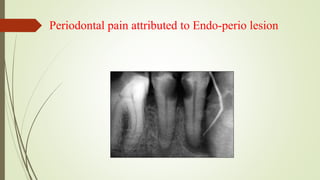
Periodontal pain attributed to pulpal
inflammation
๏‚ด The periodontal inflammation is centered to the
periapical region.
๏‚ด The pulp is vital and thus the tooth typically responds
to pulp vitality testing.
๏ƒ˜ The tooth is often tender to percussion.
๏ƒ˜ Clinical findings may include deep caries,
deep/defective restoration, or external cervical root
resorption.
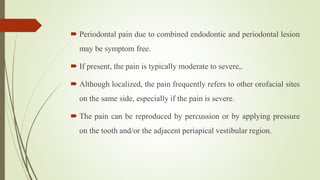
Periodontal pain attributed to Endo-perio lesion
๏‚ด Periodontal pain due to combined endodontic and periodontal lesion
may be symptom free.
๏‚ด If present, the pain is typically moderate to severe,.
๏‚ด Although localized, the pain frequently refers to other orofacial sites
on the same side, especially if the pain is severe.
๏‚ด The pain can be reproduced by percussion or by applying pressure
on the tooth and/or the adjacent periapical vestibular region.
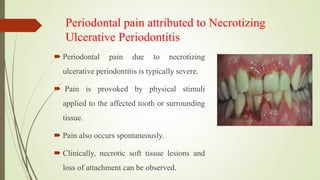
Periodontal pain attributed to Necrotizing
Ulcerative Periodontitis
๏‚ด Periodontal pain due to necrotizing
ulcerative periodontitis is typically severe.
๏‚ด Pain is provoked by physical stimuli
applied to the affected tooth or surrounding
tissue.
๏‚ด Pain also occurs spontaneously.
๏‚ด Clinically, necrotic soft tissue lesions and
loss of attachment can be observed.
Periodontal pain attributed to periodontal abscess
๏‚ด Pain due to this is acute condition is usually severe.
๏‚ด Although localized, the pain frequently refers to other orofacial sites
on the same side, especially if the pain is severe.
๏‚ด The pain can be reproduced by percussion or by applying pressure
on the tooth and/or the adjacent periapical vestibular region.
๏‚ด Imaging shows evidence of marginal and periradicular bone
resorption, which may or may not include the periapical region.
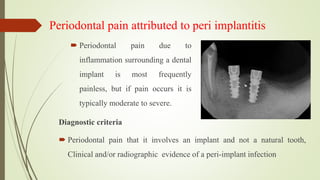
Periodontal pain attributed to peri implantitis
๏‚ด Periodontal pain due to
inflammation surrounding a dental
implant is most frequently
painless, but if pain occurs it is
typically moderate to severe.
Diagnostic criteria
๏‚ด Periodontal pain that it involves an implant and not a natural tooth,
Clinical and/or radiographic evidence of a peri-implant infection
Gingival pain
Gingival pain
Diagnostic criteria
๏ƒ˜ Pain is localized to the site of the gingiva, but may refer to other
ipsilateral orofacial locations
๏ƒ˜Clinical, laboratory, imaging evidence of a lesion or disease of the
gingival tissues, known to be able to cause pain
1. Pain has developed in temporal relation to the onset or appearance of
the lesion
2. Familiar pain is exacerbated by manipulation of the affected gingival
tissue
Gingival pain attributed to gingivitis (gingival
inflammation)
Diagnostic criteria
๏ƒ˜The pain fulfills criteria for Gingival pain
๏ƒ˜The patient has been diagnosed with
gingival inflammation based on the clinical
observation of inflammation signs in the
gingiva (i.e. tumor, dolor, rubor, and calor)
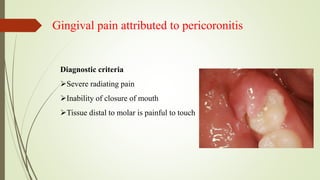
Gingival pain attributed to pericoronitis
Diagnostic criteria
๏ƒ˜Severe radiating pain
๏ƒ˜Inability of closure of mouth
๏ƒ˜Tissue distal to molar is painful to touch
Gingival pain associated with trauma
๏‚ด Traumatic injury of gingival tissues causes acute inflammation and
can be painful to a varying degree.
๏‚ด The pain may be mild to severe and is exacerbated by mechanical
provocation of the gingiva.
๏‚ด Spontaneous pain can occur.
Gingival pain associated with viral infections
๏‚ด Viral infections of the gingival tissues include HSV, VZV, HPV,
CMV, Coxsackievirus and HIV infection.
Diagnostic criteria
๏ƒ˜The infected gingival tissues may often be ulcerated and painful to
touch.
๏ƒ˜Severe local pain is often associated with eating or drinking acidic
or hot or cold foods or drinks, which may cause the individual to be
unable to eat or drink and become dehydrated.
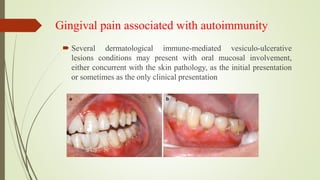
Gingival pain associated with autoimmunity
๏‚ด Several dermatological immune-mediated vesiculo-ulcerative
lesions conditions may present with oral mucosal involvement,
either concurrent with the skin pathology, as the initial presentation
or sometimes as the only clinical presentation
Diagnostic criteria
๏ƒ˜The pain fulfills criteria for Gingival pain
๏ƒ˜The pain may be mild to severe and is exacerbated by mechanical
provocation of the gingiva.
๏ƒ˜Spontaneous pain can occur.
Gingival pain associated with allergic reaction
๏‚ด The pain may be mild to severe and is exacerbated by mechanical
provocation of the gingiva.
๏‚ด Spontaneous pain can occur
Diagnostic criteria
๏ƒ˜ The pain fulfills criteria for Gingival pain
๏ƒ˜Lesions may present with non-specific tissue oedema, erythema,
cracking, ulceration, hyperkeratotic white plaques or mucosal
desquamation
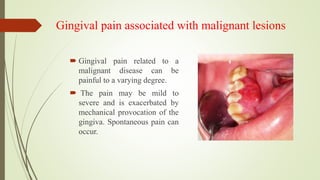
Gingival pain associated with malignant lesions
๏‚ด Gingival pain related to a
malignant disease can be
painful to a varying degree.
๏‚ด The pain may be mild to
severe and is exacerbated by
mechanical provocation of the
gingiva. Spontaneous pain can
occur.
Diagnostic criteria
๏ƒ˜Oral squamous cell carcinoma (OSCC) is the most common,
frequently presenting as ulceration with clinical induration, fixation to
the underlying tissues, rolled exophytic margins, and pain and/or
numbness
Gingival pain associated with trigeminal neuralgia
Diagnostic criteria
๏ƒ˜ The pain fulfills criteria for Gingival pain
๏ƒ˜Trigger points of trigeminal neuralgia may be located in the gingiva,
and
๏ƒ˜Light touch will elicit the typical intense paroxysmal pain attacks
affecting the whole dermatome corresponding to the affected nerve
branch.
๏ƒ˜The diffuse deep pain, โ€œpre-trigeminal neuralgia painโ€, that sometimes
precedes the onset of characteristic paroxysmal pain.
Management of pain
Control of Pain
Methods:
1) Removing the cause
2) Blocking the pathway of painful impulses e.g. Local anaesthetics
3) Raising the pain threshold e.g. aspirin and other pharmacological agents.
4) Preventing pain reaction by cortical depression e.g. general anaesthesia
5) Using psychosomatic methods e.g. hypnosis, faith healing
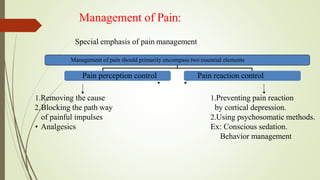
Management of Pain:
Special emphasis of pain management
Management of pain should primarily encompass two essential elements
Pain perception control Pain reaction control
1.Removing the cause
2.Blocking the path way
of painful impulses
โ€ข Analgesics
1.Preventing pain reaction
by cortical depression.
2.Using psychosomatic methods.
Ex: Conscious sedation.
Behavior management
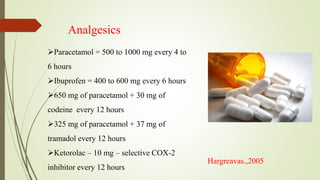
๏ƒ˜Paracetamol = 500 to 1000 mg every 4 to
6 hours
๏ƒ˜Ibuprofen = 400 to 600 mg every 6 hours
๏ƒ˜650 mg of paracetamol + 30 mg of
codeine every 12 hours
๏ƒ˜325 mg of paracetamol + 37 mg of
tramadol every 12 hours
๏ƒ˜Ketorolac โ€“ 10 mg โ€“ selective COX-2
inhibitor every 12 hours
Analgesics
Hargreavas.,2005
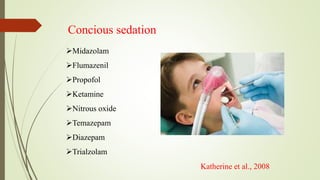
๏ƒ˜Midazolam
๏ƒ˜Flumazenil
๏ƒ˜Propofol
๏ƒ˜Ketamine
๏ƒ˜Nitrous oxide
๏ƒ˜Temazepam
๏ƒ˜Diazepam
๏ƒ˜Trialzolam
Concious sedation
Katherine et al., 2008
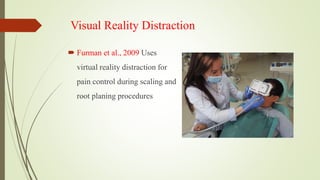
Visual Reality Distraction
๏‚ด Furman et al., 2009 Uses
virtual reality distraction for
pain control during scaling and
root planing procedures
Local Anesthesia
๏‚ด Most commonly used to control pain
๏‚ด Local anesthesia forms the backbone of pain control techniques in
dentistry and local anesthetics are the safest and most effective
drugs in all of medicine for the prevention and management of pain
Painless Periodontal Probing
๏‚ด Uses of intrapocket anesthetic gel during periodontal probing.
๏‚ด 20% benzocaine gel showed favaroble anesthetic efficacy compared
to 2% lidocaine gel in reducing pain on periodontal probing .
Arunkumar et al , 2017
Computer-controlled Local Anesthetic
Delivery Systems [CCLAD]
๏‚ด It is essential to deliver local
anesthetic solution at a
constant rate and slower
speed to avoid causing
discomfort to the patient.
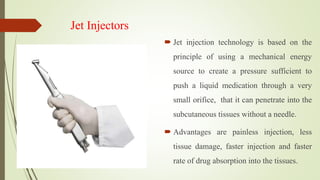
Jet Injectors
๏‚ด Jet injection technology is based on the
principle of using a mechanical energy
source to create a pressure sufficient to
push a liquid medication through a very
small orifice, that it can penetrate into the
subcutaneous tissues without a needle.
๏‚ด Advantages are painless injection, less
tissue damage, faster injection and faster
rate of drug absorption into the tissues.
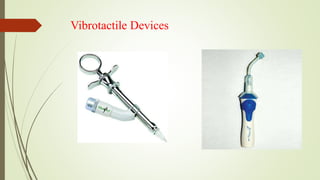
Vibrotactile Devices
๏‚ด These devices work on the principle of โ€˜gate controlโ€™ theory thereby
reduces pain.
๏‚ด It acts based on the fact that the vibration message is carried to brain
through insulated nerves and pain message through smaller
uninsulated nerves.
๏‚ด The insulated nerves overrule the smaller uninsulated nerves.
๏‚ด The devices are: vibraject, dental vibe, accupal.
Dentipatch (Intraoral lignocaine patch)
๏‚ด Dentipatch contains 10-20%
lidocaine, which is placed on dried
mucosa for 15 minutes.
๏‚ด Hersh et al (1996) studied the
efficacy of this patch and
recommended it for use in achieving
topical anesthesia for injections in
both maxilla and mandible.
Conclusion
Conclusion
Every day patient seeks care for the reduction or elimination of pain.
Nothing is more satisfying to the clinician than the successful
elimination of pain. The most important part of managing pain is
understanding the problem and cause of pain. It is only through
proper diagnosis that appropriate therapy can be selected.
References
๏ƒ˜ Tandon OP, Malhotra V, Tandon S, D'silva I. Neurophysiology of pain: insight to
orofacial pain. Indian journal of physiology and pharmacology. 2003 Jul;47:247-69.
๏ƒ˜ Jacobs R, van Steenberghe D. Role of periodontal ligament receptors in the tactile
function of teeth: a review. Journal of periodontal research. 1994 May;29(3):153-67.
๏ƒ˜ Chintala K, Kumar SP, Murthy KR. Comparative evaluation of effectiveness of intra-
pocket anesthetic gel and injected local anesthesia during scaling and root planingโ€“A
split-mouth clinical trial. Indian Journal of Dental Research. 2017 May 1;28(3):281.
References :
๏ƒ˜ Okeson JP. Bell's orofacial pains: the clinical management of orofacial pain. Chicago,
Ill, USA: Quintessence Publishing Company; 2005 Jan 1.
๏ƒ˜ Treede RD, Rief W, Barke A, Aziz Q, Bennett MI, Benoliel R, Cohen M, Evers S,
Finnerup NB, First MB, Giamberardino MA. Chronic pain as a symptom or a disease:
the IASP Classification of Chronic Pain for the: International Classification of
Diseases:(: ICD-11:). Pain. 2019 Jan 1;160(1):19-27.
๏ƒ˜ Kumar KH, Elavarasi P. Definition of pain and classification of pain disorders.
Journal of Advanced Clinical and Research Insights. 2016 May 1;3(3):87-90.
๏ƒ˜ Renton T, Durham J, Aggarwal VR. The classification and differential diagnosis of
orofacial pain. Expert review of neurotherapeutics. 2012 May 1;12(5):569-76.
๏ƒ˜ Baume RM, Croog SH, Nalbandian J. Pain perception, coping strategies, and stress
management among periodontal patients with repeated surgeries. Perceptual and
motor skills. 1995 Feb;80(1):307-19.
๏ƒ˜ Furman E, Jasinevicius TR, Bissada NF, Victoroff KZ, Skillicorn R, Buchner M.
Virtual reality distraction for pain control during periodontal scaling and root planing
procedures. The Journal of the American Dental Association. 2009 Dec
1;140(12):1508-16.
๏ƒ˜ Hargreaves K, Abbott PV. Drugs for pain management in dentistry. Australian dental
journal. 2005 Dec;50:S14-22.
๏ƒ˜ Li A, Montaรฑo Z, Chen VJ, Gold JI. Virtual reality and pain management: current
trends and future directions. Pain management. 2011 Mar;1(2):147-57.
๏ƒ˜ McCormack HM, David JD, Sheather S. Clinical applications of visual analogue scales:
a critical review. Psychological medicine. 1988 Nov;18(4):1007-19.
๏ƒ˜ Maeda T, Kannari K, Sato O, Iwanaga T. Nerve terminals in human periodontal ligament
as demonstrated by immunohistochemistry for neurofilament protein (NFP) and S-100
protein. Archives of histology and cytology. 1990;53(3):259-65.
๏ƒ˜ Perry DA, Gansky SA, Loomer PM. Effectiveness of a transmucosal lidocaine delivery
system for local anaesthesia during scaling and root planing. Journal of clinical
periodontology. 2005 Jun;32(6):590-4.
๏ƒ˜ Textbook of oral medicine, 2nd edition Anil Govind Ghom

Pain and periodontics

  • 1.
    Pain and itsrelation to Periodontics PAIN
  • 2.
    ๏‚ง Introduction ๏‚ง Definition ๏‚งHistorical note ๏‚ง Classification of pain ๏‚ง Nervous system ๏‚ง Theories of pain CONTENTS : ๏‚ง Pain pathway ๏‚ง Assessment of pain ๏‚ง Periodontal pain ๏‚ง Gingival pain ๏‚ง Management of pain ๏‚ง Conclusion
  • 3.
    Introduction : ๏‚ด Painis a sensory experience of special clinical significance to dentists. ๏‚ด Pain is the commonest symptom which dentist are called upon to treat. ๏‚ด Pain is intensely subjective experience and is therefore difficult to describe.
  • 4.
    ๏ƒ˜First it isunpleasant experience and secondly it is evoked by a stimulus which is actually or potentially damaging to living tissues. ๏ƒ˜Although it is unpleasant , pain serve as a protective function by making us aware of actual or impending damage to the body. ๏ƒ˜Apart from its obvious applied value, study of physiology of pain has taught us a lot about diagnosis and treatment plan in general.
  • 5.
    Definition: โ€ข Pain isan unpleasant sensory and emotional experience associated with actual or potential tissue damage or described in terms of such damage (Mersky 1986). (International Association for Study of Pain) โ€ข An unpleasant emotional experience usually initiated by noxious stimulus and transmitted over a specialized neural network to the CNS where it is interpreted as such - Monheim
  • 6.
    Historical note : ๏ถThe word pain is derived from โ€˜poineโ€™ meaning penalty or payment, which certain religious segments have translated it s synonyms for punishment. ๏ถ Homer thought that pain was result of arrows shot by god ๏ถ Aristotle was the first to distinguish five physical senses considering โ€œpain as passion of soulโ€ ๏ถ Plato described pain as emotional experience more than a localized body disturbance ๏ถ John Bonica- father of pain
  • 7.
  • 8.
    CLASSIFICATION OF PAIN: According to Duration Acute Chronic Textbook of ORAL MEDICINE, 2nd edition, Anil Govind Ghom
  • 9.
    CLASSIFICATION OF PAIN: According to pain intensity Mild Moderate Severe Textbook of ORAL MEDICINE, 2nd edition, Anil Govind Ghom
  • 10.
    CLASSIFICATION OF PAIN: According to Onset Spontaneous Induced Trigerred Textbook of ORAL MEDICINE, 2nd edition, Anil Govind Ghom
  • 11.
    CLASSIFICATION OF PAIN: According to Type Nocioceptive Neuropathic Inflammatory Textbook of ORAL MEDICINE, 2nd edition, Anil Govind Ghom
  • 12.
    CLASSIFICATION OF PAIN: According to Site of Pain expression Primary Heterotrophic Textbook of ORAL MEDICINE, 2nd edition, Anil Govind Ghom
  • 13.
    According to temporalrelation and duration Intermitent Continuous Protracted Intractable Reccurent Remission Periodic Textbook of ORAL MEDICINE, 2nd edition, Anil Govind Ghom
  • 14.
    According to painlocation Localized Diffused Radiating Migrating Lancinating Enlarging Spreading CLASSIFICATION OF PAIN : Textbook of ORAL MEDICINE, 2nd edition, Anil Govind Ghom
  • 15.
    According to qualitiesof pain Steady Pricking Paroxymal Stinging Bright Burning Dull CLASSIFICATION OF PAIN : Throbbing Itching Aching Textbook of ORAL MEDICINE, 2nd edition, Anil Govind Ghom
  • 16.
  • 17.
  • 18.
  • 19.
    CLASSIFICATION OF NEURONS BASEDON NUMBER OF MYELIN SHEATH 1) Myelinated 2) Non myelinated 3) Partially myelinated
  • 20.
    CLASSIFICATION OF NEURONS BASEDON NUMBER OF SENSATION
  • 21.
    CLASSIFICATION OF NEURONS BASEDON FUNCTION 1) Afferent neuron 2) Efferent neuron
  • 22.
  • 23.
    THEORIES OF PAINMECHANISM (A) Specificity theory: ๏ƒ˜ 1644, Descartes advocated the concept specific cutaneous receptors pain, touch, cold, pressure and heat. ๏ƒ˜ He proposed that free nerve endings gave rise to pain sensation in brain. ๏ƒ˜ This theory is concerned primarily with the sensory discrimination aspects of pain, its quality, location on skin, intensity and duration.
  • 24.
    B) Pattern theory ๏‚—Goldschieder 1894 ๏‚— He proposed that pain results from over stimulation of other primary sensations. ๏‚— He proposed that pain resulted when activity exceeded a critical level due to excessive activation of receptors resulting in convergence and summation of activity.
  • 25.
    C) Gate ControlTheory ๏‚— Melzack & Wall 1965 ๏‚— Combined the strengths of previous theories and added some of its own. ๏‚— multidimensionality of the pain experience. ๏‚— The term โ€œgateโ€ only refers to the relative amount of inhibition or facilitation that modulates the activity of the transmission cells carrying information about noxious stimuli.
  • 26.
    ๏ƒ˜ Activity inlarge fibers tends to inhibit transmission (close the gate) ๏ƒ˜ Small fiber activity tends to facilitate transmission (open the gate). ๏ƒ˜ Thus the theory recognizes receptor specificity and mechanisms of convergence, summation and inhibition.
  • 27.
    D) Central SummationTheory (Livingstone) It proposed that the intense stimulation resulting from the nerve and tissue damage activates fibers that project to internuncial neuron pools within the spinal cord creating abnormal reverberating circuits with self- activating neurons. E) Intensive Theory (Erb,1874) Rather, the number of impulses in neurons determines the intensity of a stimulus.
  • 28.
  • 29.
    The Trigeminal system โ€ขSensory input from face and mouth carried by 5th cranial nerve. โ€ข The cell bodies of Trigeminal afferent neurons located in the large gasserian ganglion.
  • 31.
    Trigeminal nuclei The sensorytrigeminal nerve nuclei 1. The mesencephalic nucleus - proprioception 2. The chief sensory nucleus (or "pontine nucleus" or "primary nucleus") โ€“ touch 3. The spinal trigeminal nucleus โ€“ pain & temperature.
  • 32.
    SENSORY RECEPTORS ๏ƒ˜ Atdistal terminals of afferent nerves are specialized sensory receptors that respond to physical or chemical stimuli. ๏ƒ˜ When they are adequately stimulated, impulse is generated in primary afferent neuron which is carried centrally to CNS They are classified as: ๏ƒ˜ Exteroceptors ๏ƒ˜ Proprioceptors ๏ƒ˜ Interoceptors
  • 33.
    Exteroceptors Merkels corpuscles Meissnerโ€™s corpuscles Ruffiniโ€™scorpuscles Krauseโ€™s corpuscles Free nerve endings Proprioceptors Muscle spindles Golgi tendon organs Pacinian corpuscles Periodontal mechano receptors Free nerve endings Interoceptors Pacinian corpuscles Free nerve endings
  • 34.
    ๏ƒ˜Free nerve endingshowing tree-like ramifications near the root apex. ๏ƒ˜A Ruffini-like nerve ending near the root apex. ๏ƒ˜An coiled nerve ending in mid periodontal ligament region. ๏ƒ˜A spindle-shaped nerve terminal RECEPTORS OF PDL Takeiyasu et al.,1990
  • 35.
    NOCICEPTORS ๏ƒ˜ Sensory receptorsfor pain, nociceptors, are naked nerve endings that terminate in the skin and most other tissues of the body. ๏ƒ˜ This โ€˜noxiousโ€™ information is transduced by the receptors into an electrical signal and transmitted from the periphery to the central nervous system along axons. Jacobs et al.,1994
  • 36.
    ๏ƒ˜ These receptorsare generally classified according to the type to which they respond: 1. Mechanosensitive pain receptors respond to mechanical damage. 2. Thermosensitive pain receptors respond to respond to temperature extremes. 3. Chemosensitive pain receptors respond to chemicals that occur with damaged tissues Jacobs et al.,1994
  • 37.
    Chemical pain mediators ๏‚ดNociceptors activated by ๏‚— Bradykinin ๏‚— Histamine ๏‚— Serotonin ๏‚— Increased potassium concentration ๏‚— Proteolytic enzymes ๏‚— Acetlycholine ๏‚— Prostaglandins ๏‚— Substance P ๏‚— Interleukins ๏‚— Leukotrienes Jacobs et al.,1994
  • 38.
    First order neuron: ๏ƒ˜Each sensory receptor attached to first order neuron which carries impulses to CNS. ๏ƒ˜A delta fibres and c fibers terminate on dorsal horn of spinal cord . ๏ƒ˜First order neurons ends here. ๏ƒ˜Tip of the dorsal horn is called Substantia Gelatinosa Rolandi.
  • 39.
    General classification : TypeA : Alpha fibers โ€“ 13 to 20 ยตm diameter โ€“ 70 to 120 m/s Beta fibers โ€“ 6 to 13 ยตm diameter โ€“ 40 to 70 m/s Gamma fibers โ€“ 3 to 8 ยตm diameter โ€“ 15 to 40 m/s Delta fibers โ€“ 1 to 5 ยตm diameter โ€“ 5to 15 m/s Type c : 0.5 to 1 ยตm diameter โ€“ 0.5 to 2 m/s Erlanger and gasser
  • 40.
    ๏ƒ˜Carried by Adelta fibers ๏ƒ˜Sharp pricking sensation ๏ƒ˜Early localized ๏ƒ˜Occurs first ๏ƒ˜Carried by C fibers ๏ƒ˜Dull aching , burning ๏ƒ˜Poorly localized ๏ƒ˜Occurs second , persistent for longer time Slow painFast pain Zoterman., 1978
  • 41.
    Second order neuron ๏ƒ˜FromSGR second order neurons arise and cross to the opposite and form spinothalamic tract and end in thalamus. ๏ƒ˜From thalamus third order neurons arise to end in sensory cortex in parietal lobe. Some decending fibers from brain terminate an SGR. Third order neuron
  • 42.
  • 43.
  • 44.
  • 45.
    Assessment of pain METHODOF PAIN ASSESSMENT ๏ƒ˜Comprehensive history intake ๏ถ Medical history ๏ถ Physical history ๏ถ Family history ๏ƒ˜Physical exam ๏ƒ˜Questioning on characteristic of pain โ€“ onset, duration, location, quality, severity & intensity ๏ƒ˜Evaluation of psychological status, functional status, behavior status.
  • 46.
    Pain assessment tools ๏ƒ˜Pain may be accompanied by physiologic signs and symptoms and there are no reliable objective markers of pain ๏ƒ˜ The severity of pain can be assessed by rating scales & multidimensional scales. Provide a simple way to classify the intensity of pain and should be selected based Williamson et al .,2005
  • 47.
    RATING SCALES SIMPLE DESCRIPTIVEPAIN INTENSITY SCALE NO PAIN MILD PAIN MODERATE PAIN SEVERE PAIN VERY SEVERE PAIN WORST POSSIBLE PAIN NUMERIC SCALE Williamson et al .,2005
  • 48.
    VISUAL ANALOG SCALE(VAS) FACES SCALE Collins et al .,1997
  • 49.
    VERBAL RATING SCALE PAINTHERMOMETER Williamson et al .,2005
  • 50.
    Periodontal pain International Classificationof Orofacial Pain, version 1.0 BETA Orofacial pain associated with disorders of dentoalveolar and associated structures Maria Pigg, Sweden (Chair); Alan Law, USA; Donald Nixdorf, USA; Tara Renton, UK; Yair Sharav, Israel
  • 51.
    PERIODONTAL PAIN ๏‚ด Dentalpain caused by a disorder involving the periodontium, meaning the periodontal ligament and the adjacent alveolar (periradicular) bone tissue. ๏‚ด Localized deep throbbing pain ๏‚ด Inflammation around PDL ๏‚ด Mobility ๏‚ด Localized bleeding ๏‚ด Presence of pocket
  • 52.
    Periodontal pain attributedto chronic periodontitis ๏‚ด Periodontal pain due to chronic periodontitis may present in association with increased tooth mobility is typically mild. ๏‚ด The intensity may be mild to severe. ๏‚ด The pain can be reproduced by percussion or by applying pressure to the tooth. ๏‚ด Most cases of chronic periodontitis are not painful, but may become painful on inflammatory exacerbation.
  • 53.
    Periodontal pain attributedto hyperocclusion or -articulation ๏‚ด Sensitization of periodontal nociceptors and an inflammatory response due to the excessive loading of the tooth.
  • 54.
    ๏ƒ˜The patient mayreport that the tooth feels elevated.. ๏ƒ˜The pain can be reproduced by percussion or by applying pressure to the tooth. ๏ƒ˜The tooth may have increased mobility, and if so, radiographic examination may show widening of the periodontal space. Diagnostic criteria ๏ƒ˜Periodontal pain has developed in close temporal relation to a change in occlusal conditions involving the painful tooth ๏ƒ˜Mechanical provocation reproduces the pain
  • 55.
    Postoperative periodontal pain ๏‚ดThe pain is typically mild to moderate and may co-occur with clinically observable swelling and occasionally pus formation.
  • 56.
    Diagnostic criteria ๏ƒ˜ Periodontalpain has developed in close temporal relation to a surgical intervention involving the periodontium. ๏ƒ˜If physiologic (primary) healing occurs normally, the pain duration is typically short (1โ€“2 weeks). ๏ƒ˜Prolonged pain due to secondary healing and/or postoperative infection is occasionally observed but usually does not exceed 3 months.
  • 57.
    Periodontal pain dueto accidental dental trauma ๏‚ด The characteristics and severity of pain, depends on the nature and severity of the traumatic injury.
  • 58.
    Diagnostic criteria ๏ƒ˜Periodontal pain+ The history reveals a recent accidental trauma affecting the tooth. ๏ƒ˜ The tooth has been diagnosed with a traumatic injury based on clinical and/or radiographic observations a. concussion , b. subluxation, c. lateral luxation d. intrusion , e. extrusion , f. avulsion, g. root fracture
  • 59.
    Periodontal pain attributedto pulpal inflammation ๏‚ด The periodontal inflammation is centered to the periapical region. ๏‚ด The pulp is vital and thus the tooth typically responds to pulp vitality testing. ๏ƒ˜ The tooth is often tender to percussion. ๏ƒ˜ Clinical findings may include deep caries, deep/defective restoration, or external cervical root resorption.
  • 60.
    Periodontal pain attributedto Endo-perio lesion
  • 61.
    ๏‚ด Periodontal paindue to combined endodontic and periodontal lesion may be symptom free. ๏‚ด If present, the pain is typically moderate to severe,. ๏‚ด Although localized, the pain frequently refers to other orofacial sites on the same side, especially if the pain is severe. ๏‚ด The pain can be reproduced by percussion or by applying pressure on the tooth and/or the adjacent periapical vestibular region.
  • 62.
    Periodontal pain attributedto Necrotizing Ulcerative Periodontitis ๏‚ด Periodontal pain due to necrotizing ulcerative periodontitis is typically severe. ๏‚ด Pain is provoked by physical stimuli applied to the affected tooth or surrounding tissue. ๏‚ด Pain also occurs spontaneously. ๏‚ด Clinically, necrotic soft tissue lesions and loss of attachment can be observed.
  • 63.
    Periodontal pain attributedto periodontal abscess ๏‚ด Pain due to this is acute condition is usually severe. ๏‚ด Although localized, the pain frequently refers to other orofacial sites on the same side, especially if the pain is severe. ๏‚ด The pain can be reproduced by percussion or by applying pressure on the tooth and/or the adjacent periapical vestibular region. ๏‚ด Imaging shows evidence of marginal and periradicular bone resorption, which may or may not include the periapical region.
  • 64.
    Periodontal pain attributedto peri implantitis ๏‚ด Periodontal pain due to inflammation surrounding a dental implant is most frequently painless, but if pain occurs it is typically moderate to severe. Diagnostic criteria ๏‚ด Periodontal pain that it involves an implant and not a natural tooth, Clinical and/or radiographic evidence of a peri-implant infection
  • 65.
  • 66.
    Gingival pain Diagnostic criteria ๏ƒ˜Pain is localized to the site of the gingiva, but may refer to other ipsilateral orofacial locations ๏ƒ˜Clinical, laboratory, imaging evidence of a lesion or disease of the gingival tissues, known to be able to cause pain 1. Pain has developed in temporal relation to the onset or appearance of the lesion 2. Familiar pain is exacerbated by manipulation of the affected gingival tissue
  • 67.
    Gingival pain attributedto gingivitis (gingival inflammation) Diagnostic criteria ๏ƒ˜The pain fulfills criteria for Gingival pain ๏ƒ˜The patient has been diagnosed with gingival inflammation based on the clinical observation of inflammation signs in the gingiva (i.e. tumor, dolor, rubor, and calor)
  • 68.
    Gingival pain attributedto pericoronitis Diagnostic criteria ๏ƒ˜Severe radiating pain ๏ƒ˜Inability of closure of mouth ๏ƒ˜Tissue distal to molar is painful to touch
  • 69.
    Gingival pain associatedwith trauma ๏‚ด Traumatic injury of gingival tissues causes acute inflammation and can be painful to a varying degree. ๏‚ด The pain may be mild to severe and is exacerbated by mechanical provocation of the gingiva. ๏‚ด Spontaneous pain can occur.
  • 70.
    Gingival pain associatedwith viral infections ๏‚ด Viral infections of the gingival tissues include HSV, VZV, HPV, CMV, Coxsackievirus and HIV infection. Diagnostic criteria ๏ƒ˜The infected gingival tissues may often be ulcerated and painful to touch. ๏ƒ˜Severe local pain is often associated with eating or drinking acidic or hot or cold foods or drinks, which may cause the individual to be unable to eat or drink and become dehydrated.
  • 71.
    Gingival pain associatedwith autoimmunity ๏‚ด Several dermatological immune-mediated vesiculo-ulcerative lesions conditions may present with oral mucosal involvement, either concurrent with the skin pathology, as the initial presentation or sometimes as the only clinical presentation
  • 72.
    Diagnostic criteria ๏ƒ˜The painfulfills criteria for Gingival pain ๏ƒ˜The pain may be mild to severe and is exacerbated by mechanical provocation of the gingiva. ๏ƒ˜Spontaneous pain can occur.
  • 73.
    Gingival pain associatedwith allergic reaction ๏‚ด The pain may be mild to severe and is exacerbated by mechanical provocation of the gingiva. ๏‚ด Spontaneous pain can occur Diagnostic criteria ๏ƒ˜ The pain fulfills criteria for Gingival pain ๏ƒ˜Lesions may present with non-specific tissue oedema, erythema, cracking, ulceration, hyperkeratotic white plaques or mucosal desquamation
  • 74.
    Gingival pain associatedwith malignant lesions ๏‚ด Gingival pain related to a malignant disease can be painful to a varying degree. ๏‚ด The pain may be mild to severe and is exacerbated by mechanical provocation of the gingiva. Spontaneous pain can occur.
  • 75.
    Diagnostic criteria ๏ƒ˜Oral squamouscell carcinoma (OSCC) is the most common, frequently presenting as ulceration with clinical induration, fixation to the underlying tissues, rolled exophytic margins, and pain and/or numbness
  • 76.
    Gingival pain associatedwith trigeminal neuralgia Diagnostic criteria ๏ƒ˜ The pain fulfills criteria for Gingival pain ๏ƒ˜Trigger points of trigeminal neuralgia may be located in the gingiva, and ๏ƒ˜Light touch will elicit the typical intense paroxysmal pain attacks affecting the whole dermatome corresponding to the affected nerve branch. ๏ƒ˜The diffuse deep pain, โ€œpre-trigeminal neuralgia painโ€, that sometimes precedes the onset of characteristic paroxysmal pain.
  • 77.
  • 78.
    Control of Pain Methods: 1)Removing the cause 2) Blocking the pathway of painful impulses e.g. Local anaesthetics 3) Raising the pain threshold e.g. aspirin and other pharmacological agents. 4) Preventing pain reaction by cortical depression e.g. general anaesthesia 5) Using psychosomatic methods e.g. hypnosis, faith healing
  • 79.
    Management of Pain: Specialemphasis of pain management Management of pain should primarily encompass two essential elements Pain perception control Pain reaction control 1.Removing the cause 2.Blocking the path way of painful impulses โ€ข Analgesics 1.Preventing pain reaction by cortical depression. 2.Using psychosomatic methods. Ex: Conscious sedation. Behavior management
  • 80.
    ๏ƒ˜Paracetamol = 500to 1000 mg every 4 to 6 hours ๏ƒ˜Ibuprofen = 400 to 600 mg every 6 hours ๏ƒ˜650 mg of paracetamol + 30 mg of codeine every 12 hours ๏ƒ˜325 mg of paracetamol + 37 mg of tramadol every 12 hours ๏ƒ˜Ketorolac โ€“ 10 mg โ€“ selective COX-2 inhibitor every 12 hours Analgesics Hargreavas.,2005
  • 81.
  • 82.
    Visual Reality Distraction ๏‚ดFurman et al., 2009 Uses virtual reality distraction for pain control during scaling and root planing procedures
  • 83.
    Local Anesthesia ๏‚ด Mostcommonly used to control pain ๏‚ด Local anesthesia forms the backbone of pain control techniques in dentistry and local anesthetics are the safest and most effective drugs in all of medicine for the prevention and management of pain
  • 84.
    Painless Periodontal Probing ๏‚ดUses of intrapocket anesthetic gel during periodontal probing. ๏‚ด 20% benzocaine gel showed favaroble anesthetic efficacy compared to 2% lidocaine gel in reducing pain on periodontal probing . Arunkumar et al , 2017
  • 85.
    Computer-controlled Local Anesthetic DeliverySystems [CCLAD] ๏‚ด It is essential to deliver local anesthetic solution at a constant rate and slower speed to avoid causing discomfort to the patient.
  • 86.
    Jet Injectors ๏‚ด Jetinjection technology is based on the principle of using a mechanical energy source to create a pressure sufficient to push a liquid medication through a very small orifice, that it can penetrate into the subcutaneous tissues without a needle. ๏‚ด Advantages are painless injection, less tissue damage, faster injection and faster rate of drug absorption into the tissues.
  • 87.
  • 88.
    ๏‚ด These deviceswork on the principle of โ€˜gate controlโ€™ theory thereby reduces pain. ๏‚ด It acts based on the fact that the vibration message is carried to brain through insulated nerves and pain message through smaller uninsulated nerves. ๏‚ด The insulated nerves overrule the smaller uninsulated nerves. ๏‚ด The devices are: vibraject, dental vibe, accupal.
  • 89.
    Dentipatch (Intraoral lignocainepatch) ๏‚ด Dentipatch contains 10-20% lidocaine, which is placed on dried mucosa for 15 minutes. ๏‚ด Hersh et al (1996) studied the efficacy of this patch and recommended it for use in achieving topical anesthesia for injections in both maxilla and mandible.
  • 90.
  • 91.
    Conclusion Every day patientseeks care for the reduction or elimination of pain. Nothing is more satisfying to the clinician than the successful elimination of pain. The most important part of managing pain is understanding the problem and cause of pain. It is only through proper diagnosis that appropriate therapy can be selected.
  • 92.
  • 93.
    ๏ƒ˜ Tandon OP,Malhotra V, Tandon S, D'silva I. Neurophysiology of pain: insight to orofacial pain. Indian journal of physiology and pharmacology. 2003 Jul;47:247-69. ๏ƒ˜ Jacobs R, van Steenberghe D. Role of periodontal ligament receptors in the tactile function of teeth: a review. Journal of periodontal research. 1994 May;29(3):153-67. ๏ƒ˜ Chintala K, Kumar SP, Murthy KR. Comparative evaluation of effectiveness of intra- pocket anesthetic gel and injected local anesthesia during scaling and root planingโ€“A split-mouth clinical trial. Indian Journal of Dental Research. 2017 May 1;28(3):281. References :
  • 94.
    ๏ƒ˜ Okeson JP.Bell's orofacial pains: the clinical management of orofacial pain. Chicago, Ill, USA: Quintessence Publishing Company; 2005 Jan 1. ๏ƒ˜ Treede RD, Rief W, Barke A, Aziz Q, Bennett MI, Benoliel R, Cohen M, Evers S, Finnerup NB, First MB, Giamberardino MA. Chronic pain as a symptom or a disease: the IASP Classification of Chronic Pain for the: International Classification of Diseases:(: ICD-11:). Pain. 2019 Jan 1;160(1):19-27. ๏ƒ˜ Kumar KH, Elavarasi P. Definition of pain and classification of pain disorders. Journal of Advanced Clinical and Research Insights. 2016 May 1;3(3):87-90. ๏ƒ˜ Renton T, Durham J, Aggarwal VR. The classification and differential diagnosis of orofacial pain. Expert review of neurotherapeutics. 2012 May 1;12(5):569-76.
  • 95.
    ๏ƒ˜ Baume RM,Croog SH, Nalbandian J. Pain perception, coping strategies, and stress management among periodontal patients with repeated surgeries. Perceptual and motor skills. 1995 Feb;80(1):307-19. ๏ƒ˜ Furman E, Jasinevicius TR, Bissada NF, Victoroff KZ, Skillicorn R, Buchner M. Virtual reality distraction for pain control during periodontal scaling and root planing procedures. The Journal of the American Dental Association. 2009 Dec 1;140(12):1508-16. ๏ƒ˜ Hargreaves K, Abbott PV. Drugs for pain management in dentistry. Australian dental journal. 2005 Dec;50:S14-22. ๏ƒ˜ Li A, Montaรฑo Z, Chen VJ, Gold JI. Virtual reality and pain management: current trends and future directions. Pain management. 2011 Mar;1(2):147-57.
  • 96.
    ๏ƒ˜ McCormack HM,David JD, Sheather S. Clinical applications of visual analogue scales: a critical review. Psychological medicine. 1988 Nov;18(4):1007-19. ๏ƒ˜ Maeda T, Kannari K, Sato O, Iwanaga T. Nerve terminals in human periodontal ligament as demonstrated by immunohistochemistry for neurofilament protein (NFP) and S-100 protein. Archives of histology and cytology. 1990;53(3):259-65. ๏ƒ˜ Perry DA, Gansky SA, Loomer PM. Effectiveness of a transmucosal lidocaine delivery system for local anaesthesia during scaling and root planing. Journal of clinical periodontology. 2005 Jun;32(6):590-4. ๏ƒ˜ Textbook of oral medicine, 2nd edition Anil Govind Ghom