Paediatrics fracture
1. Physeal injury
2. Supracondylar of humerus
fracture
3. Paediatric abuse
SALMIAH BAHRI
Anatomical difference (Children vs adult
bone)
• The long bone in a child is
divided into four regions: the
diaphysis, metaphysis, physis
and the epiphysis.
• In the adult, only the metaphysis
and diaphysis are present
https://www.rch.org.au/fracture-education/anatomy/Anatomic_differences_child_vs_adult/
Biomechanical difference between adult &
child
• The osteoid density of a child's
bone is less than an adult's.
• Juvenile bone is more porous
than adult bone because the
Haversian canals occupy a much
greater part of the bone
• This is the principal reason a
child's bone can bend more than
an adult's bone.
https://www.rch.org.au/fracture-
education/biomechanics/Biomechanical_differences_between_adult_and_child/
Fracture pattern in children
• The ability to bend before breaking leads to unique
fracture patterns in children such as:
• Buckle injury
• Greenstick injury
• Plastic bowing
Buckle injury
• Failure of a child's bone in
compression results in a
"buckle" injury, also known as a
"torus" injury.
• Most commonly occur in the
distal metaphysis, where
porosity is greatest
https://www.rch.org.au/fracture-
education/biomechanics/Biomechanical_differences_between_adult_and_child/
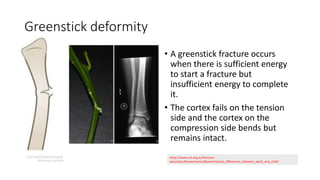
Greenstick deformity
• A greenstick fracture occurs
when there is sufficient energy
to start a fracture but
insufficient energy to complete
it.
• The cortex fails on the tension
side and the cortex on the
compression side bends but
remains intact.
https://www.rch.org.au/fracture-
education/biomechanics/Biomechanical_differences_between_adult_and_child/
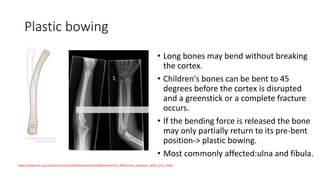
Plastic bowing
• Long bones may bend without breaking
the cortex.
• Children's bones can be bent to 45
degrees before the cortex is disrupted
and a greenstick or a complete fracture
occurs.
• If the bending force is released the bone
may only partially return to its pre-bent
position-> plastic bowing.
• Most commonly affected:ulna and fibula.
https://www.rch.org.au/fracture-education/biomechanics/Biomechanical_differences_between_adult_and_child/
Physeal injury
• The key difference between the child's bone and that of an
adult is the presence of a physis.
• Physeal injuries are very common in children, making up 15-
30% of all bony injuries.
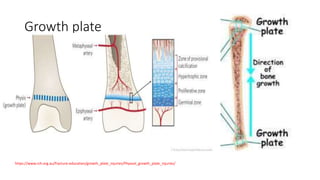
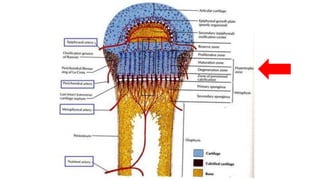
• The growth plate, or physis, is the translucent, cartilaginous disc
separating the epiphysis from the metaphysis and is responsible
for longitudinal growth of long bones.
https://www.rch.org.au/fracture-education/growth_plate_injuries/Physeal_growth_plate_injuries/
Growth plate
https://www.rch.org.au/fracture-education/growth_plate_injuries/Physeal_growth_plate_injuries/
Physeal plate on xray
6%
75% -> most
common
8%
10%
1%, difficult to
see on xray
QUIZ time
Salter Harris Type 1
• AP and lateral x-ray of 10 year
old girl with Salter-Harris type I
fracture.
• Difficult to see on x-ray and are
primarily diagnosed on clinical
findings.
• The key clinical sign is localised
tenderness.
https://www.rch.org.au/clinicalguide/guideline_index/fractures/Dist
al_radial_physeal_fractures_Emergency_Department_setting/
Salter Harris Type 5
• A fracture will not be visible in
an acute injury but is usually
recognised later because of
growth arrest and progressive
deformity.
• This AP and lateral x-ray shows a
bony bar extending across the
growth plate of the distal radius,
indicating the presence of a
growth arrest
https://www.rch.org.au/clinicalguide/guideline_index/fractures/Distal_radial_p
hyseal_fractures_Emergency_Department_setting/
Approach
History Clinical features Examination Xray
• The peak age for injury to the
growth plate is in the pre-adolescent
growth spurt.
• Fall on an outstretched hand.
Extension of the wrist at the time of
injury causes the distal fragment to
be displaced dorsally (posteriorly).
• Pain
• Swelling
• Deformity
• Diminished
spontaneous
movement
• Look for swelling,
bruises, wound
• Localised tenderness
at fracture site
• Assess ROM
• Neurovascular
• Compartment
• Widen physeal gap
• Incongruity of the
joint
https://www.rch.org.au/clinicalguide/guideline_index/fractures/Distal_radial_physeal_fractures
_Emergency_Department_setting/
Management
Salter harris classification (undisplaced) Treatment
Type 1-2 Splinting the part in cast for 2-4 weeks
Type 3-4 • Splinting the part in cast for 2-4 weeks
• Repeat xray after 4days and 10days -> to rule out displacement
Salter harris classification (displaced) Treatment
Type 1-2 CMR then cast for 3-6 weeks
Type 3-4 • CMR then cast for 4-8weeks -> check xray after 4days and
10days to ensure anatomical position has been attained
• If failed, open reduction and K-wire insertion then splinting the
limb for 4-6weeks
Injuries of the physis, Apley and Solomon's concise system of orthopaedics and trauma, pg 332-333
Complications
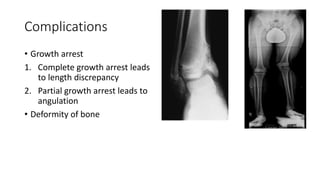
• Growth arrest
1. Complete growth arrest leads
to length discrepancy
2. Partial growth arrest leads to
angulation
• Deformity of bone
How it occur?
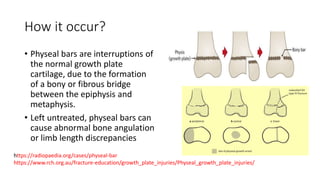
• Physeal bars are interruptions of
the normal growth plate
cartilage, due to the formation
of a bony or fibrous bridge
between the epiphysis and
metaphysis.
• Left untreated, physeal bars can
cause abnormal bone angulation
or limb length discrepancies
https://radiopaedia.org/cases/physeal-bar
https://www.rch.org.au/fracture-education/growth_plate_injuries/Physeal_growth_plate_injuries/
Supracondylar fracture
• A supracondylar fracture occurs
through the thin part of the
distal humerus above the level
of the growth plate.
• occur most commonly in
children aged 5-7years
• M = F
Posteriorly vs anteriorly displaced #
• Flexion-type (rare) - distal fragment
is displaced anteriorly
• Extension-type (98%) - distal
fragment is displaced posteriorly
• The Gartland classification system
is used to describe the severity of
displacement for extension-type
supracondylar fractures.
https://www.rch.org.au/clinicalguide/guideline_index/fr
actures/Supracondylar_fracture_of_the_humerus_Emer
gency_Department/
Supracondylar fracture of humerus
QUIZ time
Approach
History Clinical feature Examination Radiology
• Mechanism of injury: fall
on outstretched hand
• Elbow hyperextended
• Force is trasmitted up
through the ulnar and into
distal humerus
• Fall directly on elbow
rather than outstretched
hand
• Pain
• Swelling
• Bruises
• Wound
• Look for swelling, bruises,
wound
• Assess compartment
• Neurovascular
• ROM
• Breach in cortex of bone
• Baumann angle
• occult sign of fracture:
posterior fat pad sign,
exaggerated anterior fat pad
sign
• Ossification centers of elbow
1.https://www.orthobullets.com/pediatrics/4007/supraco
ndylar-fracture--pediatric
2.https://www.rch.org.au/clinicalguide/guideline_index/fr
actures/Supracondylar_fracture_of_the_humerus_Emerg
ency_Department/
Nerves involved in supracondylar fracture
Nerve assessment
• Anterior interosseus nerve
neuropraxia: motor innervation
- can't make OK sign
• median nerve injury
- loss of sensation over volar aspect
of index finger
• Radial nerve palsy
-inability to extend wrist or MCP
joints
• Ulnar nerve palsy (involved in
flexion type #)
- weakness in adductor pollicis
Xray: Baumann's angle
• AP view
• normal is 70-75°
• best judge is a comparison of the contralateral side
• deviation of >5-10° indicates coronal plane deformity and should not be accepted
https://www.orthobullets.com/pediatrics/4007/supracondylar-fracture--pediatric
Xray: Anterior humeral line
• xray: True lateral view
• line along the anterior surface
of of the humerus should pass
the middle 3rd of capitellum
• capitellum moves posterior to
this reference line in ->
extension type fractures
• capitellum moves anteriorly in
flexion type fracture
https://www.orthobullets.com/pediatrics/4007/supracondylar-fracture--pediatric
Ossification centre (orthobullet)
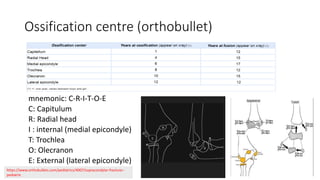
mnemonic: C-R-I-T-O-E
C: Capitulum
R: Radial head
I : internal (medial epicondyle)
T: Trochlea
O: Olecranon
E: External (lateral epicondyle)
https://www.orthobullets.com/pediatrics/4007/supracondylar-fracture--
pediatric
Relevance of ossification centre
• Not to be mistaken for fracture
fragments
• Epiphyseal displacement will not
be detected before these age ->
need to use baumnann's angle
Management
Type Management
Gartland 1 • Nondisplaced
• Treated with cast immobilization x 3-4wks,
with radiographs at 1 wk
Gartland 2 • Displaced posterior cortex and posterior
periosteal hinge intact
• Deformity is in the sagittal plane only
• Typically treated with CRPP
Gartland 3 • Displaced, often in 2 or 3 planes
• Treated most commonly with CRPP or open
reduction if needed
https://www.orthobullets.com/pediatrics/4007/supracondylar-fracture-
-pediatric
Complications
• Vascular injury
• Nerve injury
• Malunion
• Compartment syndrome
• Elbow stiffness
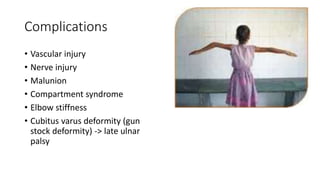
• Cubitus varus deformity (gun
stock deformity) -> late ulnar
palsy
Vascular injury
https://www.orthobullets.com/pediatrics/4007/supracondylar-fracture--pediatric
Advice for parents
• There may be swelling of the elbow, hand and fingers -> rest as much as possible with the elbow and
hand supported on pillows (elbow and hand above the heart)
• The sling may be removed when your child is lying down.
• Encourage your child to bend and straighten the fingers regularly.
• Check their fingers often for movement, feeling and circulation.
• The elbow will be painful initially -> Give a simple painmedication such as paracetamol
Advice for parents
Take your child immediately back to the
hospital emergency department, when,
even after elevating the limb for 30
minutes:
1. the fingers remain very swollen
2. the fingers remain white or blue
3. the child complains of pins and needles,
or numbness in the fingers
4. the child is not be able to move their
fingers, or complains of pain when you
move them
5. there is severe pain that is not relieved
by the recommended medication at the
recommended dose.
Take your child to the hospital you
attended, or the local doctor if:
1. the backslab is cracked, soft, loose or
tight, or has rough edges that hurt
2. you are worried that an object has
been pushed inside the backslab
3. there is increasing pain.
Paediatric abuse
• child abuse is the 2nd most
common cause of death in
children behind accidental injury
• head injury is the most frequent
cause of long term physical
morbidity in the child
• 90% of fractures due to abuse occur
in children < 5 years of age
• 50% of fractures in children < 1 year
of age are attributable to abuse
• 30% of fractures in children < 3 years
of age are attributable to abuse
• the most common cause of femur
fractures in the non ambulatory
infant is non accidental trauma
Risk factors
Child Parents
• first-born
• unplanned pregnancy
• premature
• disabilities (cerebral palsy)
• step-children
• single-parent home
• recent social stressor (move, job loss)
• unemployment
• drug-use
• personal history of abuse as a child
• lower socioeconomic status
• lack of support system
• types (can have more than one
type present):
1. neglect 78%
2. physical abuse 18%
3. sexual 9%
4. psychological 8%
• Prognosis:
If unreported, 30-50% chance of
repeat abuse and 5-10% chance of
death from abuse
Differential diagnosis
• true accidental injury
• osteogenesis imperfecta
• osteopenia of prematurity
• disuse osteopenia
(nonambulatory or minimally
ambulatory children)
• chronic disease (kidney and
liver)
Approach
History Clinical features Radiology Management
• injury often
inconsistent with
history
• delay in seeking care
• long bone fractures in
nonambulatory child
• pain related to
fractures
• bruises: old and new
• deformity
• xray of the involved
bones and joints
• skeletal survey
• report abuse to
appropriate agency
• hospital admission
• cast application
References
• https://www.orthobullets.com/pediatrics/4007/supracondylar-fracture--
pediatric
• https://www.rch.org.au/clinicalguide/guideline_index/fractures/Supracondyla
r_fracture_of_the_humerus_Emergency_Department/
(royal children's hospital of melbourne)
• https://www.orthobullets.com/pediatrics/4002/physeal-considerations
• https://www.rch.org.au/fracture-
education/growth_plate_injuries/Physeal_growth_plate_injuries/
• https://www.orthobullets.com/pediatrics/4001/pediatric-
abuse?expandLeftMenu=true

Paediatrics fracture

  • 1.
    Paediatrics fracture 1. Physealinjury 2. Supracondylar of humerus fracture 3. Paediatric abuse SALMIAH BAHRI
  • 2.
    Anatomical difference (Childrenvs adult bone) • The long bone in a child is divided into four regions: the diaphysis, metaphysis, physis and the epiphysis. • In the adult, only the metaphysis and diaphysis are present https://www.rch.org.au/fracture-education/anatomy/Anatomic_differences_child_vs_adult/
  • 3.
    Biomechanical difference betweenadult & child • The osteoid density of a child's bone is less than an adult's. • Juvenile bone is more porous than adult bone because the Haversian canals occupy a much greater part of the bone • This is the principal reason a child's bone can bend more than an adult's bone. https://www.rch.org.au/fracture- education/biomechanics/Biomechanical_differences_between_adult_and_child/
  • 4.
    Fracture pattern inchildren • The ability to bend before breaking leads to unique fracture patterns in children such as: • Buckle injury • Greenstick injury • Plastic bowing
  • 5.
    Buckle injury • Failureof a child's bone in compression results in a "buckle" injury, also known as a "torus" injury. • Most commonly occur in the distal metaphysis, where porosity is greatest https://www.rch.org.au/fracture- education/biomechanics/Biomechanical_differences_between_adult_and_child/
  • 6.
    Greenstick deformity • Agreenstick fracture occurs when there is sufficient energy to start a fracture but insufficient energy to complete it. • The cortex fails on the tension side and the cortex on the compression side bends but remains intact. https://www.rch.org.au/fracture- education/biomechanics/Biomechanical_differences_between_adult_and_child/
  • 7.
    Plastic bowing • Longbones may bend without breaking the cortex. • Children's bones can be bent to 45 degrees before the cortex is disrupted and a greenstick or a complete fracture occurs. • If the bending force is released the bone may only partially return to its pre-bent position-> plastic bowing. • Most commonly affected:ulna and fibula. https://www.rch.org.au/fracture-education/biomechanics/Biomechanical_differences_between_adult_and_child/
  • 8.
    Physeal injury • Thekey difference between the child's bone and that of an adult is the presence of a physis. • Physeal injuries are very common in children, making up 15- 30% of all bony injuries. • The growth plate, or physis, is the translucent, cartilaginous disc separating the epiphysis from the metaphysis and is responsible for longitudinal growth of long bones. https://www.rch.org.au/fracture-education/growth_plate_injuries/Physeal_growth_plate_injuries/
  • 9.
  • 11.
  • 12.
    6% 75% -> most common 8% 10% 1%,difficult to see on xray
  • 13.
  • 14.
    Salter Harris Type1 • AP and lateral x-ray of 10 year old girl with Salter-Harris type I fracture. • Difficult to see on x-ray and are primarily diagnosed on clinical findings. • The key clinical sign is localised tenderness. https://www.rch.org.au/clinicalguide/guideline_index/fractures/Dist al_radial_physeal_fractures_Emergency_Department_setting/
  • 15.
    Salter Harris Type5 • A fracture will not be visible in an acute injury but is usually recognised later because of growth arrest and progressive deformity. • This AP and lateral x-ray shows a bony bar extending across the growth plate of the distal radius, indicating the presence of a growth arrest https://www.rch.org.au/clinicalguide/guideline_index/fractures/Distal_radial_p hyseal_fractures_Emergency_Department_setting/
  • 16.
    Approach History Clinical featuresExamination Xray • The peak age for injury to the growth plate is in the pre-adolescent growth spurt. • Fall on an outstretched hand. Extension of the wrist at the time of injury causes the distal fragment to be displaced dorsally (posteriorly). • Pain • Swelling • Deformity • Diminished spontaneous movement • Look for swelling, bruises, wound • Localised tenderness at fracture site • Assess ROM • Neurovascular • Compartment • Widen physeal gap • Incongruity of the joint https://www.rch.org.au/clinicalguide/guideline_index/fractures/Distal_radial_physeal_fractures _Emergency_Department_setting/
  • 17.
    Management Salter harris classification(undisplaced) Treatment Type 1-2 Splinting the part in cast for 2-4 weeks Type 3-4 • Splinting the part in cast for 2-4 weeks • Repeat xray after 4days and 10days -> to rule out displacement Salter harris classification (displaced) Treatment Type 1-2 CMR then cast for 3-6 weeks Type 3-4 • CMR then cast for 4-8weeks -> check xray after 4days and 10days to ensure anatomical position has been attained • If failed, open reduction and K-wire insertion then splinting the limb for 4-6weeks Injuries of the physis, Apley and Solomon's concise system of orthopaedics and trauma, pg 332-333
  • 18.
    Complications • Growth arrest 1.Complete growth arrest leads to length discrepancy 2. Partial growth arrest leads to angulation • Deformity of bone
  • 19.
    How it occur? •Physeal bars are interruptions of the normal growth plate cartilage, due to the formation of a bony or fibrous bridge between the epiphysis and metaphysis. • Left untreated, physeal bars can cause abnormal bone angulation or limb length discrepancies https://radiopaedia.org/cases/physeal-bar https://www.rch.org.au/fracture-education/growth_plate_injuries/Physeal_growth_plate_injuries/
  • 20.
    Supracondylar fracture • Asupracondylar fracture occurs through the thin part of the distal humerus above the level of the growth plate. • occur most commonly in children aged 5-7years • M = F
  • 22.
    Posteriorly vs anteriorlydisplaced # • Flexion-type (rare) - distal fragment is displaced anteriorly • Extension-type (98%) - distal fragment is displaced posteriorly • The Gartland classification system is used to describe the severity of displacement for extension-type supracondylar fractures. https://www.rch.org.au/clinicalguide/guideline_index/fr actures/Supracondylar_fracture_of_the_humerus_Emer gency_Department/
  • 23.
  • 24.
  • 25.
    Approach History Clinical featureExamination Radiology • Mechanism of injury: fall on outstretched hand • Elbow hyperextended • Force is trasmitted up through the ulnar and into distal humerus • Fall directly on elbow rather than outstretched hand • Pain • Swelling • Bruises • Wound • Look for swelling, bruises, wound • Assess compartment • Neurovascular • ROM • Breach in cortex of bone • Baumann angle • occult sign of fracture: posterior fat pad sign, exaggerated anterior fat pad sign • Ossification centers of elbow 1.https://www.orthobullets.com/pediatrics/4007/supraco ndylar-fracture--pediatric 2.https://www.rch.org.au/clinicalguide/guideline_index/fr actures/Supracondylar_fracture_of_the_humerus_Emerg ency_Department/
  • 26.
    Nerves involved insupracondylar fracture
  • 27.
    Nerve assessment • Anteriorinterosseus nerve neuropraxia: motor innervation - can't make OK sign • median nerve injury - loss of sensation over volar aspect of index finger • Radial nerve palsy -inability to extend wrist or MCP joints • Ulnar nerve palsy (involved in flexion type #) - weakness in adductor pollicis
  • 28.
    Xray: Baumann's angle •AP view • normal is 70-75° • best judge is a comparison of the contralateral side • deviation of >5-10° indicates coronal plane deformity and should not be accepted https://www.orthobullets.com/pediatrics/4007/supracondylar-fracture--pediatric
  • 29.
    Xray: Anterior humeralline • xray: True lateral view • line along the anterior surface of of the humerus should pass the middle 3rd of capitellum • capitellum moves posterior to this reference line in -> extension type fractures • capitellum moves anteriorly in flexion type fracture https://www.orthobullets.com/pediatrics/4007/supracondylar-fracture--pediatric
  • 30.
    Ossification centre (orthobullet) mnemonic:C-R-I-T-O-E C: Capitulum R: Radial head I : internal (medial epicondyle) T: Trochlea O: Olecranon E: External (lateral epicondyle) https://www.orthobullets.com/pediatrics/4007/supracondylar-fracture-- pediatric
  • 31.
    Relevance of ossificationcentre • Not to be mistaken for fracture fragments • Epiphyseal displacement will not be detected before these age -> need to use baumnann's angle
  • 32.
    Management Type Management Gartland 1• Nondisplaced • Treated with cast immobilization x 3-4wks, with radiographs at 1 wk Gartland 2 • Displaced posterior cortex and posterior periosteal hinge intact • Deformity is in the sagittal plane only • Typically treated with CRPP Gartland 3 • Displaced, often in 2 or 3 planes • Treated most commonly with CRPP or open reduction if needed https://www.orthobullets.com/pediatrics/4007/supracondylar-fracture- -pediatric
  • 33.
    Complications • Vascular injury •Nerve injury • Malunion • Compartment syndrome • Elbow stiffness • Cubitus varus deformity (gun stock deformity) -> late ulnar palsy
  • 34.
  • 35.
    Advice for parents •There may be swelling of the elbow, hand and fingers -> rest as much as possible with the elbow and hand supported on pillows (elbow and hand above the heart) • The sling may be removed when your child is lying down. • Encourage your child to bend and straighten the fingers regularly. • Check their fingers often for movement, feeling and circulation. • The elbow will be painful initially -> Give a simple painmedication such as paracetamol
  • 36.
    Advice for parents Takeyour child immediately back to the hospital emergency department, when, even after elevating the limb for 30 minutes: 1. the fingers remain very swollen 2. the fingers remain white or blue 3. the child complains of pins and needles, or numbness in the fingers 4. the child is not be able to move their fingers, or complains of pain when you move them 5. there is severe pain that is not relieved by the recommended medication at the recommended dose. Take your child to the hospital you attended, or the local doctor if: 1. the backslab is cracked, soft, loose or tight, or has rough edges that hurt 2. you are worried that an object has been pushed inside the backslab 3. there is increasing pain.
  • 37.
    Paediatric abuse • childabuse is the 2nd most common cause of death in children behind accidental injury • head injury is the most frequent cause of long term physical morbidity in the child • 90% of fractures due to abuse occur in children < 5 years of age • 50% of fractures in children < 1 year of age are attributable to abuse • 30% of fractures in children < 3 years of age are attributable to abuse • the most common cause of femur fractures in the non ambulatory infant is non accidental trauma
  • 38.
    Risk factors Child Parents •first-born • unplanned pregnancy • premature • disabilities (cerebral palsy) • step-children • single-parent home • recent social stressor (move, job loss) • unemployment • drug-use • personal history of abuse as a child • lower socioeconomic status • lack of support system
  • 39.
    • types (canhave more than one type present): 1. neglect 78% 2. physical abuse 18% 3. sexual 9% 4. psychological 8% • Prognosis: If unreported, 30-50% chance of repeat abuse and 5-10% chance of death from abuse
  • 40.
    Differential diagnosis • trueaccidental injury • osteogenesis imperfecta • osteopenia of prematurity • disuse osteopenia (nonambulatory or minimally ambulatory children) • chronic disease (kidney and liver)
  • 41.
    Approach History Clinical featuresRadiology Management • injury often inconsistent with history • delay in seeking care • long bone fractures in nonambulatory child • pain related to fractures • bruises: old and new • deformity • xray of the involved bones and joints • skeletal survey • report abuse to appropriate agency • hospital admission • cast application
  • 42.
    References • https://www.orthobullets.com/pediatrics/4007/supracondylar-fracture-- pediatric • https://www.rch.org.au/clinicalguide/guideline_index/fractures/Supracondyla r_fracture_of_the_humerus_Emergency_Department/ (royalchildren's hospital of melbourne) • https://www.orthobullets.com/pediatrics/4002/physeal-considerations • https://www.rch.org.au/fracture- education/growth_plate_injuries/Physeal_growth_plate_injuries/ • https://www.orthobullets.com/pediatrics/4001/pediatric- abuse?expandLeftMenu=true

Editor's Notes

  • #3 royal children's hsptl, melbbourne the diaphysis (shaft or primary ossification centre), metaphysis (where the bone flares), physis (or growth plate) and the epiphysis (secondary ossification centre). In the adult, only the metaphysis and diaphysis are present
  • #6 torus fracture: much more common, metaphyseal and results in buckling of the cortex bowing fracture: the bone is bowed, but there is no discernible fractur
  • #7 torus fracture: much more common, metaphyseal and results in buckling of the cortex bowing fracture: the bone is bowed, but there is no discernible fracture The degree of deformity is variable and sometimes complete reduction can only be achieved by deliberately completing the fracture i.e. fracturing the concave cortex, which is bent but not broken.
  • #8 greenstick fracture: accompanying bowing, there is a visible fracture buckle fracture: there is cortical irregularity physiological bowing stress fracture: there is a periosteal reaction radial bowing Because there is no obvious fracture of the ulna, the injury is frequently not diagnosed, resulting in delayed diagnosis and long-term morbidity. Monteggia fracture is a fracture of the proximal third of the ulna with dislocation of the proximal head of the radius
  • #10 royal children hosptl melbourne what is the 3 zones of hypertrophic zone The key difference between the child's bone and that of an adult is the presence of a physis. Physeal injuries are very common in children, making up 15-30% of all bony injuries. The growth plate, or physis, is the translucent, cartilaginous disc separating the epiphysis from the metaphysis and is responsible for longitudinal growth of long bones.
  • #12 children vs adult
  • #13 xray of salter harris
  • #14 The Salter-Harris type II fracture is the most common type.
  • #16 royal children hsptl https://www.rch.org.au/clinicalguide/guideline_index/fractures/Distal_radial_physeal_fractures_Emergency_Department_setting/
  • #17 physeal: radiolucent in xray, if difficult to assess, need to compare to the contralateral side
  • #18 apley indication for operative intervention https://www.rch.org.au/clinicalguide/guideline_index/fractures/Distal_radial_physeal_fractures_Emergency_Department_setting/
  • #19 pics n explanation 16yo with severe valgus and 7cm LLD after traumatic growth arrest to distal Left femur how does growth arrest and bone deformities affect the pt's ADL and future
  • #20 royal children hsptl melbourne https://radiopaedia.org/articles/physeal-bar-2
  • #21 orthobullet
  • #23 https://www.rch.org.au/clinicalguide/guideline_index/fractures/Supracondylar_fracture_of_the_humerus_Emergency_Department/
  • #24 xray of gartland type 1 non displaced type 2 displaced with intact posterior cortex type 3 displaced completely
  • #25  The Gartland type classification is based on the lateral x-ray, identifying where the capitellum sits in relation to a line drawn down the anterior aspect of the humerus - the anterior humeral line. In a normal elbow, a line drawn on a lateral view along the anterior surface of the humerus should pass through the middle third of the capitellum. To assess this accurately, the view must be a true lateral view of the elbow. If it passes through the anterior third of the capitellum or misses the capitellum completely, the fracture is displaced posteriorly.
  • #27 netter
  • #28 unable to flex the interphalageal joint of his thumb and the distal interphalangeal joint of index finger AIN has principally motor innervation (no cutaneous sensory) and innervates 3 muscles FDP (index and middle finger) FPL pronator quadratus
  • #29 Baumann's angle is created by drawing a line parallel to the longitudinal axis of the humeral shaft and a line along the lateral condylar physis as viewed on the AP image normal is 70-75°, but best judge is a comparison of the contralateral side deviation of >5-10° indicates coronal plane deformity and should not be accepted
  • #30 orthobullet
  • #31 orthobullets important to determine whether bone in elbow represent avulsion fragment or an ossification centre epiphyseal displacement will not be detected on xray before these ages, but will be determined based on baumann's angle
  • #32 important to determine whether bone in elbow represent avulsion fragment or an ossification centre
  • #33 Nonoperative long arm casting with less than 90° of elbow flexion indications Type I (non-displaced) fractures Type II fractures that meet the following criteria anterior humeral line intersects the capitellum minimal swelling present no medial comminution technique typically used for 3 weeks repeat radiographs at 1 week to assess for interval displacement x: not used to avoid ulnar injury but provides more stability anteriorposterior and rotational stability
  • #35 Good..excellenttttt Besides that..u need to think of compartment syndrome also..hahaha ^^ Entah2..pulseless sbb compartment.. =P
  • #41 OI: The underlying mechanism is usually a problem with connective tissue due to a lack of type I collagen Osteopenia, a condition characterised by a reduction in bone mineral content, is a common disease of preterm babies between the tenth and sixteenth week of life. Prematurely born infants are deprived of the intrauterine supply of minerals affecting bone mineralization
  • #42 pain related to fractures fractures are the second most common lesion in abused children q q frequency of fractures humerus > tibia > femur q diaphyseal fractures 4 times more common than metaphyseal hospital admission indications early multidisciplinary evaluation admit infants with fractures to the hospital and consult child protective services obtain social service consult cast application indications most fractures are splinted or casted until adequate callus is formed