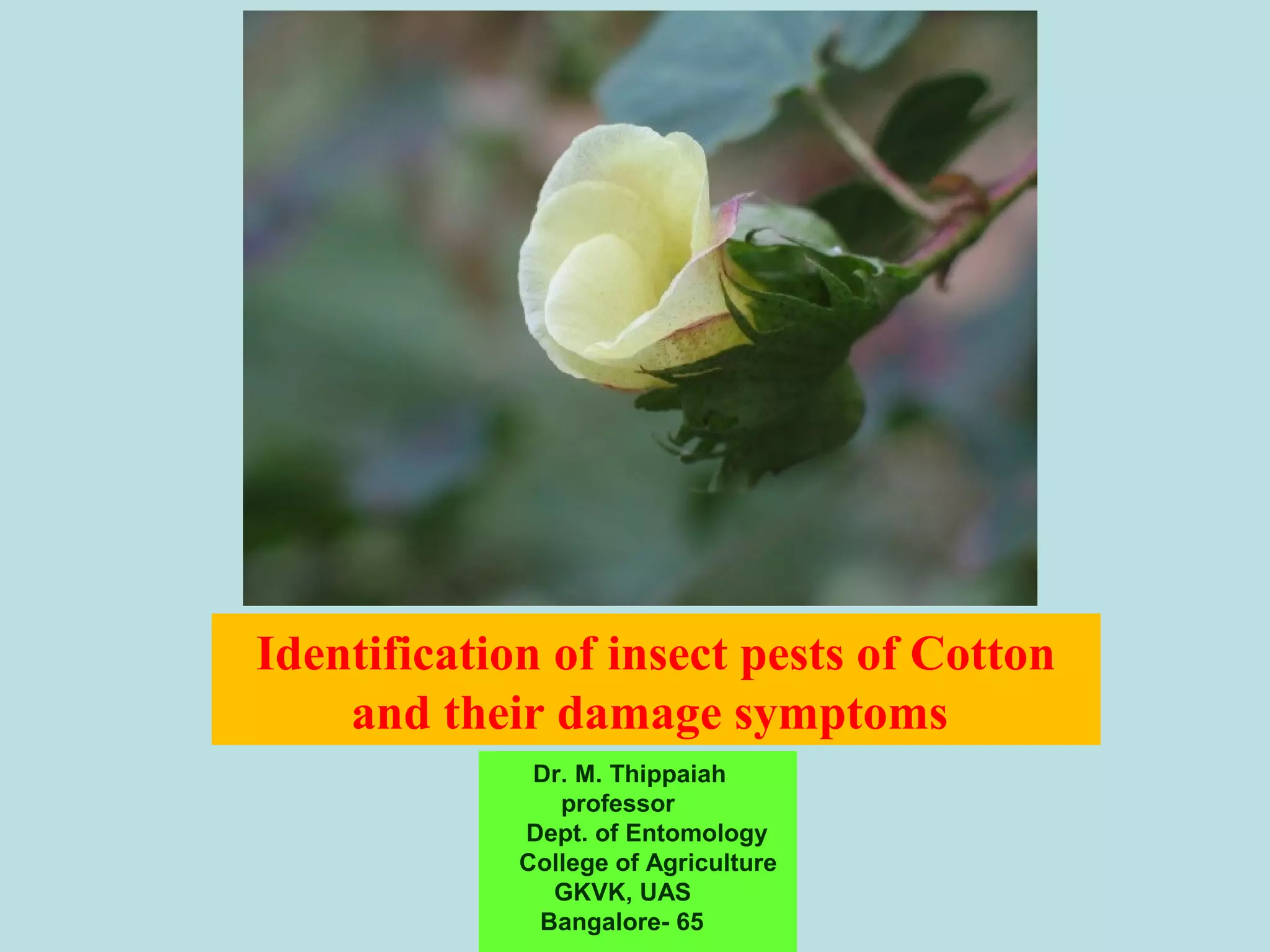
Identification of insect pests of Cotton
and their damage symptoms
Dr. M. Thippaiah
professor
Dept. of Entomology
College of Agriculture
GKVK, UAS
Bangalore- 65
 It is a important fiber crop in India and also high valued
commercial crop for textile industries
 India occupies the largest area in the world under cotton and
it ranks third in production
 At present this crop is grown in an
Area- 12.18 million ha
Production- 13.73million bales (170kgs each)
All the 4 spices of cotton i.e.
Gossypium herbaium
G. herborium
G. hirsutum
G. barbadens
are grown in India commercially that's why India is much important
in cotton cultivation
Factors that affects poor yield in cotton
 Cultivation in rainfed condition
 Timely not taking plant protection measures
 Use of high yielding varieties- attracts more pest
 Indiscriminate use of pesticides particularly broad spectrum
pesticides leads emergence pests
Maximum pesticides consumption
In cotton – 52.58 %
Rice - 24 %
Pulses - 17.18 %
60 % of total pesticides produced are diverted to cotton because of this
Pest resurgence – only the crop where in synthetic pyrethroids are
recommended
Main problems of synthetic pyrethroids are
 Resurgence of white flies in 1995 in AP
 Resurgence of Helicoverpa in 1988-89 in AP
To avoid this they recommended only 2-3 sprays of pyrethroids
alternated with conventional insecticides
Change in species composition
Environmental pollution
Health hazards
Destruction of natural enemies
Most of the insects develops resistance
Crop loss – 50-60 % due to insect pests
 In India expenditure on plant protection i.e. pest control on
varalaxmi hybrid ranges from 43-72 % i.e. 12-25 sprays are
taken up to control different insect pests
 There are more than 1326 species of insects have been reported
attacking cotton in the world. However, in India only 162 species
have been recorded ,
 Among which 14-15 species may be called as major pests due to
their occurrence in serious proportions almost every year
Insect pests of cotton are classified as
Sucking pests
Boll worms
Defoliators
Root / Stem feeders or Borer pests
Non insect pests
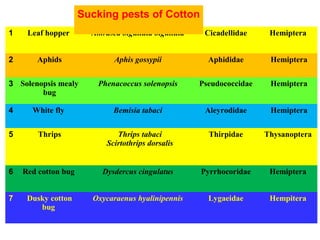
1 Leaf hopper Amrasca biguttula biguttula Cicadellidae Hemiptera
2 Aphids Aphis gossypii Aphididae Hemiptera
3 Solenopsis mealy
bug
Phenacoccus solenopsis Pseudococcidae Hemiptera
4 White fly Bemisia tabaci Aleyrodidae Hemiptera
5 Thrips Thrips tabaci
Scirtothrips dorsalis
Thirpidae Thysanoptera
6 Red cotton bug Dysdercus cingulatus Pyrrhocoridae Hemiptera
7 Dusky cotton
bug
Oxycaraenus hyalinipennis Lygaeidae Hempitera
Sucking pests of Cotton
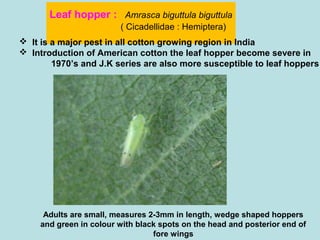
Leaf hopper : Amrasca biguttula biguttula
( Cicadellidae : Hemiptera)
 It is a major pest in all cotton growing region in India
 Introduction of American cotton the leaf hopper become severe in
1970’s and J.K series are also more susceptible to leaf hoppers
Adults are small, measures 2-3mm in length, wedge shaped hoppers
and green in colour with black spots on the head and posterior end of
fore wings
Nature and symptoms of damage
 Both nymphs and adults suck the sap from under surface of leaves as a
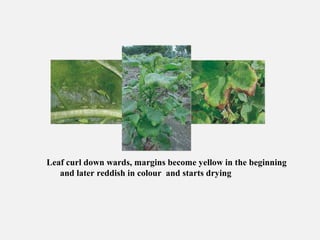
result tender leaves turn yellow, the leaf margin curl down wards, margins
become yellow in the beginning and later reddish in colour and starts drying
 In severe cases, leaves get a bronze or brick red colour which typical
‘hopper burn’ and crop growth retarted
 The infestation occur in seedling stage and seedlings gets killed, the number
of flowers and bolls are reduced
Life Cycle of the pest
Eggs : are laid singly with in leaf veins and epidermis on upper surface
Matured leaves of one month old crop are more preferred for egg laying
Each female lays – more than 20 eggs
I.P – 4-11 days
Nymphs – there are 4 nymphal instars
 Nymphs are light green in colour and translucent found between veins of
leaves on ventral surface
N.P – 7-21 days
 Total life cycle- 15-45 days
 There are 11 generations / years
Leaf curl down wards, margins become yellow in the beginning
and later reddish in colour and starts drying
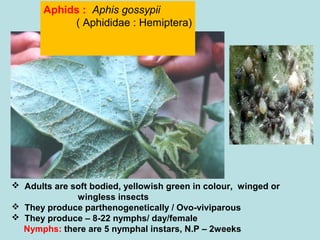
Aphids : Aphis gossypii
( Aphididae : Hemiptera)
 Adults are soft bodied, yellowish green in colour, winged or
wingless insects
 They produce parthenogenetically / Ovo-viviparous
 They produce – 8-22 nymphs/ day/female
Nymphs: there are 5 nymphal instars, N.P – 2weeks
Nature and symptoms of damage
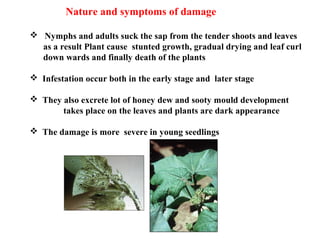
 Nymphs and adults suck the sap from the tender shoots and leaves
as a result Plant cause stunted growth, gradual drying and leaf curl
down wards and finally death of the plants
 Infestation occur both in the early stage and later stage
 They also excrete lot of honey dew and sooty mould development
takes place on the leaves and plants are dark appearance
 The damage is more severe in young seedlings
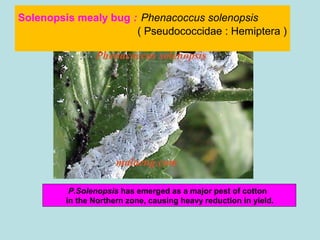
Solenopsis mealy bug : Phenacoccus solenopsis
( Pseudococcidae : Hemiptera )
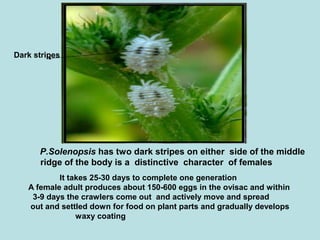
P.Solenopsis has emerged as a major pest of cotton
in the Northern zone, causing heavy reduction in yield.
P.Solenopsis has two dark stripes on either side of the middle
ridge of the body is a distinctive character of females
Dark stripes
It takes 25-30 days to complete one generation
A female adult produces about 150-600 eggs in the ovisac and within
3-9 days the crawlers come out and actively move and spread
out and settled down for food on plant parts and gradually develops
waxy coating
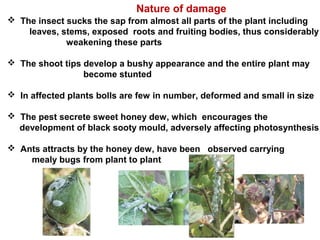
Nature of damage
 The insect sucks the sap from almost all parts of the plant including
leaves, stems, exposed roots and fruiting bodies, thus considerably
weakening these parts
 The shoot tips develop a bushy appearance and the entire plant may
become stunted
 In affected plants bolls are few in number, deformed and small in size
 The pest secrete sweet honey dew, which encourages the
development of black sooty mould, adversely affecting photosynthesis
 Ants attracts by the honey dew, have been observed carrying
mealy bugs from plant to plant
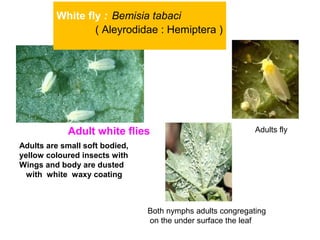
White fly : Bemisia tabaci
( Aleyrodidae : Hemiptera )
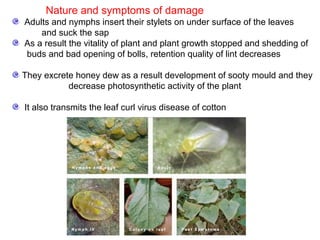
Adult white flies Adults fly
Both nymphs adults congregating
on the under surface the leaf
Adults are small soft bodied,
yellow coloured insects with
Wings and body are dusted
with white waxy coating
It is a polyphagous pest it attacks bhendi, potato, tomato etc.,
In early days it is a minor pest and in 1980’s on wards it become
a major pest
Life cycle of the pest
Eggs : stalked eggs laid singly on the lower surface of the leaves
Each female lays 120 eggs
I.P – 3-5 days
Nymphs : First instars are very active , highly mobile are called as
crawlers and greenish yellow in colour
Second and third instar nymphs are flat, scale like
and immobile
After fourth moult it stops feeding, and 4th nymphal stage is
pseudopupal stage and extends 2 days
N.P -5-33 days
Total life cycle – 45-50 days when temp. 40-500
C
Complete its development with in 15 days at 30o
c
Nature and symptoms of damage
Adults and nymphs insert their stylets on under surface of the leaves
and suck the sap
As a result the vitality of plant and plant growth stopped and shedding of
buds and bad opening of bolls, retention quality of lint decreases
They excrete honey dew as a result development of sooty mould and they
decrease photosynthetic activity of the plant
It also transmits the leaf curl virus disease of cotton
Symptoms
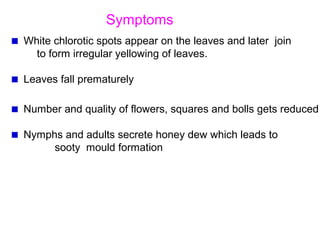
White chlorotic spots appear on the leaves and later join
to form irregular yellowing of leaves.
Leaves fall prematurely
Number and quality of flowers, squares and bolls gets reduced
Nymphs and adults secrete honey dew which leads to
sooty mould formation
Favourable condition for multiplication of the white flies
Introduction of new variety which is susceptible
to the pest
Prolonged dry spell
Excess nitrogen application
Frequent irrigation and closer spacing
Indiscriminate use of insecticides, especially
synthetic pyrethroids
Abiotic factors i.e Change in
Temp.
RH and
Intermittent rainfall
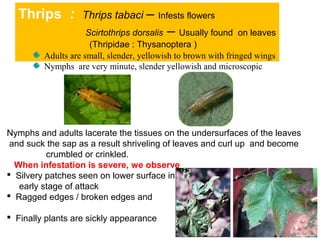
Thrips : Thrips tabaci – Infests flowers
Scirtothrips dorsalis – Usually found on leaves
(Thripidae : Thysanoptera )
Nymphs and adults lacerate the tissues on the undersurfaces of the leaves
and suck the sap as a result shriveling of leaves and curl up and become
crumbled or crinkled.
When infestation is severe, we observe
 Silvery patches seen on lower surface in
early stage of attack
 Ragged edges / broken edges and
 Finally plants are sickly appearance
Adults are small, slender, yellowish to brown with fringed wings
Nymphs are very minute, slender yellowish and microscopic
Cotton stainers
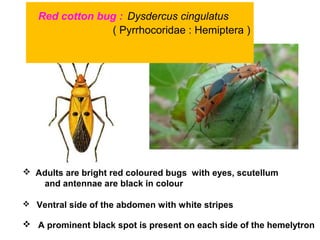
Red cotton bug : Dysdercus cingulatus
( Pyrrhocoridae : Hemiptera )
 Adults are bright red coloured bugs with eyes, scutellum
and antennae are black in colour
 Ventral side of the abdomen with white stripes
 A prominent black spot is present on each side of the hemelytron
 Nymphs and adults suck the sap from tender ripening bolls as well as from
developing Seeds
 The seeds become shriken and loose its viability and quality of the lint is
reduced
 The proboscis of this bug will always have a bacterium, Nematospora gossypii
The moment they insert the proboscis, the bacterium enter the boll and multiply
and lint get discolured that why this bug also called cotton stainer
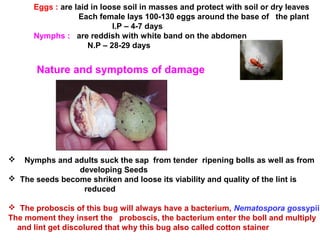
Eggs : are laid in loose soil in masses and protect with soil or dry leaves
Each female lays 100-130 eggs around the base of the plant
I.P – 4-7 days
Nymphs : are reddish with white band on the abdomen
N.P – 28-29 days
Nature and symptoms of damage
Overall :
 Development of bolls will be affected
 Oil content of seed is reduced
 Staining of the lint
 Seeds become unfit for sowing
Alternate hosts:
Bhendi, Hibiscus, Maize, Sorghum etc.,
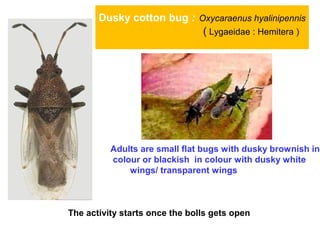
Dusky cotton bug : Oxycaraenus hyalinipennis
( Lygaeidae : Hemitera )
Adults are small flat bugs with dusky brownish in
colour or blackish in colour with dusky white
wings/ transparent wings
The activity starts once the bolls gets open
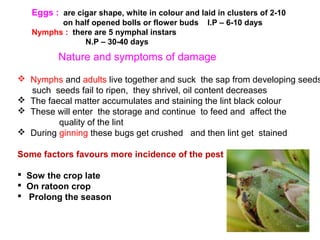
 Nymphs and adults live together and suck the sap from developing seeds
such seeds fail to ripen, they shrivel, oil content decreases
 The faecal matter accumulates and staining the lint black colour
 These will enter the storage and continue to feed and affect the
quality of the lint
 During ginning these bugs get crushed and then lint get stained
Some factors favours more incidence of the pest
 Sow the crop late
 On ratoon crop
 Prolong the season
Eggs : are cigar shape, white in colour and laid in clusters of 2-10
on half opened bolls or flower buds I.P – 6-10 days
Nymphs : there are 5 nymphal instars
N.P – 30-40 days
Nature and symptoms of damage
IPM practices for Leaf hopper, Aphids , Thrips and Mealy bugs
First we known the phenology of the crop which influences pest activity
1st
to 4th
weeks - seedling stage during this stage growth will be slow
5th
to 7th
week – Vegetative stage
8th
to 14th
- Active reproductive stage
First four weeks after reproductive phase is very important because more than 87 %
of flowers are produced and 95 % flowers develops in to bolls
During vegetative stage - Leaf hopper, Aphids , Thrips ,Mealy bugs and white flies
are more problematic on hirsutum varieties than arboreum varieties
I. Cultural practices
1. Growing cotton after cotton should be avoided so adopt proper crop rotation
2. Selection healthy seeds of resistant / tolerant varieties
RS- 875, RST-9 , ABH- 466, H- 777
MECH-183 – resistant to Jassids
Varieties having hairyness on stem and leaf will offer resistant against these pests
especially leaf hoppers
3. Seed treatment with imidacloprid 70WS @ 5 gm / kg of seeds in case of non hybrid
variety and 10 gm / kg of seeds in case of hybrid varieties
or
Thiomethoxam @ 5 gm / kg of seeds
or
Carbosulfan 25 DS @ 50 gm / kg of seeds
4. Adopt proper spacing, irrigation and fertilizer management . Avoid application
of high nitrogenous fertilizer
5. Use of pyrethroids only once ( Max. 2 times)
II. Mechanical control
Using Yellow sticky traps @ 7-10 traps / ha to monitoring the pest population
III. Biological control
1.TO encourage natural enemies or to conserve natural enemies
1. Chrysoperla zastrowii
2. Lady bird beetles
3. Staphylinids
4. Syrphids
5. Reduviids
6. Spiders
7. Predatory mites
2. Release of Chrysoperla zastrowii grubs @ 10,000 / ha
IV. Chemical control
ETL: Leaf hoppers – 2 jassid or nymphs / leaf
Aphids – 15-20 % affected leaves
Thrips – 5-10 thrips / leaf
1.Treat the crop with neem oil @ 5 ml / lit. of water 9 1-2 ml of soap solution + 5 ml
of neem oil)
2. Spray the crop with Fish oil resion soap @ 2 % ( 1 kg in 40 lit. of water)
3. Spray the crop with Phosalone 35 EC @ 2ml / lit.
or
Metasystox @ 2 ml / lit.
or
Monocrotophos @ 2.5 ml / lit.
or
Imidacloprid @ 0.5 ml lit. of water
Avoid using varieties with dense foliage and hairness
Boll worms of Cotton
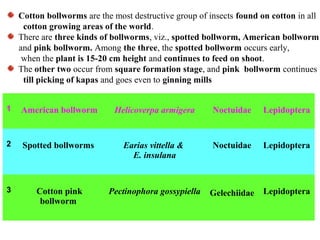
1 American bollworm Helicoverpa armigera Noctuidae Lepidoptera
2 Spotted bollworms Earias vittella &
E. insulana
Noctuidae Lepidoptera
3 Cotton pink
bollworm
Pectinophora gossypiella Gelechiidae Lepidoptera
Cotton bollworms are the most destructive group of insects found on cotton in all
cotton growing areas of the world.
There are three kinds of bollworms, viz., spotted bollworm, American bollworm
and pink bollworm. Among the three, the spotted bollworm occurs early,
when the plant is 15-20 cm height and continues to feed on shoot.
The other two occur from square formation stage, and pink bollworm continues
till picking of kapas and goes even to ginning mills
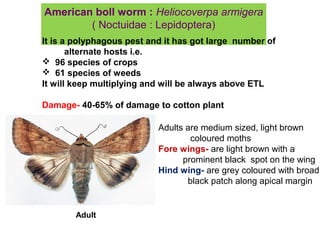
American boll worm : Heliocoverpa armigera
( Noctuidae : Lepidoptera)
It is a polyphagous pest and it has got large number of
alternate hosts i.e.
 96 species of crops
 61 species of weeds
It will keep multiplying and will be always above ETL
Damage- 40-65% of damage to cotton plant
Adult
Adults are medium sized, light brown
coloured moths
Fore wings- are light brown with a
prominent black spot on the wing
Hind wing- are grey coloured with broad
black patch along apical margin
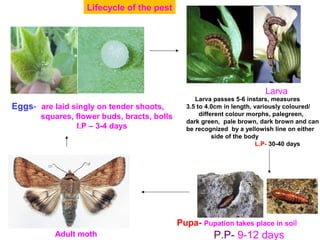
Lifecycle of the pest
Eggs- are laid singly on tender shoots,
squares, flower buds, bracts, bolls
I.P – 3-4 days
Larva
Pupa- Pupation takes place in soil
P.P- 9-12 daysAdult moth
Larva passes 5-6 instars, measures
3.5 to 4.0cm in length, variously coloured/
different colour morphs, palegreen,
dark green, pale brown, dark brown and can
be recognized by a yellowish line on either
side of the body
L.P- 30-40 days
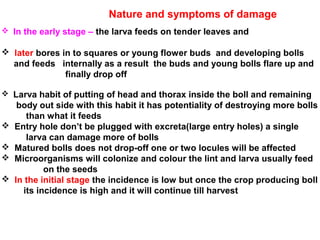
Nature and symptoms of damage
 In the early stage – the larva feeds on tender leaves and
 later bores in to squares or young flower buds and developing bolls
and feeds internally as a result the buds and young bolls flare up and
finally drop off
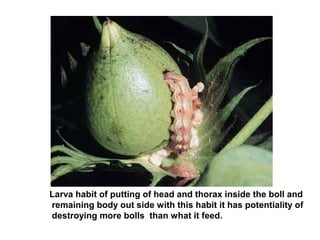
 Larva habit of putting of head and thorax inside the boll and remaining
body out side with this habit it has potentiality of destroying more bolls
than what it feeds
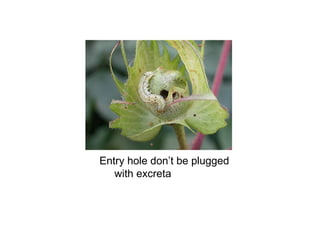
 Entry hole don’t be plugged with excreta(large entry holes) a single
larva can damage more of bolls
 Matured bolls does not drop-off one or two locules will be affected
 Microorganisms will colonize and colour the lint and larva usually feed
on the seeds
 In the initial stage the incidence is low but once the crop producing boll
its incidence is high and it will continue till harvest
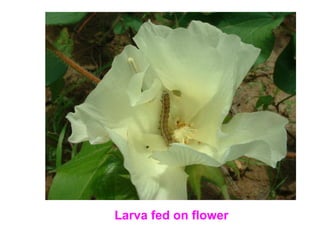
Larva fed on flower
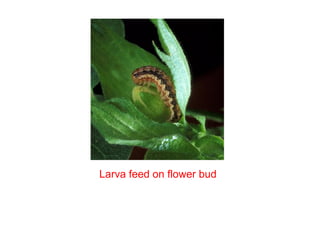
Larva feed on flower bud
Larva habit of putting of head and thorax inside the boll and
remaining body out side with this habit it has potentiality of
destroying more bolls than what it feed.
Entry hole don’t be plugged
with excreta
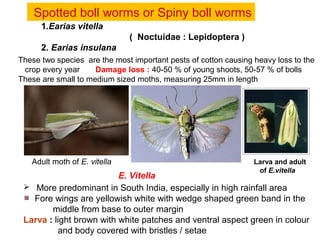
Spotted boll worms or Spiny boll worms
1.Earias vitella
( Noctuidae : Lepidoptera )
2. Earias insulana
Adult moth of E. vitella Larva and adult
of E.vitella
E. Vitella
 More predominant in South India, especially in high rainfall area
Fore wings are yellowish white with wedge shaped green band in the
middle from base to outer margin
Larva : light brown with white patches and ventral aspect green in colour
and body covered with bristles / setae
These two species are the most important pests of cotton causing heavy loss to the
crop every year Damage loss : 40-50 % of young shoots, 50-57 % of bolls
These are small to medium sized moths, measuring 25mm in length
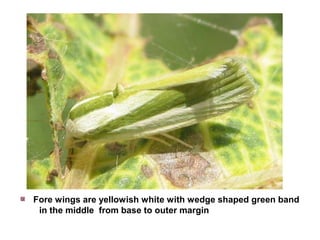
Fore wings are yellowish white with wedge shaped green band
in the middle from base to outer margin
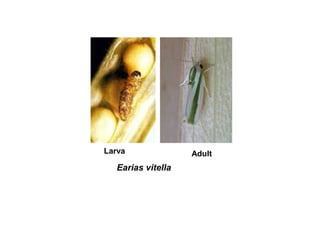
Larva Adult
Earias vitella
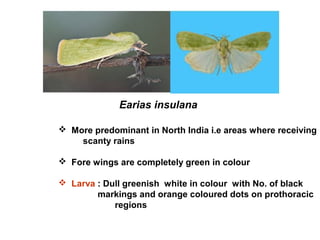
Earias insulana
 More predominant in North India i.e areas where receiving
scanty rains
 Fore wings are completely green in colour
 Larva : Dull greenish white in colour with No. of black
markings and orange coloured dots on prothoracic
regions
Life cycle of the pest
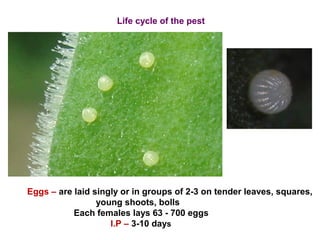
Eggs – are laid singly or in groups of 2-3 on tender leaves, squares,
young shoots, bolls
Each females lays 63 - 700 eggs
I.P – 3-10 days
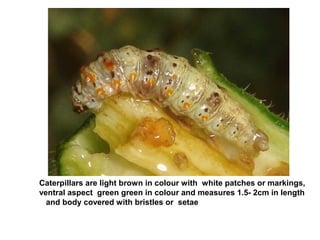
Caterpillars are light brown in colour with white patches or markings,
ventral aspect green green in colour and measures 1.5- 2cm in length
and body covered with bristles or setae
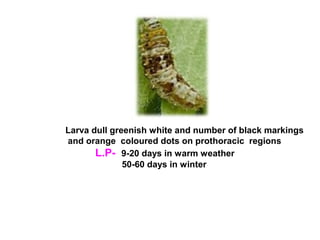
Larva dull greenish white and number of black markings
and orange coloured dots on prothoracic regions
L.P- 9-20 days in warm weather
50-60 days in winter
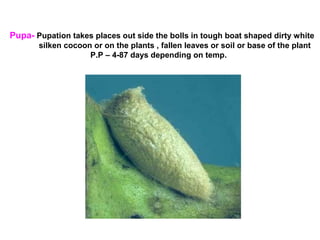
Pupa- Pupation takes places out side the bolls in tough boat shaped dirty white
silken cocoon or on the plants , fallen leaves or soil or base of the plant
P.P – 4-87 days depending on temp.
Nature and symptoms of damage
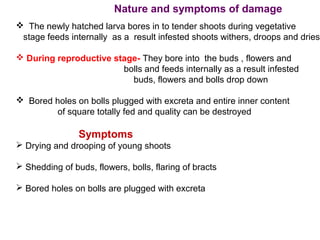
 The newly hatched larva bores in to tender shoots during vegetative
stage feeds internally as a result infested shoots withers, droops and dries
 During reproductive stage- They bore into the buds , flowers and
bolls and feeds internally as a result infested
buds, flowers and bolls drop down
 Bored holes on bolls plugged with excreta and entire inner content
of square totally fed and quality can be destroyed
Symptoms
 Drying and drooping of young shoots
 Shedding of buds, flowers, bolls, flaring of bracts
 Bored holes on bolls are plugged with excreta
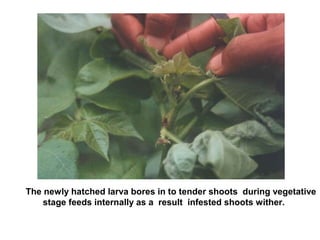
The newly hatched larva bores in to tender shoots during vegetative
stage feeds internally as a result infested shoots wither.
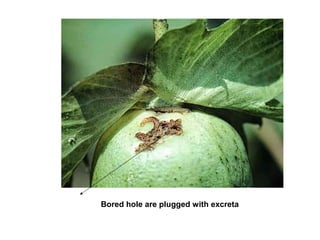
Bored hole are plugged with excreta
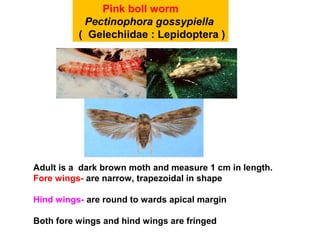
Pink boll worm
Pectinophora gossypiella
( Gelechiidae : Lepidoptera )
Adult is a dark brown moth and measure 1 cm in length.
Fore wings- are narrow, trapezoidal in shape
Hind wings- are round to wards apical margin
Both fore wings and hind wings are fringed
Life cycle of the pest
Eggs : female moth lays small flat eggs singly on the tender leaves,
flowers, squares and developing bolls
Each female lays 400 eggs
I.P – 4-25 days
Larva : there are 3 larval instars
First instars and second instars larvae are green in colour and
later instars, smooth pinkish coloured body with brown coloured
head
L.P – 8-41 days
Pupa : the fully grown larvae pupates among fallen leaves, debris,
dropped bolls, under clods of soil
P.P- 10-15 days
Climate plays an important role in determining the abundance of the pest
 Moderate temp.
 Cloudy weather
 Moderate rains
Nature and symptoms of damage
 Larvae feeds on leaf tissues and later bores in to flower buds, flowers
bores in to the bolls
 First brood develops by feeding on the anthers, style and occasionally
on ovaries in the flower buds
 When they are found on flowers, the flowers do not open and give
‘ rosette appearance ’
 Subsequent broods develop within young and matured bolls, and entry
hole not visible out side and they feed on inner contents thus affecting
bolls, flowers, young infested bolls drop down and finally lint become
black colour
Symptoms
 Premature shedding of flower buds and bolls
 Infested flowers are rosette appearance or clustering together
 Premature opening of the bolls
 Lint quality declines and seed germination reduced
 Presence of interlocular burrow in the opened bolls
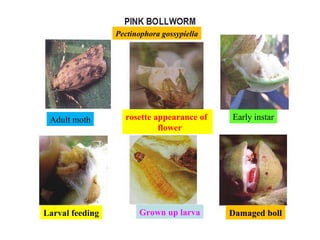
Pectinophora gossypiella
Adult moth rosette appearance of
flower
Early instar
Larval feeding Grown up larva Damaged boll
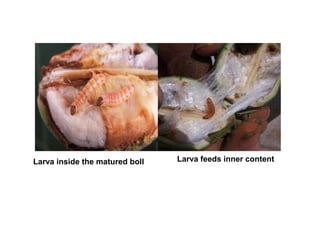
Larva inside the matured boll Larva feeds inner content
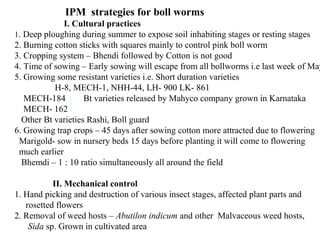
IPM strategies for boll worms
I. Cultural practices
1. Deep ploughing during summer to expose soil inhabiting stages or resting stages
2. Burning cotton sticks with squares mainly to control pink boll worm
3. Cropping system – Bhendi followed by Cotton is not good
4. Time of sowing – Early sowing will escape from all bollworms i.e last week of May
5. Growing some resistant varieties i.e. Short duration varieties
H-8, MECH-1, NHH-44, LH- 900 LK- 861
MECH-184 Bt varieties released by Mahyco company grown in Karnataka
MECH- 162
Other Bt varieties Rashi, Boll guard
6. Growing trap crops – 45 days after sowing cotton more attracted due to flowering
Marigold- sow in nursery beds 15 days before planting it will come to flowering
much earlier
Bhemdi – 1 : 10 ratio simultaneously all around the field
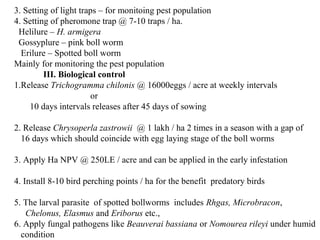
II. Mechanical control
1. Hand picking and destruction of various insect stages, affected plant parts and
rosetted flowers
2. Removal of weed hosts – Abutilon indicum and other Malvaceous weed hosts,
Sida sp. Grown in cultivated area
3. Setting of light traps – for monitoing pest population
4. Setting of pheromone trap @ 7-10 traps / ha.
Helilure – H. armigera
Gossyplure – pink boll worm
Erilure – Spotted boll worm
Mainly for monitoring the pest population
III. Biological control
1.Release Trichogramma chilonis @ 16000eggs / acre at weekly intervals
or
10 days intervals releases after 45 days of sowing
2. Release Chrysoperla zastrowii @ 1 lakh / ha 2 times in a season with a gap of
16 days which should coincide with egg laying stage of the boll worms
3. Apply Ha NPV @ 250LE / acre and can be applied in the early infestation
4. Install 8-10 bird perching points / ha for the benefit predatory birds
5. The larval parasite of spotted bollworms includes Rhgas, Microbracon,
Chelonus, Elasmus and Eriborus etc.,
6. Apply fungal pathogens like Beauverai bassiana or Nomourea rileyi under humid
condition
IV. Chemical control
During square formation stage i.e. 55 days old crop , spraying takes places in
15 days interval
70 days old crop
85 days old crop
100 days old crop
115 days old crop
130 days old crop
1.Spraying Cypermethrin or decamethrin or fenvalerate @ 0.5ml / lit. of water for
the control spotted boll worm
2. Spraying Fevalerate or permethrin @ 0.5ml / lit. of water for the control of
American bollworm and pink bollworm
3. Spraying the crop with 5 % NSKE also effective against boll worms
4. Neem based formulations with pyrethroids i.e. 4.5 to 9.0 gm of azadirachtin +
45 to 60gm ai of cypermethrin / ha.
5. Spraying carbaryl 50wdp @ 4gm / lit. of water
or
Quinalphos @ 2ml / lit. of water
or
Phosalone @ 2ml / lit. of water
or
Profenophos @ 2 ml / lit. of water
or
Indoxacarb @ 0.75ml / lit. of water
or
Spinosad @ 0.5ml / lit. of water
Mainly for the control of pink boll worm and American boll worm
Use of Synthetic pyrethroids should be alternated with traditional pesticides
Ipm of cotton

Ipm of cotton

  • 1.
    Identification of insectpests of Cotton and their damage symptoms Dr. M. Thippaiah professor Dept. of Entomology College of Agriculture GKVK, UAS Bangalore- 65
  • 2.
     It isa important fiber crop in India and also high valued commercial crop for textile industries  India occupies the largest area in the world under cotton and it ranks third in production  At present this crop is grown in an Area- 12.18 million ha Production- 13.73million bales (170kgs each) All the 4 spices of cotton i.e. Gossypium herbaium G. herborium G. hirsutum G. barbadens are grown in India commercially that's why India is much important in cotton cultivation Factors that affects poor yield in cotton  Cultivation in rainfed condition  Timely not taking plant protection measures  Use of high yielding varieties- attracts more pest  Indiscriminate use of pesticides particularly broad spectrum pesticides leads emergence pests
  • 3.
    Maximum pesticides consumption Incotton – 52.58 % Rice - 24 % Pulses - 17.18 % 60 % of total pesticides produced are diverted to cotton because of this Pest resurgence – only the crop where in synthetic pyrethroids are recommended Main problems of synthetic pyrethroids are  Resurgence of white flies in 1995 in AP  Resurgence of Helicoverpa in 1988-89 in AP To avoid this they recommended only 2-3 sprays of pyrethroids alternated with conventional insecticides Change in species composition Environmental pollution Health hazards Destruction of natural enemies Most of the insects develops resistance Crop loss – 50-60 % due to insect pests
  • 4.
     In Indiaexpenditure on plant protection i.e. pest control on varalaxmi hybrid ranges from 43-72 % i.e. 12-25 sprays are taken up to control different insect pests  There are more than 1326 species of insects have been reported attacking cotton in the world. However, in India only 162 species have been recorded ,  Among which 14-15 species may be called as major pests due to their occurrence in serious proportions almost every year
  • 5.
    Insect pests ofcotton are classified as Sucking pests Boll worms Defoliators Root / Stem feeders or Borer pests Non insect pests
  • 6.
    1 Leaf hopperAmrasca biguttula biguttula Cicadellidae Hemiptera 2 Aphids Aphis gossypii Aphididae Hemiptera 3 Solenopsis mealy bug Phenacoccus solenopsis Pseudococcidae Hemiptera 4 White fly Bemisia tabaci Aleyrodidae Hemiptera 5 Thrips Thrips tabaci Scirtothrips dorsalis Thirpidae Thysanoptera 6 Red cotton bug Dysdercus cingulatus Pyrrhocoridae Hemiptera 7 Dusky cotton bug Oxycaraenus hyalinipennis Lygaeidae Hempitera Sucking pests of Cotton
  • 7.
    Leaf hopper :Amrasca biguttula biguttula ( Cicadellidae : Hemiptera)  It is a major pest in all cotton growing region in India  Introduction of American cotton the leaf hopper become severe in 1970’s and J.K series are also more susceptible to leaf hoppers Adults are small, measures 2-3mm in length, wedge shaped hoppers and green in colour with black spots on the head and posterior end of fore wings
  • 8.
    Nature and symptomsof damage  Both nymphs and adults suck the sap from under surface of leaves as a result tender leaves turn yellow, the leaf margin curl down wards, margins become yellow in the beginning and later reddish in colour and starts drying  In severe cases, leaves get a bronze or brick red colour which typical ‘hopper burn’ and crop growth retarted  The infestation occur in seedling stage and seedlings gets killed, the number of flowers and bolls are reduced Life Cycle of the pest Eggs : are laid singly with in leaf veins and epidermis on upper surface Matured leaves of one month old crop are more preferred for egg laying Each female lays – more than 20 eggs I.P – 4-11 days Nymphs – there are 4 nymphal instars  Nymphs are light green in colour and translucent found between veins of leaves on ventral surface N.P – 7-21 days  Total life cycle- 15-45 days  There are 11 generations / years
  • 9.
    Leaf curl downwards, margins become yellow in the beginning and later reddish in colour and starts drying
  • 10.
    Aphids : Aphisgossypii ( Aphididae : Hemiptera)  Adults are soft bodied, yellowish green in colour, winged or wingless insects  They produce parthenogenetically / Ovo-viviparous  They produce – 8-22 nymphs/ day/female Nymphs: there are 5 nymphal instars, N.P – 2weeks
  • 11.
    Nature and symptomsof damage  Nymphs and adults suck the sap from the tender shoots and leaves as a result Plant cause stunted growth, gradual drying and leaf curl down wards and finally death of the plants  Infestation occur both in the early stage and later stage  They also excrete lot of honey dew and sooty mould development takes place on the leaves and plants are dark appearance  The damage is more severe in young seedlings
  • 12.
    Solenopsis mealy bug: Phenacoccus solenopsis ( Pseudococcidae : Hemiptera ) P.Solenopsis has emerged as a major pest of cotton in the Northern zone, causing heavy reduction in yield.
  • 13.
    P.Solenopsis has twodark stripes on either side of the middle ridge of the body is a distinctive character of females Dark stripes It takes 25-30 days to complete one generation A female adult produces about 150-600 eggs in the ovisac and within 3-9 days the crawlers come out and actively move and spread out and settled down for food on plant parts and gradually develops waxy coating
  • 14.
    Nature of damage The insect sucks the sap from almost all parts of the plant including leaves, stems, exposed roots and fruiting bodies, thus considerably weakening these parts  The shoot tips develop a bushy appearance and the entire plant may become stunted  In affected plants bolls are few in number, deformed and small in size  The pest secrete sweet honey dew, which encourages the development of black sooty mould, adversely affecting photosynthesis  Ants attracts by the honey dew, have been observed carrying mealy bugs from plant to plant
  • 15.
    White fly :Bemisia tabaci ( Aleyrodidae : Hemiptera ) Adult white flies Adults fly Both nymphs adults congregating on the under surface the leaf Adults are small soft bodied, yellow coloured insects with Wings and body are dusted with white waxy coating
  • 16.
    It is apolyphagous pest it attacks bhendi, potato, tomato etc., In early days it is a minor pest and in 1980’s on wards it become a major pest Life cycle of the pest Eggs : stalked eggs laid singly on the lower surface of the leaves Each female lays 120 eggs I.P – 3-5 days Nymphs : First instars are very active , highly mobile are called as crawlers and greenish yellow in colour Second and third instar nymphs are flat, scale like and immobile After fourth moult it stops feeding, and 4th nymphal stage is pseudopupal stage and extends 2 days N.P -5-33 days Total life cycle – 45-50 days when temp. 40-500 C Complete its development with in 15 days at 30o c
  • 17.
    Nature and symptomsof damage Adults and nymphs insert their stylets on under surface of the leaves and suck the sap As a result the vitality of plant and plant growth stopped and shedding of buds and bad opening of bolls, retention quality of lint decreases They excrete honey dew as a result development of sooty mould and they decrease photosynthetic activity of the plant It also transmits the leaf curl virus disease of cotton
  • 18.
    Symptoms White chlorotic spotsappear on the leaves and later join to form irregular yellowing of leaves. Leaves fall prematurely Number and quality of flowers, squares and bolls gets reduced Nymphs and adults secrete honey dew which leads to sooty mould formation
  • 19.
    Favourable condition formultiplication of the white flies Introduction of new variety which is susceptible to the pest Prolonged dry spell Excess nitrogen application Frequent irrigation and closer spacing Indiscriminate use of insecticides, especially synthetic pyrethroids Abiotic factors i.e Change in Temp. RH and Intermittent rainfall
  • 20.
    Thrips : Thripstabaci – Infests flowers Scirtothrips dorsalis – Usually found on leaves (Thripidae : Thysanoptera ) Nymphs and adults lacerate the tissues on the undersurfaces of the leaves and suck the sap as a result shriveling of leaves and curl up and become crumbled or crinkled. When infestation is severe, we observe  Silvery patches seen on lower surface in early stage of attack  Ragged edges / broken edges and  Finally plants are sickly appearance Adults are small, slender, yellowish to brown with fringed wings Nymphs are very minute, slender yellowish and microscopic
  • 21.
  • 22.
    Red cotton bug: Dysdercus cingulatus ( Pyrrhocoridae : Hemiptera )  Adults are bright red coloured bugs with eyes, scutellum and antennae are black in colour  Ventral side of the abdomen with white stripes  A prominent black spot is present on each side of the hemelytron
  • 23.
     Nymphs andadults suck the sap from tender ripening bolls as well as from developing Seeds  The seeds become shriken and loose its viability and quality of the lint is reduced  The proboscis of this bug will always have a bacterium, Nematospora gossypii The moment they insert the proboscis, the bacterium enter the boll and multiply and lint get discolured that why this bug also called cotton stainer Eggs : are laid in loose soil in masses and protect with soil or dry leaves Each female lays 100-130 eggs around the base of the plant I.P – 4-7 days Nymphs : are reddish with white band on the abdomen N.P – 28-29 days Nature and symptoms of damage
  • 24.
    Overall :  Developmentof bolls will be affected  Oil content of seed is reduced  Staining of the lint  Seeds become unfit for sowing Alternate hosts: Bhendi, Hibiscus, Maize, Sorghum etc.,
  • 25.
    Dusky cotton bug: Oxycaraenus hyalinipennis ( Lygaeidae : Hemitera ) Adults are small flat bugs with dusky brownish in colour or blackish in colour with dusky white wings/ transparent wings The activity starts once the bolls gets open
  • 26.
     Nymphs andadults live together and suck the sap from developing seeds such seeds fail to ripen, they shrivel, oil content decreases  The faecal matter accumulates and staining the lint black colour  These will enter the storage and continue to feed and affect the quality of the lint  During ginning these bugs get crushed and then lint get stained Some factors favours more incidence of the pest  Sow the crop late  On ratoon crop  Prolong the season Eggs : are cigar shape, white in colour and laid in clusters of 2-10 on half opened bolls or flower buds I.P – 6-10 days Nymphs : there are 5 nymphal instars N.P – 30-40 days Nature and symptoms of damage
  • 27.
    IPM practices forLeaf hopper, Aphids , Thrips and Mealy bugs First we known the phenology of the crop which influences pest activity 1st to 4th weeks - seedling stage during this stage growth will be slow 5th to 7th week – Vegetative stage 8th to 14th - Active reproductive stage First four weeks after reproductive phase is very important because more than 87 % of flowers are produced and 95 % flowers develops in to bolls During vegetative stage - Leaf hopper, Aphids , Thrips ,Mealy bugs and white flies are more problematic on hirsutum varieties than arboreum varieties I. Cultural practices 1. Growing cotton after cotton should be avoided so adopt proper crop rotation 2. Selection healthy seeds of resistant / tolerant varieties RS- 875, RST-9 , ABH- 466, H- 777 MECH-183 – resistant to Jassids Varieties having hairyness on stem and leaf will offer resistant against these pests especially leaf hoppers 3. Seed treatment with imidacloprid 70WS @ 5 gm / kg of seeds in case of non hybrid variety and 10 gm / kg of seeds in case of hybrid varieties or Thiomethoxam @ 5 gm / kg of seeds or Carbosulfan 25 DS @ 50 gm / kg of seeds
  • 28.
    4. Adopt properspacing, irrigation and fertilizer management . Avoid application of high nitrogenous fertilizer 5. Use of pyrethroids only once ( Max. 2 times) II. Mechanical control Using Yellow sticky traps @ 7-10 traps / ha to monitoring the pest population III. Biological control 1.TO encourage natural enemies or to conserve natural enemies 1. Chrysoperla zastrowii 2. Lady bird beetles 3. Staphylinids 4. Syrphids 5. Reduviids 6. Spiders 7. Predatory mites 2. Release of Chrysoperla zastrowii grubs @ 10,000 / ha IV. Chemical control ETL: Leaf hoppers – 2 jassid or nymphs / leaf Aphids – 15-20 % affected leaves Thrips – 5-10 thrips / leaf 1.Treat the crop with neem oil @ 5 ml / lit. of water 9 1-2 ml of soap solution + 5 ml of neem oil)
  • 29.
    2. Spray thecrop with Fish oil resion soap @ 2 % ( 1 kg in 40 lit. of water) 3. Spray the crop with Phosalone 35 EC @ 2ml / lit. or Metasystox @ 2 ml / lit. or Monocrotophos @ 2.5 ml / lit. or Imidacloprid @ 0.5 ml lit. of water Avoid using varieties with dense foliage and hairness
  • 30.
  • 31.
    1 American bollwormHelicoverpa armigera Noctuidae Lepidoptera 2 Spotted bollworms Earias vittella & E. insulana Noctuidae Lepidoptera 3 Cotton pink bollworm Pectinophora gossypiella Gelechiidae Lepidoptera Cotton bollworms are the most destructive group of insects found on cotton in all cotton growing areas of the world. There are three kinds of bollworms, viz., spotted bollworm, American bollworm and pink bollworm. Among the three, the spotted bollworm occurs early, when the plant is 15-20 cm height and continues to feed on shoot. The other two occur from square formation stage, and pink bollworm continues till picking of kapas and goes even to ginning mills
  • 32.
    American boll worm: Heliocoverpa armigera ( Noctuidae : Lepidoptera) It is a polyphagous pest and it has got large number of alternate hosts i.e.  96 species of crops  61 species of weeds It will keep multiplying and will be always above ETL Damage- 40-65% of damage to cotton plant Adult Adults are medium sized, light brown coloured moths Fore wings- are light brown with a prominent black spot on the wing Hind wing- are grey coloured with broad black patch along apical margin
  • 33.
    Lifecycle of thepest Eggs- are laid singly on tender shoots, squares, flower buds, bracts, bolls I.P – 3-4 days Larva Pupa- Pupation takes place in soil P.P- 9-12 daysAdult moth Larva passes 5-6 instars, measures 3.5 to 4.0cm in length, variously coloured/ different colour morphs, palegreen, dark green, pale brown, dark brown and can be recognized by a yellowish line on either side of the body L.P- 30-40 days
  • 34.
    Nature and symptomsof damage  In the early stage – the larva feeds on tender leaves and  later bores in to squares or young flower buds and developing bolls and feeds internally as a result the buds and young bolls flare up and finally drop off  Larva habit of putting of head and thorax inside the boll and remaining body out side with this habit it has potentiality of destroying more bolls than what it feeds  Entry hole don’t be plugged with excreta(large entry holes) a single larva can damage more of bolls  Matured bolls does not drop-off one or two locules will be affected  Microorganisms will colonize and colour the lint and larva usually feed on the seeds  In the initial stage the incidence is low but once the crop producing boll its incidence is high and it will continue till harvest
  • 35.
  • 36.
    Larva feed onflower bud
  • 37.
    Larva habit ofputting of head and thorax inside the boll and remaining body out side with this habit it has potentiality of destroying more bolls than what it feed.
  • 38.
    Entry hole don’tbe plugged with excreta
  • 39.
    Spotted boll wormsor Spiny boll worms 1.Earias vitella ( Noctuidae : Lepidoptera ) 2. Earias insulana Adult moth of E. vitella Larva and adult of E.vitella E. Vitella  More predominant in South India, especially in high rainfall area Fore wings are yellowish white with wedge shaped green band in the middle from base to outer margin Larva : light brown with white patches and ventral aspect green in colour and body covered with bristles / setae These two species are the most important pests of cotton causing heavy loss to the crop every year Damage loss : 40-50 % of young shoots, 50-57 % of bolls These are small to medium sized moths, measuring 25mm in length
  • 40.
    Fore wings areyellowish white with wedge shaped green band in the middle from base to outer margin
  • 41.
  • 42.
    Earias insulana  Morepredominant in North India i.e areas where receiving scanty rains  Fore wings are completely green in colour  Larva : Dull greenish white in colour with No. of black markings and orange coloured dots on prothoracic regions
  • 43.
    Life cycle ofthe pest Eggs – are laid singly or in groups of 2-3 on tender leaves, squares, young shoots, bolls Each females lays 63 - 700 eggs I.P – 3-10 days
  • 44.
    Caterpillars are lightbrown in colour with white patches or markings, ventral aspect green green in colour and measures 1.5- 2cm in length and body covered with bristles or setae
  • 45.
    Larva dull greenishwhite and number of black markings and orange coloured dots on prothoracic regions L.P- 9-20 days in warm weather 50-60 days in winter
  • 46.
    Pupa- Pupation takesplaces out side the bolls in tough boat shaped dirty white silken cocoon or on the plants , fallen leaves or soil or base of the plant P.P – 4-87 days depending on temp.
  • 47.
    Nature and symptomsof damage  The newly hatched larva bores in to tender shoots during vegetative stage feeds internally as a result infested shoots withers, droops and dries  During reproductive stage- They bore into the buds , flowers and bolls and feeds internally as a result infested buds, flowers and bolls drop down  Bored holes on bolls plugged with excreta and entire inner content of square totally fed and quality can be destroyed Symptoms  Drying and drooping of young shoots  Shedding of buds, flowers, bolls, flaring of bracts  Bored holes on bolls are plugged with excreta
  • 48.
    The newly hatchedlarva bores in to tender shoots during vegetative stage feeds internally as a result infested shoots wither.
  • 49.
    Bored hole areplugged with excreta
  • 50.
    Pink boll worm Pectinophoragossypiella ( Gelechiidae : Lepidoptera ) Adult is a dark brown moth and measure 1 cm in length. Fore wings- are narrow, trapezoidal in shape Hind wings- are round to wards apical margin Both fore wings and hind wings are fringed
  • 51.
    Life cycle ofthe pest Eggs : female moth lays small flat eggs singly on the tender leaves, flowers, squares and developing bolls Each female lays 400 eggs I.P – 4-25 days Larva : there are 3 larval instars First instars and second instars larvae are green in colour and later instars, smooth pinkish coloured body with brown coloured head L.P – 8-41 days Pupa : the fully grown larvae pupates among fallen leaves, debris, dropped bolls, under clods of soil P.P- 10-15 days Climate plays an important role in determining the abundance of the pest  Moderate temp.  Cloudy weather  Moderate rains
  • 52.
    Nature and symptomsof damage  Larvae feeds on leaf tissues and later bores in to flower buds, flowers bores in to the bolls  First brood develops by feeding on the anthers, style and occasionally on ovaries in the flower buds  When they are found on flowers, the flowers do not open and give ‘ rosette appearance ’  Subsequent broods develop within young and matured bolls, and entry hole not visible out side and they feed on inner contents thus affecting bolls, flowers, young infested bolls drop down and finally lint become black colour Symptoms  Premature shedding of flower buds and bolls  Infested flowers are rosette appearance or clustering together  Premature opening of the bolls  Lint quality declines and seed germination reduced  Presence of interlocular burrow in the opened bolls
  • 53.
    Pectinophora gossypiella Adult mothrosette appearance of flower Early instar Larval feeding Grown up larva Damaged boll
  • 54.
    Larva inside thematured boll Larva feeds inner content
  • 55.
    IPM strategies forboll worms I. Cultural practices 1. Deep ploughing during summer to expose soil inhabiting stages or resting stages 2. Burning cotton sticks with squares mainly to control pink boll worm 3. Cropping system – Bhendi followed by Cotton is not good 4. Time of sowing – Early sowing will escape from all bollworms i.e last week of May 5. Growing some resistant varieties i.e. Short duration varieties H-8, MECH-1, NHH-44, LH- 900 LK- 861 MECH-184 Bt varieties released by Mahyco company grown in Karnataka MECH- 162 Other Bt varieties Rashi, Boll guard 6. Growing trap crops – 45 days after sowing cotton more attracted due to flowering Marigold- sow in nursery beds 15 days before planting it will come to flowering much earlier Bhemdi – 1 : 10 ratio simultaneously all around the field II. Mechanical control 1. Hand picking and destruction of various insect stages, affected plant parts and rosetted flowers 2. Removal of weed hosts – Abutilon indicum and other Malvaceous weed hosts, Sida sp. Grown in cultivated area
  • 56.
    3. Setting oflight traps – for monitoing pest population 4. Setting of pheromone trap @ 7-10 traps / ha. Helilure – H. armigera Gossyplure – pink boll worm Erilure – Spotted boll worm Mainly for monitoring the pest population III. Biological control 1.Release Trichogramma chilonis @ 16000eggs / acre at weekly intervals or 10 days intervals releases after 45 days of sowing 2. Release Chrysoperla zastrowii @ 1 lakh / ha 2 times in a season with a gap of 16 days which should coincide with egg laying stage of the boll worms 3. Apply Ha NPV @ 250LE / acre and can be applied in the early infestation 4. Install 8-10 bird perching points / ha for the benefit predatory birds 5. The larval parasite of spotted bollworms includes Rhgas, Microbracon, Chelonus, Elasmus and Eriborus etc., 6. Apply fungal pathogens like Beauverai bassiana or Nomourea rileyi under humid condition
  • 57.
    IV. Chemical control Duringsquare formation stage i.e. 55 days old crop , spraying takes places in 15 days interval 70 days old crop 85 days old crop 100 days old crop 115 days old crop 130 days old crop 1.Spraying Cypermethrin or decamethrin or fenvalerate @ 0.5ml / lit. of water for the control spotted boll worm 2. Spraying Fevalerate or permethrin @ 0.5ml / lit. of water for the control of American bollworm and pink bollworm 3. Spraying the crop with 5 % NSKE also effective against boll worms 4. Neem based formulations with pyrethroids i.e. 4.5 to 9.0 gm of azadirachtin + 45 to 60gm ai of cypermethrin / ha. 5. Spraying carbaryl 50wdp @ 4gm / lit. of water or Quinalphos @ 2ml / lit. of water or Phosalone @ 2ml / lit. of water or Profenophos @ 2 ml / lit. of water
  • 58.
    or Indoxacarb @ 0.75ml/ lit. of water or Spinosad @ 0.5ml / lit. of water Mainly for the control of pink boll worm and American boll worm Use of Synthetic pyrethroids should be alternated with traditional pesticides