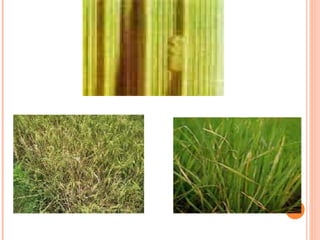
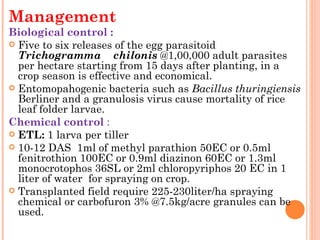
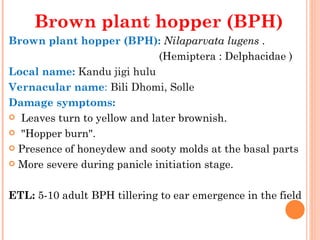
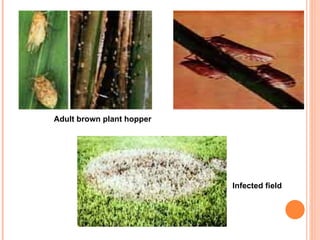
Rice thrips:
Paddy thrips: Stenchaetothrips biformis
                   (Thripidae: Thysanoptera)
Local name: Thrips nusi
Damage symptoms
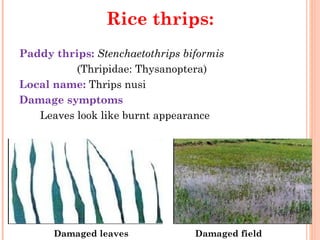
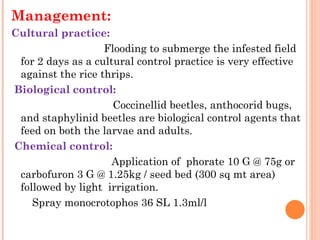
       Leaves look like burnt appearance


       Damaged leaves                Damaged field
Management:
Cultural practice:
                    Flooding to submerge the infested field
  for 2 days as a cultural control practice is very effective
  against the rice thrips.
 Biological control:
                      Coccinellid beetles, anthocorid bugs,
  and staphylinid beetles are biological control agents that
  feed on both the larvae and adults.
 Chemical control:
                      Application of  phorate 10 G @ 75g or
  carbofuron 3 G @ 1.25kg / seed bed (300 sq mt area)
  followed by light  irrigation.
     Spray monocrotophos 36 SL 1.3ml/l     
 
Rice grass hopper
Rice grass hopper: Oxya hyla intricata
                                    (Orthoptera :Acrididae)
Local name: Midate
Damage symptoms:
 Both nymph and adult feed on leaves.

 Nibble at the florets into base of inflorescence stalks
   causing formation of white ears.
Management:   
Cultural practices:
 Cleaning of bunds to destroy egg pods and
  nymphs.
 Deep ploughing is recommended in winter season
  to expose the egg mass.
 
Chemical controls:
 Spray chloropyriphos 20EC 2ml/l for about
  130-135liters of chemical solution required for one
  acre.
 Dusting of 50% malathion or 1.5% quinolphos or
  1% endosalfon on bunds
Rice Gundhi bug
Rice Gundhi Bug:  Leptocorisa acuta
                          (Hemiptera : Coreidae)
Local name: Gandhi Tigane
Damage symptoms
 The nymphs and adults suck the milk from the developing
  grains and stem in the early stage of grain formation.
 Discolouration of panicles as well as the presence of some
  empty or ill filled grains in the panicles.
 Infested paddy straw contains foul smell. 

 
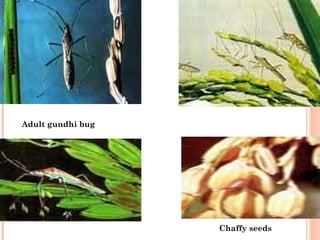
Adult gundhi bug


                   Chaffy seeds
Management:
Preventive measures 
 Remove weeds from fields and surrounding areas

Biological control
 Small wasps parasitize the eggs and the meadow
  grasshoppers prey on them.
 Both the adults and nymphs are preys to spiders,
  coccinellid beetles and dragonflies
 A fungus infects both nymphs and adults.
Chemical control
 Look for rice bugs at pre flowering stage and continue
  daily until the hard dough stage during early morning
  or late afternoon hours.
 malathion dust 5% @ 8kg/acre or  malathion 50EC @
  2ml/l (350ml/acre) and take up spraying on panicle.
 270 liter of spraying chemical is required per acre.
Army worm
Armyworm/Climbing cutworm:  Mythimna separata
                                 (Lepidoptera : Noctuidae)
Kannada name: Tene kattarisuva hulu
Damage symptoms:
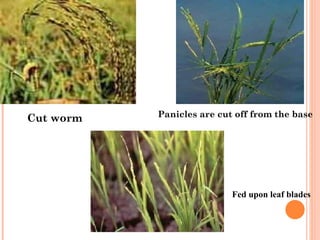
 Early instar larvae skeletonise the leaves whereas
   later instar larvae are voracious feeders on leaves
   during night.
                          
Cut worm   Panicles are cut off from the base


                           Fed upon leaf blades
Management:
Preventive measures:
 Remove weeds from fields and surrounding areas

Cultural practices:
 Flooding seed bed is the best defence
 Digging pits or trenches, covered with leaves gives
  caterpillar a place to take shelter from the sunlight
 Ash filled trenches around the field serve as barriers
 Placing branches around the field gives a place for
  armyworm to congregate where than can be easily collected
  by hand.
Chemical control:
 1ml of methyl parathion 50EC or 0.5ml fenitrothion 100EC
  or 0.9ml diazinon 60EC or 1.3ml monocrotophos 36SL or
  2ml chloropyriphos 20 EC or 1.5ml fenthoate 50EC or 2ml
  phasalone 35EC or 2ml endosalfon 35EC or 2ml quinolphos
  25EC during evening
Rice case worm
Rice Caseworm: Paraponyx stagnalis
                    (Lepidoptera : Pyralidae)
Local name: Kolave Hulu, Goodu maru Hulu
Damage symptoms:
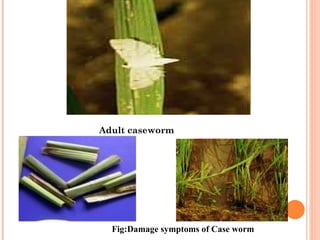
 The larva feeds on the foliage by scrapping chlorophyll
  leaving horizontal rows of green material.
 The leaf tips are sharply cut off and the cut portions
  are turned into cylindrical tubes, is either attached to
  the plant or seen floating on the water surface
Adult caseworm


                                       Fig:Damage symptoms of Case worm
Management
Cultural practices:
 Drain water from the field.
 Keep kerosene soaked gunny bags in the field water and
  dislodge the leaf cases by passing rope or branches of
  thorny plant.
 The use of correct fertilizer application, wider spacing (30
  × 20 mm), and early planting.
Biological Control:
 Spiders, dragonflies, and birds eat the adults.
 There is a nuclear polyhedrosis virus, which is a potential
  control agent against the rice caseworm.
Chemical control:
 10-12 DAS  1ml of methyl parathion 50EC or 1.3ml
  monocrotophos 36SL or 2ml chloropyriphos 20 EC in 1
  liter of water for spraying crop.
 Transplanted field require 225-230liter/acre spraying
  chemical or carbofuron 3% 7.6kg/acre granules can be
  used.
Rice hispa
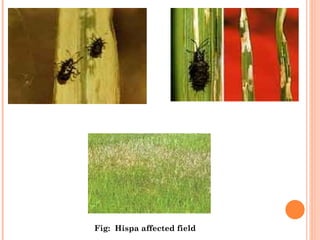
Rice hispa: Dicladispa armig-era
              (Coleoptera : Chrysomelidae)
 Kannada name : Mullu chippina dumbhi
Damage symptoms:
 Grubs make tunneling through leaf tissue causing
  irregular translucent white patches that -are parallel
  to the leaf veins.
 Damaged areas have white streaks that are parallel to
  the midrib
Fig:  Hispa affected field
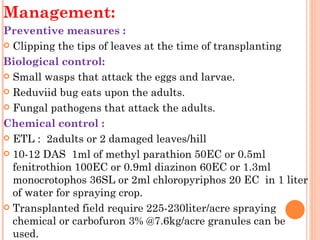
Management:
Preventive measures :
 Clipping the tips of leaves at the time of transplanting

Biological control:
 Small wasps that attack the eggs and larvae.

 Reduviid bug eats upon the adults.

 Fungal pathogens that attack the adults.

Chemical control :
 ETL :  2adults or 2 damaged leaves/hill

 10-12 DAS  1ml of methyl parathion 50EC or 0.5ml
  fenitrothion 100EC or 0.9ml diazinon 60EC or 1.3ml
  monocrotophos 36SL or 2ml chloropyriphos 20 EC in 1 liter
  of water for spraying crop.
 Transplanted field require 225-230liter/acre spraying
  chemical or carbofuron 3% @7.6kg/acre granules can be
  used.
Rice leaf folder
Rice Leaf Folder: Cnaphalocrosis medinalis
                    (Lepidoptera: Pyralidae)
Kannada name :  Yele Suruli Hulu, Yele Madachuva
   Hulu, Gari Suttuva Hulu
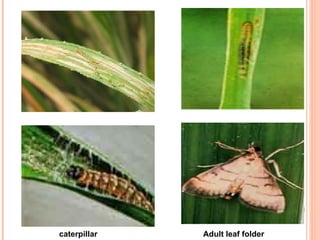
Damage symptoms
 Longitudinal white and transparent streaks on leaf
   blades are created which later giving scorched
   appearance.
 Folded leaf with larva inside along with excreta

 Sickly appearance of the filed

           
caterpillar   Adult leaf folder
Management
Biological control :
 Five to six releases of the egg parasitoid
  Trichogramma    chilonis @1,00,000 adult parasites
  per hectare starting from 15 days after planting, in a
  crop season is effective and economical.
 Entomopahogenic bacteria such as Bacillus thuringiensis
  Berliner and a granulosis virus cause mortality of rice
  leaf folder larvae.
Chemical control :
 ETL: 1 larva per tiller
 10-12 DAS  1ml of methyl parathion 50EC or 0.5ml
  fenitrothion 100EC or 0.9ml diazinon 60EC or 1.3ml
  monocrotophos 36SL or 2ml chloropyriphos 20 EC in 1
  liter of water  for spraying on crop.
 Transplanted field require 225-230liter/ha spraying
  chemical or carbofuron 3% @7.5kg/acre granules can be
  used.
Brown plant hopper (BPH)
Brown plant hopper (BPH): Nilaparvata lugens .
                                                 (Hemiptera : Delphacidae )
Local name: Kandu jigi hulu
Vernacular name: Bili Dhomi, Solle
Damage symptoms:
  Leaves turn to yellow and later brownish.

  "Hopper burn".

 Presence of honeydew and sooty molds at the basal parts

 More severe during panicle initiation stage.

                                                           
ETL: 5-10 adult BPH tillering to ear emergence in the field
Adult brown plant hopper


                           Infected field
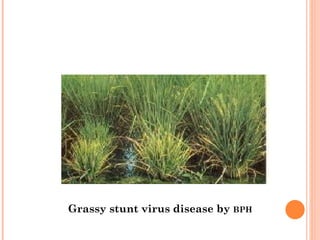
Grassy stunt virus disease by BPH  
Management:
Cultural practices:
 Avoid use of excess nitrogen.

 Monitoring of BPH at base of the plant 30 days after
  transplanting at weekly interval
 Resistant varieties IET-7575 and IET-8116

 Alternate wetting and drying the field during peak
  infestation.
 Apply recommended dose of nitrogen fertilizer.

Biological control:
 Wolf Spider Pardosa psuedoannulata and Lynx spider
  Oxyopes javanus prey on  leaf-and plant hoppers
 Mirid bug, Cyrtorhinus lividipennis  Reuter prey on eggs
  and small nymphs of GLH,BPH and WBPH
Chemical control:
 Spray monocrtophos 35 EC @ 2ml/l (624ml/acre) at
  nursery stage.
 Application of granular phorate 10G@ 4kg/acre or
  carbofuran 3G@ 10kg/acre insecticides in presence of thin
  film of water                                                                   or
 Spray imidacloprid 200 SL @ 0.5ml (125ml/acre) or
  thiomethaxm 25WG @ 0.5g (125kg/acre) or phaslone 35
  EC @ 2ml/l (800ml/acre) water or quinolphos 5G @
  12kg/acre
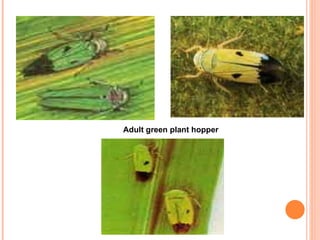
Green plant hopper 
Green Leaf  Hopper : Nephotettix nigropictus and
                                         Nephotettix virescens
                                           (Hemiptera : Cicadellidae )
Local name: Hasiru Jigi Hulu
Damage symptoms:
 Stunted growth and reduced tillering.

 On tillers appearance of white patches at higher population
  level.
 Transmits virus diseases: tungro, yellow dwarf, yellow-
  orange leaf, and transitory yellowing.
Adult green plant hopper
Management:
Cultural practices
 Avoid use of excess nitrogen.
 Monitoring of GLH at base of the plant 30 days after transplanting at
  weekly interval
 Alternate wetting and drying the field during peak infestation.
 Apply recommended dose of nitrogenous fertilizers

Biological control:
 Mirid bug, Cyrtorhinus lividipennis  Reuter prey on  eggs and small
  nymphs of GLH
Chemical control:
 Spray monocrtophos 35 EC @ 2ml/l (624ml/acre) at nursery stage.
 Application of granular phorate 10G@ 4kg/acre or carbofuran 3G@ 10kg/
  acre .                                                                           
 Spray imidacloprid 200 SL @ 0.5ml (125ml/acre) or thiomethaxm 25WG
  @ 0.5g (125kg/acre) or phaslone 35 EC @ 2ml/l (800ml/acre) water
White backed plant hopper
White Backed Plant Hopper : Sogatella furcifera  
                                                    (Hemiptera : Delphacidae)
Local name:Bili Bennina Jigi Hulu
Vernacular name: Bili dhomi, Solle
Damage symptoms:
 Leaves turn yellow and later brownish.

  "Hopper burn".

 Sooty mould development due to honeydew secretion by
  hoppers.
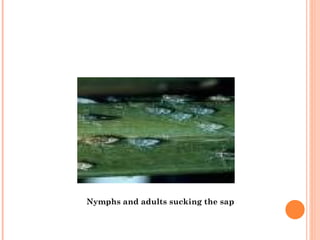
Nymphs and adults sucking the sap
Management:
Cultural practices:
 Avoid use of excess nitrogen.

 Monitoring of WBPH at base of the plant 30 days after
  transplanting at weekly interval
 Alternate wetting and drying the field during peak
  infestation.
 Apply recommended dose of nitrogenous fertilizers

Biological control:
 Mirid bug, Cyrtorhinus lividipennis  Reuter prey on eggs and
  small nymphs of WBPH
  Spider (Paradosa, Tetragnatha, Argiope, Araenus,
  Oxypes)feed on  leaf-and plant hoppers
  Damsel flies, Dragon flies prey on hoppers and moths
Chemical control:
 Spray monocrtophos 35 EC @ 2ml/l (624ml/acre) at
  nursery stage.
 Application of granular phorate 10G@ 4kg/acre or
  carbofuran 3G@ 10kg/acre insecticides in presence of
  thin film of
  water.                                                                  
 Spray imidacloprid 200 SL @ 0.5ml (125ml/acre) or
  thiomethaxm 25WG @ 0.5g (125kg/acre)
Rice Stem Borer
Rice Stem Borer :Scirpophaga incertulas
                     (Pyralidae : Lepidoptera)
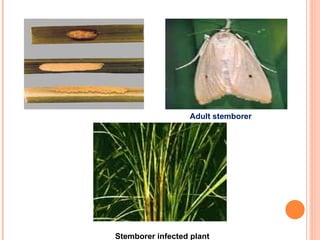
Damage symptoms:
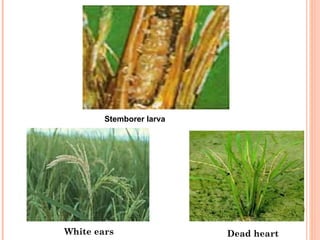
 Caterpillars bore central shoot of seedlings and tillers
  leading to death of central shoot called "Dead Heart".
 Panicle turn whitish, erect with chaffy spikelets and
  can be easily pulled out, is known as "white ears"
Adult stemborer


Stemborer infected plant
Stemborer larva


White ears                Dead heart
Management:
Cultural practices:
 Clipping of seedling before transplanting for prevention
  egg laying
  Harvesting done at the base of plant in order to avoid
  pupae remain in the field.
Biological control:
 Five to six releases of the egg parasitoid Trichogramma
  japonicum @1,00,000 adult parasites per hectare starting
  from 15 days after planting, in a crop season is effective
  and economical.  
Chemical control:
  ETL:5-10% dead heart, 5% chaffy earhead per square  
  meter 1 adult/egg mass
 Spray endosulfan or monocrtophos or chloropyriphos 2ml /
  liter (624ml/acre) in water.
 Before sowing apply 10kg/acre of 0.3 G fipronil or
  carbofuron 3G @ 7.6kg/acre in soil and then go for
  irrigation.
Asian Gall Midge
Asian Gall Midge :Orseolla oryzae
                    ( Diptera : Cecidomyiidae )
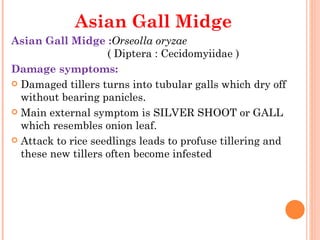
Damage symptoms:
 Damaged tillers turns into tubular galls which dry off
  without bearing panicles.
 Main external symptom is SILVER SHOOT or GALL
  which resembles onion leaf.
 Attack to rice seedlings leads to profuse tillering and
  these new tillers often become infested
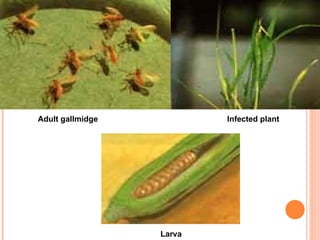
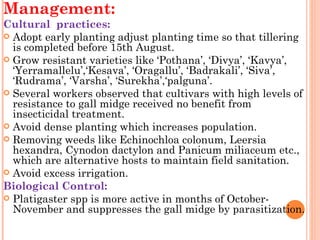
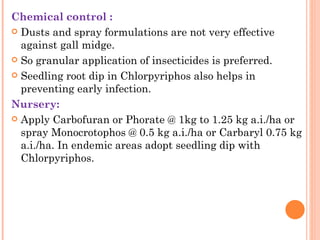
Adult gallmidge           Infected plant


                  Larva
Management:
Cultural practices:
 Adopt early planting adjust planting time so that tillering
  is completed before 15th August.
 Grow resistant varieties like ‘Pothana’, ‘Divya’, ‘Kavya’,
  ‘Yerramallelu’,‘Kesava’, ‘Oragallu’, ‘Badrakali’, ‘Siva’,
  ‘Rudrama’, ‘Varsha’, ‘Surekha’,‘palguna’.
 Several workers observed that cultivars with high levels of
  resistance to gall midge received no benefit from
  insecticidal treatment.
 Avoid dense planting which increases population.
 Removing weeds like Echinochloa colonum, Leersia
  hexandra, Cynodon dactylon and Panicum miliaceum etc.,
  which are alternative hosts to maintain field sanitation.
 Avoid excess irrigation.
Biological Control:
 Platigaster spp is more active in months of October-
  November and suppresses the gall midge by parasitization.
Chemical control :
 Dusts and spray formulations are not very effective
  against gall midge.
 So granular application of insecticides is preferred.

 Seedling root dip in Chlorpyriphos also helps in
  preventing early infection.
Nursery:
 Apply Carbofuran or Phorate @ 1kg to 1.25 kg a.i./ha or
  spray Monocrotophos @ 0.5 kg a.i./ha or Carbaryl 0.75 kg
  a.i./ha. In endemic areas adopt seedling dip with
  Chlorpyriphos.
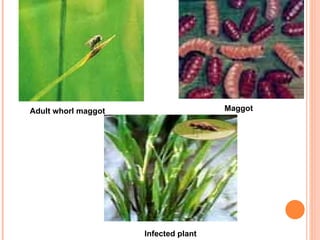
Whorl Maggot
Whorl Maggot :Hydrellia spp
                  (Diptera: Ephydridae)
Damage symptoms:
 The maggots attack the leaf blades even before
  uncurling and the initial damage is characterized by
  the presence of narrow stripes of whitish area in the
  blade margins.
 Heavy infestation causes a marked stunting of the
  plant and reduction of tillers.
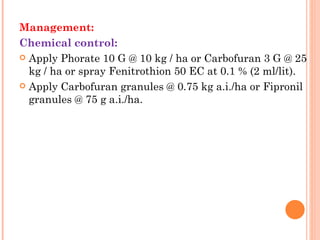
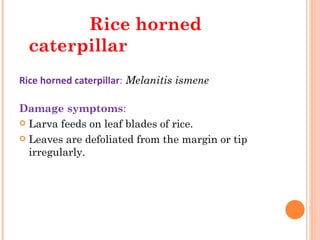
Adult whorl maggot                    Maggot


                     Infected plant
Management:
Chemical control:
 Apply Phorate 10 G @ 10 kg / ha or Carbofuran 3 G @ 25
  kg / ha or spray Fenitrothion 50 EC at 0.1 % (2 ml/lit).
 Apply Carbofuran granules @ 0.75 kg a.i./ha or Fipronil
  granules @ 75 g a.i./ha.
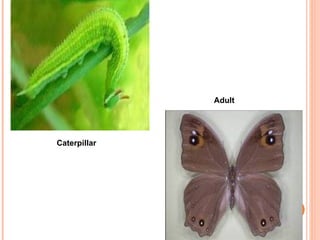
Rice horned
 caterpillar
Rice horned caterpillar: Melanitis ismene
   
Damage symptoms:
 Larva feeds on leaf blades of rice.

 Leaves are defoliated from the margin or tip
  irregularly.
Adult


Caterpillar
Management
   Spray endosulfan 35 EC 1000 ml / ha or monocrotophos 36
    WSC 500 ml / ha
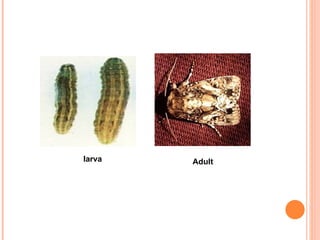
larva   Adult
Management
 Kerosenate the water while irrigation – suffocation
 Allow ducks into the field

Nursery
 Drain the water

 Spray chlorpyriphos 20 EC 80ml or endosulfan 35 EC 80ml + 20
  lit of water for 8 cents
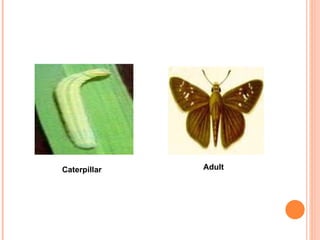
Caterpillar   Adult
Management
   Spray endosulfan 35 EC 1000 ml / ha  or  
    monocrotophos 36 WSC 500 ml / ha
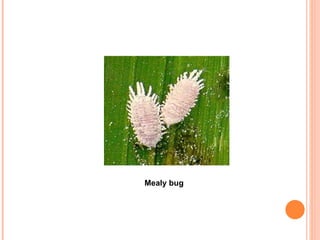
Mealy bug
Management
Cultural practice:
 Durin field preparation - remove the grasses from the bunds
  and trim the bunds
 Remove and destroy the affected plants.

Biological control:
o Conserve the natural enemies like Scymnus sp.,Anatrichus

  pygmaeus, and Mepachymerus ensifer
Chemical control:
 Spray any one of the following insecticides in the initial stage
  of infestation
   dimethoate 30 EC 500 ml/ha
   methyl demeton 25 EC@ 500 ml/ha.
Ipm in rice

Ipm in rice

  • 3.
    Rice thrips: Paddy thrips:Stenchaetothrips biformis                    (Thripidae: Thysanoptera) Local name: Thrips nusi Damage symptoms Leaves look like burnt appearance Damaged leaves Damaged field
  • 4.
    Management: Cultural practice: Flooding to submerge the infested field for 2 days as a cultural control practice is very effective against the rice thrips.  Biological control: Coccinellid beetles, anthocorid bugs, and staphylinid beetles are biological control agents that feed on both the larvae and adults.  Chemical control: Application of  phorate 10 G @ 75g or carbofuron 3 G @ 1.25kg / seed bed (300 sq mt area) followed by light  irrigation. Spray monocrotophos 36 SL 1.3ml/l       
  • 5.
    Rice grass hopper Ricegrass hopper: Oxya hyla intricata                                     (Orthoptera :Acrididae) Local name: Midate Damage symptoms:  Both nymph and adult feed on leaves.  Nibble at the florets into base of inflorescence stalks causing formation of white ears.
  • 6.
    Management:    Cultural practices: Cleaning of bunds to destroy egg pods and nymphs.  Deep ploughing is recommended in winter season to expose the egg mass.   Chemical controls:  Spray chloropyriphos 20EC 2ml/l for about 130-135liters of chemical solution required for one acre.  Dusting of 50% malathion or 1.5% quinolphos or 1% endosalfon on bunds
  • 7.
    Rice Gundhi bug RiceGundhi Bug:  Leptocorisa acuta (Hemiptera : Coreidae) Local name: Gandhi Tigane Damage symptoms  The nymphs and adults suck the milk from the developing grains and stem in the early stage of grain formation.  Discolouration of panicles as well as the presence of some empty or ill filled grains in the panicles.  Infested paddy straw contains foul smell.   
  • 8.
    Adult gundhi bug Chaffy seeds
  • 9.
    Management: Preventive measures   Removeweeds from fields and surrounding areas Biological control  Small wasps parasitize the eggs and the meadow grasshoppers prey on them.  Both the adults and nymphs are preys to spiders, coccinellid beetles and dragonflies  A fungus infects both nymphs and adults.
  • 10.
    Chemical control  Lookfor rice bugs at pre flowering stage and continue daily until the hard dough stage during early morning or late afternoon hours.  malathion dust 5% @ 8kg/acre or  malathion 50EC @ 2ml/l (350ml/acre) and take up spraying on panicle.  270 liter of spraying chemical is required per acre.
  • 11.
    Army worm Armyworm/Climbing cutworm: Mythimna separata (Lepidoptera : Noctuidae) Kannada name: Tene kattarisuva hulu Damage symptoms:  Early instar larvae skeletonise the leaves whereas later instar larvae are voracious feeders on leaves during night.                           
  • 12.
    Cut worm Panicles are cut off from the base Fed upon leaf blades
  • 13.
    Management: Preventive measures:  Removeweeds from fields and surrounding areas Cultural practices:  Flooding seed bed is the best defence  Digging pits or trenches, covered with leaves gives caterpillar a place to take shelter from the sunlight  Ash filled trenches around the field serve as barriers  Placing branches around the field gives a place for armyworm to congregate where than can be easily collected by hand. Chemical control:  1ml of methyl parathion 50EC or 0.5ml fenitrothion 100EC or 0.9ml diazinon 60EC or 1.3ml monocrotophos 36SL or 2ml chloropyriphos 20 EC or 1.5ml fenthoate 50EC or 2ml phasalone 35EC or 2ml endosalfon 35EC or 2ml quinolphos 25EC during evening
  • 14.
    Rice case worm RiceCaseworm: Paraponyx stagnalis (Lepidoptera : Pyralidae) Local name: Kolave Hulu, Goodu maru Hulu Damage symptoms:  The larva feeds on the foliage by scrapping chlorophyll leaving horizontal rows of green material.  The leaf tips are sharply cut off and the cut portions are turned into cylindrical tubes, is either attached to the plant or seen floating on the water surface
  • 15.
  • 16.
    Management Cultural practices:  Drainwater from the field.  Keep kerosene soaked gunny bags in the field water and dislodge the leaf cases by passing rope or branches of thorny plant.  The use of correct fertilizer application, wider spacing (30 × 20 mm), and early planting. Biological Control:  Spiders, dragonflies, and birds eat the adults.  There is a nuclear polyhedrosis virus, which is a potential control agent against the rice caseworm. Chemical control:  10-12 DAS  1ml of methyl parathion 50EC or 1.3ml monocrotophos 36SL or 2ml chloropyriphos 20 EC in 1 liter of water for spraying crop.  Transplanted field require 225-230liter/acre spraying chemical or carbofuron 3% 7.6kg/acre granules can be used.
  • 17.
    Rice hispa Rice hispa:Dicladispa armig-era (Coleoptera : Chrysomelidae)  Kannada name : Mullu chippina dumbhi Damage symptoms:  Grubs make tunneling through leaf tissue causing irregular translucent white patches that -are parallel to the leaf veins.  Damaged areas have white streaks that are parallel to the midrib
  • 18.
  • 19.
    Management: Preventive measures :  Clippingthe tips of leaves at the time of transplanting Biological control:  Small wasps that attack the eggs and larvae.  Reduviid bug eats upon the adults.  Fungal pathogens that attack the adults. Chemical control :  ETL :  2adults or 2 damaged leaves/hill  10-12 DAS  1ml of methyl parathion 50EC or 0.5ml fenitrothion 100EC or 0.9ml diazinon 60EC or 1.3ml monocrotophos 36SL or 2ml chloropyriphos 20 EC in 1 liter of water for spraying crop.  Transplanted field require 225-230liter/acre spraying chemical or carbofuron 3% @7.6kg/acre granules can be used.
  • 20.
    Rice leaf folder RiceLeaf Folder: Cnaphalocrosis medinalis (Lepidoptera: Pyralidae) Kannada name :  Yele Suruli Hulu, Yele Madachuva Hulu, Gari Suttuva Hulu Damage symptoms  Longitudinal white and transparent streaks on leaf blades are created which later giving scorched appearance.  Folded leaf with larva inside along with excreta  Sickly appearance of the filed            
  • 21.
    caterpillar Adult leaf folder
  • 23.
    Management Biological control : Five to six releases of the egg parasitoid Trichogramma    chilonis @1,00,000 adult parasites per hectare starting from 15 days after planting, in a crop season is effective and economical.  Entomopahogenic bacteria such as Bacillus thuringiensis Berliner and a granulosis virus cause mortality of rice leaf folder larvae. Chemical control :  ETL: 1 larva per tiller  10-12 DAS  1ml of methyl parathion 50EC or 0.5ml fenitrothion 100EC or 0.9ml diazinon 60EC or 1.3ml monocrotophos 36SL or 2ml chloropyriphos 20 EC in 1 liter of water  for spraying on crop.  Transplanted field require 225-230liter/ha spraying chemical or carbofuron 3% @7.5kg/acre granules can be used.
  • 24.
    Brown plant hopper (BPH) Brown planthopper (BPH): Nilaparvata lugens .                      (Hemiptera : Delphacidae ) Local name: Kandu jigi hulu Vernacular name: Bili Dhomi, Solle Damage symptoms:   Leaves turn to yellow and later brownish.   "Hopper burn".  Presence of honeydew and sooty molds at the basal parts  More severe during panicle initiation stage.                                                             ETL: 5-10 adult BPH tillering to ear emergence in the field
  • 25.
    Adult brown planthopper Infected field
  • 26.
    Grassy stunt virusdisease by BPH  
  • 27.
    Management: Cultural practices:  Avoiduse of excess nitrogen.  Monitoring of BPH at base of the plant 30 days after transplanting at weekly interval  Resistant varieties IET-7575 and IET-8116  Alternate wetting and drying the field during peak infestation.  Apply recommended dose of nitrogen fertilizer. Biological control:  Wolf Spider Pardosa psuedoannulata and Lynx spider Oxyopes javanus prey on  leaf-and plant hoppers  Mirid bug, Cyrtorhinus lividipennis  Reuter prey on eggs and small nymphs of GLH,BPH and WBPH
  • 28.
    Chemical control:  Spraymonocrtophos 35 EC @ 2ml/l (624ml/acre) at nursery stage.  Application of granular phorate 10G@ 4kg/acre or carbofuran 3G@ 10kg/acre insecticides in presence of thin film of water                                                                   or  Spray imidacloprid 200 SL @ 0.5ml (125ml/acre) or thiomethaxm 25WG @ 0.5g (125kg/acre) or phaslone 35 EC @ 2ml/l (800ml/acre) water or quinolphos 5G @ 12kg/acre
  • 29.
    Green plant hopper  GreenLeaf  Hopper : Nephotettix nigropictus and Nephotettix virescens                                            (Hemiptera : Cicadellidae ) Local name: Hasiru Jigi Hulu Damage symptoms:  Stunted growth and reduced tillering.  On tillers appearance of white patches at higher population level.  Transmits virus diseases: tungro, yellow dwarf, yellow- orange leaf, and transitory yellowing.
  • 30.
  • 31.
    Management: Cultural practices  Avoiduse of excess nitrogen.  Monitoring of GLH at base of the plant 30 days after transplanting at weekly interval  Alternate wetting and drying the field during peak infestation.  Apply recommended dose of nitrogenous fertilizers Biological control:  Mirid bug, Cyrtorhinus lividipennis  Reuter prey on  eggs and small nymphs of GLH Chemical control:  Spray monocrtophos 35 EC @ 2ml/l (624ml/acre) at nursery stage.  Application of granular phorate 10G@ 4kg/acre or carbofuran 3G@ 10kg/ acre .                                                                             Spray imidacloprid 200 SL @ 0.5ml (125ml/acre) or thiomethaxm 25WG @ 0.5g (125kg/acre) or phaslone 35 EC @ 2ml/l (800ml/acre) water
  • 32.
    White backed planthopper White Backed Plant Hopper : Sogatella furcifera                                                   (Hemiptera : Delphacidae) Local name:Bili Bennina Jigi Hulu Vernacular name: Bili dhomi, Solle Damage symptoms:  Leaves turn yellow and later brownish.   "Hopper burn".  Sooty mould development due to honeydew secretion by hoppers.
  • 33.
    Nymphs and adultssucking the sap
  • 34.
    Management: Cultural practices:  Avoiduse of excess nitrogen.  Monitoring of WBPH at base of the plant 30 days after transplanting at weekly interval  Alternate wetting and drying the field during peak infestation.  Apply recommended dose of nitrogenous fertilizers Biological control:  Mirid bug, Cyrtorhinus lividipennis  Reuter prey on eggs and small nymphs of WBPH   Spider (Paradosa, Tetragnatha, Argiope, Araenus, Oxypes)feed on  leaf-and plant hoppers   Damsel flies, Dragon flies prey on hoppers and moths
  • 35.
    Chemical control:  Spraymonocrtophos 35 EC @ 2ml/l (624ml/acre) at nursery stage.  Application of granular phorate 10G@ 4kg/acre or carbofuran 3G@ 10kg/acre insecticides in presence of thin film of water.                                                                    Spray imidacloprid 200 SL @ 0.5ml (125ml/acre) or thiomethaxm 25WG @ 0.5g (125kg/acre)
  • 36.
    Rice Stem Borer RiceStem Borer :Scirpophaga incertulas (Pyralidae : Lepidoptera) Damage symptoms:  Caterpillars bore central shoot of seedlings and tillers leading to death of central shoot called "Dead Heart".  Panicle turn whitish, erect with chaffy spikelets and can be easily pulled out, is known as "white ears"
  • 37.
  • 38.
  • 39.
    Management: Cultural practices:  Clippingof seedling before transplanting for prevention egg laying   Harvesting done at the base of plant in order to avoid pupae remain in the field. Biological control:  Five to six releases of the egg parasitoid Trichogramma japonicum @1,00,000 adult parasites per hectare starting from 15 days after planting, in a crop season is effective and economical.   Chemical control:   ETL:5-10% dead heart, 5% chaffy earhead per square   meter 1 adult/egg mass  Spray endosulfan or monocrtophos or chloropyriphos 2ml / liter (624ml/acre) in water.  Before sowing apply 10kg/acre of 0.3 G fipronil or carbofuron 3G @ 7.6kg/acre in soil and then go for irrigation.
  • 40.
    Asian Gall Midge AsianGall Midge :Orseolla oryzae ( Diptera : Cecidomyiidae ) Damage symptoms:  Damaged tillers turns into tubular galls which dry off without bearing panicles.  Main external symptom is SILVER SHOOT or GALL which resembles onion leaf.  Attack to rice seedlings leads to profuse tillering and these new tillers often become infested
  • 41.
    Adult gallmidge Infected plant Larva
  • 42.
    Management: Cultural practices:  Adoptearly planting adjust planting time so that tillering is completed before 15th August.  Grow resistant varieties like ‘Pothana’, ‘Divya’, ‘Kavya’, ‘Yerramallelu’,‘Kesava’, ‘Oragallu’, ‘Badrakali’, ‘Siva’, ‘Rudrama’, ‘Varsha’, ‘Surekha’,‘palguna’.  Several workers observed that cultivars with high levels of resistance to gall midge received no benefit from insecticidal treatment.  Avoid dense planting which increases population.  Removing weeds like Echinochloa colonum, Leersia hexandra, Cynodon dactylon and Panicum miliaceum etc., which are alternative hosts to maintain field sanitation.  Avoid excess irrigation. Biological Control:  Platigaster spp is more active in months of October- November and suppresses the gall midge by parasitization.
  • 43.
    Chemical control : Dusts and spray formulations are not very effective against gall midge.  So granular application of insecticides is preferred.  Seedling root dip in Chlorpyriphos also helps in preventing early infection. Nursery:  Apply Carbofuran or Phorate @ 1kg to 1.25 kg a.i./ha or spray Monocrotophos @ 0.5 kg a.i./ha or Carbaryl 0.75 kg a.i./ha. In endemic areas adopt seedling dip with Chlorpyriphos.
  • 44.
    Whorl Maggot Whorl Maggot:Hydrellia spp (Diptera: Ephydridae) Damage symptoms:  The maggots attack the leaf blades even before uncurling and the initial damage is characterized by the presence of narrow stripes of whitish area in the blade margins.  Heavy infestation causes a marked stunting of the plant and reduction of tillers.
  • 45.
    Adult whorl maggot Maggot Infected plant
  • 46.
    Management: Chemical control:  ApplyPhorate 10 G @ 10 kg / ha or Carbofuran 3 G @ 25 kg / ha or spray Fenitrothion 50 EC at 0.1 % (2 ml/lit).  Apply Carbofuran granules @ 0.75 kg a.i./ha or Fipronil granules @ 75 g a.i./ha.
  • 47.
    Rice horned caterpillar Ricehorned caterpillar: Melanitis ismene   Damage symptoms:  Larva feeds on leaf blades of rice.  Leaves are defoliated from the margin or tip irregularly.
  • 48.
  • 49.
    Management  Spray endosulfan 35 EC 1000 ml / ha or monocrotophos 36 WSC 500 ml / ha
  • 50.
    larva Adult
  • 51.
    Management  Kerosenate thewater while irrigation – suffocation  Allow ducks into the field Nursery  Drain the water  Spray chlorpyriphos 20 EC 80ml or endosulfan 35 EC 80ml + 20 lit of water for 8 cents
  • 52.
  • 53.
    Management  Spray endosulfan 35 EC 1000 ml / ha  or   monocrotophos 36 WSC 500 ml / ha
  • 54.
  • 55.
    Management Cultural practice:  Durinfield preparation - remove the grasses from the bunds and trim the bunds  Remove and destroy the affected plants. Biological control: o Conserve the natural enemies like Scymnus sp.,Anatrichus pygmaeus, and Mepachymerus ensifer Chemical control:  Spray any one of the following insecticides in the initial stage of infestation dimethoate 30 EC 500 ml/ha methyl demeton 25 EC@ 500 ml/ha.