Identification of different Insect
pests
◦ DHA=2 by:
◦ Name: Deeksha Singh
◦ Roll no.:2003032
Helicoverpa armigera
Helicoverpa armigera is a species of Lepidoptera in the
family Noctuidae. It is known as the cotton bollworm, corn
earworm, Old World (African) bollworm, or scarce bordered
straw
The larvae feed on a wide range of plants and a major pest in
cotton .
Cotton bollworms are attracted to succulent, rank-growing cotton
plants; keep water, fertilizer, and plant density at recommended levels
to avoid rank growth. Because populations seldom reach damaging
levels before late summer, manage the crop for early maturing and plan to
defoliate by late September.
Chilli Thrips
The chilli thrips, Scirtothrips dorsalis Hood, is an important
pest of various vegetable, ornamental and fruit crops in
southern and eastern Asia, Africa, and Oceania
Generally, chilli thrips are pale colored and the lengths of their
first and second instar larvae and the pupae are 0.37-0.39, 0.68-
0.71 and 0.78-0.80 mm, respectively. Adults are about 1.2 mm
long with dark wings and dark spots forming incomplete stripes
which appear dorsally on the abdomen
Management practices include crop rotation, removal of weeds
(which may serve as hosts), and supporting the maximum use of
natural enemies, including predators and parasites, and rotating
insecticides.
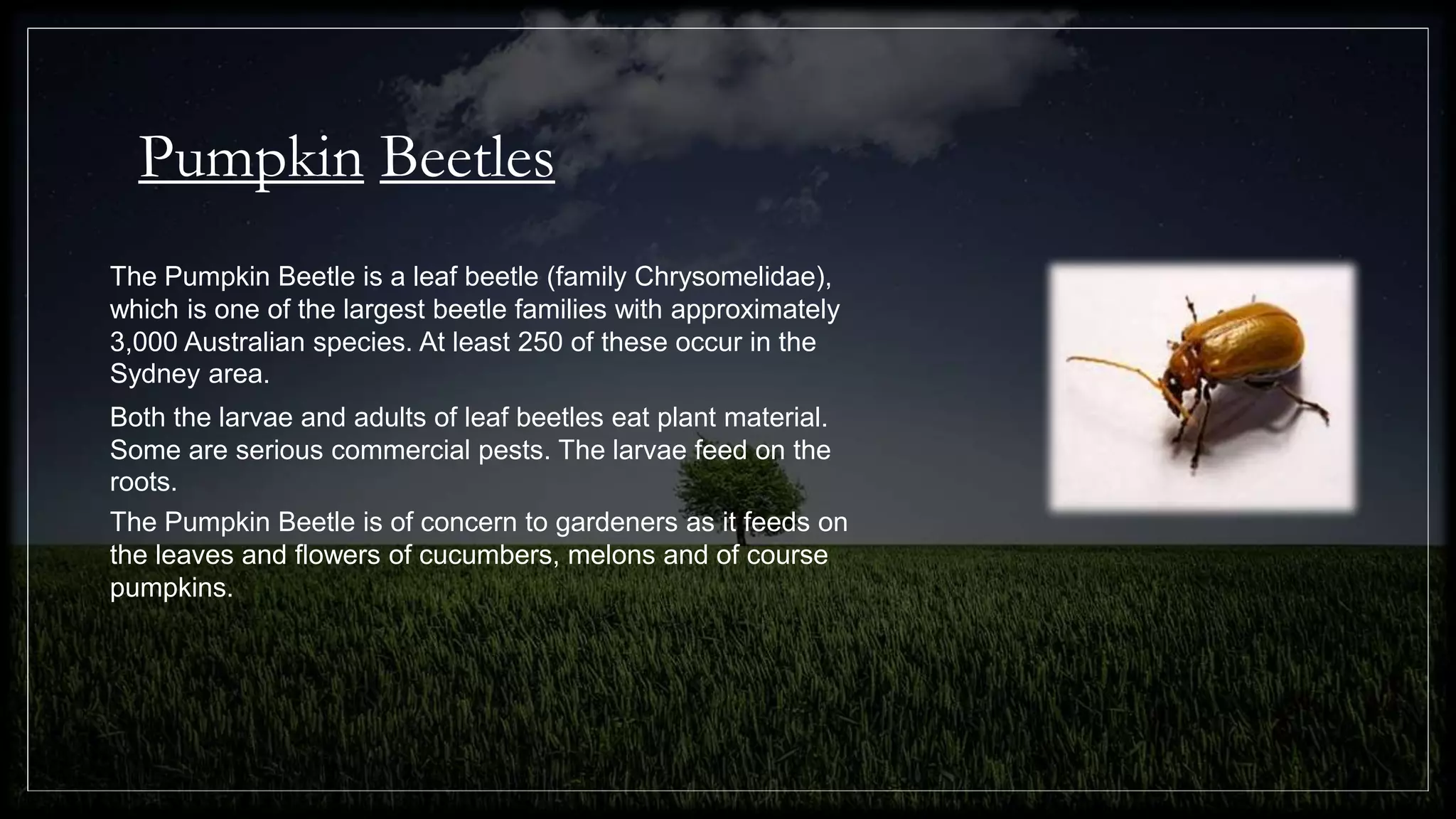
Pumpkin Beetles
The Pumpkin Beetle is a leaf beetle (family Chrysomelidae),
which is one of the largest beetle families with approximately
3,000 Australian species. At least 250 of these occur in the
Sydney area.
Both the larvae and adults of leaf beetles eat plant material.
Some are serious commercial pests. The larvae feed on the
roots.
The Pumpkin Beetle is of concern to gardeners as it feeds on
the leaves and flowers of cucumbers, melons and of course
pumpkins.
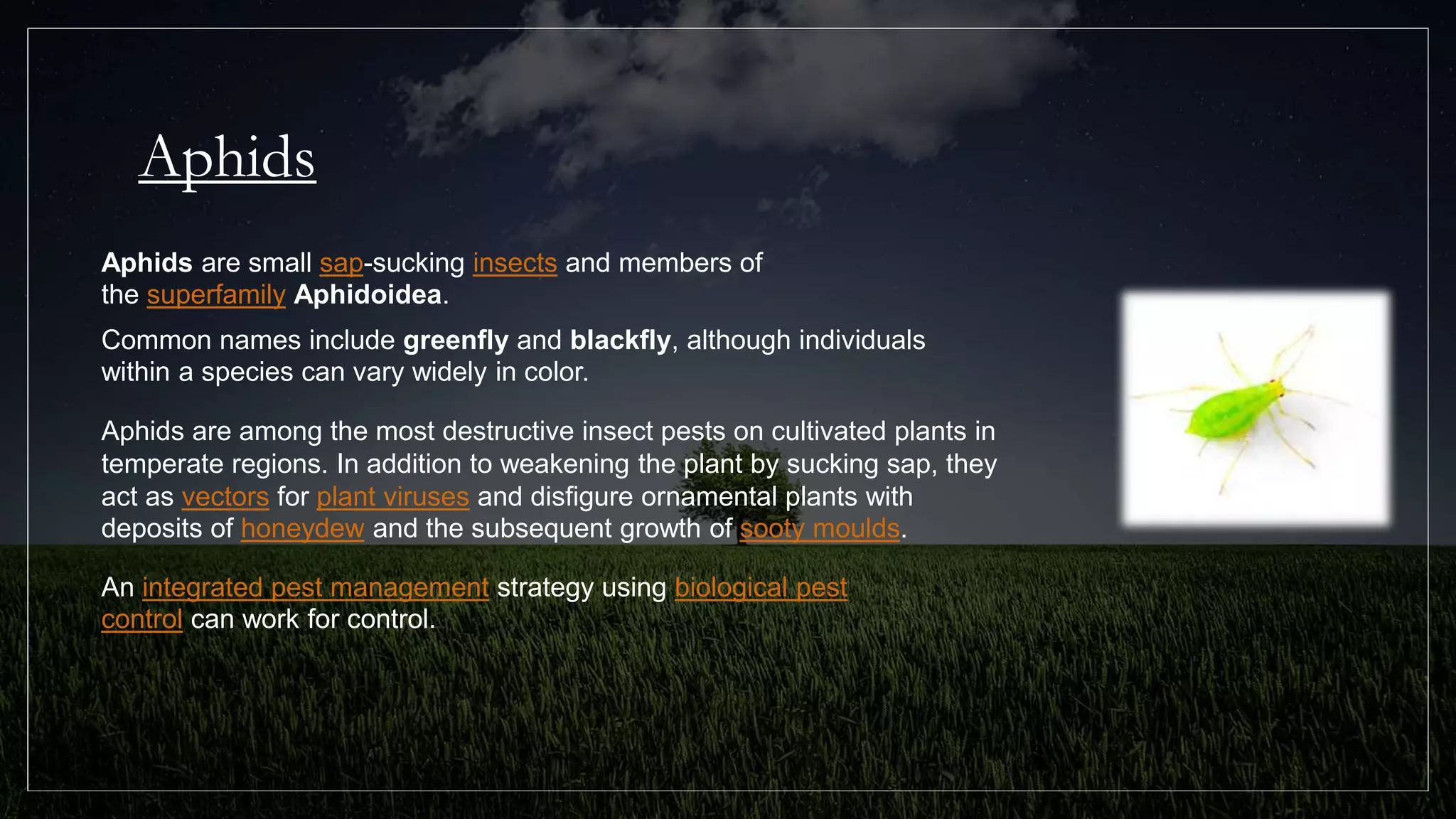
Aphids
Aphids are small sap-sucking insects and members of
the superfamily Aphidoidea.
Common names include greenfly and blackfly, although individuals
within a species can vary widely in color.
Aphids are among the most destructive insect pests on cultivated plants in
temperate regions. In addition to weakening the plant by sucking sap, they
act as vectors for plant viruses and disfigure ornamental plants with
deposits of honeydew and the subsequent growth of sooty moulds.
An integrated pest management strategy using biological pest
control can work for control.
Brinjal shoot and fruit borer
◦ Brinjal fruit & shoot borer (LEUCINODES ORBONALIS) is a
serious pest for brinjal plant. This fruit and shoot borer only infest on all
kinds of egg plants or brinjal and it feed internally damaging the tender
shoots and fruits
◦ .Damage to the plant is caused mainly by the larvae, which bores through
the terminal part of the mid rib of large leaves and tender shoots to
cause “dead hearts”.
◦ If we can understand the life cycle of the Lucinodes insect, an integrated
approach may be adapted to manage it effectively.
Pink Bollworms
The pink bollworm (Pectinophora gossypiella) is one of the most
destructive pests of cotton. Though probably native to India, it is now
distributed worldwide. It bores into cotton bolls, devouring blossoms and
seeds. The pinkish-coloured larva generally pupates in a cocoon inside a
boll or seed, in litter, or underground. The brown adult has fringed
wings. In warm climates several generations occur annually.
Symptoms of damage
1.Rosetted flowers.
2.Excreta observed at the point of bore holes by larval feeding. ...
3.They cut window holes (interlocular burrowing) in the two adjoining
seeds thereby forming "double seeds"
4.The attacked buds and immature bolls drop off.
5.Discolored lint and burrowed seeds.
Pyrilla in Sugarcane
The sugarcane Pyrilla, also known as as sugarcane leafhopper, is the
most destructive sucking pest of sugarcane
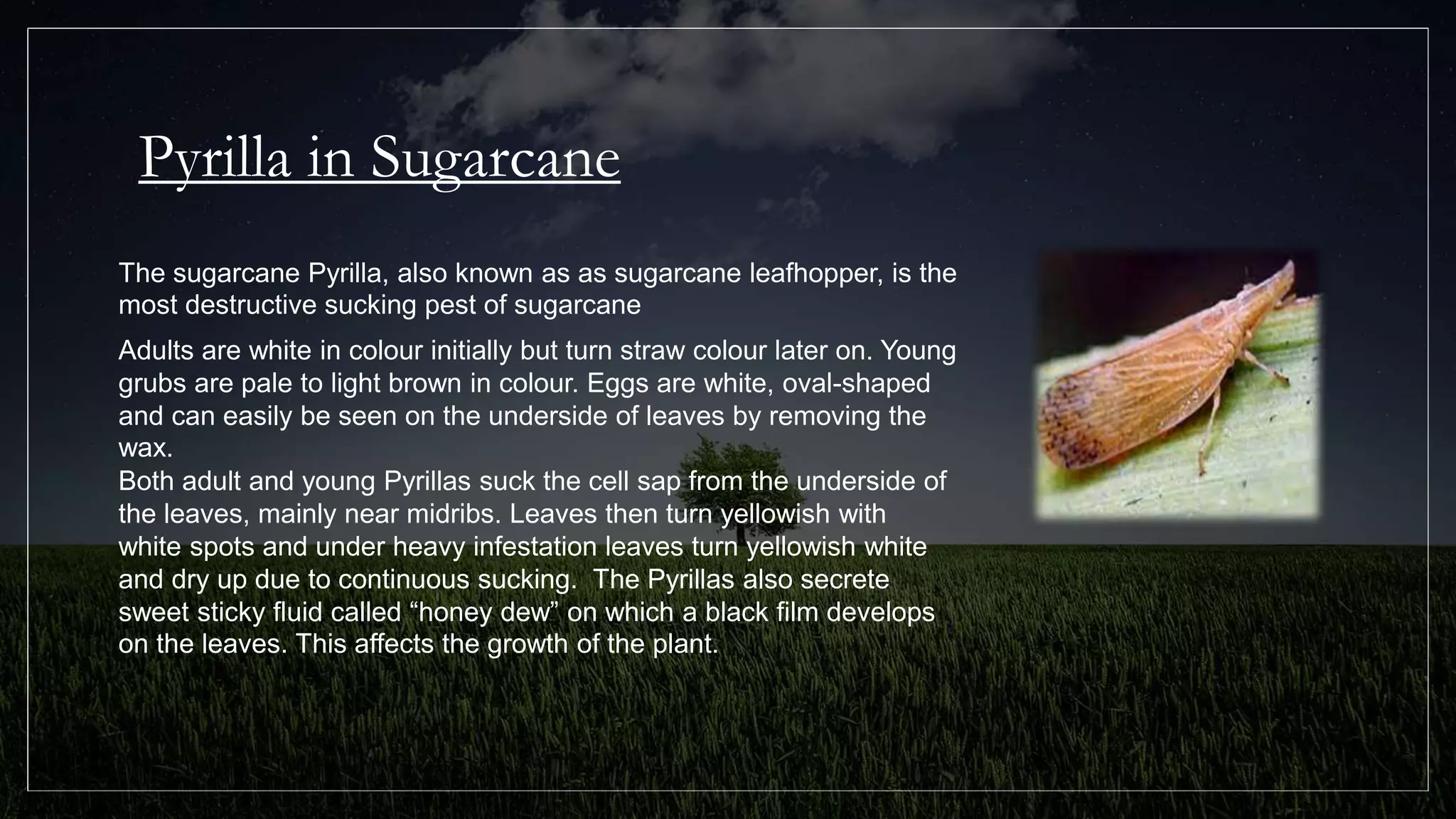
Adults are white in colour initially but turn straw colour later on. Young
grubs are pale to light brown in colour. Eggs are white, oval-shaped
and can easily be seen on the underside of leaves by removing the
wax.
Both adult and young Pyrillas suck the cell sap from the underside of
the leaves, mainly near midribs. Leaves then turn yellowish with
white spots and under heavy infestation leaves turn yellowish white
and dry up due to continuous sucking. The Pyrillas also secrete
sweet sticky fluid called “honey dew” on which a black film develops
on the leaves. This affects the growth of the plant.
Hairy Caterpillar
Metanastria hyrtaca, called the hairy caterpillar as a larva, is
a moth of the family Lasiocampidae first described by Pieter Cramer in
1782.
Distribution and status: Generally called as gristly citrus
caterpillar and found all over the Indian sub-continent.
Host range: Polyphagous pest and prefers several Citrus
species.
Damage symptoms
Caterpillars are nocturnal in habit and feed gregariously and
voraciously. During day, they remain crowded on shady side of
tree trunks.
Mango Fruitfly
The mango fruit fly is believed to be the single largest crop
damager in India. It accounts for about 27 per cent of
harvesting loss. The flies attack semi ripe and mature fruits
during the months of April and May. Other fruits like guava,
citrus, plum, peach, sapota, loquot, etc are also susceptible to
this pest attack.
If fruit fly is very serious (> 5/Surveillance trap), give bait
sprays on the tree trunks at weekly interval: (Bait spray is
prepared by mixing 100g of jaggery in one litre of water to which
2 mL of deltamethrin (2.8 EC) is added). The harvested fruits
may be treated with hot water for 1 hour at 48oC.
Rice Horned Caterpillar
Rice horned caterpillar: Melanitis ismene (Satyridae, Lepidoptera)
Distribution and status: Throughout India
Host range: Rice, Millets
Damage symptoms: The larva of this butterfly feeds on leaf blades of
rice. Leaves are defoliated from the margin or tip irregularly.
Management Strategies:
1.Expose the eggs to be picked up by birds after ploughing and trim the
bunds.
2.Dusting the crop with 5-10% methyl parathion 2% @ 25-30 kg/ha. ...
3.Spraying nuvan 100 EC @ 200 ml/ha (or) malathion 50 EC@ 2.5 lit/ha
etc.
Mustard Aphids
Lipaphis erysimi is a species of aphid of
the family Aphididae. Its common names include mustard
aphid and turnip aphid.
It is found in most temperate and tropical areas of the world and
feeds only on cruciferous plants.
Spraying should be done in evening time. Spray the crop with
one of the following insecticides in the aphid
appearance; Imidacloprid 17.8% @ 0.25 ml/l, Thiamethoxam
25 WG @ o. 2g/l, Dimethoate 30EC @v 1 ml/l of water.
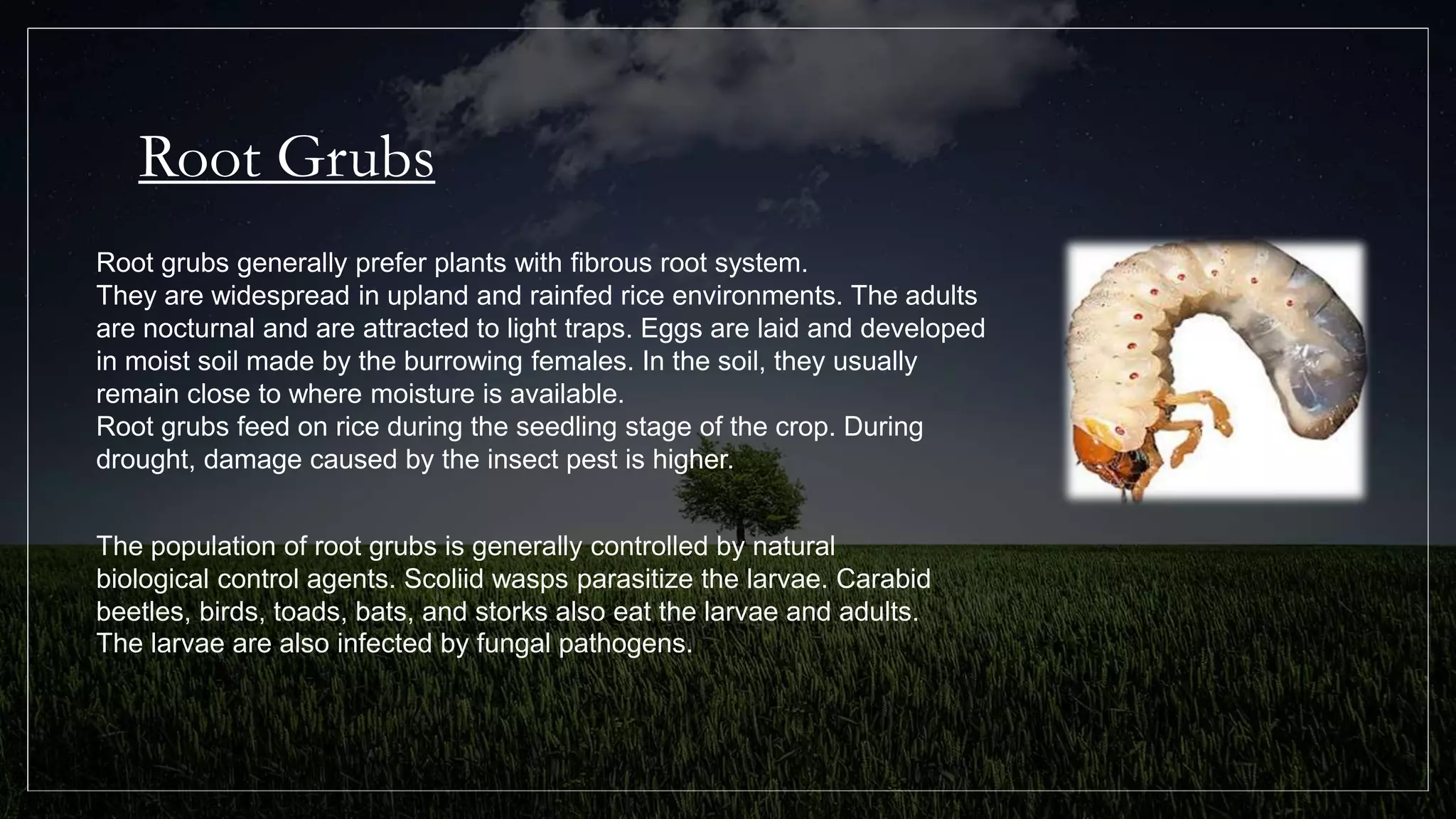
Root Grubs
Root grubs generally prefer plants with fibrous root system.
They are widespread in upland and rainfed rice environments. The adults
are nocturnal and are attracted to light traps. Eggs are laid and developed
in moist soil made by the burrowing females. In the soil, they usually
remain close to where moisture is available.
Root grubs feed on rice during the seedling stage of the crop. During
drought, damage caused by the insect pest is higher.
The population of root grubs is generally controlled by natural
biological control agents. Scoliid wasps parasitize the larvae. Carabid
beetles, birds, toads, bats, and storks also eat the larvae and adults.
The larvae are also infected by fungal pathogens.
Armyworm
Armyworms are caterpillar pests of grass pastures and cereal
crops.
They are the only caterpillars that growers are likely to
encounter in cereal crops,
Armyworms mostly feed on leaves, but under certain
circumstances will feed on the seed stem, resulting in head loss
Armyworm are easily controlled by insecticides, especially if
detected early and sprays are applied when economic damage
is imminent. Barley crops can be extensively damaged by
armyworm lopping barley heads in just a few days.
Green Leaf Hopper
Damage symptoms: Both nymphs and adults desap the leaves and
cause “hopper burn” due to heavy infestation. Yellowing of leaves
from tip downwards is the typical symptom caused by this pest.
However, it is more important as a vector forrice virus, rice yellow
dwarf and transitory yellowing diseases.
Distribution and status: India, South Japan to oriental region,
west of south Africa, Phillippines, Formosa, Sri Lanka
Host range: Rice, millets, grasses
The most effective means of GLH management is to use GLH-
resistant and tungro-resistant varieties like IR 50, IR 54, IR
64, CR 1009, PY 3, Co 46 and white ponni . Apply neem cake
@ 12.5 kg/20 cent nursery as basal dose.
Whitefly
Whiteflies are Hemipterans that typically feed on the undersides
of plant leaves. They comprise the family Aleyrodidae, the only
family in the superfamily Aleyrodoidea
Whiteflies are soft-bodied, winged insects closely related
to aphids and mealybugs. Despite their name, whiteflies are not a
type of fly, though they do have wings and are capable of flying.
Whiteflies can be difficult to control with insecticides. Most less-
toxic products such as insecticidal soaps, neem oil, or
petroleum-based oils control only those whiteflies that are
directly sprayed. Therefore, plants must be thoroughly covered
with the spray solution, and repeat applications may be
necessary.

Identification of different insect pests.pptx

  • 1.
    Identification of differentInsect pests ◦ DHA=2 by: ◦ Name: Deeksha Singh ◦ Roll no.:2003032
  • 2.
    Helicoverpa armigera Helicoverpa armigerais a species of Lepidoptera in the family Noctuidae. It is known as the cotton bollworm, corn earworm, Old World (African) bollworm, or scarce bordered straw The larvae feed on a wide range of plants and a major pest in cotton . Cotton bollworms are attracted to succulent, rank-growing cotton plants; keep water, fertilizer, and plant density at recommended levels to avoid rank growth. Because populations seldom reach damaging levels before late summer, manage the crop for early maturing and plan to defoliate by late September.
  • 3.
    Chilli Thrips The chillithrips, Scirtothrips dorsalis Hood, is an important pest of various vegetable, ornamental and fruit crops in southern and eastern Asia, Africa, and Oceania Generally, chilli thrips are pale colored and the lengths of their first and second instar larvae and the pupae are 0.37-0.39, 0.68- 0.71 and 0.78-0.80 mm, respectively. Adults are about 1.2 mm long with dark wings and dark spots forming incomplete stripes which appear dorsally on the abdomen Management practices include crop rotation, removal of weeds (which may serve as hosts), and supporting the maximum use of natural enemies, including predators and parasites, and rotating insecticides.
  • 4.
    Pumpkin Beetles The PumpkinBeetle is a leaf beetle (family Chrysomelidae), which is one of the largest beetle families with approximately 3,000 Australian species. At least 250 of these occur in the Sydney area. Both the larvae and adults of leaf beetles eat plant material. Some are serious commercial pests. The larvae feed on the roots. The Pumpkin Beetle is of concern to gardeners as it feeds on the leaves and flowers of cucumbers, melons and of course pumpkins.
  • 5.
    Aphids Aphids are smallsap-sucking insects and members of the superfamily Aphidoidea. Common names include greenfly and blackfly, although individuals within a species can vary widely in color. Aphids are among the most destructive insect pests on cultivated plants in temperate regions. In addition to weakening the plant by sucking sap, they act as vectors for plant viruses and disfigure ornamental plants with deposits of honeydew and the subsequent growth of sooty moulds. An integrated pest management strategy using biological pest control can work for control.
  • 6.
    Brinjal shoot andfruit borer ◦ Brinjal fruit & shoot borer (LEUCINODES ORBONALIS) is a serious pest for brinjal plant. This fruit and shoot borer only infest on all kinds of egg plants or brinjal and it feed internally damaging the tender shoots and fruits ◦ .Damage to the plant is caused mainly by the larvae, which bores through the terminal part of the mid rib of large leaves and tender shoots to cause “dead hearts”. ◦ If we can understand the life cycle of the Lucinodes insect, an integrated approach may be adapted to manage it effectively.
  • 7.
    Pink Bollworms The pinkbollworm (Pectinophora gossypiella) is one of the most destructive pests of cotton. Though probably native to India, it is now distributed worldwide. It bores into cotton bolls, devouring blossoms and seeds. The pinkish-coloured larva generally pupates in a cocoon inside a boll or seed, in litter, or underground. The brown adult has fringed wings. In warm climates several generations occur annually. Symptoms of damage 1.Rosetted flowers. 2.Excreta observed at the point of bore holes by larval feeding. ... 3.They cut window holes (interlocular burrowing) in the two adjoining seeds thereby forming "double seeds" 4.The attacked buds and immature bolls drop off. 5.Discolored lint and burrowed seeds.
  • 8.
    Pyrilla in Sugarcane Thesugarcane Pyrilla, also known as as sugarcane leafhopper, is the most destructive sucking pest of sugarcane Adults are white in colour initially but turn straw colour later on. Young grubs are pale to light brown in colour. Eggs are white, oval-shaped and can easily be seen on the underside of leaves by removing the wax. Both adult and young Pyrillas suck the cell sap from the underside of the leaves, mainly near midribs. Leaves then turn yellowish with white spots and under heavy infestation leaves turn yellowish white and dry up due to continuous sucking. The Pyrillas also secrete sweet sticky fluid called “honey dew” on which a black film develops on the leaves. This affects the growth of the plant.
  • 9.
    Hairy Caterpillar Metanastria hyrtaca,called the hairy caterpillar as a larva, is a moth of the family Lasiocampidae first described by Pieter Cramer in 1782. Distribution and status: Generally called as gristly citrus caterpillar and found all over the Indian sub-continent. Host range: Polyphagous pest and prefers several Citrus species. Damage symptoms Caterpillars are nocturnal in habit and feed gregariously and voraciously. During day, they remain crowded on shady side of tree trunks.
  • 10.
    Mango Fruitfly The mangofruit fly is believed to be the single largest crop damager in India. It accounts for about 27 per cent of harvesting loss. The flies attack semi ripe and mature fruits during the months of April and May. Other fruits like guava, citrus, plum, peach, sapota, loquot, etc are also susceptible to this pest attack. If fruit fly is very serious (> 5/Surveillance trap), give bait sprays on the tree trunks at weekly interval: (Bait spray is prepared by mixing 100g of jaggery in one litre of water to which 2 mL of deltamethrin (2.8 EC) is added). The harvested fruits may be treated with hot water for 1 hour at 48oC.
  • 11.
    Rice Horned Caterpillar Ricehorned caterpillar: Melanitis ismene (Satyridae, Lepidoptera) Distribution and status: Throughout India Host range: Rice, Millets Damage symptoms: The larva of this butterfly feeds on leaf blades of rice. Leaves are defoliated from the margin or tip irregularly. Management Strategies: 1.Expose the eggs to be picked up by birds after ploughing and trim the bunds. 2.Dusting the crop with 5-10% methyl parathion 2% @ 25-30 kg/ha. ... 3.Spraying nuvan 100 EC @ 200 ml/ha (or) malathion 50 EC@ 2.5 lit/ha etc.
  • 12.
    Mustard Aphids Lipaphis erysimiis a species of aphid of the family Aphididae. Its common names include mustard aphid and turnip aphid. It is found in most temperate and tropical areas of the world and feeds only on cruciferous plants. Spraying should be done in evening time. Spray the crop with one of the following insecticides in the aphid appearance; Imidacloprid 17.8% @ 0.25 ml/l, Thiamethoxam 25 WG @ o. 2g/l, Dimethoate 30EC @v 1 ml/l of water.
  • 13.
    Root Grubs Root grubsgenerally prefer plants with fibrous root system. They are widespread in upland and rainfed rice environments. The adults are nocturnal and are attracted to light traps. Eggs are laid and developed in moist soil made by the burrowing females. In the soil, they usually remain close to where moisture is available. Root grubs feed on rice during the seedling stage of the crop. During drought, damage caused by the insect pest is higher. The population of root grubs is generally controlled by natural biological control agents. Scoliid wasps parasitize the larvae. Carabid beetles, birds, toads, bats, and storks also eat the larvae and adults. The larvae are also infected by fungal pathogens.
  • 14.
    Armyworm Armyworms are caterpillarpests of grass pastures and cereal crops. They are the only caterpillars that growers are likely to encounter in cereal crops, Armyworms mostly feed on leaves, but under certain circumstances will feed on the seed stem, resulting in head loss Armyworm are easily controlled by insecticides, especially if detected early and sprays are applied when economic damage is imminent. Barley crops can be extensively damaged by armyworm lopping barley heads in just a few days.
  • 15.
    Green Leaf Hopper Damagesymptoms: Both nymphs and adults desap the leaves and cause “hopper burn” due to heavy infestation. Yellowing of leaves from tip downwards is the typical symptom caused by this pest. However, it is more important as a vector forrice virus, rice yellow dwarf and transitory yellowing diseases. Distribution and status: India, South Japan to oriental region, west of south Africa, Phillippines, Formosa, Sri Lanka Host range: Rice, millets, grasses The most effective means of GLH management is to use GLH- resistant and tungro-resistant varieties like IR 50, IR 54, IR 64, CR 1009, PY 3, Co 46 and white ponni . Apply neem cake @ 12.5 kg/20 cent nursery as basal dose.
  • 16.
    Whitefly Whiteflies are Hemipteransthat typically feed on the undersides of plant leaves. They comprise the family Aleyrodidae, the only family in the superfamily Aleyrodoidea Whiteflies are soft-bodied, winged insects closely related to aphids and mealybugs. Despite their name, whiteflies are not a type of fly, though they do have wings and are capable of flying. Whiteflies can be difficult to control with insecticides. Most less- toxic products such as insecticidal soaps, neem oil, or petroleum-based oils control only those whiteflies that are directly sprayed. Therefore, plants must be thoroughly covered with the spray solution, and repeat applications may be necessary.