PLASTIC
PACKAGING
TECHNIQUE
Chapter 5
 Plastic For Packaging, Packaging Characteristic , Various Plastic Materials
Used In Packaging Their Properties , Advantages And Limitation,
Fabrication And Decorative Techniques.
Plastic For Packaging
 Packaging fulfills the diverse role of protecting products, preventing spoilage, contamination, extending
shelf life, ensuring safe storage thereby helping to make them readily available to consumers.
 Plastics are a material of choice in packaging applications because of their low cost, light weight, and high
performance, coupled with good processability. Plastics packaging materials are used for various products-
from food, beverages, chemicals, electronic items, and so on.
 Plastics based on Polypropylene, Polyethylene, Polyvinyl Chloride, and PET are mainly used for packaging
applications.
 Every day there are new products packed in plastics replacing conventional products and when a thought is
given to pack a new product the first choice appears in the mind is Plastic packaging material.
Why Plastics for packing?
 Safety: Plastics are safe for packaging of food products specially polyolefins which don't react with food.
 Shelf Life: Plastics packaging material offer better shelf life
 Cost: Plastics are the most cost effective medium of packaging when compared with any other material.
 Convenience: Plastics can be converted in any form with various processing techniques, thus can pack any
type of substances like liquids, powders, flakes, granules, solids.
 Waste: Packaging in plastics reduces the wastage of various food products.
 Aesthetics: Best plastics packaging increased the aesthetic value of products and helps in brand identity.
 Handling and Storage: Products packed in plastics are easiest to handle and store as well as transport.
 Plastic products are easy to recycle.
Packaging Characteristic
 Good barrier character to atmospheric penetrants such as water vapor and oxygen.
 Good mechanical performance such as good elongation at break, high ductility, high impact strength.
 High transparency
 Low cost and light in weight
 Chemically inert , odorless and tasteless
 High recyclability
 High durability and higher
Various Plastic Materials Used In Packaging
 Nowadays, the most widely used materials are polyethylene terephthalate (PET), Polyvinyl chloride (PVC),
and polyolefins such as polyethylene (PE) and polypropylene (PP)
 But conventional plastic packaging materials have also caused increasing plastic waste accumulation in
oceans and landfills, thus research work on biodegradable polymers such as polylactide (PLA), polyhydroxy
butyrate (PHB), poly(γ) butyrolactone (PγBL) has started.
 The plastic mostly used in packaging are discussed next.
1. High Density Polyethylene (HDPE)
Characteristics
 Low – cost
 Moderately flexible
 Stiffer and has better barrier
properties
 Chemical resistant
 Poor clarity
 Odorless and tasteless
Advantages
 Low-cost
 Good moisture barrier
 Not attack by most solvent
Disadvantages
 Poor barrier for oxygen & other gases
 Odors and flavors are sometimes lost
 Perfume or flavoring oil can transpire rapidly
 Stress-crack in the presence of some product
Application
 For thin-wall blow-moulded containers
 Injection moulding of closures
 Rotational moulding for large containers such as
carboys
 Industrial and consumer bags and thermoformed
trays
2. Low Density Polyethylene (LDPE)
Characteristics
 Odorless and tasteless
 Easily blended with such copolymers
 Highly resistant to most solvent
 Poor barrier for gases
 Softening temperature is around 210ºF
 Easily pigmented and Good transparency
Advantages
 Flexible and moisture barrier
 Tough and chemical resistant
 Low cost and light weight
Disadvantages
 Not practical for rigid container and flexible packages
 Problem in flavors and odors
 Stress cracking
 Not recommended for oily products
Application
 Use in squeezable tubes and bottles
 Wrappers and bags for different products
 Thermoformed into trays, frozen food containers
 Coating material for bottle cartons, bacon wrappers
and paperboard milk containers
3. Linear Low Density Polyethylene (LLDPE)
Characteristics
 Low-cost and Light weight
 Superior toughness
 Rigid and Moisture barrier
 Chemical and stress-crack resistant
Advantages
 Good tensile strength
 Puncture resistance
 Good impact and tear properties
 Stress cracking and warding resistance
Disadvantages
 High wear rate
 Low crystalline ratio
 Low fatigue resistance
 Not useful in extremely high or low temperatures
 High permeability to carbon dioxide and other gases
Application
 For large-sized bagging and wrapping operations
 Plastic bags and Wash bottles
 Corrosion protection layer for work surfaces
 Computer hardware covers and packaging
4. Polypropylene (PP)
Characteristics
 Heat and chemical resistance
 Tough & rigid
 Resist oil and greases
 Stress-crack resistance
 Fairly good barrier to moisture and gases
 High melting point
Advantages
 Light weight
 Low-cost
 Less shrinkage
Disadvantages
 Low impact strength
 Sharp melting point
Application
 Widely used in closures of all kinds
 Suitable for some boil-in-bag
packages and containers
 Standard plastic in moulded
container
5. Polyvinyl chloride (PVC)
Characteristics
 Crystal clear
 Low in impact strength
 Tough and has good puncture resistance
 Good barrier properties (moisture and gases)
 Retains odors and flavors
Advantages
 Relatively inexpensive
 Tough
 clear
Disadvantages
 Corrosive when overheated
 Yellows when exposed to heat or Utf light
 Scratches easily seen
Application
 Blister packaging for pharmaceutical and capsules
 Garment, box and pallet load wrapping
applications
6. Nylon
Characteristics
 Structurally strong
 Relatively low moisture absorption
 Good dimensional stability
 Heat sealability.
Advantages
 Clear
 Good barrier properties to gases
 Excellent stability at both high and
low temp.
Disadvantages
 Can be oxidized causing nylon to lose strength
 Hygroscopic in nature
 React with moisture
 Swells and deteriorates rapidly
Applications:
 Co-extruded with poly-olefins to enhance
packaging properties
 Coating on paperboards, papers and foils
 Extrusion-blow-molded containers for hard to-
hold chemicals
7. Polyester (Polyethylene Tetra phthalate)
Characteristics
 Excels in strength, toughness and clarity
 Resistant to weak acids, bases and most
solvents
 Not good barrier for gases
Advantages
 Fairly stiff material
 Excellent transparency
 Excellent heat, low
 temperature and water resistance
 Excellent oil, chemical and solvent resistance
 Excellent barrier to aroma and Flavor
Disadvantages
 Poor seal property
 High cost
 Poor resistance to melting
 Poor dyeability
Applications
 Home Furnishing Material
 Mouse Pads
 Clothing Fabrics.
 Car Tyre Reinforcements.
 Safety Belts And Conveyor Belts
8. Polystyrene (PS)
Characteristics
 Crystal clear and very hard, brittle and
rigid
 Low melting point (190ºF)
 Poor impact strength
 Not good barrier for moisture or gases
 Odorless and tasteless
Advantages
 Clear and light weight
 Low in cost
 Easily molded, thermoformed and
extruded into film
 Accept printing, metallizing and hot-
stamping
Disadvantages
 Slight tendency to shrink
 Discolor in strong sunlight
 Can craze and become cloudy
 Builds up static changes Easily
Applications
 Bottles for pharmaceutical tablets and
capsules
 In molded forms for close containment of
fragile products
9. Polycarbonate
Characteristics
 Good clarity, impact strength, ductility
and low controllable mold shrinkage
 Sterilizable and tolerates gamma
radiation
 High-priced material
Advantages
 Great clarity, toughness and high
softening temp.
 Dimensionally stable and processable
 Odorless and non-staining
Disadvantages
 High- cost
 High permeation of moisture and gases
 Sensitive to oxygen and carbon dioxide
Application
 Room Divider
 Safety Glasses
 Electronics parts
 Auto Parts.
Fabrication
 Plastic fabrication is the process of designing, manufacturing, and assembling a product
made out of plastic material or composites that contain plastic.
 There are numerous plastic fabrication methods known today, considering the wide variety
of products made out of plastic. Each method is suitable for the fabrication of certain
designs because of its unique advantages and disadvantages.
 Today, plastic fabrication is quite popular among manufacturers because of its two main
properties, i.e., malleability and cost-effectiveness. These two properties make it versatile
and durable for a wide range of products spread over various industries.
 Joining and coating process are also employed after fabrication as a finishing process.
Cont…
 There is a wide variety of plastic fabrication methods depending on the distinctive characteristics and the
resulting product. The most common plastic fabrication methods are:
 The following points are considered for selection of plastic fabrication methods.
 Thermoforming
 Die Cutting
 Pultrusion
 Forging
 Vacuum Casting
 Plastic Welding
 Compounding
 Plastic Lamination
 Molding
 Plastic Extrusion
 Plastic type
 Part Geometry
 Required Precision
 Design Flexibility
 Cost
 Lead Time
Cont.
Advantages
 Light in weight
 Ease of forming
 Faster production
 Reduced finishing efforts
Disadvantages
 Limited temperature resistance
 Limited wear resistance
 Structural weakness
 Non degradable
Application
 Construction industry- window , doors, pipe and interior application
 Automobile industry -
 Aerospace industry -line fuel tanks and fliers’ boots, radar covers
Decoration of Plastic
 The surface of a plastic article film or sheet may be coated, marked, mechanically finished or otherwise altered
for appearance or performance reasons.
 The decorating process might be performed in line with other processes and the rate of decorating should not
slow down the operation.
 A plastic part may be of irregular shape, as many injection molded parts are, or it can be processed in the form
of a film or sheet.
 The choice of decorating method might be determined by the shape of the surface. the purpose of decoration
should be to create a visually exciting plastics promotes the brand image of the company and creates a sense of
value.
 Since plastics decoration is used in so many industries, ranging from packaging and consumer products to
telecommunications and automotive, the requirements for both appearance and function vary widely.
Decorating Methods
1. Spray Painting
2. Pad Painting
3. Silk-screening
4. Powder Coating
5. Vacuum Coating
Techniques
6. Metal Printing
7. Laser
8. Hydrographic
9. IMD Decoration
10. OMD Decoration
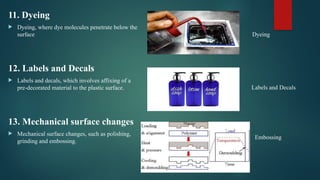
11. Dyeing
12. Labels & Decals
13. Mechanical Surface Changes
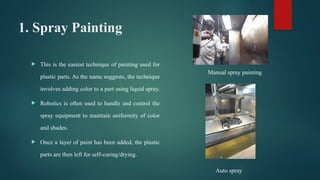
1. Spray Painting
 This is the easiest technique of painting used for
plastic parts. As the name suggests, the technique
involves adding color to a part using liquid spray.
 Robotics is often used to handle and control the
spray equipment to maintain uniformity of color
and shades.
 Once a layer of paint has been added, the plastic
parts are then left for self-curing/drying.
Manual spray painting
Auto spray
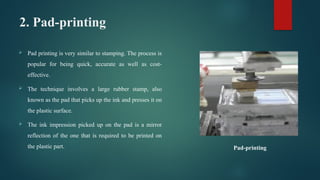
2. Pad-printing
 Pad printing is very similar to stamping. The process is
popular for being quick, accurate as well as cost-
effective.
 The technique involves a large rubber stamp, also
known as the pad that picks up the ink and presses it on
the plastic surface.
 The ink impression picked up on the pad is a mirror
reflection of the one that is required to be printed on
the plastic part. Pad-printing
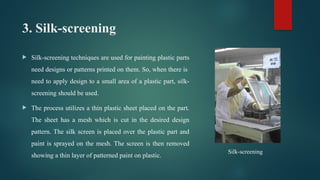
3. Silk-screening
 Silk-screening techniques are used for painting plastic parts
need designs or patterns printed on them. So, when there is
need to apply design to a small area of a plastic part, silk-
screening should be used.
 The process utilizes a thin plastic sheet placed on the part.
The sheet has a mesh which is cut in the desired design
pattern. The silk screen is placed over the plastic part and
paint is sprayed on the mesh. The screen is then removed
showing a thin layer of patterned paint on plastic.
Silk-screening
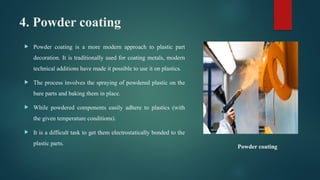
4. Powder coating
 Powder coating is a more modern approach to plastic part
decoration. It is traditionally used for coating metals, modern
technical additions have made it possible to use it on plastics.
 The process involves the spraying of powdered plastic on the
bare parts and baking them in place.
 While powdered components easily adhere to plastics (with
the given temperature conditions).
 It is a difficult task to get them electrostatically bonded to the
plastic parts.
Powder coating
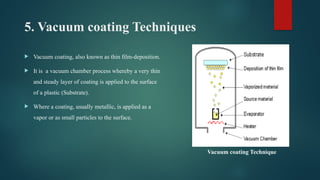
5. Vacuum coating Techniques
 Vacuum coating, also known as thin film-deposition.
 It is a vacuum chamber process whereby a very thin
and steady layer of coating is applied to the surface
of a plastic (Substrate).
 Where a coating, usually metallic, is applied as a
vapor or as small particles to the surface.
Vacuum coating Technique
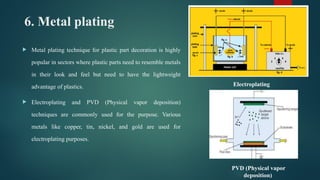
6. Metal plating
 Metal plating technique for plastic part decoration is highly
popular in sectors where plastic parts need to resemble metals
in their look and feel but need to have the lightweight
advantage of plastics.
 Electroplating and PVD (Physical vapor deposition)
techniques are commonly used for the purpose. Various
metals like copper, tin, nickel, and gold are used for
electroplating purposes.
Electroplating
PVD (Physical vapor
deposition)
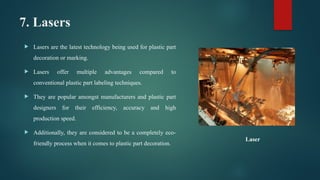
7. Lasers
 Lasers are the latest technology being used for plastic part
decoration or marking.
 Lasers offer multiple advantages compared to
conventional plastic part labeling techniques.
 They are popular amongst manufacturers and plastic part
designers for their efficiency, accuracy and high
production speed.
 Additionally, they are considered to be a completely eco-
friendly process when it comes to plastic part decoration.
Laser
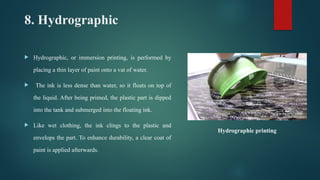
8. Hydrographic
 Hydrographic, or immersion printing, is performed by
placing a thin layer of paint onto a vat of water.
 The ink is less dense than water, so it floats on top of
the liquid. After being primed, the plastic part is dipped
into the tank and submerged into the floating ink.
 Like wet clothing, the ink clings to the plastic and
envelops the part. To enhance durability, a clear coat of
paint is applied afterwards.
Hydrographic printing
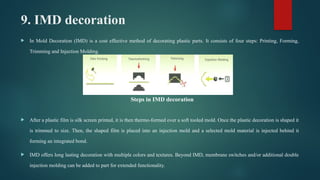
9. IMD decoration
 In Mold Decoration (IMD) is a cost effective method of decorating plastic parts. It consists of four steps: Printing, Forming,
Trimming and Injection Molding.
 After a plastic film is silk screen printed, it is then thermo-formed over a soft tooled mold. Once the plastic decoration is shaped it
is trimmed to size. Then, the shaped film is placed into an injection mold and a selected mold material is injected behind it
forming an integrated bond.
 IMD offers long lasting decoration with multiple colors and textures. Beyond IMD, membrane switches and/or additional double
injection molding can be added to part for extended functionality.
Steps in IMD decoration
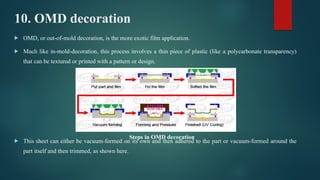
10. OMD decoration
 OMD, or out-of-mold decoration, is the more exotic film application.
 Much like in-mold-decoration, this process involves a thin piece of plastic (like a polycarbonate transparency)
that can be textured or printed with a pattern or design.
 This sheet can either be vacuum-formed on its own and then adhered to the part or vacuum-formed around the
part itself and then trimmed, as shown here.
Steps in OMD decoration
11. Dyeing
 Dyeing, where dye molecules penetrate below the
surface
12. Labels and Decals
 Labels and decals, which involves affixing of a
pre-decorated material to the plastic surface.
13. Mechanical surface changes
 Mechanical surface changes, such as polishing,
grinding and embossing.
Labels and Decals
Dyeing
Embossing

study of various techniques used for PLASTIC PACKAGING TECHNIQUE.pptx

  • 1.
  • 2.
    Chapter 5  PlasticFor Packaging, Packaging Characteristic , Various Plastic Materials Used In Packaging Their Properties , Advantages And Limitation, Fabrication And Decorative Techniques.
  • 3.
    Plastic For Packaging Packaging fulfills the diverse role of protecting products, preventing spoilage, contamination, extending shelf life, ensuring safe storage thereby helping to make them readily available to consumers.  Plastics are a material of choice in packaging applications because of their low cost, light weight, and high performance, coupled with good processability. Plastics packaging materials are used for various products- from food, beverages, chemicals, electronic items, and so on.  Plastics based on Polypropylene, Polyethylene, Polyvinyl Chloride, and PET are mainly used for packaging applications.  Every day there are new products packed in plastics replacing conventional products and when a thought is given to pack a new product the first choice appears in the mind is Plastic packaging material.
  • 4.
    Why Plastics forpacking?  Safety: Plastics are safe for packaging of food products specially polyolefins which don't react with food.  Shelf Life: Plastics packaging material offer better shelf life  Cost: Plastics are the most cost effective medium of packaging when compared with any other material.  Convenience: Plastics can be converted in any form with various processing techniques, thus can pack any type of substances like liquids, powders, flakes, granules, solids.  Waste: Packaging in plastics reduces the wastage of various food products.  Aesthetics: Best plastics packaging increased the aesthetic value of products and helps in brand identity.  Handling and Storage: Products packed in plastics are easiest to handle and store as well as transport.  Plastic products are easy to recycle.
  • 5.
    Packaging Characteristic  Goodbarrier character to atmospheric penetrants such as water vapor and oxygen.  Good mechanical performance such as good elongation at break, high ductility, high impact strength.  High transparency  Low cost and light in weight  Chemically inert , odorless and tasteless  High recyclability  High durability and higher
  • 6.
    Various Plastic MaterialsUsed In Packaging  Nowadays, the most widely used materials are polyethylene terephthalate (PET), Polyvinyl chloride (PVC), and polyolefins such as polyethylene (PE) and polypropylene (PP)  But conventional plastic packaging materials have also caused increasing plastic waste accumulation in oceans and landfills, thus research work on biodegradable polymers such as polylactide (PLA), polyhydroxy butyrate (PHB), poly(γ) butyrolactone (PγBL) has started.  The plastic mostly used in packaging are discussed next.
  • 7.
    1. High DensityPolyethylene (HDPE) Characteristics  Low – cost  Moderately flexible  Stiffer and has better barrier properties  Chemical resistant  Poor clarity  Odorless and tasteless Advantages  Low-cost  Good moisture barrier  Not attack by most solvent Disadvantages  Poor barrier for oxygen & other gases  Odors and flavors are sometimes lost  Perfume or flavoring oil can transpire rapidly  Stress-crack in the presence of some product Application  For thin-wall blow-moulded containers  Injection moulding of closures  Rotational moulding for large containers such as carboys  Industrial and consumer bags and thermoformed trays
  • 8.
    2. Low DensityPolyethylene (LDPE) Characteristics  Odorless and tasteless  Easily blended with such copolymers  Highly resistant to most solvent  Poor barrier for gases  Softening temperature is around 210ºF  Easily pigmented and Good transparency Advantages  Flexible and moisture barrier  Tough and chemical resistant  Low cost and light weight Disadvantages  Not practical for rigid container and flexible packages  Problem in flavors and odors  Stress cracking  Not recommended for oily products Application  Use in squeezable tubes and bottles  Wrappers and bags for different products  Thermoformed into trays, frozen food containers  Coating material for bottle cartons, bacon wrappers and paperboard milk containers
  • 9.
    3. Linear LowDensity Polyethylene (LLDPE) Characteristics  Low-cost and Light weight  Superior toughness  Rigid and Moisture barrier  Chemical and stress-crack resistant Advantages  Good tensile strength  Puncture resistance  Good impact and tear properties  Stress cracking and warding resistance Disadvantages  High wear rate  Low crystalline ratio  Low fatigue resistance  Not useful in extremely high or low temperatures  High permeability to carbon dioxide and other gases Application  For large-sized bagging and wrapping operations  Plastic bags and Wash bottles  Corrosion protection layer for work surfaces  Computer hardware covers and packaging
  • 10.
    4. Polypropylene (PP) Characteristics Heat and chemical resistance  Tough & rigid  Resist oil and greases  Stress-crack resistance  Fairly good barrier to moisture and gases  High melting point Advantages  Light weight  Low-cost  Less shrinkage Disadvantages  Low impact strength  Sharp melting point Application  Widely used in closures of all kinds  Suitable for some boil-in-bag packages and containers  Standard plastic in moulded container
  • 11.
    5. Polyvinyl chloride(PVC) Characteristics  Crystal clear  Low in impact strength  Tough and has good puncture resistance  Good barrier properties (moisture and gases)  Retains odors and flavors Advantages  Relatively inexpensive  Tough  clear Disadvantages  Corrosive when overheated  Yellows when exposed to heat or Utf light  Scratches easily seen Application  Blister packaging for pharmaceutical and capsules  Garment, box and pallet load wrapping applications
  • 12.
    6. Nylon Characteristics  Structurallystrong  Relatively low moisture absorption  Good dimensional stability  Heat sealability. Advantages  Clear  Good barrier properties to gases  Excellent stability at both high and low temp. Disadvantages  Can be oxidized causing nylon to lose strength  Hygroscopic in nature  React with moisture  Swells and deteriorates rapidly Applications:  Co-extruded with poly-olefins to enhance packaging properties  Coating on paperboards, papers and foils  Extrusion-blow-molded containers for hard to- hold chemicals
  • 13.
    7. Polyester (PolyethyleneTetra phthalate) Characteristics  Excels in strength, toughness and clarity  Resistant to weak acids, bases and most solvents  Not good barrier for gases Advantages  Fairly stiff material  Excellent transparency  Excellent heat, low  temperature and water resistance  Excellent oil, chemical and solvent resistance  Excellent barrier to aroma and Flavor Disadvantages  Poor seal property  High cost  Poor resistance to melting  Poor dyeability Applications  Home Furnishing Material  Mouse Pads  Clothing Fabrics.  Car Tyre Reinforcements.  Safety Belts And Conveyor Belts
  • 14.
    8. Polystyrene (PS) Characteristics Crystal clear and very hard, brittle and rigid  Low melting point (190ºF)  Poor impact strength  Not good barrier for moisture or gases  Odorless and tasteless Advantages  Clear and light weight  Low in cost  Easily molded, thermoformed and extruded into film  Accept printing, metallizing and hot- stamping Disadvantages  Slight tendency to shrink  Discolor in strong sunlight  Can craze and become cloudy  Builds up static changes Easily Applications  Bottles for pharmaceutical tablets and capsules  In molded forms for close containment of fragile products
  • 15.
    9. Polycarbonate Characteristics  Goodclarity, impact strength, ductility and low controllable mold shrinkage  Sterilizable and tolerates gamma radiation  High-priced material Advantages  Great clarity, toughness and high softening temp.  Dimensionally stable and processable  Odorless and non-staining Disadvantages  High- cost  High permeation of moisture and gases  Sensitive to oxygen and carbon dioxide Application  Room Divider  Safety Glasses  Electronics parts  Auto Parts.
  • 16.
    Fabrication  Plastic fabricationis the process of designing, manufacturing, and assembling a product made out of plastic material or composites that contain plastic.  There are numerous plastic fabrication methods known today, considering the wide variety of products made out of plastic. Each method is suitable for the fabrication of certain designs because of its unique advantages and disadvantages.  Today, plastic fabrication is quite popular among manufacturers because of its two main properties, i.e., malleability and cost-effectiveness. These two properties make it versatile and durable for a wide range of products spread over various industries.  Joining and coating process are also employed after fabrication as a finishing process.
  • 17.
    Cont…  There isa wide variety of plastic fabrication methods depending on the distinctive characteristics and the resulting product. The most common plastic fabrication methods are:  The following points are considered for selection of plastic fabrication methods.  Thermoforming  Die Cutting  Pultrusion  Forging  Vacuum Casting  Plastic Welding  Compounding  Plastic Lamination  Molding  Plastic Extrusion  Plastic type  Part Geometry  Required Precision  Design Flexibility  Cost  Lead Time
  • 18.
    Cont. Advantages  Light inweight  Ease of forming  Faster production  Reduced finishing efforts Disadvantages  Limited temperature resistance  Limited wear resistance  Structural weakness  Non degradable Application  Construction industry- window , doors, pipe and interior application  Automobile industry -  Aerospace industry -line fuel tanks and fliers’ boots, radar covers
  • 19.
    Decoration of Plastic The surface of a plastic article film or sheet may be coated, marked, mechanically finished or otherwise altered for appearance or performance reasons.  The decorating process might be performed in line with other processes and the rate of decorating should not slow down the operation.  A plastic part may be of irregular shape, as many injection molded parts are, or it can be processed in the form of a film or sheet.  The choice of decorating method might be determined by the shape of the surface. the purpose of decoration should be to create a visually exciting plastics promotes the brand image of the company and creates a sense of value.  Since plastics decoration is used in so many industries, ranging from packaging and consumer products to telecommunications and automotive, the requirements for both appearance and function vary widely.
  • 20.
    Decorating Methods 1. SprayPainting 2. Pad Painting 3. Silk-screening 4. Powder Coating 5. Vacuum Coating Techniques 6. Metal Printing 7. Laser 8. Hydrographic 9. IMD Decoration 10. OMD Decoration 11. Dyeing 12. Labels & Decals 13. Mechanical Surface Changes
  • 21.
    1. Spray Painting This is the easiest technique of painting used for plastic parts. As the name suggests, the technique involves adding color to a part using liquid spray.  Robotics is often used to handle and control the spray equipment to maintain uniformity of color and shades.  Once a layer of paint has been added, the plastic parts are then left for self-curing/drying. Manual spray painting Auto spray
  • 22.
    2. Pad-printing  Padprinting is very similar to stamping. The process is popular for being quick, accurate as well as cost- effective.  The technique involves a large rubber stamp, also known as the pad that picks up the ink and presses it on the plastic surface.  The ink impression picked up on the pad is a mirror reflection of the one that is required to be printed on the plastic part. Pad-printing
  • 23.
    3. Silk-screening  Silk-screeningtechniques are used for painting plastic parts need designs or patterns printed on them. So, when there is need to apply design to a small area of a plastic part, silk- screening should be used.  The process utilizes a thin plastic sheet placed on the part. The sheet has a mesh which is cut in the desired design pattern. The silk screen is placed over the plastic part and paint is sprayed on the mesh. The screen is then removed showing a thin layer of patterned paint on plastic. Silk-screening
  • 24.
    4. Powder coating Powder coating is a more modern approach to plastic part decoration. It is traditionally used for coating metals, modern technical additions have made it possible to use it on plastics.  The process involves the spraying of powdered plastic on the bare parts and baking them in place.  While powdered components easily adhere to plastics (with the given temperature conditions).  It is a difficult task to get them electrostatically bonded to the plastic parts. Powder coating
  • 25.
    5. Vacuum coatingTechniques  Vacuum coating, also known as thin film-deposition.  It is a vacuum chamber process whereby a very thin and steady layer of coating is applied to the surface of a plastic (Substrate).  Where a coating, usually metallic, is applied as a vapor or as small particles to the surface. Vacuum coating Technique
  • 26.
    6. Metal plating Metal plating technique for plastic part decoration is highly popular in sectors where plastic parts need to resemble metals in their look and feel but need to have the lightweight advantage of plastics.  Electroplating and PVD (Physical vapor deposition) techniques are commonly used for the purpose. Various metals like copper, tin, nickel, and gold are used for electroplating purposes. Electroplating PVD (Physical vapor deposition)
  • 27.
    7. Lasers  Lasersare the latest technology being used for plastic part decoration or marking.  Lasers offer multiple advantages compared to conventional plastic part labeling techniques.  They are popular amongst manufacturers and plastic part designers for their efficiency, accuracy and high production speed.  Additionally, they are considered to be a completely eco- friendly process when it comes to plastic part decoration. Laser
  • 28.
    8. Hydrographic  Hydrographic,or immersion printing, is performed by placing a thin layer of paint onto a vat of water.  The ink is less dense than water, so it floats on top of the liquid. After being primed, the plastic part is dipped into the tank and submerged into the floating ink.  Like wet clothing, the ink clings to the plastic and envelops the part. To enhance durability, a clear coat of paint is applied afterwards. Hydrographic printing
  • 29.
    9. IMD decoration In Mold Decoration (IMD) is a cost effective method of decorating plastic parts. It consists of four steps: Printing, Forming, Trimming and Injection Molding.  After a plastic film is silk screen printed, it is then thermo-formed over a soft tooled mold. Once the plastic decoration is shaped it is trimmed to size. Then, the shaped film is placed into an injection mold and a selected mold material is injected behind it forming an integrated bond.  IMD offers long lasting decoration with multiple colors and textures. Beyond IMD, membrane switches and/or additional double injection molding can be added to part for extended functionality. Steps in IMD decoration
  • 30.
    10. OMD decoration OMD, or out-of-mold decoration, is the more exotic film application.  Much like in-mold-decoration, this process involves a thin piece of plastic (like a polycarbonate transparency) that can be textured or printed with a pattern or design.  This sheet can either be vacuum-formed on its own and then adhered to the part or vacuum-formed around the part itself and then trimmed, as shown here. Steps in OMD decoration
  • 31.
    11. Dyeing  Dyeing,where dye molecules penetrate below the surface 12. Labels and Decals  Labels and decals, which involves affixing of a pre-decorated material to the plastic surface. 13. Mechanical surface changes  Mechanical surface changes, such as polishing, grinding and embossing. Labels and Decals Dyeing Embossing
Editor's Notes