Ppt about food packaging material and different types of packaging material Packaging material,food engineering and technology , different types of packaging material explain in brief choosing the right packaging material
DIFFRENT TYPES OFFOOD
PACKAGING MATERIALS.
Presented by:- OM VACHHANI
2.
INTRODUCTION
• Packaging materialare chosen based on their physical, chemical,
and mechanical properties.
• These properties affect food safety, shelf life, and cost.
• These are based on things like how well they protect against outside
factors, their strength, whether they can be recycled, and how they
hold up against other things in the environment.
3.
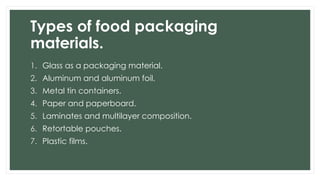
Types of foodpackaging
materials.
1. Glass as a packaging material.
2. Aluminum and aluminum foil.
3. Metal tin containers.
4. Paper and paperboard.
5. Laminates and multilayer composition.
6. Retortable pouches.
7. Plastic films.
4.
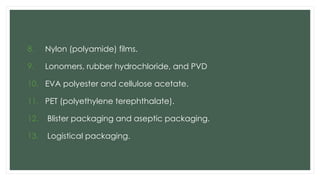
8. Nylon (polyamide)films.
9. Lonomers, rubber hydrochloride, and PVD
10. EVA polyester and cellulose acetate.
11. PET (polyethylene terephthalate).
12. Blister packaging and aseptic packaging.
13. Logistical packaging.
5.
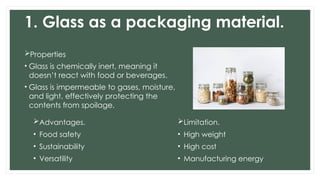
1. Glass asa packaging material.
Properties
• Glass is chemically inert, meaning it
doesn’t react with food or beverages.
• Glass is impermeable to gases, moisture,
and light, effectively protecting the
contents from spoilage.
Advantages.
• Food safety
• Sustainability
• Versatility
Limitation.
• High weight
• High cost
• Manufacturing energy
6.
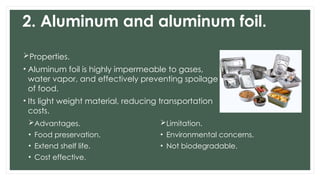
2. Aluminum andaluminum foil.
Properties.
• Aluminum foil is highly impermeable to gases,
water vapor, and effectively preventing spoilage
of food.
• Its light weight material, reducing transportation
costs.
Advantages.
• Food preservation.
• Extend shelf life.
• Cost effective.
Limitation.
• Environmental concerns.
• Not biodegradable.
7.
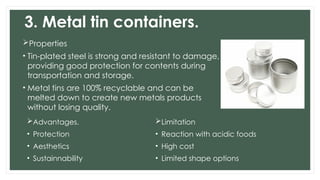
3. Metal tincontainers.
Properties
• Tin-plated steel is strong and resistant to damage,
providing good protection for contents during
transportation and storage.
• Metal tins are 100% recyclable and can be
melted down to create new metals products
without losing quality.
Advantages.
• Protection
• Aesthetics
• Sustainnability
Limitation
• Reaction with acidic foods
• High cost
• Limited shape options
8.
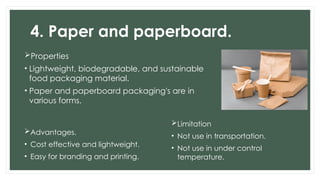
4. Paper andpaperboard.
Properties
• Lightweight, biodegradable, and sustainable
food packaging material.
• Paper and paperboard packaging's are in
various forms.
Advantages.
• Cost effective and lightweight.
• Easy for branding and printing.
Limitation
• Not use in transportation.
• Not use in under control
temperature.
9.
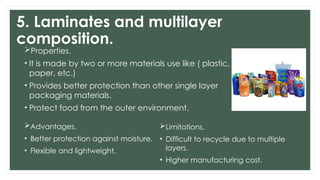
5. Laminates andmultilayer
composition.
Properties.
• It is made by two or more materials use like ( plastic,
paper, etc.)
• Provides better protection than other single layer
packaging materials.
• Protect food from the outer environment.
Advantages.
• Better protection against moisture.
• Flexible and lightweight.
Limitations.
• Difficult to recycle due to multiple
layers.
• Higher manufacturing cost.
10.
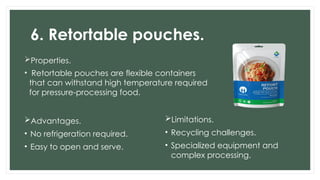
6. Retortable pouches.
Properties.
•Retortable pouches are flexible containers
that can withstand high temperature required
for pressure-processing food.
Advantages.
• No refrigeration required.
• Easy to open and serve.
Limitations.
• Recycling challenges.
• Specialized equipment and
complex processing.
11.
7. Plastic films.
1.LDPE - Low density polyethylene
2. LLDPE - Linear low density polyethylene
3. HDPE – High density polyethylene
4. PVC – Polyvinyl chloride
5. PS – Polystyrene
6. PP – Polypropylene
12.
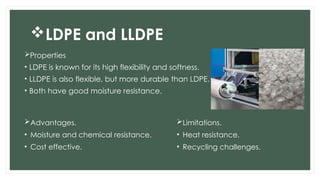
LDPE and LLDPE
Properties
•LDPE is known for its high flexibility and softness.
• LLDPE is also flexible, but more durable than LDPE.
• Both have good moisture resistance.
Advantages.
• Moisture and chemical resistance.
• Cost effective.
Limitations.
• Heat resistance.
• Recycling challenges.
13.
HDPE
Properties.
• Stronger thanLDPE.
• Resistant to chemicals, moisture, and
impact.
Advantages.
• Lightweight.
• HDPE is food safe plastic.
limitations.
• Less flexible than LDPE.
• Recycling challenges.
• HDPE has limited temperature
range.
14.
PVC
Properties
PVC canbe made clear and transparent, allowing for
product visibility and appealing packaging aesthetics.
PVC is lightweight material, reducing the overall weight of
packaging and potentially lowering transportation cost.
It is durable and strong material.
15.
Advantages.
• Provides excellenttransparency
for product visibility.
• Reduce transportation cost and
environmental impact.
• Generally cheaper than
alternatives like glass or
biodegradable plastics.
Limitation.
• Difficult to recycle dur to the
presence of additives.
• Not suitable for high-
temperature application like
microwaving.
• Some courtiers have strict
regulations on PVC use in food
packaging.
16.
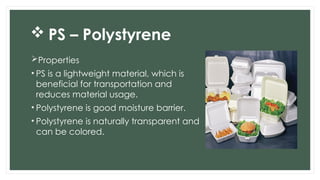
PS –Polystyrene
Properties
• PS is a lightweight material, which is
beneficial for transportation and
reduces material usage.
• Polystyrene is good moisture barrier.
• Polystyrene is naturally transparent and
can be colored.
17.
Advantages.
• Reduces transportationcost
and is easy to handle.
• Help in maintain food
temperature.
• Protect food from damage
during transportation.
• Can be molded into various
shapes and size.
Limitation.
• PS is a brittle material.
(Meaning it can be prone to
cracking or breaking under
stress.)
• PS is not bio-degradable.
• Low heat resistance.
• Limited recycling facilities
available for PS.
18.
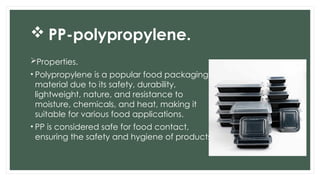
PP-polypropylene.
Properties.
• Polypropyleneis a popular food packaging
material due to its safety, durability,
lightweight, nature, and resistance to
moisture, chemicals, and heat, making it
suitable for various food applications.
• PP is considered safe for food contact,
ensuring the safety and hygiene of products.
19.
Advantages.
• Strong andresistant to
impact, cracking, breakage.
• Protect food from
contamination and spoilage.
• Easier to recycle compared
to PVC and PS.
• Allows for product visibility.
Limitation.
• It is not biodegradable and
contributes to plastic
waste.
• While technically
recyclable, some areas
lack proper recycling
facilities.
• More flexible than some
alternatives (PVC).
20.
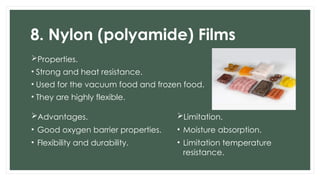
8. Nylon (polyamide)Films
Properties.
• Strong and heat resistance.
• Used for the vacuum food and frozen food.
• They are highly flexible.
Advantages.
• Good oxygen barrier properties.
• Flexibility and durability.
Limitation.
• Moisture absorption.
• Limitation temperature
resistance.
21.
9.lonomers, Rubber hydrochloride,and PVD
Properties.
1.lonomers.
Used for high barrier films in food packaging.
2. Rubber hydrochloride.
Used in heat sellable wraps.
3. PVD (polyvinylidene chloride)
High barrier to oxygen and moisture.
22.
Advantages.
• Provide strong,tamper-proof
sealing, even in
contaminated areas.
• Ensure good visibility of
packaged food.
• Protect food from damage
during handling.
• Suitable for fatty and oily
foods.
Limitation.
• Expensive than common
plastics like polyethylene.
• May deform under high
temperatures.
• Can be difficult to recycle in
standard plastic waste
streams.
23.
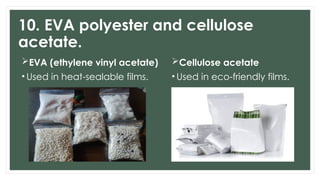
10. EVA polyesterand cellulose
acetate.
EVA (ethylene vinyl acetate)
• Used in heat-sealable films.
Cellulose acetate
• Used in eco-friendly films.
24.
Advantages.
• Highly flexibleand
stretchable, making it ideal
for wrapping and sealing.
• Allows clear visibility.
• Maintain flexibility even at
freezing temperatures,
making it suitable
temperatures.
Limitation.
• Limited use in food
packaging.
• Not moisture proof.
Application.
• Sandwich wraps.
• Candy wrappers.
• For sample.
25.
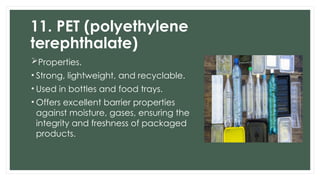
11. PET (polyethylene
terephthalate)
Properties.
•Strong, lightweight, and recyclable.
• Used in bottles and food trays.
• Offers excellent barrier properties
against moisture, gases, ensuring the
integrity and freshness of packaged
products.
26.
Advantages.
• It isimpact-resistant and
shatterproof, making it safer
than glass.
• PET is widely recyclable,
reducing environmental impact
when properly managed.
• Less expensive to produce
compared to glass or metal
packaging.
Limitation.
• PET has a low melting point
and may deform at high
temperatures, making it
unsuitable for hot food
storage.
• PET take a very long time to
degrade in natural
environments.
27.
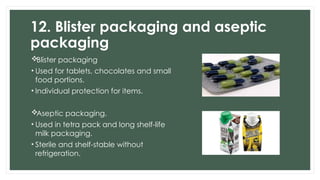
12. Blister packagingand aseptic
packaging
Blister packaging
• Used for tablets, chocolates and small
food portions.
• Individual protection for items.
Aseptic packaging.
• Used in tetra pack and long shelf-life
milk packaging.
• Sterile and shelf-stable without
refrigeration.
28.
Advantages.
• Shields itemsfrom moisture,
contamination, and physical
damage.
• Provide a good barrier
against air, light, and
moisture.
• Transparent packaging
material.
Limitation.
• Some consumers, especially
elderly individuals, may find it
hard to open.
• Some types are challenging
to recycle due to mix
material.
• Requires precise sealing.
29.
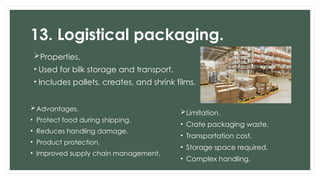
13. Logistical packaging.
Properties.
•Used for bilk storage and transport.
• Includes pallets, creates, and shrink films.
Advantages.
• Protect food during shipping.
• Reduces handling damage.
• Product protection.
• Improved supply chain management.
Limitation.
• Crate packaging waste.
• Transportation cost.
• Storage space required.
• Complex handling.
30.
14. Conclusion
Food packagingplays a crucial role in preserving
food quality, ensuring safety, and enhancing
convenience. Different materials distinct advantages
and limitations based on the type of food, storage
conditions, and environmental impact.






![74676371-Coagulation-and-Flocculation[1].ppt](https://cdn.slidesharecdn.com/ss_thumbnails/74676371-coagulation-and-flocculation1-260116154109-a3cbf55e-thumbnail.jpg?width=640&height=640&fit=bounds)


