PHARMACEUTICAL
PACKAGING
Guided by..
Ms. Priyanka Shah
Dept. of pharmaceutical Quality
Assurance
Prepared by..
Mr. Sawankumar R. Padavi
M.Pharm .(Sem-II)
Department of Pharmaceutical Quality
Assurance
ANAND PHARMACY COLLEGE
Oppo.town hall, Anand -388001
4/20/2019 1
 CONTENT OF PRESENTATION
 INTRODUCTION
 IDEAL PACKAGING REQUIRMENT
 FUNCTION OF PACKAGING
 TYPES OF PACKGING
 PACKAGING TESTING
 TYPES OF PACKAGING MATERIAL USED IN
PHARMACEUTICAL PACKAGING
 SELECTION OF THE PACKAGING MATERIAL
 CONCLUSION
 REFERENCES
4/20/2019 2
 INTRODUCTION
 Packaging is the science art and technology of enclosing or
protecting products for distribution, storage sale and use.
 Packaging also refers to the process of design, evaluation,
and production of packages.
 Pharmaceutical packaging can be defined as the economical
means of providing presentation, protection, identification,
information, convenience, compliance, integrity and
stability of the product.
4/20/2019 3
 Ideal packaging requirements
 They must protect the preparation from environmental conditions.
 They must not be reactive with the product.
 They must be impart to the product tastes or odors.
 They must be nontoxic.
 They must be FDA approved.
 They must meet applicable tamper – resistance requirements.
 They must not be the cause of product degradation.
 They must be adaptable to commonly high speed packaging equipment.
4/20/2019 4
 FUNCTIONS OF PACKAGING
 Product Identification :- packaging greatly helps in identification
 Product protection :- packaging protects the contents of a product from
spoilage, breakage, leakage etc.
 Facilitating the use of product :- packaging should be convenience to
open, handle and use for the consumers.
 Product promotion :- packaging is also used for promotional and
attracting the attention of the people while purchasing.
 Marketing :- the packaging and labels can be used by marketers to
encourage potential buyers to purchase the product.
4/20/2019 5
 Convenience :- packages can have features that add convenience in
distribution ,handling, stacking, display, sale, opening, re-closing, use,
dispensing, reuse, recycling, and ease of disposal.
 Barrier protection :- A barrier from oxygen, water vapor, dust etc., is
often required. Permeation is a critical factor in designg Some packages
contain desiccants or oxygen absorbency to help extend shelf life.
Keeping the contents clean. Fresh, sterile and safe for the intended shelf
life is a primary function.
 Security :- packaging can play an important role in reducing the security
risks of shipment. Packages can be engineered to help reduce the risks
of package pilferage.
4/20/2019 6
 TYPES OF PACKAGING
 Primary packaging – is material that first envelops the product and
hold it. This usually is the smallest unit of distribution or use.
Ex. Aerosol spray can, blister packs bottle
4/20/2019 7
 Secondary packaging-
Is outside the primary packaging perhaps
used to group primary package together.
Ex. Boxes,cartons
4/20/2019 8
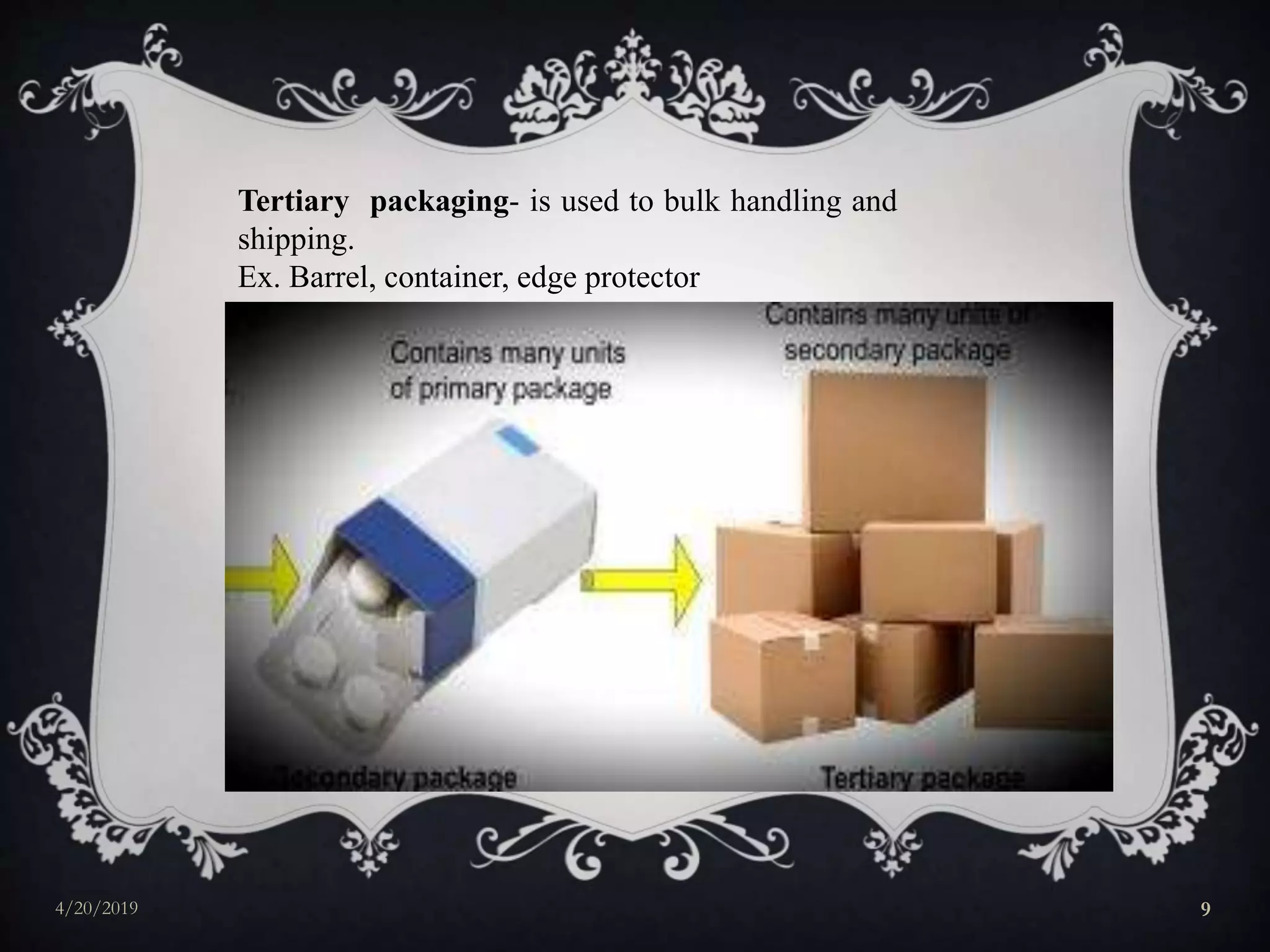
Tertiary packaging- is used to bulk handling and
shipping.
Ex. Barrel, container, edge protector
4/20/2019 9
 PACKAGE TESTING
 Drop test
 Vibration test
 Shock test
 Inclined impact test
 Revolving drum test
4/20/2019 10
 TYPES OF PACKAGING MATERIALS USED FOR
PHARMACEUTICAL PACKAGING
 Glass
 Plastics
 Rubbers
 Metal
 Paper/card boards
4/20/2019 11
 GIASS
 Glass has been widely used as a drug packaging material.
 Glass is composed of sand ash, limestone, & cullet .
 Si ,Al, Na, K, Ca , Mg , Zn, & Ba. are generally used into preparation
of glass
Advantages of glass:
 They are hygienic and suitable for sterilization
 They are relatively non reactive ( depending on the grade chosen )
 They are transparent.
 They have good protection power.
 They can be easily labeled.
4/20/2019 12
 They are available in various shapes and sizes.
 They can withstand the variation in temperature and
pressure during sterilization.
 They are economical and easily available.
 They are neutral after proper treatment.
 They can be sealed hermetically or by removable closures.
 They do not deteriorate with age.
 They are imperameable to atmospheric gases and moisture.
4/20/2019 13
o Disadvantages
 It is relatively heavy
 Glass is fragile so easily broken.
 Release alkali to aqueous preparation
 Photosensitive drug can not be protected in the
transparent glass container. Amber color glass container
is required in this case.
 As glass is a chemical substance, some time it reacts
with the product contained inside it.
4/20/2019 14
 Types of glass
 Type I ( Neutral or borosilicate glass )
 Type II ( Treated Soda Lime glass)
 Type III ( Soda Lime Glass )
 Type NP ( General purpose soda limeglass)
 Coloured glass
4/20/2019 15
Type I ( Borosilicate Glass)
 Borosilicate Glass is produced by replacing the sodium oxide
by boric oxide ( B202) and some lime by alumina ( A 12O3) In
the Basic Components of glass .
4/20/2019 16
 Higher ingredients and processing cost therefore used for
more sensitive pharmaceutical product such as parenteral
or blood product.
 Mostly ampules and vials are made up of type I glass.
 high melting point and can withstand high Temperature .
 Resistance to chemical substance.
 Least reactive
4/20/2019 17
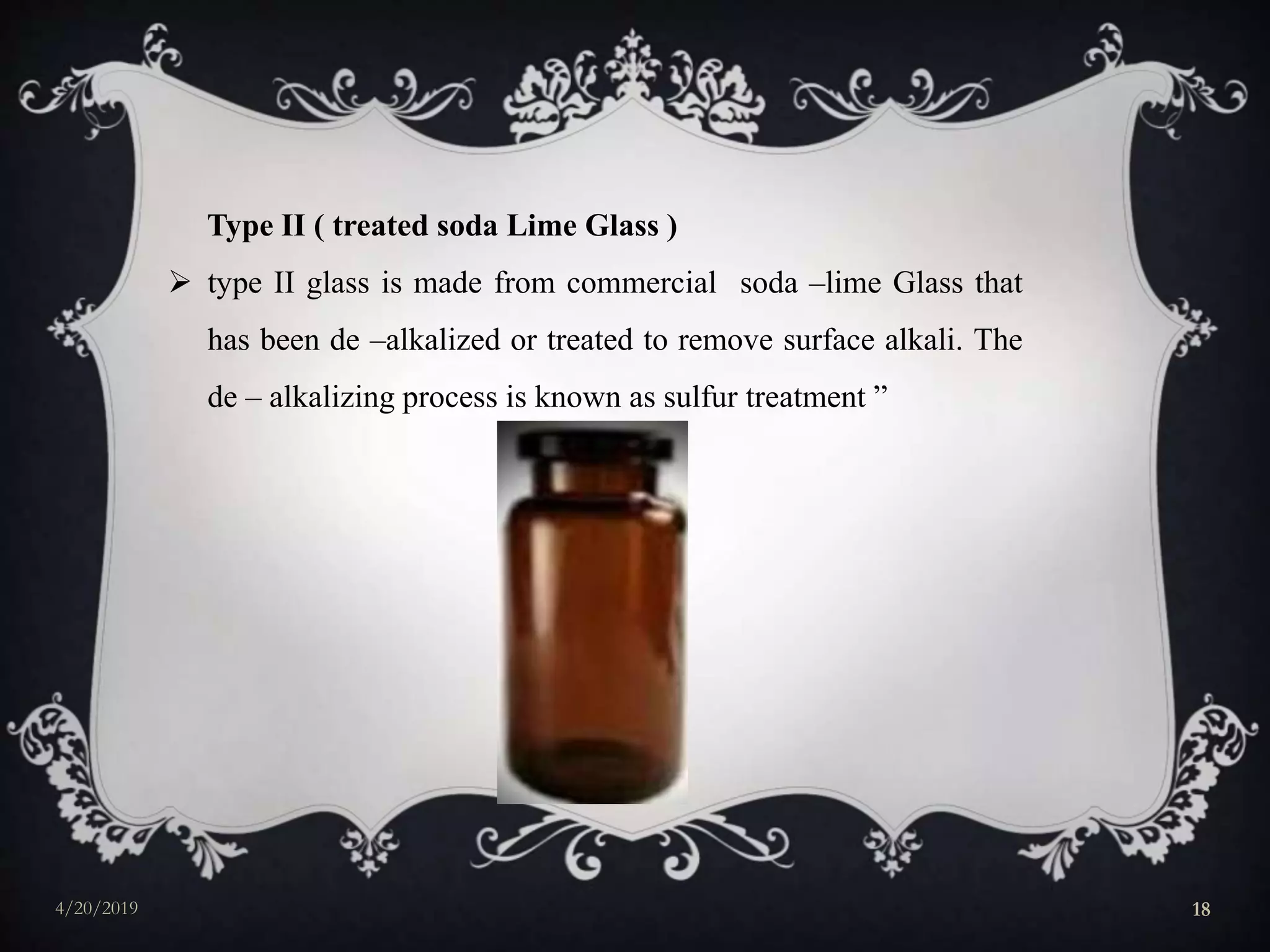
Type II ( treated soda Lime Glass )
 type II glass is made from commercial soda –lime Glass that
has been de –alkalized or treated to remove surface alkali. The
de – alkalizing process is known as sulfur treatment ”
4/20/2019 18
 Sulfur Treatment neutralize The alkaline oxides on
the surface rendering the glass more chemically
resistant.
 Higher chemical resistance but not as much as type I
 Cheaper than type I.
 acceptable for most products accept blood products
and aqueous pharmaceutical with a pH less than 7.
4/20/2019 19
Type III {Soda lime glass }
It is ordinarily glass prepared from silicon dioxide ,soda
ash and lime stone and is generally referred to as soda lime glass.
Glass containers are untreated and made up of commercial soda-lime
glass of average or better than average chemical resistance .
4/20/2019 20
 It is cheapest in quality.
 This type of glass is not suitable for alkali sensitive products
has average or slight better than average resistance and his
suitable for non aqueous parenteral and non parenteral
products.
 Type III Glass containers are normally dry sterilized before
being filled
4/20/2019 21
NP ( General purpose soda lime
glass)
It is general purpose soda lime
glass used for oral and topical
preparation.it has lowest hydraulic
resistance and is suitable for solid
products, some liquid and semi
solid and not for parenteral .
4/20/2019 22
Coloured glass
 Coloured glass is obtained by adding small amounts of
metals during fusion of glass.
 Coloured glass is used for light sensitive products which
does not allow the UV rays to pass through it.
 Coloured glass should not be used for parenteral
preparation because it becomes difficult to check clarity
in such preparations.
4/20/2019 23
Neutral glass
 It is another variety of glass available in between soda-lime
glass and borosilicate glass.
 It is resistant to alkali
 Resistant to weathering
 Withstand to autoclaving
 It is used for the manufacture of multidose vials and
transfusion bottles etc.
4/20/2019 24
Test for glass materials
 U.S.P. and I.P. provides two testes to determine the
chemical resistance of glass containers:
 Test for surface hydrolytic resistance.
 Test for hydrolytic resistance of powdered glass.
4/20/2019 25
PLASTIC
Plastics may be defined as any group of substances, of natural or
synthetic origins, consisting chiefly of polymers of high molecular
weight that can be moulded into a shape or form by heat and
pressure.
o Advantages
 Less weight than glass,
 flexible
 Variety of sizes and shapes
 Essentially chemically inert, strong, rigid Safety use, high quality,
various designs.
4/20/2019 26
 Extremely resistant to breakage
 Disadvantages
 Absorption permeable to moisture
 Poor printing, thermostatic charge
 TYPES OF PLASTICS
 Thermosetting type –When heated they may become
flexible but they do not become liquid e.g. Urea
formaldehyde (UF),Phenol formaldehyde ,Melamine.
formaldehyde (MF), Epoxy resins (epoxides), Polyurethanes
(PURs)
4/20/2019 27
 Thermoplastics type-On heating they are soften to viscous fluid
which harden again on cooling. e.g. Polyethylene{HDPE – LDPE},
Polyvinylchloride(PVC),Polystyrene Polypropylene, Nylon(PA),
Polyethylene terepthalate(PET) ,Polyvinylidene chloride(PVdC),
Polycarbonate Acrylonitrile butadiene styrene(ABS)
s
4/20/2019 28
 RUBBER:
 Rubber is used mainly for the construction of closure meant for vials,
transfusion fluid bottles, dropping bottles and as washers in many other
types of product.
4/20/2019 29
 BUTYL RUBBER:
o Advantages:
 Permeability to water vapour .
 Water absorption is very low.
 They are relatively cheaper compared to other synthetic rubbers.
o Disadvantages:
 Slow decomposition takes place above 130 ▫ C.
 Oil and solvent resistance is not very good.
 NITRILE RUBBER:
o Advantages : Oil resistant due to polar nitrile group.
o Disadvantages:
 Absorption of bactericide and leaching of extractives are considerable.
4/20/2019 30
 CHLOROPRENE RUBBERS:
o Advantages:Oil resistant heat stability is good.
 SILICON RUBBERS:
o Advantages:
 Heat resistance.
 Extremely low absorption and permeability of water.
 Excellent aging characteristic.
o Disadvantages:
 They are very expensive.
4/20/2019 31
 METALS
 Metals are used for construction of containers.
 The metals commonly used for this purpose are aluminium ,tin plated
steel, stainless steel, tin and lead
4/20/2019 32
o Advantages:
 They are impermeable to light, moisture and gases.
 They are made into rigid unbreakable containers by
impact extrusion.
 They are light in weight compared to glass containers.
 Labels can printed directly on to their surface.
o Disadvantages:
 They are expensive.
 They react with certain chemicals
4/20/2019 33
 COLLAPSIBLE TUBES METAL
 The collapsible metal tube is an attractive container that
 permits controlled amounts to be dispensed easily, with good reclosure,
and adequate protection of the product.
 It is light in weight and unbreakable and lends itself to high speed
automatic filling operations. Most commonly used are tin, aluminium
and lead.
4/20/2019 34
 Fibrous materials
 The fibrous materials are the important part of pharmaceutical packaging.
 Fibrous materials include: Papers, Labels, Cartons, Bags, Outers etc.
 The Applications as well as Advantages of Cartons include:
 Increases display area
 Provides better stacking for display of stock items
 Provides physical protection especially to items like metal collapsible tubes.
 Fiberboard outers either as solid or corrugated board also find substantial
application for bulk shipments.
4/20/2019 35
 Films, foils & laminates
 Characteristics:
 Applicable to tablets, capsules, pills, etc.
 It's a good substitute for PVC sheet.
 it is shaped easily by changing the mold.
 It has the quite good blocking properties effectively protecting
drugs from water vapor, oxygen and ultraviolet.
 It can extend the storage period of drugs.
 It is particularly suitable for packing moisture-sensitive drugs or
 those sold in the hot and humid areas.
 Nice appearance can upgrade drug’s image
4/20/2019 36
Material Types Example of use
Glass Primary Ampules or vial
Plastic Primary Ampules, Vial and
Dropper bottle
Secondary Wrapper to contain
primary pack
Cardboard Secondary Carton box
Paper Secondary Labels, Patient
information
TYPES OF PRIMARY AND SECONDARY MATERIAL
4/20/2019 37
 selection of packaging material
 The degree of protection required
 Compatibility with the dosage form
 Customer convenience e .g size, weight of dosage form,
 Filling method
 Sterilization
4/20/2019 38
4/20/2019 39
Conclusion:
Packaging is one of the most important part of pharmaceutical industrises.
Product produced is might be of vary good quality at the time production
but it is useless if is not able to reach as it is up to end user.
Quality Maintenance is the major role played by packaging material.
Along with that it gives pharmaceutical elegance and convenience to user to
product.
Many times the Packaging is may become a ideal unique identification for
some brand in market.
Quality control of such important part is also a vary valuable work.
 REFERNCES
 Theory and Practice of Industrial Pharmacy, L. Lachman, H. A.
Liberman, J. L. Kanig. 4th edition, (1991), Varghese publication
house, Bombay, p. no. 711-732.
 Pharmaceutical Quality Assurance, M. Potdar, 2nd edition(2007),
Nirali Prakashan, Pune, p. .no.5.5
 Introduction to Pharmaceutics, A. Pawar, 2nd edition(2012), Career
Publication, Nashik, p.no.103.
 www.mypharmaguide.com.
 Plastic Packaging, Remington, The Science and Practice of Pharmacy,
19th edition, Volume II, p. no. 1487.
4/20/2019 40
 http://www.slideshare.net/akshayjoshi35/akshy-33890359assessed on
17may2014
 Pharmaeutics-1, R. M. Mehta, 2nd edition , Vallabh Prakashan , Delhi,
p.no. 73-93
 http:www.slideshare.net/akshyjoshi35/akshy-33890359 assessed on
17may2014
 http://wwwpharmatuter.org/article/the pharmaceutical-packaging-
article.
 Modern pharmaceutics , GS Banker and TR Christopher, 4th edition,
Revised and expanded, Informa healthcare pub. 121:595- 596
4/20/2019 41
4/20/2019 42

Pharmaceutical packagingpptx (1)

  • 1.
    PHARMACEUTICAL PACKAGING Guided by.. Ms. PriyankaShah Dept. of pharmaceutical Quality Assurance Prepared by.. Mr. Sawankumar R. Padavi M.Pharm .(Sem-II) Department of Pharmaceutical Quality Assurance ANAND PHARMACY COLLEGE Oppo.town hall, Anand -388001 4/20/2019 1
  • 2.
     CONTENT OFPRESENTATION  INTRODUCTION  IDEAL PACKAGING REQUIRMENT  FUNCTION OF PACKAGING  TYPES OF PACKGING  PACKAGING TESTING  TYPES OF PACKAGING MATERIAL USED IN PHARMACEUTICAL PACKAGING  SELECTION OF THE PACKAGING MATERIAL  CONCLUSION  REFERENCES 4/20/2019 2
  • 3.
     INTRODUCTION  Packagingis the science art and technology of enclosing or protecting products for distribution, storage sale and use.  Packaging also refers to the process of design, evaluation, and production of packages.  Pharmaceutical packaging can be defined as the economical means of providing presentation, protection, identification, information, convenience, compliance, integrity and stability of the product. 4/20/2019 3
  • 4.
     Ideal packagingrequirements  They must protect the preparation from environmental conditions.  They must not be reactive with the product.  They must be impart to the product tastes or odors.  They must be nontoxic.  They must be FDA approved.  They must meet applicable tamper – resistance requirements.  They must not be the cause of product degradation.  They must be adaptable to commonly high speed packaging equipment. 4/20/2019 4
  • 5.
     FUNCTIONS OFPACKAGING  Product Identification :- packaging greatly helps in identification  Product protection :- packaging protects the contents of a product from spoilage, breakage, leakage etc.  Facilitating the use of product :- packaging should be convenience to open, handle and use for the consumers.  Product promotion :- packaging is also used for promotional and attracting the attention of the people while purchasing.  Marketing :- the packaging and labels can be used by marketers to encourage potential buyers to purchase the product. 4/20/2019 5
  • 6.
     Convenience :-packages can have features that add convenience in distribution ,handling, stacking, display, sale, opening, re-closing, use, dispensing, reuse, recycling, and ease of disposal.  Barrier protection :- A barrier from oxygen, water vapor, dust etc., is often required. Permeation is a critical factor in designg Some packages contain desiccants or oxygen absorbency to help extend shelf life. Keeping the contents clean. Fresh, sterile and safe for the intended shelf life is a primary function.  Security :- packaging can play an important role in reducing the security risks of shipment. Packages can be engineered to help reduce the risks of package pilferage. 4/20/2019 6
  • 7.
     TYPES OFPACKAGING  Primary packaging – is material that first envelops the product and hold it. This usually is the smallest unit of distribution or use. Ex. Aerosol spray can, blister packs bottle 4/20/2019 7
  • 8.
     Secondary packaging- Isoutside the primary packaging perhaps used to group primary package together. Ex. Boxes,cartons 4/20/2019 8
  • 9.
    Tertiary packaging- isused to bulk handling and shipping. Ex. Barrel, container, edge protector 4/20/2019 9
  • 10.
     PACKAGE TESTING Drop test  Vibration test  Shock test  Inclined impact test  Revolving drum test 4/20/2019 10
  • 11.
     TYPES OFPACKAGING MATERIALS USED FOR PHARMACEUTICAL PACKAGING  Glass  Plastics  Rubbers  Metal  Paper/card boards 4/20/2019 11
  • 12.
     GIASS  Glasshas been widely used as a drug packaging material.  Glass is composed of sand ash, limestone, & cullet .  Si ,Al, Na, K, Ca , Mg , Zn, & Ba. are generally used into preparation of glass Advantages of glass:  They are hygienic and suitable for sterilization  They are relatively non reactive ( depending on the grade chosen )  They are transparent.  They have good protection power.  They can be easily labeled. 4/20/2019 12
  • 13.
     They areavailable in various shapes and sizes.  They can withstand the variation in temperature and pressure during sterilization.  They are economical and easily available.  They are neutral after proper treatment.  They can be sealed hermetically or by removable closures.  They do not deteriorate with age.  They are imperameable to atmospheric gases and moisture. 4/20/2019 13
  • 14.
    o Disadvantages  Itis relatively heavy  Glass is fragile so easily broken.  Release alkali to aqueous preparation  Photosensitive drug can not be protected in the transparent glass container. Amber color glass container is required in this case.  As glass is a chemical substance, some time it reacts with the product contained inside it. 4/20/2019 14
  • 15.
     Types ofglass  Type I ( Neutral or borosilicate glass )  Type II ( Treated Soda Lime glass)  Type III ( Soda Lime Glass )  Type NP ( General purpose soda limeglass)  Coloured glass 4/20/2019 15
  • 16.
    Type I (Borosilicate Glass)  Borosilicate Glass is produced by replacing the sodium oxide by boric oxide ( B202) and some lime by alumina ( A 12O3) In the Basic Components of glass . 4/20/2019 16
  • 17.
     Higher ingredientsand processing cost therefore used for more sensitive pharmaceutical product such as parenteral or blood product.  Mostly ampules and vials are made up of type I glass.  high melting point and can withstand high Temperature .  Resistance to chemical substance.  Least reactive 4/20/2019 17
  • 18.
    Type II (treated soda Lime Glass )  type II glass is made from commercial soda –lime Glass that has been de –alkalized or treated to remove surface alkali. The de – alkalizing process is known as sulfur treatment ” 4/20/2019 18
  • 19.
     Sulfur Treatmentneutralize The alkaline oxides on the surface rendering the glass more chemically resistant.  Higher chemical resistance but not as much as type I  Cheaper than type I.  acceptable for most products accept blood products and aqueous pharmaceutical with a pH less than 7. 4/20/2019 19
  • 20.
    Type III {Sodalime glass } It is ordinarily glass prepared from silicon dioxide ,soda ash and lime stone and is generally referred to as soda lime glass. Glass containers are untreated and made up of commercial soda-lime glass of average or better than average chemical resistance . 4/20/2019 20
  • 21.
     It ischeapest in quality.  This type of glass is not suitable for alkali sensitive products has average or slight better than average resistance and his suitable for non aqueous parenteral and non parenteral products.  Type III Glass containers are normally dry sterilized before being filled 4/20/2019 21
  • 22.
    NP ( Generalpurpose soda lime glass) It is general purpose soda lime glass used for oral and topical preparation.it has lowest hydraulic resistance and is suitable for solid products, some liquid and semi solid and not for parenteral . 4/20/2019 22
  • 23.
    Coloured glass  Colouredglass is obtained by adding small amounts of metals during fusion of glass.  Coloured glass is used for light sensitive products which does not allow the UV rays to pass through it.  Coloured glass should not be used for parenteral preparation because it becomes difficult to check clarity in such preparations. 4/20/2019 23
  • 24.
    Neutral glass  Itis another variety of glass available in between soda-lime glass and borosilicate glass.  It is resistant to alkali  Resistant to weathering  Withstand to autoclaving  It is used for the manufacture of multidose vials and transfusion bottles etc. 4/20/2019 24
  • 25.
    Test for glassmaterials  U.S.P. and I.P. provides two testes to determine the chemical resistance of glass containers:  Test for surface hydrolytic resistance.  Test for hydrolytic resistance of powdered glass. 4/20/2019 25
  • 26.
    PLASTIC Plastics may bedefined as any group of substances, of natural or synthetic origins, consisting chiefly of polymers of high molecular weight that can be moulded into a shape or form by heat and pressure. o Advantages  Less weight than glass,  flexible  Variety of sizes and shapes  Essentially chemically inert, strong, rigid Safety use, high quality, various designs. 4/20/2019 26
  • 27.
     Extremely resistantto breakage  Disadvantages  Absorption permeable to moisture  Poor printing, thermostatic charge  TYPES OF PLASTICS  Thermosetting type –When heated they may become flexible but they do not become liquid e.g. Urea formaldehyde (UF),Phenol formaldehyde ,Melamine. formaldehyde (MF), Epoxy resins (epoxides), Polyurethanes (PURs) 4/20/2019 27
  • 28.
     Thermoplastics type-Onheating they are soften to viscous fluid which harden again on cooling. e.g. Polyethylene{HDPE – LDPE}, Polyvinylchloride(PVC),Polystyrene Polypropylene, Nylon(PA), Polyethylene terepthalate(PET) ,Polyvinylidene chloride(PVdC), Polycarbonate Acrylonitrile butadiene styrene(ABS) s 4/20/2019 28
  • 29.
     RUBBER:  Rubberis used mainly for the construction of closure meant for vials, transfusion fluid bottles, dropping bottles and as washers in many other types of product. 4/20/2019 29
  • 30.
     BUTYL RUBBER: oAdvantages:  Permeability to water vapour .  Water absorption is very low.  They are relatively cheaper compared to other synthetic rubbers. o Disadvantages:  Slow decomposition takes place above 130 ▫ C.  Oil and solvent resistance is not very good.  NITRILE RUBBER: o Advantages : Oil resistant due to polar nitrile group. o Disadvantages:  Absorption of bactericide and leaching of extractives are considerable. 4/20/2019 30
  • 31.
     CHLOROPRENE RUBBERS: oAdvantages:Oil resistant heat stability is good.  SILICON RUBBERS: o Advantages:  Heat resistance.  Extremely low absorption and permeability of water.  Excellent aging characteristic. o Disadvantages:  They are very expensive. 4/20/2019 31
  • 32.
     METALS  Metalsare used for construction of containers.  The metals commonly used for this purpose are aluminium ,tin plated steel, stainless steel, tin and lead 4/20/2019 32
  • 33.
    o Advantages:  Theyare impermeable to light, moisture and gases.  They are made into rigid unbreakable containers by impact extrusion.  They are light in weight compared to glass containers.  Labels can printed directly on to their surface. o Disadvantages:  They are expensive.  They react with certain chemicals 4/20/2019 33
  • 34.
     COLLAPSIBLE TUBESMETAL  The collapsible metal tube is an attractive container that  permits controlled amounts to be dispensed easily, with good reclosure, and adequate protection of the product.  It is light in weight and unbreakable and lends itself to high speed automatic filling operations. Most commonly used are tin, aluminium and lead. 4/20/2019 34
  • 35.
     Fibrous materials The fibrous materials are the important part of pharmaceutical packaging.  Fibrous materials include: Papers, Labels, Cartons, Bags, Outers etc.  The Applications as well as Advantages of Cartons include:  Increases display area  Provides better stacking for display of stock items  Provides physical protection especially to items like metal collapsible tubes.  Fiberboard outers either as solid or corrugated board also find substantial application for bulk shipments. 4/20/2019 35
  • 36.
     Films, foils& laminates  Characteristics:  Applicable to tablets, capsules, pills, etc.  It's a good substitute for PVC sheet.  it is shaped easily by changing the mold.  It has the quite good blocking properties effectively protecting drugs from water vapor, oxygen and ultraviolet.  It can extend the storage period of drugs.  It is particularly suitable for packing moisture-sensitive drugs or  those sold in the hot and humid areas.  Nice appearance can upgrade drug’s image 4/20/2019 36
  • 37.
    Material Types Exampleof use Glass Primary Ampules or vial Plastic Primary Ampules, Vial and Dropper bottle Secondary Wrapper to contain primary pack Cardboard Secondary Carton box Paper Secondary Labels, Patient information TYPES OF PRIMARY AND SECONDARY MATERIAL 4/20/2019 37
  • 38.
     selection ofpackaging material  The degree of protection required  Compatibility with the dosage form  Customer convenience e .g size, weight of dosage form,  Filling method  Sterilization 4/20/2019 38
  • 39.
    4/20/2019 39 Conclusion: Packaging isone of the most important part of pharmaceutical industrises. Product produced is might be of vary good quality at the time production but it is useless if is not able to reach as it is up to end user. Quality Maintenance is the major role played by packaging material. Along with that it gives pharmaceutical elegance and convenience to user to product. Many times the Packaging is may become a ideal unique identification for some brand in market. Quality control of such important part is also a vary valuable work.
  • 40.
     REFERNCES  Theoryand Practice of Industrial Pharmacy, L. Lachman, H. A. Liberman, J. L. Kanig. 4th edition, (1991), Varghese publication house, Bombay, p. no. 711-732.  Pharmaceutical Quality Assurance, M. Potdar, 2nd edition(2007), Nirali Prakashan, Pune, p. .no.5.5  Introduction to Pharmaceutics, A. Pawar, 2nd edition(2012), Career Publication, Nashik, p.no.103.  www.mypharmaguide.com.  Plastic Packaging, Remington, The Science and Practice of Pharmacy, 19th edition, Volume II, p. no. 1487. 4/20/2019 40
  • 41.
     http://www.slideshare.net/akshayjoshi35/akshy-33890359assessed on 17may2014 Pharmaeutics-1, R. M. Mehta, 2nd edition , Vallabh Prakashan , Delhi, p.no. 73-93  http:www.slideshare.net/akshyjoshi35/akshy-33890359 assessed on 17may2014  http://wwwpharmatuter.org/article/the pharmaceutical-packaging- article.  Modern pharmaceutics , GS Banker and TR Christopher, 4th edition, Revised and expanded, Informa healthcare pub. 121:595- 596 4/20/2019 41
  • 42.