s
BY,
PRAVADA NAMDEO PATIL
ROLLNO.– 022
GUIDED BY: DR. SHRUTIKA D. PATIL MAM
QUALITYASSURANCETECHNIQUE,2019-2020
1
DEFINITION
 Packing: Packing consists of enclosing an individual
item, or several items, in a container, usually for
shipment or delivery.
 Pharmaceutical Packaging: Pharmaceutical
packaging means the combination of components
necessary to contain, preserve, protect & deliver a
safe, efficacious drug product, such that at any time
point before expiration date of the drug product, a
safe & efficacious dosage form is available.
2
TYPES OF PACKAGING SYSTEMS
 Primary package system: Made up of those
package components & sub components that come
into direct contact with the product, or those that
may have a direct effect on the product shelf life.
 Secondary or tertiary package system: Includes
cartons, corrugated shippers & pallets.
3
PACKAGING MUST MEET THE FOLLOWING
REQUIREMENTS
 Protect the preparation from environmental
conditions.
 Non-reactive with the product and so does not alter
the identity of the product.
 Does not impart taste or odour to the product
 Nontoxic
 FDA approved
 Protect the dosage form from damage or breakage
 Meet tamper-resistance requirements, wherever
applicable. 4
CRITERIA FOR SELECTION OF PACKAGE
TYPE AND PACKAGE MATERIAL
• Stability .
• Compatibility with the contents .
• Strength of container and the degree of protection
required.
• Moisture- proofness .
• Resistance to corrosion by Acids or Alkalis.
• Resistance to grease ,microorganism, insects,
rodents and the difference in the temperature.
• Protection against salt.
5
• Protection against light, fire
• Cost
• Machine suitability of packaging and the filling
method
• Convenience of the packaging for the physician,
pharmacist and finally the patient.
6
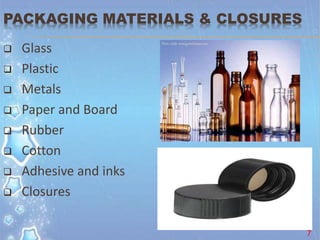
PACKAGING MATERIALS & CLOSURES
 Glass
 Plastic
 Metals
 Paper and Board
 Rubber
 Cotton
 Adhesive and inks
 Closures
7
GLASS
 Advantages:
 Superior protective qualities
 Economical
 Readily available in a wide variety of sizes & shapes
 Essentially chemically inert, impermeable, strong and
rigid
 Has FDA clearance
 Does not deteriorate with age
 Provides an excellent barrier against every element
except light with a proper closure system. Coloured
glass, especially amber, can give protection against
light. 8
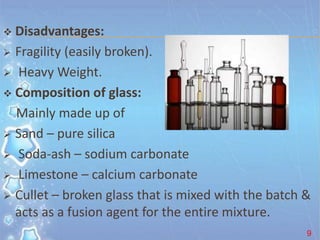
 Disadvantages:
 Fragility (easily broken).
 Heavy Weight.
 Composition of glass:
Mainly made up of
 Sand – pure silica
 Soda-ash – sodium carbonate
 Limestone – calcium carbonate
 Cullet – broken glass that is mixed with the batch &
acts as a fusion agent for the entire mixture.
9
TYPES OF GLASS CONTAINERS
 Type-I Borosilicate Glass
 Type-II Treated Soda Lime Glass
 Type-III Regular Soda Lime Glass
 Type-NP General Purpose Soda Lime Glass
10
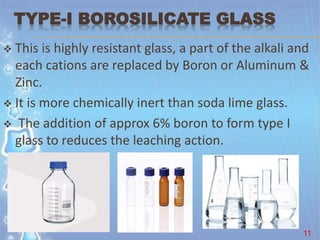
TYPE-I BOROSILICATE GLASS
 This is highly resistant glass, a part of the alkali and
each cations are replaced by Boron or Aluminum &
Zinc.
 It is more chemically inert than soda lime glass.
 The addition of approx 6% boron to form type I
glass to reduces the leaching action.
11
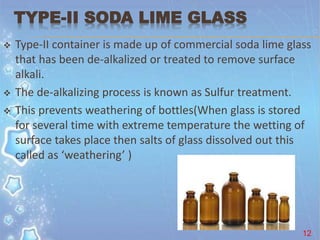
TYPE-II SODA LIME GLASS
 Type-II container is made up of commercial soda lime glass
that has been de-alkalized or treated to remove surface
alkali.
 The de-alkalizing process is known as Sulfur treatment.
 This prevents weathering of bottles(When glass is stored
for several time with extreme temperature the wetting of
surface takes place then salts of glass dissolved out this
called as ‘weathering’ )
12
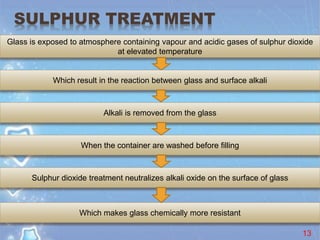
SULPHUR TREATMENT
13
Glass is exposed to atmosphere containing vapour and acidic gases of sulphur dioxide
at elevated temperature
Which result in the reaction between glass and surface alkali
Alkali is removed from the glass
When the container are washed before filling
Sulphur dioxide treatment neutralizes alkali oxide on the surface of glass
Which makes glass chemically more resistant
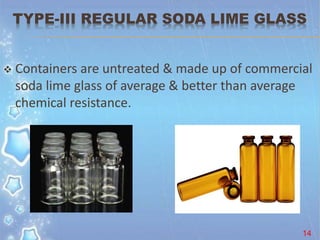
TYPE-III REGULAR SODA LIME GLASS
 Containers are untreated & made up of commercial
soda lime glass of average & better than average
chemical resistance.
14
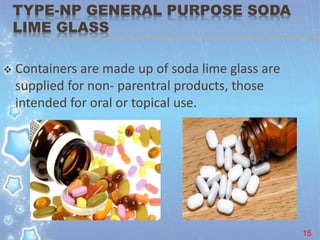
TYPE-NP GENERAL PURPOSE SODA
LIME GLASS
 Containers are made up of soda lime glass are
supplied for non- parentral products, those
intended for oral or topical use.
15
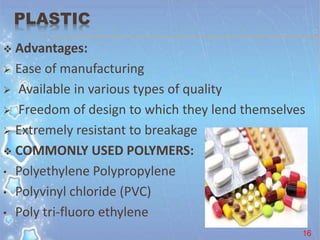
PLASTIC
 Advantages:
 Ease of manufacturing
 Available in various types of quality
 Freedom of design to which they lend themselves
 Extremely resistant to breakage
 COMMONLY USED POLYMERS:
• Polyethylene Polypropylene
• Polyvinyl chloride (PVC)
• Poly tri-fluoro ethylene
16
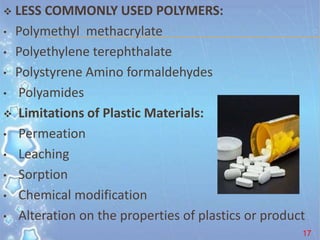
 LESS COMMONLY USED POLYMERS:
• Polymethyl methacrylate
• Polyethylene terephthalate
• Polystyrene Amino formaldehydes
• Polyamides
 Limitations of Plastic Materials:
• Permeation
• Leaching
• Sorption
• Chemical modification
• Alteration on the properties of plastics or product
17
TYPES OF PLASTIC CONTAINER
 Thermosetting Type :-
• It is used in packing industry for bottles & closures.
• These are usually hard & brittle at room
temperature & cannot be remelt without
decomposition.
• The main types are Formaldehyde & Urea
formaldehyde resins.
18
 Thermoplastic Type :-
• It includes material which can be converted into an
unlimited range of shapes & sizes.
• This type of plastic can be remelted without
decomposition.
• The commonly used materials are low density
polythene, high density polythene, polyvinyl
chloride, Poly methyl meth-acrylate (PMMA),
polystyrene polyamide (Nylon), polypropylene,
polytetra-fluoroethylene (PTFE).
19
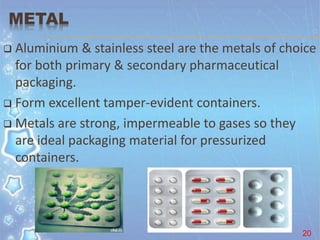
METAL
 Aluminium & stainless steel are the metals of choice
for both primary & secondary pharmaceutical
packaging.
 Form excellent tamper-evident containers.
 Metals are strong, impermeable to gases so they
are ideal packaging material for pressurized
containers.
20
PAPER AND BOARD
 The paper-based materials are the important part
of pharmaceutical packaging.
 Paper-based materials include: Labels, Cartons,
Bags, Outers, Trays For Shrink Wraps, Layer Boards
On Pallets, etc.
 The Advantages of Cartons include: -
• Increases display area
• Provides better stacking for display of stock items -
Assembles leaflets
• Provides physical protection especially to items like
metal collapsible tubes.
21
RUBBER
 Mostly used to make stoppers and bulbs for
dropper assemblies.
 Examples of rubber for pharmaceutical products
include:
1. Natural rubber
2. Neoprene rubber
3. Nitrile rubber
4. Butyl rubber
5. Chlorobutyl rubber
6. Bromobutyl rubber
7. Silicone rubber 22
CLOSURES
 Depending upon the type of container, closures
may have different shapes & sizes.
 Special design of stopper may also be required
for some pharmaceutical production processes
such as lyophilization.
 Closures, which form a part of the primary
packaging system, are very important & should
be therefore carefully selected. They form
essential component of the container & an
integral part of the drug preparation.
23
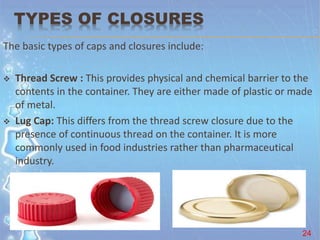
TYPES OF CLOSURES
The basic types of caps and closures include:
 Thread Screw : This provides physical and chemical barrier to the
contents in the container. They are either made of plastic or made
of metal.
 Lug Cap: This differs from the thread screw closure due to the
presence of continuous thread on the container. It is more
commonly used in food industries rather than pharmaceutical
industry.
24
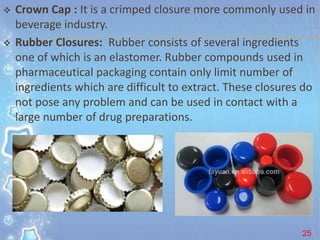
 Crown Cap : It is a crimped closure more commonly used in
beverage industry.
 Rubber Closures: Rubber consists of several ingredients
one of which is an elastomer. Rubber compounds used in
pharmaceutical packaging contain only limit number of
ingredients which are difficult to extract. These closures do
not pose any problem and can be used in contact with a
large number of drug preparations.
25
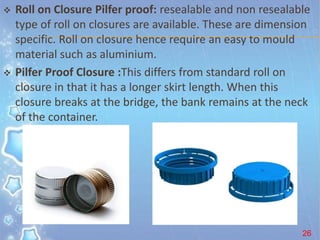
 Roll on Closure Pilfer proof: resealable and non resealable
type of roll on closures are available. These are dimension
specific. Roll on closure hence require an easy to mould
material such as aluminium.
 Pilfer Proof Closure :This differs from standard roll on
closure in that it has a longer skirt length. When this
closure breaks at the bridge, the bank remains at the neck
of the container.
26
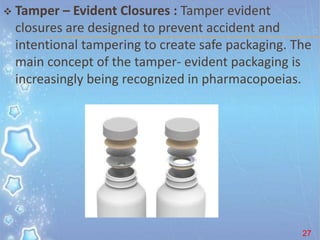
 Tamper – Evident Closures : Tamper evident
closures are designed to prevent accident and
intentional tampering to create safe packaging. The
main concept of the tamper- evident packaging is
increasingly being recognized in pharmacopoeias.
27
WHO GUIDELINES FOR QUALITY
CONTROL OF PACKAGING MATERIALS :
 All the containers and closures anticipated for use
should fulfill the pharmacopoeial indicated
requirements.
 All the containers and closure should be washed before
sterilization with water for injection according to the
procedure.
 The design of the closures, containers and stoppers
should have an airtight seal when fitted to the bottles.
 When the glass containers are used, the composed
calendar of purging might be set down and followed.
 Containers of parenteral and ophthalmic preparation
should be scrutinized against dark or white background
to guarantee freedom from impurities 28
REFERENCE
 Book of Packaging of Pharmaceutical and Healthcare by Paine and
Lokhard.
 Handbook of Pharmaceutical Packaging by Edward and J Bauer
 Book of Pharmaceutical Packaging and Technology by Evans and
Hall.
 file:///G:/presentations/pics/FeaturesfunctionsandselectionofPharmaceutic
alpackaging.pdf
 file:///G:/presentations/pics/hitesh-
pharmaceutical_packaging_component_and_evaluation.pdf
 file:///G:/presentations/pics/packagingevaluation.pdf
29
30

Pharmaceutical packaging

  • 1.
    s BY, PRAVADA NAMDEO PATIL ROLLNO.–022 GUIDED BY: DR. SHRUTIKA D. PATIL MAM QUALITYASSURANCETECHNIQUE,2019-2020 1
  • 2.
    DEFINITION  Packing: Packingconsists of enclosing an individual item, or several items, in a container, usually for shipment or delivery.  Pharmaceutical Packaging: Pharmaceutical packaging means the combination of components necessary to contain, preserve, protect & deliver a safe, efficacious drug product, such that at any time point before expiration date of the drug product, a safe & efficacious dosage form is available. 2
  • 3.
    TYPES OF PACKAGINGSYSTEMS  Primary package system: Made up of those package components & sub components that come into direct contact with the product, or those that may have a direct effect on the product shelf life.  Secondary or tertiary package system: Includes cartons, corrugated shippers & pallets. 3
  • 4.
    PACKAGING MUST MEETTHE FOLLOWING REQUIREMENTS  Protect the preparation from environmental conditions.  Non-reactive with the product and so does not alter the identity of the product.  Does not impart taste or odour to the product  Nontoxic  FDA approved  Protect the dosage form from damage or breakage  Meet tamper-resistance requirements, wherever applicable. 4
  • 5.
    CRITERIA FOR SELECTIONOF PACKAGE TYPE AND PACKAGE MATERIAL • Stability . • Compatibility with the contents . • Strength of container and the degree of protection required. • Moisture- proofness . • Resistance to corrosion by Acids or Alkalis. • Resistance to grease ,microorganism, insects, rodents and the difference in the temperature. • Protection against salt. 5
  • 6.
    • Protection againstlight, fire • Cost • Machine suitability of packaging and the filling method • Convenience of the packaging for the physician, pharmacist and finally the patient. 6
  • 7.
    PACKAGING MATERIALS &CLOSURES  Glass  Plastic  Metals  Paper and Board  Rubber  Cotton  Adhesive and inks  Closures 7
  • 8.
    GLASS  Advantages:  Superiorprotective qualities  Economical  Readily available in a wide variety of sizes & shapes  Essentially chemically inert, impermeable, strong and rigid  Has FDA clearance  Does not deteriorate with age  Provides an excellent barrier against every element except light with a proper closure system. Coloured glass, especially amber, can give protection against light. 8
  • 9.
     Disadvantages:  Fragility(easily broken).  Heavy Weight.  Composition of glass: Mainly made up of  Sand – pure silica  Soda-ash – sodium carbonate  Limestone – calcium carbonate  Cullet – broken glass that is mixed with the batch & acts as a fusion agent for the entire mixture. 9
  • 10.
    TYPES OF GLASSCONTAINERS  Type-I Borosilicate Glass  Type-II Treated Soda Lime Glass  Type-III Regular Soda Lime Glass  Type-NP General Purpose Soda Lime Glass 10
  • 11.
    TYPE-I BOROSILICATE GLASS This is highly resistant glass, a part of the alkali and each cations are replaced by Boron or Aluminum & Zinc.  It is more chemically inert than soda lime glass.  The addition of approx 6% boron to form type I glass to reduces the leaching action. 11
  • 12.
    TYPE-II SODA LIMEGLASS  Type-II container is made up of commercial soda lime glass that has been de-alkalized or treated to remove surface alkali.  The de-alkalizing process is known as Sulfur treatment.  This prevents weathering of bottles(When glass is stored for several time with extreme temperature the wetting of surface takes place then salts of glass dissolved out this called as ‘weathering’ ) 12
  • 13.
    SULPHUR TREATMENT 13 Glass isexposed to atmosphere containing vapour and acidic gases of sulphur dioxide at elevated temperature Which result in the reaction between glass and surface alkali Alkali is removed from the glass When the container are washed before filling Sulphur dioxide treatment neutralizes alkali oxide on the surface of glass Which makes glass chemically more resistant
  • 14.
    TYPE-III REGULAR SODALIME GLASS  Containers are untreated & made up of commercial soda lime glass of average & better than average chemical resistance. 14
  • 15.
    TYPE-NP GENERAL PURPOSESODA LIME GLASS  Containers are made up of soda lime glass are supplied for non- parentral products, those intended for oral or topical use. 15
  • 16.
    PLASTIC  Advantages:  Easeof manufacturing  Available in various types of quality  Freedom of design to which they lend themselves  Extremely resistant to breakage  COMMONLY USED POLYMERS: • Polyethylene Polypropylene • Polyvinyl chloride (PVC) • Poly tri-fluoro ethylene 16
  • 17.
     LESS COMMONLYUSED POLYMERS: • Polymethyl methacrylate • Polyethylene terephthalate • Polystyrene Amino formaldehydes • Polyamides  Limitations of Plastic Materials: • Permeation • Leaching • Sorption • Chemical modification • Alteration on the properties of plastics or product 17
  • 18.
    TYPES OF PLASTICCONTAINER  Thermosetting Type :- • It is used in packing industry for bottles & closures. • These are usually hard & brittle at room temperature & cannot be remelt without decomposition. • The main types are Formaldehyde & Urea formaldehyde resins. 18
  • 19.
     Thermoplastic Type:- • It includes material which can be converted into an unlimited range of shapes & sizes. • This type of plastic can be remelted without decomposition. • The commonly used materials are low density polythene, high density polythene, polyvinyl chloride, Poly methyl meth-acrylate (PMMA), polystyrene polyamide (Nylon), polypropylene, polytetra-fluoroethylene (PTFE). 19
  • 20.
    METAL  Aluminium &stainless steel are the metals of choice for both primary & secondary pharmaceutical packaging.  Form excellent tamper-evident containers.  Metals are strong, impermeable to gases so they are ideal packaging material for pressurized containers. 20
  • 21.
    PAPER AND BOARD The paper-based materials are the important part of pharmaceutical packaging.  Paper-based materials include: Labels, Cartons, Bags, Outers, Trays For Shrink Wraps, Layer Boards On Pallets, etc.  The Advantages of Cartons include: - • Increases display area • Provides better stacking for display of stock items - Assembles leaflets • Provides physical protection especially to items like metal collapsible tubes. 21
  • 22.
    RUBBER  Mostly usedto make stoppers and bulbs for dropper assemblies.  Examples of rubber for pharmaceutical products include: 1. Natural rubber 2. Neoprene rubber 3. Nitrile rubber 4. Butyl rubber 5. Chlorobutyl rubber 6. Bromobutyl rubber 7. Silicone rubber 22
  • 23.
    CLOSURES  Depending uponthe type of container, closures may have different shapes & sizes.  Special design of stopper may also be required for some pharmaceutical production processes such as lyophilization.  Closures, which form a part of the primary packaging system, are very important & should be therefore carefully selected. They form essential component of the container & an integral part of the drug preparation. 23
  • 24.
    TYPES OF CLOSURES Thebasic types of caps and closures include:  Thread Screw : This provides physical and chemical barrier to the contents in the container. They are either made of plastic or made of metal.  Lug Cap: This differs from the thread screw closure due to the presence of continuous thread on the container. It is more commonly used in food industries rather than pharmaceutical industry. 24
  • 25.
     Crown Cap: It is a crimped closure more commonly used in beverage industry.  Rubber Closures: Rubber consists of several ingredients one of which is an elastomer. Rubber compounds used in pharmaceutical packaging contain only limit number of ingredients which are difficult to extract. These closures do not pose any problem and can be used in contact with a large number of drug preparations. 25
  • 26.
     Roll onClosure Pilfer proof: resealable and non resealable type of roll on closures are available. These are dimension specific. Roll on closure hence require an easy to mould material such as aluminium.  Pilfer Proof Closure :This differs from standard roll on closure in that it has a longer skirt length. When this closure breaks at the bridge, the bank remains at the neck of the container. 26
  • 27.
     Tamper –Evident Closures : Tamper evident closures are designed to prevent accident and intentional tampering to create safe packaging. The main concept of the tamper- evident packaging is increasingly being recognized in pharmacopoeias. 27
  • 28.
    WHO GUIDELINES FORQUALITY CONTROL OF PACKAGING MATERIALS :  All the containers and closures anticipated for use should fulfill the pharmacopoeial indicated requirements.  All the containers and closure should be washed before sterilization with water for injection according to the procedure.  The design of the closures, containers and stoppers should have an airtight seal when fitted to the bottles.  When the glass containers are used, the composed calendar of purging might be set down and followed.  Containers of parenteral and ophthalmic preparation should be scrutinized against dark or white background to guarantee freedom from impurities 28
  • 29.
    REFERENCE  Book ofPackaging of Pharmaceutical and Healthcare by Paine and Lokhard.  Handbook of Pharmaceutical Packaging by Edward and J Bauer  Book of Pharmaceutical Packaging and Technology by Evans and Hall.  file:///G:/presentations/pics/FeaturesfunctionsandselectionofPharmaceutic alpackaging.pdf  file:///G:/presentations/pics/hitesh- pharmaceutical_packaging_component_and_evaluation.pdf  file:///G:/presentations/pics/packagingevaluation.pdf 29
  • 30.