Packaging - I
Definition
Art and science of, and the operations
involved in, preparing articles for
transport – safe and stable
storage – short term or long term
display – for sale
use - ease of removal, re-closing
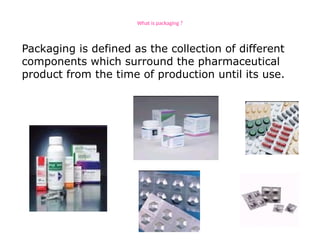
What is packaging ?
Packaging is defined as the collection of different
components which surround the pharmaceutical
product from the time of production until its use.
Importance of packaging
• Protect against all adverse external influences
that can alter the properties of the product.
• Protect against biological contamination.
• Protect against physical damage.
• Carry the correct information and identification
of the product.
• Tamper evident / Child resistance/
Anti- counterfeiting.
Functions of packaging
1. Containment
Not to leak, nor allow diffusion and permeation
Strong enough to hold the contents during handling
2. Protection from hazards
1. Mechanical – shock, compression, vibration etc
2. Environmental – temp., moisture, gasses, light
3. Biological – biological contamination.
3. Tamper evident / Child resistance.
4. Carry the correct information and identification
of the product.
5. Convenience
Packaging material characteristics
1. Mechanical –
Should have sufficient mechanical strength to withstand
handling. Special care for glass container.
2. Physical –
- Impervious
- Able to withstand heat
- Good surface for labeling. Difficulty with plastic.
- Suitable life
3. Chemical –
- Non-reactive
- No chemical changes
- Non-absorbable and non-leachable
4. Biological –
- No support of microbial growth.
- Non toxic
5. Regulatory – FDA approved
Choosing appropriate primary pack
Product characteristics/sensitivity
-Hygroscopicity
-Physical degradation
-Chemical degradation
-Drug release properties
-Mechanical properties
-Photosensitivity
-Gas liberation tendency
-Dimensional aspects
Selection of packaging material
-Moisture barrier requirements
-Light barrier requirements
-Gas barrier requirements
-Chemical properties
Packaging component
⮚ Glass
⮚ Plastic
⮚ Metal
⮚ Rubber
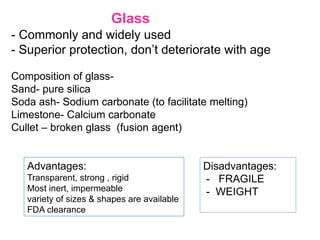
- Commonly and widely used
- Superior protection, don’t deteriorate with age
Composition of glass-
Sand- pure silica
Soda ash- Sodium carbonate (to facilitate melting)
Limestone- Calcium carbonate
Cullet – broken glass (fusion agent)
Disadvantages:
- FRAGILE
- WEIGHT
Glass
Advantages:
Transparent, strong , rigid
Most inert, impermeable
variety of sizes & shapes are available
FDA clearance
TYPES Of GLASS :-
Type I Borosilicate glass
Type II Treated Na-lime glass
Type III Regular Na-lime glass
Type NP General purpose Na lime glass
Glass
Type I - Borosilicate glass
• Type I glass is defined as a borosilicate glass with a high degree of
hydrolytic stability due to its chemical composition.
• Substantial part of the alkali and earth cations are replaced by
boron and /or aluminium and zinc.
Type I glass is suited to containers for preparations both for parental
and other use.
• Injectable products with acid, neutral or slightly alkaline pH can be
packaged in this type of glass.
•
The containers may be sterilized before and after filling and provide
mechanical resistance to sudden changes in temperature better
than type II and III glass
Type II Treated Na-lime glass
• Type II glass is a sodium-calcium glass which,
with proper treatment of the surfaces
(dealkalising/ sulfur treatment), achieves the
hydrolytic stability of type I glass.
• Type II glass containers are suited for holding
acid and neutral preparations both for
parental and other use.
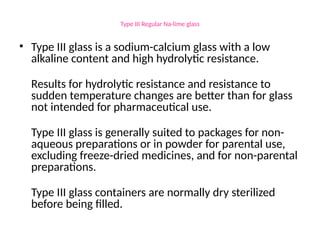
Type III Regular Na-lime glass
• Type III glass is a sodium-calcium glass with a low
alkaline content and high hydrolytic resistance.
Results for hydrolytic resistance and resistance to
sudden temperature changes are better than for glass
not intended for pharmaceutical use.
Type III glass is generally suited to packages for non-
aqueous preparations or in powder for parental use,
excluding freeze-dried medicines, and for non-parental
preparations.
Type III glass containers are normally dry sterilized
before being filled.
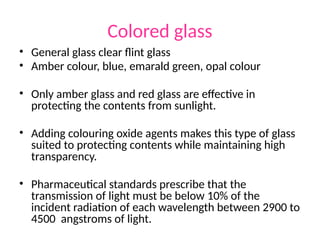
Colored glass
• General glass clear flint glass
• Amber colour, blue, emarald green, opal colour
• Only amber glass and red glass are effective in
protecting the contents from sunlight.
• Adding colouring oxide agents makes this type of glass
suited to protecting contents while maintaining high
transparency.
• Pharmaceutical standards prescribe that the
transmission of light must be below 10% of the
incident radiation of each wavelength between 2900 to
4500 angstroms of light.
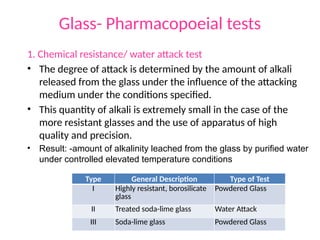
Glass- Pharmacopoeial tests
1. Chemical resistance/ water attack test
• The degree of attack is determined by the amount of alkali
released from the glass under the influence of the attacking
medium under the conditions specified.
• This quantity of alkali is extremely small in the case of the
more resistant glasses and the use of apparatus of high
quality and precision.
• Result: -amount of alkalinity leached from the glass by purified water
under controlled elevated temperature conditions
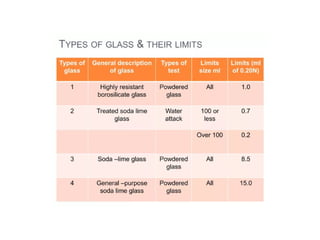
Type General Description Type of Test
I Highly resistant, borosilicate
glass
Powdered Glass
II Treated soda-lime glass Water Attack
III Soda-lime glass Powdered Glass
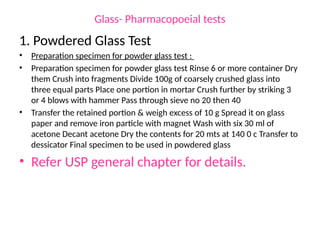
Glass- Pharmacopoeial tests
1. Powdered Glass Test
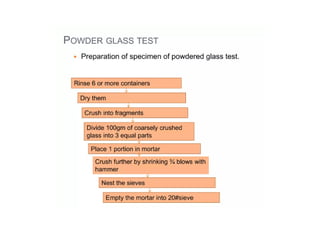
• Preparation specimen for powder glass test :
• Preparation specimen for powder glass test Rinse 6 or more container Dry
them Crush into fragments Divide 100g of coarsely crushed glass into
three equal parts Place one portion in mortar Crush further by striking 3
or 4 blows with hammer Pass through sieve no 20 then 40
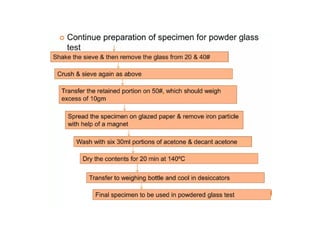
• Transfer the retained portion & weigh excess of 10 g Spread it on glass
paper and remove iron particle with magnet Wash with six 30 ml of
acetone Decant acetone Dry the contents for 20 mts at 140 0 c Transfer to
dessicator Final specimen to be used in powdered glass
• Refer USP general chapter for details.
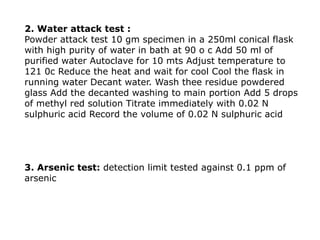
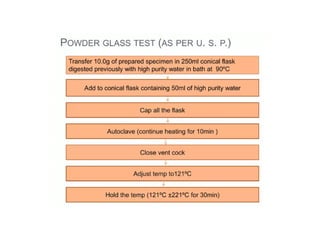
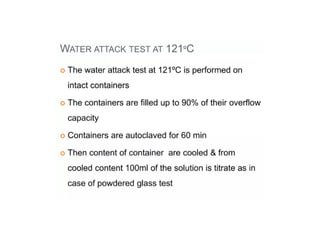
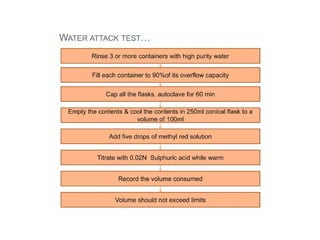
2. Water attack test :
Powder attack test 10 gm specimen in a 250ml conical flask
with high purity of water in bath at 90 o c Add 50 ml of
purified water Autoclave for 10 mts Adjust temperature to
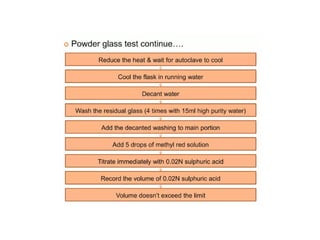
121 0c Reduce the heat and wait for cool Cool the flask in
running water Decant water. Wash thee residue powdered
glass Add the decanted washing to main portion Add 5 drops
of methyl red solution Titrate immediately with 0.02 N
sulphuric acid Record the volume of 0.02 N sulphuric acid
3. Arsenic test: detection limit tested against 0.1 ppm of
arsenic
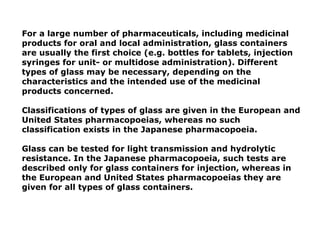
For a large number of pharmaceuticals, including medicinal
products for oral and local administration, glass containers
are usually the first choice (e.g. bottles for tablets, injection
syringes for unit- or multidose administration). Different
types of glass may be necessary, depending on the
characteristics and the intended use of the medicinal
products concerned.
Classifications of types of glass are given in the European and
United States pharmacopoeias, whereas no such
classification exists in the Japanese pharmacopoeia.
Glass can be tested for light transmission and hydrolytic
resistance. In the Japanese pharmacopoeia, such tests are
described only for glass containers for injection, whereas in
the European and United States pharmacopoeias they are
given for all types of glass containers.
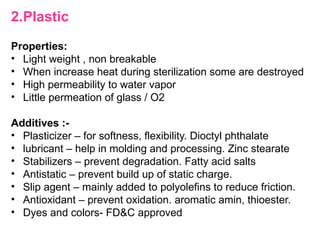
2.Plastic
Properties:
• Light weight , non breakable
• When increase heat during sterilization some are destroyed
• High permeability to water vapor
• Little permeation of glass / O2
Additives :-
• Plasticizer – for softness, flexibility. Dioctyl phthalate
• lubricant – help in molding and processing. Zinc stearate
• Stabilizers – prevent degradation. Fatty acid salts
• Antistatic – prevent build up of static charge.
• Slip agent – mainly added to polyolefins to reduce friction.
• Antioxidant – prevent oxidation. aromatic amin, thioester.
• Dyes and colors- FD&C approved
Types of plastic
1. Thermoplastic-
Thermoplastics are the plastics that do not undergo
chemical change in their composition when heated and
can be moulded again and again; examples are
polyethyleneThermoplastics are the plastics that do
not undergo chemical change in their composition
when heated and can be moulded again and again;
examples are polyethylene, polypropylene
Thermoplastics are the plastics that do not undergo
chemical change in their composition when heated and
can be moulded again and again; examples are
polyethylene, polypropylene, polystyrene
Thermoplastics are the plastics that do not undergo
chemical change in their composition when heated and
can be moulded again and again; examples are
Thermoplastics
1. Polyethylene –
• 2 type. High density and low density (HDPE and LDPE).
• Good moisture barrier but poor against oxygen and other gasses.
• Unaffected by strong acids and alkalis.
• Lack of clarity.
• High rate of permeation of essential odors, flavors etc.
• This are susceptible to oxidation so some amount of antioxidant
(butylated hydroxy toluene) should be used.
• Antistatic agent (PEG) is also used to minimize air dust
accumulation.
2. Polypropylene –
• it has high melting point so suitable for high temp. sterilization.
• Excellent gas and vapour barrier.
• Lack of clarity, improvement is possible by constructing thinner wall
• Brittle at low temp.
• Doesn’t stress crack except hot aromatic and halogenated acids
softens it.
3. Polyvinyl cloride –
•Crystal clarity, greater stiffness, good oxygen barrier.
•Inexpensive, tough, easili processed.
•It must not be overheated bcoz starts to degrade at 280 F
and degradation products are extremely corrosive.
•It becomes yellow when exposed to heat or UV unless a
stabilizer (tin comp., sulphur, calcium and zinc salts) is
included.
4. polystyrene-
• rigid, crystal clear plastic, low in cost.
•Not useful for liquid products bcoz of high water vapor
transmission as well as high water vapor permeability.
•Polystyrene containers get easily scratched and often cracked
when dropped.
•It easily build up static charge.
•Low melting point so cant use for high temp application.
•To increase its quality general purpose polystyrene may be
combined with various conc. Of rubber and acrylic compound.
5. Nylon –
•It is made from a dibasic acid combined with a diamin.
•Since there are many dibasic acids and many different amins,
there is great variety of nylon.
•They can be autoclaved.
•Extremely strong and quite difficult to destroy by mechanical
means.
•Resistant to wide range of organic and inorganic chemicals.
•Highly impermeable to oxygen.
•Not good barrier of water vapor.
6. Polycarbonate –
•Expensive material.
•Able to get sterilized repeatedly.
•Rigid as glass so use as an alternate to glass vials and syringes.
•It is moderately chemical resistant and fair oxygen barrier.
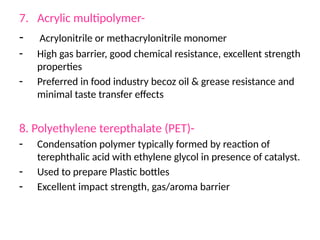
7. Acrylic multipolymer-
- Acrylonitrile or methacrylonitrile monomer
- High gas barrier, good chemical resistance, excellent strength
properties
- Preferred in food industry becoz oil & grease resistance and
minimal taste transfer effects
8. Polyethylene terepthalate (PET)-
- Condensation polymer typically formed by reaction of
terephthalic acid with ethylene glycol in presence of catalyst.
- Used to prepare Plastic bottles
- Excellent impact strength, gas/aroma barrier
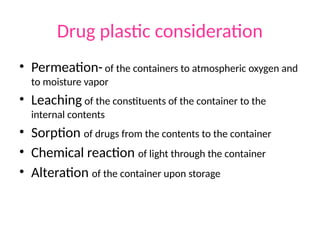
Drug plastic consideration
• Permeation-of the containers to atmospheric oxygen and
to moisture vapor
• Leaching of the constituents of the container to the
internal contents
• Sorption of drugs from the contents to the container
• Chemical reaction of light through the container
• Alteration of the container upon storage
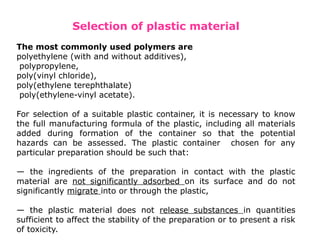
Selection of plastic material
The most commonly used polymers are
polyethylene (with and without additives),
polypropylene,
poly(vinyl chloride),
poly(ethylene terephthalate)
poly(ethylene-vinyl acetate).
For selection of a suitable plastic container, it is necessary to know
the full manufacturing formula of the plastic, including all materials
added during formation of the container so that the potential
hazards can be assessed. The plastic container chosen for any
particular preparation should be such that:
— the ingredients of the preparation in contact with the plastic
material are not significantly adsorbed on its surface and do not
significantly migrate into or through the plastic,
— the plastic material does not release substances in quantities
sufficient to affect the stability of the preparation or to present a risk
of toxicity.
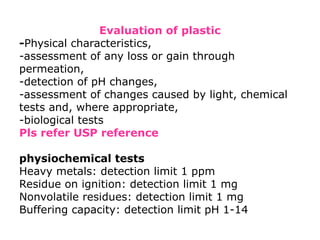
Evaluation of plastic
-Physical characteristics,
-assessment of any loss or gain through
permeation,
-detection of pH changes,
-assessment of changes caused by light, chemical
tests and, where appropriate,
-biological tests
Pls refer USP reference
physiochemical tests
Heavy metals: detection limit 1 ppm
Residue on ignition: detection limit 1 mg
Nonvolatile residues: detection limit 1 mg
Buffering capacity: detection limit pH 1-14
BIOLOGICAL REACTIVITY TESTS, IN VIVO
The following tests are designed to determine the biological
response of animals to elastomerics, plastics and other polymeric
material with direct or indirect patient contact, or by the injection
of specific extracts prepared from the material under test. It is
essential to make available the specific surface area for
extraction. When the surface area of the specimen cannot be
determined, use 0.1 g of elastomer or 0.2 g of plastic or other
material for every mL of extraction fluid.
BIOLOGICAL REACTIVITY TESTS, IN VITRO
The following tests are designed to determine the biological
reactivity of mammalian cell cultures following contact with the
elastomeric plastics and other polymeric materials with direct or
indirect patient contact or of specific extracts prepared from the
materials under test.
Leakage test for plastic container :
Leakage test for plastic container Fill 10 container with
water and fit the closure Keep them inverted at RT for 24
hrs No sign of leakage from any container
Water vapour permeability test for plastic container :
Water vapour permeability test for plastic container Fill 5
containers with nominal volume of water and seal Weigh
each container Allow to stand for 14 days at RH of 60 at
20 -25 0 c Reweigh the container Loss of weight in each
container should not be more than 0.2%
Collapsibility test for plastic containers :
Collapsibility test for plastic containers This test is
applicable for those container which have to be squeezes
for the withdrawal of the product a continue squeezing
yields at least 90% of its nominal content at regular flow
rate at ambient temperature .
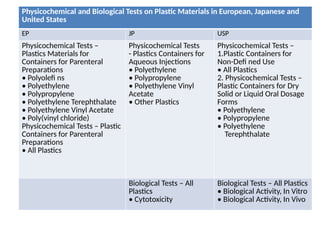
Physicochemical and Biological Tests on Plastic Materials in European, Japanese and
United States
EP JP USP
Physicochemical Tests –
Plastics Materials for
Containers for Parenteral
Preparations
• Polyolefi ns
• Polyethylene
• Polypropylene
• Polyethylene Terephthalate
• Polyethylene Vinyl Acetate
• Poly(vinyl chloride)
Physicochemical Tests – Plastic
Containers for Parenteral
Preparations
• All Plastics
Physicochemical Tests
- Plastics Containers for
Aqueous Injections
• Polyethylene
• Polypropylene
• Polyethylene Vinyl
Acetate
• Other Plastics
Physicochemical Tests –
1.Plastic Containers for
Non-Defi ned Use
• All Plastics
2. Physicochemical Tests –
Plastic Containers for Dry
Solid or Liquid Oral Dosage
Forms
• Polyethylene
• Polypropylene
• Polyethylene
Terephthalate
Biological Tests – All
Plastics
• Cytotoxicity
Biological Tests – All Plastics
• Biological Activity, In Vitro
• Biological Activity, In Vivo
3. Metals
Mainly used to prepare collapsible tubes.
1. Tin – preferred for foods, pharmaceutical for which purity is
major consideration. Most chemically inert material. Good
appearance and compatibility with wide range of product.
2. Aluminum – light weight and lower shipping cost.
3. Lead – lowest cost. Used for nonfood products. it should not
use alone for internal use products due to risk of lead
poisoning. With internal lining they can used for product like
tooth paste.
Linings – If product is not compitable with bare metal, interior
prepared by wax like formulations or resins solutions. They
are sprayed or applied on the interior surface of the container
to prevent direct contact of the product with metal.
Wax linings are used with tin tubes.
Phenolics and epoxides and vinyls are used with aluminium
tubes. Phenolics better protect from acid products.
Epoxides are effective against alkalis.
Metal containers are used solely for medicinal
products for non-parenteral administration.
They include tubes, packs made from foil or
blisters, cans , and aerosol and gas cylinders.
Aluminium and stainless steel are the metals of
choice for both primary and secondary packaging
for medicinal products.
They provide excellent tamper-evident containers.
Since metal is strong, impermeable to gases and
shatterproof, it is the ideal packaging material for
pressurized containers.
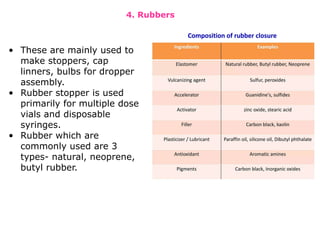
• These are mainly used to
make stoppers, cap
linners, bulbs for dropper
assembly.
• Rubber stopper is used
primarily for multiple dose
vials and disposable
syringes.
• Rubber which are
commonly used are 3
types- natural, neoprene,
butyl rubber.
4. Rubbers
Evaluation of rubber
Physicochemical test:-
On aqueous extract ph , turbidity, residue on drying, iodine
no., heavy metals contents are tested
Biological test :-
Extract with saline / PEG 400 / cottonseed oil
Inject in mice and rabbit
Compare with control
Fragmentation test for rubber closures :
Fragmentation test for rubber closures Place a 4ml of water in
each of 12 clean vials. Close a vial with closure and secure caps
for 16 hrs. Pierce the closure with 21 SWG hypodermic needle
inject 1ml water and 1ml air Repeat the operation 4 times for
each closures ( use new needle for each closure)
Count the number of fragment visible on the rubber . Total
number of fragment should not be more than 10 except butyl
rubber.
Self Sealbility Test For Rubber Closure ( Vials ) :
SELF SEALBILITY TEST FOR RUBBER CLOSURE ( VIALS ) Fill 10
vials with to nominal volume and close the vial with closure
Pierce the cap 10 times at different size with 21 SWG
hypodermic needle. Immerse the vials in 0.1% w/v solution of
methylene blue under reduced external pressure for 10 mts
Restore the normal pressure and keep the container immersed
for 30 mins, Wash the vial .
none of the vials should contained trace colored solution.
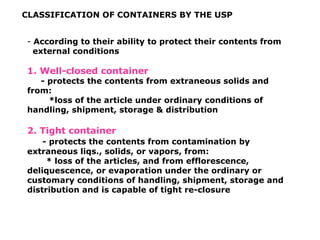
CLASSIFICATION OF CONTAINERS BY THE USP
- According to their ability to protect their contents from
external conditions
1. Well-closed container
- protects the contents from extraneous solids and
from:
*loss of the article under ordinary conditions of
handling, shipment, storage & distribution
2. Tight container
- protects the contents from contamination by
extraneous liqs., solids, or vapors, from:
* loss of the articles, and from efflorescence,
deliquescence, or evaporation under the ordinary or
customary conditions of handling, shipment, storage and
distribution and is capable of tight re-closure
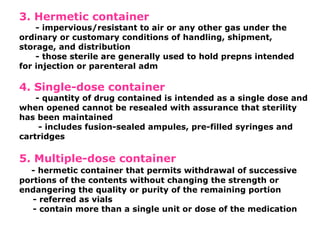
3. Hermetic container
- impervious/resistant to air or any other gas under the
ordinary or customary conditions of handling, shipment,
storage, and distribution
- those sterile are generally used to hold prepns intended
for injection or parenteral adm
4. Single-dose container
- quantity of drug contained is intended as a single dose and
when opened cannot be resealed with assurance that sterility
has been maintained
- includes fusion-sealed ampules, pre-filled syringes and
cartridges
5. Multiple-dose container
- hermetic container that permits withdrawal of successive
portions of the contents without changing the strength or
endangering the quality or purity of the remaining portion
- referred as vials
- contain more than a single unit or dose of the medication
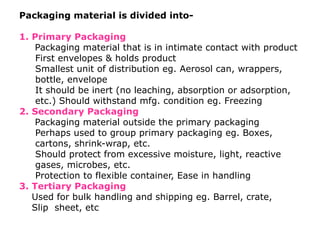
Packaging material is divided into-
1. Primary Packaging
Packaging material that is in intimate contact with product
First envelopes & holds product
Smallest unit of distribution eg. Aerosol can, wrappers,
bottle, envelope
It should be inert (no leaching, absorption or adsorption,
etc.) Should withstand mfg. condition eg. Freezing
2. Secondary Packaging
Packaging material outside the primary packaging
Perhaps used to group primary packaging eg. Boxes,
cartons, shrink-wrap, etc.
Should protect from excessive moisture, light, reactive
gases, microbes, etc.
Protection to flexible container, Ease in handling
3. Tertiary Packaging
Used for bulk handling and shipping eg. Barrel, crate,
Slip sheet, etc
Containers for pharmaceuticals
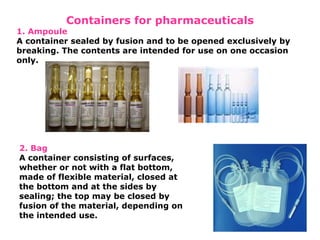
1. Ampoule
A container sealed by fusion and to be opened exclusively by
breaking. The contents are intended for use on one occasion
only.
2. Bag
A container consisting of surfaces,
whether or not with a flat bottom,
made of flexible material, closed at
the bottom and at the sides by
sealing; the top may be closed by
fusion of the material, depending on
the intended use.
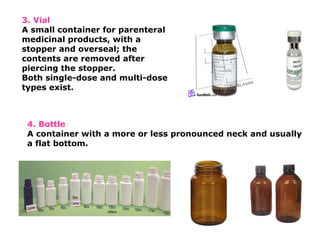
4. Bottle
A container with a more or less pronounced neck and usually
a flat bottom.
3. Vial
A small container for parenteral
medicinal products, with a
stopper and overseal; the
contents are removed after
piercing the stopper.
Both single-dose and multi-dose
types exist.
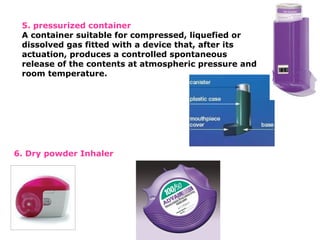
5. pressurized container
A container suitable for compressed, liquefied or
dissolved gas fitted with a device that, after its
actuation, produces a controlled spontaneous
release of the contents at atmospheric pressure and
room temperature.
6. Dry powder Inhaler
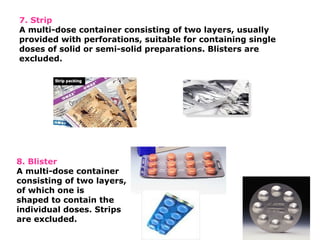
7. Strip
A multi-dose container consisting of two layers, usually
provided with perforations, suitable for containing single
doses of solid or semi-solid preparations. Blisters are
excluded.
8. Blister
A multi-dose container
consisting of two layers,
of which one is
shaped to contain the
individual doses. Strips
are excluded.
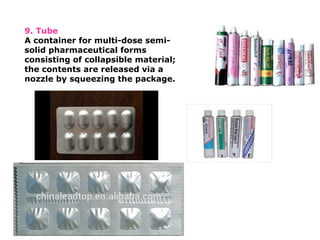
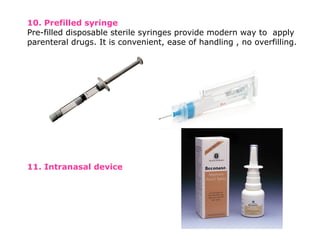
9. Tube
A container for multi-dose semi-
solid pharmaceutical forms
consisting of collapsible material;
the contents are released via a
nozzle by squeezing the package.
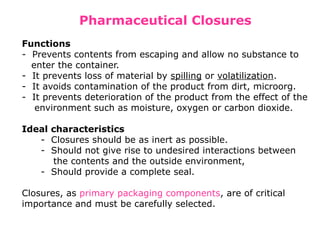
10. Prefilled syringe
Pre-filled disposable sterile syringes provide modern way to apply
parenteral drugs. It is convenient, ease of handling , no overfilling.
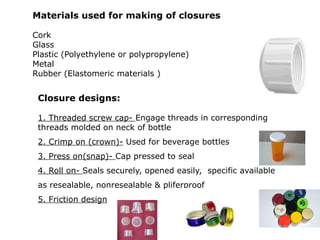
11. Intranasal device
Pharmaceutical Closures
Functions
- Prevents contents from escaping and allow no substance to
enter the container.
- It prevents loss of material by spilling or volatilization.
- It avoids contamination of the product from dirt, microorg.
- It prevents deterioration of the product from the effect of the
environment such as moisture, oxygen or carbon dioxide.
Ideal characteristics
- Closures should be as inert as possible.
- Should not give rise to undesired interactions between
the contents and the outside environment,
- Should provide a complete seal.
Closures, as primary packaging components, are of critical
importance and must be carefully selected.
Closure designs:
1. Threaded screw cap- Engage threads in corresponding
threads molded on neck of bottle
2. Crimp on (crown)- Used for beverage bottles
3. Press on(snap)- Cap pressed to seal
4. Roll on- Seals securely, opened easily, specific available
as resealable, nonresealable & pliferproof
5. Friction design
Materials used for making of closures
Cork
Glass
Plastic (Polyethylene or polypropylene)
Metal
Rubber (Elastomeric materials )
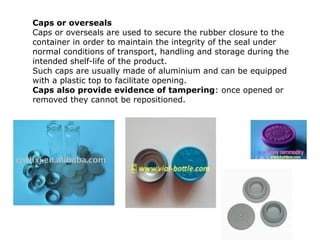
Caps or overseals
Caps or overseals are used to secure the rubber closure to the
container in order to maintain the integrity of the seal under
normal conditions of transport, handling and storage during the
intended shelf-life of the product.
Such caps are usually made of aluminium and can be equipped
with a plastic top to facilitate opening.
Caps also provide evidence of tampering: once opened or
removed they cannot be repositioned.
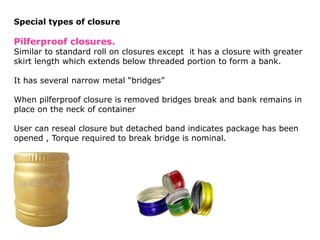
Special types of closure
Pilferproof closures.
Similar to standard roll on closures except it has a closure with greater
skirt length which extends below threaded portion to form a bank.
It has several narrow metal “bridges”
When pilferproof closure is removed bridges break and bank remains in
place on the neck of container
User can reseal closure but detached band indicates package has been
opened , Torque required to break bridge is nominal.
Child-resistant container and closures
Child-resistant container
- defined as:
*significantly difficult for children under 5 years of age to open or to
obtain a harmful amount of its contents within a reasonable time
*not difficult for “normal adults” to use properly.
Child-proof closures
The three most common reclosable child-resistant types of closure are
the “press–turn”, the “squeeze–turn” and a combination lock.
-To avoid cases of poisoning
- Reduce risk of accidental ingestion medication
- Safety cap provided for prescription drug, OTC
medicine, pesticide, etc.
Most designs that are child-resistant require two hands to open
the closure.
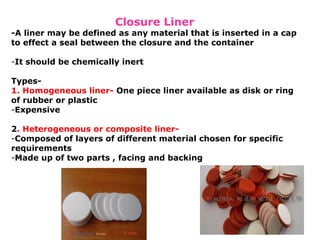
Closure Liner
-A liner may be defined as any material that is inserted in a cap
to effect a seal between the closure and the container
-It should be chemically inert
Types-
1. Homogeneous liner- One piece liner available as disk or ring
of rubber or plastic
-Expensive
2. Heterogeneous or composite liner-
-Composed of layers of different material chosen for specific
requirements
-Made up of two parts , facing and backing
Tampering involves the deliberate altering or adulteration of
a product, package, or system.
According to FDA “ a tamper evident package is one having an
indicator or barrier to entry which, if breached or missing, can
reasonably be expected to provide 1`visible evidence to consumers
that tampering has occurred.
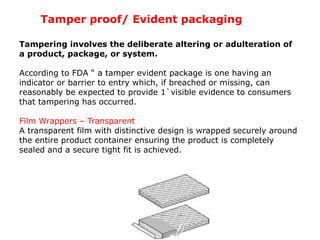
Film Wrappers – Transparent
A transparent film with distinctive design is wrapped securely around
the entire product container ensuring the product is completely
sealed and a secure tight fit is achieved.
Tamper proof/ Evident packaging
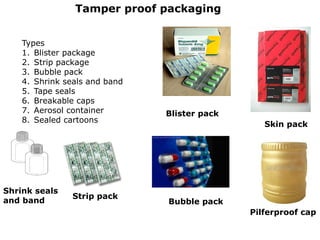
Tamper proof packaging
Types
1. Blister package
2. Strip package
3. Bubble pack
4. Shrink seals and band
5. Tape seals
6. Breakable caps
7. Aerosol container
8. Sealed cartoons
Blister pack
Strip pack
Bubble pack
Pilferproof cap
Skin pack
Shrink seals
and band
Strip Package
Formed by feeding 2 webs of heat sealable flexible film thr’
heated crimping roller & product is dropped into pocket
formed prior to forming final seal.
Cellophane, PE, PVC, etc.
Shrink Banding
Heat shrinkable polymer slightly larger in diameter than cap
and neck ring of bottle . Bottle is moved thr’ a heat tunnel
which shrinks tubing material tightly to engage cap & neck
Tamper Resistant Packaging
Aerosol HC propellant in its cooled liquid phase added to
drawn Al-container along with product and spray nozzle
contained in gasketted metal ferrule crimmped over opening
of container
Two-piece capsules
They are sealed such that the two halves of the capsule cannot
be separated or rejoined without leaving visible evidence of
entry
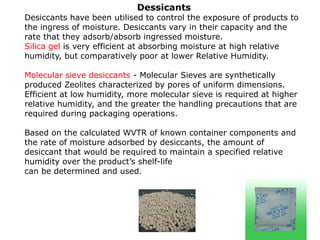
Dessicants
Desiccants have been utilised to control the exposure of products to
the ingress of moisture. Desiccants vary in their capacity and the
rate that they adsorb/absorb ingressed moisture.
Silica gel is very efficient at absorbing moisture at high relative
humidity, but comparatively poor at lower Relative Humidity.
Molecular sieve desiccants - Molecular Sieves are synthetically
produced Zeolites characterized by pores of uniform dimensions.
Efficient at low humidity, more molecular sieve is required at higher
relative humidity, and the greater the handling precautions that are
required during packaging operations.
Based on the calculated WVTR of known container components and
the rate of moisture adsorbed by desiccants, the amount of
desiccant that would be required to maintain a specified relative
humidity over the product’s shelf-life
can be determined and used.
SECONDARY PACKAGING MATERIALS
PAPER : -
This can be used as a flexible wrap for products, or as a closure
material for jars. Most paper materials are used with a liner
applied either as a laminate or as a coating.
PHARMACEUTICAL CORRUGATED FIBERBOARD
Corrugated fiberboard is a paper-based construction material
consisting of a fluted corrugated sheet and one or two flat
linerboards. It is widely used in the manufacture of corrugated
boxes
CARTON
A carton is a type of suitable for food, pharmaceuticals, hardware,
and many other types of products. Folding cartons are usually
combined into a tube at the manufacturer and shipped flat
(knocked down) to the packager.

packaging of pharmaceutical formulations

  • 1.
  • 2.
    Definition Art and scienceof, and the operations involved in, preparing articles for transport – safe and stable storage – short term or long term display – for sale use - ease of removal, re-closing
  • 3.
    What is packaging? Packaging is defined as the collection of different components which surround the pharmaceutical product from the time of production until its use.
  • 4.
    Importance of packaging •Protect against all adverse external influences that can alter the properties of the product. • Protect against biological contamination. • Protect against physical damage. • Carry the correct information and identification of the product. • Tamper evident / Child resistance/ Anti- counterfeiting.
  • 5.
    Functions of packaging 1.Containment Not to leak, nor allow diffusion and permeation Strong enough to hold the contents during handling 2. Protection from hazards 1. Mechanical – shock, compression, vibration etc 2. Environmental – temp., moisture, gasses, light 3. Biological – biological contamination. 3. Tamper evident / Child resistance. 4. Carry the correct information and identification of the product. 5. Convenience
  • 6.
    Packaging material characteristics 1.Mechanical – Should have sufficient mechanical strength to withstand handling. Special care for glass container. 2. Physical – - Impervious - Able to withstand heat - Good surface for labeling. Difficulty with plastic. - Suitable life 3. Chemical – - Non-reactive - No chemical changes - Non-absorbable and non-leachable 4. Biological – - No support of microbial growth. - Non toxic 5. Regulatory – FDA approved
  • 7.
    Choosing appropriate primarypack Product characteristics/sensitivity -Hygroscopicity -Physical degradation -Chemical degradation -Drug release properties -Mechanical properties -Photosensitivity -Gas liberation tendency -Dimensional aspects Selection of packaging material -Moisture barrier requirements -Light barrier requirements -Gas barrier requirements -Chemical properties
  • 8.
    Packaging component ⮚ Glass ⮚Plastic ⮚ Metal ⮚ Rubber
  • 9.
    - Commonly andwidely used - Superior protection, don’t deteriorate with age Composition of glass- Sand- pure silica Soda ash- Sodium carbonate (to facilitate melting) Limestone- Calcium carbonate Cullet – broken glass (fusion agent) Disadvantages: - FRAGILE - WEIGHT Glass Advantages: Transparent, strong , rigid Most inert, impermeable variety of sizes & shapes are available FDA clearance
  • 10.
    TYPES Of GLASS:- Type I Borosilicate glass Type II Treated Na-lime glass Type III Regular Na-lime glass Type NP General purpose Na lime glass Glass
  • 11.
    Type I -Borosilicate glass • Type I glass is defined as a borosilicate glass with a high degree of hydrolytic stability due to its chemical composition. • Substantial part of the alkali and earth cations are replaced by boron and /or aluminium and zinc. Type I glass is suited to containers for preparations both for parental and other use. • Injectable products with acid, neutral or slightly alkaline pH can be packaged in this type of glass. • The containers may be sterilized before and after filling and provide mechanical resistance to sudden changes in temperature better than type II and III glass
  • 12.
    Type II TreatedNa-lime glass • Type II glass is a sodium-calcium glass which, with proper treatment of the surfaces (dealkalising/ sulfur treatment), achieves the hydrolytic stability of type I glass. • Type II glass containers are suited for holding acid and neutral preparations both for parental and other use.
  • 13.
    Type III RegularNa-lime glass • Type III glass is a sodium-calcium glass with a low alkaline content and high hydrolytic resistance. Results for hydrolytic resistance and resistance to sudden temperature changes are better than for glass not intended for pharmaceutical use. Type III glass is generally suited to packages for non- aqueous preparations or in powder for parental use, excluding freeze-dried medicines, and for non-parental preparations. Type III glass containers are normally dry sterilized before being filled.
  • 14.
    Colored glass • Generalglass clear flint glass • Amber colour, blue, emarald green, opal colour • Only amber glass and red glass are effective in protecting the contents from sunlight. • Adding colouring oxide agents makes this type of glass suited to protecting contents while maintaining high transparency. • Pharmaceutical standards prescribe that the transmission of light must be below 10% of the incident radiation of each wavelength between 2900 to 4500 angstroms of light.
  • 15.
    Glass- Pharmacopoeial tests 1.Chemical resistance/ water attack test • The degree of attack is determined by the amount of alkali released from the glass under the influence of the attacking medium under the conditions specified. • This quantity of alkali is extremely small in the case of the more resistant glasses and the use of apparatus of high quality and precision. • Result: -amount of alkalinity leached from the glass by purified water under controlled elevated temperature conditions Type General Description Type of Test I Highly resistant, borosilicate glass Powdered Glass II Treated soda-lime glass Water Attack III Soda-lime glass Powdered Glass
  • 16.
    Glass- Pharmacopoeial tests 1.Powdered Glass Test • Preparation specimen for powder glass test : • Preparation specimen for powder glass test Rinse 6 or more container Dry them Crush into fragments Divide 100g of coarsely crushed glass into three equal parts Place one portion in mortar Crush further by striking 3 or 4 blows with hammer Pass through sieve no 20 then 40 • Transfer the retained portion & weigh excess of 10 g Spread it on glass paper and remove iron particle with magnet Wash with six 30 ml of acetone Decant acetone Dry the contents for 20 mts at 140 0 c Transfer to dessicator Final specimen to be used in powdered glass • Refer USP general chapter for details.
  • 17.
    2. Water attacktest : Powder attack test 10 gm specimen in a 250ml conical flask with high purity of water in bath at 90 o c Add 50 ml of purified water Autoclave for 10 mts Adjust temperature to 121 0c Reduce the heat and wait for cool Cool the flask in running water Decant water. Wash thee residue powdered glass Add the decanted washing to main portion Add 5 drops of methyl red solution Titrate immediately with 0.02 N sulphuric acid Record the volume of 0.02 N sulphuric acid 3. Arsenic test: detection limit tested against 0.1 ppm of arsenic
  • 18.
    For a largenumber of pharmaceuticals, including medicinal products for oral and local administration, glass containers are usually the first choice (e.g. bottles for tablets, injection syringes for unit- or multidose administration). Different types of glass may be necessary, depending on the characteristics and the intended use of the medicinal products concerned. Classifications of types of glass are given in the European and United States pharmacopoeias, whereas no such classification exists in the Japanese pharmacopoeia. Glass can be tested for light transmission and hydrolytic resistance. In the Japanese pharmacopoeia, such tests are described only for glass containers for injection, whereas in the European and United States pharmacopoeias they are given for all types of glass containers.
  • 26.
    2.Plastic Properties: • Light weight, non breakable • When increase heat during sterilization some are destroyed • High permeability to water vapor • Little permeation of glass / O2 Additives :- • Plasticizer – for softness, flexibility. Dioctyl phthalate • lubricant – help in molding and processing. Zinc stearate • Stabilizers – prevent degradation. Fatty acid salts • Antistatic – prevent build up of static charge. • Slip agent – mainly added to polyolefins to reduce friction. • Antioxidant – prevent oxidation. aromatic amin, thioester. • Dyes and colors- FD&C approved
  • 27.
    Types of plastic 1.Thermoplastic- Thermoplastics are the plastics that do not undergo chemical change in their composition when heated and can be moulded again and again; examples are polyethyleneThermoplastics are the plastics that do not undergo chemical change in their composition when heated and can be moulded again and again; examples are polyethylene, polypropylene Thermoplastics are the plastics that do not undergo chemical change in their composition when heated and can be moulded again and again; examples are polyethylene, polypropylene, polystyrene Thermoplastics are the plastics that do not undergo chemical change in their composition when heated and can be moulded again and again; examples are
  • 28.
    Thermoplastics 1. Polyethylene – •2 type. High density and low density (HDPE and LDPE). • Good moisture barrier but poor against oxygen and other gasses. • Unaffected by strong acids and alkalis. • Lack of clarity. • High rate of permeation of essential odors, flavors etc. • This are susceptible to oxidation so some amount of antioxidant (butylated hydroxy toluene) should be used. • Antistatic agent (PEG) is also used to minimize air dust accumulation. 2. Polypropylene – • it has high melting point so suitable for high temp. sterilization. • Excellent gas and vapour barrier. • Lack of clarity, improvement is possible by constructing thinner wall • Brittle at low temp. • Doesn’t stress crack except hot aromatic and halogenated acids softens it.
  • 29.
    3. Polyvinyl cloride– •Crystal clarity, greater stiffness, good oxygen barrier. •Inexpensive, tough, easili processed. •It must not be overheated bcoz starts to degrade at 280 F and degradation products are extremely corrosive. •It becomes yellow when exposed to heat or UV unless a stabilizer (tin comp., sulphur, calcium and zinc salts) is included. 4. polystyrene- • rigid, crystal clear plastic, low in cost. •Not useful for liquid products bcoz of high water vapor transmission as well as high water vapor permeability. •Polystyrene containers get easily scratched and often cracked when dropped. •It easily build up static charge. •Low melting point so cant use for high temp application. •To increase its quality general purpose polystyrene may be combined with various conc. Of rubber and acrylic compound.
  • 30.
    5. Nylon – •Itis made from a dibasic acid combined with a diamin. •Since there are many dibasic acids and many different amins, there is great variety of nylon. •They can be autoclaved. •Extremely strong and quite difficult to destroy by mechanical means. •Resistant to wide range of organic and inorganic chemicals. •Highly impermeable to oxygen. •Not good barrier of water vapor. 6. Polycarbonate – •Expensive material. •Able to get sterilized repeatedly. •Rigid as glass so use as an alternate to glass vials and syringes. •It is moderately chemical resistant and fair oxygen barrier.
  • 31.
    7. Acrylic multipolymer- -Acrylonitrile or methacrylonitrile monomer - High gas barrier, good chemical resistance, excellent strength properties - Preferred in food industry becoz oil & grease resistance and minimal taste transfer effects 8. Polyethylene terepthalate (PET)- - Condensation polymer typically formed by reaction of terephthalic acid with ethylene glycol in presence of catalyst. - Used to prepare Plastic bottles - Excellent impact strength, gas/aroma barrier
  • 32.
    Drug plastic consideration •Permeation-of the containers to atmospheric oxygen and to moisture vapor • Leaching of the constituents of the container to the internal contents • Sorption of drugs from the contents to the container • Chemical reaction of light through the container • Alteration of the container upon storage
  • 33.
    Selection of plasticmaterial The most commonly used polymers are polyethylene (with and without additives), polypropylene, poly(vinyl chloride), poly(ethylene terephthalate) poly(ethylene-vinyl acetate). For selection of a suitable plastic container, it is necessary to know the full manufacturing formula of the plastic, including all materials added during formation of the container so that the potential hazards can be assessed. The plastic container chosen for any particular preparation should be such that: — the ingredients of the preparation in contact with the plastic material are not significantly adsorbed on its surface and do not significantly migrate into or through the plastic, — the plastic material does not release substances in quantities sufficient to affect the stability of the preparation or to present a risk of toxicity.
  • 34.
    Evaluation of plastic -Physicalcharacteristics, -assessment of any loss or gain through permeation, -detection of pH changes, -assessment of changes caused by light, chemical tests and, where appropriate, -biological tests Pls refer USP reference physiochemical tests Heavy metals: detection limit 1 ppm Residue on ignition: detection limit 1 mg Nonvolatile residues: detection limit 1 mg Buffering capacity: detection limit pH 1-14
  • 35.
    BIOLOGICAL REACTIVITY TESTS,IN VIVO The following tests are designed to determine the biological response of animals to elastomerics, plastics and other polymeric material with direct or indirect patient contact, or by the injection of specific extracts prepared from the material under test. It is essential to make available the specific surface area for extraction. When the surface area of the specimen cannot be determined, use 0.1 g of elastomer or 0.2 g of plastic or other material for every mL of extraction fluid. BIOLOGICAL REACTIVITY TESTS, IN VITRO The following tests are designed to determine the biological reactivity of mammalian cell cultures following contact with the elastomeric plastics and other polymeric materials with direct or indirect patient contact or of specific extracts prepared from the materials under test.
  • 36.
    Leakage test forplastic container : Leakage test for plastic container Fill 10 container with water and fit the closure Keep them inverted at RT for 24 hrs No sign of leakage from any container Water vapour permeability test for plastic container : Water vapour permeability test for plastic container Fill 5 containers with nominal volume of water and seal Weigh each container Allow to stand for 14 days at RH of 60 at 20 -25 0 c Reweigh the container Loss of weight in each container should not be more than 0.2% Collapsibility test for plastic containers : Collapsibility test for plastic containers This test is applicable for those container which have to be squeezes for the withdrawal of the product a continue squeezing yields at least 90% of its nominal content at regular flow rate at ambient temperature .
  • 37.
    Physicochemical and BiologicalTests on Plastic Materials in European, Japanese and United States EP JP USP Physicochemical Tests – Plastics Materials for Containers for Parenteral Preparations • Polyolefi ns • Polyethylene • Polypropylene • Polyethylene Terephthalate • Polyethylene Vinyl Acetate • Poly(vinyl chloride) Physicochemical Tests – Plastic Containers for Parenteral Preparations • All Plastics Physicochemical Tests - Plastics Containers for Aqueous Injections • Polyethylene • Polypropylene • Polyethylene Vinyl Acetate • Other Plastics Physicochemical Tests – 1.Plastic Containers for Non-Defi ned Use • All Plastics 2. Physicochemical Tests – Plastic Containers for Dry Solid or Liquid Oral Dosage Forms • Polyethylene • Polypropylene • Polyethylene Terephthalate Biological Tests – All Plastics • Cytotoxicity Biological Tests – All Plastics • Biological Activity, In Vitro • Biological Activity, In Vivo
  • 38.
    3. Metals Mainly usedto prepare collapsible tubes. 1. Tin – preferred for foods, pharmaceutical for which purity is major consideration. Most chemically inert material. Good appearance and compatibility with wide range of product. 2. Aluminum – light weight and lower shipping cost. 3. Lead – lowest cost. Used for nonfood products. it should not use alone for internal use products due to risk of lead poisoning. With internal lining they can used for product like tooth paste. Linings – If product is not compitable with bare metal, interior prepared by wax like formulations or resins solutions. They are sprayed or applied on the interior surface of the container to prevent direct contact of the product with metal. Wax linings are used with tin tubes. Phenolics and epoxides and vinyls are used with aluminium tubes. Phenolics better protect from acid products. Epoxides are effective against alkalis.
  • 39.
    Metal containers areused solely for medicinal products for non-parenteral administration. They include tubes, packs made from foil or blisters, cans , and aerosol and gas cylinders. Aluminium and stainless steel are the metals of choice for both primary and secondary packaging for medicinal products. They provide excellent tamper-evident containers. Since metal is strong, impermeable to gases and shatterproof, it is the ideal packaging material for pressurized containers.
  • 40.
    • These aremainly used to make stoppers, cap linners, bulbs for dropper assembly. • Rubber stopper is used primarily for multiple dose vials and disposable syringes. • Rubber which are commonly used are 3 types- natural, neoprene, butyl rubber. 4. Rubbers
  • 41.
    Evaluation of rubber Physicochemicaltest:- On aqueous extract ph , turbidity, residue on drying, iodine no., heavy metals contents are tested Biological test :- Extract with saline / PEG 400 / cottonseed oil Inject in mice and rabbit Compare with control
  • 42.
    Fragmentation test forrubber closures : Fragmentation test for rubber closures Place a 4ml of water in each of 12 clean vials. Close a vial with closure and secure caps for 16 hrs. Pierce the closure with 21 SWG hypodermic needle inject 1ml water and 1ml air Repeat the operation 4 times for each closures ( use new needle for each closure) Count the number of fragment visible on the rubber . Total number of fragment should not be more than 10 except butyl rubber. Self Sealbility Test For Rubber Closure ( Vials ) : SELF SEALBILITY TEST FOR RUBBER CLOSURE ( VIALS ) Fill 10 vials with to nominal volume and close the vial with closure Pierce the cap 10 times at different size with 21 SWG hypodermic needle. Immerse the vials in 0.1% w/v solution of methylene blue under reduced external pressure for 10 mts Restore the normal pressure and keep the container immersed for 30 mins, Wash the vial . none of the vials should contained trace colored solution.
  • 43.
    CLASSIFICATION OF CONTAINERSBY THE USP - According to their ability to protect their contents from external conditions 1. Well-closed container - protects the contents from extraneous solids and from: *loss of the article under ordinary conditions of handling, shipment, storage & distribution 2. Tight container - protects the contents from contamination by extraneous liqs., solids, or vapors, from: * loss of the articles, and from efflorescence, deliquescence, or evaporation under the ordinary or customary conditions of handling, shipment, storage and distribution and is capable of tight re-closure
  • 44.
    3. Hermetic container -impervious/resistant to air or any other gas under the ordinary or customary conditions of handling, shipment, storage, and distribution - those sterile are generally used to hold prepns intended for injection or parenteral adm 4. Single-dose container - quantity of drug contained is intended as a single dose and when opened cannot be resealed with assurance that sterility has been maintained - includes fusion-sealed ampules, pre-filled syringes and cartridges 5. Multiple-dose container - hermetic container that permits withdrawal of successive portions of the contents without changing the strength or endangering the quality or purity of the remaining portion - referred as vials - contain more than a single unit or dose of the medication
  • 45.
    Packaging material isdivided into- 1. Primary Packaging Packaging material that is in intimate contact with product First envelopes & holds product Smallest unit of distribution eg. Aerosol can, wrappers, bottle, envelope It should be inert (no leaching, absorption or adsorption, etc.) Should withstand mfg. condition eg. Freezing 2. Secondary Packaging Packaging material outside the primary packaging Perhaps used to group primary packaging eg. Boxes, cartons, shrink-wrap, etc. Should protect from excessive moisture, light, reactive gases, microbes, etc. Protection to flexible container, Ease in handling 3. Tertiary Packaging Used for bulk handling and shipping eg. Barrel, crate, Slip sheet, etc
  • 47.
    Containers for pharmaceuticals 1.Ampoule A container sealed by fusion and to be opened exclusively by breaking. The contents are intended for use on one occasion only. 2. Bag A container consisting of surfaces, whether or not with a flat bottom, made of flexible material, closed at the bottom and at the sides by sealing; the top may be closed by fusion of the material, depending on the intended use.
  • 48.
    4. Bottle A containerwith a more or less pronounced neck and usually a flat bottom. 3. Vial A small container for parenteral medicinal products, with a stopper and overseal; the contents are removed after piercing the stopper. Both single-dose and multi-dose types exist.
  • 49.
    5. pressurized container Acontainer suitable for compressed, liquefied or dissolved gas fitted with a device that, after its actuation, produces a controlled spontaneous release of the contents at atmospheric pressure and room temperature. 6. Dry powder Inhaler
  • 50.
    7. Strip A multi-dosecontainer consisting of two layers, usually provided with perforations, suitable for containing single doses of solid or semi-solid preparations. Blisters are excluded. 8. Blister A multi-dose container consisting of two layers, of which one is shaped to contain the individual doses. Strips are excluded.
  • 51.
    9. Tube A containerfor multi-dose semi- solid pharmaceutical forms consisting of collapsible material; the contents are released via a nozzle by squeezing the package.
  • 52.
    10. Prefilled syringe Pre-filleddisposable sterile syringes provide modern way to apply parenteral drugs. It is convenient, ease of handling , no overfilling. 11. Intranasal device
  • 53.
    Pharmaceutical Closures Functions - Preventscontents from escaping and allow no substance to enter the container. - It prevents loss of material by spilling or volatilization. - It avoids contamination of the product from dirt, microorg. - It prevents deterioration of the product from the effect of the environment such as moisture, oxygen or carbon dioxide. Ideal characteristics - Closures should be as inert as possible. - Should not give rise to undesired interactions between the contents and the outside environment, - Should provide a complete seal. Closures, as primary packaging components, are of critical importance and must be carefully selected.
  • 54.
    Closure designs: 1. Threadedscrew cap- Engage threads in corresponding threads molded on neck of bottle 2. Crimp on (crown)- Used for beverage bottles 3. Press on(snap)- Cap pressed to seal 4. Roll on- Seals securely, opened easily, specific available as resealable, nonresealable & pliferproof 5. Friction design Materials used for making of closures Cork Glass Plastic (Polyethylene or polypropylene) Metal Rubber (Elastomeric materials )
  • 55.
    Caps or overseals Capsor overseals are used to secure the rubber closure to the container in order to maintain the integrity of the seal under normal conditions of transport, handling and storage during the intended shelf-life of the product. Such caps are usually made of aluminium and can be equipped with a plastic top to facilitate opening. Caps also provide evidence of tampering: once opened or removed they cannot be repositioned.
  • 56.
    Special types ofclosure Pilferproof closures. Similar to standard roll on closures except it has a closure with greater skirt length which extends below threaded portion to form a bank. It has several narrow metal “bridges” When pilferproof closure is removed bridges break and bank remains in place on the neck of container User can reseal closure but detached band indicates package has been opened , Torque required to break bridge is nominal.
  • 57.
    Child-resistant container andclosures Child-resistant container - defined as: *significantly difficult for children under 5 years of age to open or to obtain a harmful amount of its contents within a reasonable time *not difficult for “normal adults” to use properly. Child-proof closures The three most common reclosable child-resistant types of closure are the “press–turn”, the “squeeze–turn” and a combination lock. -To avoid cases of poisoning - Reduce risk of accidental ingestion medication - Safety cap provided for prescription drug, OTC medicine, pesticide, etc. Most designs that are child-resistant require two hands to open the closure.
  • 58.
    Closure Liner -A linermay be defined as any material that is inserted in a cap to effect a seal between the closure and the container -It should be chemically inert Types- 1. Homogeneous liner- One piece liner available as disk or ring of rubber or plastic -Expensive 2. Heterogeneous or composite liner- -Composed of layers of different material chosen for specific requirements -Made up of two parts , facing and backing
  • 59.
    Tampering involves thedeliberate altering or adulteration of a product, package, or system. According to FDA “ a tamper evident package is one having an indicator or barrier to entry which, if breached or missing, can reasonably be expected to provide 1`visible evidence to consumers that tampering has occurred. Film Wrappers – Transparent A transparent film with distinctive design is wrapped securely around the entire product container ensuring the product is completely sealed and a secure tight fit is achieved. Tamper proof/ Evident packaging
  • 60.
    Tamper proof packaging Types 1.Blister package 2. Strip package 3. Bubble pack 4. Shrink seals and band 5. Tape seals 6. Breakable caps 7. Aerosol container 8. Sealed cartoons Blister pack Strip pack Bubble pack Pilferproof cap Skin pack Shrink seals and band
  • 61.
    Strip Package Formed byfeeding 2 webs of heat sealable flexible film thr’ heated crimping roller & product is dropped into pocket formed prior to forming final seal. Cellophane, PE, PVC, etc. Shrink Banding Heat shrinkable polymer slightly larger in diameter than cap and neck ring of bottle . Bottle is moved thr’ a heat tunnel which shrinks tubing material tightly to engage cap & neck Tamper Resistant Packaging Aerosol HC propellant in its cooled liquid phase added to drawn Al-container along with product and spray nozzle contained in gasketted metal ferrule crimmped over opening of container Two-piece capsules They are sealed such that the two halves of the capsule cannot be separated or rejoined without leaving visible evidence of entry
  • 62.
    Dessicants Desiccants have beenutilised to control the exposure of products to the ingress of moisture. Desiccants vary in their capacity and the rate that they adsorb/absorb ingressed moisture. Silica gel is very efficient at absorbing moisture at high relative humidity, but comparatively poor at lower Relative Humidity. Molecular sieve desiccants - Molecular Sieves are synthetically produced Zeolites characterized by pores of uniform dimensions. Efficient at low humidity, more molecular sieve is required at higher relative humidity, and the greater the handling precautions that are required during packaging operations. Based on the calculated WVTR of known container components and the rate of moisture adsorbed by desiccants, the amount of desiccant that would be required to maintain a specified relative humidity over the product’s shelf-life can be determined and used.
  • 63.
    SECONDARY PACKAGING MATERIALS PAPER: - This can be used as a flexible wrap for products, or as a closure material for jars. Most paper materials are used with a liner applied either as a laminate or as a coating. PHARMACEUTICAL CORRUGATED FIBERBOARD Corrugated fiberboard is a paper-based construction material consisting of a fluted corrugated sheet and one or two flat linerboards. It is widely used in the manufacture of corrugated boxes CARTON A carton is a type of suitable for food, pharmaceuticals, hardware, and many other types of products. Folding cartons are usually combined into a tube at the manufacturer and shipped flat (knocked down) to the packager.