Dr.Daryl Dugdale 2015
Leaky Masculinities: The Challenge
of Practice with Risky Men
“Desirable masculinity is context-dependant:
there is tension between women`s different
constructions of ideal masculinity across
contexts; there is likely to be a strong contextual
element in women`s “taking up” and “putting
down” of different ideal masculinities; and
different contextual masculinities may be
arranged hierarchically in terms of status and
desire.” (Talbot & Quayle, 2010, p258)
Key Questions
• How might men`s understanding of fatherhood influence
their behaviours?
• How might their sense of manliness or masculinity inform
this understanding?
• What changes can be proposed to increase the
likelihood of fathers becoming involved in the social care
process?
Method
• Multiple case study design (4 fathers).
• Triangulation
• Semi structured interviews
• Observations core group meetings and case
conferences
• Focus group interviews
• Use of case files
• Longitudinal
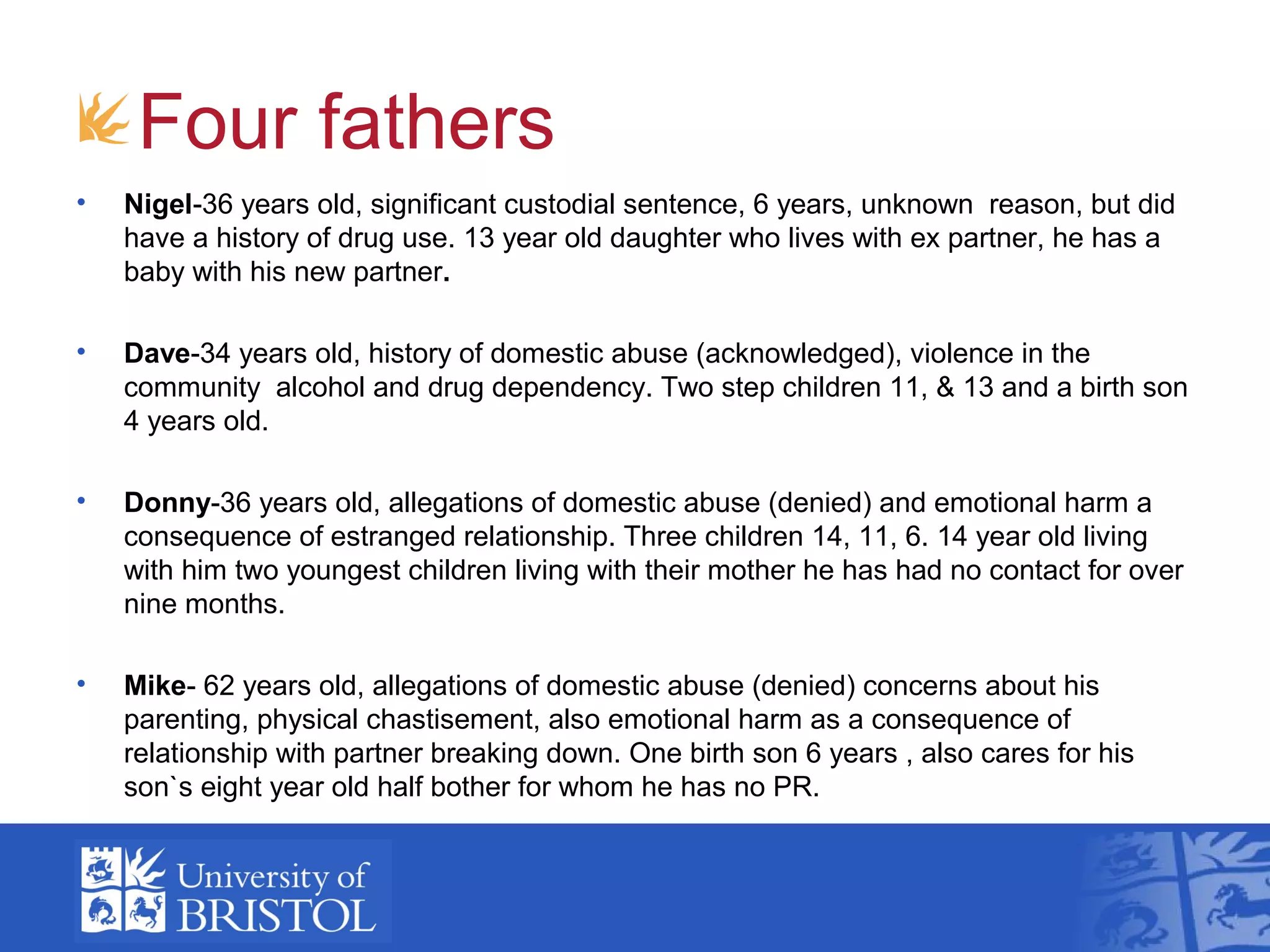
Four fathers
• Nigel-36 years old, significant custodial sentence, 6 years, unknown reason, but did
have a history of drug use. 13 year old daughter who lives with ex partner, he has a
baby with his new partner.
• Dave-34 years old, history of domestic abuse (acknowledged), violence in the
community alcohol and drug dependency. Two step children 11, & 13 and a birth son
4 years old.
• Donny-36 years old, allegations of domestic abuse (denied) and emotional harm a
consequence of estranged relationship. Three children 14, 11, 6. 14 year old living
with him two youngest children living with their mother he has had no contact for over
nine months.
• Mike- 62 years old, allegations of domestic abuse (denied) concerns about his
parenting, physical chastisement, also emotional harm as a consequence of
relationship with partner breaking down. One birth son 6 years , also cares for his
son`s eight year old half bother for whom he has no PR.
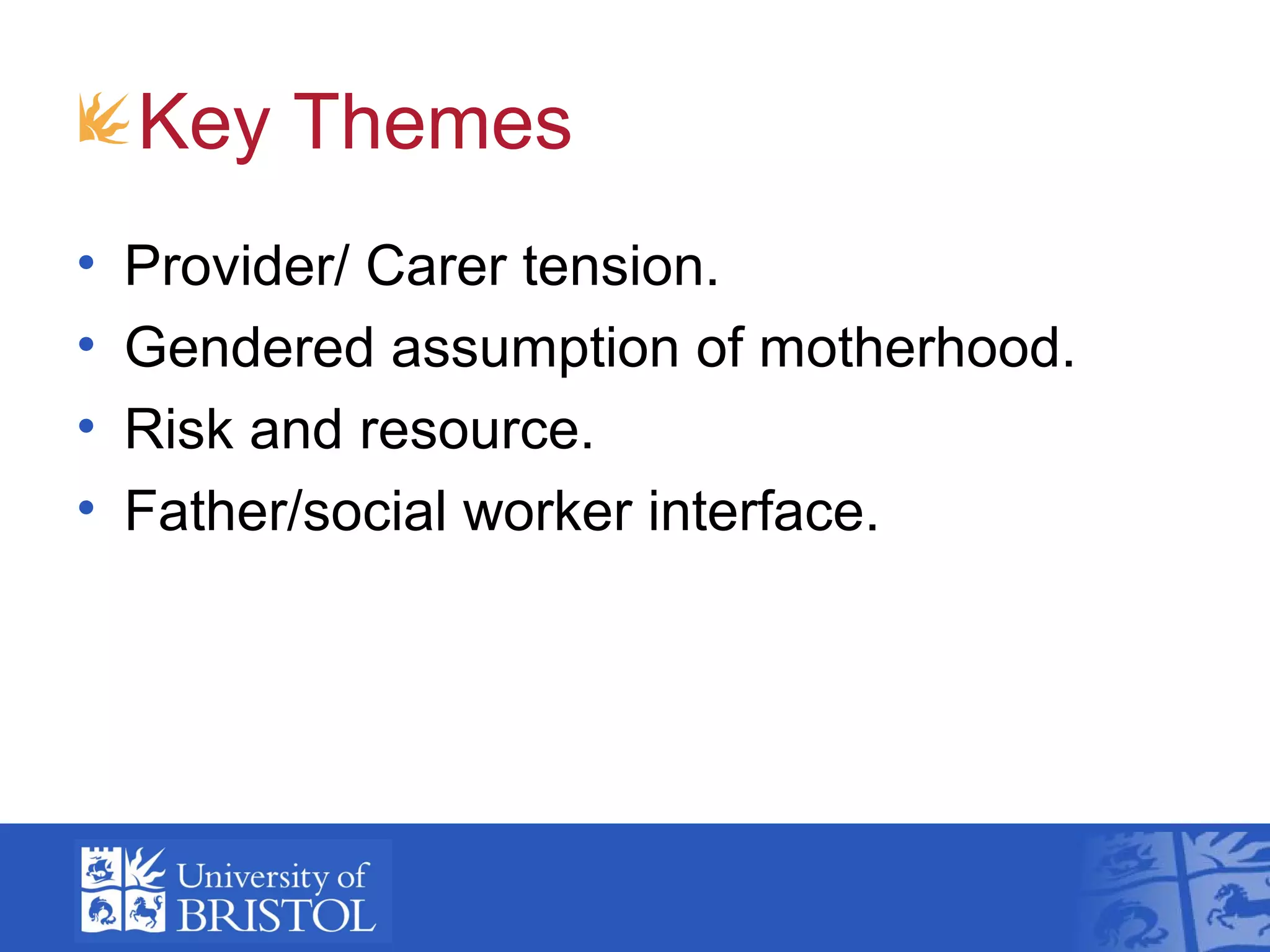
• Provider/ Carer tension.
• Gendered assumption of motherhood.
• Risk and resource.
• Father/social worker interface.
Key Themes
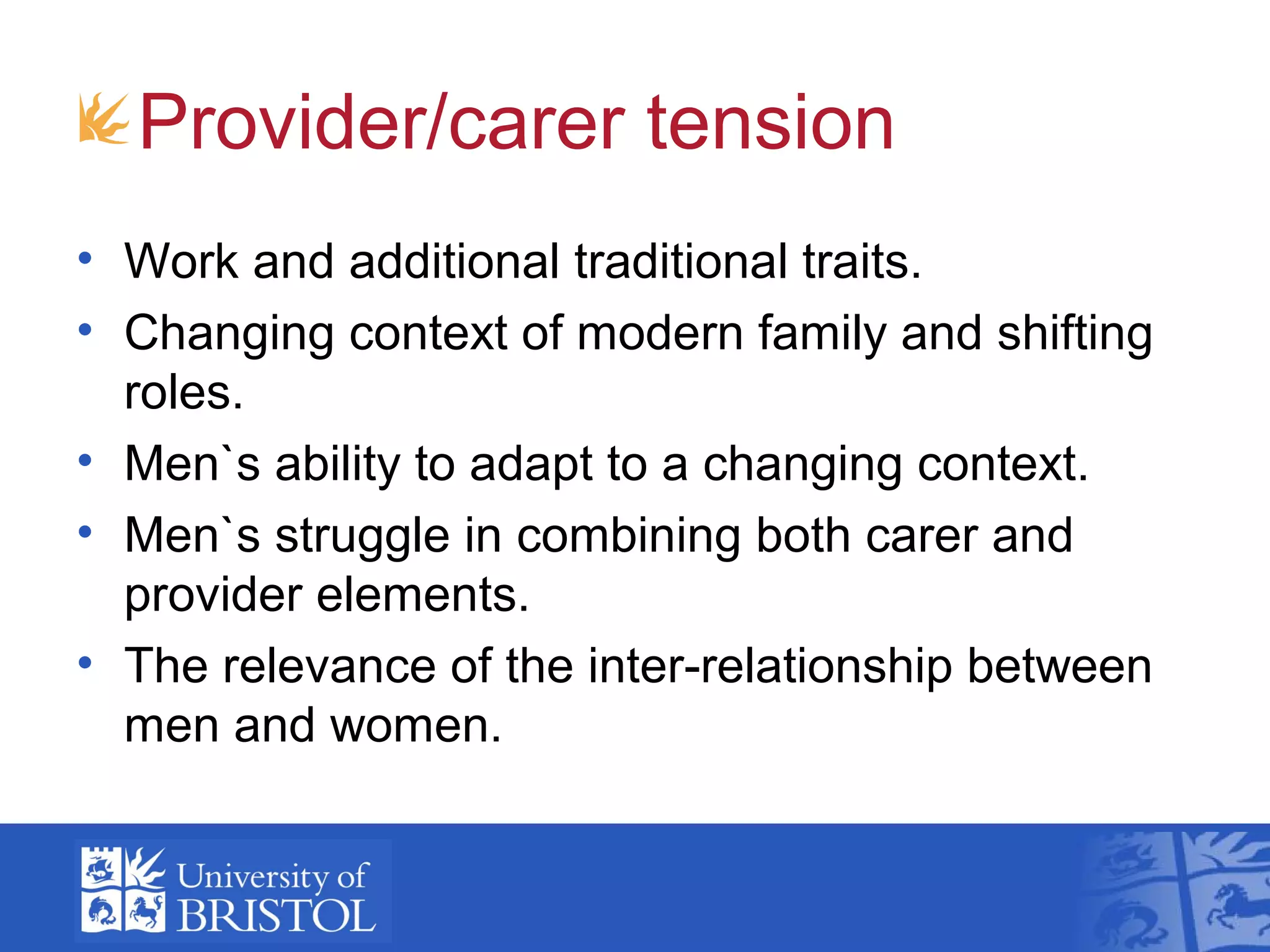
Provider/carer tension
• Work and additional traditional traits.
• Changing context of modern family and shifting
roles.
• Men`s ability to adapt to a changing context.
• Men`s struggle in combining both carer and
provider elements.
• The relevance of the inter-relationship between
men and women.
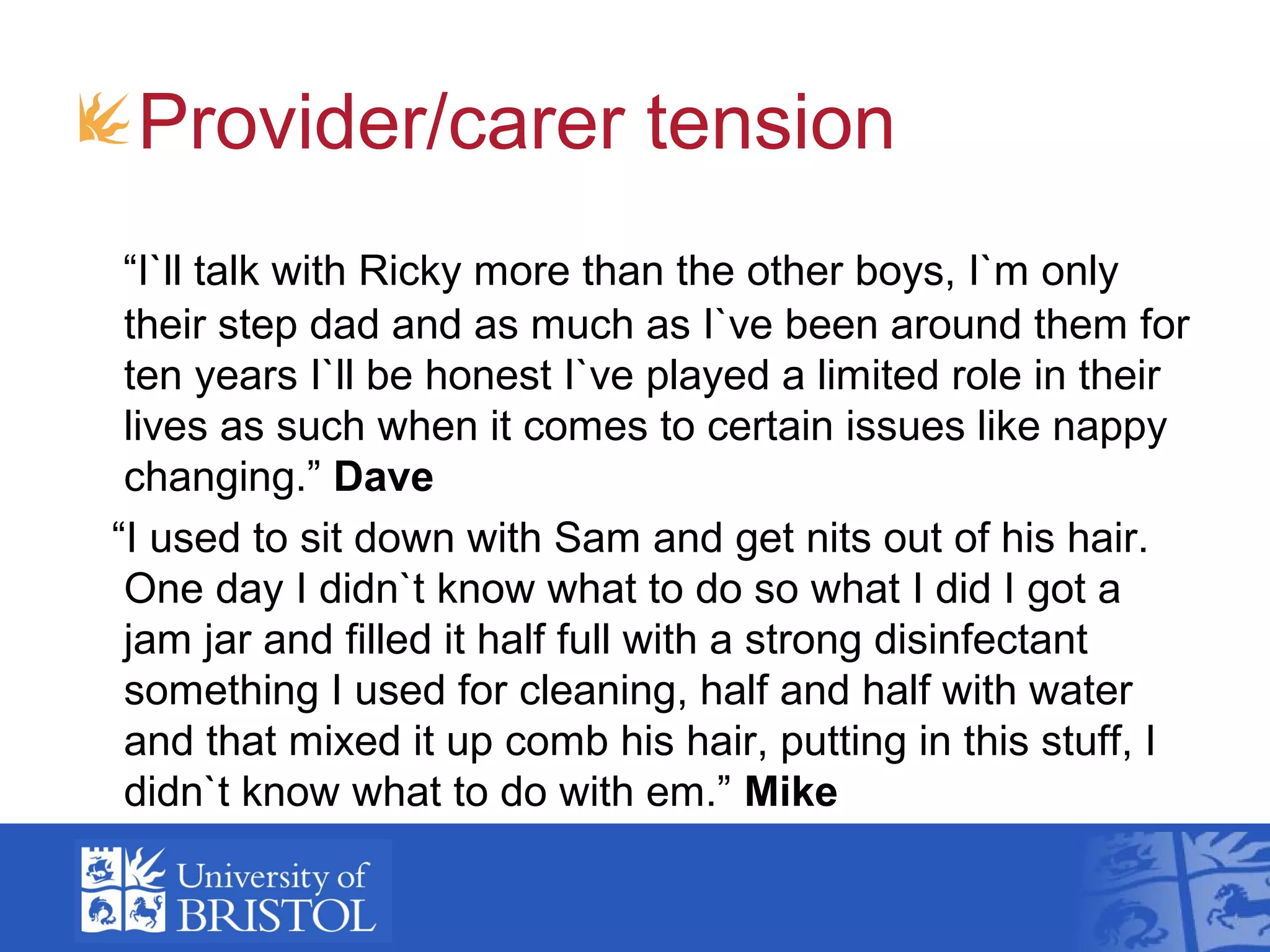
Provider/carer tension
“I`ll talk with Ricky more than the other boys, I`m only
their step dad and as much as I`ve been around them for
ten years I`ll be honest I`ve played a limited role in their
lives as such when it comes to certain issues like nappy
changing.” Dave
“I used to sit down with Sam and get nits out of his hair.
One day I didn`t know what to do so what I did I got a
jam jar and filled it half full with a strong disinfectant
something I used for cleaning, half and half with water
and that mixed it up comb his hair, putting in this stuff, I
didn`t know what to do with em.” Mike
Gendered assumption of
motherhood
• Hegemonic responsibility means holding
women to account.
• Men still have resistance to certain
aspects of femininity.
• Provides an insight into discussion of the
roles and benefits from their parenting.
• Lack of coherence and contradiction in
men`s narratives.
Gendered assumption of
motherhood
• “Well er, one of the main things is teaching
him to be a proper human being, because
his mother is just useless you know she`s
just totally absolutely useless at it. I mean
he swears, he comes to my house he
swears like a chap off a building site.”
Mike
Gendered assumption of
motherhood
“I want to take part in this, you know, cos it`s ..err.. It`s
different. But, on the flip side, of me being an aggressive
and angry person and stuff and on a domestic abuse
programme… ermmmm, there`s nothing for women out
there on the violent front. ‘Cos I`m not blaming anything
on Linda but, where as everything on this , sort of,
category of stuff, Linda gets spoke to about and I don`t
really. It`s the other way round on the violent side of stuff
you know, it`s all me and yous, ‘cos you`re a male.”
Dave
Risk and resource
• Practitioners and fathers see risk and
resource in different ways.
• Fathers explicit acknowledgement of risk.
• Reframing risky behaviours with what they
believed to be examples of resource.
• Subtlety of disclosure
Risk and resource
• “I was surprised actually how easy it was for them to say
alright we think there`s not a risk any more especially
when I`m debating in my head am I a child abuser or
not.” Dave
• “If you were to go around Balton and go into some
places and say do you know Mike, oh yeah Mike we
don`t mess with him I `ve got a reputation and that
reputation is nothing about me being violent, it`s always
when somebody`s been violent towards me.” Mike
Mike
• “The next door neighbour, she`s 10, she comes with me and we go places
and I treat her like my own daughter, and I think children should be treated
like that. They are children. They`re not mine or yours or someone elses.
They`re kids. Kids. And I love them, love them to death. They mean so
much.”
• “I said “she`s lovely, she`s only”, you know what I said every time she used
to go to her mother`s house… what`s that, her nana. Then she used to go to
come along to me first thing she said, “what we having for dinner, what we
got for tea?, I`m hungry.” Every time, and I used to cook all these lovely
meals for her, like, you know, owhh, I`m like a bloody pied piper with her
kids because they get nothing from her.”
• Sam was using my little finger like that to masturbate like that
(demonstrates). I didn`t say nothing and he went (gives a sigh), like that.
Evan Jake said, “ Sam what`s the matter with you ? Why you puffing or
something like that?”
Father social worker interface
• “It`s as if I`ve got no rights. They look at me as though
I`m a piece of dirt, basically. They think I`m scum, they
think I was, you know what I mean, basically they denied
me my parental rights you know, it`s wrong it`s wrong.”
Donny
• I mean if I`ve got to do this every six months to keep
them under child protection I`d rather do that. Because I
think they need to be looked at. She said well if we get
them off the child protection we`ll still follow up, but I
mean they don`t do enough now.” Mike
Conclusion
• The ever changing social construct of fatherhood acts as
a vehicle to support the transfer of hegemonic
masculinity.
• Complex gendered relations are at work informed by
men`s understanding of how to father, their response to
mothering which connect themselves to the construct of
risk and practitioners response to this.
• Social workers need to address gendered practices to
engage with men`s performance and to investigate
masculinities that present themselves in men`s lifestyle
choices, both as service users and male practitioners.
Conclusion
“I propose the development of an alliance
between father figures and practitioners. I
suggest that this should be framed around the
relevance of masculinities and femininities. This
will help support more effective understanding of
behaviour which will ultimately lead to the better
protection of children. It will additionally support
the quest for greater gender equality.”
Dugdale 2013

Leaky Masculinities: The Challenge of Practice with Risky Men

  • 1.
    Dr.Daryl Dugdale 2015 LeakyMasculinities: The Challenge of Practice with Risky Men
  • 2.
    “Desirable masculinity iscontext-dependant: there is tension between women`s different constructions of ideal masculinity across contexts; there is likely to be a strong contextual element in women`s “taking up” and “putting down” of different ideal masculinities; and different contextual masculinities may be arranged hierarchically in terms of status and desire.” (Talbot & Quayle, 2010, p258)
  • 3.
    Key Questions • Howmight men`s understanding of fatherhood influence their behaviours? • How might their sense of manliness or masculinity inform this understanding? • What changes can be proposed to increase the likelihood of fathers becoming involved in the social care process?
  • 4.
    Method • Multiple casestudy design (4 fathers). • Triangulation • Semi structured interviews • Observations core group meetings and case conferences • Focus group interviews • Use of case files • Longitudinal
  • 5.
    Four fathers • Nigel-36years old, significant custodial sentence, 6 years, unknown reason, but did have a history of drug use. 13 year old daughter who lives with ex partner, he has a baby with his new partner. • Dave-34 years old, history of domestic abuse (acknowledged), violence in the community alcohol and drug dependency. Two step children 11, & 13 and a birth son 4 years old. • Donny-36 years old, allegations of domestic abuse (denied) and emotional harm a consequence of estranged relationship. Three children 14, 11, 6. 14 year old living with him two youngest children living with their mother he has had no contact for over nine months. • Mike- 62 years old, allegations of domestic abuse (denied) concerns about his parenting, physical chastisement, also emotional harm as a consequence of relationship with partner breaking down. One birth son 6 years , also cares for his son`s eight year old half bother for whom he has no PR.
  • 6.
    • Provider/ Carertension. • Gendered assumption of motherhood. • Risk and resource. • Father/social worker interface. Key Themes
  • 7.
    Provider/carer tension • Workand additional traditional traits. • Changing context of modern family and shifting roles. • Men`s ability to adapt to a changing context. • Men`s struggle in combining both carer and provider elements. • The relevance of the inter-relationship between men and women.
  • 8.
    Provider/carer tension “I`ll talkwith Ricky more than the other boys, I`m only their step dad and as much as I`ve been around them for ten years I`ll be honest I`ve played a limited role in their lives as such when it comes to certain issues like nappy changing.” Dave “I used to sit down with Sam and get nits out of his hair. One day I didn`t know what to do so what I did I got a jam jar and filled it half full with a strong disinfectant something I used for cleaning, half and half with water and that mixed it up comb his hair, putting in this stuff, I didn`t know what to do with em.” Mike
  • 9.
    Gendered assumption of motherhood •Hegemonic responsibility means holding women to account. • Men still have resistance to certain aspects of femininity. • Provides an insight into discussion of the roles and benefits from their parenting. • Lack of coherence and contradiction in men`s narratives.
  • 10.
    Gendered assumption of motherhood •“Well er, one of the main things is teaching him to be a proper human being, because his mother is just useless you know she`s just totally absolutely useless at it. I mean he swears, he comes to my house he swears like a chap off a building site.” Mike
  • 11.
    Gendered assumption of motherhood “Iwant to take part in this, you know, cos it`s ..err.. It`s different. But, on the flip side, of me being an aggressive and angry person and stuff and on a domestic abuse programme… ermmmm, there`s nothing for women out there on the violent front. ‘Cos I`m not blaming anything on Linda but, where as everything on this , sort of, category of stuff, Linda gets spoke to about and I don`t really. It`s the other way round on the violent side of stuff you know, it`s all me and yous, ‘cos you`re a male.” Dave
  • 12.
    Risk and resource •Practitioners and fathers see risk and resource in different ways. • Fathers explicit acknowledgement of risk. • Reframing risky behaviours with what they believed to be examples of resource. • Subtlety of disclosure
  • 13.
    Risk and resource •“I was surprised actually how easy it was for them to say alright we think there`s not a risk any more especially when I`m debating in my head am I a child abuser or not.” Dave • “If you were to go around Balton and go into some places and say do you know Mike, oh yeah Mike we don`t mess with him I `ve got a reputation and that reputation is nothing about me being violent, it`s always when somebody`s been violent towards me.” Mike
  • 14.
    Mike • “The nextdoor neighbour, she`s 10, she comes with me and we go places and I treat her like my own daughter, and I think children should be treated like that. They are children. They`re not mine or yours or someone elses. They`re kids. Kids. And I love them, love them to death. They mean so much.” • “I said “she`s lovely, she`s only”, you know what I said every time she used to go to her mother`s house… what`s that, her nana. Then she used to go to come along to me first thing she said, “what we having for dinner, what we got for tea?, I`m hungry.” Every time, and I used to cook all these lovely meals for her, like, you know, owhh, I`m like a bloody pied piper with her kids because they get nothing from her.” • Sam was using my little finger like that to masturbate like that (demonstrates). I didn`t say nothing and he went (gives a sigh), like that. Evan Jake said, “ Sam what`s the matter with you ? Why you puffing or something like that?”
  • 15.
    Father social workerinterface • “It`s as if I`ve got no rights. They look at me as though I`m a piece of dirt, basically. They think I`m scum, they think I was, you know what I mean, basically they denied me my parental rights you know, it`s wrong it`s wrong.” Donny • I mean if I`ve got to do this every six months to keep them under child protection I`d rather do that. Because I think they need to be looked at. She said well if we get them off the child protection we`ll still follow up, but I mean they don`t do enough now.” Mike
  • 16.
    Conclusion • The everchanging social construct of fatherhood acts as a vehicle to support the transfer of hegemonic masculinity. • Complex gendered relations are at work informed by men`s understanding of how to father, their response to mothering which connect themselves to the construct of risk and practitioners response to this. • Social workers need to address gendered practices to engage with men`s performance and to investigate masculinities that present themselves in men`s lifestyle choices, both as service users and male practitioners.
  • 17.
    Conclusion “I propose thedevelopment of an alliance between father figures and practitioners. I suggest that this should be framed around the relevance of masculinities and femininities. This will help support more effective understanding of behaviour which will ultimately lead to the better protection of children. It will additionally support the quest for greater gender equality.” Dugdale 2013

Editor's Notes