Young People’s
Perspectives on
Recognising and Telling
about Abuse
and Neglect
Jeanette Cossar
University Of East Anglia, Norwich
Funded by the Office of the Children’s
Commissioner for England
Research team
Jeanette Cossar
Marian Brandon
Sue Bailey
Pippa Belderson
Laura Biggart University of East Anglia
Darren Sharpe Anglia Ruskin University
Anabel Acheampong
Aundre Boudier
Darrel Fritz-Campbell
Joshua Snape
Reece Thibou
Ben Thrower Young Researchers
Research Aims
• To examine young people’s perceptions of
abuse and neglect, and to explore their
experiences of telling and getting help
from both informal and formal sources
• To use this knowledge to make
suggestions for practice which would
improve access to support following abuse
Strands of the study
• A structured literature review about children’s and
young people’s recognition and disclosure of abuse.
• A content analysis of an online peer support site
where young people post and respond to problems
involving abuse and neglect (261 ‘threads’).
• An interview study with thirty vulnerable young people,
aged between 11 and 20.
• Six focus groups with children and young people,
parents and practitioners involved in working in different
tiers of services for young people.
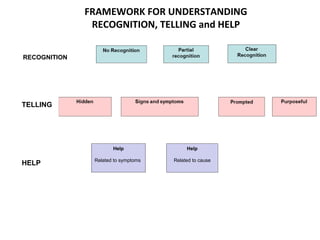
RECOGNITION TELLING HELP
RECOGNITION
TELLING
HELP
Help
 
Related to cause
Help
 
Related to symptoms
 
FRAMEWORK FOR UNDERSTANDING
RECOGNITION, TELLING and HELP
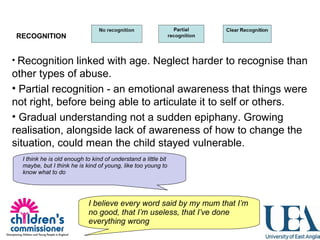
• Recognition linked with age. Neglect harder to recognise than 
other types of abuse.
• Partial recognition - an emotional awareness that things were 
not right, before being able to articulate it to self or others. 
• Gradual understanding not a sudden epiphany. Growing 
realisation, alongside lack of awareness of how to change the 
situation, could mean the child stayed vulnerable.
RECOGNITION
I think he is old enough to kind of understand a little bit
maybe, but I think he is kind of young, like too young to
know what to do
I believe every word said by my mum that I’m
no good, that I’m useless, that I’ve done
everything wrong
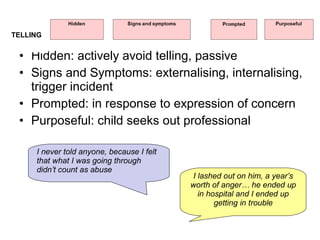
• Hidden: actively avoid telling, passive
• Signs and Symptoms: externalising, internalising, 
trigger incident
• Prompted: in response to expression of concern
• Purposeful: child seeks out professional
TELLING
I lashed out on him, a year’s
worth of anger… he ended up
in hospital and I ended up
getting in trouble
I never told anyone, because I felt
that what I was going through
didn’t count as abuse
Symptoms: 
•Often time limited, but could be helpful.
Cause: 
•Sometimes an immediate and effective helping response 
where issue was clear from the beginning.
•Sometimes underlying issues of abuse became gradually 
apparent through provision of holistic support services 
which allowed relationships to build over time.
HELP
Help
 
Related to cause
Help
 
Related to symptoms
 
I find it hard to open up about things like
that… but [the youth worker] learned me.
I could speak to her [teaching 
assistant] and not feel like she was
laughing at me.
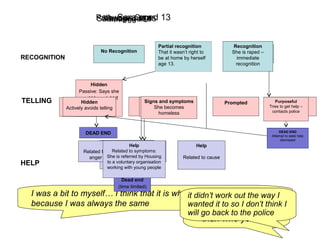
Sara aged 13
No Recognition Partial recognition Clear
Recognition
Hidden Trigger point
Signs and symptoms
Prompted Purposeful
RECOGNITION
TELLING
HELP
Help
Related to cause
Help
Related to symptoms
Partial recognition
That it wasn’t right to
be at home by herself
age 13.
Hidden
Passive: Says she
would have told if
she had been
asked.
DEAD END
I was a bit to myself… I think that it is why no one knew anything
because I was always the same
Signs and
symptoms
Violence
Help
Related to symptoms: school based
anger management sessions
Dead end
(time limited)
They focused more on
your school uniform
than who you are
Recognition
She is raped –
immediate
recognition
Hidden
Actively avoids telling
Purposeful
Tries to get help –
contacts police
 
DEAD END
Attempt to seek help
dismissed
it didn’t work out the way I
wanted it to so I don’t think I
will go back to the police
Signs and symptoms
She becomes
homeless
Help
Related to symptoms:
She is referred by Housing
to a voluntary organisation
working with young people
Sara, aged 15Sara, aged 17Sara, aged 19Pathways: Sara
Effectiveness
Trust
Duration
Closeness
Intervention Related to cause:
1. Police involvement re. DV
2. Police involvement re. sexual abuse
3. Involvement of further support
(teacher, counsellor, social worker)
Intervention
Related to
symptoms
 
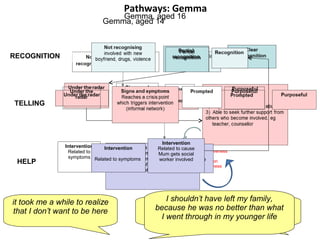
Gemma, aged 14
RECOGNITION
TELLING
HELP
Intervention
Related to cause
Intervention
Related to symptoms
Pathways: Gemma
Gemma, aged 16
 
Intervention
Related to cause
Mum gets social
worker involved
I was like, I have got to speak to
somebody because it was just killing me
it took me a while to realize
that I don’t want to be here
I shouldn’t have left my family,
because he was no better than what
I went through in my younger life
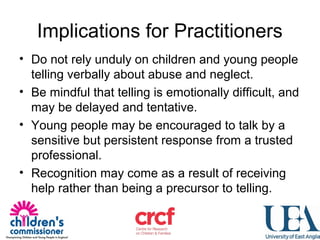
Implications for Practitioners
• Do not rely unduly on children and young people
telling verbally about abuse and neglect.
• Be mindful that telling is emotionally difficult, and
may be delayed and tentative.
• Young people may be encouraged to talk by a
sensitive but persistent response from a trusted
professional.
• Recognition may come as a result of receiving
help rather than being a precursor to telling.
Using the framework
• Helps professionals to consider that a young person who
comes to their attention because of their behaviour might be
experiencing underlying problems.
• Helps professionals to understand different types of telling
and highlights the importance of a professional’s response.
• Looking at pathways helps professionals to understand a
young person holistically, looking at their past experience both
of life in their family and of service provision.
• Draws attention to the needs of young people who may be
well known to services but who may still need help to
recognise and talk about what has happened to them.
 
jeanette.cossar@uea.ac.uk
 
https://www.uea.ac.uk/centre-research-
child-family
‘It takes a lot to build trust’. Recognition and 
Telling: Developing earlier routes to help for 
children and young people. 
Available at 
http://www.childrenscommissioner.gov.uk/co
ntent/publications/content_747

Young People's Perspectives on Recognising and Telling about Abuse and Neglect

Editor's Notes

  • #7 In literature, omission rather than commission, fewer posts on web, more querying is it neglect, other areas of the site were more focused on what they should do. Social comparisons important Confusion as to the boundaries between discipline and physical abuse; Confusion about the issue of physical coercion/consent in sexual abuse. Extreme self-reliance Difficulty acknowledging that a parent could be abusive. A parent’s unpredictability when abuse was episodic, and the relationship was sometimes good. Young person feeling they deserved it.
  • #8 An emotional barrier: shame, embarrassment, not being able to face telling, finding it hard to find/say the words. Worry about family knowing, the impact on family members, loyalty to family. Thinking their situation was not problematic enough to disclose to others. Threats from the abuser. Fear of not being believed if they were to tell.
  • #9 Importance of trust which was promoted by: the duration of the relationship being believed not being judged knowledge, expertise and effectiveness services that were accessible