A friend in need - Young
people’s views of peer
support about issues of
abuse and neglect.
Jeanette Cossar
University Of East Anglia, Norwich
Funded by the Office of the Children’s
Commissioner for England
Research team
Jeanette Cossar
Marian Brandon
Sue Bailey
Pippa Belderson
Laura Biggart University of East Anglia
Darren Sharpe Anglia Ruskin University
Anabel Acheampong
Aundre Boudier
Darrel Fritz-Campbell
Joshua Snape
Reece Thibou
Ben Thrower Young Researchers
Research Aims
• To examine young people’s perceptions of
abuse and neglect, and to explore their
experiences of telling and getting help
from both informal and formal sources
• To use this knowledge to make
suggestions for practice which would
improve access to support following abuse
Strands of the study
• A structured literature review about children’s and
young people’s recognition and disclosure of abuse.
• A content analysis of an online peer support site
where young people post and respond to problems
involving abuse and neglect (261 ‘threads’).
• An interview study with thirty vulnerable young people,
aged between 11 and 20.
• Six focus groups with children and young people,
parents and practitioners involved in working in different
tiers of services for young people.
RECOGNITION TELLING HELP
Who do young people tell?
• Confidante varies with age: young children more likely to disclose to a
parent, adolescents to friends or other family members (Roesler 1994).
• In adolescence disclosures more likely to be to a friend (Smith et al 2000,
Jackson, 2002, Kogan 2004, Priebe et al, 2008).
• Vincent and Daniel (2004) in an analysis of calls to ChildLine Scotland,
found that of those who had talked to someone prior to phoning ChildLine
were twice as likely to have spoken to a friend than a parent. Only 9%
had spoken to a professional.
• Studies suggest young people are more likely to speak to friends or
family than professionals (Palmer et al 1999, Baron et al, 2010)
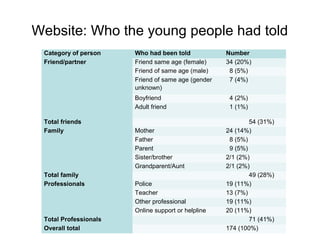
Website: Who the young people had told
Category of person Who had been told Number
Friend/partner Friend same age (female) 34 (20%)
Friend of same age (male) 8 (5%)
Friend of same age (gender
unknown)
7 (4%)
Boyfriend 4 (2%)
Adult friend 1 (1%)
Total friends 54 (31%)
Family Mother 24 (14%)
Father 8 (5%)
Parent 9 (5%)
Sister/brother 2/1 (2%)
Grandparent/Aunt 2/1 (2%)
Total family 49 (28%)
Professionals Police 19 (11%)
Teacher 13 (7%)
Other professional 19 (11%)
Online support or helpline 20 (11%)
Total Professionals 71 (41%)
Overall total 174 (100%)
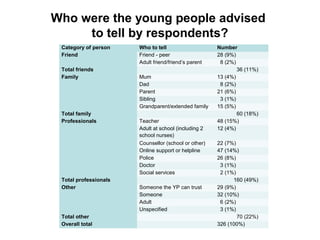
Who were the young people advised
to tell by respondents?
Category of person Who to tell Number
Friend Friend - peer 28 (9%)
Adult friend/friend’s parent 8 (2%)
Total friends 36 (11%)
Family Mum 13 (4%)
Dad 8 (2%)
Parent 21 (6%)
Sibling 3 (1%)
Grandparent/extended family 15 (5%)
Total family 60 (18%)
Professionals Teacher 48 (15%)
Adult at school (including 2
school nurses)
12 (4%)
Counsellor (school or other) 22 (7%)
Online support or helpline 47 (14%)
Police 26 (8%)
Doctor 3 (1%)
Social services 2 (1%)
Total professionals 160 (49%)
Other Someone the YP can trust 29 (9%)
Someone 32 (10%)
Adult 6 (2%)
Unspecified 3 (1%)
Total other 70 (22%)
Overall total 326 (100%)
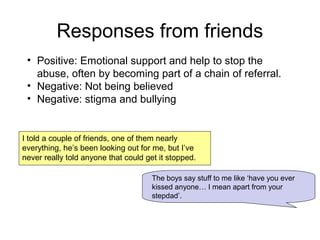
Responses from friends
I told a couple of friends, one of them nearly
everything, he’s been looking out for me, but I’ve
never really told anyone that could get it stopped.
The boys say stuff to me like ‘have you ever
kissed anyone… I mean apart from your
stepdad’.
• Positive: Emotional support and help to stop the
abuse, often by becoming part of a chain of referral.
• Negative: Not being believed
• Negative: stigma and bullying
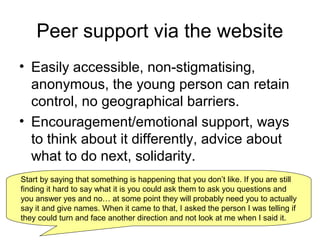
Peer support via the website
• Easily accessible, non-stigmatising,
anonymous, the young person can retain
control, no geographical barriers.
• Encouragement/emotional support, ways
to think about it differently, advice about
what to do next, solidarity.
Start by saying that something is happening that you don’t like. If you are still
finding it hard to say what it is you could ask them to ask you questions and
you answer yes and no… at some point they will probably need you to actually
say it and give names. When it came to that, I asked the person I was telling if
they could turn and face another direction and not look at me when I said it.
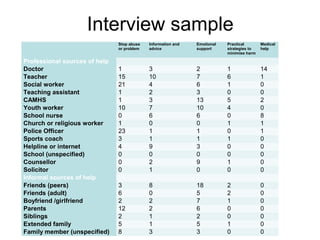
Interview sample
  Stop abuse 
or problem
Information and 
advice
Emotional 
support
Practical 
strategies to 
minimise harm
Medical 
help
Professional sources of help
Doctor 1 3 2 1 14
Teacher 15 10 7 6 1
Social worker 21 4 6 1 0
Teaching assistant 1 2 3 0 0
CAMHS 1 3 13 5 2
Youth worker 10 7 10 4 0
School nurse 0 6 6 0 8
Church or religious worker 1 0 0 1 1
Police Officer 23 1 1 0 1
Sports coach 3 1 1 1 0
Helpline or internet 4 9 3 0 0
School (unspecified) 0 0 0 0 0
Counsellor 0 2 9 1 0
Solicitor 0 1 0 0 0
Informal sources of help
Friends (peers) 3 8 18 2 0
Friends (adult) 6 0 5 2 0
Boyfriend /girlfriend 2 2 7 1 0
Parents 12 2 6 0 0
Siblings 2 1 2 0 0
Extended family 5 1 5 1 0
Family member (unspecified) 8 3 3 0 0
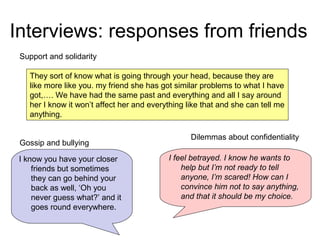
Interviews: responses from friends
They sort of know what is going through your head, because they are
like more like you. my friend she has got similar problems to what I have
got,…. We have had the same past and everything and all I say around
her I know it won’t affect her and everything like that and she can tell me
anything.
I know you have your closer
friends but sometimes
they can go behind your
back as well, ‘Oh you
never guess what?’ and it
goes round everywhere.
Support and solidarity
Gossip and bullying
I feel betrayed. I know he wants to
help but I’m not ready to tell
anyone, I’m scared! How can I
convince him not to say anything,
and that it should be my choice.
Dilemmas about confidentiality
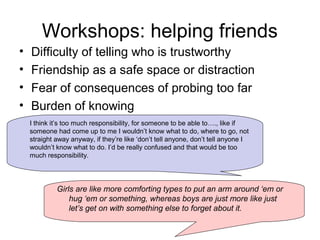
Workshops: helping friends
• Difficulty of telling who is trustworthy
• Friendship as a safe space or distraction
• Fear of consequences of probing too far
• Burden of knowing
I think it’s too much responsibility, for someone to be able to…., like if
someone had come up to me I wouldn’t know what to do, where to go, not
straight away anyway, if they’re like ‘don’t tell anyone, don’t tell anyone I
wouldn’t know what to do. I’d be really confused and that would be too
much responsibility.
Girls are like more comforting types to put an arm around ‘em or
hug ‘em or something, whereas boys are just more like just
let’s get on with something else to forget about it.
Conclusions
• Young people do turn to their friends for support with
abuse and neglect. They also value professionals.
• Young people are also wary about turning to friends,
fearing gossip and not being believed.
• Young people make a distinction between emotional
support and stopping the abuse. They see adults as
having the power stop the abuse.
• Knowing about abuse is a big responsibility for friends.
Implications for practice
• Include discussion about abuse and neglect in the school
and college curriculum.
• Provide clear information for children and young people
about where they can get help if they think they are
being abused.
• Provide information about how young people can
support friends and how to manage the dilemmas that
might arise for them if they are worried about a friend.
jeanette.cossar@uea.ac.uk
https://www.uea.ac.uk/centre-research-child-fam
‘It takes a lot to build trust’. Recognition and
Telling: Developing earlier routes to help for
children and young people.
Available at http://www.childrenscommissioner.g

A friend in need - Young people's views of peer support about issues of abuse and neglect

  • 1.
    A friend inneed - Young people’s views of peer support about issues of abuse and neglect. Jeanette Cossar University Of East Anglia, Norwich Funded by the Office of the Children’s Commissioner for England
  • 2.
    Research team Jeanette Cossar MarianBrandon Sue Bailey Pippa Belderson Laura Biggart University of East Anglia Darren Sharpe Anglia Ruskin University Anabel Acheampong Aundre Boudier Darrel Fritz-Campbell Joshua Snape Reece Thibou Ben Thrower Young Researchers
  • 3.
    Research Aims • Toexamine young people’s perceptions of abuse and neglect, and to explore their experiences of telling and getting help from both informal and formal sources • To use this knowledge to make suggestions for practice which would improve access to support following abuse
  • 4.
    Strands of thestudy • A structured literature review about children’s and young people’s recognition and disclosure of abuse. • A content analysis of an online peer support site where young people post and respond to problems involving abuse and neglect (261 ‘threads’). • An interview study with thirty vulnerable young people, aged between 11 and 20. • Six focus groups with children and young people, parents and practitioners involved in working in different tiers of services for young people. RECOGNITION TELLING HELP
  • 5.
    Who do youngpeople tell? • Confidante varies with age: young children more likely to disclose to a parent, adolescents to friends or other family members (Roesler 1994). • In adolescence disclosures more likely to be to a friend (Smith et al 2000, Jackson, 2002, Kogan 2004, Priebe et al, 2008). • Vincent and Daniel (2004) in an analysis of calls to ChildLine Scotland, found that of those who had talked to someone prior to phoning ChildLine were twice as likely to have spoken to a friend than a parent. Only 9% had spoken to a professional. • Studies suggest young people are more likely to speak to friends or family than professionals (Palmer et al 1999, Baron et al, 2010)
  • 6.
    Website: Who theyoung people had told Category of person Who had been told Number Friend/partner Friend same age (female) 34 (20%) Friend of same age (male) 8 (5%) Friend of same age (gender unknown) 7 (4%) Boyfriend 4 (2%) Adult friend 1 (1%) Total friends 54 (31%) Family Mother 24 (14%) Father 8 (5%) Parent 9 (5%) Sister/brother 2/1 (2%) Grandparent/Aunt 2/1 (2%) Total family 49 (28%) Professionals Police 19 (11%) Teacher 13 (7%) Other professional 19 (11%) Online support or helpline 20 (11%) Total Professionals 71 (41%) Overall total 174 (100%)
  • 7.
    Who were theyoung people advised to tell by respondents? Category of person Who to tell Number Friend Friend - peer 28 (9%) Adult friend/friend’s parent 8 (2%) Total friends 36 (11%) Family Mum 13 (4%) Dad 8 (2%) Parent 21 (6%) Sibling 3 (1%) Grandparent/extended family 15 (5%) Total family 60 (18%) Professionals Teacher 48 (15%) Adult at school (including 2 school nurses) 12 (4%) Counsellor (school or other) 22 (7%) Online support or helpline 47 (14%) Police 26 (8%) Doctor 3 (1%) Social services 2 (1%) Total professionals 160 (49%) Other Someone the YP can trust 29 (9%) Someone 32 (10%) Adult 6 (2%) Unspecified 3 (1%) Total other 70 (22%) Overall total 326 (100%)
  • 8.
    Responses from friends Itold a couple of friends, one of them nearly everything, he’s been looking out for me, but I’ve never really told anyone that could get it stopped. The boys say stuff to me like ‘have you ever kissed anyone… I mean apart from your stepdad’. • Positive: Emotional support and help to stop the abuse, often by becoming part of a chain of referral. • Negative: Not being believed • Negative: stigma and bullying
  • 9.
    Peer support viathe website • Easily accessible, non-stigmatising, anonymous, the young person can retain control, no geographical barriers. • Encouragement/emotional support, ways to think about it differently, advice about what to do next, solidarity. Start by saying that something is happening that you don’t like. If you are still finding it hard to say what it is you could ask them to ask you questions and you answer yes and no… at some point they will probably need you to actually say it and give names. When it came to that, I asked the person I was telling if they could turn and face another direction and not look at me when I said it.
  • 10.
    Interview sample   Stop abuse  or problem Information and  advice Emotional  support Practical  strategies to  minimise harm Medical  help Professional sources of help Doctor1 3 2 1 14 Teacher 15 10 7 6 1 Social worker 21 4 6 1 0 Teaching assistant 1 2 3 0 0 CAMHS 1 3 13 5 2 Youth worker 10 7 10 4 0 School nurse 0 6 6 0 8 Church or religious worker 1 0 0 1 1 Police Officer 23 1 1 0 1 Sports coach 3 1 1 1 0 Helpline or internet 4 9 3 0 0 School (unspecified) 0 0 0 0 0 Counsellor 0 2 9 1 0 Solicitor 0 1 0 0 0 Informal sources of help Friends (peers) 3 8 18 2 0 Friends (adult) 6 0 5 2 0 Boyfriend /girlfriend 2 2 7 1 0 Parents 12 2 6 0 0 Siblings 2 1 2 0 0 Extended family 5 1 5 1 0 Family member (unspecified) 8 3 3 0 0
  • 11.
    Interviews: responses fromfriends They sort of know what is going through your head, because they are like more like you. my friend she has got similar problems to what I have got,…. We have had the same past and everything and all I say around her I know it won’t affect her and everything like that and she can tell me anything. I know you have your closer friends but sometimes they can go behind your back as well, ‘Oh you never guess what?’ and it goes round everywhere. Support and solidarity Gossip and bullying I feel betrayed. I know he wants to help but I’m not ready to tell anyone, I’m scared! How can I convince him not to say anything, and that it should be my choice. Dilemmas about confidentiality
  • 12.
    Workshops: helping friends •Difficulty of telling who is trustworthy • Friendship as a safe space or distraction • Fear of consequences of probing too far • Burden of knowing I think it’s too much responsibility, for someone to be able to…., like if someone had come up to me I wouldn’t know what to do, where to go, not straight away anyway, if they’re like ‘don’t tell anyone, don’t tell anyone I wouldn’t know what to do. I’d be really confused and that would be too much responsibility. Girls are like more comforting types to put an arm around ‘em or hug ‘em or something, whereas boys are just more like just let’s get on with something else to forget about it.
  • 13.
    Conclusions • Young peopledo turn to their friends for support with abuse and neglect. They also value professionals. • Young people are also wary about turning to friends, fearing gossip and not being believed. • Young people make a distinction between emotional support and stopping the abuse. They see adults as having the power stop the abuse. • Knowing about abuse is a big responsibility for friends.
  • 14.
    Implications for practice •Include discussion about abuse and neglect in the school and college curriculum. • Provide clear information for children and young people about where they can get help if they think they are being abused. • Provide information about how young people can support friends and how to manage the dilemmas that might arise for them if they are worried about a friend.
  • 15.
    jeanette.cossar@uea.ac.uk https://www.uea.ac.uk/centre-research-child-fam ‘It takes alot to build trust’. Recognition and Telling: Developing earlier routes to help for children and young people. Available at http://www.childrenscommissioner.g

Editor's Notes

  • #6 Child-related: lack of recognition, emotional barriers, fear of consequences Relational: family dysfunction, fear of consequences Social: labelling and stigma, taboos around sexuality, cultural norms, lack of services (Collin-Vezina 2013)
  • #8 no significant difference according to whehter it was intrafamilial vs extrafamilial abuse in terms of whom it was recommended to tell.
  • #9 – in 25 posts where not being believed was cited as a consequence of telling, 21 of these were friends and family. 12 involved a family member, 9 involved friends.