Care for young carers
Wisdom
Young Carers
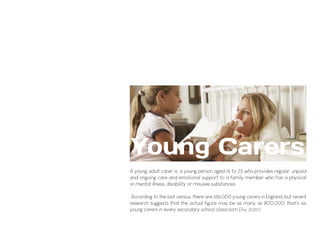
A young adult carer is: a young person aged 16 to 25 who provides regular, unpaid
and ongoing care and emotional support to a family member who has a physical
or mental illness, disability or misuses substances.
According to the last census, there are 166,000 young carers in England, but recent
research suggests that the actual figure may be as many as 800,000, that's six
young carers in every secondary school classroom (Fry, 2020).
(Childrenssociety.org.uk, 2018)
More than a third of young carers in the UK have experienced problems with their mental wellbeing, according to new research (Giordano,
2020). Caring for someone can be a huge self-sacrifice and a huge challenge for young carers. They are still in the process of learning and
maturing. They must mature a lot faster and tend to miss out on a lot of typical childhood experiences. They often feel alone and isolated.
They often can find juggling home life with school, collage or a job much harder than their peers. They are also more likely to face strains
such as family break ups, bereavements, and lack of income. No child should have to experience these issues but in UK's current state, the
support needed cannot be provided to replace these young carers with substantial professional care.
The needs of young carers, regarding mental health, are largely invisible within national and local policies. This is despite the fact that Young
carers frequently report that their caring role can cause distress and impact on their mental health (Carers.org, 2016).
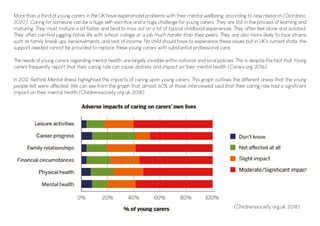
In 2012, Rethink Mental illness highlighted the impacts of caring upon young carers. This graph outlines the different areas that the young
people felt were affected. We can see from the graph that almost 60% of those interviewed said that their caring role had a significant
impact on their mental health (Childrenssociety.org.uk, 2018).
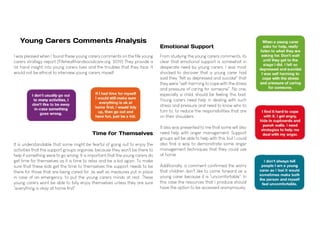
From studying the young carers comments, its
clear that emotional support is somewhat in
desperate need by young carers. I was most
shocked to discover that a young carer had
said they "felt so depressed and suicidal" that
they were "self-harming to cope with the stress
and pressure of caring for someone". No one,
especially a child, should be feeling this bad.
Young carers need help in dealing with such
stress and pressure and need to know who to
turn to, to reduce the responsibilities that are
on their shoulders.
It also was presented to me that some will also
need help with anger management. Support
groups will be able to help with this, but I could
also find a way to demonstrate some anger
management techniques that they could use
at home.
Additionally, a comment confirmed the worry
that children don't like to come forward as a
young carer because it is "uncomfortable". In
this case the resources that I produce should
have the option to be accessed anonymously.
Emotional Support
I was pleased when I found these young carers comments on the fife young
carers strategy report (Fifehealthandsocialcare.org. 2019) They provide a
1st hand insight into young carers lives and the troubles that they face. It
would not be ethical to interview young carers myself.
It is understandable that some might be fearful of going out to enjoy the
activities that the support groups organise, because they won't be there to
help if something were to go wrong. It is important that the young carers do
get time for themselves as it is time to relax and be a kid again. To make
sure that these kids get the time to themselves the support needs to be
there for those that are being cared for, as well as measures put in place
in case of an emergency, to put the young carers minds at rest. These
young carers wont be able to fully enjoy themselves unless they are sure
"everything is okay at home first".
Young Carers Comments Analysis
Time for Themselves
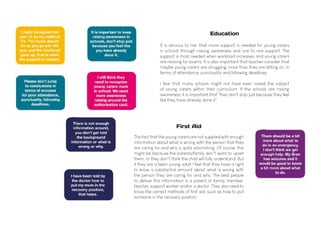
It is obvious to me, that more support is needed for young carers
in schools through raising awareness and one to one support. The
support is most needed when workload increases, and young carers
are revising for exams. It is also important that teacher consider that
maybe young carers are struggling more than they are letting on, in
terms of attendance, punctuality and following deadlines.
I fear that many schools might not have even raised the subject
of young carers within their curriculum. If the schools are raising
awareness, it is important that "they don't stop just because they feel
like they have already done it".
Education
The fact that the young carers are not supplied with enough
information about what is wrong with the person that they
are caring for and why is quite astonishing. Of course, this
might be because the parents/family don"t want to upset
them, or they don"t think the child will fully understand. But
if they are a teen/ young adult I feel that they have a right
to know a substantial amount about what is wrong with
the person they are caring for and why. The best people
to deliver this information is a parent or family member,
teacher, support worker and/or a doctor. They also need to
know the correct methods of first aid, such as how to put
someone in the recovery position.
First Aid
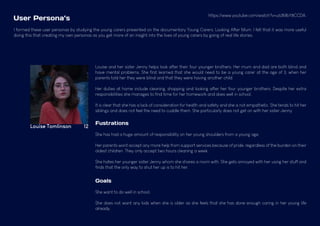
Louise Tomlinson 12
Louise and her sister Jenny helps look after their four younger brothers. Her mum and dad are both blind and
have mental problems. She first learned that she would need to be a young carer at the age of 3, when her
parents told her they were blind and that they were having another child.
Her duties at home include cleaning, shopping and looking after her four younger brothers. Despite her extra
responsibilities she manages to find time for her homework and does well in school.
It is clear that she has a lack of consideration for health and safety and she is not empathetic. She tends to hit her
siblings and does not feel the need to cuddle them. She particularly does not get on with her sister Jenny.
Fustrations
She has had a huge amount of responsibility on her young shoulders from a young age.
Her parents wont accept any more help from support services because of pride, regardless of the burden on their
oldest children. They only accept two hours cleaning a week.
She hates her younger sister Jenny whom she shares a room with. She gets annoyed with her using her stuff and
finds that the only way to shut her up is to hit her.
Goals
She want to do well in school.
She does not want any kids when she is older as she feels that she has done enough caring in her young life
already.
I formed these user personas by studying the young carers presented on the documentary Young Carers: Looking After Mum. I felt that it was more useful
doing this that creating my own personas as you get more of an insight into the lives of young carers by going of real life stories.
User Persona’s
https://www.youtube.com/watch?v=u63MbY8CCDA.
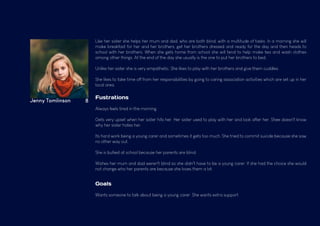
Jenny Tomlinson 8
Like her sister she helps her mum and dad, who are both blind, with a multitude of tasks. In a morning she will
make breakfast for her and her brothers, get her brothers dressed and ready for the day and then heads to
school with her brothers. When she gets home from school she will tend to help make tea and wash clothes
among other things. At the end of the day she usually is the one to put her brothers to bed.
Unlike her sister she is very empathetic. She likes to play with her brothers and give them cuddles.
She likes to take time off from her responsibilities by going to caring association activities which are set up in her
local area.
Fustrations
Always feels tired in the morning.
Gets very upset when her sister hits her. Her sister used to play with her and look after her. Shee doesn't know
why her sister hates her.
Its hard work being a young carer and sometimes it gets too much. She tried to commit suicide because she saw
no other way out.
She is bullied at school because her parents are blind.
Wishes her mum and dad weren't blind so she didn't have to be a young carer. If she had the choice she would
not change who her parents are because she loves them a lot.
Goals
Wants someone to talk about being a young carer. She wants extra support.
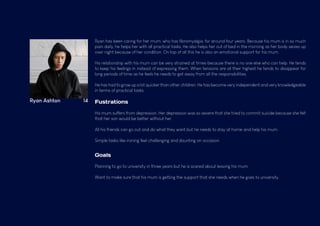
Ryan Ashton 14
Ryan has been caring for her mum, who has fibromyalgia, for around four years. Because his mum is in so much
pain daily, he helps her with all practical tasks. He also helps her out of bed in the morning as her body seizes up
over night because of her condition. On top of all this he is also an emotional support for his mum.
His relationship with his mum can be very strained at times because there is no one else who can help. He tends
to keep his feelings in instead of expressing them. When tensions are at their highest he tends to disappear for
long periods of time as he feels he needs to get away from all the responsibilities.
He has had to grow up a lot quicker than other children. He has become very independent and very knowledgeable
in terms of practical tasks.
Fustrations
His mum suffers from depression. Her depression was so severe that she tried to commit suicide because she felt
that her son would be better without her.
All his friends can go out and do what they want but he needs to stay at home and help his mum.
Simple tasks like ironing feel challenging and daunting on occasion.
Goals
Planning to go to university in three years but he is scared about leaving his mum.
Want to make sure that his mum is getting the support that she needs when he goes to university.
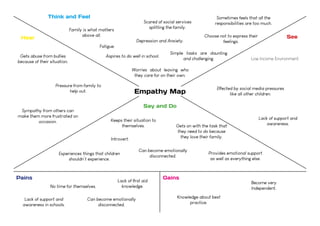
Empathy Map
Think and Feel
SeeHear
Say and Do
Scared of social services
splitting the family.
Family is what matters
above all.
Aspires to do well in school.
Fatigue.
Worries about leaving who
they care for on their own.
Depression and Anxiety.
Simple tasks are daunting
and challenging.
Sometimes feels that all the
responsibilities are too much.
Choose not to express their
feelings.
Gets abuse from bullies
because of their situation.
Pressure from family to
help out.
Sympathy from others can
make them more frustrated on
occasion.
Low Income Environment.
Effected by social media pressures
like all other children.
Lack of support and
awareness.
Keeps their situation to
themselves.
Experiences things that children
shouldn’t experience.
Introvert.
Gets on with the task that
they need to do because
they love their family.
Can become emotionally
disconnected.
Provides emotional support
as well as everything else.
Pains Gains
Lack of support and
awareness in schools.
No time for themselves.
Can become emotionally
disconnected.
Lack of first aid
knowledge.
Knowledge about best
practice.
Become very
Independent.
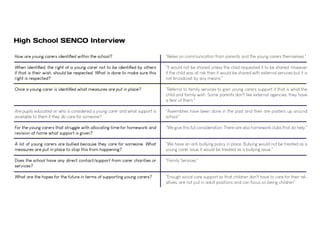
High School SENCO Interview
How are young carers identified within the school?
When identified, the right of a young carer not to be identified by others
if that is their wish, should be respected. What is done to make sure this
right is respected?
Once a young carer is identified what measures are put in place?
Are pupils educated on who is considered a young carer and what support is
available to them if they do care for someone?
For the young carers that struggle with allocating time for homework and
revision at home what support is given?
A lot of young carers are bullied because they care for someone. What
measures are put in place to stop this from happening?
Does the school have any direct contact/support from carer charities or
services?
What are the hopes for the future in terms of supporting young carers?
"Relies on communication from parents and the young carers themselves."
"It would not be shared unless the child requested it to be shared. However
if the child was at risk then it would be shared with external services but it is
not broadcast by any means."
"Referral to family services to gain young carers support if that is what the
child and family wish. Some parents don't like external agencies, they have
a fear of them."
"Assemblies have been done in the past and their are posters up around
school."
"We give this full consideration. There are also homework clubs that do help."
"We have an anti bullying policy in place. Bullying would not be treated as a
young carer issue it would be treated as a bullying issue."
"Family Services."
"Enough social care support so that children don't have to care for their rel-
atives, are not put in adult positions and can focus on being children".
After going through the question that I had prepared earlier, I ended up having
a long conversation with the SENCO which I let her lead. She told me so much
information that was very valid.
She started of by saying that the main reasoning for children not getting the
support that they desperately need is because of lack of funds. "It boils down
to money". No money equals a lack of services within the community, a lack of
facilities and of support workers. "In the past 3-4 years the amount of support
has been poor". It was bad before but now it is non existent.
As awful as it sounds, young carers are not a priority. Drug and alcohol abuse,
exploitation and other high risk issues get the most attention. And even then, it is
those that "shout the loudest" that are at the front of the que.
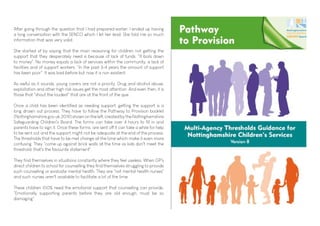
Once a child has been identified as needing support, getting the support is a
long drawn out process. They have to follow the Pathway to Provision booklet
(Nottinghamshire.gov.uk, 2019) shown on the left, created by the Nottinghamshire
Safeguarding Children's Board. The forms can take over 4 hours to fill in and
parents have to sign it. Once these forms are sent off it can take a while for help
to be sent out and the support might not be adequate at the end of the process.
The thresholds that have to be met change all the time which make it even more
confusing. They "come up against brick walls all the time as kids don't meet the
threshold, that's the favourite statement".
They find themselves in situations constantly where they feel useless. When GP's
direct children to school for counselling they find themselves struggling to provide
such counselling or evaluate mental health. They are "not mental health nurses"
and such nurses aren't available to facilitate a lot of the time.
These children 100% need the emotional support that counselling can provide.
"Emotionally supporting parents before they are old enough, must be so
damaging".
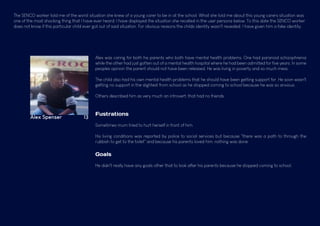
Alex Spenser 13
Alex was caring for both his parents who both have mental health problems. One had paranoid schizophrenia
while the other had just gotten out of a mental health hospital where he had been admitted for five years. In some
peoples opinion the parent should not have been released. He was living in poverty and so much mess.
The child also had his own mental health problems that he should have been getting support for. He soon wasn't
getting no support in the slightest from school as he stopped coming to school because he was so anxious.
Others described him as very much an introvert, that had no friends
Fustrations
Sometimes mum tried to hurt herself in front of him.
His living conditions was reported by police to social services but because "there was a path to through the
rubbish to get to the toilet" and because his parents loved him, nothing was done.
Goals
He didn't really have any goals other that to look after his parents because he stopped coming to school.
The SENCO worker told me of the worst situation she knew of a young carer to be in at the school. What she told me about this young carers situation was
one of the most shocking thing that I have ever heard. I have displayed the situation she recalled in the user persona below. To this date the SENCO worker
does not know if this particular child ever got out of said situation. For obvious reasons the childs identity wasn't revealed. I have given him a fake identity.
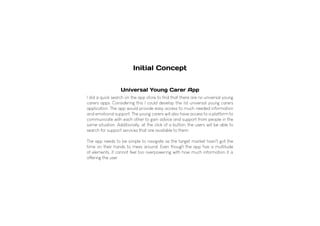
I did a quick search on the app store to find that there are no universal young
carers apps. Considering this I could develop the 1st universal young carers
application. The app would provide easy access to much needed information
and emotional support. The young carers will also have access to a platform to
communicate with each other to gain advice and support from people in the
same situation. Additionally, at the click of a button, the users will be able to
search for support services that are available to them.
The app needs to be simple to navigate as the target market hasn't got the
time on their hands to mess around. Even though the app has a multitude
of elements, it cannot feel too overpowering with how much information it is
offering the user.
Universal Young Carer App
Initial Concept
Young Carers Applications Analysis
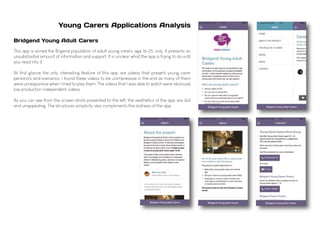
Bridgend Young Adult Carers
This app is aimed the Brigend population of adult young carers, age 16-25, only. It presents an
unsubstantial amount of information and support. It is unclear what the app is trying to do until
you read into it.
At first glance the only interesting feature of this app are videos that present young carer
persona's and scenarios. I found these videos to be unimpressive in the end as many of them
were unresponsive when I tried to play them. The videos that I was able to watch were obviously
low production independent videos.
As you can see from the screen-shots presented to the left, the aesthetics of the app are dull
and unappealing. The structures simplicity also compliments the dullness of the app.
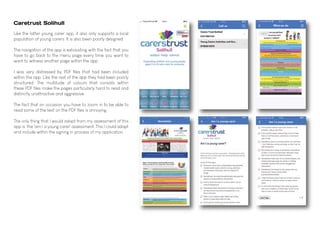
Caretrust Solihull
Like the latter young carer app, it also only supports a local
population of young carers. It is also been poorly designed.
The navigation of the app is exhausting with the fact that you
have to go back to the menu page every time you want to
want to witness another page within the app.
I was very distressed by PDF files that had been included
within the app. Like the rest of the app they had been poorly
structured. The multitude of colours that consists within
these PDF files make the pages particularly hard to read and
distinctly unattractive and aggressive.
The fact that on occasion you have to zoom in to be able to
read some of the text on the PDF files is annoying.
The only thing that I would adopt from my assessment of this
app is the 'am I a young carer' assessment. This I could adapt
and include within the signing in process of my application.
Care Assistant Applications Analysis
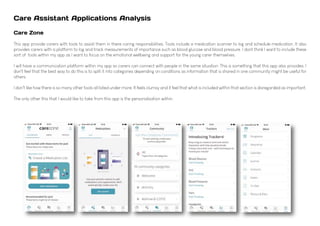
Care Zone
This app provide carers with tools to assist them in there caring responsibilities. Tools include a medication scanner to log and schedule medication. It also
provides carers with a platform to log and track measurements of importance such as blood glucose and blood pressure. I dont think I want to include these
sort of tools within my app as I want to focus on the emotional wellbeing and support for the young carer themselves.
I will have a communication platform within my app so carers can connect with people in the same situation. This is something that this app also provides, I
don't feel that the best way to do this is to split it into categories depending on conditions as information that is shared in one community might be useful for
others.
I don't like how there is so many other tools all listed under more. It feels clumsy and it feel that what is included within that section is disregarded as important.
The only other this that I would like to take from this app is the personalisation within.
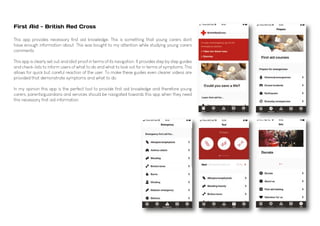
First Aid - British Red Cross
This app provides necessary first aid knowledge. This is something that young carers dont
have enough information about. This was bought to my attention while studying young carers
comments.
This app is clearly set out and idiot proof in terms of its navigation. It provides step by step guides
and check-lists to inform users of what to do and what to look out for in terms of symptoms. This
allows for quick but careful reaction of the user. To make these guides even clearer videos are
provided that demonstrate symptoms and what to do.
In my opinion this app is the perfect tool to provide first aid knowledge and therefore young
carers, parents/guardians and services should be navigated towards this app when they need
this necessary first aid information.
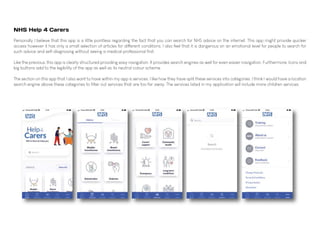
NHS Help 4 Carers
Personally I believe that this app is a little pointless regarding the fact that you can search for NHS advice on the internet. This app might provide quicker
access however it has only a small selection of articles for different conditions. I also feel that it is dangerous on an emotional level for people to search for
such advice and self-diagnosing without seeing a medical professional first.
Like the previous, this app is clearly structured providing easy navigation. It provides search engines as well for even easier navigation. Furthermore, Icons and
big buttons add to the legibility of the app as well as its neutral colour scheme.
The section on this app that I also want to have within my app is services. I like how they have split these services into categories. I think I would have a location
search engine above these categories to filter out services that are too far away. The services listed in my application will include more children services.
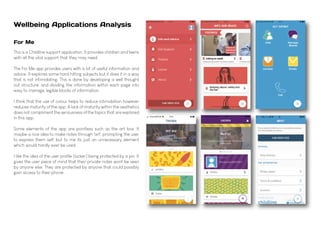
Wellbeing Applications Analysis
For Me
This is a Childline support application. It provides children and teens
with all the vital support that they may need.
The For Me app provides users with a lot of useful information and
advice. It explores some hard hitting subjects but it does it in a way
that is not intimidating. This is done by developing a well thought
out structure, and dividing the information within each page into
easy to manage, legible blocks of information.
I think that the use of colour helps to reduce intimidation however
reduces maturity of the app. A lack of maturity within the aesthetics
does not compliment the seriousness of the topics that are explored
in this app.
Some elements of the app are pointless such as the art box. It
maybe a nice idea to make notes through 'art', prompting the user
to express them self, but to me its just an unnecessary element
which would hardly ever be used.
I like the idea of the user profile (locker) being protected by a pin. It
gives the user piece of mind that their private notes wont be seen
by anyone else. They are protected by anyone that could possibly
gain access to their phone.
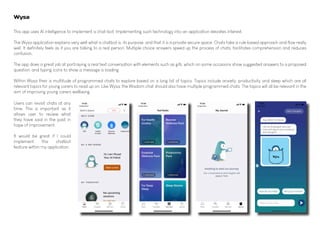
This app uses AI intelligence to implement a chat-bot. Implementing such technology into an application elevates interest.
The Wysa application explains very well what a chatbot is, its purpose, and that it is a private secure space. Chats take a rule based approach and flow really
well. It definitely feels as if you are talking to a real person. Multiple choice answers speed up the process of chats, facilitates comprehension and reduces
confusion.
The app does a great job at portraying a real text conversation with elements such as gifs, which on some occasions show suggested answers to a proposed
question, and typing icons to show a message is loading.
Within Wysa their is multitude of programmed chats to explore based on a long list of topics. Topics include anxiety, productivity and sleep which are all
relevant topics for young carers to read up on. Like Wysa, the Wisdom chat should also have multiple programmed chats. The topics will all be relevant in the
aim of improving young carers wellbeing.
Wysa
Users can revisit chats at any
time. This is important as it
allows user to review what
they have said in the past in
hope of improvement.
It would be great if I could
implement this chatbot
feature within my application.
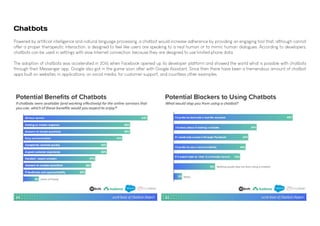
Powered by artificial intelligence and natural language processing, a chatbot would increase adherence by providing an engaging tool that, although cannot
offer a proper therapeutic interaction, is designed to feel like users are speaking to a real human or to mimic human dialogues. According to developers,
chatbots can be used in settings with slow Internet connection, because they are designed to use limited phone data.
The adoption of chatbots was accelerated in 2016 when Facebook opened up its developer platform and showed the world what is possible with chatbots
through their Messenger app. Google also got in the game soon after with Google Assistant. Since then there have been a tremendous amount of chatbot
apps built on websites, in applications, on social media, for customer support, and countless other examples.
Chatbots
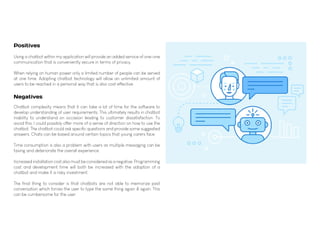
Using a chatbot within my application will provide an added service of one-one
communication that is conveniently secure in terms of privacy.
When relying on human power only a limited number of people can be served
at one time. Adopting chatbot technology will allow an unlimited amount of
users to be reached in a personal way that is also cost effective.
Chatbot complexity means that it can take a lot of time for the software to
develop understanding of user requirements. This ultimately results in chatbot
inability to understand on occasion leading to customer dissatisfaction. To
avoid this, I could possibly offer more of a sense of direction on how to use the
chatbot. The chatbot could ask specific questions and provide some suggested
answers. Chats can be based around certain topics that young carers face.
Time consumption is also a problem with users as multiple messaging can be
taxing and deteriorate the overall experience.
Increased installation cost also must be considered as a negative. Programming
cost and development time will both be increased with the adoption of a
chatbot and make it a risky investment.
The final thing to consider is that chatbots are not able to memorize past
conversation which forces the user to type the same thing again & again. This
can be cumbersome for the user.
Positives
Negatives
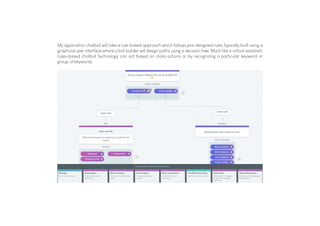
My application chatbot will take a rule-based approach which follows pre-designed rules, typically built using a
graphical user interface where a bot builder will design paths using a decision tree. Much like a virtual assistant,
rules-based chatbot technology can act based on clicks actions or by recognizing a particular keyword or
group of keywords.
Chatbot Counselling Qualities
Paraphrasing
This is a verbal skill which is used to communicate that a comment has been
heard and understood. It involved feeding back what has been said in own
words.
Empathy
The ability to demonstrate empathy or empathetic understanding in
the counselling relationship is generally considered to be essential to
the counselling process. Empathy will ensure the user feels valued and
understood, reduces the sense of isolation, and encourages trust and further
exploration.
Non-judgemental acceptance
Non-judgemental acceptance is a fundamental attitude that should
be offered consistently and not determined by the users behaviour. All
judgement and criticism should be suspended.
Considering this I feel that it would be better if the chatbot does not react to
responses throughout the chatbot conversation which was an or a plan that
came to mind.
Genuineness
Counselling provided should be genuine, open, and sincere. Genuineness
encourages trust and provide a more human experience.
Reflecting feelings
Reflection will demonstrate that the chatbot understands how the user is
feeling. Emojis can be used to back this up and set tone. Reflection enables
the client to feel understood, accepted and encouraged to share more of
their feelings.
Making the appropriate reflection involves identifying feelings accurately,
but also selecting, sensitively and tentatively, the appropriate time, tone and
words to convey them to the client.
Focusing
Initially users may be vague about what is troubling them. Focusing is about
helping the user to face issues fully and take responsibility.
Organising the chat conversations under a variety of headings will aid such
focus.
I acquired the following information from a friend who has completed a counselling course in recent times:
E-Mental Health
Benefits
Online and mobile-delivered mental health applications hold promise to overcome important barriers
in the delivery of and access to mental health support. They are readily accessible and easy to use,
whenever users feel sad, anxious, stressed, or just want a distraction. Digital application is accessible to
anyone with a smartphone and internet connection, and can therefore provide support to young people
in regions that have a lack of services. They can also provide support quicker than services as publicly
funded support services tend to have a waiting list. These applications are also significantly less costly
than private face-to-face interventions such as cognitive behavioural therapy.
Beyond structural barriers, young people are often reluctant to access mental health treatment due to
social and self-stigmatising attitudes to mental health interventions. Many prefer to overcome emotional
difficulties off their own back or obtain support from family and/or friends rather than seek professional
support.
There is also evidence that younger teenagers tend to feel more in control of situations in online
conversations rather than in in-person interactions. The UK suicide-prevention charity Samaritans has
recorded that users aged less than 25 years had the highest use of their text messaging service and were
less likely to phone or visit a branch than older users.
Digital forms of support also offer confidentiality. Many people feel that problems are too personal to be
discussed with anyone one to one. Within online conversations it is much easier to maintain their privacy.
Young people are more likely to find a fully automated chatbot conversation and a community platform,
a suitable alternative for disclosure of their difficulties.
If effective, my application and other digital interventions like it may act as the less daunting bridge to
getting professional support from services and charities. As they gain more and more comfort from the
Limitations
Even though a minimal level of personalisation
exists within such digital interactions, the support
provided is still quite generic and perhaps more
akin to a self-help book. Neither can chatbots
grasp users past history and make informed
connections to current circumstances.
When a user sends longer or more complex
messages to a chatbot, they often reply not
having understood or provide an off-topic,
inappropriate response. Although the responses
might be comical and entertaining at times, it
couldunderminetheuserssensethatthechatbot
is 'listening' carefully. To avoid such responses
chatbots offer multiple choice responses in
addition to free text, which facilitates compre.
hension.
Contextual Research
As it is offering emotional wellbeing support, the app should be backed up by clinical approaches such as cognitive
behavioural therapy. It is also important that it informs users about the theoretical approach that guides the service, what
difficulties it targets and what psychological or clinical effects users may expect from using the platform. This should be
mostly taken into consideration within the chatbot conversations.
Clinical Approaches
Cognitive Behavioural Therapy
Cognitive behavioural therapy (CBT) is a talking therapy. It helps you manage problems by helping you recognise how your thoughts
can affect your feelings and behaviour. CBT combines a cognitive approach (examining your thoughts) with a behavioural approach
(the things you do). It aims to break overwhelming problems down into smaller parts, making them easier to manage. CBT has become
one of the most popular forms of talk therapy and is recommended by the National Institute for Health and Care Excellence (NICE).
CBT combines two approaches for a practical and solution-focused therapy. It provides tools and exercise which young carers will be
able to do from the comfort of their home.
The idea behind CBT is that our thoughts and behaviours influence each other. The premise is that, by changing the way people think or
behave in a situation, they can change the way they feel about life. It examines learnt behaviours, habits and negative thought patterns
with the view of adapting and turning them into a positive. Unlike some other therapies, CBT is rooted in the present and looks to the
future.
CBT can be implemented into the chatbot conversations to help young carers understand any negative thought patterns they have,
how they affect them and most importantly, what can be done to change them.
I believe this type of therapy would be particularly helpful for young carers as many of them suffer from depression and/or anxiety
due to the extra pressure they are typically under. Some also struggle to reduce their stress levels and experiencing sleeping problems.
This type of therapy allows young carers to control of their emotions and lives. The fact that issues are discussed with a chatbot
provides users with a safe space to helps them gain a new perspective.
Mindfulness
Mindfulness is the quality of being present and fully engaged, free from distraction or judgment, and aware of our thoughts and feelings without getting caught
up in them. We train in this moment-to-moment awareness through meditation, allowing us to build the skill of mindfulness so that we can then apply it to
everyday life. Teaching young carers to be present, taking a breath, not beholden to reactive thoughts and feelings is particularly helpful as they typically face
challenging circumstances.
Mindfulness will help young carers to becoming aware of unpleasant thoughts and emotions that arise because of their challenging situations, they will be able
to handle them better, calmly, and empathetically when faced with stress or challenges.
Meditation is the training ground for learning mindfulness. At first, we meditate to become familiar with the here and now for a limited period of time. Over
time, however, regularly practicing mindfulness helps us develop the ability to be present throughout the day, every day.
Mindfulness meditation doesn't only change our mindset and perspective, it actually can change the shape of our brains. Meditation allows us to move from
high-frequency brain waves to a lower frequency, which activates, and deactivates, certain areas of the brain. In turn, meditation can also build new pathways
to the parts of the brain and change the shape of the brain as well, a process known as neuroplasticity. Research shows that grey matter (the area of the brain
responsible for emotional regulation, planning, and problem-solving) and the cortical thickness (responsible for learning and memory) both increase with regular
meditation practice. Alternatively, the amygdala (regulates how we feel stress, fear, and anxiety) decreases in size.
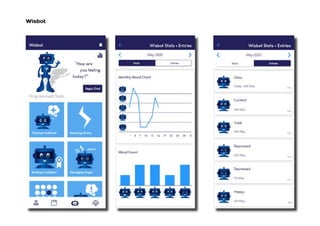
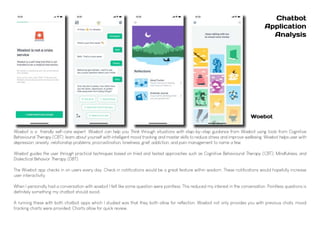
Woebot is a friendly self-care expert. Woebot can help you Think through situations with step-by-step guidance from Woebot using tools from Cognitive
Behavioural Therapy (CBT), learn about yourself with intelligent mood tracking and master skills to reduce stress and improve wellbeing. Woebot helps user with
depression, anxiety, relationship problems, procrastination, loneliness, grief, addiction, and pain management to name a few.
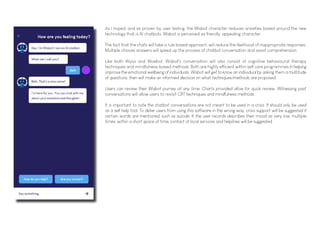
Woebot guides the user through practical techniques based on tried and tested approaches such as Cognitive Behavioural Therapy (CBT), Mindfulness, and
Dialectical Behavior Therapy (DBT).
The Woebot app checks in on users every day. Check in notifications would be a great feature within wisdom. These notifications would hopefully increase
user interactivity.
When I personally had a conversation with woebot I felt like some question were pointless. This reduced my interest in the conversation. Pointless questions is
definitely something my chatbot should avoid.
A running these with both chatbot apps which I studied was that they both allow for reflection. Woebot not only provides you with previous chats, mood
tracking charts were provided. Charts allow for quick review.
Chatbot
Application
Analysis
Woebot
Child Centred Approach
The application should take a child centred approach. Fundamental to this is the recognition of children
and young people as competent individuals.
Young carers deserve to be respected and valued. From the Senco interview it is clear that young
carers don't receive help needed as others are put before them. From my background research it was
shown that they are left out of the loop a lot of the time. My application should allow young carers to
share and receive advise, treating them as respectful individuals which have something to contribute
and deserve help. They may be considered vulnerable, but they are also strong intelligent individuals
able to take on extra responsibilities.
Critics would say that young carers don't have all the answers and shouldn't be expected to provide
solutions. It's true they don't have social work qualifications, management diplomas and years
of experience of working with children. They are not experts. But what they do have is first-hand
experience. They often surprise adults with their depth of understanding, their perceptive approaches
and maturity. Most of all they bring immediacy, freshness and the ability to cut through any pretence,
to get straight to the point. (Coramvoice.org.uk, 2005)
Improving Emotional Well-being through
Communication
Communication is the act of connecting, of sharing not just information but all aspects of life. It is a vital
part of wellbeing, mental health and quality of life. It connects us with others and ourselves. When we
communicate with each other and ourselves, fully and honestly we reduce stress and anxiety and grow in
confidence. We solve problems more efficiently and create satisfying relationships. By letting others know
our needs and learning others need, we, as a society can learn how to better respond.
In the wisdom application users can reduce stress and anxiety by communicating with other user and
gaining other perspectives. They will gain strength and grow in confidence as they realise the positives of
being a young carer. They will be able to improve their quality of life and wellbeing by considering advice
given. In addition, as a society we can learn and respond to the needs of young carers discussed within the
application. A deeper understanding on the life of young carers will be generating and we can get a more
exact account of the volume of young carers in the UK.
Implementing a successful wellbeing strategy
The wellbeing strategy is usually adopted by business and companies. This
strategy recognises that the mental, physical, financial, and social wellbeing of
a workforce in an important element of business success. If employees have
high levels of wellbeing, the evidence suggests that this leads to less attrition,
reduced absenteeism, and higher productivity. It is my belief that taking such
a strategy into account when developing my application, will improve quality
and enhance communication.
A wellbeing initiative needs to be measured carefully to assess its impact.
Establishing what you are trying to improve can make the difference between
a successful strategy and a waste of time and money. I focused my application
with the help of research for semester one, at the start of this design document
by setting myself the goal of improving the mental health and wellbeing of
young carers through communication. This led me to stripping some tools
from the application which were featured previously (safe zone).
Conducting research has not only helped me to determine the focus, but
also which features young carers could benefit from (community platform,
service address book, chatbot conversations). I will complete further research
on the topic of these features. I will consider the implications of including these
features.
Communicating the wellbeing support, benefits and help available to users is
key within a wellbeing strategy. The following points will aid in doing this:
1.	 Emulating safety and openness. The more people feel safe to discuss
wellbeing issues, and the more involved they feel, the more they will
benefit. To emulate safety trust needs to be established and a professional
standard met within the application. Acquiring the support of services
and charities will also help in getting people talking.
2.	 Share stories, not facts. Most people make decisions and choices based
on emotion, not logic, even if they use logic to justify them afterwards. The
community platform allows young carers and their families to share their
compelling stories is an effective and engaging way to create a narrative
which promotes and reinforces a healthy wellbeing culture.
3.	 Make it entertaining. Avoid being preachy, sanctimonious or too strait-
laced in communicating your wellbeing offering. Although mental health
wellbeing needs to be handled with sensitivity, the more you can weave
humour into your communications on physical, the more engagement
you will get. This will be taken into high consideration when developing the
chatbot conversations.
4.	 Have realistic expectations. Don't try to do too much in one go. The
chatbot conversation should be developed based on a programme with
small deliverable milestones that meet needs of the young carer.
5.	 Get support from services. Unless I get full support from services and
charities, your wellbeing strategy will not stand the test of time or be
properly resourced. Having a wellbeing champion on the board or senior
leadership team and getting senior people involved in wellbeing stories is
ideal.
Helping young carers improve their overall wellbeing won't always be plain
sailing or easy but, with a bit of imagination and consistent effort, it will be a
very worthwhile, rewarding and noble cause indeed.
Facilitating Effective Communication
Consider Feelings
Whatever they are feeling, children need to know that it is completely okay
to feel that way. The application should portray that fact that we can feel
all kinds of things that don't make sense but there are no silly feelings or sil-
ly things to think. The chat-bot, in particular, should ask them what they're
thinking and feeling and give them permission to say anything they want to
(Young, 2015).
Set the Tone
The general tone of the wisdom application should be screaming of helpfulness
and friendliness. The application should also come across as understanding
and sympathetic of the situation young carers find themselves in. A genuine
attempt of setting such a tone should be made to put the user at ease when
using the application.
It is key that the chat-bot in particular sets such a tone as it would be more
than likely be something that the user has never experienced before. The
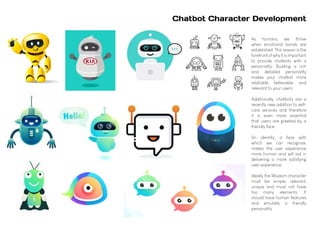
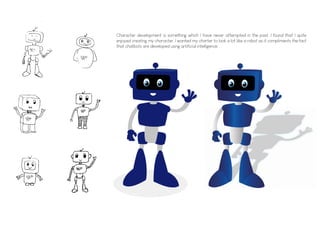
chat-bot character which I will design will help present the chat-bot as
sympathetic. It could present human emotion at times in response to answers
to show sympathy.
Summarise and Conclude
In context of the chat-bot, From this summary a plan of action can be formed.
The users can reflect on these plans to form their own plans to improve their
emotional well-being. Such plans should be stored within the application
within the users personal profile. If merely left to the fragile human memory,
may fuse into meaningless, disconnected scenes in a panorama of many
human happenings (Strategies of Effective Interviewing, 1964).
Consider Sensitivity
Children and teenagers, especially those that are vulnerable, can be sensitive
and can often find it hard to talk about their worries or concerns. They do not
like to be bombarded by questions which is something to consider in terms
of Wisdoms chat-bot. Discussing sensitive issues with children is highly skilled
work. Charities and services should be dealing with such sensitive issues, they
shouldn't really be discussed within community or within the chat-bot. They
can find such charities and services within services.
We should communicate this within the app. To control what topics are
discussed within the community, I should structure it in a way that dictates/
suggests efficiently what topics can be discussed, but also gives them the
freedom of sharing what they like, giving them freedom of expression.
Freedom of speech
Within the young carers community platform and chatbot chats, users should
have the freedom to ask questions, pose feelings, ides and thoughts. They
should be allowed to say as little or as much as they want. In reply, comments
should provide comfort and assurance (Young, 2015). However, there should
be measures in place to defer users from saying something they might regret
later. Also, there should be features in place to allow user to report posts at
ease and allow admin to remove posts if needed.
Clear presentation
Any information that is provided should be explained and summarised very
clearly as info-graphics. Info-graphics can communicate information in a
condensed and highly visual way. To give an example of where I can utilise
Info-graphics within my application is when explaining how to use elements
within the app and the house rules.
Effective communication according to age (Young, 2015):
5-11 years.
Let the child lead the conversation here. They want help to feel safe. The driving question should
what it means for them.
They'll be looking for comfort in answers. Give them the details asked for, but you don't need to give
them more than that. Direct questions should not be avoided and honesty is the best policy
11-14 years
Its difficult to know exactly how much they understand about what is happening or what they're
worried about. The answers will be in their questions or their misunderstandings. The most important
thing is letting them know that you're there for them if they need to talk or ask questions, any
misunderstandings or misconceptions are cleared up and give them a balanced view.
At this age they start to think about things in creative, abstract ways so it can be difficult to anticipate
what they're thinking or feeling. Given that the emotional centres of their brains are developing at
a heightened rate during adolescence, it might be that they show a greater intensity of fear, anger
or sadness. They might even show no emotion at all. This is completely okay and is nothing to worry
about. People feel things and respond to things in all different ways.
Above 14 years.
They'll most likely be hearing a lot of information through friends and social media, so it's important
to make sure the information they have is accurate.
By this age, they'll be turning to their peers to meet their needs. When they need comfort or
conversation, it's very normal for them to turn to their friends. They might want to spend more time
with them, or they might seem even more attached to their phone. They won't necessarily be wanting
to be with their friends to talk about things, it's just how they find stability and comfort.
Contextual research
Considering the research on the left, I feel that I should
concentrate on young carers 11 years old and above.
The app should be accessible to such an age range.
Those younger than 11 would need more of a one to
one approach, guided by their parents or support
workers.
From reading the research on the left, I can make the
informed prediction that those aged 11-14 are more
likely to use the Chatbot as it is more of a creative,
abstract way to interpret what they are thinking or
feeling, Those above the age of 14 are more likely to
look to the community as a tool for finding stability
and comfort.
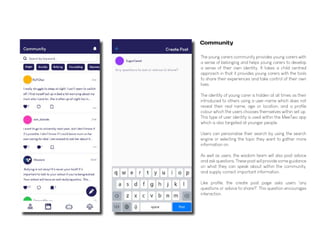
Young Carer's Community
Wisdom provides an Online Young carers community. The definition of an online community is any virtual
space where people come together with others to converse, exchange information or other resources,
learn, play or just be social. Online communities provide members with opportunities for information shar-
ing and learning, for companionship, social support, and for entertainment. The promise of these com-
munities is that they break the barriers of time, space and scale that limit offline interactions. For young
carers and their families the benefit of an online community includes gaining social support from others
without having to leave their house. They can do so whenever they want rather than only at a scheduled
meeting. Providing such social support has become a necessity for all in recent events of lockdown due to
the covid-19 pandemic (Resnick and Kraut, 2011)
Following this the app creates a community that understand and can sympathise. Belonging to a com-
munity is a major contributor to helping children develop a sense of their own identity and of themselves
as Young Carers.
Making connections with other young carers in a place that feels safe and supporting, assists a child to de-
velop a sense of their own identity. The relationships that children have with the people around them are
central to their emotional well-being and to achieving positive outcomes. They can make more sense of
their own behaviours and feelings when comparing other Young Carers situations and notes to their own.
Those a part of directly caring for Young Carers would also benefit from having such relationships with
others directly caring as they will be able to compare situations and notes to assist in developing a further
understanding of young carers needs.
The benefits of good relationships can be enormous, in helping develop confidence, self-esteem and the
ability to cope. Having someone to talk to is greatly important, and of the therapeutic value of talking
through problems with an equal is huge. (Coramvoice.org.uk, 2005)
Online Community Design Challenges
Regulating Behaviour
Mostcommunities(especiallythosethatdealwithcontroversialtopics),attract
trolls, people who post controversial, inflammatory, irrelevant, or off-topic
messages to provoke other users into an emotional response. Commercial
spammers would also like to drive traffic to their external websites. It is a
challenge to deter such inappropriate behaviour by members, prevent trolls
and other outside attackers, and limit the damage that is caused when
inappropriate behaviour occurs. Online communities particularly struggle with
the previous due to the following. Anonymity allows user to not be inhibited by
social accountability, and ease of entry and exit inhibit interpersonal ties and
affect how sanctions and other deterrence strategies work.
Plenty of resources can be implemented to deter such behaviour. The first
is that online communities can benefit from computation. Which allows
summary traces of past behaviour as quantifiable and viewable reputation.
Within the wisdom application, it will not make the information public, this
information would be only for admin to view.
In addition, welcomes for newcomers which provide house rules and guidance,
and dispute handlers, will deter bad behaviour.
Access controls could place limits on who can join the community and set out
actions they can take. For example, with the wisdom application, credentials
shouldbecheckedwhencharitiesandservicessignuptotheapporverification
should be established before charities and services can post anything.
Some participant, within the wisdom application might possibly speak on
topics within community that should only be discussed with young carers
charities and services. To deter users from speaking on such topics, topics
could be suggested and examples could be presented (Resnick and Kraut,
2011).
Starting a new community
Many online communities are successful because they have a rich inventory
of content that attracts new members. By allowing charities and service
to communicate within the wisdom community from the offset, a supply
of quality content will be assured. Providing a service search engine and a
chatbot alongside the community, will also encourage people to invest their
time and efforts into the application, and therefore will increase activity.
Attracting and socialising new members
Even established online communities must attract a stream of new members
to replace others who leave. For the Wisdom community, a major component
of this challenge is to identify and encourage young carers and their families
to contribute. In addition, although there are no other online young carers
community's that I know of, there are other carer and young people
communities that provide support which are more established. In response
to this, It would be detrimental to gain the support of charities and services to
increase promotion and gain easy access to young carers and their families
to advertise the application.
Within the initial set up and the description of the application within the app
store it is also detrimental that a sufficient amount of information is provided,
trust is established, and inappropriate members are screened out. Initial
observations and interactions are likely to strongly influence whether they
stick around long enough to learn that the site provides much needed support.
Encouraging contribution
To be successful, wisdoms online communities need users to converse and
exchange information. I need to make sure that the app feels safe and
professional to assure users feel comfortable communicating within this
space. An app culture that is open and supportive needs to be established.
The app should make a habit of asking the user questions to encourage them
to communicate.
Online Community Comments
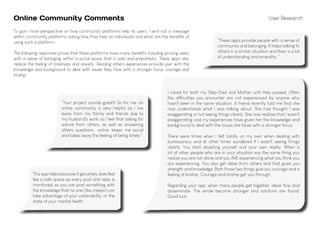
"Your project sounds great!! So for me, an
online community is very helpful as I live
away from my family and friends due to
my husband's work, so I feel that asking for
advice from others, as well as answering
others questions online, keeps me social
and takes away the feeling of being lonely."
"These apps provide people with a sense of
community and belonging. It helps talking to
others in a similar situation and their is a lot
of understanding and empathy. "
I cared for both my Step-Dad and Mother until they passed. Often
the difficulties you encounter are not experienced by anyone who
hasn't been in the same situation. A friend recently told me that she
now understands what I was talking about. She had thought I was
exaggerating or not seeing things clearly. She now realizes that I wasn't
exaggerating and my experiences have given her the knowledge and
background to deal with the issues she faces with a stronger focus.
There were times when I felt totally on my own when dealing with
bureaucracy and at other times wondered if I wasn't seeing things
clearly. You start doubting yourself and your own reality. When a
lot of other people who are in your situation say the same thing you
realize you are not alone and you ARE experiencing what you think you
are experiencing. You also get ideas from others and that gives you
strength and knowledge. Both those two things give you courage and a
feeling of kinship. Courage and kinship get you through.
Regarding your app, when many people get together, ideas flow and
disseminate. The whole become stronger and solutions are found.
Good luck.
User Research
This app helps because it genuinely does feel
like a safe space as every post and reply is
monitored, so you can post something with
the knowledge that no one (like creeps) can
take advantage of your vulnerability, or the
state of your mental heath.
To gain more perspective on how community platforms help its users, I sent out a message
within community platforms asking how they help as individuals and what are the benefits of
using such a platform.
The following responses prove that these platforms have many benefits including proving users
with a sense of belonging within a social space that is safe and empathetic. These apps also
reduce the feeling of loneliness and anxiety. Reading others experiences provide user with the
knowledge and background to deal with issues they face with a stronger focus, courage and
kinship.
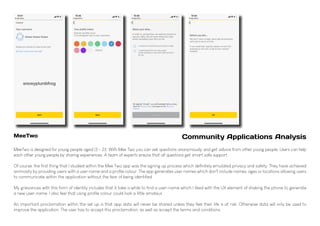
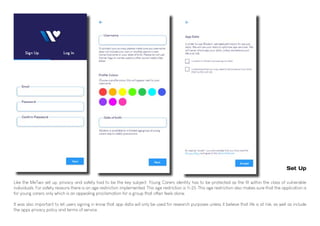
MeeTwo is designed for young people aged 13 - 23. With Mee Two you can ask questions anonymously and get advice from other young people. Users can help
each other young people by sharing experiences. A team of experts ensure that all questions get smart safe support.
Of course, the first thing that I studied within the Mee Two app was the signing up process which definitely emulated privacy and safety. They have achieved
animosity by providing users with a user name and a profile colour. The app generates user names which don't include names, ages or locations allowing users
to communicate within the application without the fear of being identified.
My grievances with this form of identity includes that it take a while to find a user-name which I liked with the UX element of shaking the phone to generate
a new user-name. I also feel that using profile colour could look a little amateur.
An important proclamation within the set up is that app data will never be shared unless they feel their life is at risk. Otherwise data will only be used to
improve the application. The user has to accept this proclamation, as well as accept the terms and conditions.
MeeTwo Community Applications Analysis
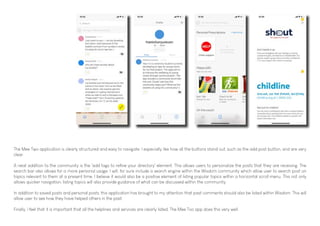
The Mee Two application is clearly structured and easy to navigate. I especially like how all the buttons stand out, such as the add post button, and are very
clear.
A neat addition to the community is the 'add tags to refine your directory' element. This allows users to personalize the posts that they are receiving. The
search bar also allows for a more personal usage. I will, for sure include a search engine within the Wisdom community which allow user to search post on
topics relevant to them at a present time. I believe it would also be a positive element of listing popular topics within a horizontal scroll menu. This not only
allows quicker navigation, listing topics will also provide guidance of what can be discussed within the community.
In addition to saved posts and personal posts, this application has brought to my attention that past comments should also be listed within Wisdom. This will
allow user to see how they have helped others in the past.
Finally, I feel that it is important that all the helplines and services are clearly listed. The Mee Too app does this very well.
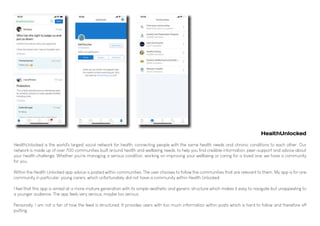
HealthUnlocked is the world's largest social network for health, connecting people with the same health needs and chronic conditions to each other. Our
network is made up of over 700 communities built around health and wellbeing needs, to help you find credible information, peer-support and advice about
your health challenge. Whether you're managing a serious condition, working on improving your wellbeing or caring for a loved one; we have a community
for you.
Within the Health Unlocked app advice is posted within communities. The user chooses to follow the communities that are relevant to them. My app is for one
community in particular, young carers, which unfortunately did not have a community within Health Unlocked.
I feel that this app is aimed at a more mature generation with its simple aesthetic and generic structure which makes it easy to navigate but unappealing to
a younger audience. The app feels very serious, maybe too serious.
Personally, I am not a fan of how the feed is structured. It provides users with too much information within posts which is hard to follow and therefore off
putting.
HealthUnlocked
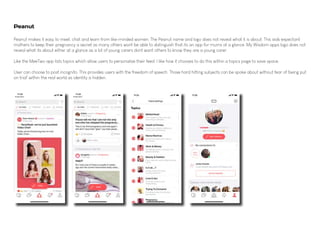
Peanut makes it easy to meet, chat and learn from like-minded women. The Peanut name and logo does not reveal what it is about. This aids expectant
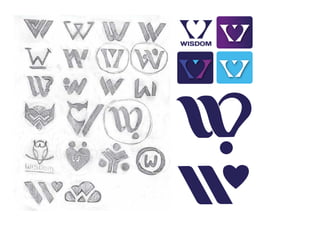
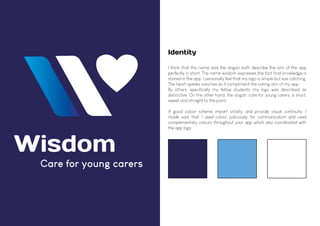
mothers to keep their pregnancy a secret as many others wont be able to distinguish that its an app for mums at a glance. My Wisdom apps logo does not
reveal what its about either at a glance as a lot of young carers dont want others to know they are a young carer.
Like the MeeTwo app lists topics which allow users to personalise their feed. I like how it chooses to do this within a topics page to save space.
User can choose to post incognito. This provides users with the freedom of speech. Those hard hitting subjects can be spoke about without fear of 'being put
on trial' within the real world as identity is hidden.
Peanut
Ethical Standards
Privacy and confidentiality
Within traditional mental health settings, patients find it essential that their clinicians
protect and keep their information confidential. Users data should be kept private as
far as possible with the Wisdom application. Anything shared by young carers and
their families should not include any personally identifiable information. This should
be kept strictly confidential. When we tried the platforms, we felt more comfortable
with disclosing information. To ensure this I will provide user to talk about our mental
well-being anonymously using aliases or privacy settings.
An app privacy policy should be presented to users mentioning that user content
is not shared with other companies or services. Anonymous data is only used to
optimise app services.
Given the nature of these services users may type identifiable information in
conversation with the chatbot. These potential identifiers will be hidden or removed
as far as possible when data are used to optimise services, for research, or if any
information is shared with third parties. If data are used for research, we find it
important that this is explicitly stated and consent is sought before we begin using
the platform.
In addition, users should have the option of being reminded of confidentiality
arrangements at any point.
A great user-friendly feature of the chatbot should be that if words such as privacy
or confidentiality are typed into the conversation, an automated and up-to-date
reminder of privacy policies is generated.
Tosumup,privacyandconfidentialityareofutmostimportance.Alackoftransparency
may deter users from using wisdom. Full transparency on the topics will increase the
number of young carers and their families who are willing to share information about
their mood and well-being, as well as the quantity of information shared.
Safety
I should aim to reduce the risk that online support poses to the
young carers and their family's safety and wellbeing to a minimum.
Systems should be in place to respond to situations in which users
safety may be at risk. Users should be able to delete and edit their
posts and report others post if needed within community. The apps
chatbot should inform users that they are talking to a robot with
limited capacity to understand what a user type. Additionally, the
app should point the users in the right direction of services if they
are experiencing severe mental health difficulties and should also
encourage users to seek human support from family and friends or
health professionals.
A worry is that users could become over-reliant on wisdoms
community and chat to provide support, because they are available
24/7. I find it essential that the app discourages over-reliance. For
example the chatbot conversations could provide users with tasks to
complete in the real-world, to encourage human interaction.
Finally, it is important to note that young carers will be particularly
concerned with protecting their privacy from their parents and
other relatives intrusion, and there is evidence that they use online
communication as a way to do so. Therefore, the application should
be password protected.
Data Analytics
Data Analytics is used to gain quality insights
and apprehend best practices. Armed with such
information potential improvement to quality of
service could be pursued within the application.
This information could also aid improvement of
the social care system, charities and services that
support young carers and their families. Data
collated from the application will help develop
a better understanding of young carers lives,
monitor quality and efficiency of care, provide
an oversight of how effective the care system is
and inform decision making within the social care
sector.
At present, the ability to exploit advances in
digital technology, such as big data analytics, in
support of better health and better health care is
a priority for health care services. The NHS Long
Term Plan, published in January 2019, envisages
a central role for technology, forecasting that
technology will empower people, support health
and care professionals to deliver better care,
improve clinical efficiency and safety and improve
population health overall. Strategies aimed at
exploiting the promise of data typically cover,
innovation and investment in new technologies,
managing and accessing new data streams in new
ways and investing in the analytical workforce,
which can use the data to provide actionable
insight. By developing Wisdom, I am innovating
a new technology that could potentially provide
access to new data streams surrounding the
subject of Young carers. (Bardsley, Steventon and
Fothergill, 2019)
Risk-stratification tools are currently used across the NHS, for example to help identify
which general practice patients are at the highest risk of being admitted to hospital. The
potential benefits of this are that patients are prevented from experiencing an adverse
event and emergency-care costs are avoided. Birmingham and Solihull Mental Health NHS
Foundation Trust is applying risk stratification to mental health by building models that
predict the likelihood of an individual being admitted to psychiatric hospital.
The aim is to develop and implement a risk-stratification model that will help clinicians
prevent mental-health patients from requiring urgent hospital care. The model uses 4
years of historical clinical and social demographic data to provide an overall indication of
the risk of a patient experiencing a mental health crisis. The data is drawn from a range
of sources and is not limited to a set of patient characteristics such as age, diagnosis and
previous hospital admissions.
The project looks at how the models can be used in practice, working with several Trust
community mental-health teams to pilot the risk-stratification model. Analysts will work
with clinicians and managers to refine, test, implement and see how they can embed
it into systems for routine clinical care. The goal is to understand its impact on clinical
decision making and make improvements as part of a continuous cycle of learning via a
comprehensive evaluation process. (Bardsley, Steventon and Fothergill, 2019)
Case Study: Birmingham and Solihull Mental Health NHS
Foundation Trust
Technological Research
Human Interface Guidelines
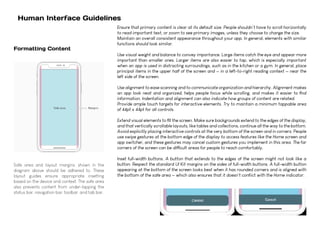
Safe area and layout margins, shown in the
diagram above should be adhered to. These
layout guides ensure appropriate insetting
based on the device and context. The safe area
also prevents content from under-lapping the
status bar, navigation bar, toolbar, and tab bar.
Formatting Content
Ensure that primary content is clear at its default size. People shouldn’t have to scroll horizontally
to read important text, or zoom to see primary images, unless they choose to change the size.
Maintain an overall consistent appearance throughout your app. In general, elements with similar
functions should look similar.
Use visual weight and balance to convey importance. Large items catch the eye and appear more
important than smaller ones. Larger items are also easier to tap, which is especially important
when an app is used in distracting surroundings, such as in the kitchen or a gym. In general, place
principal items in the upper half of the screen and — in a left-to-right reading context — near the
left side of the screen.
Use alignment to ease scanning and to communicate organization and hierarchy. Alignment makes
an app look neat and organized, helps people focus while scrolling, and makes it easier to find
information. Indentation and alignment can also indicate how groups of content are related.
Provide ample touch targets for interactive elements. Try to maintain a minimum tappable area
of 44pt x 44pt for all controls.
Extend visual elements to fill the screen. Make sure backgrounds extend to the edges of the display,
and that vertically scrollable layouts, like tables and collections, continue all the way to the bottom.
Avoid explicitly placing interactive controls at the very bottom of the screen and in corners. People
use swipe gestures at the bottom edge of the display to access features like the Home screen and
app switcher, and these gestures may cancel custom gestures you implement in this area. The far
corners of the screen can be difficult areas for people to reach comfortably.
Inset full-width buttons. A button that extends to the edges of the screen might not look like a
button. Respect the standard UI Kit margins on the sides of full-width buttons. A full-width button
appearing at the bottom of the screen looks best when it has rounded corners and is aligned with
the bottom of the safe area — which also ensures that it doesn't conflict with the Home indicator.
Interface Controls
Buttons
Use verbs in titles. An action-specific title shows that a button is interactive and says what happens when
you tap it.
Use title-case for titles. Capitalize every word except articles, coordinating conjunctions, and prepositions
of four or fewer letters.
Keep titles short. Overly long text can crowd your interface and may get truncated on smaller screens.
Consider adding a border or a background only when necessary. By default, a system button has no
border or background. In some content areas, however, a border or background is necessary to denote
interactivity. In the Phone app, bordered number keys reinforce the traditional model of making a call,
and the background of the Call button provides an eye-catching target that's easy to hit.
Segmented Controls
A segmented control is a linear set of two or more segments, each of which functions as a mutually
exclusive button. Within the control, all segments are equal in width. Like buttons, segments can contain
text or images.
Limit the number of segments to improve usability. Wider segments are easier to tap. On IPhone, a
segmented control should have five or fewer segments.
Try to keep segment content size consistent. Because all segments have equal width, it doesn't look great
if content fills some segments but not others.
Avoid mixing text and images in a segmented control. Although individual segments can contain text or
images, mixing the two in a single control can lead to a disconnected and confusing interface.
Position content appropriately in a custom segmented control. If you change the background appearance
of a segmented control, make sure content still looks good and doesn't appear misaligned.
Text Field
Show a hint in a text field to help communicate
purpose. A text field can contain place-holder
text such as 'Email' or 'Password' when there's
no other text in the field. Don't use a separate
label to describe a text field when place-holder
text is sufficient.
Use images and buttons to provide clarity
and functionality in text fields. You can display
custom images in the left or right sides of a text
field, or you can add a system-provided button,
such as the Bookmarks button. In general,
use the left end of a text field to indicate a
field's purpose and the right end to indicate
the presence of additional features, such as
bookmarking.
Labels
Keep labels legible. Labels can include plain or
styled text. If you adjust the style of a label or use
custom fonts, be sure to not sacrifice legibility.
Progress Indicators
Activity indicators and progress bars let people
know your app is not stalled and to give them
some idea of how long they'll be waiting.
User Persona's and Scenarios
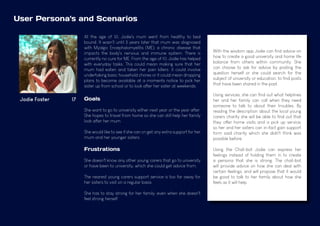
Jodie Foster 17
At the age of 10, Jodie's mum went from healthy to bed
bound. It wasn't until 3 years later that mum was diagnosed
with Myalgic Encephalomyelitis (ME), a chronic disease that
impacts the body's nervous and immune system. There is
currently no cure for ME. From the age of 10, Jodie has helped
with everyday tasks. This could mean making sure that her
mum had eaten and taken her pain killers: it could involve
undertaking basic household chores or it could mean dropping
plans to become available at a moments notice to pick her
sister up from school or to look after her sister at weekends.
Goals
She want to go to university either next year or the year after.
She hopes to travel from home so she can still help her family
look after her mum.
She would like to see if she can cn get any extra support for her
mum and her younger sisters.
Frustrations
She doesn't know any other young carers that go to university
or have been to university, which she could get advice from.
The nearest young carers support service is too far away for
her sisters to visit on a regular basis.
She has to stay strong for her family, even when she doesn't
feel strong herself.
With the wisdom app Jodie can find advice on
how to create a good university and home life
balance from others within community. She
can choose to ask for advice by posting the
question herself or she could search for the
subject of university or education, to find posts
that have been shared in the past.
Using services, she can find out what helplines
her and her family can call when they need
someone to talk to about their troubles. By
reading the description about the local young
carers charity she will be able to find out that
they offer home visits and a pick up service,
so her and her sisters can in-fact gain support
form said charity which she didn't think was
possible before.
Using the Chat-bot Jodie can express her
feelings instead of holding them in to create
a persona that she is strong. The chat-bot
will provide advice on how she can deal with
certain feelings, and will propose that it would
be good to talk to her family about how she
feels as it will help.
User Research
Stephen Johnson 14
Goals
He would like to campaign for the rights of other young people
facing the same challenges in the future.
He would like to gain extra support with his education but is
not sure how to go about doing that.
Frustrations
Stephen struggles with the pressure of studying for his GCSE's
and looking after his dad.
He keeps the fact that he is a young carer hidden due to fear
of being 'found out' and social services separating his family.
Inseeingothersviewsonthewisdomapplication,
he will be able to gain strength from the fact
that despite facing such adversity, others gain
a sense of pride and confidence from their role.
It will help him to see the positives that the
extra responsibilities have gained instead of
just looking at the negatives.
Posts within community would provide him with
advice and tools to help him with his education.
There would also be a chatbot conversation
on the topic of education providing advice and
tools.
Furthermore, the application will reduce his fear
of social services. Community thoughts and
feelings surrounding services and descriptions
of services/ charities will describe the good
work that these services do to support.
Stephen helps looks after his Dad who has a severe mental
health disorder and his younger sister who has ADHD. He
has been a young carer from a very young age so does not
know any different. Until the age of twelve, he did not realise
that other children don't do the same thing. He has a strong
relationship with his mum and sister, unconditional love and
solidarity which keeps him going and carries him through the
darkest hours.
User Research
Haley Clarke 12
Goals
She want herself and her brother to gain some extra support.
She feels that she would benefit from some counselling. When
the worst was happens she wants her brother to have the
support in place to help him deal with his grief.
Frustrations
Her mental health has deteriorated over time as she has
struggled to come to term with the situation their family is in.
She worries about her brother mostly as he is young and
he is very close to his mum. She is unsure weather he fully
understands what is going on.
She doesn't want to speak to her dad about her worries as she
feels he has enough to deal with without adding to it.
The wisdom app will provide Haley with all the
contact details of services and charities that
could provide herself and her brother with
counselling and grief support. These support
services can also provide the children with
much needed rest-bite as they organise outings
and holidays.
Within the community platform, Haley can ask
for advice on how she relieve her stress and
anxiety.
She can use the chatbot as a tool to speak
about her feelings and thoughts.
Unfortunately, Haley's mum has a rare terminal cancer. Herself
and her younger brother both now must help more with daily
chores, as her mum simply does not have the strength to do
certain jobs at times.
It takes a village
Wisdom
Base
Buddy
Mood
Safe Space
Mind Mate
Commune
Young Carer Commune
It takes a village
Support others, support yourself.
Young carers standing together
Care for young carers
Caring for young carers
Support for young carers
Helping young carers
Supporting young carers minds and
hearts
Helping young carers minds and hearts
Brainstorming Names and Slogans
Logo Development
WISDOM
Care for young carers
Wisdom
Identity
I think that the name and the slogan both describe the aim of the app
perfectly in short. The name wisdom expresses the fact that knowledge is
shared in the app. I personally feel that my logo is simple but eye catching.
The heart speaks volumes as it compliment the caring aim of my app.
By others, specifically my fellow students, my logo was described as
distinctive. On the other hand, the slogan, care for young carers, is short,
sweet and straight to the point.
A good colour scheme impart vitality and provide visual continuity. I
made sure that I used colour judiciously for communication and used
complementary colours throughout your app which also coordinated with
the app logo.
As humans, we thrive
when emotional bonds are
established. This reason is the
forefrontofwhyitisimportant
to provide chatbots with a
personality. Building a rich
and detailed personality
makes your chatbot more
relatable, believable, and
relevant to your users.
Additionally, chatbots are a
recently new addition to self-
care services and therefore
it is even more essential
that users are greeted by a
friendly face.
An identity, a face with
which we can recognize,
makes the user experience
more human and will aid in
delivering a more satisfying
user experience.
Ideally the Wisdom character
must be simple, relevant,
unique and must not have
too many elements. It
should have human features
and emulate a friendly
personality.
Chatbot Character Development
Character development is something which I have never attempted in the past. I found that I quite
enjoyed creating my character. I wanted my charter to look a lot like a robot as it compliments the fact
that chatbots are developed using artificial intelligence.
I named my character Wisbot taking inspiration form the Woebot
app. I think Wisbot is a very catchy name witch compliments the
Wisdom name.
When developing my character I found that gradient was key to
making him look 3D. I made him all blue as reduced how detailed
he looked. Using the pathfinder - unite tool I was able to give
Wisbot a realistic shadow.
Personally I think Wisbot is unique and compliments the Wisdom
brand. He is also pretty cute and comes across as friendly. This
was particularly important as using chatbots can be daunting,
especially when it aims, is to improve your wellbeing. This
character accompanying the chatbot will make the experience
feel less daunting.
Application Development
My first action in consideration of the application layout, was the structure of the app at its simplest form. I didn't want it to be too complexed as it might put
users off. This is why I decided to go with quite a generic structure which users would be familiar with. I wanted the three main areas, community, services and
chatbot, to be presented on the same level of importance. This is why I decided to place the access points for these areas within a typical app menu at the
bottom of the screen. Although It is quite standard in its design, this type of menu provides the easiest access to my three main areas of the app, therefore it
will increase user satisfaction.
I took inspiration from the community apps which I studied earlier to build a young carers community which was structured well, easy to follow and incorporated
elements that personalised user experience. Additionally, I downloaded UI kits for the purpose of making sure the Wisdom app met human interface guidelines
researched previously.
I tried out 3 different news feed layouts for my community. The layout which I settled on was the easiest to follow. By presenting only the first three lines, I
presented the users with enough information to get a gist on what each post is about, while making sure I could fit at least 3 posts within the screen.
As you can see from the final two screen-shots, I originally included a user profile within the community, providing users access to previous posts of theirs,
comments and saved posts.
At first, I though I have to included multiple sections within services. These sections are as follows: emergency;
young carers services; mental health;social services; medical conditions. Once I looked at the services I would
need to include in the app I realised I only needed two separate areas which are local services and helplines.
Helplines which I have included provide emergency help as well as mental health advice and carers advices.
The young carers services and the helplines will be able to point you in the right direction if you could get extra
support from social services and if need more specific advice on the topic of a medical condition.
User Testing
Once I felt I my application was at a presentable level where I decided that I needed to conduct some user testing. Unfortunately
when I got to this stage, we, as the a nation, was on lock-down due to the coronavirus pandemic.
My original plan was to conduct user testing with social worker which had experience of working with young carers on a one
to one basis. I did try to get in contact with some via email but they must have been too busy at that present time as I had no
replies. This is entirely understandable as I'm sure social distancing measures, limited PPE and school closures made their jobs
a lot harder.
Fortunately at this time I was on lockdown with my family. My Dad, Mum and Brother all conducted a heuristic evaluation. It
helped me identify multiple user experience problems. My family member navigated my app, with little instruction from me,
using XD's desktop preview. As they navigated the application, I asked them to explain to me what they thought of all elements.
The first thing to be said was that the Wisdom name suggests that it will be very helpful.
All though the app was clearly structured.
They were all highly in favour of the young carer's community which would bring young carers together within one virtual space.
My mum really liked the fact that users could save posts which can be referred to at any time. She also mentioned that it was
useful that topics were listed in alphabetical order.
All my family were intrigued by chat the most, which includes a good range of programmed chats. They found Wisbot to be a
friendly, appealing character who would reduce user's anxiety around talking to an AI chatbot. They did they that the character
should be used more within the app as he is such an enticing unique element.
The service page was described as clear, helpful, and easy to use although it was said it should be named support not services.
Services could initially be perceived as settings. Furthermore, the map view is a great feature. My brother said that he liked the
fact that the map image is not that of a real map. It is not until you click the link that you gain access to the google map view.
If the google map view was incorporated within the app it would look out of place.
The last thing that was mentioned was that the pages needed to have labels to provide users with a little more direction
.
Armed with this feedback I went on to make quite a few informed changes to my app.
Community
This page allows users to share advice, feelings
and thoughts and pose questions to others
within the applications community. Users will
share support within this platform by liking and
commenting on others posts.
A search engine will allow users to search for
posts on particular topics. Suggested topics to
search for will be proposed. Topics provides
guidance on subject matters to discuss or think
about.
Wisbot
My chatbot will offer responsive, guided
conversations and advice to help users cope
with challenges young carers face. The bots
would offer daily check-ins on users emotions,
thoughts, and behaviours. Conversations
will consist of cognitive behavioural therapy
techniques and mindfulness-based methods.
It will allow users to discuss their feelings and
worries and ask question in a very private
setting. No judgement, only sympathy.
Wisbot accompanies these chats providing a
friendly face in aid of reducing anxiety toward
AI chatbots.
Their are multiple programmed chats which
are possibly relevant to young carers.
Support
Young carers helplines and useful helplines
are listed within this section. These services
are able to provide extra support to young
carers and their families.
The user will be able to specify where they live
by searching a location or tapping the geo
location icon implemented to speed up the
process of search.
Each services /charity will have their own
information page, which will not only provide
users with a described of the service/ charity,
it will also provide easy access to the websites,
as well as contact details.
Profile
Incorporates all three main areas of the application, The Wisbot character is the centrepiece of the profile being the most enticing element of
the application. The profile provides access to past posts, comments and saved posts from the community, provides a link to the main chatbot
conversation, recommends programmed services and provides a link to services. It makes a habit of asking users questions.
Final Designs
I decided to incorporate a profile page as I could
incorporate the Wisbot character within it, making him
more of a central element.
I took inspiration from the Wysa app in the fact that I
incorporated all three main areas of my app within one
page. Bringing all elements within one page will allow
users to recognise how each section can help them,
and how they all aim to improve wellbeing through
communication.
The profile makes a habit of asking the user direct
questions which makes the app feel more personal
and encourages interaction. By asking the user
such questions, they will possibly come to their own
judgements that they do need advice or extra support.
Recommended programmed chats will be based
on viewed post within the community and topics
mentioned or searched by the user.
Profile
The young carers community provides young carers with
a sense of belonging and helps young carers to develop
a sense of their own identity. It takes a child centred
approach in that it provides young carers with the tools
to share their experiences and take control of their own
lives.
The identity of young carer is hidden at all times as their
introduced to others using a user-name which does not
reveal their real name, age or location, and a profile
colour which the users chooses themselves within set up.
This type of user identity is used within the MeeTwo app
which is also targeted at younger people.
Users can personalise their search by using the search
engine or selecting the topic they want to gather more
information on.
As well as users, the wisdom team will also post advice
and ask questions. These post will provide some guidance
on what they can speak about within the community,
and supply correct important information.
Like profile, the create post page asks users 'any
questions or advice to share?'. This question encourages
interaction.
Community
Wisbot
As I hoped, and as proven by user testing, the Wisbot character reduces anxieties based around the new
technology that is AI chatbots. Wisbot is perceived as friendly, appealing character.
The fact that the chats will take a rule based approach, will reduce the likelihood of inappropriate responses.
Multiple choices answers will speed up the process of chatbot conversation and assist comprehension.
Like both Wysa and Woebot, Wisbot's conversation will also consist of cognitive behavioural therapy
techniques and mindfulness-based methods. Both are highly efficient within self care programmes In helping
improve the emotional wellbeing of individuals. Wisbot will get to know an individual by asking them a multitude
of questions, then will make an informed decision on what techniques/methods are proposed.
Users can review their Wisbot journey at any time. Charts provided allow for quick review. Witnessing past
conversations will allow users to revisit CBT techniques and mindfulness methods.
It is important to note the chatbot conversations are not meant to be used in a crisis. It should only be used
as a self help tool. To deter users from using this software in the wrong way, crisis support will be suggested if
certain words are mentioned, such as suicide. It the user records describes their mood as very low, multiple
times, within a short space of time, contact of local services and helplines will be suggested.
Support
The support section within Wisdom provides young carers
with ease of access to local young carers services and
helplines. Website links, as well as contact details are
provided. Auto fill will speed up the process of contacting
services via email or phone call.
Service descriptions will let the young carers know of all
support available to them. Many young carers don't realise
that young carers services do more that just set up outings
and activities.
Helplines will include a mixture of Young peoples helplines,
suicide prevention helplines and carer helplines. All provide
much needed support. The helplines button is highlighted in
red to represent urgency and crisis.
Using the map view, young carers can gain a better
understanding of where the young carers local services are
situated. The fact that its linked to google maps, mean that
they can plan their journey to and from the service. I made
the map view button stand out more as I feel that map
view is a key element within support.
Set Up
Like the MeTwo set up, privacy and safety had to be the key subject. Young Carers identity has to be protected as the fit within the class of vulnerable
individuals. For safety reasons there is an age restriction implemented. This age restriction is 11-25. This age restriction also makes sure that the application is
for young carers only which is an appealing proclamation for a group that often feels alone.
It was also important to let users signing in know that app data will only be used for research purposes unless it believe that life is at risk, as well as include
the apps privacy policy and terms of service.
Young Minds. (2019). Young Carers. [online] Available at: https://youngminds.org.uk/find-help/looking-after-yourself/young-carers/.
Carers.org. (2019). About young carers | Carers Trust. [online] Available at: https://carers.org/about-us/about-young-carers.
nhs.uk. (2019). Being a young carer: your rights. [online] Available at: https://www.nhs.uk/conditions/social-care-and-support-guide/support-and-benefits-
for-carers/being-a-young-carer-your-rights/
Fifehealthandsocialcare.org. (2019). [online] Available at: https://www.fifehealthandsocialcare.org/wp-content/uploads/sites/12/2019/03/Young-Carers-
Strategy-FULL-V2-2018-2021.pdf
Youtube.com. (2019). YouTube. [online] Available at: https://www.youtube.com/watch?v=u63MbY8CCDA.
Youtube.com. (2019). YouTube. [online] Available at: https://www.youtube.com/watch?v=tqjrPxYrhDU.
Youtube.com. (2019). YouTube. [online] Available at: https://www.youtube.com/watch?v=EEUTz6VLkGo.
Nottinghamshire.gov.uk. (2019). [online] Available at: https://www.nottinghamshire.gov.uk/media/129861/pathwaytoprovisionhandbook.pdf.
Oracle.com. (2019). What is a Chatbot?. [online] Available at: https://www.oracle.com/uk/solutions/chatbots/what-is-a-chatbot/.
Gupta, M. (2019). Chatbots - Boon or Bane?. [online] Bluelupin - Top Mobile, Web and Chatbot Development Company. Available at: https://blog.bluelupin.
com/chatbot-advantages-and-disadvantages/
Inc., S. (2019). SilverCloud Health | The Leading Digital Mental Health Platform. [online] Silvercloudhealth.com. Available at: https://www.silvercloudhealth.
com/uk.
www.charitychoice.co.uk. (2019). [online] Available at: https://www.charitychoice.co.uk/charities/.
Fry, E. (2020). ‘Grief and confusion clashed with unconditional love and joy’: The hidden lives of young carers. [online] The Independent. Available at: https://
www.independent.co.uk/life-style/health-and-families/young-carers-charity-support-mental-health-disability-awareness-carers-week-2019-universi-
ty-a8946801.html.
Bibliograghy
Giordano, C. (2020). Third of young carers feel ‘stressed’ and ‘worried’ because they have to look after someone. [online] The Independent. Available at:
https://www.independent.co.uk/news/uk/home-news/young-carers-stressed-worried-mental-health-young-carers-awareness-day-a8755356.html.
Carers.org. (2016). Invisible and in distress: Prioritising the Mental Health of England’s Young Carers | Carers Trust. [online] Available at: https://carers.org/in-
visible-and-distress-prioritising-mental-health-englands-young-carers.
Childrenssociety.org.uk. (2018). Young Carers Well-being. [online] Available at: https://www.childrenssociety.org.uk/sites/default/files/young-carers-wellbeing.
pdf.
Coramvoice.org.uk. (2005). Start with the child, stay with the child. [online] Available at: https://coramvoice.org.uk/sites/default/files/Blueprint%20main%20
doc.pdf.
Resnick, P. and Kraut, R., 2011. Building Successful Online Communities - Evidence-Based Social Design. Cambridge, Massachusetts: The MIT Press, pp.1 to 8.

Wisdom Research and Development

  • 1.
    Care for youngcarers Wisdom
  • 2.
    Young Carers A youngadult carer is: a young person aged 16 to 25 who provides regular, unpaid and ongoing care and emotional support to a family member who has a physical or mental illness, disability or misuses substances. According to the last census, there are 166,000 young carers in England, but recent research suggests that the actual figure may be as many as 800,000, that's six young carers in every secondary school classroom (Fry, 2020).
  • 3.
    (Childrenssociety.org.uk, 2018) More thana third of young carers in the UK have experienced problems with their mental wellbeing, according to new research (Giordano, 2020). Caring for someone can be a huge self-sacrifice and a huge challenge for young carers. They are still in the process of learning and maturing. They must mature a lot faster and tend to miss out on a lot of typical childhood experiences. They often feel alone and isolated. They often can find juggling home life with school, collage or a job much harder than their peers. They are also more likely to face strains such as family break ups, bereavements, and lack of income. No child should have to experience these issues but in UK's current state, the support needed cannot be provided to replace these young carers with substantial professional care. The needs of young carers, regarding mental health, are largely invisible within national and local policies. This is despite the fact that Young carers frequently report that their caring role can cause distress and impact on their mental health (Carers.org, 2016). In 2012, Rethink Mental illness highlighted the impacts of caring upon young carers. This graph outlines the different areas that the young people felt were affected. We can see from the graph that almost 60% of those interviewed said that their caring role had a significant impact on their mental health (Childrenssociety.org.uk, 2018).
  • 4.
    From studying theyoung carers comments, its clear that emotional support is somewhat in desperate need by young carers. I was most shocked to discover that a young carer had said they "felt so depressed and suicidal" that they were "self-harming to cope with the stress and pressure of caring for someone". No one, especially a child, should be feeling this bad. Young carers need help in dealing with such stress and pressure and need to know who to turn to, to reduce the responsibilities that are on their shoulders. It also was presented to me that some will also need help with anger management. Support groups will be able to help with this, but I could also find a way to demonstrate some anger management techniques that they could use at home. Additionally, a comment confirmed the worry that children don't like to come forward as a young carer because it is "uncomfortable". In this case the resources that I produce should have the option to be accessed anonymously. Emotional Support I was pleased when I found these young carers comments on the fife young carers strategy report (Fifehealthandsocialcare.org. 2019) They provide a 1st hand insight into young carers lives and the troubles that they face. It would not be ethical to interview young carers myself. It is understandable that some might be fearful of going out to enjoy the activities that the support groups organise, because they won't be there to help if something were to go wrong. It is important that the young carers do get time for themselves as it is time to relax and be a kid again. To make sure that these kids get the time to themselves the support needs to be there for those that are being cared for, as well as measures put in place in case of an emergency, to put the young carers minds at rest. These young carers wont be able to fully enjoy themselves unless they are sure "everything is okay at home first". Young Carers Comments Analysis Time for Themselves
  • 5.
    It is obviousto me, that more support is needed for young carers in schools through raising awareness and one to one support. The support is most needed when workload increases, and young carers are revising for exams. It is also important that teacher consider that maybe young carers are struggling more than they are letting on, in terms of attendance, punctuality and following deadlines. I fear that many schools might not have even raised the subject of young carers within their curriculum. If the schools are raising awareness, it is important that "they don't stop just because they feel like they have already done it". Education The fact that the young carers are not supplied with enough information about what is wrong with the person that they are caring for and why is quite astonishing. Of course, this might be because the parents/family don"t want to upset them, or they don"t think the child will fully understand. But if they are a teen/ young adult I feel that they have a right to know a substantial amount about what is wrong with the person they are caring for and why. The best people to deliver this information is a parent or family member, teacher, support worker and/or a doctor. They also need to know the correct methods of first aid, such as how to put someone in the recovery position. First Aid
  • 6.
    Louise Tomlinson 12 Louiseand her sister Jenny helps look after their four younger brothers. Her mum and dad are both blind and have mental problems. She first learned that she would need to be a young carer at the age of 3, when her parents told her they were blind and that they were having another child. Her duties at home include cleaning, shopping and looking after her four younger brothers. Despite her extra responsibilities she manages to find time for her homework and does well in school. It is clear that she has a lack of consideration for health and safety and she is not empathetic. She tends to hit her siblings and does not feel the need to cuddle them. She particularly does not get on with her sister Jenny. Fustrations She has had a huge amount of responsibility on her young shoulders from a young age. Her parents wont accept any more help from support services because of pride, regardless of the burden on their oldest children. They only accept two hours cleaning a week. She hates her younger sister Jenny whom she shares a room with. She gets annoyed with her using her stuff and finds that the only way to shut her up is to hit her. Goals She want to do well in school. She does not want any kids when she is older as she feels that she has done enough caring in her young life already. I formed these user personas by studying the young carers presented on the documentary Young Carers: Looking After Mum. I felt that it was more useful doing this that creating my own personas as you get more of an insight into the lives of young carers by going of real life stories. User Persona’s https://www.youtube.com/watch?v=u63MbY8CCDA.
  • 7.
    Jenny Tomlinson 8 Likeher sister she helps her mum and dad, who are both blind, with a multitude of tasks. In a morning she will make breakfast for her and her brothers, get her brothers dressed and ready for the day and then heads to school with her brothers. When she gets home from school she will tend to help make tea and wash clothes among other things. At the end of the day she usually is the one to put her brothers to bed. Unlike her sister she is very empathetic. She likes to play with her brothers and give them cuddles. She likes to take time off from her responsibilities by going to caring association activities which are set up in her local area. Fustrations Always feels tired in the morning. Gets very upset when her sister hits her. Her sister used to play with her and look after her. Shee doesn't know why her sister hates her. Its hard work being a young carer and sometimes it gets too much. She tried to commit suicide because she saw no other way out. She is bullied at school because her parents are blind. Wishes her mum and dad weren't blind so she didn't have to be a young carer. If she had the choice she would not change who her parents are because she loves them a lot. Goals Wants someone to talk about being a young carer. She wants extra support.
  • 8.
    Ryan Ashton 14 Ryanhas been caring for her mum, who has fibromyalgia, for around four years. Because his mum is in so much pain daily, he helps her with all practical tasks. He also helps her out of bed in the morning as her body seizes up over night because of her condition. On top of all this he is also an emotional support for his mum. His relationship with his mum can be very strained at times because there is no one else who can help. He tends to keep his feelings in instead of expressing them. When tensions are at their highest he tends to disappear for long periods of time as he feels he needs to get away from all the responsibilities. He has had to grow up a lot quicker than other children. He has become very independent and very knowledgeable in terms of practical tasks. Fustrations His mum suffers from depression. Her depression was so severe that she tried to commit suicide because she felt that her son would be better without her. All his friends can go out and do what they want but he needs to stay at home and help his mum. Simple tasks like ironing feel challenging and daunting on occasion. Goals Planning to go to university in three years but he is scared about leaving his mum. Want to make sure that his mum is getting the support that she needs when he goes to university.
  • 9.
    Empathy Map Think andFeel SeeHear Say and Do Scared of social services splitting the family. Family is what matters above all. Aspires to do well in school. Fatigue. Worries about leaving who they care for on their own. Depression and Anxiety. Simple tasks are daunting and challenging. Sometimes feels that all the responsibilities are too much. Choose not to express their feelings. Gets abuse from bullies because of their situation. Pressure from family to help out. Sympathy from others can make them more frustrated on occasion. Low Income Environment. Effected by social media pressures like all other children. Lack of support and awareness. Keeps their situation to themselves. Experiences things that children shouldn’t experience. Introvert. Gets on with the task that they need to do because they love their family. Can become emotionally disconnected. Provides emotional support as well as everything else. Pains Gains Lack of support and awareness in schools. No time for themselves. Can become emotionally disconnected. Lack of first aid knowledge. Knowledge about best practice. Become very Independent.
  • 10.
    High School SENCOInterview How are young carers identified within the school? When identified, the right of a young carer not to be identified by others if that is their wish, should be respected. What is done to make sure this right is respected? Once a young carer is identified what measures are put in place? Are pupils educated on who is considered a young carer and what support is available to them if they do care for someone? For the young carers that struggle with allocating time for homework and revision at home what support is given? A lot of young carers are bullied because they care for someone. What measures are put in place to stop this from happening? Does the school have any direct contact/support from carer charities or services? What are the hopes for the future in terms of supporting young carers? "Relies on communication from parents and the young carers themselves." "It would not be shared unless the child requested it to be shared. However if the child was at risk then it would be shared with external services but it is not broadcast by any means." "Referral to family services to gain young carers support if that is what the child and family wish. Some parents don't like external agencies, they have a fear of them." "Assemblies have been done in the past and their are posters up around school." "We give this full consideration. There are also homework clubs that do help." "We have an anti bullying policy in place. Bullying would not be treated as a young carer issue it would be treated as a bullying issue." "Family Services." "Enough social care support so that children don't have to care for their rel- atives, are not put in adult positions and can focus on being children".
  • 11.
    After going throughthe question that I had prepared earlier, I ended up having a long conversation with the SENCO which I let her lead. She told me so much information that was very valid. She started of by saying that the main reasoning for children not getting the support that they desperately need is because of lack of funds. "It boils down to money". No money equals a lack of services within the community, a lack of facilities and of support workers. "In the past 3-4 years the amount of support has been poor". It was bad before but now it is non existent. As awful as it sounds, young carers are not a priority. Drug and alcohol abuse, exploitation and other high risk issues get the most attention. And even then, it is those that "shout the loudest" that are at the front of the que. Once a child has been identified as needing support, getting the support is a long drawn out process. They have to follow the Pathway to Provision booklet (Nottinghamshire.gov.uk, 2019) shown on the left, created by the Nottinghamshire Safeguarding Children's Board. The forms can take over 4 hours to fill in and parents have to sign it. Once these forms are sent off it can take a while for help to be sent out and the support might not be adequate at the end of the process. The thresholds that have to be met change all the time which make it even more confusing. They "come up against brick walls all the time as kids don't meet the threshold, that's the favourite statement". They find themselves in situations constantly where they feel useless. When GP's direct children to school for counselling they find themselves struggling to provide such counselling or evaluate mental health. They are "not mental health nurses" and such nurses aren't available to facilitate a lot of the time. These children 100% need the emotional support that counselling can provide. "Emotionally supporting parents before they are old enough, must be so damaging".
  • 12.
    Alex Spenser 13 Alexwas caring for both his parents who both have mental health problems. One had paranoid schizophrenia while the other had just gotten out of a mental health hospital where he had been admitted for five years. In some peoples opinion the parent should not have been released. He was living in poverty and so much mess. The child also had his own mental health problems that he should have been getting support for. He soon wasn't getting no support in the slightest from school as he stopped coming to school because he was so anxious. Others described him as very much an introvert, that had no friends Fustrations Sometimes mum tried to hurt herself in front of him. His living conditions was reported by police to social services but because "there was a path to through the rubbish to get to the toilet" and because his parents loved him, nothing was done. Goals He didn't really have any goals other that to look after his parents because he stopped coming to school. The SENCO worker told me of the worst situation she knew of a young carer to be in at the school. What she told me about this young carers situation was one of the most shocking thing that I have ever heard. I have displayed the situation she recalled in the user persona below. To this date the SENCO worker does not know if this particular child ever got out of said situation. For obvious reasons the childs identity wasn't revealed. I have given him a fake identity.
  • 13.
    I did aquick search on the app store to find that there are no universal young carers apps. Considering this I could develop the 1st universal young carers application. The app would provide easy access to much needed information and emotional support. The young carers will also have access to a platform to communicate with each other to gain advice and support from people in the same situation. Additionally, at the click of a button, the users will be able to search for support services that are available to them. The app needs to be simple to navigate as the target market hasn't got the time on their hands to mess around. Even though the app has a multitude of elements, it cannot feel too overpowering with how much information it is offering the user. Universal Young Carer App Initial Concept
  • 14.
    Young Carers ApplicationsAnalysis Bridgend Young Adult Carers This app is aimed the Brigend population of adult young carers, age 16-25, only. It presents an unsubstantial amount of information and support. It is unclear what the app is trying to do until you read into it. At first glance the only interesting feature of this app are videos that present young carer persona's and scenarios. I found these videos to be unimpressive in the end as many of them were unresponsive when I tried to play them. The videos that I was able to watch were obviously low production independent videos. As you can see from the screen-shots presented to the left, the aesthetics of the app are dull and unappealing. The structures simplicity also compliments the dullness of the app.
  • 15.
    Caretrust Solihull Like thelatter young carer app, it also only supports a local population of young carers. It is also been poorly designed. The navigation of the app is exhausting with the fact that you have to go back to the menu page every time you want to want to witness another page within the app. I was very distressed by PDF files that had been included within the app. Like the rest of the app they had been poorly structured. The multitude of colours that consists within these PDF files make the pages particularly hard to read and distinctly unattractive and aggressive. The fact that on occasion you have to zoom in to be able to read some of the text on the PDF files is annoying. The only thing that I would adopt from my assessment of this app is the 'am I a young carer' assessment. This I could adapt and include within the signing in process of my application.
  • 16.
    Care Assistant ApplicationsAnalysis Care Zone This app provide carers with tools to assist them in there caring responsibilities. Tools include a medication scanner to log and schedule medication. It also provides carers with a platform to log and track measurements of importance such as blood glucose and blood pressure. I dont think I want to include these sort of tools within my app as I want to focus on the emotional wellbeing and support for the young carer themselves. I will have a communication platform within my app so carers can connect with people in the same situation. This is something that this app also provides, I don't feel that the best way to do this is to split it into categories depending on conditions as information that is shared in one community might be useful for others. I don't like how there is so many other tools all listed under more. It feels clumsy and it feel that what is included within that section is disregarded as important. The only other this that I would like to take from this app is the personalisation within.
  • 17.
    First Aid -British Red Cross This app provides necessary first aid knowledge. This is something that young carers dont have enough information about. This was bought to my attention while studying young carers comments. This app is clearly set out and idiot proof in terms of its navigation. It provides step by step guides and check-lists to inform users of what to do and what to look out for in terms of symptoms. This allows for quick but careful reaction of the user. To make these guides even clearer videos are provided that demonstrate symptoms and what to do. In my opinion this app is the perfect tool to provide first aid knowledge and therefore young carers, parents/guardians and services should be navigated towards this app when they need this necessary first aid information.
  • 18.
    NHS Help 4Carers Personally I believe that this app is a little pointless regarding the fact that you can search for NHS advice on the internet. This app might provide quicker access however it has only a small selection of articles for different conditions. I also feel that it is dangerous on an emotional level for people to search for such advice and self-diagnosing without seeing a medical professional first. Like the previous, this app is clearly structured providing easy navigation. It provides search engines as well for even easier navigation. Furthermore, Icons and big buttons add to the legibility of the app as well as its neutral colour scheme. The section on this app that I also want to have within my app is services. I like how they have split these services into categories. I think I would have a location search engine above these categories to filter out services that are too far away. The services listed in my application will include more children services.
  • 19.
    Wellbeing Applications Analysis ForMe This is a Childline support application. It provides children and teens with all the vital support that they may need. The For Me app provides users with a lot of useful information and advice. It explores some hard hitting subjects but it does it in a way that is not intimidating. This is done by developing a well thought out structure, and dividing the information within each page into easy to manage, legible blocks of information. I think that the use of colour helps to reduce intimidation however reduces maturity of the app. A lack of maturity within the aesthetics does not compliment the seriousness of the topics that are explored in this app. Some elements of the app are pointless such as the art box. It maybe a nice idea to make notes through 'art', prompting the user to express them self, but to me its just an unnecessary element which would hardly ever be used. I like the idea of the user profile (locker) being protected by a pin. It gives the user piece of mind that their private notes wont be seen by anyone else. They are protected by anyone that could possibly gain access to their phone.
  • 20.
    This app usesAI intelligence to implement a chat-bot. Implementing such technology into an application elevates interest. The Wysa application explains very well what a chatbot is, its purpose, and that it is a private secure space. Chats take a rule based approach and flow really well. It definitely feels as if you are talking to a real person. Multiple choice answers speed up the process of chats, facilitates comprehension and reduces confusion. The app does a great job at portraying a real text conversation with elements such as gifs, which on some occasions show suggested answers to a proposed question, and typing icons to show a message is loading. Within Wysa their is multitude of programmed chats to explore based on a long list of topics. Topics include anxiety, productivity and sleep which are all relevant topics for young carers to read up on. Like Wysa, the Wisdom chat should also have multiple programmed chats. The topics will all be relevant in the aim of improving young carers wellbeing. Wysa Users can revisit chats at any time. This is important as it allows user to review what they have said in the past in hope of improvement. It would be great if I could implement this chatbot feature within my application.
  • 21.
    Powered by artificialintelligence and natural language processing, a chatbot would increase adherence by providing an engaging tool that, although cannot offer a proper therapeutic interaction, is designed to feel like users are speaking to a real human or to mimic human dialogues. According to developers, chatbots can be used in settings with slow Internet connection, because they are designed to use limited phone data. The adoption of chatbots was accelerated in 2016 when Facebook opened up its developer platform and showed the world what is possible with chatbots through their Messenger app. Google also got in the game soon after with Google Assistant. Since then there have been a tremendous amount of chatbot apps built on websites, in applications, on social media, for customer support, and countless other examples. Chatbots
  • 22.
    Using a chatbotwithin my application will provide an added service of one-one communication that is conveniently secure in terms of privacy. When relying on human power only a limited number of people can be served at one time. Adopting chatbot technology will allow an unlimited amount of users to be reached in a personal way that is also cost effective. Chatbot complexity means that it can take a lot of time for the software to develop understanding of user requirements. This ultimately results in chatbot inability to understand on occasion leading to customer dissatisfaction. To avoid this, I could possibly offer more of a sense of direction on how to use the chatbot. The chatbot could ask specific questions and provide some suggested answers. Chats can be based around certain topics that young carers face. Time consumption is also a problem with users as multiple messaging can be taxing and deteriorate the overall experience. Increased installation cost also must be considered as a negative. Programming cost and development time will both be increased with the adoption of a chatbot and make it a risky investment. The final thing to consider is that chatbots are not able to memorize past conversation which forces the user to type the same thing again & again. This can be cumbersome for the user. Positives Negatives
  • 23.
    My application chatbotwill take a rule-based approach which follows pre-designed rules, typically built using a graphical user interface where a bot builder will design paths using a decision tree. Much like a virtual assistant, rules-based chatbot technology can act based on clicks actions or by recognizing a particular keyword or group of keywords.
  • 24.
    Chatbot Counselling Qualities Paraphrasing Thisis a verbal skill which is used to communicate that a comment has been heard and understood. It involved feeding back what has been said in own words. Empathy The ability to demonstrate empathy or empathetic understanding in the counselling relationship is generally considered to be essential to the counselling process. Empathy will ensure the user feels valued and understood, reduces the sense of isolation, and encourages trust and further exploration. Non-judgemental acceptance Non-judgemental acceptance is a fundamental attitude that should be offered consistently and not determined by the users behaviour. All judgement and criticism should be suspended. Considering this I feel that it would be better if the chatbot does not react to responses throughout the chatbot conversation which was an or a plan that came to mind. Genuineness Counselling provided should be genuine, open, and sincere. Genuineness encourages trust and provide a more human experience. Reflecting feelings Reflection will demonstrate that the chatbot understands how the user is feeling. Emojis can be used to back this up and set tone. Reflection enables the client to feel understood, accepted and encouraged to share more of their feelings. Making the appropriate reflection involves identifying feelings accurately, but also selecting, sensitively and tentatively, the appropriate time, tone and words to convey them to the client. Focusing Initially users may be vague about what is troubling them. Focusing is about helping the user to face issues fully and take responsibility. Organising the chat conversations under a variety of headings will aid such focus. I acquired the following information from a friend who has completed a counselling course in recent times:
  • 25.
    E-Mental Health Benefits Online andmobile-delivered mental health applications hold promise to overcome important barriers in the delivery of and access to mental health support. They are readily accessible and easy to use, whenever users feel sad, anxious, stressed, or just want a distraction. Digital application is accessible to anyone with a smartphone and internet connection, and can therefore provide support to young people in regions that have a lack of services. They can also provide support quicker than services as publicly funded support services tend to have a waiting list. These applications are also significantly less costly than private face-to-face interventions such as cognitive behavioural therapy. Beyond structural barriers, young people are often reluctant to access mental health treatment due to social and self-stigmatising attitudes to mental health interventions. Many prefer to overcome emotional difficulties off their own back or obtain support from family and/or friends rather than seek professional support. There is also evidence that younger teenagers tend to feel more in control of situations in online conversations rather than in in-person interactions. The UK suicide-prevention charity Samaritans has recorded that users aged less than 25 years had the highest use of their text messaging service and were less likely to phone or visit a branch than older users. Digital forms of support also offer confidentiality. Many people feel that problems are too personal to be discussed with anyone one to one. Within online conversations it is much easier to maintain their privacy. Young people are more likely to find a fully automated chatbot conversation and a community platform, a suitable alternative for disclosure of their difficulties. If effective, my application and other digital interventions like it may act as the less daunting bridge to getting professional support from services and charities. As they gain more and more comfort from the Limitations Even though a minimal level of personalisation exists within such digital interactions, the support provided is still quite generic and perhaps more akin to a self-help book. Neither can chatbots grasp users past history and make informed connections to current circumstances. When a user sends longer or more complex messages to a chatbot, they often reply not having understood or provide an off-topic, inappropriate response. Although the responses might be comical and entertaining at times, it couldunderminetheuserssensethatthechatbot is 'listening' carefully. To avoid such responses chatbots offer multiple choice responses in addition to free text, which facilitates compre. hension.
  • 26.
    Contextual Research As itis offering emotional wellbeing support, the app should be backed up by clinical approaches such as cognitive behavioural therapy. It is also important that it informs users about the theoretical approach that guides the service, what difficulties it targets and what psychological or clinical effects users may expect from using the platform. This should be mostly taken into consideration within the chatbot conversations. Clinical Approaches Cognitive Behavioural Therapy Cognitive behavioural therapy (CBT) is a talking therapy. It helps you manage problems by helping you recognise how your thoughts can affect your feelings and behaviour. CBT combines a cognitive approach (examining your thoughts) with a behavioural approach (the things you do). It aims to break overwhelming problems down into smaller parts, making them easier to manage. CBT has become one of the most popular forms of talk therapy and is recommended by the National Institute for Health and Care Excellence (NICE). CBT combines two approaches for a practical and solution-focused therapy. It provides tools and exercise which young carers will be able to do from the comfort of their home. The idea behind CBT is that our thoughts and behaviours influence each other. The premise is that, by changing the way people think or behave in a situation, they can change the way they feel about life. It examines learnt behaviours, habits and negative thought patterns with the view of adapting and turning them into a positive. Unlike some other therapies, CBT is rooted in the present and looks to the future. CBT can be implemented into the chatbot conversations to help young carers understand any negative thought patterns they have, how they affect them and most importantly, what can be done to change them. I believe this type of therapy would be particularly helpful for young carers as many of them suffer from depression and/or anxiety due to the extra pressure they are typically under. Some also struggle to reduce their stress levels and experiencing sleeping problems. This type of therapy allows young carers to control of their emotions and lives. The fact that issues are discussed with a chatbot provides users with a safe space to helps them gain a new perspective.
  • 27.
    Mindfulness Mindfulness is thequality of being present and fully engaged, free from distraction or judgment, and aware of our thoughts and feelings without getting caught up in them. We train in this moment-to-moment awareness through meditation, allowing us to build the skill of mindfulness so that we can then apply it to everyday life. Teaching young carers to be present, taking a breath, not beholden to reactive thoughts and feelings is particularly helpful as they typically face challenging circumstances. Mindfulness will help young carers to becoming aware of unpleasant thoughts and emotions that arise because of their challenging situations, they will be able to handle them better, calmly, and empathetically when faced with stress or challenges. Meditation is the training ground for learning mindfulness. At first, we meditate to become familiar with the here and now for a limited period of time. Over time, however, regularly practicing mindfulness helps us develop the ability to be present throughout the day, every day. Mindfulness meditation doesn't only change our mindset and perspective, it actually can change the shape of our brains. Meditation allows us to move from high-frequency brain waves to a lower frequency, which activates, and deactivates, certain areas of the brain. In turn, meditation can also build new pathways to the parts of the brain and change the shape of the brain as well, a process known as neuroplasticity. Research shows that grey matter (the area of the brain responsible for emotional regulation, planning, and problem-solving) and the cortical thickness (responsible for learning and memory) both increase with regular meditation practice. Alternatively, the amygdala (regulates how we feel stress, fear, and anxiety) decreases in size.
  • 28.
    Woebot is afriendly self-care expert. Woebot can help you Think through situations with step-by-step guidance from Woebot using tools from Cognitive Behavioural Therapy (CBT), learn about yourself with intelligent mood tracking and master skills to reduce stress and improve wellbeing. Woebot helps user with depression, anxiety, relationship problems, procrastination, loneliness, grief, addiction, and pain management to name a few. Woebot guides the user through practical techniques based on tried and tested approaches such as Cognitive Behavioural Therapy (CBT), Mindfulness, and Dialectical Behavior Therapy (DBT). The Woebot app checks in on users every day. Check in notifications would be a great feature within wisdom. These notifications would hopefully increase user interactivity. When I personally had a conversation with woebot I felt like some question were pointless. This reduced my interest in the conversation. Pointless questions is definitely something my chatbot should avoid. A running these with both chatbot apps which I studied was that they both allow for reflection. Woebot not only provides you with previous chats, mood tracking charts were provided. Charts allow for quick review. Chatbot Application Analysis Woebot
  • 29.
    Child Centred Approach Theapplication should take a child centred approach. Fundamental to this is the recognition of children and young people as competent individuals. Young carers deserve to be respected and valued. From the Senco interview it is clear that young carers don't receive help needed as others are put before them. From my background research it was shown that they are left out of the loop a lot of the time. My application should allow young carers to share and receive advise, treating them as respectful individuals which have something to contribute and deserve help. They may be considered vulnerable, but they are also strong intelligent individuals able to take on extra responsibilities. Critics would say that young carers don't have all the answers and shouldn't be expected to provide solutions. It's true they don't have social work qualifications, management diplomas and years of experience of working with children. They are not experts. But what they do have is first-hand experience. They often surprise adults with their depth of understanding, their perceptive approaches and maturity. Most of all they bring immediacy, freshness and the ability to cut through any pretence, to get straight to the point. (Coramvoice.org.uk, 2005)
  • 30.
    Improving Emotional Well-beingthrough Communication Communication is the act of connecting, of sharing not just information but all aspects of life. It is a vital part of wellbeing, mental health and quality of life. It connects us with others and ourselves. When we communicate with each other and ourselves, fully and honestly we reduce stress and anxiety and grow in confidence. We solve problems more efficiently and create satisfying relationships. By letting others know our needs and learning others need, we, as a society can learn how to better respond. In the wisdom application users can reduce stress and anxiety by communicating with other user and gaining other perspectives. They will gain strength and grow in confidence as they realise the positives of being a young carer. They will be able to improve their quality of life and wellbeing by considering advice given. In addition, as a society we can learn and respond to the needs of young carers discussed within the application. A deeper understanding on the life of young carers will be generating and we can get a more exact account of the volume of young carers in the UK.
  • 31.
    Implementing a successfulwellbeing strategy The wellbeing strategy is usually adopted by business and companies. This strategy recognises that the mental, physical, financial, and social wellbeing of a workforce in an important element of business success. If employees have high levels of wellbeing, the evidence suggests that this leads to less attrition, reduced absenteeism, and higher productivity. It is my belief that taking such a strategy into account when developing my application, will improve quality and enhance communication. A wellbeing initiative needs to be measured carefully to assess its impact. Establishing what you are trying to improve can make the difference between a successful strategy and a waste of time and money. I focused my application with the help of research for semester one, at the start of this design document by setting myself the goal of improving the mental health and wellbeing of young carers through communication. This led me to stripping some tools from the application which were featured previously (safe zone). Conducting research has not only helped me to determine the focus, but also which features young carers could benefit from (community platform, service address book, chatbot conversations). I will complete further research on the topic of these features. I will consider the implications of including these features. Communicating the wellbeing support, benefits and help available to users is key within a wellbeing strategy. The following points will aid in doing this: 1. Emulating safety and openness. The more people feel safe to discuss wellbeing issues, and the more involved they feel, the more they will benefit. To emulate safety trust needs to be established and a professional standard met within the application. Acquiring the support of services and charities will also help in getting people talking. 2. Share stories, not facts. Most people make decisions and choices based on emotion, not logic, even if they use logic to justify them afterwards. The community platform allows young carers and their families to share their compelling stories is an effective and engaging way to create a narrative which promotes and reinforces a healthy wellbeing culture. 3. Make it entertaining. Avoid being preachy, sanctimonious or too strait- laced in communicating your wellbeing offering. Although mental health wellbeing needs to be handled with sensitivity, the more you can weave humour into your communications on physical, the more engagement you will get. This will be taken into high consideration when developing the chatbot conversations. 4. Have realistic expectations. Don't try to do too much in one go. The chatbot conversation should be developed based on a programme with small deliverable milestones that meet needs of the young carer. 5. Get support from services. Unless I get full support from services and charities, your wellbeing strategy will not stand the test of time or be properly resourced. Having a wellbeing champion on the board or senior leadership team and getting senior people involved in wellbeing stories is ideal. Helping young carers improve their overall wellbeing won't always be plain sailing or easy but, with a bit of imagination and consistent effort, it will be a very worthwhile, rewarding and noble cause indeed.
  • 32.
    Facilitating Effective Communication ConsiderFeelings Whatever they are feeling, children need to know that it is completely okay to feel that way. The application should portray that fact that we can feel all kinds of things that don't make sense but there are no silly feelings or sil- ly things to think. The chat-bot, in particular, should ask them what they're thinking and feeling and give them permission to say anything they want to (Young, 2015). Set the Tone The general tone of the wisdom application should be screaming of helpfulness and friendliness. The application should also come across as understanding and sympathetic of the situation young carers find themselves in. A genuine attempt of setting such a tone should be made to put the user at ease when using the application. It is key that the chat-bot in particular sets such a tone as it would be more than likely be something that the user has never experienced before. The chat-bot character which I will design will help present the chat-bot as sympathetic. It could present human emotion at times in response to answers to show sympathy. Summarise and Conclude In context of the chat-bot, From this summary a plan of action can be formed. The users can reflect on these plans to form their own plans to improve their emotional well-being. Such plans should be stored within the application within the users personal profile. If merely left to the fragile human memory, may fuse into meaningless, disconnected scenes in a panorama of many human happenings (Strategies of Effective Interviewing, 1964). Consider Sensitivity Children and teenagers, especially those that are vulnerable, can be sensitive and can often find it hard to talk about their worries or concerns. They do not like to be bombarded by questions which is something to consider in terms of Wisdoms chat-bot. Discussing sensitive issues with children is highly skilled work. Charities and services should be dealing with such sensitive issues, they shouldn't really be discussed within community or within the chat-bot. They can find such charities and services within services. We should communicate this within the app. To control what topics are discussed within the community, I should structure it in a way that dictates/ suggests efficiently what topics can be discussed, but also gives them the freedom of sharing what they like, giving them freedom of expression. Freedom of speech Within the young carers community platform and chatbot chats, users should have the freedom to ask questions, pose feelings, ides and thoughts. They should be allowed to say as little or as much as they want. In reply, comments should provide comfort and assurance (Young, 2015). However, there should be measures in place to defer users from saying something they might regret later. Also, there should be features in place to allow user to report posts at ease and allow admin to remove posts if needed. Clear presentation Any information that is provided should be explained and summarised very clearly as info-graphics. Info-graphics can communicate information in a condensed and highly visual way. To give an example of where I can utilise Info-graphics within my application is when explaining how to use elements within the app and the house rules.
  • 33.
    Effective communication accordingto age (Young, 2015): 5-11 years. Let the child lead the conversation here. They want help to feel safe. The driving question should what it means for them. They'll be looking for comfort in answers. Give them the details asked for, but you don't need to give them more than that. Direct questions should not be avoided and honesty is the best policy 11-14 years Its difficult to know exactly how much they understand about what is happening or what they're worried about. The answers will be in their questions or their misunderstandings. The most important thing is letting them know that you're there for them if they need to talk or ask questions, any misunderstandings or misconceptions are cleared up and give them a balanced view. At this age they start to think about things in creative, abstract ways so it can be difficult to anticipate what they're thinking or feeling. Given that the emotional centres of their brains are developing at a heightened rate during adolescence, it might be that they show a greater intensity of fear, anger or sadness. They might even show no emotion at all. This is completely okay and is nothing to worry about. People feel things and respond to things in all different ways. Above 14 years. They'll most likely be hearing a lot of information through friends and social media, so it's important to make sure the information they have is accurate. By this age, they'll be turning to their peers to meet their needs. When they need comfort or conversation, it's very normal for them to turn to their friends. They might want to spend more time with them, or they might seem even more attached to their phone. They won't necessarily be wanting to be with their friends to talk about things, it's just how they find stability and comfort. Contextual research Considering the research on the left, I feel that I should concentrate on young carers 11 years old and above. The app should be accessible to such an age range. Those younger than 11 would need more of a one to one approach, guided by their parents or support workers. From reading the research on the left, I can make the informed prediction that those aged 11-14 are more likely to use the Chatbot as it is more of a creative, abstract way to interpret what they are thinking or feeling, Those above the age of 14 are more likely to look to the community as a tool for finding stability and comfort.
  • 34.
    Young Carer's Community Wisdomprovides an Online Young carers community. The definition of an online community is any virtual space where people come together with others to converse, exchange information or other resources, learn, play or just be social. Online communities provide members with opportunities for information shar- ing and learning, for companionship, social support, and for entertainment. The promise of these com- munities is that they break the barriers of time, space and scale that limit offline interactions. For young carers and their families the benefit of an online community includes gaining social support from others without having to leave their house. They can do so whenever they want rather than only at a scheduled meeting. Providing such social support has become a necessity for all in recent events of lockdown due to the covid-19 pandemic (Resnick and Kraut, 2011) Following this the app creates a community that understand and can sympathise. Belonging to a com- munity is a major contributor to helping children develop a sense of their own identity and of themselves as Young Carers. Making connections with other young carers in a place that feels safe and supporting, assists a child to de- velop a sense of their own identity. The relationships that children have with the people around them are central to their emotional well-being and to achieving positive outcomes. They can make more sense of their own behaviours and feelings when comparing other Young Carers situations and notes to their own. Those a part of directly caring for Young Carers would also benefit from having such relationships with others directly caring as they will be able to compare situations and notes to assist in developing a further understanding of young carers needs. The benefits of good relationships can be enormous, in helping develop confidence, self-esteem and the ability to cope. Having someone to talk to is greatly important, and of the therapeutic value of talking through problems with an equal is huge. (Coramvoice.org.uk, 2005)
  • 35.
    Online Community DesignChallenges Regulating Behaviour Mostcommunities(especiallythosethatdealwithcontroversialtopics),attract trolls, people who post controversial, inflammatory, irrelevant, or off-topic messages to provoke other users into an emotional response. Commercial spammers would also like to drive traffic to their external websites. It is a challenge to deter such inappropriate behaviour by members, prevent trolls and other outside attackers, and limit the damage that is caused when inappropriate behaviour occurs. Online communities particularly struggle with the previous due to the following. Anonymity allows user to not be inhibited by social accountability, and ease of entry and exit inhibit interpersonal ties and affect how sanctions and other deterrence strategies work. Plenty of resources can be implemented to deter such behaviour. The first is that online communities can benefit from computation. Which allows summary traces of past behaviour as quantifiable and viewable reputation. Within the wisdom application, it will not make the information public, this information would be only for admin to view. In addition, welcomes for newcomers which provide house rules and guidance, and dispute handlers, will deter bad behaviour. Access controls could place limits on who can join the community and set out actions they can take. For example, with the wisdom application, credentials shouldbecheckedwhencharitiesandservicessignuptotheapporverification should be established before charities and services can post anything. Some participant, within the wisdom application might possibly speak on topics within community that should only be discussed with young carers charities and services. To deter users from speaking on such topics, topics could be suggested and examples could be presented (Resnick and Kraut, 2011). Starting a new community Many online communities are successful because they have a rich inventory of content that attracts new members. By allowing charities and service to communicate within the wisdom community from the offset, a supply of quality content will be assured. Providing a service search engine and a chatbot alongside the community, will also encourage people to invest their time and efforts into the application, and therefore will increase activity. Attracting and socialising new members Even established online communities must attract a stream of new members to replace others who leave. For the Wisdom community, a major component of this challenge is to identify and encourage young carers and their families to contribute. In addition, although there are no other online young carers community's that I know of, there are other carer and young people communities that provide support which are more established. In response to this, It would be detrimental to gain the support of charities and services to increase promotion and gain easy access to young carers and their families to advertise the application. Within the initial set up and the description of the application within the app store it is also detrimental that a sufficient amount of information is provided, trust is established, and inappropriate members are screened out. Initial observations and interactions are likely to strongly influence whether they stick around long enough to learn that the site provides much needed support. Encouraging contribution To be successful, wisdoms online communities need users to converse and exchange information. I need to make sure that the app feels safe and professional to assure users feel comfortable communicating within this space. An app culture that is open and supportive needs to be established. The app should make a habit of asking the user questions to encourage them to communicate.
  • 36.
    Online Community Comments "Yourproject sounds great!! So for me, an online community is very helpful as I live away from my family and friends due to my husband's work, so I feel that asking for advice from others, as well as answering others questions online, keeps me social and takes away the feeling of being lonely." "These apps provide people with a sense of community and belonging. It helps talking to others in a similar situation and their is a lot of understanding and empathy. " I cared for both my Step-Dad and Mother until they passed. Often the difficulties you encounter are not experienced by anyone who hasn't been in the same situation. A friend recently told me that she now understands what I was talking about. She had thought I was exaggerating or not seeing things clearly. She now realizes that I wasn't exaggerating and my experiences have given her the knowledge and background to deal with the issues she faces with a stronger focus. There were times when I felt totally on my own when dealing with bureaucracy and at other times wondered if I wasn't seeing things clearly. You start doubting yourself and your own reality. When a lot of other people who are in your situation say the same thing you realize you are not alone and you ARE experiencing what you think you are experiencing. You also get ideas from others and that gives you strength and knowledge. Both those two things give you courage and a feeling of kinship. Courage and kinship get you through. Regarding your app, when many people get together, ideas flow and disseminate. The whole become stronger and solutions are found. Good luck. User Research This app helps because it genuinely does feel like a safe space as every post and reply is monitored, so you can post something with the knowledge that no one (like creeps) can take advantage of your vulnerability, or the state of your mental heath. To gain more perspective on how community platforms help its users, I sent out a message within community platforms asking how they help as individuals and what are the benefits of using such a platform. The following responses prove that these platforms have many benefits including proving users with a sense of belonging within a social space that is safe and empathetic. These apps also reduce the feeling of loneliness and anxiety. Reading others experiences provide user with the knowledge and background to deal with issues they face with a stronger focus, courage and kinship.
  • 37.
    MeeTwo is designedfor young people aged 13 - 23. With Mee Two you can ask questions anonymously and get advice from other young people. Users can help each other young people by sharing experiences. A team of experts ensure that all questions get smart safe support. Of course, the first thing that I studied within the Mee Two app was the signing up process which definitely emulated privacy and safety. They have achieved animosity by providing users with a user name and a profile colour. The app generates user names which don't include names, ages or locations allowing users to communicate within the application without the fear of being identified. My grievances with this form of identity includes that it take a while to find a user-name which I liked with the UX element of shaking the phone to generate a new user-name. I also feel that using profile colour could look a little amateur. An important proclamation within the set up is that app data will never be shared unless they feel their life is at risk. Otherwise data will only be used to improve the application. The user has to accept this proclamation, as well as accept the terms and conditions. MeeTwo Community Applications Analysis
  • 38.
    The Mee Twoapplication is clearly structured and easy to navigate. I especially like how all the buttons stand out, such as the add post button, and are very clear. A neat addition to the community is the 'add tags to refine your directory' element. This allows users to personalize the posts that they are receiving. The search bar also allows for a more personal usage. I will, for sure include a search engine within the Wisdom community which allow user to search post on topics relevant to them at a present time. I believe it would also be a positive element of listing popular topics within a horizontal scroll menu. This not only allows quicker navigation, listing topics will also provide guidance of what can be discussed within the community. In addition to saved posts and personal posts, this application has brought to my attention that past comments should also be listed within Wisdom. This will allow user to see how they have helped others in the past. Finally, I feel that it is important that all the helplines and services are clearly listed. The Mee Too app does this very well.
  • 39.
    HealthUnlocked is theworld's largest social network for health, connecting people with the same health needs and chronic conditions to each other. Our network is made up of over 700 communities built around health and wellbeing needs, to help you find credible information, peer-support and advice about your health challenge. Whether you're managing a serious condition, working on improving your wellbeing or caring for a loved one; we have a community for you. Within the Health Unlocked app advice is posted within communities. The user chooses to follow the communities that are relevant to them. My app is for one community in particular, young carers, which unfortunately did not have a community within Health Unlocked. I feel that this app is aimed at a more mature generation with its simple aesthetic and generic structure which makes it easy to navigate but unappealing to a younger audience. The app feels very serious, maybe too serious. Personally, I am not a fan of how the feed is structured. It provides users with too much information within posts which is hard to follow and therefore off putting. HealthUnlocked
  • 40.
    Peanut makes iteasy to meet, chat and learn from like-minded women. The Peanut name and logo does not reveal what it is about. This aids expectant mothers to keep their pregnancy a secret as many others wont be able to distinguish that its an app for mums at a glance. My Wisdom apps logo does not reveal what its about either at a glance as a lot of young carers dont want others to know they are a young carer. Like the MeeTwo app lists topics which allow users to personalise their feed. I like how it chooses to do this within a topics page to save space. User can choose to post incognito. This provides users with the freedom of speech. Those hard hitting subjects can be spoke about without fear of 'being put on trial' within the real world as identity is hidden. Peanut
  • 41.
    Ethical Standards Privacy andconfidentiality Within traditional mental health settings, patients find it essential that their clinicians protect and keep their information confidential. Users data should be kept private as far as possible with the Wisdom application. Anything shared by young carers and their families should not include any personally identifiable information. This should be kept strictly confidential. When we tried the platforms, we felt more comfortable with disclosing information. To ensure this I will provide user to talk about our mental well-being anonymously using aliases or privacy settings. An app privacy policy should be presented to users mentioning that user content is not shared with other companies or services. Anonymous data is only used to optimise app services. Given the nature of these services users may type identifiable information in conversation with the chatbot. These potential identifiers will be hidden or removed as far as possible when data are used to optimise services, for research, or if any information is shared with third parties. If data are used for research, we find it important that this is explicitly stated and consent is sought before we begin using the platform. In addition, users should have the option of being reminded of confidentiality arrangements at any point. A great user-friendly feature of the chatbot should be that if words such as privacy or confidentiality are typed into the conversation, an automated and up-to-date reminder of privacy policies is generated. Tosumup,privacyandconfidentialityareofutmostimportance.Alackoftransparency may deter users from using wisdom. Full transparency on the topics will increase the number of young carers and their families who are willing to share information about their mood and well-being, as well as the quantity of information shared. Safety I should aim to reduce the risk that online support poses to the young carers and their family's safety and wellbeing to a minimum. Systems should be in place to respond to situations in which users safety may be at risk. Users should be able to delete and edit their posts and report others post if needed within community. The apps chatbot should inform users that they are talking to a robot with limited capacity to understand what a user type. Additionally, the app should point the users in the right direction of services if they are experiencing severe mental health difficulties and should also encourage users to seek human support from family and friends or health professionals. A worry is that users could become over-reliant on wisdoms community and chat to provide support, because they are available 24/7. I find it essential that the app discourages over-reliance. For example the chatbot conversations could provide users with tasks to complete in the real-world, to encourage human interaction. Finally, it is important to note that young carers will be particularly concerned with protecting their privacy from their parents and other relatives intrusion, and there is evidence that they use online communication as a way to do so. Therefore, the application should be password protected.
  • 42.
    Data Analytics Data Analyticsis used to gain quality insights and apprehend best practices. Armed with such information potential improvement to quality of service could be pursued within the application. This information could also aid improvement of the social care system, charities and services that support young carers and their families. Data collated from the application will help develop a better understanding of young carers lives, monitor quality and efficiency of care, provide an oversight of how effective the care system is and inform decision making within the social care sector. At present, the ability to exploit advances in digital technology, such as big data analytics, in support of better health and better health care is a priority for health care services. The NHS Long Term Plan, published in January 2019, envisages a central role for technology, forecasting that technology will empower people, support health and care professionals to deliver better care, improve clinical efficiency and safety and improve population health overall. Strategies aimed at exploiting the promise of data typically cover, innovation and investment in new technologies, managing and accessing new data streams in new ways and investing in the analytical workforce, which can use the data to provide actionable insight. By developing Wisdom, I am innovating a new technology that could potentially provide access to new data streams surrounding the subject of Young carers. (Bardsley, Steventon and Fothergill, 2019) Risk-stratification tools are currently used across the NHS, for example to help identify which general practice patients are at the highest risk of being admitted to hospital. The potential benefits of this are that patients are prevented from experiencing an adverse event and emergency-care costs are avoided. Birmingham and Solihull Mental Health NHS Foundation Trust is applying risk stratification to mental health by building models that predict the likelihood of an individual being admitted to psychiatric hospital. The aim is to develop and implement a risk-stratification model that will help clinicians prevent mental-health patients from requiring urgent hospital care. The model uses 4 years of historical clinical and social demographic data to provide an overall indication of the risk of a patient experiencing a mental health crisis. The data is drawn from a range of sources and is not limited to a set of patient characteristics such as age, diagnosis and previous hospital admissions. The project looks at how the models can be used in practice, working with several Trust community mental-health teams to pilot the risk-stratification model. Analysts will work with clinicians and managers to refine, test, implement and see how they can embed it into systems for routine clinical care. The goal is to understand its impact on clinical decision making and make improvements as part of a continuous cycle of learning via a comprehensive evaluation process. (Bardsley, Steventon and Fothergill, 2019) Case Study: Birmingham and Solihull Mental Health NHS Foundation Trust Technological Research
  • 43.
    Human Interface Guidelines Safearea and layout margins, shown in the diagram above should be adhered to. These layout guides ensure appropriate insetting based on the device and context. The safe area also prevents content from under-lapping the status bar, navigation bar, toolbar, and tab bar. Formatting Content Ensure that primary content is clear at its default size. People shouldn’t have to scroll horizontally to read important text, or zoom to see primary images, unless they choose to change the size. Maintain an overall consistent appearance throughout your app. In general, elements with similar functions should look similar. Use visual weight and balance to convey importance. Large items catch the eye and appear more important than smaller ones. Larger items are also easier to tap, which is especially important when an app is used in distracting surroundings, such as in the kitchen or a gym. In general, place principal items in the upper half of the screen and — in a left-to-right reading context — near the left side of the screen. Use alignment to ease scanning and to communicate organization and hierarchy. Alignment makes an app look neat and organized, helps people focus while scrolling, and makes it easier to find information. Indentation and alignment can also indicate how groups of content are related. Provide ample touch targets for interactive elements. Try to maintain a minimum tappable area of 44pt x 44pt for all controls. Extend visual elements to fill the screen. Make sure backgrounds extend to the edges of the display, and that vertically scrollable layouts, like tables and collections, continue all the way to the bottom. Avoid explicitly placing interactive controls at the very bottom of the screen and in corners. People use swipe gestures at the bottom edge of the display to access features like the Home screen and app switcher, and these gestures may cancel custom gestures you implement in this area. The far corners of the screen can be difficult areas for people to reach comfortably. Inset full-width buttons. A button that extends to the edges of the screen might not look like a button. Respect the standard UI Kit margins on the sides of full-width buttons. A full-width button appearing at the bottom of the screen looks best when it has rounded corners and is aligned with the bottom of the safe area — which also ensures that it doesn't conflict with the Home indicator.
  • 44.
    Interface Controls Buttons Use verbsin titles. An action-specific title shows that a button is interactive and says what happens when you tap it. Use title-case for titles. Capitalize every word except articles, coordinating conjunctions, and prepositions of four or fewer letters. Keep titles short. Overly long text can crowd your interface and may get truncated on smaller screens. Consider adding a border or a background only when necessary. By default, a system button has no border or background. In some content areas, however, a border or background is necessary to denote interactivity. In the Phone app, bordered number keys reinforce the traditional model of making a call, and the background of the Call button provides an eye-catching target that's easy to hit. Segmented Controls A segmented control is a linear set of two or more segments, each of which functions as a mutually exclusive button. Within the control, all segments are equal in width. Like buttons, segments can contain text or images. Limit the number of segments to improve usability. Wider segments are easier to tap. On IPhone, a segmented control should have five or fewer segments. Try to keep segment content size consistent. Because all segments have equal width, it doesn't look great if content fills some segments but not others. Avoid mixing text and images in a segmented control. Although individual segments can contain text or images, mixing the two in a single control can lead to a disconnected and confusing interface. Position content appropriately in a custom segmented control. If you change the background appearance of a segmented control, make sure content still looks good and doesn't appear misaligned. Text Field Show a hint in a text field to help communicate purpose. A text field can contain place-holder text such as 'Email' or 'Password' when there's no other text in the field. Don't use a separate label to describe a text field when place-holder text is sufficient. Use images and buttons to provide clarity and functionality in text fields. You can display custom images in the left or right sides of a text field, or you can add a system-provided button, such as the Bookmarks button. In general, use the left end of a text field to indicate a field's purpose and the right end to indicate the presence of additional features, such as bookmarking. Labels Keep labels legible. Labels can include plain or styled text. If you adjust the style of a label or use custom fonts, be sure to not sacrifice legibility. Progress Indicators Activity indicators and progress bars let people know your app is not stalled and to give them some idea of how long they'll be waiting.
  • 45.
    User Persona's andScenarios Jodie Foster 17 At the age of 10, Jodie's mum went from healthy to bed bound. It wasn't until 3 years later that mum was diagnosed with Myalgic Encephalomyelitis (ME), a chronic disease that impacts the body's nervous and immune system. There is currently no cure for ME. From the age of 10, Jodie has helped with everyday tasks. This could mean making sure that her mum had eaten and taken her pain killers: it could involve undertaking basic household chores or it could mean dropping plans to become available at a moments notice to pick her sister up from school or to look after her sister at weekends. Goals She want to go to university either next year or the year after. She hopes to travel from home so she can still help her family look after her mum. She would like to see if she can cn get any extra support for her mum and her younger sisters. Frustrations She doesn't know any other young carers that go to university or have been to university, which she could get advice from. The nearest young carers support service is too far away for her sisters to visit on a regular basis. She has to stay strong for her family, even when she doesn't feel strong herself. With the wisdom app Jodie can find advice on how to create a good university and home life balance from others within community. She can choose to ask for advice by posting the question herself or she could search for the subject of university or education, to find posts that have been shared in the past. Using services, she can find out what helplines her and her family can call when they need someone to talk to about their troubles. By reading the description about the local young carers charity she will be able to find out that they offer home visits and a pick up service, so her and her sisters can in-fact gain support form said charity which she didn't think was possible before. Using the Chat-bot Jodie can express her feelings instead of holding them in to create a persona that she is strong. The chat-bot will provide advice on how she can deal with certain feelings, and will propose that it would be good to talk to her family about how she feels as it will help.
  • 46.
    User Research Stephen Johnson14 Goals He would like to campaign for the rights of other young people facing the same challenges in the future. He would like to gain extra support with his education but is not sure how to go about doing that. Frustrations Stephen struggles with the pressure of studying for his GCSE's and looking after his dad. He keeps the fact that he is a young carer hidden due to fear of being 'found out' and social services separating his family. Inseeingothersviewsonthewisdomapplication, he will be able to gain strength from the fact that despite facing such adversity, others gain a sense of pride and confidence from their role. It will help him to see the positives that the extra responsibilities have gained instead of just looking at the negatives. Posts within community would provide him with advice and tools to help him with his education. There would also be a chatbot conversation on the topic of education providing advice and tools. Furthermore, the application will reduce his fear of social services. Community thoughts and feelings surrounding services and descriptions of services/ charities will describe the good work that these services do to support. Stephen helps looks after his Dad who has a severe mental health disorder and his younger sister who has ADHD. He has been a young carer from a very young age so does not know any different. Until the age of twelve, he did not realise that other children don't do the same thing. He has a strong relationship with his mum and sister, unconditional love and solidarity which keeps him going and carries him through the darkest hours.
  • 47.
    User Research Haley Clarke12 Goals She want herself and her brother to gain some extra support. She feels that she would benefit from some counselling. When the worst was happens she wants her brother to have the support in place to help him deal with his grief. Frustrations Her mental health has deteriorated over time as she has struggled to come to term with the situation their family is in. She worries about her brother mostly as he is young and he is very close to his mum. She is unsure weather he fully understands what is going on. She doesn't want to speak to her dad about her worries as she feels he has enough to deal with without adding to it. The wisdom app will provide Haley with all the contact details of services and charities that could provide herself and her brother with counselling and grief support. These support services can also provide the children with much needed rest-bite as they organise outings and holidays. Within the community platform, Haley can ask for advice on how she relieve her stress and anxiety. She can use the chatbot as a tool to speak about her feelings and thoughts. Unfortunately, Haley's mum has a rare terminal cancer. Herself and her younger brother both now must help more with daily chores, as her mum simply does not have the strength to do certain jobs at times.
  • 48.
    It takes avillage Wisdom Base Buddy Mood Safe Space Mind Mate Commune Young Carer Commune It takes a village Support others, support yourself. Young carers standing together Care for young carers Caring for young carers Support for young carers Helping young carers Supporting young carers minds and hearts Helping young carers minds and hearts Brainstorming Names and Slogans
  • 49.
  • 50.
  • 53.
    Care for youngcarers Wisdom Identity I think that the name and the slogan both describe the aim of the app perfectly in short. The name wisdom expresses the fact that knowledge is shared in the app. I personally feel that my logo is simple but eye catching. The heart speaks volumes as it compliment the caring aim of my app. By others, specifically my fellow students, my logo was described as distinctive. On the other hand, the slogan, care for young carers, is short, sweet and straight to the point. A good colour scheme impart vitality and provide visual continuity. I made sure that I used colour judiciously for communication and used complementary colours throughout your app which also coordinated with the app logo.
  • 54.
    As humans, wethrive when emotional bonds are established. This reason is the forefrontofwhyitisimportant to provide chatbots with a personality. Building a rich and detailed personality makes your chatbot more relatable, believable, and relevant to your users. Additionally, chatbots are a recently new addition to self- care services and therefore it is even more essential that users are greeted by a friendly face. An identity, a face with which we can recognize, makes the user experience more human and will aid in delivering a more satisfying user experience. Ideally the Wisdom character must be simple, relevant, unique and must not have too many elements. It should have human features and emulate a friendly personality. Chatbot Character Development
  • 55.
    Character development issomething which I have never attempted in the past. I found that I quite enjoyed creating my character. I wanted my charter to look a lot like a robot as it compliments the fact that chatbots are developed using artificial intelligence.
  • 56.
    I named mycharacter Wisbot taking inspiration form the Woebot app. I think Wisbot is a very catchy name witch compliments the Wisdom name. When developing my character I found that gradient was key to making him look 3D. I made him all blue as reduced how detailed he looked. Using the pathfinder - unite tool I was able to give Wisbot a realistic shadow. Personally I think Wisbot is unique and compliments the Wisdom brand. He is also pretty cute and comes across as friendly. This was particularly important as using chatbots can be daunting, especially when it aims, is to improve your wellbeing. This character accompanying the chatbot will make the experience feel less daunting.
  • 57.
    Application Development My firstaction in consideration of the application layout, was the structure of the app at its simplest form. I didn't want it to be too complexed as it might put users off. This is why I decided to go with quite a generic structure which users would be familiar with. I wanted the three main areas, community, services and chatbot, to be presented on the same level of importance. This is why I decided to place the access points for these areas within a typical app menu at the bottom of the screen. Although It is quite standard in its design, this type of menu provides the easiest access to my three main areas of the app, therefore it will increase user satisfaction.
  • 58.
    I took inspirationfrom the community apps which I studied earlier to build a young carers community which was structured well, easy to follow and incorporated elements that personalised user experience. Additionally, I downloaded UI kits for the purpose of making sure the Wisdom app met human interface guidelines researched previously. I tried out 3 different news feed layouts for my community. The layout which I settled on was the easiest to follow. By presenting only the first three lines, I presented the users with enough information to get a gist on what each post is about, while making sure I could fit at least 3 posts within the screen. As you can see from the final two screen-shots, I originally included a user profile within the community, providing users access to previous posts of theirs, comments and saved posts.
  • 59.
    At first, Ithough I have to included multiple sections within services. These sections are as follows: emergency; young carers services; mental health;social services; medical conditions. Once I looked at the services I would need to include in the app I realised I only needed two separate areas which are local services and helplines. Helplines which I have included provide emergency help as well as mental health advice and carers advices. The young carers services and the helplines will be able to point you in the right direction if you could get extra support from social services and if need more specific advice on the topic of a medical condition.
  • 60.
    User Testing Once Ifelt I my application was at a presentable level where I decided that I needed to conduct some user testing. Unfortunately when I got to this stage, we, as the a nation, was on lock-down due to the coronavirus pandemic. My original plan was to conduct user testing with social worker which had experience of working with young carers on a one to one basis. I did try to get in contact with some via email but they must have been too busy at that present time as I had no replies. This is entirely understandable as I'm sure social distancing measures, limited PPE and school closures made their jobs a lot harder. Fortunately at this time I was on lockdown with my family. My Dad, Mum and Brother all conducted a heuristic evaluation. It helped me identify multiple user experience problems. My family member navigated my app, with little instruction from me, using XD's desktop preview. As they navigated the application, I asked them to explain to me what they thought of all elements. The first thing to be said was that the Wisdom name suggests that it will be very helpful. All though the app was clearly structured. They were all highly in favour of the young carer's community which would bring young carers together within one virtual space. My mum really liked the fact that users could save posts which can be referred to at any time. She also mentioned that it was useful that topics were listed in alphabetical order. All my family were intrigued by chat the most, which includes a good range of programmed chats. They found Wisbot to be a friendly, appealing character who would reduce user's anxiety around talking to an AI chatbot. They did they that the character should be used more within the app as he is such an enticing unique element. The service page was described as clear, helpful, and easy to use although it was said it should be named support not services. Services could initially be perceived as settings. Furthermore, the map view is a great feature. My brother said that he liked the fact that the map image is not that of a real map. It is not until you click the link that you gain access to the google map view. If the google map view was incorporated within the app it would look out of place. The last thing that was mentioned was that the pages needed to have labels to provide users with a little more direction . Armed with this feedback I went on to make quite a few informed changes to my app.
  • 62.
    Community This page allowsusers to share advice, feelings and thoughts and pose questions to others within the applications community. Users will share support within this platform by liking and commenting on others posts. A search engine will allow users to search for posts on particular topics. Suggested topics to search for will be proposed. Topics provides guidance on subject matters to discuss or think about. Wisbot My chatbot will offer responsive, guided conversations and advice to help users cope with challenges young carers face. The bots would offer daily check-ins on users emotions, thoughts, and behaviours. Conversations will consist of cognitive behavioural therapy techniques and mindfulness-based methods. It will allow users to discuss their feelings and worries and ask question in a very private setting. No judgement, only sympathy. Wisbot accompanies these chats providing a friendly face in aid of reducing anxiety toward AI chatbots. Their are multiple programmed chats which are possibly relevant to young carers. Support Young carers helplines and useful helplines are listed within this section. These services are able to provide extra support to young carers and their families. The user will be able to specify where they live by searching a location or tapping the geo location icon implemented to speed up the process of search. Each services /charity will have their own information page, which will not only provide users with a described of the service/ charity, it will also provide easy access to the websites, as well as contact details. Profile Incorporates all three main areas of the application, The Wisbot character is the centrepiece of the profile being the most enticing element of the application. The profile provides access to past posts, comments and saved posts from the community, provides a link to the main chatbot conversation, recommends programmed services and provides a link to services. It makes a habit of asking users questions. Final Designs
  • 63.
    I decided toincorporate a profile page as I could incorporate the Wisbot character within it, making him more of a central element. I took inspiration from the Wysa app in the fact that I incorporated all three main areas of my app within one page. Bringing all elements within one page will allow users to recognise how each section can help them, and how they all aim to improve wellbeing through communication. The profile makes a habit of asking the user direct questions which makes the app feel more personal and encourages interaction. By asking the user such questions, they will possibly come to their own judgements that they do need advice or extra support. Recommended programmed chats will be based on viewed post within the community and topics mentioned or searched by the user. Profile
  • 64.
    The young carerscommunity provides young carers with a sense of belonging and helps young carers to develop a sense of their own identity. It takes a child centred approach in that it provides young carers with the tools to share their experiences and take control of their own lives. The identity of young carer is hidden at all times as their introduced to others using a user-name which does not reveal their real name, age or location, and a profile colour which the users chooses themselves within set up. This type of user identity is used within the MeeTwo app which is also targeted at younger people. Users can personalise their search by using the search engine or selecting the topic they want to gather more information on. As well as users, the wisdom team will also post advice and ask questions. These post will provide some guidance on what they can speak about within the community, and supply correct important information. Like profile, the create post page asks users 'any questions or advice to share?'. This question encourages interaction. Community
  • 65.
  • 66.
    As I hoped,and as proven by user testing, the Wisbot character reduces anxieties based around the new technology that is AI chatbots. Wisbot is perceived as friendly, appealing character. The fact that the chats will take a rule based approach, will reduce the likelihood of inappropriate responses. Multiple choices answers will speed up the process of chatbot conversation and assist comprehension. Like both Wysa and Woebot, Wisbot's conversation will also consist of cognitive behavioural therapy techniques and mindfulness-based methods. Both are highly efficient within self care programmes In helping improve the emotional wellbeing of individuals. Wisbot will get to know an individual by asking them a multitude of questions, then will make an informed decision on what techniques/methods are proposed. Users can review their Wisbot journey at any time. Charts provided allow for quick review. Witnessing past conversations will allow users to revisit CBT techniques and mindfulness methods. It is important to note the chatbot conversations are not meant to be used in a crisis. It should only be used as a self help tool. To deter users from using this software in the wrong way, crisis support will be suggested if certain words are mentioned, such as suicide. It the user records describes their mood as very low, multiple times, within a short space of time, contact of local services and helplines will be suggested.
  • 67.
    Support The support sectionwithin Wisdom provides young carers with ease of access to local young carers services and helplines. Website links, as well as contact details are provided. Auto fill will speed up the process of contacting services via email or phone call. Service descriptions will let the young carers know of all support available to them. Many young carers don't realise that young carers services do more that just set up outings and activities. Helplines will include a mixture of Young peoples helplines, suicide prevention helplines and carer helplines. All provide much needed support. The helplines button is highlighted in red to represent urgency and crisis. Using the map view, young carers can gain a better understanding of where the young carers local services are situated. The fact that its linked to google maps, mean that they can plan their journey to and from the service. I made the map view button stand out more as I feel that map view is a key element within support.
  • 68.
    Set Up Like theMeTwo set up, privacy and safety had to be the key subject. Young Carers identity has to be protected as the fit within the class of vulnerable individuals. For safety reasons there is an age restriction implemented. This age restriction is 11-25. This age restriction also makes sure that the application is for young carers only which is an appealing proclamation for a group that often feels alone. It was also important to let users signing in know that app data will only be used for research purposes unless it believe that life is at risk, as well as include the apps privacy policy and terms of service.
  • 69.
    Young Minds. (2019).Young Carers. [online] Available at: https://youngminds.org.uk/find-help/looking-after-yourself/young-carers/. Carers.org. (2019). About young carers | Carers Trust. [online] Available at: https://carers.org/about-us/about-young-carers. nhs.uk. (2019). Being a young carer: your rights. [online] Available at: https://www.nhs.uk/conditions/social-care-and-support-guide/support-and-benefits- for-carers/being-a-young-carer-your-rights/ Fifehealthandsocialcare.org. (2019). [online] Available at: https://www.fifehealthandsocialcare.org/wp-content/uploads/sites/12/2019/03/Young-Carers- Strategy-FULL-V2-2018-2021.pdf Youtube.com. (2019). YouTube. [online] Available at: https://www.youtube.com/watch?v=u63MbY8CCDA. Youtube.com. (2019). YouTube. [online] Available at: https://www.youtube.com/watch?v=tqjrPxYrhDU. Youtube.com. (2019). YouTube. [online] Available at: https://www.youtube.com/watch?v=EEUTz6VLkGo. Nottinghamshire.gov.uk. (2019). [online] Available at: https://www.nottinghamshire.gov.uk/media/129861/pathwaytoprovisionhandbook.pdf. Oracle.com. (2019). What is a Chatbot?. [online] Available at: https://www.oracle.com/uk/solutions/chatbots/what-is-a-chatbot/. Gupta, M. (2019). Chatbots - Boon or Bane?. [online] Bluelupin - Top Mobile, Web and Chatbot Development Company. Available at: https://blog.bluelupin. com/chatbot-advantages-and-disadvantages/ Inc., S. (2019). SilverCloud Health | The Leading Digital Mental Health Platform. [online] Silvercloudhealth.com. Available at: https://www.silvercloudhealth. com/uk. www.charitychoice.co.uk. (2019). [online] Available at: https://www.charitychoice.co.uk/charities/. Fry, E. (2020). ‘Grief and confusion clashed with unconditional love and joy’: The hidden lives of young carers. [online] The Independent. Available at: https:// www.independent.co.uk/life-style/health-and-families/young-carers-charity-support-mental-health-disability-awareness-carers-week-2019-universi- ty-a8946801.html. Bibliograghy
  • 70.
    Giordano, C. (2020).Third of young carers feel ‘stressed’ and ‘worried’ because they have to look after someone. [online] The Independent. Available at: https://www.independent.co.uk/news/uk/home-news/young-carers-stressed-worried-mental-health-young-carers-awareness-day-a8755356.html. Carers.org. (2016). Invisible and in distress: Prioritising the Mental Health of England’s Young Carers | Carers Trust. [online] Available at: https://carers.org/in- visible-and-distress-prioritising-mental-health-englands-young-carers. Childrenssociety.org.uk. (2018). Young Carers Well-being. [online] Available at: https://www.childrenssociety.org.uk/sites/default/files/young-carers-wellbeing. pdf. Coramvoice.org.uk. (2005). Start with the child, stay with the child. [online] Available at: https://coramvoice.org.uk/sites/default/files/Blueprint%20main%20 doc.pdf. Resnick, P. and Kraut, R., 2011. Building Successful Online Communities - Evidence-Based Social Design. Cambridge, Massachusetts: The MIT Press, pp.1 to 8.