The ‘Aetiology’ of
Physical and Sexual Abuse of
Children: towards a
comprehensive theory of
prevention and protection
Christine Jones, Julie Taylor, Jon Brown and Zain Kurdi
Overview of the research
Research Questions:
1. What is currently known about the causes and conditions associated
with the perpetration of physical and sexual abuse against children?
2. What disciplinary approaches and theoretical orientations are
employed by researchers to understand and explain the aetiology of
physical and sexual abuse ?
3. To what extent are these approaches compatible when applied to a
cross-cutting prevention agenda?
Method: Literature Reviews
• Review of CSA and CPA literature
• Two elements: theory and evidence
• Searches of computerised databases: ASSIA, Medline, Cinahl plus,
IBSS, PsycInfo, PsycArticles
• Hand searches of Child Abuse & Neglect, Child Abuse Review, Child
Maltreatment, and Trauma, Violence and Abuse
• Google scholar search
• Reference list searches
Defining terms and recognising limitations
• Focus on CSA and CPA rather than child maltreatment
generally
• Broad definitions of CSA and CPA used as a starting
point
• Inclusive approach to capture nuances, commonalities
and differences
• Focus on ‘integrated theories’
• Commissioned by NSPCC: a UK context
Integrated theories of CSA
• Finkelhor's (1984) Four Precondition Model of CSA
• Hall and Hirschman’s (1992) Quadripartite Model of
sexual aggression against children
• Ward and Siegert's (2002) Pathways Model of CSA
• Smallbone, Marshall and Wortley’s (2008) New
Integrated Theory of CSA
• Marshall and Barbaree’s (1990) Integrated Theory of the
Etiology of sexual offending
• Ward and Beech’s (2006) Integrated Theory of Sexual
Offending (ITSO)
Integrated theories of CPA
• Gil’s (1970) multidimensional model of CPA
• Coohey and Braun’s (1997) Integrated Framework for
Understanding CPA
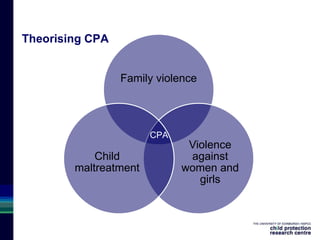
CPA
Theorising CPA
Family violence
Violence
against
women and
girls
Child
maltreatment
CPA
Some reflections on trajectories of CSA/CPA theory
• ‘Integrated frameworks’ less developed in CPA than CSA
• Recurrent themes:
• (Bio)psychosocial explanations proliferated
• Ecological systems approach highly influential
(Bronfenbrenner 1979, 1995; Belsky 1980)
• Person–situation interactions
• Continued importance of psychological theories
• CSA/CPA integrated theories remain PARTIAL
Key limitations within integrated theories
• The decentred child
• The universal child
• The dislocated child
Key limitation: the decentred child
• Mainly theories of being or becoming a ‘perpetrator’
rather than ‘perpetration’
• Child is absent, marginal, ambiguous: a generic
victim
• Aetiology: causes = blame
• Focuses away from victim
• Underplays complexity of dynamics of abuse
• Person – situation theories more dynamic
• feature perpetrator, victim, capable guardian
• but latter two positioned as a situational factor
Key limitation: the universal child
• Even within the Criminological theory the victim is sketchily
drawn
– Ageless, genderless, disembodied
• All acknowledge that empirical research tells us differences are
part of the dynamics of abuse
– Girls between 2 and 5 times more at risk of sexual violence
than boys (Stoltenborgh 2011, Finkelhor 2014)
– Lgb boys and girls experiencing higher levels of CSA and
CPA (Saewyc et al 2006)
– Disabled children 3 to 4 times more at risk of abuse (Sullivan
and Knutson 2000; Kvam 2004)
• But not fully accounted for at theoretical level
• Inattention to intersectionality
Key limitation: the dislocated child
• Social/cultural aspects acknowledged but understood differently
• Interpersonal factors, cultural factors, structural factors
• Target for intervention intimate relationships, cultural beliefs or
structural inequalities
• Little attention to structural equalities that maintain victimhood
(e.g. access to justice) and role of institutions
• Feminist theory influential but few attempts to integrated
• Need to integrate critical theories re patriarchy, disablism,
heterosexism/heteronormativity
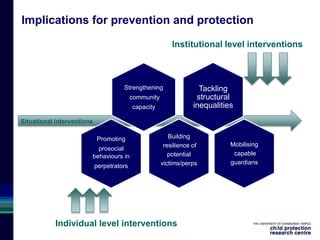
Implications for prevention and protection
Strengthening
community
capacity
Tackling
structural
inequalities
Mobilising
capable
guardians
Building
resilience of
potential
victims/perps
Promoting
prosocial
behaviours in
perpetrators
Individual level interventions
Institutional level interventions
Situational interventions
Acknowledgements:
Estelle Clayton
Research Assistant who joined the project in late 2014
NSPCC
Commissioned this research
Contact: Chris Jones - c.a.jones@ed.ac.uk
Thank you for listening

The "Aetiology" of Physical and Sexual Abuse of Children:

  • 1.
    The ‘Aetiology’ of Physicaland Sexual Abuse of Children: towards a comprehensive theory of prevention and protection Christine Jones, Julie Taylor, Jon Brown and Zain Kurdi
  • 2.
    Overview of theresearch Research Questions: 1. What is currently known about the causes and conditions associated with the perpetration of physical and sexual abuse against children? 2. What disciplinary approaches and theoretical orientations are employed by researchers to understand and explain the aetiology of physical and sexual abuse ? 3. To what extent are these approaches compatible when applied to a cross-cutting prevention agenda?
  • 3.
    Method: Literature Reviews •Review of CSA and CPA literature • Two elements: theory and evidence • Searches of computerised databases: ASSIA, Medline, Cinahl plus, IBSS, PsycInfo, PsycArticles • Hand searches of Child Abuse & Neglect, Child Abuse Review, Child Maltreatment, and Trauma, Violence and Abuse • Google scholar search • Reference list searches
  • 4.
    Defining terms andrecognising limitations • Focus on CSA and CPA rather than child maltreatment generally • Broad definitions of CSA and CPA used as a starting point • Inclusive approach to capture nuances, commonalities and differences • Focus on ‘integrated theories’ • Commissioned by NSPCC: a UK context
  • 5.
    Integrated theories ofCSA • Finkelhor's (1984) Four Precondition Model of CSA • Hall and Hirschman’s (1992) Quadripartite Model of sexual aggression against children • Ward and Siegert's (2002) Pathways Model of CSA • Smallbone, Marshall and Wortley’s (2008) New Integrated Theory of CSA • Marshall and Barbaree’s (1990) Integrated Theory of the Etiology of sexual offending • Ward and Beech’s (2006) Integrated Theory of Sexual Offending (ITSO)
  • 6.
    Integrated theories ofCPA • Gil’s (1970) multidimensional model of CPA • Coohey and Braun’s (1997) Integrated Framework for Understanding CPA CPA
  • 7.
  • 8.
    Some reflections ontrajectories of CSA/CPA theory • ‘Integrated frameworks’ less developed in CPA than CSA • Recurrent themes: • (Bio)psychosocial explanations proliferated • Ecological systems approach highly influential (Bronfenbrenner 1979, 1995; Belsky 1980) • Person–situation interactions • Continued importance of psychological theories • CSA/CPA integrated theories remain PARTIAL
  • 9.
    Key limitations withinintegrated theories • The decentred child • The universal child • The dislocated child
  • 10.
    Key limitation: thedecentred child • Mainly theories of being or becoming a ‘perpetrator’ rather than ‘perpetration’ • Child is absent, marginal, ambiguous: a generic victim • Aetiology: causes = blame • Focuses away from victim • Underplays complexity of dynamics of abuse • Person – situation theories more dynamic • feature perpetrator, victim, capable guardian • but latter two positioned as a situational factor
  • 11.
    Key limitation: theuniversal child • Even within the Criminological theory the victim is sketchily drawn – Ageless, genderless, disembodied • All acknowledge that empirical research tells us differences are part of the dynamics of abuse – Girls between 2 and 5 times more at risk of sexual violence than boys (Stoltenborgh 2011, Finkelhor 2014) – Lgb boys and girls experiencing higher levels of CSA and CPA (Saewyc et al 2006) – Disabled children 3 to 4 times more at risk of abuse (Sullivan and Knutson 2000; Kvam 2004) • But not fully accounted for at theoretical level • Inattention to intersectionality
  • 12.
    Key limitation: thedislocated child • Social/cultural aspects acknowledged but understood differently • Interpersonal factors, cultural factors, structural factors • Target for intervention intimate relationships, cultural beliefs or structural inequalities • Little attention to structural equalities that maintain victimhood (e.g. access to justice) and role of institutions • Feminist theory influential but few attempts to integrated • Need to integrate critical theories re patriarchy, disablism, heterosexism/heteronormativity
  • 13.
    Implications for preventionand protection Strengthening community capacity Tackling structural inequalities Mobilising capable guardians Building resilience of potential victims/perps Promoting prosocial behaviours in perpetrators Individual level interventions Institutional level interventions Situational interventions
  • 14.
    Acknowledgements: Estelle Clayton Research Assistantwho joined the project in late 2014 NSPCC Commissioned this research Contact: Chris Jones - c.a.jones@ed.ac.uk Thank you for listening