Abuse and Neglect
All Data Collected is from 2009 Unless Stated Otherwise


                          ITC
Overview

CHILD ABUSE AND NEGLECT

   RESULTS OF ABUSE

   ABUSE IN ARIZONA

   THE CHILD VICTIMS

TYPES OF MALTREATMENT

    CHILD FATALITIES

    PERPETRATORS

 REPORTING ABUSE OR
      NEGLECT
CHILD ABUSE AND
          NEGLECT

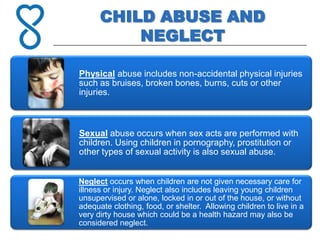
Physical abuse includes non-accidental physical injuries
such as bruises, broken bones, burns, cuts or other
injuries.


Sexual abuse occurs when sex acts are performed with
children. Using children in pornography, prostitution or
other types of sexual activity is also sexual abuse.


Neglect occurs when children are not given necessary care for
illness or injury. Neglect also includes leaving young children
unsupervised or alone, locked in or out of the house, or without
adequate clothing, food, or shelter. Allowing children to live in a
very dirty house which could be a health hazard may also be
considered neglect.
CHILD ABUSE AND
          NEGLECT
Emotional abuse of a child is evidenced by severe
anxiety, depression, withdrawal or improper aggressive
behavior as diagnosed by a medical doctor or
psychologist, and caused by the acts or omissions of the
parent or caretaker.


Exploitation means use of a child by a parent, guardian
or custodian for material gain.


Abandonment means the failure of the parent to provide
reasonable support and to maintain regular contact with
the child, including providing normal supervision, when
such failure is intentional and continues for an indefinite
period.
RESULTS OF ABUSE
• Abused children have an increased risk for adverse
  health effects and behaviors as adults
   – including smoking, alcoholism, drug abuse, suicide, sexual
     promiscuity, and certain chronic diseases.
• Child abuse can also lead to improper brain
  development.
• Acts of sexual assault can lead to the spread of
  sexually transmitted diseases such as AIDS, effect
  reproductive health, and cause severe emotional
  distress and withdraw.
THE CHILD VICTIMS

For 2009, more than 3.6 million (duplicate)
children were the subjects of at least one
report and received one or more dispositions.
The duplicate count of child victims counts a
child each time he or she was found to be a
victim. The unique count of child victims
counts a child only once.

The duplicate victim rate was 10.1 victims
per 1,000 children in the population, while the
unique victim rate was 9.3 victims per 1,000
children in the population. The number of
nationally estimated duplicate victims was
763,000; the number of nationally estimated
unique victims was 702,000.
THE CHILD VICTIMS


    Victims in the age group of birth to 1 year
    had the highest rate of victimization at
    20.6 per 1,000 children of the same age
    group in the national population.

    Victimization was split between the sexes
    with boys accounting for 48.2 percent and
    girls accounting for 51.1 percent.

    Eighty-seven percent of victims were
    comprised of three races or ethnicities—
    African-American (22.3%), Hispanic
    (20.7%), and White (44.0%).
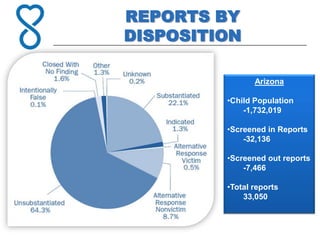
REPORTS BY
DISPOSITION

                Arizona

         •Child Population
             -1,732,019

         •Screened in Reports
             -32,136

         •Screened out reports
             -7,466

         •Total reports
             33,050
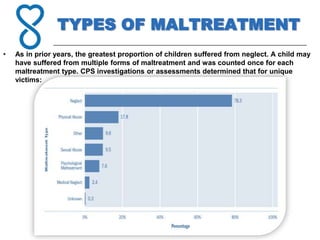
TYPES OF MALTREATMENT
•   As in prior years, the greatest proportion of children suffered from neglect. A child may
    have suffered from multiple forms of maltreatment and was counted once for each
    maltreatment type. CPS investigations or assessments determined that for unique
    victims:
CHILD FATALITIES FROM
                    ABUSE OR NEGLECT
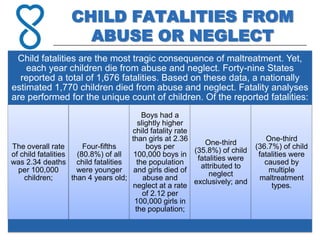
 Child fatalities are the most tragic consequence of maltreatment. Yet,
    each year children die from abuse and neglect. Forty-nine States
  reported a total of 1,676 fatalities. Based on these data, a nationally
estimated 1,770 children died from abuse and neglect. Fatality analyses
are performed for the unique count of children. Of the reported fatalities:
                                          Boys had a
                                        slightly higher
                                      child fatality rate
                                      than girls at 2.36                        One-third
                                                             One-third
The overall rate        Four-fifths        boys per                          (36.7%) of child
                                                          (35.8%) of child
of child fatalities   (80.8%) of all   100,000 boys in                        fatalities were
                                                           fatalities were
was 2.34 deaths child fatalities        the population                          caused by
                                                            attributed to
  per 100,000         were younger and girls died of                             multiple
                                                               neglect
    children;       than 4 years old;     abuse and                           maltreatment
                                                          exclusively; and
                                      neglect at a rate                           types.
                                          of 2.12 per
                                       100,000 girls in
                                       the population;
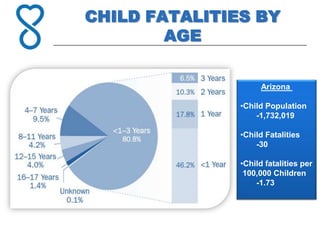
CHILD FATALITIES BY
        AGE


                     Arizona

               •Child Population
                   -1,732,019

               •Child Fatalities
                   -30

               •Child fatalities per
                100,000 Children
                   -1.73
PERPETRATORS
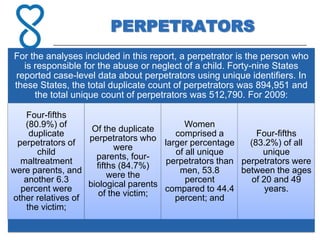
For the analyses included in this report, a perpetrator is the person who
  is responsible for the abuse or neglect of a child. Forty-nine States
reported case-level data about perpetrators using unique identifiers. In
these States, the total duplicate count of perpetrators was 894,951 and
     the total unique count of perpetrators was 512,790. For 2009:

   Four-fifths
   (80.9%) of                               Women
                    Of the duplicate
     duplicate                           comprised a         Four-fifths
                   perpetrators who
 perpetrators of                      larger percentage    (83.2%) of all
                           were
       child                             of all unique         unique
                     parents, four-
  maltreatment                         perpetrators than perpetrators were
                     fifths (84.7%)
were parents, and                         men, 53.8      between the ages
                         were the
   another 6.3                              percent         of 20 and 49
                   biological parents
  percent were                        compared to 44.4          years.
                      of the victim;
other relatives of                       percent; and
    the victim;
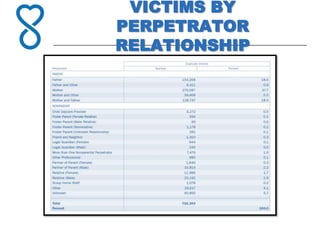
VICTIMS BY
PERPETRATOR
RELATIONSHIP
REPORTING ABUSE OR
                   NEGLECT
• Arizona law requires certain persons who suspect that a
  child has received non-accidental injury or has been
  neglected to report their concerns to CPS or local law
  enforcement.
• YOU may be a child’s only advocate at the time you report
  the possibility of abuse or neglect. Children often tell a
  person with whom they feel safe about abuse or neglect. If a
  child tells you of such experiences, act to protect that child
  by calling the toll free (1-888-767-2445).

        Arizona Child Abuse Hotline
             1-888-SOS-CHILD
WHO MUST REPORT?
• Any person who reasonably believes that a minor is or has been
  the victim of physical injury, abuse, child abuse, a reportable
  offense or neglect that appears to have been inflicted on the
  minor by other than accidental means or that is not explained
  by the available medical history as being accidental in
  nature, or who reasonably believes that there has been a
  denial or deprivation of necessary medical treatment or
  surgical care or nourishment with the intent to cause or allow
  the death of an infant who is protected under A.R.S. 36-
  2281, shall immediately report or cause reports to be made of
  this information to a peace office or to Child Protective Services
  in the Department of Economic Security, except if the report
  concerns a person who does not have care, custody or control
  of the minor, the report shall be made to a peace office only.
WHO MUST REPORT?


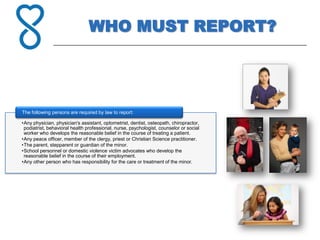
The following persons are required by law to report:

•Any physician, physician's assistant, optometrist, dentist, osteopath, chiropractor,
 podiatrist, behavioral health professional, nurse, psychologist, counselor or social
 worker who develops the reasonable belief in the course of treating a patient.
•Any peace officer, member of the clergy, priest or Christian Science practitioner.
•The parent, stepparent or guardian of the minor.
•School personnel or domestic violence victim advocates who develop the
 reasonable belief in the course of their employment.
•Any other person who has responsibility for the care or treatment of the minor.
WHO MUST REPORT?

  A person making a report or providing
  information about a child is immune from civil
  or criminal liability unless such person has
  been charged with, or is suspected of, the
  abuse or neglect in question.


  A person acting with malice who either
  knowingly and intentionally makes a false
  report of child abuse and neglect or who
  coerces another person to make a false report
  is guilty of a crime. A person who knowingly
  and intentionally falsely accuses another of
  maliciously making a false report of child
  abuse and neglect is also guilty of a crime.
WHEN TO REPORT?

• A report should be made when any person, who
  reasonably believes that a child under 18 has been
  abused, neglected, exploited or abandoned. A report
  of suspected abuse, neglect, exploitation or
  abandonment is only a request for an investigation.
  The person making the report does not need to
  prove the abuse. Investigation and validation of child
  abuse reports are the responsibilities of child
  protective service workers. If additional incidents of
  abuse occur after the initial report has been
  made, make another report.
WHEN TO REPORT?

When reporting, the following
information if known will be requested:
• name, age, and gender of child and other family
  members
• address, phone numbers, and/or directions to child's
  home
• parents' place of employment
• description of suspected abuse or neglect
• current condition of the child
WHAT HAPPENS TO THE
                  REPORT?
• A CPS Specialist will investigate the report through
  interviews with all children in the home, parents, friends,
  relatives, and any other person who may have
  information about the child and family. After
  investigation, if CPS has reason to believe that a parent
  guardian or custodian abused or neglected a child and
  intends to confirm this, a letter will be sent to the person
  accused explaining how an appeal of this decision may
  be requested and how to get a copy of the CPS report.
REMEMBER!

Arizona Child Abuse Hotline
     1-888-SOS-CHILD
          (1-888-767-2445)


 A report of suspected child
abuse, neglect, exploitation or
abandonment is a responsible
  attempt to protect a child.

Abuse & neglect

  • 1.
    Abuse and Neglect AllData Collected is from 2009 Unless Stated Otherwise ITC
  • 2.
    Overview CHILD ABUSE ANDNEGLECT RESULTS OF ABUSE ABUSE IN ARIZONA THE CHILD VICTIMS TYPES OF MALTREATMENT CHILD FATALITIES PERPETRATORS REPORTING ABUSE OR NEGLECT
  • 3.
    CHILD ABUSE AND NEGLECT Physical abuse includes non-accidental physical injuries such as bruises, broken bones, burns, cuts or other injuries. Sexual abuse occurs when sex acts are performed with children. Using children in pornography, prostitution or other types of sexual activity is also sexual abuse. Neglect occurs when children are not given necessary care for illness or injury. Neglect also includes leaving young children unsupervised or alone, locked in or out of the house, or without adequate clothing, food, or shelter. Allowing children to live in a very dirty house which could be a health hazard may also be considered neglect.
  • 4.
    CHILD ABUSE AND NEGLECT Emotional abuse of a child is evidenced by severe anxiety, depression, withdrawal or improper aggressive behavior as diagnosed by a medical doctor or psychologist, and caused by the acts or omissions of the parent or caretaker. Exploitation means use of a child by a parent, guardian or custodian for material gain. Abandonment means the failure of the parent to provide reasonable support and to maintain regular contact with the child, including providing normal supervision, when such failure is intentional and continues for an indefinite period.
  • 5.
    RESULTS OF ABUSE •Abused children have an increased risk for adverse health effects and behaviors as adults – including smoking, alcoholism, drug abuse, suicide, sexual promiscuity, and certain chronic diseases. • Child abuse can also lead to improper brain development. • Acts of sexual assault can lead to the spread of sexually transmitted diseases such as AIDS, effect reproductive health, and cause severe emotional distress and withdraw.
  • 6.
    THE CHILD VICTIMS For2009, more than 3.6 million (duplicate) children were the subjects of at least one report and received one or more dispositions. The duplicate count of child victims counts a child each time he or she was found to be a victim. The unique count of child victims counts a child only once. The duplicate victim rate was 10.1 victims per 1,000 children in the population, while the unique victim rate was 9.3 victims per 1,000 children in the population. The number of nationally estimated duplicate victims was 763,000; the number of nationally estimated unique victims was 702,000.
  • 7.
    THE CHILD VICTIMS Victims in the age group of birth to 1 year had the highest rate of victimization at 20.6 per 1,000 children of the same age group in the national population. Victimization was split between the sexes with boys accounting for 48.2 percent and girls accounting for 51.1 percent. Eighty-seven percent of victims were comprised of three races or ethnicities— African-American (22.3%), Hispanic (20.7%), and White (44.0%).
  • 8.
    REPORTS BY DISPOSITION Arizona •Child Population -1,732,019 •Screened in Reports -32,136 •Screened out reports -7,466 •Total reports 33,050
  • 9.
    TYPES OF MALTREATMENT • As in prior years, the greatest proportion of children suffered from neglect. A child may have suffered from multiple forms of maltreatment and was counted once for each maltreatment type. CPS investigations or assessments determined that for unique victims:
  • 10.
    CHILD FATALITIES FROM ABUSE OR NEGLECT Child fatalities are the most tragic consequence of maltreatment. Yet, each year children die from abuse and neglect. Forty-nine States reported a total of 1,676 fatalities. Based on these data, a nationally estimated 1,770 children died from abuse and neglect. Fatality analyses are performed for the unique count of children. Of the reported fatalities: Boys had a slightly higher child fatality rate than girls at 2.36 One-third One-third The overall rate Four-fifths boys per (36.7%) of child (35.8%) of child of child fatalities (80.8%) of all 100,000 boys in fatalities were fatalities were was 2.34 deaths child fatalities the population caused by attributed to per 100,000 were younger and girls died of multiple neglect children; than 4 years old; abuse and maltreatment exclusively; and neglect at a rate types. of 2.12 per 100,000 girls in the population;
  • 11.
    CHILD FATALITIES BY AGE Arizona •Child Population -1,732,019 •Child Fatalities -30 •Child fatalities per 100,000 Children -1.73
  • 12.
    PERPETRATORS For the analysesincluded in this report, a perpetrator is the person who is responsible for the abuse or neglect of a child. Forty-nine States reported case-level data about perpetrators using unique identifiers. In these States, the total duplicate count of perpetrators was 894,951 and the total unique count of perpetrators was 512,790. For 2009: Four-fifths (80.9%) of Women Of the duplicate duplicate comprised a Four-fifths perpetrators who perpetrators of larger percentage (83.2%) of all were child of all unique unique parents, four- maltreatment perpetrators than perpetrators were fifths (84.7%) were parents, and men, 53.8 between the ages were the another 6.3 percent of 20 and 49 biological parents percent were compared to 44.4 years. of the victim; other relatives of percent; and the victim;
  • 13.
  • 14.
    REPORTING ABUSE OR NEGLECT • Arizona law requires certain persons who suspect that a child has received non-accidental injury or has been neglected to report their concerns to CPS or local law enforcement. • YOU may be a child’s only advocate at the time you report the possibility of abuse or neglect. Children often tell a person with whom they feel safe about abuse or neglect. If a child tells you of such experiences, act to protect that child by calling the toll free (1-888-767-2445). Arizona Child Abuse Hotline 1-888-SOS-CHILD
  • 15.
    WHO MUST REPORT? •Any person who reasonably believes that a minor is or has been the victim of physical injury, abuse, child abuse, a reportable offense or neglect that appears to have been inflicted on the minor by other than accidental means or that is not explained by the available medical history as being accidental in nature, or who reasonably believes that there has been a denial or deprivation of necessary medical treatment or surgical care or nourishment with the intent to cause or allow the death of an infant who is protected under A.R.S. 36- 2281, shall immediately report or cause reports to be made of this information to a peace office or to Child Protective Services in the Department of Economic Security, except if the report concerns a person who does not have care, custody or control of the minor, the report shall be made to a peace office only.
  • 16.
    WHO MUST REPORT? Thefollowing persons are required by law to report: •Any physician, physician's assistant, optometrist, dentist, osteopath, chiropractor, podiatrist, behavioral health professional, nurse, psychologist, counselor or social worker who develops the reasonable belief in the course of treating a patient. •Any peace officer, member of the clergy, priest or Christian Science practitioner. •The parent, stepparent or guardian of the minor. •School personnel or domestic violence victim advocates who develop the reasonable belief in the course of their employment. •Any other person who has responsibility for the care or treatment of the minor.
  • 17.
    WHO MUST REPORT? A person making a report or providing information about a child is immune from civil or criminal liability unless such person has been charged with, or is suspected of, the abuse or neglect in question. A person acting with malice who either knowingly and intentionally makes a false report of child abuse and neglect or who coerces another person to make a false report is guilty of a crime. A person who knowingly and intentionally falsely accuses another of maliciously making a false report of child abuse and neglect is also guilty of a crime.
  • 18.
    WHEN TO REPORT? •A report should be made when any person, who reasonably believes that a child under 18 has been abused, neglected, exploited or abandoned. A report of suspected abuse, neglect, exploitation or abandonment is only a request for an investigation. The person making the report does not need to prove the abuse. Investigation and validation of child abuse reports are the responsibilities of child protective service workers. If additional incidents of abuse occur after the initial report has been made, make another report.
  • 19.
    WHEN TO REPORT? Whenreporting, the following information if known will be requested: • name, age, and gender of child and other family members • address, phone numbers, and/or directions to child's home • parents' place of employment • description of suspected abuse or neglect • current condition of the child
  • 20.
    WHAT HAPPENS TOTHE REPORT? • A CPS Specialist will investigate the report through interviews with all children in the home, parents, friends, relatives, and any other person who may have information about the child and family. After investigation, if CPS has reason to believe that a parent guardian or custodian abused or neglected a child and intends to confirm this, a letter will be sent to the person accused explaining how an appeal of this decision may be requested and how to get a copy of the CPS report.
  • 21.
    REMEMBER! Arizona Child AbuseHotline 1-888-SOS-CHILD (1-888-767-2445) A report of suspected child abuse, neglect, exploitation or abandonment is a responsible attempt to protect a child.