 The World Health Organization defines child abuse as, "all
forms of physical and/or emotional ill-treatment, sexual
abuse, neglect or negligent treatment or commercial or other
exploitation, resulting in actual or potential harm to the
child's health, survival, development or dignity in the context
of a relationship of responsibility, trust or power.”
 Child abuse may include any act or failure to act by a parent
or a caregiver that results in actual or potential harm to a
child, and can occur in a child's home, or in the
organizations, schools or communities the child interacts
with.
 The study of child abuse and neglect emerged as an
academic discipline in the early 1970s in the United States.
THE MAJOR TYPES OF CHILD ABUSE
ARE AS FOLLOWS:
SEXUAL ABUSE
PSYCHOLOGICAL / EMOTIONAL ABUSE
NEGLECT
PHYSICAL ABUSE
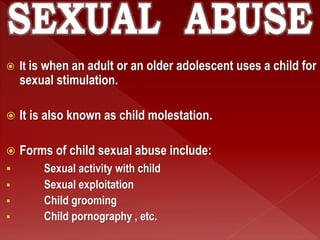
 It is when an adult or an older adolescent uses a child for
sexual stimulation.
 It is also known as child molestation.
 Forms of child sexual abuse include:
 Sexual activity with child
 Sexual exploitation
 Child grooming
 Child pornography , etc.
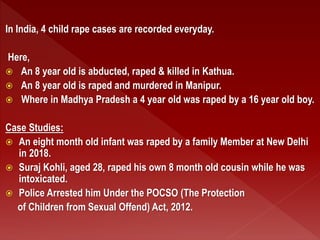
In India, 4 child rape cases are recorded everyday.
Here,
 An 8 year old is abducted, raped & killed in Kathua.
 An 8 year old is raped and murdered in Manipur.
 Where in Madhya Pradesh a 4 year old was raped by a 16 year old boy.
Case Studies:
 An eight month old infant was raped by a family Member at New Delhi
in 2018.
 Suraj Kohli, aged 28, raped his own 8 month old cousin while he was
intoxicated.
 Police Arrested him Under the POCSO (The Protection
of Children from Sexual Offend) Act, 2012.
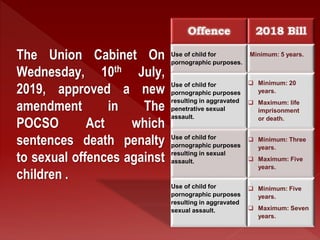
The Union Cabinet On
Wednesday, 10th July,
2019, approved a new
amendment in The
POCSO Act which
sentences death penalty
to sexual offences against
children .
Offence 2018 Bill
Use of child for
pornographic purposes.
Minimum: 5 years.
Use of child for
pornographic purposes
resulting in aggravated
penetrative sexual
assault.
 Minimum: 20
years.
 Maximum: life
imprisonment
or death.
Use of child for
pornographic purposes
resulting in sexual
assault.
 Minimum: Three
years.
 Maximum: Five
years.
Use of child for
pornographic purposes
resulting in aggravated
sexual assault.
 Minimum: Five
years.
 Maximum: Seven
years.
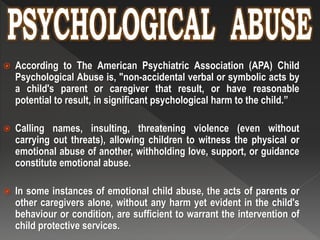
 According to The American Psychiatric Association (APA) Child
Psychological Abuse is, "non-accidental verbal or symbolic acts by
a child's parent or caregiver that result, or have reasonable
potential to result, in significant psychological harm to the child.”
 Calling names, insulting, threatening violence (even without
carrying out threats), allowing children to witness the physical or
emotional abuse of another, withholding love, support, or guidance
constitute emotional abuse.
 In some instances of emotional child abuse, the acts of parents or
other caregivers alone, without any harm yet evident in the child's
behaviour or condition, are sufficient to warrant the intervention of
child protective services.
 Child neglect is defined as any confirmed or suspected egregious act
or omission by a parent or other caregiver that deprives a child of
basic age-appropriate needs and thereby results, or has reasonable
potential to result, in physical or psychological harm
 Child neglect depends on how a child and society perceives the
parents’ behaviour; it is not how parents believe they are behaving
towards their child.
 Causes of neglect may result from several parenting problems
including mental disorders, substance abuse, domestic violence,
unemployment, unplanned pregnancy, and poverty. The
circumstances and intentionality must be examined before defining
behaviour as neglectful.
TYPES OF NEGLECT
 Physical neglect refers to the failure to provide a child with basic
necessities of life such as food and clothing.
 Medical neglect is the failure of caregivers to meet a child’s basic
health care needs.
 Emotional neglect is failing to provide emotional support such as
emotional security and encouragement.
 Educational/developmental neglect is the failure to provide a child
with experiences for necessary growth and development.
 Depending on the laws and child protective policies in one's area,
leaving a young child unsupervised may be considered neglect,
especially if doing so places the child in danger.
Emotional abuse as well as child neglect both are difficult
to define. A wide range of behaviours can be considered
abusive, and all forms are thought to be underreported,
since it can be difficult to detect as well as to document.
Psychological abuse against children has been allotted
even less attention globally than physical and sexual
abuse.
Cultural factors appear strongly to influence the non-
physical techniques that parents choose to discipline
their children – some of which may be regarded by people
from other cultural backgrounds as psychologically
harmful.
 Physical child abuse is physical injury inflicted
upon the child with cruel and/or malicious intent.
 Physical abuse can be the result of punching,
beating, kicking, biting, burning, shaking, or
otherwise harming a child physically.
 Easiest form of maltreatment to be identified.
 Often the abuse stems from an angry response of
caretaker to punish the child for misbehaviour.
 Most commonly recognized by clinical findings, but
the history is a helpful tool when child reports with
non descriptive findings.
 Identifying factors elucidated in history and clinical
examination.
 Refers to injuries sustained by a child as a result of
physical abuse inflicted by an adult caregiver.
 Initially described by DR. C Henry Kempe and
colleagues in 1962.
 Elaborated further by Kempe and Helfer in 1972.
 Clinical picture of physical trauma in which the
explanation of injury was not consistent with the
severity and type of injury observed.
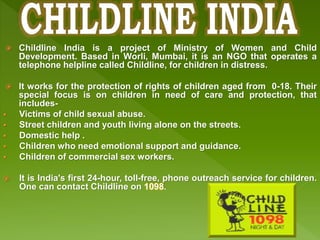
 Childline India is a project of Ministry of Women and Child
Development. Based in Worli, Mumbai, it is an NGO that operates a
telephone helpline called Childline, for children in distress.
 It works for the protection of rights of children aged from 0-18. Their
special focus is on children in need of care and protection, that
includes-
 Victims of child sexual abuse.
 Street children and youth living alone on the streets.
 Domestic help .
 Children who need emotional support and guidance.
 Children of commercial sex workers.
 It is India's first 24-hour, toll-free, phone outreach service for children.
One can contact Childline on 1098.
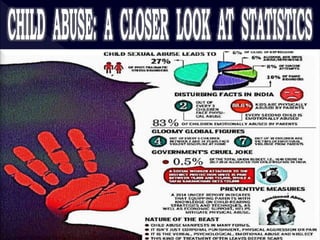
 More than 50% of crimes against children have been recorded in just five States,
namely Uttar Pradesh, Maharashtra, Madhya Pradesh, Delhi UT and West Bengal.
While Uttar Pradesh records the highest number of cases with 15% of recorded
crimes against children, followed by Maharashtra (14%) and Madhya Pradesh
(13%).
 A 2017 government study revealed that half of the 9,000 childcare institutions
across the country were unregistered, many running illegally. A number of
reports submitted to the government in the past five years outlined substandard
conditions in the shelters for children
 India performed poorly in the Kids’ Right Index 2019, ranking 117th out of 181
countries.
 Although child abuse is a global issue, it is still considered a taboo
subject.
 Victims of child abuse are at a greater risk for developing mental health
issues. The severity of these problems depends on the time that abuse
first began, how long it lasted and the severity of abuse.
 There’s a dire need to sensitize and educate children about issues
pertaining to maltreatment/abuse.
 Schools/institutions should implement proper mechanisms to ensure that
CCTV camera are put up at appropriate places. Staff must be sensitized
towards a victim’s needs. A major step to combat the issue is to employ
counsellors and advisors who are well-equipped to deal with such
situations.
 The community at large should support victims and parents and take
responsibility for preventing abuse, gender equity, awareness on child
rights and child protection issues.
• https://encrypted-
tbn0.gstatic.com/images?q=tbn%3AANd9GcQyETr_4a7yHPsdiiuZUHorg3Zc7feu_ChZPw&usqp=CA
U
• http://apps.who.int/iris/bitstream/10665/65900/1/WHO_HSC
• https://www.who.int/violence_injury_prevention/violence/global_campaign/en/chap3.pdf
• https://en.wikipedia.org/wiki/Child_abuse
• https://en.wikipedia.org/wiki/Child_sexual_abuse#:~:text=Child%20sexual%20abuse%2C%20also%2
0called,a%20child%20for%20sexual%20stimulation.
• https://www.hindustantimes.com/india-news/kathua-chargesheet-reveals-gory-details-of-how-8-yr-old-
was-raped-bludgeoned/story-UNKVij0yKD6FGWbGSdgu9O.html
• https://timesofindia.indiatimes.com/topic/Rape-of-Manipur-girl/3
• https://www.ndtv.com/india-news/minor-boy-rapes-4-year-old-girl-in-madhya-pradesh-1901674
• https://www.bbc.com/news/world-asia-india-
42869010#:~:text=An%20eight%2Dmonth%2Dold%20baby,28%2Dyear%2Dold%20cousin.
• https://www.firstpost.com/india/union-cabinet-approves-amendments-to-pocso-act-by-including-death-
penalty-for-aggravated-sexual-assault-on-children-6971841.html
• https://www.prsindia.org/billtrack/protection-children-sexual-offences-amendment-bill-2019-0
• https://www.hopkinsguides.com/hopkins/view/Johns_Hopkins_Psychiatry_Guide/787122/all/Abuse_a
nd_Neglect
• https://www.healthline.com/health/child-neglect-and-psychological-abuse
• https://www.medicinenet.com/script/main/art.asp?articlekey=8370
• https://www.psychologytoday.com/us/conditions/child-neglect
• https://en.wikipedia.org/wiki/Child_neglect
• https://www.medicinenet.com/script/main/art.asp?articlekey=8369
• https://www.slideshare.net/DivyaGaur3/child-abuse-and-neglect-56040202
• https://www.ncbi.nlm.nih.gov/pmc/articles/PMC4614596/#:~:text=Child%20abuse%20is%20referred%20to,%
E2%80%9D%20(7%2C%208).
• https://en.wikipedia.org/wiki/Childline_India
• https://www.childlineindia.org/
• https://www.google.com/url?sa=i&url=https%3A%2F%2Fwww.girlsnotbrides.org%2Fmembers%2Fchildline-
india-foundation-
cif%2F&psig=AOvVaw1DKPoAHIZR23DIi_Bhx3Xr&ust=1604575770931000&source=images&cd=vfe&ved=0
CA0QjhxqFwoTCLD-0Njk6OwCFQAAAAAdAAAAABAD
• https://www.google.com/url?sa=i&url=https%3A%2F%2Fwww.deccanchronicle.com%2Fdiscourse%2F12111
7%2Fabusive-parents-dont-skip-this-
page.html&psig=AOvVaw1_7M8wyFL9hzKHzeP2al7d&ust=1604579186886000&source=images&cd=vfe&ve
d=0CA0QjhxqFwoTCNiDrrbx6OwCFQAAAAAdAAAAABAD
• https://www.cry.org/wp-content/uploads/2018/01/CRY-Media-release-Crime-against-Children-2017.pdf
• https://www.dw.com/en/sexual-abuse-cases-and-indias-failure-to-protect-children/a-45003832
• https://www.deccanchronicle.com/nation/current-affairs/170519/india-performs-poorly-in-kids-right-index-
ranks-
117.html#:~:text=Hyderabad%3A%20India%20stands%20in%20a,equipped%20to%20improve%20child%20r
ights.
• https://neurosciencenews.com/child-abuse-mental-health-
9981/#:~:text=Children%20who%20are%20physically%20or,University%20of%20Alabama%20at%20Birming
ham.
• https://www.deccanchronicle.com/nation/current-affairs/130917/child-safety-schools-up-security-
measures.html

Child Abuse

  • 2.
     The WorldHealth Organization defines child abuse as, "all forms of physical and/or emotional ill-treatment, sexual abuse, neglect or negligent treatment or commercial or other exploitation, resulting in actual or potential harm to the child's health, survival, development or dignity in the context of a relationship of responsibility, trust or power.”  Child abuse may include any act or failure to act by a parent or a caregiver that results in actual or potential harm to a child, and can occur in a child's home, or in the organizations, schools or communities the child interacts with.  The study of child abuse and neglect emerged as an academic discipline in the early 1970s in the United States.
  • 3.
    THE MAJOR TYPESOF CHILD ABUSE ARE AS FOLLOWS: SEXUAL ABUSE PSYCHOLOGICAL / EMOTIONAL ABUSE NEGLECT PHYSICAL ABUSE
  • 4.
     It iswhen an adult or an older adolescent uses a child for sexual stimulation.  It is also known as child molestation.  Forms of child sexual abuse include:  Sexual activity with child  Sexual exploitation  Child grooming  Child pornography , etc.
  • 5.
    In India, 4child rape cases are recorded everyday. Here,  An 8 year old is abducted, raped & killed in Kathua.  An 8 year old is raped and murdered in Manipur.  Where in Madhya Pradesh a 4 year old was raped by a 16 year old boy. Case Studies:  An eight month old infant was raped by a family Member at New Delhi in 2018.  Suraj Kohli, aged 28, raped his own 8 month old cousin while he was intoxicated.  Police Arrested him Under the POCSO (The Protection of Children from Sexual Offend) Act, 2012.
  • 6.
    The Union CabinetOn Wednesday, 10th July, 2019, approved a new amendment in The POCSO Act which sentences death penalty to sexual offences against children . Offence 2018 Bill Use of child for pornographic purposes. Minimum: 5 years. Use of child for pornographic purposes resulting in aggravated penetrative sexual assault.  Minimum: 20 years.  Maximum: life imprisonment or death. Use of child for pornographic purposes resulting in sexual assault.  Minimum: Three years.  Maximum: Five years. Use of child for pornographic purposes resulting in aggravated sexual assault.  Minimum: Five years.  Maximum: Seven years.
  • 7.
     According toThe American Psychiatric Association (APA) Child Psychological Abuse is, "non-accidental verbal or symbolic acts by a child's parent or caregiver that result, or have reasonable potential to result, in significant psychological harm to the child.”  Calling names, insulting, threatening violence (even without carrying out threats), allowing children to witness the physical or emotional abuse of another, withholding love, support, or guidance constitute emotional abuse.  In some instances of emotional child abuse, the acts of parents or other caregivers alone, without any harm yet evident in the child's behaviour or condition, are sufficient to warrant the intervention of child protective services.
  • 8.
     Child neglectis defined as any confirmed or suspected egregious act or omission by a parent or other caregiver that deprives a child of basic age-appropriate needs and thereby results, or has reasonable potential to result, in physical or psychological harm  Child neglect depends on how a child and society perceives the parents’ behaviour; it is not how parents believe they are behaving towards their child.  Causes of neglect may result from several parenting problems including mental disorders, substance abuse, domestic violence, unemployment, unplanned pregnancy, and poverty. The circumstances and intentionality must be examined before defining behaviour as neglectful.
  • 9.
    TYPES OF NEGLECT Physical neglect refers to the failure to provide a child with basic necessities of life such as food and clothing.  Medical neglect is the failure of caregivers to meet a child’s basic health care needs.  Emotional neglect is failing to provide emotional support such as emotional security and encouragement.  Educational/developmental neglect is the failure to provide a child with experiences for necessary growth and development.  Depending on the laws and child protective policies in one's area, leaving a young child unsupervised may be considered neglect, especially if doing so places the child in danger.
  • 10.
    Emotional abuse aswell as child neglect both are difficult to define. A wide range of behaviours can be considered abusive, and all forms are thought to be underreported, since it can be difficult to detect as well as to document. Psychological abuse against children has been allotted even less attention globally than physical and sexual abuse. Cultural factors appear strongly to influence the non- physical techniques that parents choose to discipline their children – some of which may be regarded by people from other cultural backgrounds as psychologically harmful.
  • 11.
     Physical childabuse is physical injury inflicted upon the child with cruel and/or malicious intent.  Physical abuse can be the result of punching, beating, kicking, biting, burning, shaking, or otherwise harming a child physically.
  • 12.
     Easiest formof maltreatment to be identified.  Often the abuse stems from an angry response of caretaker to punish the child for misbehaviour.  Most commonly recognized by clinical findings, but the history is a helpful tool when child reports with non descriptive findings.  Identifying factors elucidated in history and clinical examination.
  • 13.
     Refers toinjuries sustained by a child as a result of physical abuse inflicted by an adult caregiver.  Initially described by DR. C Henry Kempe and colleagues in 1962.  Elaborated further by Kempe and Helfer in 1972.  Clinical picture of physical trauma in which the explanation of injury was not consistent with the severity and type of injury observed.
  • 14.
     Childline Indiais a project of Ministry of Women and Child Development. Based in Worli, Mumbai, it is an NGO that operates a telephone helpline called Childline, for children in distress.  It works for the protection of rights of children aged from 0-18. Their special focus is on children in need of care and protection, that includes-  Victims of child sexual abuse.  Street children and youth living alone on the streets.  Domestic help .  Children who need emotional support and guidance.  Children of commercial sex workers.  It is India's first 24-hour, toll-free, phone outreach service for children. One can contact Childline on 1098.
  • 16.
     More than50% of crimes against children have been recorded in just five States, namely Uttar Pradesh, Maharashtra, Madhya Pradesh, Delhi UT and West Bengal. While Uttar Pradesh records the highest number of cases with 15% of recorded crimes against children, followed by Maharashtra (14%) and Madhya Pradesh (13%).  A 2017 government study revealed that half of the 9,000 childcare institutions across the country were unregistered, many running illegally. A number of reports submitted to the government in the past five years outlined substandard conditions in the shelters for children  India performed poorly in the Kids’ Right Index 2019, ranking 117th out of 181 countries.
  • 17.
     Although childabuse is a global issue, it is still considered a taboo subject.  Victims of child abuse are at a greater risk for developing mental health issues. The severity of these problems depends on the time that abuse first began, how long it lasted and the severity of abuse.  There’s a dire need to sensitize and educate children about issues pertaining to maltreatment/abuse.  Schools/institutions should implement proper mechanisms to ensure that CCTV camera are put up at appropriate places. Staff must be sensitized towards a victim’s needs. A major step to combat the issue is to employ counsellors and advisors who are well-equipped to deal with such situations.  The community at large should support victims and parents and take responsibility for preventing abuse, gender equity, awareness on child rights and child protection issues.
  • 18.
    • https://encrypted- tbn0.gstatic.com/images?q=tbn%3AANd9GcQyETr_4a7yHPsdiiuZUHorg3Zc7feu_ChZPw&usqp=CA U • http://apps.who.int/iris/bitstream/10665/65900/1/WHO_HSC •https://www.who.int/violence_injury_prevention/violence/global_campaign/en/chap3.pdf • https://en.wikipedia.org/wiki/Child_abuse • https://en.wikipedia.org/wiki/Child_sexual_abuse#:~:text=Child%20sexual%20abuse%2C%20also%2 0called,a%20child%20for%20sexual%20stimulation. • https://www.hindustantimes.com/india-news/kathua-chargesheet-reveals-gory-details-of-how-8-yr-old- was-raped-bludgeoned/story-UNKVij0yKD6FGWbGSdgu9O.html • https://timesofindia.indiatimes.com/topic/Rape-of-Manipur-girl/3 • https://www.ndtv.com/india-news/minor-boy-rapes-4-year-old-girl-in-madhya-pradesh-1901674 • https://www.bbc.com/news/world-asia-india- 42869010#:~:text=An%20eight%2Dmonth%2Dold%20baby,28%2Dyear%2Dold%20cousin. • https://www.firstpost.com/india/union-cabinet-approves-amendments-to-pocso-act-by-including-death- penalty-for-aggravated-sexual-assault-on-children-6971841.html • https://www.prsindia.org/billtrack/protection-children-sexual-offences-amendment-bill-2019-0 • https://www.hopkinsguides.com/hopkins/view/Johns_Hopkins_Psychiatry_Guide/787122/all/Abuse_a nd_Neglect • https://www.healthline.com/health/child-neglect-and-psychological-abuse • https://www.medicinenet.com/script/main/art.asp?articlekey=8370 • https://www.psychologytoday.com/us/conditions/child-neglect • https://en.wikipedia.org/wiki/Child_neglect • https://www.medicinenet.com/script/main/art.asp?articlekey=8369 • https://www.slideshare.net/DivyaGaur3/child-abuse-and-neglect-56040202
  • 19.
    • https://www.ncbi.nlm.nih.gov/pmc/articles/PMC4614596/#:~:text=Child%20abuse%20is%20referred%20to,% E2%80%9D%20(7%2C%208). • https://en.wikipedia.org/wiki/Childline_India •https://www.childlineindia.org/ • https://www.google.com/url?sa=i&url=https%3A%2F%2Fwww.girlsnotbrides.org%2Fmembers%2Fchildline- india-foundation- cif%2F&psig=AOvVaw1DKPoAHIZR23DIi_Bhx3Xr&ust=1604575770931000&source=images&cd=vfe&ved=0 CA0QjhxqFwoTCLD-0Njk6OwCFQAAAAAdAAAAABAD • https://www.google.com/url?sa=i&url=https%3A%2F%2Fwww.deccanchronicle.com%2Fdiscourse%2F12111 7%2Fabusive-parents-dont-skip-this- page.html&psig=AOvVaw1_7M8wyFL9hzKHzeP2al7d&ust=1604579186886000&source=images&cd=vfe&ve d=0CA0QjhxqFwoTCNiDrrbx6OwCFQAAAAAdAAAAABAD • https://www.cry.org/wp-content/uploads/2018/01/CRY-Media-release-Crime-against-Children-2017.pdf • https://www.dw.com/en/sexual-abuse-cases-and-indias-failure-to-protect-children/a-45003832 • https://www.deccanchronicle.com/nation/current-affairs/170519/india-performs-poorly-in-kids-right-index- ranks- 117.html#:~:text=Hyderabad%3A%20India%20stands%20in%20a,equipped%20to%20improve%20child%20r ights. • https://neurosciencenews.com/child-abuse-mental-health- 9981/#:~:text=Children%20who%20are%20physically%20or,University%20of%20Alabama%20at%20Birming ham. • https://www.deccanchronicle.com/nation/current-affairs/130917/child-safety-schools-up-security- measures.html