Dr Khurshid Khan
Ministry of Health
      UAE
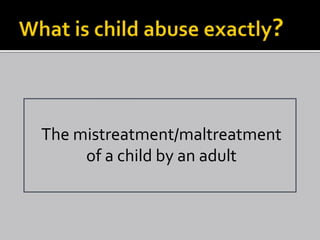
The mistreatment/maltreatment
     of a child by an adult
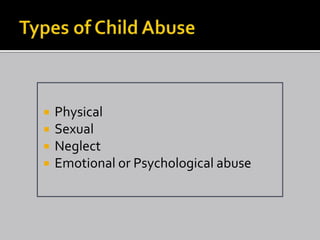
   Physical
   Sexual
   Neglect
   Emotional or Psychological abuse
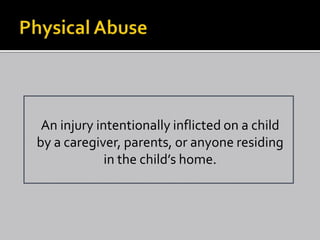
An injury intentionally inflicted on a child
by a caregiver, parents, or anyone residing
             in the child’s home.
The use of a child for sexual gratification or
  financial gain, by an adult,older child, or
      adolescent, whether by physical
       force, coercion, or persuasion.
Acts or omissions by the perpetrator that fail
 to meet the child’s needs for basic
 living, including food, hygiene, medical
 care, clothing, and a safe warm
 environment.
Verbal abuse or excessive demands on the
        child that result In impaired
     growth, negative self-image, and
         disturbed child behavior.
 Apart from the obvious physical signs of abuse
  (eg, death, traumatic brain
  injury, disfigurement), long-term mental health
  consequences of physical abuse include
  violence, criminal behavior, substance
  abuse, self-injurious and suicidal
  behavior, depression, anxiety, and other mental
  health problems.
 A small but significant number of abused
  children, although by no means a majority, later
  abuse their own children
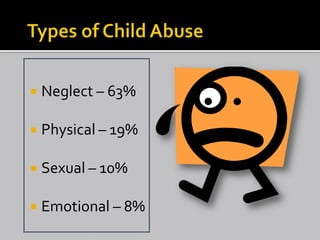
   Neglect – 63%

   Physical – 19%

   Sexual – 10%

   Emotional – 8%
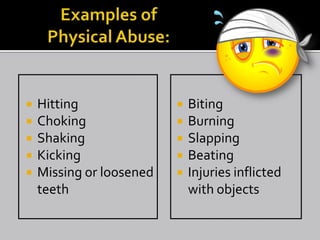
   Hitting                  Biting
   Choking                  Burning
   Shaking                  Slapping
   Kicking                  Beating
   Missing or loosened      Injuries inflicted
    teeth                     with objects
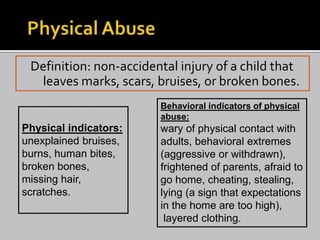
Definition: non-accidental injury of a child that
  leaves marks, scars, bruises, or broken bones.
                        Behavioral indicators of physical
                        abuse:
Physical indicators:    wary of physical contact with
unexplained bruises,    adults, behavioral extremes
burns, human bites,     (aggressive or withdrawn),
broken bones,           frightened of parents, afraid to
missing hair,           go home, cheating, stealing,
scratches.              lying (a sign that expectations
                        in the home are too high),
                         layered clothing.
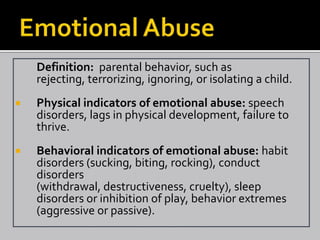
Definition: parental behavior, such as
    rejecting, terrorizing, ignoring, or isolating a child.
   Physical indicators of emotional abuse: speech
    disorders, lags in physical development, failure to
    thrive.
   Behavioral indicators of emotional abuse: habit
    disorders (sucking, biting, rocking), conduct
    disorders
    (withdrawal, destructiveness, cruelty), sleep
    disorders or inhibition of play, behavior extremes
    (aggressive or passive).
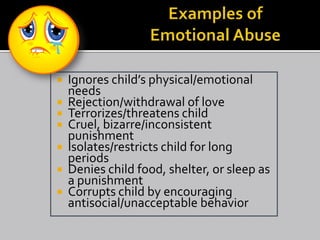
 Ignores child’s physical/emotional
  needs
 Rejection/withdrawal of love
 Terrorizes/threatens child
 Cruel, bizarre/inconsistent
  punishment
 Isolates/restricts child for long
  periods
 Denies child food, shelter, or sleep as
  a punishment
 Corrupts child by encouraging
  antisocial/unacceptable behavior
   Definition: any inappropriate sexual exposure or touch by
    an adult to a child or an older child to a younger child.
   Physical indicators of sexual abuse: difficulty in walking or
    sitting, torn, stained, or bloody underclothing, pain or
    itching in genital area, bruises or bleeding in rectal/genital
    area, venereal disease.
   Behavioral indicators of sexual abuse: age-inappropriate
    sexual knowledge/sexual touch, abrupt change in
    personality, withdrawn, poor peer relationships, unwilling
    to change for gym or participate in physical
    activities, promiscuous behavior/seductive behavior, drop
    in school performance/decline in school interest, sleep
    disturbances, regressive behavior (i.e., bed wetting).
 Fondling
 Indecent exposure
 Showing pornographic materials
 Touching sexual organs
    ď‚§ (of the child or the adult)
 Attempted or actual sexual intercourse
 Child prostitution
 Incest
Definition: failure of parents or caretakers to provide
    needed, age appropriate care including
    food, clothing, shelter, protection from harm, hygiene, and
    medical care.
   Physical indicators of neglect: constant hunger, poor
    hygiene, excessive sleepiness, lack of appropriate
    supervision, unattended physical problems or medical
    needs, abandonment, inappropriate clothing for weather
    conditions.
   Behavioral indicators of neglect: begging or stealing
    food, frequent sleepiness, lack of appropriate
    supervision, unattended physical problem or medical
    needs, abandonment, inappropriate clothing for weather
    conditions.
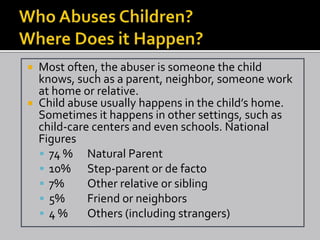
 Most often, the abuser is someone the child
  knows, such as a parent, neighbor, someone work
  at home or relative.
 Child abuse usually happens in the child’s home.
  Sometimes it happens in other settings, such as
  child-care centers and even schools. National
  Figures
  ď‚§ 74 % Natural Parent
  ď‚§ 10% Step-parent or de facto
  ď‚§ 7%      Other relative or sibling
  ď‚§ 5%      Friend or neighbors
  ď‚§ 4%      Others (including strangers)
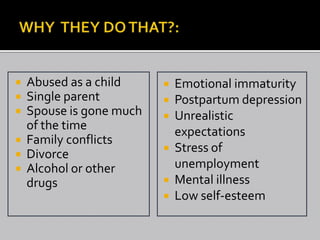
 Abused as a child      Emotional immaturity
 Single parent          Postpartum depression
 Spouse is gone much    Unrealistic
  of the time             expectations
 Family conflicts
                         Stress of
 Divorce
 Alcohol or other        unemployment
  drugs                  Mental illness
                         Low self-esteem
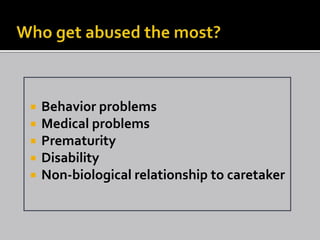
   Behavior problems
   Medical problems
   Prematurity
   Disability
   Non-biological relationship to caretaker
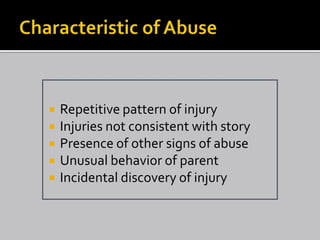
   Repetitive pattern of injury
   Injuries not consistent with story
   Presence of other signs of abuse
   Unusual behavior of parent
   Incidental discovery of injury
 Poor parenting skills
 Unreasonable expectations for child
 Undue fear of spoiling child
 Parental attitudes/religious beliefs in necessity
  for harsh physical discipline
 Multi-generational history of violence or
  domestic abuse
 Stresses such as martial problem, presence of
  extended family members, lack of social
  contract, unemployment, poor housing and
  financial problems
 Severe emotional pressure or mental illness
   Differential diagnosis
     SIDS
    ď‚§ Skin disorders
    ď‚§ Blood dyscrasia
    ď‚§ Fractures due to osteogenesis
      imperfecta, osteoporosis
    ď‚§ Failure to thrive due to disease process
Location of the injury
   Common accidental injury locations include
    knees, elbows, shins and forehead. Suspicious
    locations are the protected body parts and soft
    tissue area (the face, back, thighs, genital
    areas, buttocks, or the backs of legs.
    Approximately 30% of all childhood
      fractures are inflicted. In children
    younger than 1 year, 75% of fractures
           are likely to be inflicted.
Accidental injuries have a
  reasonable explanation.
Abuse injuries may not match
     their explanation.
 Raise the issue          Recognize the warning
 Reach out to kids and     signs
  parents in your          Report suspected
  community                 abuse or neglect
 Remember the risk
  factors
Survivors of child abuse and neglect
may be at greater risk for problems
later in life—such as low academic
achievement, drug abuse, teen
pregnancy, and criminal behavior—
that affect not just the child and
family, but society as a whole.
 Approximately  3 million reports of
 possible maltreatment are made to
 child protective service agencies
 each year.
 Theactual incidence of abuse and
 neglect is estimated to the three
 times greater than the number
 reported to authorities.
   Don’t try to conduct an investigation, yourself.
   If the child tells you of the sexual abuse
    immediately after it occurred, DO NOT bathe the
    child, or wash or change his or her clothes.
   Let the child talk as much as he or she wishes.
   Understand that the child is probably having mixed
    feelings.
   Believe the child.
   Explain what you will do next to help them.
   Never discipline your child when your anger is out of control.
   Participate in your child’s activities and get to know your child’s
    friends.
   Never leave your child unattended, especially in the car.
   Teach your child the difference between “good touches” and “bad
    touches.”
   When your child tells you he or she doesn’t want to be with
    someone, this could be a red flag. Listen to them and believe what
    they say.
   Be aware of changes in your child’s behavior or attitude.
   Teach your child what to do if you and your child become
    separated while away from home.
   Pay attention when someone shows greater than normal interest
    in your child.
   Make certain your child’s school or day care center will release
    him/her only to you or someone you officially designate.
They don’t want to hear
 the truth because the
 truth is so much harder
 to understand”
           (Fiona, 12 years)
“…Child abuse will only
 stop when children like
 me become important
 to everyone…”
            (Josh, 9 years)
Child abuse 2012

Child abuse 2012

  • 1.
  • 2.
    The mistreatment/maltreatment of a child by an adult
  • 3.
     Physical  Sexual  Neglect  Emotional or Psychological abuse
  • 4.
    An injury intentionallyinflicted on a child by a caregiver, parents, or anyone residing in the child’s home.
  • 5.
    The use ofa child for sexual gratification or financial gain, by an adult,older child, or adolescent, whether by physical force, coercion, or persuasion.
  • 6.
    Acts or omissionsby the perpetrator that fail to meet the child’s needs for basic living, including food, hygiene, medical care, clothing, and a safe warm environment.
  • 7.
    Verbal abuse orexcessive demands on the child that result In impaired growth, negative self-image, and disturbed child behavior.
  • 8.
     Apart fromthe obvious physical signs of abuse (eg, death, traumatic brain injury, disfigurement), long-term mental health consequences of physical abuse include violence, criminal behavior, substance abuse, self-injurious and suicidal behavior, depression, anxiety, and other mental health problems.  A small but significant number of abused children, although by no means a majority, later abuse their own children
  • 9.
     Neglect – 63%  Physical – 19%  Sexual – 10%  Emotional – 8%
  • 10.
     Hitting  Biting  Choking  Burning  Shaking  Slapping  Kicking  Beating  Missing or loosened  Injuries inflicted teeth with objects
  • 11.
    Definition: non-accidental injuryof a child that leaves marks, scars, bruises, or broken bones. Behavioral indicators of physical abuse: Physical indicators: wary of physical contact with unexplained bruises, adults, behavioral extremes burns, human bites, (aggressive or withdrawn), broken bones, frightened of parents, afraid to missing hair, go home, cheating, stealing, scratches. lying (a sign that expectations in the home are too high), layered clothing.
  • 12.
    Definition: parental behavior,such as rejecting, terrorizing, ignoring, or isolating a child.  Physical indicators of emotional abuse: speech disorders, lags in physical development, failure to thrive.  Behavioral indicators of emotional abuse: habit disorders (sucking, biting, rocking), conduct disorders (withdrawal, destructiveness, cruelty), sleep disorders or inhibition of play, behavior extremes (aggressive or passive).
  • 13.
     Ignores child’sphysical/emotional needs  Rejection/withdrawal of love  Terrorizes/threatens child  Cruel, bizarre/inconsistent punishment  Isolates/restricts child for long periods  Denies child food, shelter, or sleep as a punishment  Corrupts child by encouraging antisocial/unacceptable behavior
  • 14.
     Definition: any inappropriate sexual exposure or touch by an adult to a child or an older child to a younger child.  Physical indicators of sexual abuse: difficulty in walking or sitting, torn, stained, or bloody underclothing, pain or itching in genital area, bruises or bleeding in rectal/genital area, venereal disease.  Behavioral indicators of sexual abuse: age-inappropriate sexual knowledge/sexual touch, abrupt change in personality, withdrawn, poor peer relationships, unwilling to change for gym or participate in physical activities, promiscuous behavior/seductive behavior, drop in school performance/decline in school interest, sleep disturbances, regressive behavior (i.e., bed wetting).
  • 15.
     Fondling  Indecentexposure  Showing pornographic materials  Touching sexual organs  (of the child or the adult)  Attempted or actual sexual intercourse  Child prostitution  Incest
  • 16.
    Definition: failure ofparents or caretakers to provide needed, age appropriate care including food, clothing, shelter, protection from harm, hygiene, and medical care.  Physical indicators of neglect: constant hunger, poor hygiene, excessive sleepiness, lack of appropriate supervision, unattended physical problems or medical needs, abandonment, inappropriate clothing for weather conditions.  Behavioral indicators of neglect: begging or stealing food, frequent sleepiness, lack of appropriate supervision, unattended physical problem or medical needs, abandonment, inappropriate clothing for weather conditions.
  • 17.
     Most often,the abuser is someone the child knows, such as a parent, neighbor, someone work at home or relative.  Child abuse usually happens in the child’s home. Sometimes it happens in other settings, such as child-care centers and even schools. National Figures  74 % Natural Parent  10% Step-parent or de facto  7% Other relative or sibling  5% Friend or neighbors  4% Others (including strangers)
  • 18.
     Abused asa child  Emotional immaturity  Single parent  Postpartum depression  Spouse is gone much  Unrealistic of the time expectations  Family conflicts  Stress of  Divorce  Alcohol or other unemployment drugs  Mental illness  Low self-esteem
  • 19.
     Behavior problems  Medical problems  Prematurity  Disability  Non-biological relationship to caretaker
  • 20.
     Repetitive pattern of injury  Injuries not consistent with story  Presence of other signs of abuse  Unusual behavior of parent  Incidental discovery of injury
  • 21.
     Poor parentingskills  Unreasonable expectations for child  Undue fear of spoiling child  Parental attitudes/religious beliefs in necessity for harsh physical discipline  Multi-generational history of violence or domestic abuse  Stresses such as martial problem, presence of extended family members, lack of social contract, unemployment, poor housing and financial problems  Severe emotional pressure or mental illness
  • 22.
     Differential diagnosis SIDS  Skin disorders  Blood dyscrasia  Fractures due to osteogenesis imperfecta, osteoporosis  Failure to thrive due to disease process
  • 23.
    Location of theinjury  Common accidental injury locations include knees, elbows, shins and forehead. Suspicious locations are the protected body parts and soft tissue area (the face, back, thighs, genital areas, buttocks, or the backs of legs.
  • 24.
     Approximately 30% of all childhood fractures are inflicted. In children younger than 1 year, 75% of fractures are likely to be inflicted.
  • 25.
    Accidental injuries havea reasonable explanation. Abuse injuries may not match their explanation.
  • 26.
     Raise theissue  Recognize the warning  Reach out to kids and signs parents in your  Report suspected community abuse or neglect  Remember the risk factors
  • 27.
    Survivors of childabuse and neglect may be at greater risk for problems later in life—such as low academic achievement, drug abuse, teen pregnancy, and criminal behavior— that affect not just the child and family, but society as a whole.
  • 28.
     Approximately 3 million reports of possible maltreatment are made to child protective service agencies each year.  Theactual incidence of abuse and neglect is estimated to the three times greater than the number reported to authorities.
  • 29.
     Don’t try to conduct an investigation, yourself.  If the child tells you of the sexual abuse immediately after it occurred, DO NOT bathe the child, or wash or change his or her clothes.  Let the child talk as much as he or she wishes.  Understand that the child is probably having mixed feelings.  Believe the child.  Explain what you will do next to help them.
  • 30.
     Never discipline your child when your anger is out of control.  Participate in your child’s activities and get to know your child’s friends.  Never leave your child unattended, especially in the car.  Teach your child the difference between “good touches” and “bad touches.”  When your child tells you he or she doesn’t want to be with someone, this could be a red flag. Listen to them and believe what they say.  Be aware of changes in your child’s behavior or attitude.  Teach your child what to do if you and your child become separated while away from home.  Pay attention when someone shows greater than normal interest in your child.  Make certain your child’s school or day care center will release him/her only to you or someone you officially designate.
  • 31.
    They don’t wantto hear the truth because the truth is so much harder to understand” (Fiona, 12 years)
  • 32.
    “…Child abuse willonly stop when children like me become important to everyone…” (Josh, 9 years)