DESIGN THINKING
for
DIGITAL BANKING
How banks leverage Design Thinking
to restructure their DNA
It’s clear how Incumbent banks are met with unprecedented market forces.
Fintech and neobanks—new financial players that offer more and more exciting
financial products—are eating up banking market shares. Meanwhile, the
growing use of alternative payments such as PayPal, Samsung Pay, Apple Pay,
and so on points to the fact that customers are finding traditional banks
inconvenient and untrustworthy. At the same time, people are walking away
from physical branches; instead preferring mobile banking for ease and
convenience, according to a recent report by Backbase. On top of that, the
government continues to encourage Digital Banking, made apparent by the
government’s recent directives.
These factors may sound like twists and turns that took traditional banks by
surprise, yet they point to the refusal to change and innovate in the face of
digital disruption.
Now that change becomes a matter of life and death for banks, there’s an
evident need for a shift in mindset and principle called Design Thinking. This
paper looks over the relevance and application of Design Thinking in the
banking sector. You will also get to explore how some current banks are applying
this method. The promise of Design Thinking for banks proves beyond doubt.
Now let’s dive in.
If Digital Banking is a journey, Design Thinking is the compass.
01
Even now, there’s no standard
definition for Design Thinking as it’s a
relatively new phenomenon. But
Design Thinking can confuse people by
its mere look: one can be mistaken that
it is all about UX/UI - a principle
employed by such creative people as
graphic designers. True, an app’s
intuitive interface or service’s seamless
experience might be the products
every business strives for. But Design
Thinking offers more potential than
that. As Steve Jobs put it: “Design is not
just what it looks like and feels like.
Design is how it works”, hence the
beautifully designed and intuitively
functional iPhone that a billion love.
Tim Brown, the chair of IDEO and an
advocate of Design Thinking, refers to
it as a methodology that activates all
innovation-related activities with
human-centric design principles.
In the business context, Design
Thinking can be thought of as a
principle for creating commercial
innovations and ideas that revolve
around humans’ underlying needs. It’s a
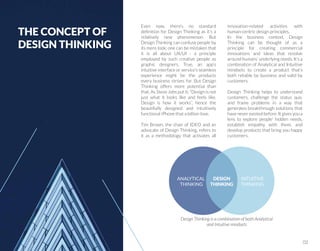
combination of Analytical and Intuitive
mindsets to create a product that’s
both reliable by business and valid by
customers.
Design Thinking helps to understand
customers, challenge the status quo,
and frame problems in a way that
generates breakthrough solutions that
have never existed before. It gives you a
lens to explore people’ hidden needs,
establish empathy with them, and
develop products that bring you happy
customers.
ANALYTICAL
THINKING
INTUITIVE
THINKING
Design Thinking is a combination of both Analytical
and Intuitive mindsets
THE CONCEPT OF
DESIGN THINKING
DESIGN
THINKING
02
THE PROCESS OF
DESIGN THINKING
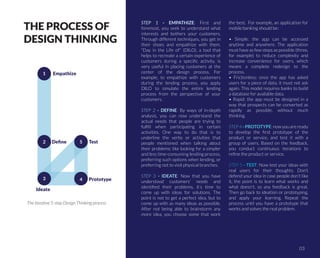
STEP 1 - EMPATHIZE: First and
foremost, you seek to understand what
interests and bothers your customers.
Through different techniques, you get in
their shoes and empathize with them.
“Day in the Life of” (DILO), a tool that
helps to recreate a certain experience of
customers during a specific activity, is
very useful in placing customers at the
center of the design process. For
example, to empathize with customers
during the lending process, you apply
DILO to simulate the entire lending
process from the perspective of your
customers.
STEP 2 - DEFINE: By ways of in-depth
analysis, you can now understand the
actual needs that people are trying to
fulfill when participating in certain
activities. One way to do that is to
underline the verbs or activities that
people mentioned when talking about
their problems: like looking for a simpler
and less time-consuming lending process,
preferring such options when lending, or
preferring not to visit physical branches.
STEP 3 - IDEATE: Now that you have
understood customers’ needs and
identified their problems, it’s time to
come up with ideas for solutions. The
point is not to get a perfect idea, but to
come up with as many ideas as possible.
After not being able to brainstorm any
more idea, you choose some that work
the best. For example, an application for
mobile banking should be:
• Simple: the app can be accessed
anytime and anywhere. The application
must have as few steps as possible (three,
for example) to reduce complexity and
increase convenience for users, which
means a complete redesign to the
process.
• Frictionless: once the app has asked
users for a piece of data, it must not ask
again. This model requires banks to build
a database for available data.
• Rapid: the app must be designed in a
way that prospects can be converted as
rapidly as possible, without much
thinking.
STEP 4 - PROTOTYPE: now you are ready
to develop the first prototype of the
product or service, and test it with a
group of users. Based on the feedback,
you conduct continuous iterations to
refine the product or service.
STEP 5 - TEST: Now test your ideas with
real users for their thoughts. Don’t
defend your idea in case people don’t like
it, the point is to learn what works and
what doesn't, so any feedback is great.
Then go back to ideation or prototyping,
and apply your learning. Repeat the
process until you have a prototype that
works and solves the real problem.
03
Empathize
1
2
3 4
5
Define
Ideate
Prototype
Test
The iterative 5-step Design Thinking process
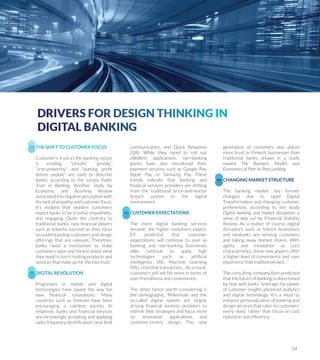
THE SHIFT TO CUSTOMER FOCUS
Customer’s trust in the banking sector
is eroding. “Unsafe”, “greedy”,
“untrustworthy”, and “putting profit
before people” are used to describe
banks, according to the survey Public
Trust in Banking. Another study by
Economic and Business Review
associated this negative perception with
the lack of empathy and customer focus.
It’s evident that modern customers
expect banks to be trustful, empathetic,
and engaging. Quite the contrary to
traditional banks, new financial players
such as fintechs succeed as they focus
on understanding customers and design
offerings that are relevant. Therefore,
banks need a mechanism to make
customers open and honest about what
they need, in turn creating products and
services that make up for the lost trust.
DIGITAL REVOLUTION
Progresses in mobile and digital
technologies have paved the way for
new financial innovations. Many
countries such as Vietnam have been
encouraging a cashless society. In
response, banks and financial services
are increasingly accepting and applying
radio frequency identification, near field
communication, and Quick Response
(QR). While they raced to roll out
eWallets applications, non-banking
giants have also introduced their
payment services such as Google Pay,
Apple Pay, or Samsung Pay. These
trends indicate that banking and
financial services providers are shifting
from the traditional brick-and-mortar
branch system to the digital
environment.
CUSTOMER EXPECTATIONS
The more digital banking services
become, the higher customers expect.
EY predicted that customer
expectations will continue to soar as
banking and non-banking businesses
alike continue to apply high
technologies such as artificial
intelligence (AI), Machine Learning
(ML), real-time transaction,... As a result,
customers will ask for more in terms of
user-friendliness and convenience.
The other factor worth considering is
the demographic. Millennials and the
so-called digital natives are largely
driving financial services providers to
rethink their strategies and focus more
on innovative applications and
customer-centric design. This new
generation of customers also places
more trust in Fintech businesses than
traditional banks, shown in a study
named The Business Models and
Economics of Peer-to-Peer Lending.
CHANGING MARKET STRUCTURE
The banking market has forever
changed, due to rapid Digital
Transformation and changing customer
preferences, according to the study
Digital banking and market disruption: a
sense of deja vu? by Financial Stability
Review. As a matter of course, digital
disruptors such as fintech businesses
and neobanks are winning customers
and taking away market shares. With
agility and innovation as core
characteristics, these new players offer
a higher level of convenience and user
experience that traditionals lack.
The consulting company Bain predicted
that the future of banking is determined
by how well banks “leverage the power
of customer insight, advanced analytics
and digital technology. It’s a must to
enhance personalization of banking and
design services that cater to customers’
every need, rather than focus on cost
reduction and efficiency.
04
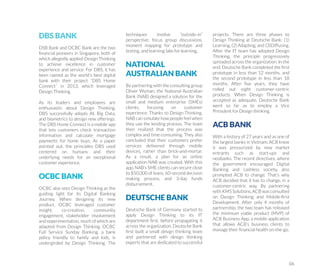
CASE STUDIES
DBS BANK
DSB Bank and OCBC Bank are the two
financial pioneers in Singapore, both of
which allegedly applied Design Thinking
to achieve excellence in customer
experience and service. For DBS, it has
been named as the world’s best digital
bank with their project “DBS Home
Connect” in 2013, which leveraged
Design Thinking.
As its leaders and employees are
enthusiastic about Design Thinking,
DBS successfully adopts AI, Big Data,
and biometrics to design new offerings.
The DBS Home Connect is a mobile app
that lets customers check transaction
information and calculate mortgage
payments for home buys. As a paper
pointed out, the principles DBS used
centered on humans and their
underlying needs for an exceptional
customer experience.
OCBC BANK
OCBC also sees Design Thinking as the
guiding light for its Digital Banking
Journey. When designing its new
product, OCBC leveraged customer
insight, co-creation, community
engagement, stakeholder involvement
and experimentation, much of which are
adapted from Design Thinking. OCBC
Full Service Sunday Banking, a bank
policy friendly to family and kids, is
undergirded by Design Thinking. The
techniques involve “outside-in”
perspective, focus group discussions,
moment mapping for prototype and
testing, and learning labs for learning.
NATIONAL
AUSTRALIAN BANK
By partnering with the consulting group
Oliver Wyman, the National Australian
Bank (NAB) designed a solution for the
small and medium enterprise (SMEs)
clients, focusing on customer
experience. Thanks to Design Thinking,
NAB can simulate how people feel when
they use the lending process. The team
then realized that the process was
complex and time-consuming. They also
concluded that their customers prefer
services delivered through mobile
devices, rather than brick-and-mortar.
As a result, a plan for an online
application NAB was created. With this
app, NAB’s SME clients can secure close
to $50,000 of loans, 60-second decision
making process, and 3-day funds
disbursement.
DEUTSCHE BANK
Deutsche Bank of Germany started to
apply Design Thinking to its IT
department first, before propagating it
across the organization. Deutsche Bank
first built a small design thinking team
and partnered with design thinking
experts that are dedicated to successful
projects. There are three phases to
Design Thinking at Deutsche Bank: (1)
Learning, (2) Adapting, and (3)Diffusing.
After the IT team has adopted Design
Thinking, the principle progressively
spreaded across the organization. In the
end, Deutsche Bank completed the first
prototype in less than 12 months, and
the second prototype in less than 18
months. After five years, they have
rolled out eight customer-centric
products. When Design Thinking is
accepted as adequate, Deutsche Bank
went so far as to employ a Vice
President for Design thinking.
ACB BANK
With a history of 27 years and as one of
the largest banks in Vietnam, ACB knew
it was pressurized by new market
entrants such as start-ups and
neobanks. The recent directives, where
the government encouraged Digital
Banking and cashless society, also
prompted ACB to change. That’s why
ACB decided that it has to change, in a
customer-centric way. By partnering
with KMS Solutions, ACB was consulted
on Design Thinking and Mobile-first
Development. After only 4 months of
partnership, the two team has released
the minimum viable product (MVP) of
ACB Business App, a mobile application
that allows ACB’s business clients to
manage their financial health on-the-go.
06
Since it has a laser focus on user experience, Design Thinking helps banks to attract and retain the so-called digital natives.
By continuously developing new products and refining them to meet the continuously changing customer needs, banks
can promote a more sustainable growth. Furthermore, Design Thinking also aids in regulatory compliance, now that the
government has introduced decrees encouraging Digital Banking.
As Design Thinking supports the end-to-end development process, Design Thinking has become a foundation for
Digital Transformation in the banking sector.
While the banking landscape is threatened by numerous disruptive forces: digitization, new regulations, changing
customer behaviors, and heightened competition, this is not the end. Instead, this marks a revolution for banking
businesses, where they change their DNA to adapt, with a change in strategy and technology.
To read our latest thoughts on Digital Banking, access: https://info.kms-solutions.asia/six-imperatives-for-digital-banking
KMS Solutions works closely with leading software companies across the globe to
bring the most advanced and innovative technologies to Asia Pacific. The focus is to
help organizations achieve their business goals through world-class fit-for-purpose
solutions and proven industry best practices. KMS Solutions’ success is ultimately
measured by the positive impact that it makes to the client’s business.
To learn more about KMS Solutions, visit kms-solutions.asia

Design Thinking for Digital Banking

  • 1.
    DESIGN THINKING for DIGITAL BANKING Howbanks leverage Design Thinking to restructure their DNA
  • 2.
    It’s clear howIncumbent banks are met with unprecedented market forces. Fintech and neobanks—new financial players that offer more and more exciting financial products—are eating up banking market shares. Meanwhile, the growing use of alternative payments such as PayPal, Samsung Pay, Apple Pay, and so on points to the fact that customers are finding traditional banks inconvenient and untrustworthy. At the same time, people are walking away from physical branches; instead preferring mobile banking for ease and convenience, according to a recent report by Backbase. On top of that, the government continues to encourage Digital Banking, made apparent by the government’s recent directives. These factors may sound like twists and turns that took traditional banks by surprise, yet they point to the refusal to change and innovate in the face of digital disruption. Now that change becomes a matter of life and death for banks, there’s an evident need for a shift in mindset and principle called Design Thinking. This paper looks over the relevance and application of Design Thinking in the banking sector. You will also get to explore how some current banks are applying this method. The promise of Design Thinking for banks proves beyond doubt. Now let’s dive in. If Digital Banking is a journey, Design Thinking is the compass. 01
  • 3.
    Even now, there’sno standard definition for Design Thinking as it’s a relatively new phenomenon. But Design Thinking can confuse people by its mere look: one can be mistaken that it is all about UX/UI - a principle employed by such creative people as graphic designers. True, an app’s intuitive interface or service’s seamless experience might be the products every business strives for. But Design Thinking offers more potential than that. As Steve Jobs put it: “Design is not just what it looks like and feels like. Design is how it works”, hence the beautifully designed and intuitively functional iPhone that a billion love. Tim Brown, the chair of IDEO and an advocate of Design Thinking, refers to it as a methodology that activates all innovation-related activities with human-centric design principles. In the business context, Design Thinking can be thought of as a principle for creating commercial innovations and ideas that revolve around humans’ underlying needs. It’s a combination of Analytical and Intuitive mindsets to create a product that’s both reliable by business and valid by customers. Design Thinking helps to understand customers, challenge the status quo, and frame problems in a way that generates breakthrough solutions that have never existed before. It gives you a lens to explore people’ hidden needs, establish empathy with them, and develop products that bring you happy customers. ANALYTICAL THINKING INTUITIVE THINKING Design Thinking is a combination of both Analytical and Intuitive mindsets THE CONCEPT OF DESIGN THINKING DESIGN THINKING 02
  • 4.
    THE PROCESS OF DESIGNTHINKING STEP 1 - EMPATHIZE: First and foremost, you seek to understand what interests and bothers your customers. Through different techniques, you get in their shoes and empathize with them. “Day in the Life of” (DILO), a tool that helps to recreate a certain experience of customers during a specific activity, is very useful in placing customers at the center of the design process. For example, to empathize with customers during the lending process, you apply DILO to simulate the entire lending process from the perspective of your customers. STEP 2 - DEFINE: By ways of in-depth analysis, you can now understand the actual needs that people are trying to fulfill when participating in certain activities. One way to do that is to underline the verbs or activities that people mentioned when talking about their problems: like looking for a simpler and less time-consuming lending process, preferring such options when lending, or preferring not to visit physical branches. STEP 3 - IDEATE: Now that you have understood customers’ needs and identified their problems, it’s time to come up with ideas for solutions. The point is not to get a perfect idea, but to come up with as many ideas as possible. After not being able to brainstorm any more idea, you choose some that work the best. For example, an application for mobile banking should be: • Simple: the app can be accessed anytime and anywhere. The application must have as few steps as possible (three, for example) to reduce complexity and increase convenience for users, which means a complete redesign to the process. • Frictionless: once the app has asked users for a piece of data, it must not ask again. This model requires banks to build a database for available data. • Rapid: the app must be designed in a way that prospects can be converted as rapidly as possible, without much thinking. STEP 4 - PROTOTYPE: now you are ready to develop the first prototype of the product or service, and test it with a group of users. Based on the feedback, you conduct continuous iterations to refine the product or service. STEP 5 - TEST: Now test your ideas with real users for their thoughts. Don’t defend your idea in case people don’t like it, the point is to learn what works and what doesn't, so any feedback is great. Then go back to ideation or prototyping, and apply your learning. Repeat the process until you have a prototype that works and solves the real problem. 03 Empathize 1 2 3 4 5 Define Ideate Prototype Test The iterative 5-step Design Thinking process
  • 5.
    THE SHIFT TOCUSTOMER FOCUS Customer’s trust in the banking sector is eroding. “Unsafe”, “greedy”, “untrustworthy”, and “putting profit before people” are used to describe banks, according to the survey Public Trust in Banking. Another study by Economic and Business Review associated this negative perception with the lack of empathy and customer focus. It’s evident that modern customers expect banks to be trustful, empathetic, and engaging. Quite the contrary to traditional banks, new financial players such as fintechs succeed as they focus on understanding customers and design offerings that are relevant. Therefore, banks need a mechanism to make customers open and honest about what they need, in turn creating products and services that make up for the lost trust. DIGITAL REVOLUTION Progresses in mobile and digital technologies have paved the way for new financial innovations. Many countries such as Vietnam have been encouraging a cashless society. In response, banks and financial services are increasingly accepting and applying radio frequency identification, near field communication, and Quick Response (QR). While they raced to roll out eWallets applications, non-banking giants have also introduced their payment services such as Google Pay, Apple Pay, or Samsung Pay. These trends indicate that banking and financial services providers are shifting from the traditional brick-and-mortar branch system to the digital environment. CUSTOMER EXPECTATIONS The more digital banking services become, the higher customers expect. EY predicted that customer expectations will continue to soar as banking and non-banking businesses alike continue to apply high technologies such as artificial intelligence (AI), Machine Learning (ML), real-time transaction,... As a result, customers will ask for more in terms of user-friendliness and convenience. The other factor worth considering is the demographic. Millennials and the so-called digital natives are largely driving financial services providers to rethink their strategies and focus more on innovative applications and customer-centric design. This new generation of customers also places more trust in Fintech businesses than traditional banks, shown in a study named The Business Models and Economics of Peer-to-Peer Lending. CHANGING MARKET STRUCTURE The banking market has forever changed, due to rapid Digital Transformation and changing customer preferences, according to the study Digital banking and market disruption: a sense of deja vu? by Financial Stability Review. As a matter of course, digital disruptors such as fintech businesses and neobanks are winning customers and taking away market shares. With agility and innovation as core characteristics, these new players offer a higher level of convenience and user experience that traditionals lack. The consulting company Bain predicted that the future of banking is determined by how well banks “leverage the power of customer insight, advanced analytics and digital technology. It’s a must to enhance personalization of banking and design services that cater to customers’ every need, rather than focus on cost reduction and efficiency. 04
  • 6.
  • 7.
    DBS BANK DSB Bankand OCBC Bank are the two financial pioneers in Singapore, both of which allegedly applied Design Thinking to achieve excellence in customer experience and service. For DBS, it has been named as the world’s best digital bank with their project “DBS Home Connect” in 2013, which leveraged Design Thinking. As its leaders and employees are enthusiastic about Design Thinking, DBS successfully adopts AI, Big Data, and biometrics to design new offerings. The DBS Home Connect is a mobile app that lets customers check transaction information and calculate mortgage payments for home buys. As a paper pointed out, the principles DBS used centered on humans and their underlying needs for an exceptional customer experience. OCBC BANK OCBC also sees Design Thinking as the guiding light for its Digital Banking Journey. When designing its new product, OCBC leveraged customer insight, co-creation, community engagement, stakeholder involvement and experimentation, much of which are adapted from Design Thinking. OCBC Full Service Sunday Banking, a bank policy friendly to family and kids, is undergirded by Design Thinking. The techniques involve “outside-in” perspective, focus group discussions, moment mapping for prototype and testing, and learning labs for learning. NATIONAL AUSTRALIAN BANK By partnering with the consulting group Oliver Wyman, the National Australian Bank (NAB) designed a solution for the small and medium enterprise (SMEs) clients, focusing on customer experience. Thanks to Design Thinking, NAB can simulate how people feel when they use the lending process. The team then realized that the process was complex and time-consuming. They also concluded that their customers prefer services delivered through mobile devices, rather than brick-and-mortar. As a result, a plan for an online application NAB was created. With this app, NAB’s SME clients can secure close to $50,000 of loans, 60-second decision making process, and 3-day funds disbursement. DEUTSCHE BANK Deutsche Bank of Germany started to apply Design Thinking to its IT department first, before propagating it across the organization. Deutsche Bank first built a small design thinking team and partnered with design thinking experts that are dedicated to successful projects. There are three phases to Design Thinking at Deutsche Bank: (1) Learning, (2) Adapting, and (3)Diffusing. After the IT team has adopted Design Thinking, the principle progressively spreaded across the organization. In the end, Deutsche Bank completed the first prototype in less than 12 months, and the second prototype in less than 18 months. After five years, they have rolled out eight customer-centric products. When Design Thinking is accepted as adequate, Deutsche Bank went so far as to employ a Vice President for Design thinking. ACB BANK With a history of 27 years and as one of the largest banks in Vietnam, ACB knew it was pressurized by new market entrants such as start-ups and neobanks. The recent directives, where the government encouraged Digital Banking and cashless society, also prompted ACB to change. That’s why ACB decided that it has to change, in a customer-centric way. By partnering with KMS Solutions, ACB was consulted on Design Thinking and Mobile-first Development. After only 4 months of partnership, the two team has released the minimum viable product (MVP) of ACB Business App, a mobile application that allows ACB’s business clients to manage their financial health on-the-go. 06
  • 8.
    Since it hasa laser focus on user experience, Design Thinking helps banks to attract and retain the so-called digital natives. By continuously developing new products and refining them to meet the continuously changing customer needs, banks can promote a more sustainable growth. Furthermore, Design Thinking also aids in regulatory compliance, now that the government has introduced decrees encouraging Digital Banking. As Design Thinking supports the end-to-end development process, Design Thinking has become a foundation for Digital Transformation in the banking sector. While the banking landscape is threatened by numerous disruptive forces: digitization, new regulations, changing customer behaviors, and heightened competition, this is not the end. Instead, this marks a revolution for banking businesses, where they change their DNA to adapt, with a change in strategy and technology. To read our latest thoughts on Digital Banking, access: https://info.kms-solutions.asia/six-imperatives-for-digital-banking
  • 9.
    KMS Solutions worksclosely with leading software companies across the globe to bring the most advanced and innovative technologies to Asia Pacific. The focus is to help organizations achieve their business goals through world-class fit-for-purpose solutions and proven industry best practices. KMS Solutions’ success is ultimately measured by the positive impact that it makes to the client’s business. To learn more about KMS Solutions, visit kms-solutions.asia