Evolving Changes of Leadership
How Leaders Can Effectively Navigate Increasing Complexity
in the Workplace
Leland Sandler
20/20 Club
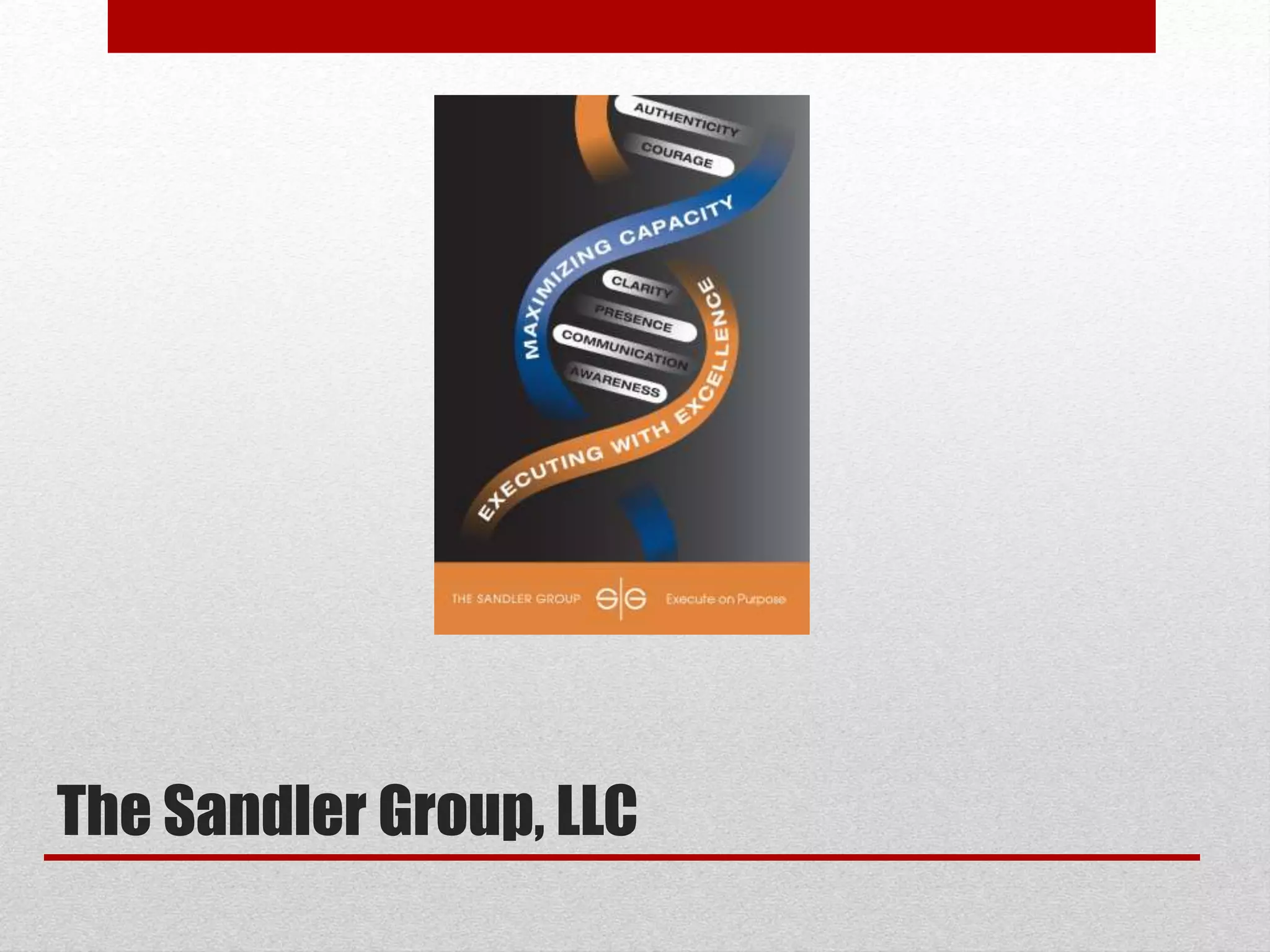
The Sandler Group, LLC
Objectives
• Identify habits to help think differently, consider divergent
possibilities to best succeed in a complex world
• Present different options to assist when faced with
challenges, opportunities, conflict, or increased complexity
• Demonstrate how leaders can grow; how they can create
new, bigger ways of making sense of their world
Organizational Complexity
• Are things in your world are a little more complex—maybe
even a little more overwhelming—than you’d like?
• Are you finding that you have to balance the needs of more
people than you did before and that there is more volatility of
perspective than you used to notice?
• Or maybe you think you would be a better leader if you could
just find a way to slow down all the changes in your team or
organization or sector so that you could catch your breath?
From: “Simple Habits for Complex Times: Powerful Practices for Leaders”
by Jennifer Garvey Berger and Keith Johnston
Organizational Complexity and Leaders
• The rise in complexity, ambiguity, volatility, and uncertainty
is not just lingering around the edges of our workdays: it’s
everywhere.
• Coping with these changes requires whole new ways of
making sense of the world and of taking action to make a
difference.
• It demands something different from ourselves and our
teams, because you cannot judge what is going to happen
in the future from what has happened in the past
Sardine Migration
Sardine Migration
• What did you see?
• What if you were charged with planning the route of migration
for the sardines; how easy would that be?
• What about getting them to move one way or another?Why?
• If you had to describe the migration planning and execution,
would you describe it as
• Straightforward or
• Messy or
• Somewhere in between?
Your Projects
• On the piece of paper, make TWO columns
• What work, objectives, goals, projects do they have
• That are messy?
• That are straightforward?
• Share your results with a partner
Your Projects
• Where did most of your items go?
• Do some of these items NOT fit into only messy or
straightforward? Why?
• What makes the messy problems messy?
• What kind of leadership do you need (characteristics,
behaviors, competencies, etc) to effectively deal with messy
problems?
Tools to Effectively Deal with Complexity
• We are going to use a couple of the many tools my team uses
in dealing with complexity
• Tools that are rooted in adult development theory; and that us
to more effectively deal with messy problems
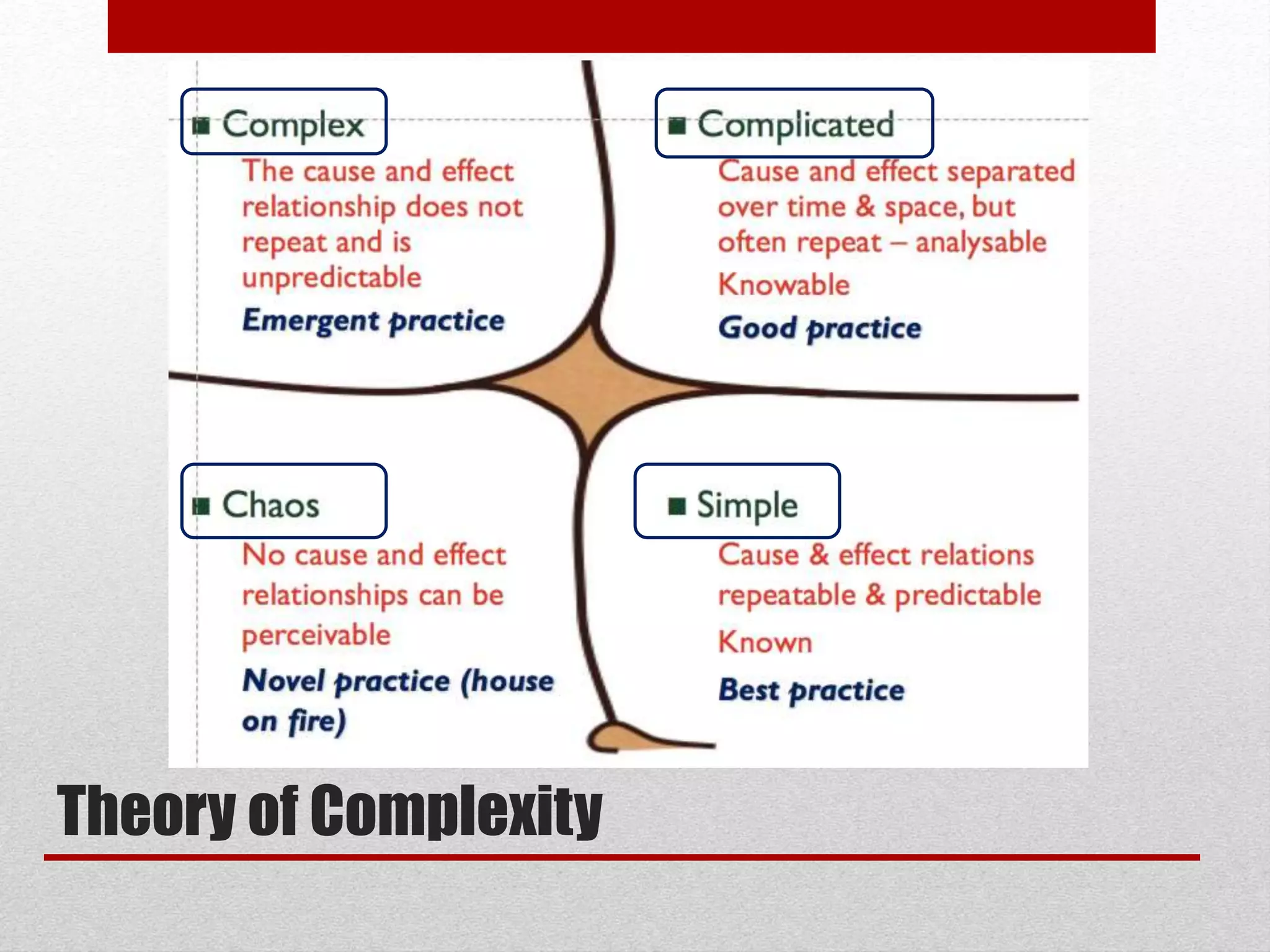
Theory of Complexity
The Value of: Asking Different Questions &
Perspective Taking
• Stimulate creativity and innovation in how to approach and
best solve complex (messy) problems and challenges
• Allows you to be better prepared to be agile as you execute a
complex project (be able to quickly and effectively change
course as needed)
• Stretches our capabilities, opens up our field of vision, expands
our thinking
Case Study
• From your list we are going to take a deeper dive into one
messy situation (a particular juicy one)
• Pick one; one that is particularly challenging, difficult for you
• We need one brave soul to share their messy problem with us
• In 3 min, you will need to
• Tell us the situation,
• Who are the stakeholders,
• Why it is such a challenge, and
• What you might have tried, or thought about doing so far (if
anything)
Small Group Question Generation
• You want to consider asking our volunteer questions that will
allow him/her to broaden their perspective of the messy issue
or situation
• Try to think of the kinds of questions you normally ask, and see
if there are different questions the might open up the thinking
about the issue or situation
• Think about the difference between fact finding questions and
perspective taking questions
Sample Questions
• Based on what you have considered, how might you be wrong?
• If you are thinking there are limitations or roadblocks, how
might any of them be an advantage or opportunity?
• How might this fail and how bad would that be?
• What might be the advantage of a “dumb idea”?
• What do you expect not to find?
• What (who) might you be discounting or explaining away a little
too quickly?
• What would happen if you shifted one of your core
assumptions on an issue, just as an experiment?
Offering Questions
• As someone asks a question, I am asking our volunteer (as well
as the rest of us) to listen and take in what an individual is
asking
• Our volunteer can ask clarifying questions of your question, but
otherwise I want him/her (and all of us) to think about (not
answer) the question:
• What was impactful about a particular question?
• What causes me to think differently about the situations/issue?
• How might this question cause me to take a broader perspective
on the situation/issue?
Debrief
• Where did you see a new perspective open-up for you?
• What is some way you are thinking differently about this?
• What assumption/assumptions were challenged?
• Did a theory of yours (how you were thinking of dealing with
this situation) get challenged?
• What, if anything, has now shifted for you?
Closing
• What did you learn today that was useful?
• What might you do differently as a result of what we have done
together today?
Q & A
Organizational Complexity
Addendum Slides
• We are shaped by the definitions and expectations of
our personal environment.
• Our self coheres by its alignment with, and loyalty to,
that with which it identifies.
• This expresses itself primarily in our relationships
with people or with schools of thought - ideas and
beliefs - or both
Socialized of Mind
Self-Authoring Mind
• Able to step back and generate “internal “seat of
judgment” or personal authority that makes
choices about external expectations.
• Our Self coheres by its alignment with its own
belief system/ideology/ personal code;
• Our ability to self-direct, take stands, set limits,
create and regulate boundaries on behalf of its
own voice.
• Able to step back from/reflect on limits of of our own
ideology/personal authority;
• Recognize that any system of self-organization is partial and
incomplete; be friendlier toward
contradiction/opposites/paradox/ambiguity;
• Seek to hold multiple systems rather than projecting all but
one onto the other.
• Our Self coheres through its ability not to confuse internal
consistency with wholeness or completeness and through
alignment with dialectic rather than either pole.
Self-Transforming Mind
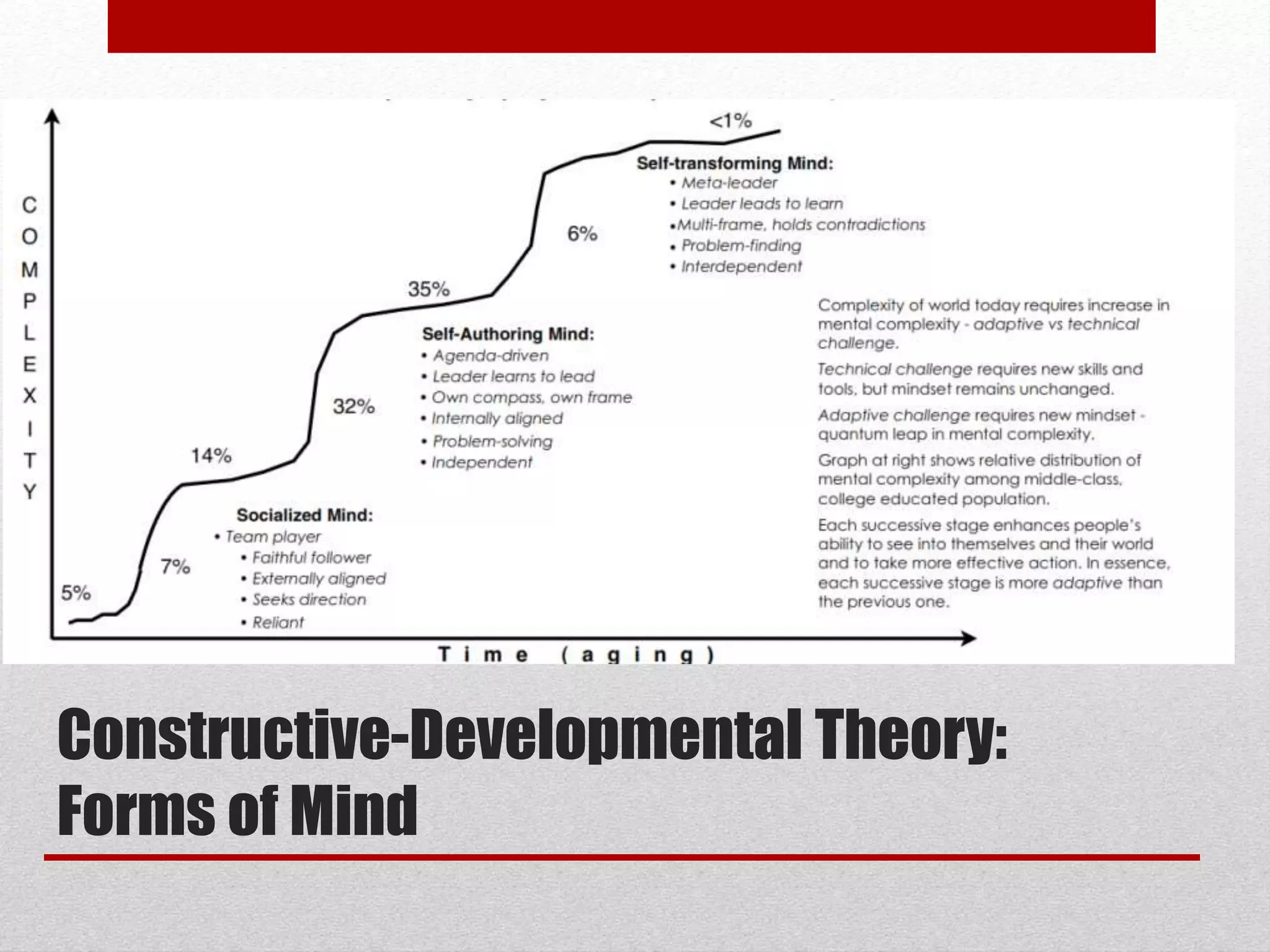
Constructive-Developmental Theory:
Forms of Mind
What would it mean to intentionally support the development
of complexity of mind (Immunity to Change)?
• Adaptive formulation of challenge – Identify where it meets
the limits of our current mental complexity (growth edge) – to
reveal the emotional ecology underlying the challenge.
• Adaptive solution - Determining how we can increase our
mental complexity - integration of cognitive, emotional and
behavioural aspects of perception and interpretation to act in
different manner.
• The Immunity to Change process uncovers out hidden
anxieties (concerns, worries, fears) and the assumptions they
are based on
ITC: Meeting Adaptive Challenges

Evolving Changes of Leadership: Navigating Complexity

  • 1.
    Evolving Changes ofLeadership How Leaders Can Effectively Navigate Increasing Complexity in the Workplace Leland Sandler 20/20 Club
  • 2.
  • 3.
    Objectives • Identify habitsto help think differently, consider divergent possibilities to best succeed in a complex world • Present different options to assist when faced with challenges, opportunities, conflict, or increased complexity • Demonstrate how leaders can grow; how they can create new, bigger ways of making sense of their world
  • 4.
    Organizational Complexity • Arethings in your world are a little more complex—maybe even a little more overwhelming—than you’d like? • Are you finding that you have to balance the needs of more people than you did before and that there is more volatility of perspective than you used to notice? • Or maybe you think you would be a better leader if you could just find a way to slow down all the changes in your team or organization or sector so that you could catch your breath? From: “Simple Habits for Complex Times: Powerful Practices for Leaders” by Jennifer Garvey Berger and Keith Johnston
  • 5.
    Organizational Complexity andLeaders • The rise in complexity, ambiguity, volatility, and uncertainty is not just lingering around the edges of our workdays: it’s everywhere. • Coping with these changes requires whole new ways of making sense of the world and of taking action to make a difference. • It demands something different from ourselves and our teams, because you cannot judge what is going to happen in the future from what has happened in the past
  • 6.
  • 7.
    Sardine Migration • Whatdid you see? • What if you were charged with planning the route of migration for the sardines; how easy would that be? • What about getting them to move one way or another?Why? • If you had to describe the migration planning and execution, would you describe it as • Straightforward or • Messy or • Somewhere in between?
  • 8.
    Your Projects • Onthe piece of paper, make TWO columns • What work, objectives, goals, projects do they have • That are messy? • That are straightforward? • Share your results with a partner
  • 9.
    Your Projects • Wheredid most of your items go? • Do some of these items NOT fit into only messy or straightforward? Why? • What makes the messy problems messy? • What kind of leadership do you need (characteristics, behaviors, competencies, etc) to effectively deal with messy problems?
  • 10.
    Tools to EffectivelyDeal with Complexity • We are going to use a couple of the many tools my team uses in dealing with complexity • Tools that are rooted in adult development theory; and that us to more effectively deal with messy problems
  • 11.
  • 12.
    The Value of:Asking Different Questions & Perspective Taking • Stimulate creativity and innovation in how to approach and best solve complex (messy) problems and challenges • Allows you to be better prepared to be agile as you execute a complex project (be able to quickly and effectively change course as needed) • Stretches our capabilities, opens up our field of vision, expands our thinking
  • 13.
    Case Study • Fromyour list we are going to take a deeper dive into one messy situation (a particular juicy one) • Pick one; one that is particularly challenging, difficult for you • We need one brave soul to share their messy problem with us • In 3 min, you will need to • Tell us the situation, • Who are the stakeholders, • Why it is such a challenge, and • What you might have tried, or thought about doing so far (if anything)
  • 14.
    Small Group QuestionGeneration • You want to consider asking our volunteer questions that will allow him/her to broaden their perspective of the messy issue or situation • Try to think of the kinds of questions you normally ask, and see if there are different questions the might open up the thinking about the issue or situation • Think about the difference between fact finding questions and perspective taking questions
  • 15.
    Sample Questions • Basedon what you have considered, how might you be wrong? • If you are thinking there are limitations or roadblocks, how might any of them be an advantage or opportunity? • How might this fail and how bad would that be? • What might be the advantage of a “dumb idea”? • What do you expect not to find? • What (who) might you be discounting or explaining away a little too quickly? • What would happen if you shifted one of your core assumptions on an issue, just as an experiment?
  • 16.
    Offering Questions • Assomeone asks a question, I am asking our volunteer (as well as the rest of us) to listen and take in what an individual is asking • Our volunteer can ask clarifying questions of your question, but otherwise I want him/her (and all of us) to think about (not answer) the question: • What was impactful about a particular question? • What causes me to think differently about the situations/issue? • How might this question cause me to take a broader perspective on the situation/issue?
  • 17.
    Debrief • Where didyou see a new perspective open-up for you? • What is some way you are thinking differently about this? • What assumption/assumptions were challenged? • Did a theory of yours (how you were thinking of dealing with this situation) get challenged? • What, if anything, has now shifted for you?
  • 18.
    Closing • What didyou learn today that was useful? • What might you do differently as a result of what we have done together today?
  • 19.
  • 21.
  • 22.
  • 23.
    • We areshaped by the definitions and expectations of our personal environment. • Our self coheres by its alignment with, and loyalty to, that with which it identifies. • This expresses itself primarily in our relationships with people or with schools of thought - ideas and beliefs - or both Socialized of Mind
  • 24.
    Self-Authoring Mind • Ableto step back and generate “internal “seat of judgment” or personal authority that makes choices about external expectations. • Our Self coheres by its alignment with its own belief system/ideology/ personal code; • Our ability to self-direct, take stands, set limits, create and regulate boundaries on behalf of its own voice.
  • 25.
    • Able tostep back from/reflect on limits of of our own ideology/personal authority; • Recognize that any system of self-organization is partial and incomplete; be friendlier toward contradiction/opposites/paradox/ambiguity; • Seek to hold multiple systems rather than projecting all but one onto the other. • Our Self coheres through its ability not to confuse internal consistency with wholeness or completeness and through alignment with dialectic rather than either pole. Self-Transforming Mind
  • 26.
  • 27.
    What would itmean to intentionally support the development of complexity of mind (Immunity to Change)? • Adaptive formulation of challenge – Identify where it meets the limits of our current mental complexity (growth edge) – to reveal the emotional ecology underlying the challenge. • Adaptive solution - Determining how we can increase our mental complexity - integration of cognitive, emotional and behavioural aspects of perception and interpretation to act in different manner. • The Immunity to Change process uncovers out hidden anxieties (concerns, worries, fears) and the assumptions they are based on ITC: Meeting Adaptive Challenges