OXYGEN RESERVE INDEX -NEWER
APPROACH TO MONITOR OXYGEN
THERAPY
DR.MOHSIN ALI
MD.ANAESTHESIA
ABSTRACT
• supplemental oxygen is administered in vast majority of patients in
the periopertive period and intensive care unit to prevent the
deleterious effects of hypoxemia
• most valuble tool in this setting is pulse oximetry, but its efficacy in
assesing the oxygenation status beyond the range of maximal arterial
saturation is very limited
• th oxygen reserve index is a new continous non invasive variable that
is provided by the new generation of pulse oximeters that use multi
wave length pulse co oximetry
• this journal review describes this new variable ,summarizes available
data and preliminary experience and discuss its potential clinical
utilities in the perioperative and intensive care settings
DISCUSSION
• THE PROBLEMS OF HYPOXIA
• THE PROBLEMS OF HYPEROXIA
• NEWER DEVELOPMENT -ORI
• PRELIMINARY SETTINGS
• POTENTIAL CLINICAL UTILITY
• POSSIBLE LIMITATIONS
• SUMMARY AND CONCLUSIONS
THE PROBLEMS OF HYPOXEMIA
• in the perioperative setting both hypoxia and hypoxemia are
deleterious and is considered a safety concern
• various retrospective analysis in the perioperative settings showed
the first postoperative day had a highest incidence of adverse
respiratory events, most of them being hypoxemic events
• most of the morbidity is due to the hypoxemia events mostly due to
spo2 less than 80% for more than 30 mins
• in the icu settings most of mortality in mechanically ventilated
patients is increased during extubation overnight compared to
extubation at day time
THE PROBLEM OF HYPEROXEMIA
• exposure of pure oxygen for longer periods provokes pulmonary
inflammation- HALI(hyperoxic acute lung injury)
• risk of hali increases with fio2 >0.7 for more than 24hrs
• it may likjewise cause a respiratory depression where respiratory
drive becomes oxygen dependentin copd patients or postop settings
• decreases cardiac output by decreasing heart rate and causing
systemic vasoconstriction
• hyperoxia is a potent vasoconstrictor to coronary circulation
• recent study in icu showed a improvement in mortality (11 vs 20%) by
small changes in pao2
MONITORING OF OXYGENATION
• arterial blood gas analysis is considered the gold standard of
monitoring the oxygenation status
• disadv being it is intermittent,invasive and costly
• significant changes may go unnoticed in between the tests of abg
• most common non invasive method of monitoring is pulse oximetry
• spo2 is measured by means of light absorption and the bias between
sao2 and spo2 is with a accuracy range of <2% and a precision of <3%
• major limitation of pulse oximetry when ot comes to assesing or
preventing hyperoxemia in patiemts receiving oxygen therapy
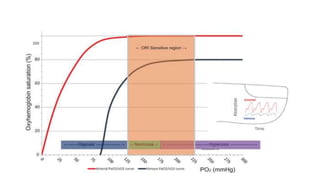
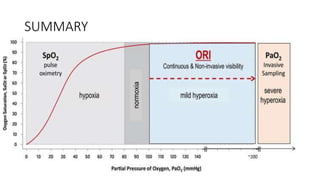
• due to sigmoid shape of the curve spo2 is near complete at a pao2 of
90-100mmhg and increasing pao2 beyond this level will no longer
effect spo2
• also pulse oximeter is a alte detector of respiratory depressioneven
when assoiciated with considerable co2 retention
ORI- NEWER DEVELOPMENT
• this is a newer development in multiple wavelength pulse oximetry
that reflects in real time, non invasively, the oxygenation status in
moderate hyperoxic range (100 -200 mmhg)
• particularly useful in patients receiving o2 therapy
• the multi wave length pulse oximetry utilises both arterial and venous
pulsatile blood absorption changes of incident light in a finger
• by combining both fick and oxygen content equations, the resulting
change in light absorption over this pao2 range is the basis of thos
equation
• ORI is a unit less scale between 0.00 and 1.00, which is arelative
indiactor of changes in pao2 in moderate hyperoxic range
• ORI is not equivalent to pao2 and cannot replace abg or classic pulse
oximetry.
PRELIMINARY STUDIES
• There are two clinical studies published as of yet demonstrating that
the ORI may provide an early warning when arterial oxygenation
deteriorates before any changes in SpO2 occur. In the first study,
Szmuk et al. followed the ORI during induction of anaesthesia in 25
healthy children
• They found that ORI detected an impeding desaturation in median of
31.5 s (range 19–34.3 s) before changes in SpO2 occurred and
concluded that this represents a clinically important warning time,
which might give clinicians time for corrective actions
• The second study looked at the relationship between ORI and PaO2 in
106 patients undergoing surgery and found a significant positive
relationship for both absolute values (r 2 = 0.536) and changes of
both variables (r 2 = 0.421) in the PaO2 range up to 240 mmHg .
• Recently, they performed a validation study of ORI in healthy
volunteers, preliminary results of which have been presented at the
Euroanaesthesia 2016 meeting in London
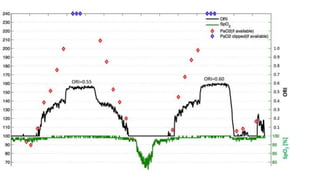
• . Volunteers were breathing via a tight fitting facemask standardized
oxygen concentrations in a stepwise fashion, ranging from ambient air
(FiO2 0.21) to pure oxygen (FiO2 1.0), followed by a short period of
mild hypoxia (FiO2 0.14).
• the ORI followed closely the changes in PaO2 related to changes in
FiO2, peaking at values of 0.55 and 0.60 respectively with maximum
FiO2. A later gradual decrease in FiO2 led to a decrease in ORI values,
which reached zero just before the SpO2 (green line) started to
decrease following the breathing of the hypoxic FiO2.
• Our results clearly show that the ORI reflects changes in oxygenation
due to changes in FiO2, and that a decline in ORI following a decrease
in FiO2 occurs well before any changes in SpO2 occur.
POTENTIAL UTILITY OF ORI
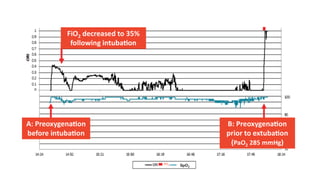
• Response to oxygen administration and to preoxygenation
• Since the ORI has been introduced into clinical practice only recently, we will
provide a theoretical exploration of its possible clinical utility in patients who
receive supplemental oxygen. First of all, the ORI may provide information
regarding the patient’s initial response to acute oxygen therapy
• The most common example of V/Q mismatch is atelectasis related to
induction of anaesthesia. A major cause of anaesthesia-induced lung collapse
in this period is the use of high inspired oxygen concentration. Loss of muscle
tone and muscle paralysis, compression of lung tissue due to heart weight and
loss of surfactant function reduces functional residual capacity, producing gas
trapping and resorption atelectasis behind closed airways. All these
mechanisms are well reviewed elsewhere
• Better titration of FiO2
• The ORI may be a useful tool for the correct titration of the FiO2.
Although in the critically ill, ventilated patients pulse oximetry may be
useful in maintaining patients above the hypoxemic levels by
adjusting inspired oxygen fractions and ventilator settings
• Early warning of impending hypoxemia
• The recent Prospective Evaluation of a RIsk Score for Postoperative
Pulmonary COmPlications in Europe (PERISCOPE) study showed that
about 4.2% of surgical patients develop postoperative respiratory
failure, carrying an in-hospital mortality of 10.3% (vs. 0.4% in the rest
of the patients), and defined risk factors for development of
postoperative respiratory failure
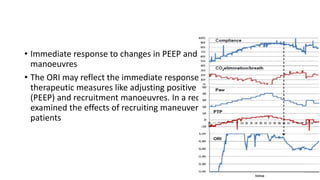
• Immediate response to changes in PEEP and to recruitment
manoeuvres
• The ORI may reflect the immediate response of the PaO2 to
therapeutic measures like adjusting positive end-expiratory pressure
(PEEP) and recruitment manoeuvres. In a recent pilot study we have
examined the effects of recruiting maneuvers on the ORI in ICU
patients
LIMITATIONS
• Although the ORI may reflect oxygenation in the moderate hyperoxic
range, it should not be considered as equivalent to PaO2 and is
certainly not meant to replace pulse oximetry (SpO2).
• The ORI should be considered as complementing SpO2 for
monitoring the oxygen status in patients receiving supplemental
oxygen
• In addition, most individuals will not reach an ORI above 0.6–0.7 (at
least with the first version of the ORI sensor) when breathing at an
FiO2 close to 1.0, so that an individualized scaling of the maximum
ORI being reached while breathing pure oxygen might be useful.
SUMMARY
CONCLUSION
• The ORI is a new promising variable that serves as a relative indicator
of the PaO2 in the range of 100–200 mmHg. Its addition to
conventional pulse oximetry opens new opportunities in the
continuous, non-invasive monitoring of the oxygenation status in
patients receiving supplemental oxygen.
• The ORI may potentially allow better control of pre-oxygenation,
provide an alarm of decreasing oxygenation well before any decrease
in SpO2, allow a more adequate titration of oxygen therapy and
prevent unintended hyperoxia, and reflect the immediate impact of
recruitment maneuvers and PEEP adjustments.
• Further studies are needed to determine the potential role of the ORI
in the management of acutely ill patients who are in need of oxygen
supplementation.
•
THANK YOU

Oxygen reserve index

  • 1.
    OXYGEN RESERVE INDEX-NEWER APPROACH TO MONITOR OXYGEN THERAPY DR.MOHSIN ALI MD.ANAESTHESIA
  • 2.
    ABSTRACT • supplemental oxygenis administered in vast majority of patients in the periopertive period and intensive care unit to prevent the deleterious effects of hypoxemia • most valuble tool in this setting is pulse oximetry, but its efficacy in assesing the oxygenation status beyond the range of maximal arterial saturation is very limited • th oxygen reserve index is a new continous non invasive variable that is provided by the new generation of pulse oximeters that use multi wave length pulse co oximetry
  • 3.
    • this journalreview describes this new variable ,summarizes available data and preliminary experience and discuss its potential clinical utilities in the perioperative and intensive care settings
  • 4.
    DISCUSSION • THE PROBLEMSOF HYPOXIA • THE PROBLEMS OF HYPEROXIA • NEWER DEVELOPMENT -ORI • PRELIMINARY SETTINGS • POTENTIAL CLINICAL UTILITY • POSSIBLE LIMITATIONS • SUMMARY AND CONCLUSIONS
  • 5.
    THE PROBLEMS OFHYPOXEMIA • in the perioperative setting both hypoxia and hypoxemia are deleterious and is considered a safety concern • various retrospective analysis in the perioperative settings showed the first postoperative day had a highest incidence of adverse respiratory events, most of them being hypoxemic events • most of the morbidity is due to the hypoxemia events mostly due to spo2 less than 80% for more than 30 mins • in the icu settings most of mortality in mechanically ventilated patients is increased during extubation overnight compared to extubation at day time
  • 6.
    THE PROBLEM OFHYPEROXEMIA • exposure of pure oxygen for longer periods provokes pulmonary inflammation- HALI(hyperoxic acute lung injury) • risk of hali increases with fio2 >0.7 for more than 24hrs • it may likjewise cause a respiratory depression where respiratory drive becomes oxygen dependentin copd patients or postop settings • decreases cardiac output by decreasing heart rate and causing systemic vasoconstriction • hyperoxia is a potent vasoconstrictor to coronary circulation • recent study in icu showed a improvement in mortality (11 vs 20%) by small changes in pao2
  • 7.
    MONITORING OF OXYGENATION •arterial blood gas analysis is considered the gold standard of monitoring the oxygenation status • disadv being it is intermittent,invasive and costly • significant changes may go unnoticed in between the tests of abg • most common non invasive method of monitoring is pulse oximetry • spo2 is measured by means of light absorption and the bias between sao2 and spo2 is with a accuracy range of <2% and a precision of <3% • major limitation of pulse oximetry when ot comes to assesing or preventing hyperoxemia in patiemts receiving oxygen therapy
  • 8.
    • due tosigmoid shape of the curve spo2 is near complete at a pao2 of 90-100mmhg and increasing pao2 beyond this level will no longer effect spo2 • also pulse oximeter is a alte detector of respiratory depressioneven when assoiciated with considerable co2 retention
  • 9.
    ORI- NEWER DEVELOPMENT •this is a newer development in multiple wavelength pulse oximetry that reflects in real time, non invasively, the oxygenation status in moderate hyperoxic range (100 -200 mmhg) • particularly useful in patients receiving o2 therapy • the multi wave length pulse oximetry utilises both arterial and venous pulsatile blood absorption changes of incident light in a finger • by combining both fick and oxygen content equations, the resulting change in light absorption over this pao2 range is the basis of thos equation
  • 10.
    • ORI isa unit less scale between 0.00 and 1.00, which is arelative indiactor of changes in pao2 in moderate hyperoxic range • ORI is not equivalent to pao2 and cannot replace abg or classic pulse oximetry.
  • 12.
    PRELIMINARY STUDIES • Thereare two clinical studies published as of yet demonstrating that the ORI may provide an early warning when arterial oxygenation deteriorates before any changes in SpO2 occur. In the first study, Szmuk et al. followed the ORI during induction of anaesthesia in 25 healthy children • They found that ORI detected an impeding desaturation in median of 31.5 s (range 19–34.3 s) before changes in SpO2 occurred and concluded that this represents a clinically important warning time, which might give clinicians time for corrective actions
  • 13.
    • The secondstudy looked at the relationship between ORI and PaO2 in 106 patients undergoing surgery and found a significant positive relationship for both absolute values (r 2 = 0.536) and changes of both variables (r 2 = 0.421) in the PaO2 range up to 240 mmHg . • Recently, they performed a validation study of ORI in healthy volunteers, preliminary results of which have been presented at the Euroanaesthesia 2016 meeting in London • . Volunteers were breathing via a tight fitting facemask standardized oxygen concentrations in a stepwise fashion, ranging from ambient air (FiO2 0.21) to pure oxygen (FiO2 1.0), followed by a short period of mild hypoxia (FiO2 0.14).
  • 14.
    • the ORIfollowed closely the changes in PaO2 related to changes in FiO2, peaking at values of 0.55 and 0.60 respectively with maximum FiO2. A later gradual decrease in FiO2 led to a decrease in ORI values, which reached zero just before the SpO2 (green line) started to decrease following the breathing of the hypoxic FiO2. • Our results clearly show that the ORI reflects changes in oxygenation due to changes in FiO2, and that a decline in ORI following a decrease in FiO2 occurs well before any changes in SpO2 occur.
  • 16.
    POTENTIAL UTILITY OFORI • Response to oxygen administration and to preoxygenation • Since the ORI has been introduced into clinical practice only recently, we will provide a theoretical exploration of its possible clinical utility in patients who receive supplemental oxygen. First of all, the ORI may provide information regarding the patient’s initial response to acute oxygen therapy • The most common example of V/Q mismatch is atelectasis related to induction of anaesthesia. A major cause of anaesthesia-induced lung collapse in this period is the use of high inspired oxygen concentration. Loss of muscle tone and muscle paralysis, compression of lung tissue due to heart weight and loss of surfactant function reduces functional residual capacity, producing gas trapping and resorption atelectasis behind closed airways. All these mechanisms are well reviewed elsewhere
  • 18.
    • Better titrationof FiO2 • The ORI may be a useful tool for the correct titration of the FiO2. Although in the critically ill, ventilated patients pulse oximetry may be useful in maintaining patients above the hypoxemic levels by adjusting inspired oxygen fractions and ventilator settings • Early warning of impending hypoxemia • The recent Prospective Evaluation of a RIsk Score for Postoperative Pulmonary COmPlications in Europe (PERISCOPE) study showed that about 4.2% of surgical patients develop postoperative respiratory failure, carrying an in-hospital mortality of 10.3% (vs. 0.4% in the rest of the patients), and defined risk factors for development of postoperative respiratory failure
  • 19.
    • Immediate responseto changes in PEEP and to recruitment manoeuvres • The ORI may reflect the immediate response of the PaO2 to therapeutic measures like adjusting positive end-expiratory pressure (PEEP) and recruitment manoeuvres. In a recent pilot study we have examined the effects of recruiting maneuvers on the ORI in ICU patients
  • 20.
    LIMITATIONS • Although theORI may reflect oxygenation in the moderate hyperoxic range, it should not be considered as equivalent to PaO2 and is certainly not meant to replace pulse oximetry (SpO2). • The ORI should be considered as complementing SpO2 for monitoring the oxygen status in patients receiving supplemental oxygen • In addition, most individuals will not reach an ORI above 0.6–0.7 (at least with the first version of the ORI sensor) when breathing at an FiO2 close to 1.0, so that an individualized scaling of the maximum ORI being reached while breathing pure oxygen might be useful.
  • 21.
  • 22.
    CONCLUSION • The ORIis a new promising variable that serves as a relative indicator of the PaO2 in the range of 100–200 mmHg. Its addition to conventional pulse oximetry opens new opportunities in the continuous, non-invasive monitoring of the oxygenation status in patients receiving supplemental oxygen. • The ORI may potentially allow better control of pre-oxygenation, provide an alarm of decreasing oxygenation well before any decrease in SpO2, allow a more adequate titration of oxygen therapy and prevent unintended hyperoxia, and reflect the immediate impact of recruitment maneuvers and PEEP adjustments. • Further studies are needed to determine the potential role of the ORI in the management of acutely ill patients who are in need of oxygen supplementation.
  • 23.