PULSE OXIMETRY
&
CAPNOGRAPHY
Chairperson:DR H V Airani
Moderator:DR Dharanish
Presenter:DR Dharmaraj
Pulse oximetry sometimes also called as fifth vital sign.
It is a non-invasive method of measuring haemoglobin
saturation with light signal transmitted through the tissue.
Until 1980s, large, cumbersome and expensive ear oximeters
were used.
Limitation of such oximeters included difficulty in
differentiating light absorbance of arterial blood (pulsatile
component) from venous blood and tissues (static component).
INTRODUCTION
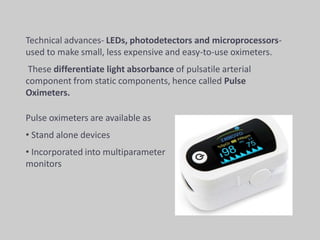
Pulse oximeters are available as
• Stand alone devices
• Incorporated into multiparameter
monitors
Technical advances- LEDs, photodetectors and microprocessors-
used to make small, less expensive and easy-to-use oximeters.
These differentiate light absorbance of pulsatile arterial
component from static components, hence called Pulse
Oximeters.
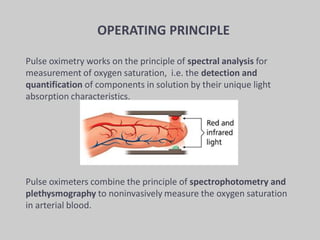
Pulse oximetry works on the principle of spectral analysis for
measurement of oxygen saturation, i.e. the detection and
quantification of components in solution by their unique light
absorption characteristics.
Pulse oximeters combine the principle of spectrophotometry and
plethysmography to noninvasively measure the oxygen saturation
in arterial blood.
OPERATING PRINCIPLE
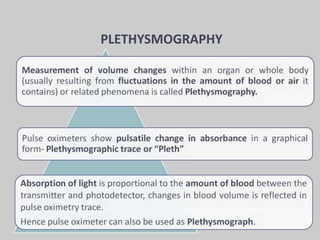
PLETHYSMOGRAPHY
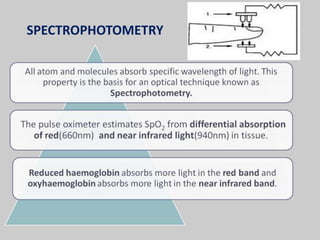
SPECTROPHOTOMETRY
Beer-Lambert law
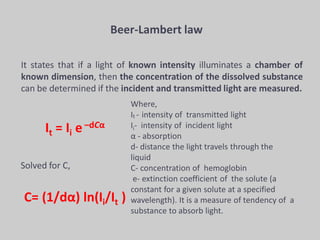
It states that if a light of known intensity illuminates a chamber of
known dimension, then the concentration of the dissolved substance
can be determined if the incident and transmitted light are measured.
It = Ii e –dCα
Solved for C,
C= (1/dα) ln(Ii/It )
Where,
It - intensity of transmitted light
Ii- intensity of incident light
α - absorption
d- distance the light travels through the
liquid
C- concentration of hemoglobin
e- extinction coefficient of the solute (a
constant for a given solute at a specified
wavelength). It is a measure of tendency of a
substance to absorb light.
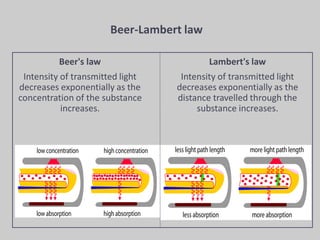
Beer-Lambert law
Beer's law
Intensity of transmitted light
decreases exponentially as the
concentration of the substance
increases.
Lambert's law
Intensity of transmitted light
decreases exponentially as the
distance travelled through the
substance increases.
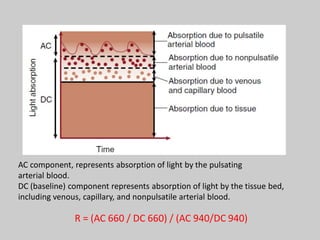
AC component, represents absorption of light by the pulsating
arterial blood.
DC (baseline) component represents absorption of light by the tissue bed,
including venous, capillary, and nonpulsatile arterial blood.
R = (AC 660 / DC 660) / (AC 940/DC 940)
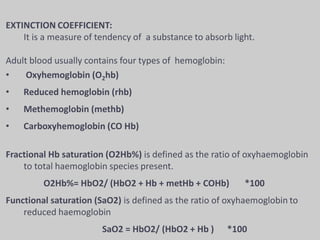
EXTINCTION COEFFICIENT:
It is a measure of tendency of a substance to absorb light.
Adult blood usually contains four types of hemoglobin:
• Oxyhemoglobin (O2hb)
• Reduced hemoglobin (rhb)
• Methemoglobin (methb)
• Carboxyhemoglobin (CO Hb)
Fractional Hb saturation (O2Hb%) is defined as the ratio of oxyhaemoglobin
to total haemoglobin species present.
O2Hb%= HbO2/ (HbO2 + Hb + metHb + COHb) *100
Functional saturation (SaO2) is defined as the ratio of oxyhaemoglobin to
reduced haemoglobin
SaO2 = HbO2/ (HbO2 + Hb ) *100
O2 content of arterial blood is,
CaO2 = Oxygen bound to hemoglobin + O2 dissolved in plasma
CaO2 = [1.36 × Hb × HbO % (SpO2)] + [0.003 × PaO2].
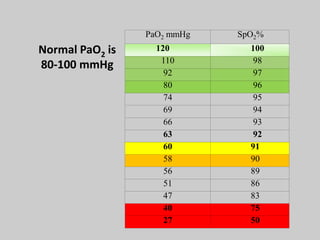
Pulse oximeter provides a non
invasive measurement of
arterial hemoglobin saturation,
a variable that is directly
related to oxygen content of
arterial
blood..
PaO2 mmHg SpO2%
120 100
110 98
92 97
80 96
74 95
69 94
66 93
63 92
60 91
58 90
56 89
51 86
47 83
40 75
27 50
Normal PaO2 is
80-100 mmHg
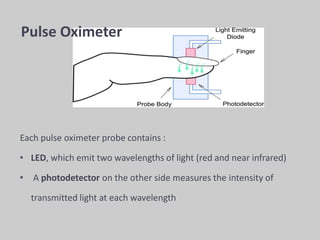
Each pulse oximeter probe contains :
• LED, which emit two wavelengths of light (red and near infrared)
• A photodetector on the other side measures the intensity of
transmitted light at each wavelength
Pulse Oximeter
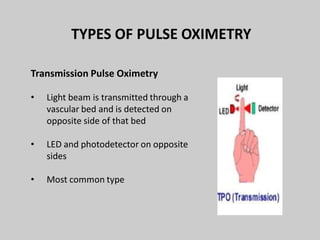
Transmission Pulse Oximetry
• Light beam is transmitted through a
vascular bed and is detected on
opposite side of that bed
• LED and photodetector on opposite
sides
• Most common type
TYPES OF PULSE OXIMETRY
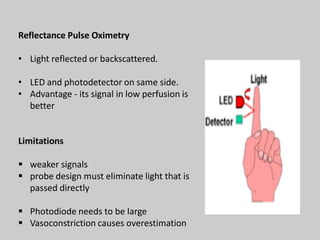
Reflectance Pulse Oximetry
• Light reflected or backscattered.
• LED and photodetector on same side.
• Advantage - its signal in low perfusion is
better
Limitations
 weaker signals
 probe design must eliminate light that is
passed directly
 Photodiode needs to be large
 Vasoconstriction causes overestimation
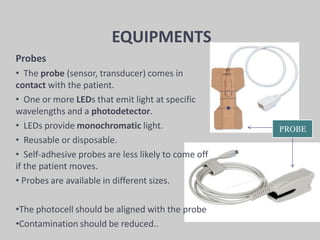
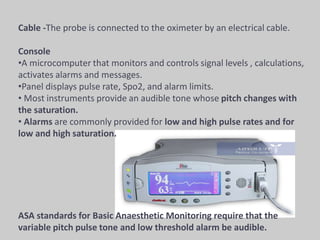
EQUIPMENTS
Probes
• The probe (sensor, transducer) comes in
contact with the patient.
• One or more LEDs that emit light at specific
wavelengths and a photodetector.
• LEDs provide monochromatic light.
• Reusable or disposable.
• Self-adhesive probes are less likely to come off
if the patient moves.
• Probes are available in different sizes.
•The photocell should be aligned with the probe
•Contamination should be reduced..
PROBE
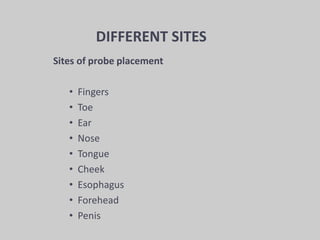
Cable -The probe is connected to the oximeter by an electrical cable.
Console
•A microcomputer that monitors and controls signal levels , calculations,
activates alarms and messages.
•Panel displays pulse rate, Spo2, and alarm limits.
• Most instruments provide an audible tone whose pitch changes with
the saturation.
• Alarms are commonly provided for low and high pulse rates and for
low and high saturation.
ASA standards for Basic Anaesthetic Monitoring require that the
variable pitch pulse tone and low threshold alarm be audible.
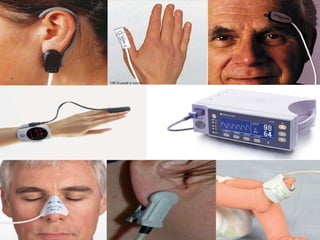
Sites of probe placement
• Fingers
• Toe
• Ear
• Nose
• Tongue
• Cheek
• Esophagus
• Forehead
• Penis
DIFFERENT SITES
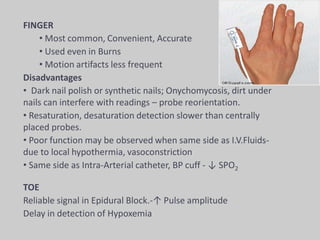
FINGER
• Most common, Convenient, Accurate
• Used even in Burns
• Motion artifacts less frequent
Disadvantages
• Dark nail polish or synthetic nails; Onychomycosis, dirt under
nails can interfere with readings – probe reorientation.
• Resaturation, desaturation detection slower than centrally
placed probes.
• Poor function may be observed when same side as I.V.Fluids-
due to local hypothermia, vasoconstriction
• Same side as Intra-Arterial catheter, BP cuff - ↓ SPO2
TOE
Reliable signal in Epidural Block.-↑ Pulse amplitude
Delay in detection of Hypoxemia
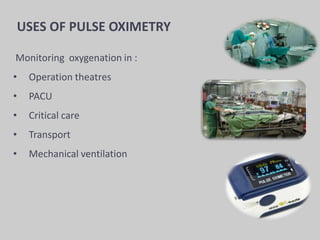
USES OF PULSE OXIMETRY
Monitoring oxygenation in :
• Operation theatres
• PACU
• Critical care
• Transport
• Mechanical ventilation
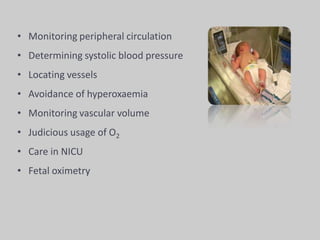
• Monitoring peripheral circulation
• Determining systolic blood pressure
• Locating vessels
• Avoidance of hyperoxaemia
• Monitoring vascular volume
• Judicious usage of O2
• Care in NICU
• Fetal oximetry
PITFALLS AND LIMITATIONS
Dyshemoglobinemias
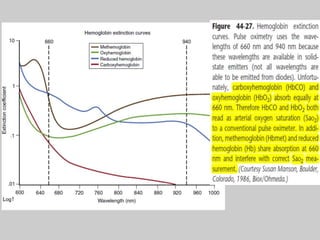
COHb and MetHb also absorb light at the pulse oximeter's two
wavelengths, and this leads to error in estimating the percentages
of reduced and oxyhemoglobins.
When the presence of either of these dyshemoglobins is
suspected, pulse oximetry should be supplemented by
multiwavelength co-oximetry.
DELAYED DETECTION OF HYPOXIC EVENTS
•Significant delay between a change in alveolar oxygen tension and a
change in the oximeter reading.
•Arterial oxygen reach dangerous levels before the pulse oximeter alarm is
activated.
•Lag time will be increased with poor perfusion and a decrease in blood
flow to the site monitored.
•Lag monitor : Partial pressure of oxygen can have fallen a great deal
before the oxygen saturation starts to fall.
•Response delay due to signal averaging: The signal is averaged out over 5
to 20 seconds. This may result in “frozen” Spo2 values (values being
displayed while the true saturation is rapidly changing) .
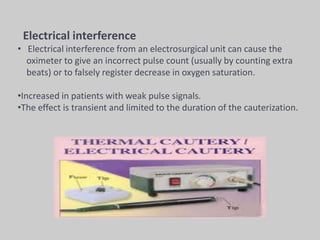
Electrical interference
• Electrical interference from an electrosurgical unit can cause the
oximeter to give an incorrect pulse count (usually by counting extra
beats) or to falsely register decrease in oxygen saturation.
•Increased in patients with weak pulse signals.
•The effect is transient and limited to the duration of the cauterization.
Steps to minimize electrical interference include
• Electrosurgery grounding plate as close to surgical field as possible
• Cable of the sensor to the oximeter away from the electrosurgery
apparatus
• Keeping the pulse oximeter sensor and console as far as possible from
the surgical site and the electrosurgery grounding plate and table
• Operating the unit in a rapid response mode
• Plug to different power source.
METHODS TO IMPROVE THE SIGNAL
• Warming cool extremities
• Application of vasodilating cream. Eg. GTN cream, EMLA
• Placing a gloves filled with warm water over patient hand.
• Try an alternative probe site
• Try a different probe.
• Administration of intra-arterial vasodilators.
• Try a different machine
• Digital nerve blocks.
Alternatives to pulse oximetry:
Bench CO-oximetry:
is the gold standard - and is the classic method by which a pulse
oximeter is calibrated.
The CO-oximeter calculates the actual concentrations of
haemoglobin, deoxyhaemoglobin, carboxyhaemoglobin and
methaemoglobin in the sample and hence calculates the actual
oxygen.
CO-oximeters are much more accurate than pulse oximeters - to
within 1%, but they give a 'snapshot' of oxygen saturation, are
bulky, expensive and require constant maintenance as well as
requiring a sample of arterial blood to be taken.
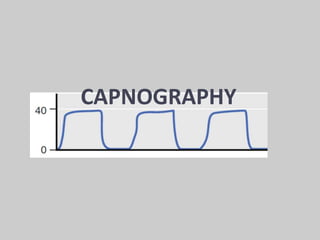
CAPNOGRAPHY
INTRODUCTION
The presence of CO2 in exhaled gas reflects the fundamental
physiologic processes of ventilation, pulmonary blood flow
and aerobic metabolism.
Its continuous monitoring assures the Anaesthesiologist of
correct placement of EndoTracheal tube or Laryngeal Mask
Airway as well as integrity of a breathing circuit.
• Capnometry is measurement and quantification of inhaled
or exhaled CO2 concentrations at the airway opening.
• Capnometer is a device that measures CO2 concentrations.
• Capnography is a method of measurement and graphical
display of CO2 as a function of time or volume.
• Capnograph is a device that records and displays CO2
concentrations, usually as a function of time.
• Capnogram refers to a graphical display that capnograph
generates; CO2 waveform.
TERMINOLOGY
• Changes in respired CO2 may reflect alterations in metabolism,
circulation, respiration and breathing system. Monitoring CO2
gives indication of patient’s metabolic rate.
• Assessment of CO2 production, pulmonary perfusion, alveolar
ventilation, respiratory patterns, and elimination of CO2 from the
anaesthesia circuit and ventilator.
•Capnography and pulse oximetry together could have helped in
the prevention of 93% of avoidable anesthesia mishaps
according to ASA closed claim study.
SIGNIFICANCE
METHODS
• Infrared Spectrography
• Mass Spectrometry
• Raman Spectrometry
• Gas Chromatography
• Photoacoustic spectrography
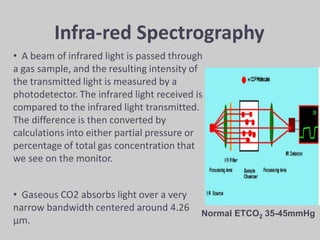
• A beam of infrared light is passed through
a gas sample, and the resulting intensity of
the transmitted light is measured by a
photodetector. The infrared light received is
compared to the infrared light transmitted.
The difference is then converted by
calculations into either partial pressure or
percentage of total gas concentration that
we see on the monitor.
• Gaseous CO2 absorbs light over a very
narrow bandwidth centered around 4.26
μm.
Infra-red Spectrography
Normal ETCO2 35-45mmHg
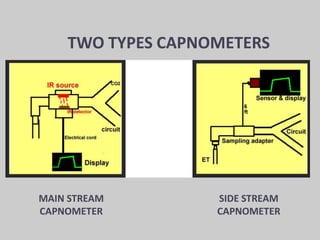
TWO TYPES CAPNOMETERS
MAIN STREAM
CAPNOMETER
SIDE STREAM
CAPNOMETER
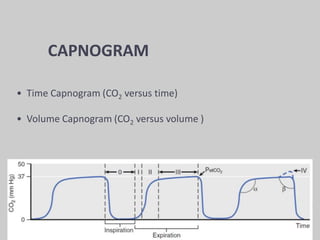
CAPNOGRAM
• Time Capnogram (CO2 versus time)
• Volume Capnogram (CO2 versus volume )
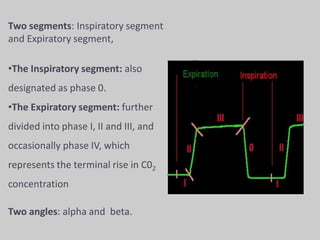
Two segments: Inspiratory segment
and Expiratory segment,
•The Inspiratory segment: also
designated as phase 0.
•The Expiratory segment: further
divided into phase I, II and III, and
occasionally phase IV, which
represents the terminal rise in C02
concentration
Two angles: alpha and beta.
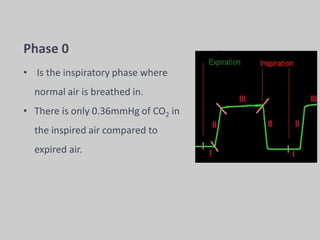
Phase 0
• Is the inspiratory phase where
normal air is breathed in.
• There is only 0.36mmHg of CO2 in
the inspired air compared to
expired air.
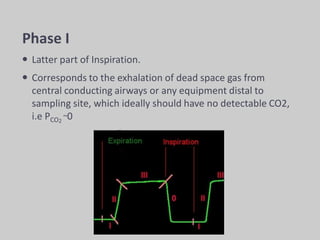
Phase I
 Latter part of Inspiration.
 Corresponds to the exhalation of dead space gas from
central conducting airways or any equipment distal to
sampling site, which ideally should have no detectable CO2,
i.e PCO2
~0
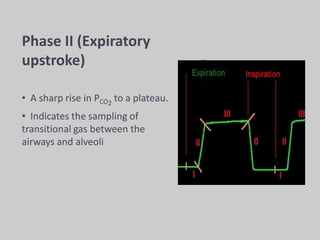
Phase II (Expiratory
upstroke)
• A sharp rise in PCO2
to a plateau.
• Indicates the sampling of
transitional gas between the
airways and alveoli
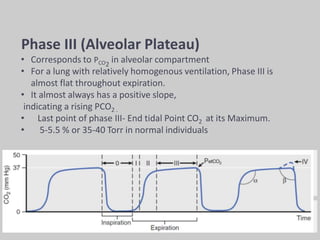
Phase III (Alveolar Plateau)
• Corresponds to PCO2
in alveolar compartment
• For a lung with relatively homogenous ventilation, Phase III is
almost flat throughout expiration.
• It almost always has a positive slope,
indicating a rising PCO2 .
• Last point of phase III- End tidal Point CO2 at its Maximum.
• 5-5.5 % or 35-40 Torr in normal individuals
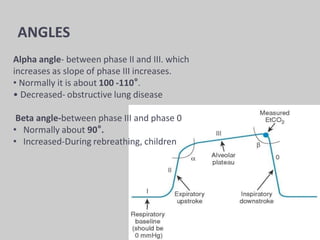
ANGLES
Alpha angle- between phase II and III. which
increases as slope of phase III increases.
• Normally it is about 100 -110°.
• Decreased- obstructive lung disease
Beta angle-between phase III and phase 0
• Normally about 90°.
• Increased-During rebreathing, children
Basic Physiology of a Capnogram
• At end of inspiration - CO2-free gases.
• Carbon dioxide diffuses in alveoli and equilibrates with end-alveolar
capillary blood (PACO2 = PcCO2 = 40 mm Hg).
• The actual concentration of CO2 in the alveoli is determined by the
extent of ventilation and perfusion into the alveoli (V/Q ratio).
• Well ventilated areas of lung ( well matched V/Q regions) – Lower
PCO2
• Less well ventilated areas (poorly matched V/Q regions) have higher
PCO2
• As one moves proximally in the respiratory tract, the concentration
of CO2 decreases gradually to zero at some point - respiratory dead
space
APPLICATIONS
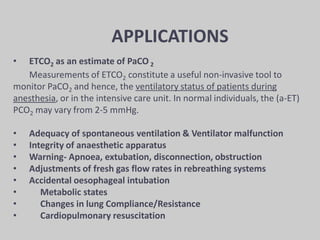
• ETCO2 as an estimate of PaCO 2
Measurements of ETCO2 constitute a useful non-invasive tool to
monitor PaCO2 and hence, the ventilatory status of patients during
anesthesia, or in the intensive care unit. In normal individuals, the (a-ET)
PCO2 may vary from 2-5 mmHg.
• Adequacy of spontaneous ventilation & Ventilator malfunction
• Integrity of anaesthetic apparatus
• Warning- Apnoea, extubation, disconnection, obstruction
• Adjustments of fresh gas flow rates in rebreathing systems
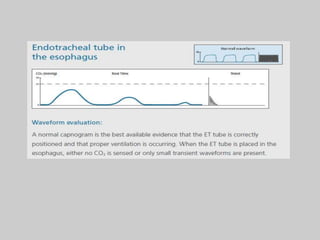
• Accidental oesophageal intubation
• Metabolic states
• Changes in lung Compliance/Resistance
• Cardiopulmonary resuscitation
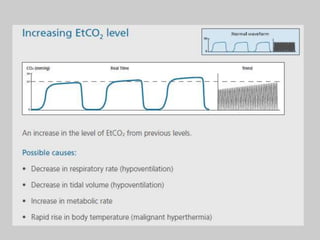
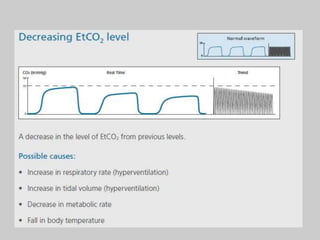
ABNORMAL CAPNOGRAM AND
CLINICAL CONSIDERATIONS
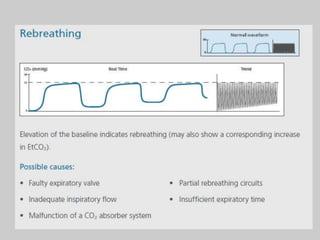
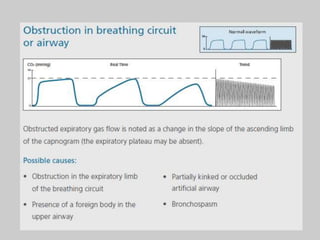
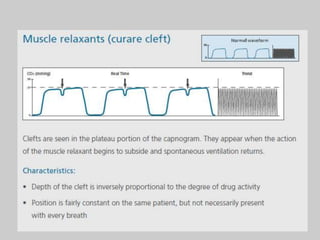
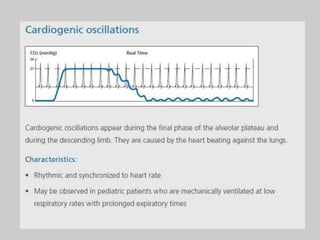
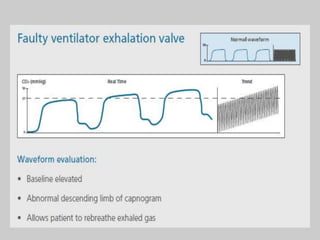
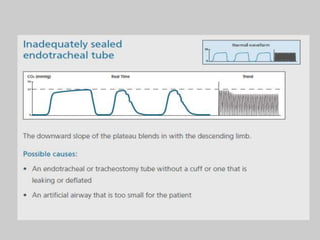
To analyze the abnormal capnogram, five
characteristics should be inspected:
• Size (height)
• Shape
• Frequency
• Rhythm
• Baseline
REFERENCES
•Miller’s anaesthesia 7th edition
•Textbook of anaesthesia by Cullen and Barash
•Dorsch and dorsch anaesthesia equipments 4th edition
THANK YOU

pulseoximetry and capnography ppt dharmaraj.pdf

  • 1.
    PULSE OXIMETRY & CAPNOGRAPHY Chairperson:DR HV Airani Moderator:DR Dharanish Presenter:DR Dharmaraj
  • 2.
    Pulse oximetry sometimesalso called as fifth vital sign. It is a non-invasive method of measuring haemoglobin saturation with light signal transmitted through the tissue. Until 1980s, large, cumbersome and expensive ear oximeters were used. Limitation of such oximeters included difficulty in differentiating light absorbance of arterial blood (pulsatile component) from venous blood and tissues (static component). INTRODUCTION
  • 3.
    Pulse oximeters areavailable as • Stand alone devices • Incorporated into multiparameter monitors Technical advances- LEDs, photodetectors and microprocessors- used to make small, less expensive and easy-to-use oximeters. These differentiate light absorbance of pulsatile arterial component from static components, hence called Pulse Oximeters.
  • 4.
    Pulse oximetry workson the principle of spectral analysis for measurement of oxygen saturation, i.e. the detection and quantification of components in solution by their unique light absorption characteristics. Pulse oximeters combine the principle of spectrophotometry and plethysmography to noninvasively measure the oxygen saturation in arterial blood. OPERATING PRINCIPLE
  • 5.
  • 6.
  • 7.
    Beer-Lambert law It statesthat if a light of known intensity illuminates a chamber of known dimension, then the concentration of the dissolved substance can be determined if the incident and transmitted light are measured. It = Ii e –dCα Solved for C, C= (1/dα) ln(Ii/It ) Where, It - intensity of transmitted light Ii- intensity of incident light α - absorption d- distance the light travels through the liquid C- concentration of hemoglobin e- extinction coefficient of the solute (a constant for a given solute at a specified wavelength). It is a measure of tendency of a substance to absorb light.
  • 8.
    Beer-Lambert law Beer's law Intensityof transmitted light decreases exponentially as the concentration of the substance increases. Lambert's law Intensity of transmitted light decreases exponentially as the distance travelled through the substance increases.
  • 9.
    AC component, representsabsorption of light by the pulsating arterial blood. DC (baseline) component represents absorption of light by the tissue bed, including venous, capillary, and nonpulsatile arterial blood. R = (AC 660 / DC 660) / (AC 940/DC 940)
  • 10.
    EXTINCTION COEFFICIENT: It isa measure of tendency of a substance to absorb light. Adult blood usually contains four types of hemoglobin: • Oxyhemoglobin (O2hb) • Reduced hemoglobin (rhb) • Methemoglobin (methb) • Carboxyhemoglobin (CO Hb) Fractional Hb saturation (O2Hb%) is defined as the ratio of oxyhaemoglobin to total haemoglobin species present. O2Hb%= HbO2/ (HbO2 + Hb + metHb + COHb) *100 Functional saturation (SaO2) is defined as the ratio of oxyhaemoglobin to reduced haemoglobin SaO2 = HbO2/ (HbO2 + Hb ) *100
  • 12.
    O2 content ofarterial blood is, CaO2 = Oxygen bound to hemoglobin + O2 dissolved in plasma CaO2 = [1.36 × Hb × HbO % (SpO2)] + [0.003 × PaO2]. Pulse oximeter provides a non invasive measurement of arterial hemoglobin saturation, a variable that is directly related to oxygen content of arterial blood..
  • 13.
    PaO2 mmHg SpO2% 120100 110 98 92 97 80 96 74 95 69 94 66 93 63 92 60 91 58 90 56 89 51 86 47 83 40 75 27 50 Normal PaO2 is 80-100 mmHg
  • 14.
    Each pulse oximeterprobe contains : • LED, which emit two wavelengths of light (red and near infrared) • A photodetector on the other side measures the intensity of transmitted light at each wavelength Pulse Oximeter
  • 15.
    Transmission Pulse Oximetry •Light beam is transmitted through a vascular bed and is detected on opposite side of that bed • LED and photodetector on opposite sides • Most common type TYPES OF PULSE OXIMETRY
  • 16.
    Reflectance Pulse Oximetry •Light reflected or backscattered. • LED and photodetector on same side. • Advantage - its signal in low perfusion is better Limitations  weaker signals  probe design must eliminate light that is passed directly  Photodiode needs to be large  Vasoconstriction causes overestimation
  • 17.
    EQUIPMENTS Probes • The probe(sensor, transducer) comes in contact with the patient. • One or more LEDs that emit light at specific wavelengths and a photodetector. • LEDs provide monochromatic light. • Reusable or disposable. • Self-adhesive probes are less likely to come off if the patient moves. • Probes are available in different sizes. •The photocell should be aligned with the probe •Contamination should be reduced.. PROBE
  • 18.
    Cable -The probeis connected to the oximeter by an electrical cable. Console •A microcomputer that monitors and controls signal levels , calculations, activates alarms and messages. •Panel displays pulse rate, Spo2, and alarm limits. • Most instruments provide an audible tone whose pitch changes with the saturation. • Alarms are commonly provided for low and high pulse rates and for low and high saturation. ASA standards for Basic Anaesthetic Monitoring require that the variable pitch pulse tone and low threshold alarm be audible.
  • 19.
    Sites of probeplacement • Fingers • Toe • Ear • Nose • Tongue • Cheek • Esophagus • Forehead • Penis DIFFERENT SITES
  • 20.
    FINGER • Most common,Convenient, Accurate • Used even in Burns • Motion artifacts less frequent Disadvantages • Dark nail polish or synthetic nails; Onychomycosis, dirt under nails can interfere with readings – probe reorientation. • Resaturation, desaturation detection slower than centrally placed probes. • Poor function may be observed when same side as I.V.Fluids- due to local hypothermia, vasoconstriction • Same side as Intra-Arterial catheter, BP cuff - ↓ SPO2 TOE Reliable signal in Epidural Block.-↑ Pulse amplitude Delay in detection of Hypoxemia
  • 22.
    USES OF PULSEOXIMETRY Monitoring oxygenation in : • Operation theatres • PACU • Critical care • Transport • Mechanical ventilation
  • 23.
    • Monitoring peripheralcirculation • Determining systolic blood pressure • Locating vessels • Avoidance of hyperoxaemia • Monitoring vascular volume • Judicious usage of O2 • Care in NICU • Fetal oximetry
  • 24.
    PITFALLS AND LIMITATIONS Dyshemoglobinemias COHband MetHb also absorb light at the pulse oximeter's two wavelengths, and this leads to error in estimating the percentages of reduced and oxyhemoglobins. When the presence of either of these dyshemoglobins is suspected, pulse oximetry should be supplemented by multiwavelength co-oximetry.
  • 25.
    DELAYED DETECTION OFHYPOXIC EVENTS •Significant delay between a change in alveolar oxygen tension and a change in the oximeter reading. •Arterial oxygen reach dangerous levels before the pulse oximeter alarm is activated. •Lag time will be increased with poor perfusion and a decrease in blood flow to the site monitored. •Lag monitor : Partial pressure of oxygen can have fallen a great deal before the oxygen saturation starts to fall. •Response delay due to signal averaging: The signal is averaged out over 5 to 20 seconds. This may result in “frozen” Spo2 values (values being displayed while the true saturation is rapidly changing) .
  • 26.
    Electrical interference • Electricalinterference from an electrosurgical unit can cause the oximeter to give an incorrect pulse count (usually by counting extra beats) or to falsely register decrease in oxygen saturation. •Increased in patients with weak pulse signals. •The effect is transient and limited to the duration of the cauterization.
  • 27.
    Steps to minimizeelectrical interference include • Electrosurgery grounding plate as close to surgical field as possible • Cable of the sensor to the oximeter away from the electrosurgery apparatus • Keeping the pulse oximeter sensor and console as far as possible from the surgical site and the electrosurgery grounding plate and table • Operating the unit in a rapid response mode • Plug to different power source.
  • 28.
    METHODS TO IMPROVETHE SIGNAL • Warming cool extremities • Application of vasodilating cream. Eg. GTN cream, EMLA • Placing a gloves filled with warm water over patient hand. • Try an alternative probe site • Try a different probe. • Administration of intra-arterial vasodilators. • Try a different machine • Digital nerve blocks.
  • 29.
    Alternatives to pulseoximetry: Bench CO-oximetry: is the gold standard - and is the classic method by which a pulse oximeter is calibrated. The CO-oximeter calculates the actual concentrations of haemoglobin, deoxyhaemoglobin, carboxyhaemoglobin and methaemoglobin in the sample and hence calculates the actual oxygen. CO-oximeters are much more accurate than pulse oximeters - to within 1%, but they give a 'snapshot' of oxygen saturation, are bulky, expensive and require constant maintenance as well as requiring a sample of arterial blood to be taken.
  • 30.
  • 31.
    INTRODUCTION The presence ofCO2 in exhaled gas reflects the fundamental physiologic processes of ventilation, pulmonary blood flow and aerobic metabolism. Its continuous monitoring assures the Anaesthesiologist of correct placement of EndoTracheal tube or Laryngeal Mask Airway as well as integrity of a breathing circuit.
  • 32.
    • Capnometry ismeasurement and quantification of inhaled or exhaled CO2 concentrations at the airway opening. • Capnometer is a device that measures CO2 concentrations. • Capnography is a method of measurement and graphical display of CO2 as a function of time or volume. • Capnograph is a device that records and displays CO2 concentrations, usually as a function of time. • Capnogram refers to a graphical display that capnograph generates; CO2 waveform. TERMINOLOGY
  • 33.
    • Changes inrespired CO2 may reflect alterations in metabolism, circulation, respiration and breathing system. Monitoring CO2 gives indication of patient’s metabolic rate. • Assessment of CO2 production, pulmonary perfusion, alveolar ventilation, respiratory patterns, and elimination of CO2 from the anaesthesia circuit and ventilator. •Capnography and pulse oximetry together could have helped in the prevention of 93% of avoidable anesthesia mishaps according to ASA closed claim study. SIGNIFICANCE
  • 34.
    METHODS • Infrared Spectrography •Mass Spectrometry • Raman Spectrometry • Gas Chromatography • Photoacoustic spectrography
  • 35.
    • A beamof infrared light is passed through a gas sample, and the resulting intensity of the transmitted light is measured by a photodetector. The infrared light received is compared to the infrared light transmitted. The difference is then converted by calculations into either partial pressure or percentage of total gas concentration that we see on the monitor. • Gaseous CO2 absorbs light over a very narrow bandwidth centered around 4.26 μm. Infra-red Spectrography Normal ETCO2 35-45mmHg
  • 36.
    TWO TYPES CAPNOMETERS MAINSTREAM CAPNOMETER SIDE STREAM CAPNOMETER
  • 37.
    CAPNOGRAM • Time Capnogram(CO2 versus time) • Volume Capnogram (CO2 versus volume )
  • 38.
    Two segments: Inspiratorysegment and Expiratory segment, •The Inspiratory segment: also designated as phase 0. •The Expiratory segment: further divided into phase I, II and III, and occasionally phase IV, which represents the terminal rise in C02 concentration Two angles: alpha and beta.
  • 39.
    Phase 0 • Isthe inspiratory phase where normal air is breathed in. • There is only 0.36mmHg of CO2 in the inspired air compared to expired air.
  • 40.
    Phase I  Latterpart of Inspiration.  Corresponds to the exhalation of dead space gas from central conducting airways or any equipment distal to sampling site, which ideally should have no detectable CO2, i.e PCO2 ~0
  • 41.
    Phase II (Expiratory upstroke) •A sharp rise in PCO2 to a plateau. • Indicates the sampling of transitional gas between the airways and alveoli
  • 42.
    Phase III (AlveolarPlateau) • Corresponds to PCO2 in alveolar compartment • For a lung with relatively homogenous ventilation, Phase III is almost flat throughout expiration. • It almost always has a positive slope, indicating a rising PCO2 . • Last point of phase III- End tidal Point CO2 at its Maximum. • 5-5.5 % or 35-40 Torr in normal individuals
  • 43.
    ANGLES Alpha angle- betweenphase II and III. which increases as slope of phase III increases. • Normally it is about 100 -110°. • Decreased- obstructive lung disease Beta angle-between phase III and phase 0 • Normally about 90°. • Increased-During rebreathing, children
  • 44.
    Basic Physiology ofa Capnogram • At end of inspiration - CO2-free gases. • Carbon dioxide diffuses in alveoli and equilibrates with end-alveolar capillary blood (PACO2 = PcCO2 = 40 mm Hg). • The actual concentration of CO2 in the alveoli is determined by the extent of ventilation and perfusion into the alveoli (V/Q ratio). • Well ventilated areas of lung ( well matched V/Q regions) – Lower PCO2 • Less well ventilated areas (poorly matched V/Q regions) have higher PCO2 • As one moves proximally in the respiratory tract, the concentration of CO2 decreases gradually to zero at some point - respiratory dead space
  • 45.
    APPLICATIONS • ETCO2 asan estimate of PaCO 2 Measurements of ETCO2 constitute a useful non-invasive tool to monitor PaCO2 and hence, the ventilatory status of patients during anesthesia, or in the intensive care unit. In normal individuals, the (a-ET) PCO2 may vary from 2-5 mmHg. • Adequacy of spontaneous ventilation & Ventilator malfunction • Integrity of anaesthetic apparatus • Warning- Apnoea, extubation, disconnection, obstruction • Adjustments of fresh gas flow rates in rebreathing systems • Accidental oesophageal intubation • Metabolic states • Changes in lung Compliance/Resistance • Cardiopulmonary resuscitation
  • 46.
    ABNORMAL CAPNOGRAM AND CLINICALCONSIDERATIONS To analyze the abnormal capnogram, five characteristics should be inspected: • Size (height) • Shape • Frequency • Rhythm • Baseline
  • 56.
    REFERENCES •Miller’s anaesthesia 7thedition •Textbook of anaesthesia by Cullen and Barash •Dorsch and dorsch anaesthesia equipments 4th edition
  • 57.