INTRODUCTION
 First breakthrough technology in internal combustion
engine design since the introduction of the 4-S Cycle
Engine.
 Designed by ADVANCED ENGINE TECHNOLOGIES,
USA.
 The engine has only six major components of which
only three are moving parts
O
• Oxygen
X
• Fuels
2
• Inlet & exhaust ports, spark plugs
• Power strokes
HISTORY OF THE ENGINE
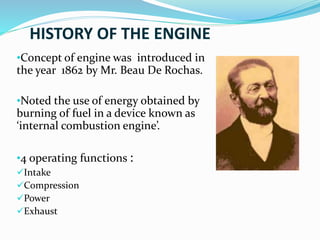
•Concept of engine was introduced in
the year 1862 by Mr. Beau De Rochas.
•Noted the use of energy obtained by
burning of fuel in a device known as
‘internal combustion engine’.
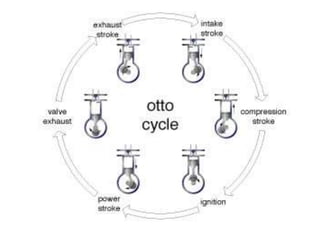
•4 operating functions :
Intake
Compression
Power
Exhaust
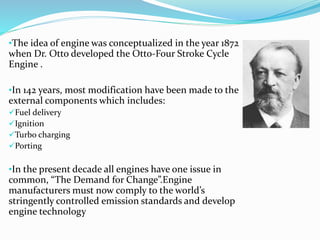
•The idea of engine was conceptualized in the year 1872
when Dr. Otto developed the Otto-Four Stroke Cycle
Engine .
•In 142 years, most modification have been made to the
external components which includes:
Fuel delivery
Ignition
Turbo charging
Porting
•In the present decade all engines have one issue in
common, “The Demand for Change”.Engine
manufacturers must now comply to the world’s
stringently controlled emission standards and develop
engine technology
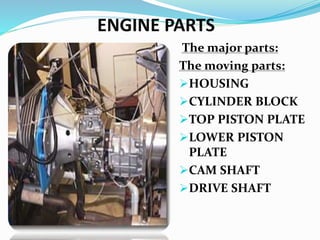
ENGINE PARTS
The major parts:
The moving parts:
HOUSING
CYLINDER BLOCK
TOP PISTON PLATE
LOWER PISTON
PLATE
CAM SHAFT
DRIVE SHAFT
WORKING OF THE ENGINE
 Consists of 8 cylinders which are placed in a circle.
 2 piston plates:
 Inner plate
 Outer plate
 The piston is also independently connected to the outer
engine housing with the help of rollers.
 The engine is started with the help of a drive shaft which
provides a rotary motion for the starting.
 A start up motor is provided for this purpose of driving the
drive shaft.
 As the pistons reciprocate, the piston rollers rotating inside
the engine housing .
 The piston rollers force the engine housing to rotate along
with the pistons.
 Since the engine housing is connected to the cylinder head,
the cylinders also move along with the pistons.
 As a result, the entire unit of the engine rotates.
 So the reciprocatory motion of the piston is converted to
the rotary motion of the engine housing and this motion
can be transmitted to the reduction gears with the help of
an axial shaft.
 Lobes on the cam plate push the pistons into the cylinder
bores, while igniting the air/fuel mixtures.
 Each cylinder fires twice during each revolution.
TECHNICAL ASPECT OF THE ENGINE
 Pistons:
 No piston skirts like other conventional engines.
 The piston support is provided by the piston plates.
 As a result, there is no side loading of the pistons against the
cylinder bore.
 Energy loss due to sideloading is eliminated.
 Prevents cylinder breakage & increases piston life.
 Piston speed:
 Remains constant throughout the entire power stroke.
 The inlet and exhaust ports do not open until the exhaust and
power strokes have been fully completed.
 This process enables a more regulated mixture to be introduced
prior to firing.
 Combustion chambers:
 The combustion chambers are only slightly longer than the
stroke.
 The pistons need only to be thick enough to house the rings.
 Flywheels:
 While a flywheel could be fitted to the OX2 engine as with any
engine, the mass of the rotating block would act as a flywheel
and the small fluctuations in the energy is removed.
 Hence a flywheel is required only when huge amount of energy
is generated.
 Horse power and output shaft speed:
 The reason for a high RPM being achieved from a crankshaft
engine is to give a better horsepower number.
 A higher output shaft speed is not necessary ,but the torque an
engine can develop at a particular RPM does the actual work.
 Thus the OX2 engine develops very high torque at reasonably low
RPM thus reducing wear and enabling better control of the
combustion process thereby resulting in better economy and
emissions.
 Consequently in most of the engine applications there would be
no need for the engine to work at revolutions higher than
2500rpm.
 This would eliminate the need of a gear box and would reduce the
engine wear.
 Timing:
 The engine design enables the timing to be adjusted sufficiently to
produce the most effective burn of combustion fuel irrespective of
the engine RPM.
 Port not present in the combustion .chamber so no pre-ignition.
 In a conventional engine pre-ignition occurs if the timing is
advanced too far which causes energy loss.
 Exhaust:
 The ox2 engine is designed to have a minute quantity of exhaust
gas fed back in to the combusting chamber.
 More fuel is used driving the piston and less is wasted
pressurizing the combustion chamber.
 When the heat of re-circulated exhaust gas is added, the fuel
remains in a gaseous form, thus ensuring an efficient burn from
the ox2 engine.
DEVELOPMENTS
 Three prototypes of the engine have been developed by the
Advanced Engine Technologies firm.
 AET engineers have successfully advanced the OX2 engine
port shape and location from its earlier design.
 This re-designing was done after the testing of Design
Level 1, OX2 test engine #1.
 This re-engineering has resulted in a 15% improvement in
the OX2 engine's Volumetric Efficiency. The efficiency is
now in the range of 92-95%. This improvement has also
yielded a 16% improvement in torque and a 23% increase in
horsepower.
 This new porting configuration has increased the exhaust
velocity by 200% which will be very valuable for turbo
applications.
 Testing of the Design Level 3, OX2 Engine #3 is also being
carried out in the University of California.
 The design is expected to yield a marked improvement in
overall engine performance.
APPLICATIONS
ADVANTAGES
 Fuel efficient
 Low emissions
 Smaller
 Higher power to weight ratio
 Light weight
 Multi-fuelled
 Inexpensive
CONCLUSION
 The OX2 Engine will soon prove to be a revolution
in the IC engine field with its eco friendly and
versatile nature allowing it to be flexible with any
type of fuel along with enhanced operation,
maintenance costs and a longer useful life.
 Also the engine has only three are moving parts
which results in low setup and production costs
and the simplicity of design promotes a high level
of quality assurance and lower maintenance costs.
OXYGEN ENGINE DIRECT PRESENTATION

OXYGEN ENGINE DIRECT PRESENTATION

  • 2.
    INTRODUCTION  First breakthroughtechnology in internal combustion engine design since the introduction of the 4-S Cycle Engine.  Designed by ADVANCED ENGINE TECHNOLOGIES, USA.  The engine has only six major components of which only three are moving parts
  • 3.
    O • Oxygen X • Fuels 2 •Inlet & exhaust ports, spark plugs • Power strokes
  • 4.
    HISTORY OF THEENGINE •Concept of engine was introduced in the year 1862 by Mr. Beau De Rochas. •Noted the use of energy obtained by burning of fuel in a device known as ‘internal combustion engine’. •4 operating functions : Intake Compression Power Exhaust
  • 5.
    •The idea ofengine was conceptualized in the year 1872 when Dr. Otto developed the Otto-Four Stroke Cycle Engine . •In 142 years, most modification have been made to the external components which includes: Fuel delivery Ignition Turbo charging Porting •In the present decade all engines have one issue in common, “The Demand for Change”.Engine manufacturers must now comply to the world’s stringently controlled emission standards and develop engine technology
  • 7.
    ENGINE PARTS The majorparts: The moving parts: HOUSING CYLINDER BLOCK TOP PISTON PLATE LOWER PISTON PLATE CAM SHAFT DRIVE SHAFT
  • 8.
    WORKING OF THEENGINE  Consists of 8 cylinders which are placed in a circle.  2 piston plates:  Inner plate  Outer plate  The piston is also independently connected to the outer engine housing with the help of rollers.  The engine is started with the help of a drive shaft which provides a rotary motion for the starting.  A start up motor is provided for this purpose of driving the drive shaft.  As the pistons reciprocate, the piston rollers rotating inside the engine housing .
  • 9.
     The pistonrollers force the engine housing to rotate along with the pistons.  Since the engine housing is connected to the cylinder head, the cylinders also move along with the pistons.  As a result, the entire unit of the engine rotates.  So the reciprocatory motion of the piston is converted to the rotary motion of the engine housing and this motion can be transmitted to the reduction gears with the help of an axial shaft.  Lobes on the cam plate push the pistons into the cylinder bores, while igniting the air/fuel mixtures.  Each cylinder fires twice during each revolution.
  • 13.
    TECHNICAL ASPECT OFTHE ENGINE  Pistons:  No piston skirts like other conventional engines.  The piston support is provided by the piston plates.  As a result, there is no side loading of the pistons against the cylinder bore.  Energy loss due to sideloading is eliminated.  Prevents cylinder breakage & increases piston life.  Piston speed:  Remains constant throughout the entire power stroke.  The inlet and exhaust ports do not open until the exhaust and power strokes have been fully completed.  This process enables a more regulated mixture to be introduced prior to firing.
  • 14.
     Combustion chambers: The combustion chambers are only slightly longer than the stroke.  The pistons need only to be thick enough to house the rings.  Flywheels:  While a flywheel could be fitted to the OX2 engine as with any engine, the mass of the rotating block would act as a flywheel and the small fluctuations in the energy is removed.  Hence a flywheel is required only when huge amount of energy is generated.  Horse power and output shaft speed:  The reason for a high RPM being achieved from a crankshaft engine is to give a better horsepower number.  A higher output shaft speed is not necessary ,but the torque an engine can develop at a particular RPM does the actual work.
  • 15.
     Thus theOX2 engine develops very high torque at reasonably low RPM thus reducing wear and enabling better control of the combustion process thereby resulting in better economy and emissions.  Consequently in most of the engine applications there would be no need for the engine to work at revolutions higher than 2500rpm.  This would eliminate the need of a gear box and would reduce the engine wear.  Timing:  The engine design enables the timing to be adjusted sufficiently to produce the most effective burn of combustion fuel irrespective of the engine RPM.  Port not present in the combustion .chamber so no pre-ignition.  In a conventional engine pre-ignition occurs if the timing is advanced too far which causes energy loss.
  • 16.
     Exhaust:  Theox2 engine is designed to have a minute quantity of exhaust gas fed back in to the combusting chamber.  More fuel is used driving the piston and less is wasted pressurizing the combustion chamber.  When the heat of re-circulated exhaust gas is added, the fuel remains in a gaseous form, thus ensuring an efficient burn from the ox2 engine.
  • 17.
    DEVELOPMENTS  Three prototypesof the engine have been developed by the Advanced Engine Technologies firm.  AET engineers have successfully advanced the OX2 engine port shape and location from its earlier design.  This re-designing was done after the testing of Design Level 1, OX2 test engine #1.  This re-engineering has resulted in a 15% improvement in the OX2 engine's Volumetric Efficiency. The efficiency is now in the range of 92-95%. This improvement has also yielded a 16% improvement in torque and a 23% increase in horsepower.
  • 18.
     This newporting configuration has increased the exhaust velocity by 200% which will be very valuable for turbo applications.  Testing of the Design Level 3, OX2 Engine #3 is also being carried out in the University of California.  The design is expected to yield a marked improvement in overall engine performance.
  • 19.
  • 20.
    ADVANTAGES  Fuel efficient Low emissions  Smaller  Higher power to weight ratio  Light weight  Multi-fuelled  Inexpensive
  • 21.
    CONCLUSION  The OX2Engine will soon prove to be a revolution in the IC engine field with its eco friendly and versatile nature allowing it to be flexible with any type of fuel along with enhanced operation, maintenance costs and a longer useful life.  Also the engine has only three are moving parts which results in low setup and production costs and the simplicity of design promotes a high level of quality assurance and lower maintenance costs.