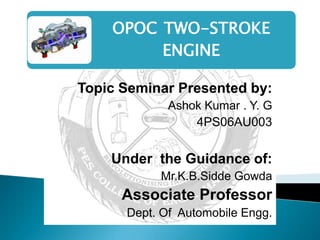
OPOC TWO-STROKE
         ENGINE

Topic Seminar Presented by:
             Ashok Kumar . Y. G
                 4PS06AU003


    Under the Guidance of:
           Mr.K.B.Sidde Gowda
      Associate Professor
      Dept. Of Automobile Engg.
Introduction
   Engine : Device that transforms one form of
    energy to another form.

Heat engine:
Classification based on combustion process
        Internal Combustion Engine
        External Combustion Engine
Classification based on mechanism
        Reciprocating Engine
        Rotary Engine
Reciprocating engine
 Classification based on arrangement of
cylinders
•     Inline Engine
•     V Engine
•     Radial Engine
•     Delta Engine
•     X Engine
•     H Engine
•     U Engine
Reciprocating engine
   Opposed cylinder
   Opposed piston
Opposed cylinder Engine
Opposed piston Engine
Two-Stroke engines:

The two stroke engines is the one in which,
one revolution of crank shaft completes all
the     processes(suction,    compression,
ignition, expansion and exhaust).

The main drawbacks of the two-stroke
engine are lake of efficiency and escaping
of un-burnt fuel.
OPOC Two-Stroke engine:
   Developed by:
          EcoMotors International, a startup based
    in Troy, Michigan.

   According to the company the two-stroke
    engine is up to 50 percent more efficient than
    most vehicle engines and pollutes far less
    than a conventional two-stroke engine.
OPOC engine
OPOC engine
OPOC engine
OPOC piston crowns
Explanation:
   The engine uses two piston movements per
    cycle(w.r.t. four-stroke engine), instead of
    four, and each cylinder contains two
    opposing pistons, instead of one.

   A single crankshaft sits in between pairs of
    cylinders.

   The design relies on precise computerized
    control of all the components.
   When the outer piston moves away from
    center of the cylinder the inner piston moves
    in opposite direction, resulting in opening of
    intake manifold.

   The fresh air enters into the cylinder.

   Then the pistons travel near the center of the
    cylinder compressing the air.
   The temperature of air increases. At that time
    fuel will be injected and the combustion takes
    place.

   When Expansion takes place exhaust
    manifold will be opened before the intake
    manifold opens and then the burnt gas will
    starts to escape.

    Addition to that, when inlet manifold opens,
    scavenging process takes place.
Technologies which have helped to reduce the
emissions of the OPOC two-stroke engine:

   An electric turbocharger allows for "variable
    compression ratio," whereby the inlet
    pressure fed into the engine's cylinders is
    varied to maximize efficiency.

   An approach called asymmetrical port timing-
    -opening the intake and exhaust ports at
    different times--helps improve the efficiency
    of gas exchange.
   High pressure injection and computerized
    control of injection improve the overall
    efficiency of the cycle.
Electrically Controlled Clutch:
   The development in clutch technology
    enables customers to take advantage of the
    engine’s modular displacement capability.

   The clutch assembly is housed between two
    engine modules, and is engaged when vehicle
    power demands require both modules to
    deliver power.
   When the power of the second module is not
    needed, the clutch is disengaged, allowing
    the second engine to stop completely.

   This not only improves fuel economy by
    reducing parasitic losses, but also improves
    the efficiency of the primary module.
Figure of two module OPOC with the electrically
controlled clutch:
Advantages:
   Putting two pistons inside each cylinder also
    means that each piston only travels half as far
    as it normally would in a two-stroke engine,
    allowing the engine to run faster.

   Delivers twice as many power strokes per
    revolution

   Requires   few   parts   compared     4-stroke
    engine.
   These factors, account for a 15 percent
    efficiency improvement.

   Having half as many parts as a conventional
    engine (the OPOC does not have cylinder
    head or valve-train components, and it has
    fewer bearings) helps to reduce friction and
    heat loss.
   Multiple engines, or "modules," can be used
    together to boost the fuel efficiency of a
    vehicle by as much as 45 percent.

   In addition to the efficiency gains of the
    engine itself, extra modules can be
    deactivated when they aren't needed using
    electrically controlled clutch. This also
    increases the fuel efficiency upto 50%.
Advantages:

The engine advantages engine offers:
 High power-to-weight ratio
 High power-to-volume ratio
 Use of a variety of fuels including gasoline,
  diesel, natural gas, JP8 and hydrogen
 Assisted HCCI combustion using proprietary
  diesel fuel system
 Conventional parts, materials and
  maintenance
Difference between common and OPOC two stroke
engines:
Sl.no                     common                                 OPOC

1.      Piston moves till the TDC.             Piston moves only till the center of
                                               the cylinder.

2.      Only one piston inside the cylinder.   Two pistons inside the cylinder.

3.      Less efficient.                        More efficient.

4.      Sensors are not required.              Sensors are required and important.

5.      Electrical clutch is absent.           Electrical clutch is present.

6.      One cylinder on the side of the        Consists of two cylinders on either
        crankshaft.                            side of a crankshaft.
Application:
Reference:

   Engine Efficiency: The Ecomotors Solution
    Joey Daubert,Andy Lawniczak     Twelfth
    Annual Freshman Conference Paper #2308
   CONCEPT BY: EcoMotors International, Troy,
    Michigan.
   www.ecomotors.com
   www.navistar.com
   http://thekneeslider.com/archives/2009/12/
    21/ecomotors-opoc-two-stroke-engines-
    opposed-piston-opposed-cylinder/
THANK YOU

opoc engine

  • 1.
    OPOC TWO-STROKE ENGINE Topic Seminar Presented by: Ashok Kumar . Y. G 4PS06AU003 Under the Guidance of: Mr.K.B.Sidde Gowda Associate Professor Dept. Of Automobile Engg.
  • 2.
    Introduction  Engine : Device that transforms one form of energy to another form. Heat engine: Classification based on combustion process Internal Combustion Engine External Combustion Engine Classification based on mechanism Reciprocating Engine Rotary Engine
  • 3.
    Reciprocating engine Classificationbased on arrangement of cylinders • Inline Engine • V Engine • Radial Engine • Delta Engine • X Engine • H Engine • U Engine
  • 4.
    Reciprocating engine  Opposed cylinder  Opposed piston
  • 5.
  • 6.
  • 9.
    Two-Stroke engines: The twostroke engines is the one in which, one revolution of crank shaft completes all the processes(suction, compression, ignition, expansion and exhaust). The main drawbacks of the two-stroke engine are lake of efficiency and escaping of un-burnt fuel.
  • 10.
    OPOC Two-Stroke engine:  Developed by: EcoMotors International, a startup based in Troy, Michigan.  According to the company the two-stroke engine is up to 50 percent more efficient than most vehicle engines and pollutes far less than a conventional two-stroke engine.
  • 11.
  • 12.
  • 13.
  • 14.
  • 16.
  • 17.
    The engine uses two piston movements per cycle(w.r.t. four-stroke engine), instead of four, and each cylinder contains two opposing pistons, instead of one.  A single crankshaft sits in between pairs of cylinders.  The design relies on precise computerized control of all the components.
  • 18.
    When the outer piston moves away from center of the cylinder the inner piston moves in opposite direction, resulting in opening of intake manifold.  The fresh air enters into the cylinder.  Then the pistons travel near the center of the cylinder compressing the air.
  • 19.
    The temperature of air increases. At that time fuel will be injected and the combustion takes place.  When Expansion takes place exhaust manifold will be opened before the intake manifold opens and then the burnt gas will starts to escape.  Addition to that, when inlet manifold opens, scavenging process takes place.
  • 20.
    Technologies which havehelped to reduce the emissions of the OPOC two-stroke engine:  An electric turbocharger allows for "variable compression ratio," whereby the inlet pressure fed into the engine's cylinders is varied to maximize efficiency.  An approach called asymmetrical port timing- -opening the intake and exhaust ports at different times--helps improve the efficiency of gas exchange.
  • 21.
    High pressure injection and computerized control of injection improve the overall efficiency of the cycle.
  • 22.
  • 23.
    The development in clutch technology enables customers to take advantage of the engine’s modular displacement capability.  The clutch assembly is housed between two engine modules, and is engaged when vehicle power demands require both modules to deliver power.
  • 24.
    When the power of the second module is not needed, the clutch is disengaged, allowing the second engine to stop completely.  This not only improves fuel economy by reducing parasitic losses, but also improves the efficiency of the primary module.
  • 25.
    Figure of twomodule OPOC with the electrically controlled clutch:
  • 26.
    Advantages:  Putting two pistons inside each cylinder also means that each piston only travels half as far as it normally would in a two-stroke engine, allowing the engine to run faster.  Delivers twice as many power strokes per revolution  Requires few parts compared 4-stroke engine.
  • 27.
    These factors, account for a 15 percent efficiency improvement.  Having half as many parts as a conventional engine (the OPOC does not have cylinder head or valve-train components, and it has fewer bearings) helps to reduce friction and heat loss.
  • 28.
    Multiple engines, or "modules," can be used together to boost the fuel efficiency of a vehicle by as much as 45 percent.  In addition to the efficiency gains of the engine itself, extra modules can be deactivated when they aren't needed using electrically controlled clutch. This also increases the fuel efficiency upto 50%.
  • 29.
    Advantages: The engine advantagesengine offers:  High power-to-weight ratio  High power-to-volume ratio  Use of a variety of fuels including gasoline, diesel, natural gas, JP8 and hydrogen  Assisted HCCI combustion using proprietary diesel fuel system  Conventional parts, materials and maintenance
  • 30.
    Difference between commonand OPOC two stroke engines: Sl.no common OPOC 1. Piston moves till the TDC. Piston moves only till the center of the cylinder. 2. Only one piston inside the cylinder. Two pistons inside the cylinder. 3. Less efficient. More efficient. 4. Sensors are not required. Sensors are required and important. 5. Electrical clutch is absent. Electrical clutch is present. 6. One cylinder on the side of the Consists of two cylinders on either crankshaft. side of a crankshaft.
  • 31.
  • 33.
    Reference:  Engine Efficiency: The Ecomotors Solution Joey Daubert,Andy Lawniczak Twelfth Annual Freshman Conference Paper #2308  CONCEPT BY: EcoMotors International, Troy, Michigan.  www.ecomotors.com  www.navistar.com  http://thekneeslider.com/archives/2009/12/ 21/ecomotors-opoc-two-stroke-engines- opposed-piston-opposed-cylinder/
  • 34.