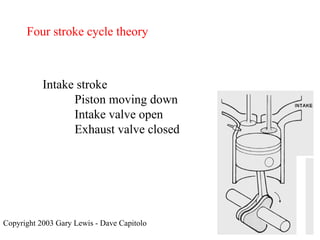
Four stroke cycle theory Intake stroke Piston moving down Intake valve open Exhaust valve closed Copyright 2003 Gary Lewis - Dave Capitolo
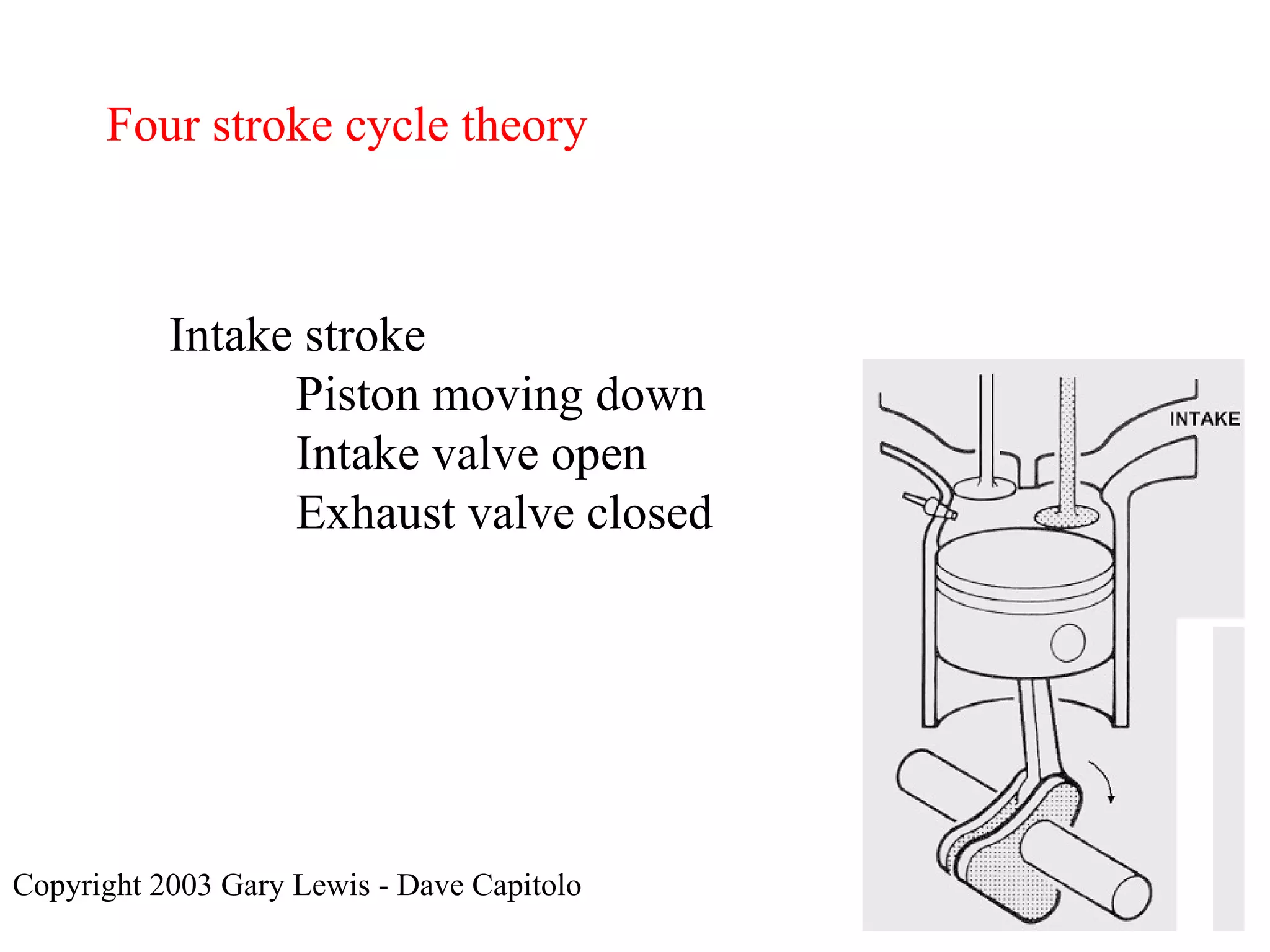
Four stroke cycle theory Compression stroke Piston moving up Intake valve closed Exhaust valve closed
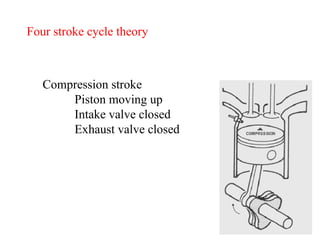
Four stroke cycle theory Power stroke Piston moving down Intake valve closed Exhaust valve closed
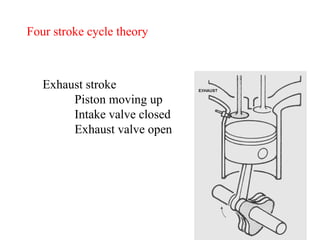
Four stroke cycle theory Exhaust stroke Piston moving up Intake valve closed Exhaust valve open
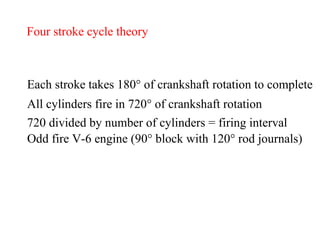
Four stroke cycle theory Each stroke takes 180 °  of crankshaft rotation to complete All cylinders fire in 720 °  of crankshaft rotation 720 divided by number of cylinders = firing interval Odd fire V-6 engine (90 ° block with 120° rod journals)
Four stroke diesel theory Compression ignition Diesel fuel low volatility High compression ratios produce the heat necessary Pre-chamber for vaporization
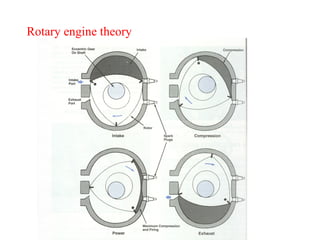
Rotary engine theory
Piston dwell time Piston travel is at a minimum. . .  TDC and BDC Crank moves horizontally Piston velocity Maximum when rod is 90 °  to crank Acceleration Maximum 30 ° earlier   Best VE is obtained by synchronizing valve opening with piston speeds
Other engine cycles Overlap Both valves are open End of exhaust & start of intake Low pressure in exhaust port Blowdown Exhaust valve opens before BDC To help evacuate cylinder before piston reverses Pumping losses at end of exhaust stroke
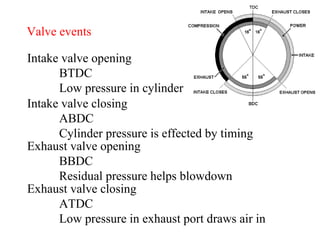
Valve events Intake valve opening BTDC Low pressure in cylinder Intake valve closing ABDC Cylinder pressure is effected by timing Exhaust valve opening BBDC Residual pressure helps blowdown Exhaust valve closing ATDC Low pressure in exhaust port draws air in
Effects on valve timing Intake valve opening Late – Reduced VE Early – Dilution of intake with exhaust Intake valve closing Late – Reduces cylinder pressure Early – Increases cylinder pressure Exhaust valve opening Late – Pumping losses Early – Power reduction Exhaust valve closing Late – Reduces vacuum Early – Reduces VE
Combustion Spark ignition Maximum cylinder pressure 15 ° ATDC Tumble and swirl Motion reduces misfires Excess motion inhibits flow AFR 14.7:1 at part throttle, 12.5:1 under load Compression ignition 18:1 direct injection 23:1 pre-chambers for better starting Cranking heats air to 600 °F Compression heats are to 800-1200 °F
Diesel fuels Cetane volatility numbers 50-55 Higher cetane #1 fuel for cold weather Lower cetane #2 fuel for warm weather Paraffin separates from fuel at 20°F
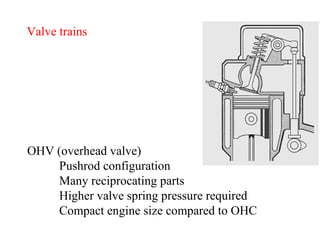
Valve trains OHV (overhead valve) Pushrod configuration Many reciprocating parts Higher valve spring pressure required Compact engine size compared to OHC
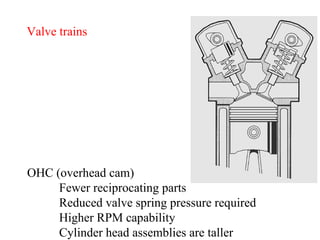
Valve trains OHC (overhead cam) Fewer reciprocating parts Reduced valve spring pressure required Higher RPM capability Cylinder head assemblies are taller
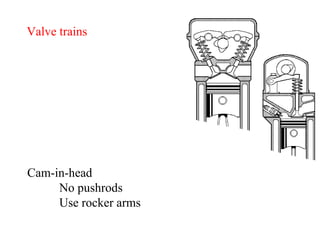
Valve trains Cam-in-head No pushrods Use rocker arms
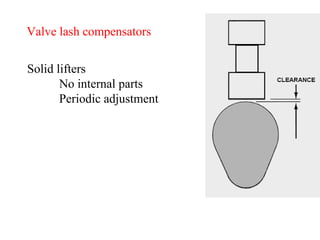
Valve lash compensators Solid lifters No internal parts Periodic adjustment
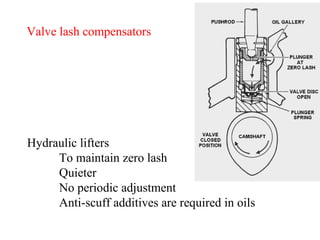
Valve lash compensators Hydraulic lifters To maintain zero lash Quieter No periodic adjustment Anti-scuff additives are required in oils
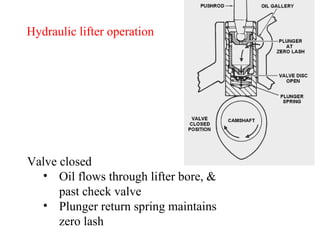
Hydraulic lifter operation Valve closed Oil flows through lifter bore, & past check valve Plunger return spring maintains  zero lash
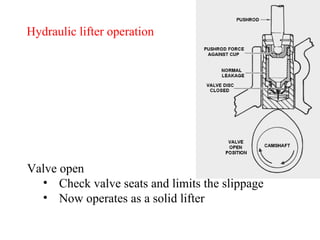
Hydraulic lifter operation Valve open Check valve seats and limits the slippage Now operates as a solid lifter
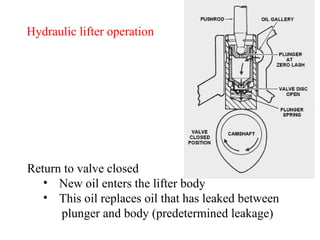
Hydraulic lifter operation Return to valve closed New oil enters the lifter body This oil replaces oil that has leaked between  plunger and body (predetermined leakage)
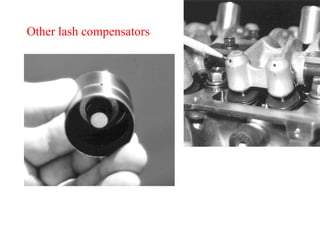
Other lash compensators
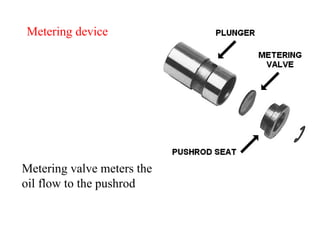
Metering device Metering valve meters the  oil flow to the pushrod
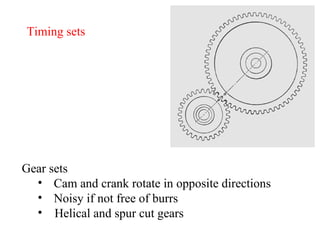
Timing sets Gear sets Cam and crank rotate in opposite directions Noisy if not free of burrs Helical and spur cut gears
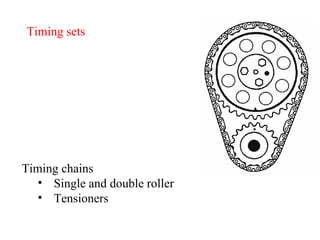
Timing sets Timing chains Single and double roller Tensioners
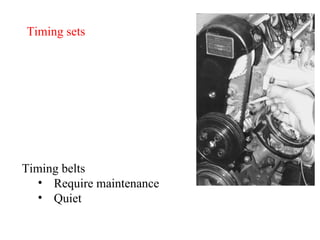
Timing sets Timing belts Require maintenance Quiet
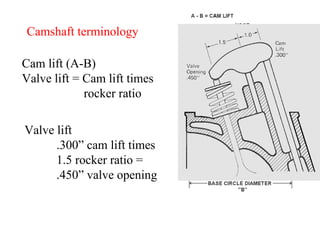
Camshaft terminology Cam lift (A-B) Valve lift = Cam lift times rocker ratio   Valve lift .300” cam lift times 1.5 rocker ratio =  .450” valve opening
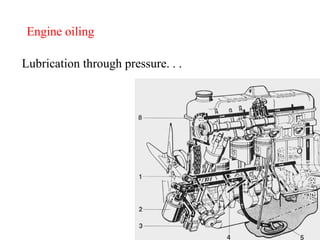
Engine oiling Lubrication through pressure. . .
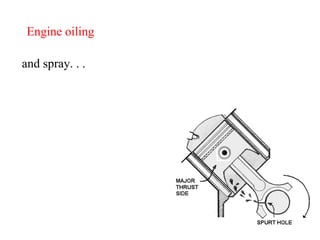
Engine oiling and spray. . .
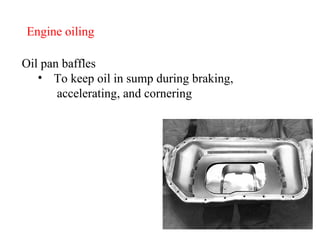
Engine oiling Oil pan baffles To keep oil in sump during braking,   accelerating, and cornering
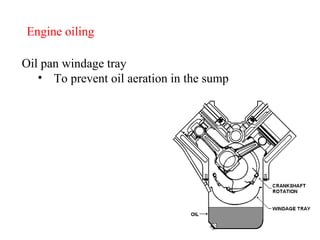
Engine oiling Oil pan windage tray To prevent oil aeration in the sump
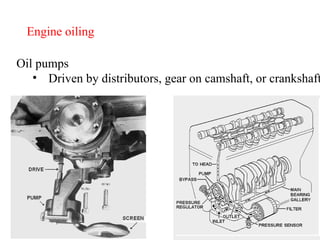
Engine oiling Oil pumps Driven by distributors, gear on camshaft, or crankshaft
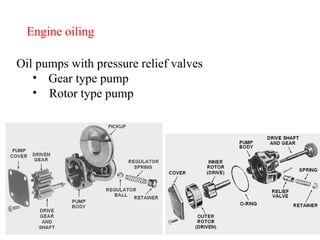
Engine oiling Oil pumps with pressure relief valves Gear type pump Rotor type pump
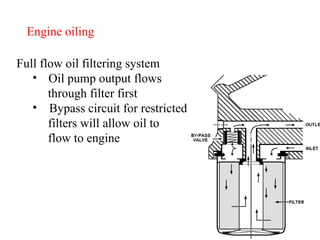
Engine oiling Full flow oil filtering system Oil pump output flows through filter first Bypass circuit for restricted filters will allow oil to flow to engine
Engine oils API, SAE, and ASTM “ S” - Spark ignition “ C” - Compression ignition
Engine oil additives Viscosity index improvers To reduce viscosity change with heat Detergents To dissolve varnish and sludge Dispersants To keep sludge, carbon and other materials from recombining and suspends them in oil to be drained Scuff inhibitors To reduce friction and wear Antifoam and antioxidants To prevent foaming and to slow oxidation in oil
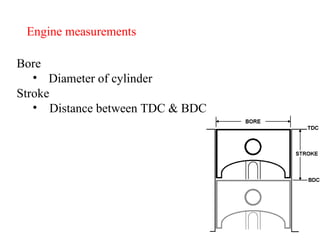
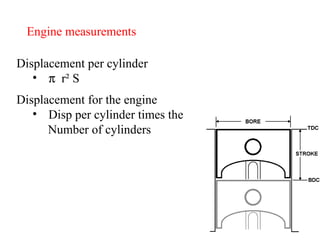
Engine measurements Bore  Diameter of cylinder Stroke Distance between TDC & BDC
Engine measurements Displacement per cylinder    r ² S  Displacement for the engine Disp per cylinder times the  Number of cylinders
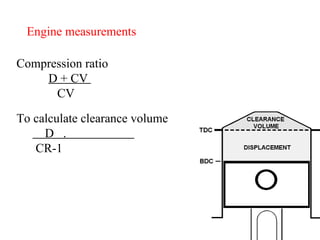
Engine measurements Compression ratio D + CV  CV To calculate clearance volume D  .  CR-1
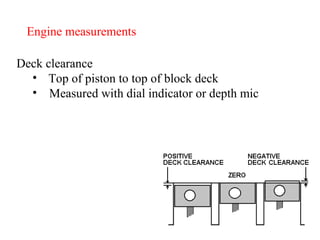
Engine measurements Deck clearance Top of piston to top of block deck Measured with dial indicator or depth mic
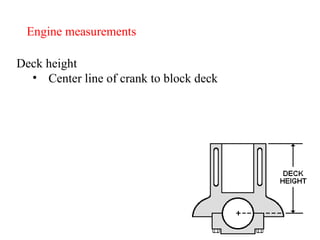
Engine measurements Deck height Center line of crank to block deck
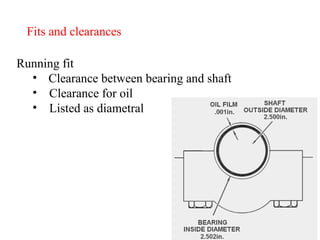
Fits and clearances Running fit Clearance between bearing and shaft Clearance for oil Listed as diametral
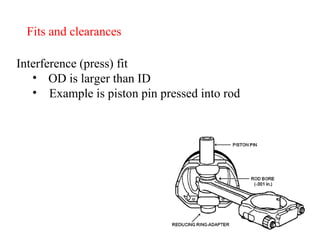
Fits and clearances Interference (press) fit OD is larger than ID Example is piston pin pressed into rod
Fits and clearances of pistons Full floating .0003 - .0005 clearance in rod .0001 - .0003 clearance in piston Oscillating .0008 - .0012 interference in rod .0003 - .0005 clearance in piston Rod offset Beam offset to center of cylinder Enlarged chamfers to clear fillets Pin offset Offset to major thrust side  Quieter engine, less cylinder wear
Cooling system operation Heat energy 1/3 usable power 1/3 released through exhaust system 1/3 released through cooling system Engine temperature Cool enough to prevent part failure Warm enough to maximize engine efficiency
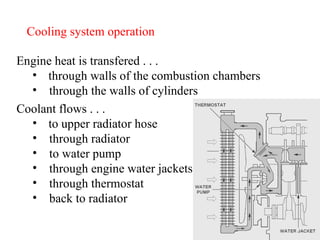
Cooling system operation Engine heat is transfered . . . through walls of the combustion chambers through the walls of cylinders Coolant flows . . . to upper radiator hose through radiator to water pump through engine water jackets through thermostat back to radiator
Cooling system operation Fans increase air flow through radiator Hydraulic fan clutches Hydraulic fans consume 6 to 8 HP Electric fans Coolant (ethylene glycol) 50/50 mixture increases boiling point to 227 ° F pressurizing system to 15 PSI increases to 265 ° F Coolant (propylene glycol) Less protection at the same temperatures Less toxic
Combustion efficiency Under perfect conditions . . . Only byproducts would be carbon dioxide and water Iso-octane fuel is laboratory fuel Because conditions are not perfect . . . Carbon monoxide and hydrocarbons are produced Oxides of nitrogen are produced from pressure & temp Emission controls Catalytic converters – Convert CO & HC to  carbon dioxide & water O2 sensors – To monitor oxygen content in exhaust EGR – To reduce peak cylinder temperatures

Chapter5 Theory

  • 1.
    Four stroke cycletheory Intake stroke Piston moving down Intake valve open Exhaust valve closed Copyright 2003 Gary Lewis - Dave Capitolo
  • 2.
    Four stroke cycletheory Compression stroke Piston moving up Intake valve closed Exhaust valve closed
  • 3.
    Four stroke cycletheory Power stroke Piston moving down Intake valve closed Exhaust valve closed
  • 4.
    Four stroke cycletheory Exhaust stroke Piston moving up Intake valve closed Exhaust valve open
  • 5.
    Four stroke cycletheory Each stroke takes 180 ° of crankshaft rotation to complete All cylinders fire in 720 ° of crankshaft rotation 720 divided by number of cylinders = firing interval Odd fire V-6 engine (90 ° block with 120° rod journals)
  • 6.
    Four stroke dieseltheory Compression ignition Diesel fuel low volatility High compression ratios produce the heat necessary Pre-chamber for vaporization
  • 7.
  • 8.
    Piston dwell timePiston travel is at a minimum. . . TDC and BDC Crank moves horizontally Piston velocity Maximum when rod is 90 ° to crank Acceleration Maximum 30 ° earlier Best VE is obtained by synchronizing valve opening with piston speeds
  • 9.
    Other engine cyclesOverlap Both valves are open End of exhaust & start of intake Low pressure in exhaust port Blowdown Exhaust valve opens before BDC To help evacuate cylinder before piston reverses Pumping losses at end of exhaust stroke
  • 10.
    Valve events Intakevalve opening BTDC Low pressure in cylinder Intake valve closing ABDC Cylinder pressure is effected by timing Exhaust valve opening BBDC Residual pressure helps blowdown Exhaust valve closing ATDC Low pressure in exhaust port draws air in
  • 11.
    Effects on valvetiming Intake valve opening Late – Reduced VE Early – Dilution of intake with exhaust Intake valve closing Late – Reduces cylinder pressure Early – Increases cylinder pressure Exhaust valve opening Late – Pumping losses Early – Power reduction Exhaust valve closing Late – Reduces vacuum Early – Reduces VE
  • 12.
    Combustion Spark ignitionMaximum cylinder pressure 15 ° ATDC Tumble and swirl Motion reduces misfires Excess motion inhibits flow AFR 14.7:1 at part throttle, 12.5:1 under load Compression ignition 18:1 direct injection 23:1 pre-chambers for better starting Cranking heats air to 600 °F Compression heats are to 800-1200 °F
  • 13.
    Diesel fuels Cetanevolatility numbers 50-55 Higher cetane #1 fuel for cold weather Lower cetane #2 fuel for warm weather Paraffin separates from fuel at 20°F
  • 14.
    Valve trains OHV(overhead valve) Pushrod configuration Many reciprocating parts Higher valve spring pressure required Compact engine size compared to OHC
  • 15.
    Valve trains OHC(overhead cam) Fewer reciprocating parts Reduced valve spring pressure required Higher RPM capability Cylinder head assemblies are taller
  • 16.
    Valve trains Cam-in-headNo pushrods Use rocker arms
  • 17.
    Valve lash compensatorsSolid lifters No internal parts Periodic adjustment
  • 18.
    Valve lash compensatorsHydraulic lifters To maintain zero lash Quieter No periodic adjustment Anti-scuff additives are required in oils
  • 19.
    Hydraulic lifter operationValve closed Oil flows through lifter bore, & past check valve Plunger return spring maintains zero lash
  • 20.
    Hydraulic lifter operationValve open Check valve seats and limits the slippage Now operates as a solid lifter
  • 21.
    Hydraulic lifter operationReturn to valve closed New oil enters the lifter body This oil replaces oil that has leaked between plunger and body (predetermined leakage)
  • 22.
  • 23.
    Metering device Meteringvalve meters the oil flow to the pushrod
  • 24.
    Timing sets Gearsets Cam and crank rotate in opposite directions Noisy if not free of burrs Helical and spur cut gears
  • 25.
    Timing sets Timingchains Single and double roller Tensioners
  • 26.
    Timing sets Timingbelts Require maintenance Quiet
  • 27.
    Camshaft terminology Camlift (A-B) Valve lift = Cam lift times rocker ratio Valve lift .300” cam lift times 1.5 rocker ratio = .450” valve opening
  • 28.
    Engine oiling Lubricationthrough pressure. . .
  • 29.
  • 30.
    Engine oiling Oilpan baffles To keep oil in sump during braking, accelerating, and cornering
  • 31.
    Engine oiling Oilpan windage tray To prevent oil aeration in the sump
  • 32.
    Engine oiling Oilpumps Driven by distributors, gear on camshaft, or crankshaft
  • 33.
    Engine oiling Oilpumps with pressure relief valves Gear type pump Rotor type pump
  • 34.
    Engine oiling Fullflow oil filtering system Oil pump output flows through filter first Bypass circuit for restricted filters will allow oil to flow to engine
  • 35.
    Engine oils API,SAE, and ASTM “ S” - Spark ignition “ C” - Compression ignition
  • 36.
    Engine oil additivesViscosity index improvers To reduce viscosity change with heat Detergents To dissolve varnish and sludge Dispersants To keep sludge, carbon and other materials from recombining and suspends them in oil to be drained Scuff inhibitors To reduce friction and wear Antifoam and antioxidants To prevent foaming and to slow oxidation in oil
  • 37.
    Engine measurements Bore Diameter of cylinder Stroke Distance between TDC & BDC
  • 38.
    Engine measurements Displacementper cylinder  r ² S Displacement for the engine Disp per cylinder times the Number of cylinders
  • 39.
    Engine measurements Compressionratio D + CV CV To calculate clearance volume D . CR-1
  • 40.
    Engine measurements Deckclearance Top of piston to top of block deck Measured with dial indicator or depth mic
  • 41.
    Engine measurements Deckheight Center line of crank to block deck
  • 42.
    Fits and clearancesRunning fit Clearance between bearing and shaft Clearance for oil Listed as diametral
  • 43.
    Fits and clearancesInterference (press) fit OD is larger than ID Example is piston pin pressed into rod
  • 44.
    Fits and clearancesof pistons Full floating .0003 - .0005 clearance in rod .0001 - .0003 clearance in piston Oscillating .0008 - .0012 interference in rod .0003 - .0005 clearance in piston Rod offset Beam offset to center of cylinder Enlarged chamfers to clear fillets Pin offset Offset to major thrust side Quieter engine, less cylinder wear
  • 45.
    Cooling system operationHeat energy 1/3 usable power 1/3 released through exhaust system 1/3 released through cooling system Engine temperature Cool enough to prevent part failure Warm enough to maximize engine efficiency
  • 46.
    Cooling system operationEngine heat is transfered . . . through walls of the combustion chambers through the walls of cylinders Coolant flows . . . to upper radiator hose through radiator to water pump through engine water jackets through thermostat back to radiator
  • 47.
    Cooling system operationFans increase air flow through radiator Hydraulic fan clutches Hydraulic fans consume 6 to 8 HP Electric fans Coolant (ethylene glycol) 50/50 mixture increases boiling point to 227 ° F pressurizing system to 15 PSI increases to 265 ° F Coolant (propylene glycol) Less protection at the same temperatures Less toxic
  • 48.
    Combustion efficiency Underperfect conditions . . . Only byproducts would be carbon dioxide and water Iso-octane fuel is laboratory fuel Because conditions are not perfect . . . Carbon monoxide and hydrocarbons are produced Oxides of nitrogen are produced from pressure & temp Emission controls Catalytic converters – Convert CO & HC to carbon dioxide & water O2 sensors – To monitor oxygen content in exhaust EGR – To reduce peak cylinder temperatures