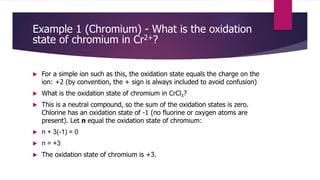
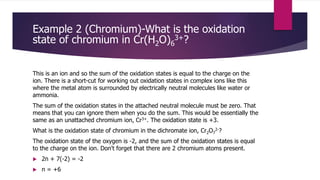
Oxidation states provide insight into the number of electrons lost by an atom and describe the extent of its oxidation. An atom's oxidation state is defined as the hypothetical charge it would have if all of its bonds were completely ionic. There are some simple rules for determining oxidation states, such as elements in their elemental state having an oxidation state of zero, and the sum of oxidation states in a compound being equal to the overall charge. Examples are provided to demonstrate how to use these rules to find the oxidation state of chromium in different compounds.