Nic Smith BI Solutions Marketing Microsoft Corporation
 
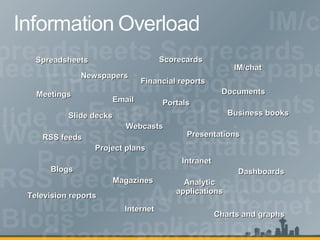
Scorecards Slide decks Meetings Analytic applications Presentations Financial reports  Dashboards Webcasts Charts and graphs Internet Project plans Documents Spreadsheets Intranet Blogs Portals RSS feeds Business books Television reports Magazines Newspapers IM/chat Email
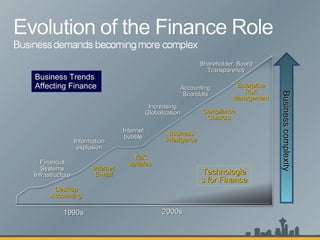
1990s 2000s Financial Systems Infrastructure Increasing Globalization Internet bubble Accounting Scandals Shareholder, Board Transparency Business Trends Affecting Finance Technologies for Finance Business Intelligence Internet E-mail Y2K updates Desktop Accounting Compliance Controls Enterprise Risk Management Information explosion Business complexity
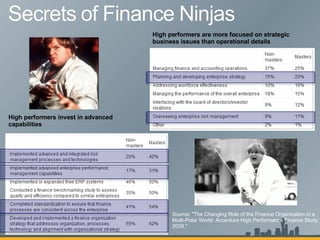
Source: "The Changing Role of the Finance Organization in a Multi-Polar World: Accenture High Performance Finance Study 2008." High performers are more focused on strategic business issues than operational details High performers invest in advanced capabilities
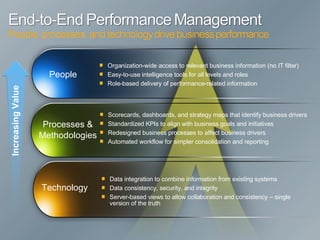
People Processes & Methodologies Technology Organization-wide access to relevant business information (no IT filter) Easy-to-use intelligence tools for all levels and roles Role-based delivery of performance-related information Scorecards, dashboards, and strategy maps that identify business drivers Standardized KPIs to align with business goals and initiatives Redesigned business processes to affect business drivers Automated workflow for simpler consolidation and reporting Data integration to combine information from existing systems Data consistency, security, and integrity Server-based views to allow collaboration and consistency – single version of the truth Increasing Value
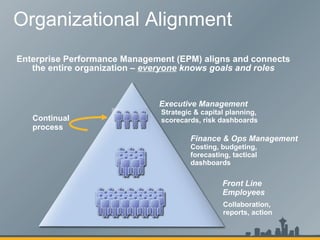
Organizational Alignment Finance & Ops Management Costing, budgeting, forecasting, tactical dashboards Executive Management Strategic & capital planning, scorecards, risk dashboards Front Line  Employees   Collaboration,  reports, action Enterprise Performance Management (EPM) aligns and connects the entire organization –  everyone  knows goals and roles Continual process
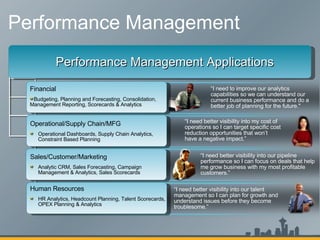
Performance Management Human Resources HR Analytics, Headcount Planning, Talent Scorecards, OPEX Planning & Analytics  Financial Budgeting, Planning and Forecasting, Consolidation, Management Reporting, Scorecards & Analytics Operational/Supply Chain/MFG Operational Dashboards, Supply Chain Analytics, Constraint Based Planning Sales/Customer/Marketing Analytic CRM, Sales Forecasting, Campaign Management & Analytics, Sales Scorecards “ I need to improve our analytics capabilities so we can understand our current business performance and do a better job of planning for the future." “ I need better visibility into my cost of operations so I can target specific cost reduction opportunities that won’t have a negative impact.” “ I need better visibility into our pipeline performance so I can focus on deals that help me grow business with my most profitable customers.” “ I need better visibility into our talent management so I can plan for growth and understand issues before they become troublesome.” Performance Management Applications
 
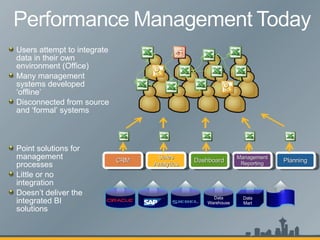
Point solutions for management processes Little or no integration Doesn’t deliver the integrated BI solutions Users attempt to integrate data in their own environment (Office) Many management systems developed ‘offline’ Disconnected from source and ‘formal’ systems Data Mart Data Warehouse CRM Planning Sales Analytics Management Reporting Dashboard
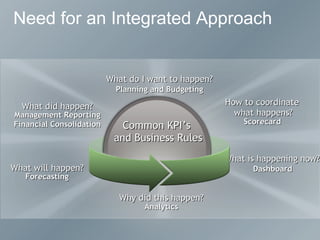
Need for an Integrated Approach Forecasting What will happen? Planning and Budgeting What do I want to happen? Dashboard What is happening now? Analytics Why did this happen? Scorecard How to coordinate what happens? Management Reporting Financial Consolidation What did happen? Common KPI’s  and Business Rules
 
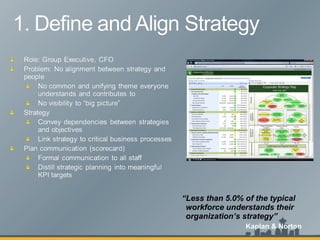
“ Less than 5.0% of the typical workforce understands their organization’s strategy” Kaplan & Norton
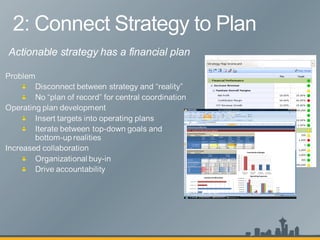
Actionable strategy has a financial plan
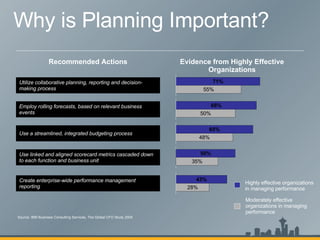
Why is Planning Important? Source: IBM Business Consulting Services, The Global CFO Study 2005 Moderately effective organizations in managing performance Utilize collaborative planning, reporting and decision-making process Employ rolling forecasts, based on relevant business events Use a streamlined, integrated budgeting process Create enterprise-wide performance management reporting 48% 50% 55% 71% 28% 43% 65% 68% 50% Use linked and aligned scorecard metrics cascaded down to each function and business unit 35% Recommended Actions Evidence from Highly Effective Organizations Highly effective organizations  in managing performance


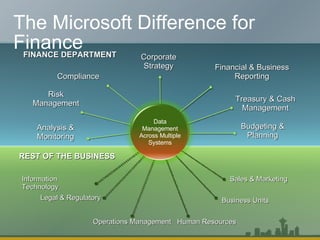
The Microsoft Difference for Finance Financial & Business Reporting Treasury & Cash Management Corporate Strategy Budgeting & Planning Compliance Risk Management Analysis & Monitoring FINANCE DEPARTMENT Information Technology Legal & Regulatory Human Resources Sales & Marketing Business Units REST OF THE BUSINESS Operations Management Data Management Across Multiple Systems
 
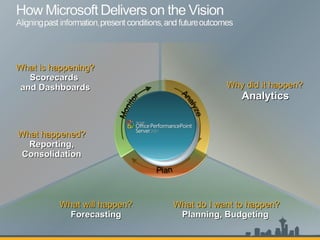
What happened? Reporting, Consolidation What is happening? Scorecards  and Dashboards Why did it happen? Analytics What will happen? Forecasting What do I want to happen? Planning, Budgeting
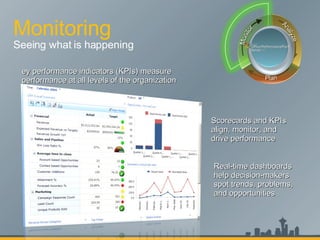
Monitoring Seeing what is happening Key performance indicators (KPIs) measure performance at all levels of the organization Scorecards and KPIs align, monitor, and drive performance Real-time dashboards help decision-makers spot trends, problems, and opportunities
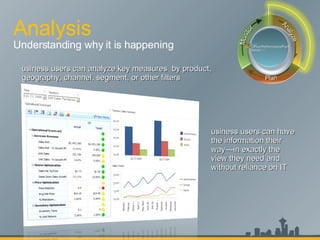
Analysis Understanding why it is happening Business users can have the information their way—in exactly the view they need and without reliance on IT Business users can analyze key measures  by product, geography, channel, segment, or other filters
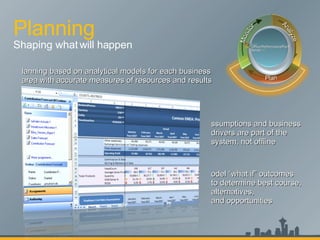
Planning Shaping what will happen Assumptions and business drivers are part of the system, not offline Model “what if” outcomes  to determine best course, alternatives,  and opportunities  Planning based on analytical models for each business  area with accurate measures of resources and results


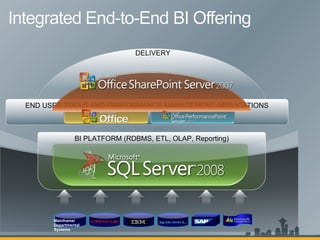
Mainframe/ Departmental Systems  END USER TOOLS AND PERFORMANCE MANAGEMENT APPLICATIONS BI PLATFORM (RDBMS, ETL, OLAP, Reporting) DELIVERY
 
 
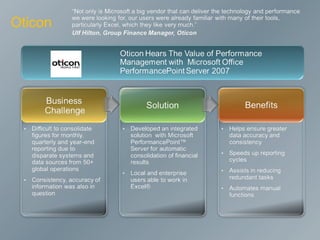
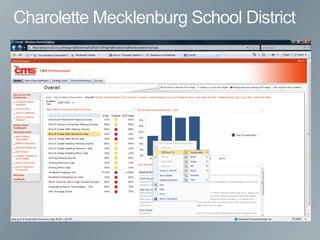
Oticon
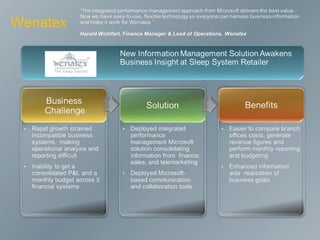
Wenatex
 
 
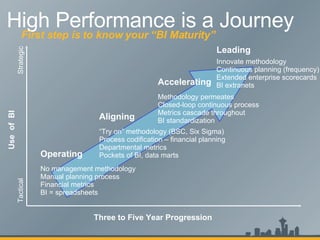
High Performance is a Journey Tactical Operating Aligning Accelerating Leading No management methodology Manual planning process Financial metrics BI = spreadsheets Strategic Three to Five Year Progression “ Try on” methodology (BSC, Six Sigma) Process codification – financial planning Departmental metrics Pockets of BI, data marts Methodology permeates Closed-loop continuous process Metrics cascade throughout  BI standardization Innovate methodology Continuous planning (frequency) Extended enterprise scorecards BI extranets Use  of  BI  First step is to know your “BI Maturity”
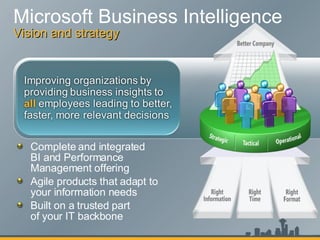
Microsoft Business Intelligence Vision and strategy Complete and integrated BI and Performance Management offering  Agile products that adapt to your information needs Built on a trusted part of your IT backbone


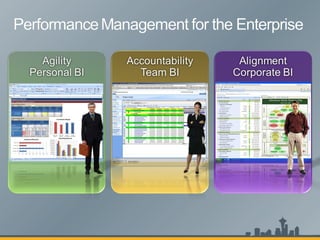
Driving Business Performance with Microsoft Performance Management

  • 1.
  • 2.
    Nic Smith BISolutions Marketing Microsoft Corporation
  • 3.
  • 4.
    Scorecards Slide decksMeetings Analytic applications Presentations Financial reports Dashboards Webcasts Charts and graphs Internet Project plans Documents Spreadsheets Intranet Blogs Portals RSS feeds Business books Television reports Magazines Newspapers IM/chat Email
  • 5.
    1990s 2000s FinancialSystems Infrastructure Increasing Globalization Internet bubble Accounting Scandals Shareholder, Board Transparency Business Trends Affecting Finance Technologies for Finance Business Intelligence Internet E-mail Y2K updates Desktop Accounting Compliance Controls Enterprise Risk Management Information explosion Business complexity
  • 6.
    Source: "The ChangingRole of the Finance Organization in a Multi-Polar World: Accenture High Performance Finance Study 2008." High performers are more focused on strategic business issues than operational details High performers invest in advanced capabilities
  • 7.
    People Processes &Methodologies Technology Organization-wide access to relevant business information (no IT filter) Easy-to-use intelligence tools for all levels and roles Role-based delivery of performance-related information Scorecards, dashboards, and strategy maps that identify business drivers Standardized KPIs to align with business goals and initiatives Redesigned business processes to affect business drivers Automated workflow for simpler consolidation and reporting Data integration to combine information from existing systems Data consistency, security, and integrity Server-based views to allow collaboration and consistency – single version of the truth Increasing Value
  • 8.
    Organizational Alignment Finance& Ops Management Costing, budgeting, forecasting, tactical dashboards Executive Management Strategic & capital planning, scorecards, risk dashboards Front Line Employees Collaboration, reports, action Enterprise Performance Management (EPM) aligns and connects the entire organization – everyone knows goals and roles Continual process
  • 9.
    Performance Management HumanResources HR Analytics, Headcount Planning, Talent Scorecards, OPEX Planning & Analytics Financial Budgeting, Planning and Forecasting, Consolidation, Management Reporting, Scorecards & Analytics Operational/Supply Chain/MFG Operational Dashboards, Supply Chain Analytics, Constraint Based Planning Sales/Customer/Marketing Analytic CRM, Sales Forecasting, Campaign Management & Analytics, Sales Scorecards “ I need to improve our analytics capabilities so we can understand our current business performance and do a better job of planning for the future." “ I need better visibility into my cost of operations so I can target specific cost reduction opportunities that won’t have a negative impact.” “ I need better visibility into our pipeline performance so I can focus on deals that help me grow business with my most profitable customers.” “ I need better visibility into our talent management so I can plan for growth and understand issues before they become troublesome.” Performance Management Applications
  • 10.
  • 11.
    Point solutions formanagement processes Little or no integration Doesn’t deliver the integrated BI solutions Users attempt to integrate data in their own environment (Office) Many management systems developed ‘offline’ Disconnected from source and ‘formal’ systems Data Mart Data Warehouse CRM Planning Sales Analytics Management Reporting Dashboard
  • 12.
    Need for anIntegrated Approach Forecasting What will happen? Planning and Budgeting What do I want to happen? Dashboard What is happening now? Analytics Why did this happen? Scorecard How to coordinate what happens? Management Reporting Financial Consolidation What did happen? Common KPI’s and Business Rules
  • 13.
  • 14.
    “ Less than5.0% of the typical workforce understands their organization’s strategy” Kaplan & Norton
  • 15.
    Actionable strategy hasa financial plan
  • 16.
    Why is PlanningImportant? Source: IBM Business Consulting Services, The Global CFO Study 2005 Moderately effective organizations in managing performance Utilize collaborative planning, reporting and decision-making process Employ rolling forecasts, based on relevant business events Use a streamlined, integrated budgeting process Create enterprise-wide performance management reporting 48% 50% 55% 71% 28% 43% 65% 68% 50% Use linked and aligned scorecard metrics cascaded down to each function and business unit 35% Recommended Actions Evidence from Highly Effective Organizations Highly effective organizations in managing performance
  • 17.
  • 18.
  • 19.
  • 20.
  • 21.
    The Microsoft Differencefor Finance Financial & Business Reporting Treasury & Cash Management Corporate Strategy Budgeting & Planning Compliance Risk Management Analysis & Monitoring FINANCE DEPARTMENT Information Technology Legal & Regulatory Human Resources Sales & Marketing Business Units REST OF THE BUSINESS Operations Management Data Management Across Multiple Systems
  • 22.
  • 23.
    What happened? Reporting,Consolidation What is happening? Scorecards and Dashboards Why did it happen? Analytics What will happen? Forecasting What do I want to happen? Planning, Budgeting
  • 24.
    Monitoring Seeing whatis happening Key performance indicators (KPIs) measure performance at all levels of the organization Scorecards and KPIs align, monitor, and drive performance Real-time dashboards help decision-makers spot trends, problems, and opportunities
  • 25.
    Analysis Understanding whyit is happening Business users can have the information their way—in exactly the view they need and without reliance on IT Business users can analyze key measures by product, geography, channel, segment, or other filters
  • 26.
    Planning Shaping whatwill happen Assumptions and business drivers are part of the system, not offline Model “what if” outcomes to determine best course, alternatives, and opportunities Planning based on analytical models for each business area with accurate measures of resources and results
  • 27.
    Mainframe/ Departmental Systems END USER TOOLS AND PERFORMANCE MANAGEMENT APPLICATIONS BI PLATFORM (RDBMS, ETL, OLAP, Reporting) DELIVERY
  • 28.
  • 29.
  • 30.
  • 31.
  • 32.
  • 33.
  • 34.
    High Performance isa Journey Tactical Operating Aligning Accelerating Leading No management methodology Manual planning process Financial metrics BI = spreadsheets Strategic Three to Five Year Progression “ Try on” methodology (BSC, Six Sigma) Process codification – financial planning Departmental metrics Pockets of BI, data marts Methodology permeates Closed-loop continuous process Metrics cascade throughout BI standardization Innovate methodology Continuous planning (frequency) Extended enterprise scorecards BI extranets Use of BI First step is to know your “BI Maturity”
  • 35.
    Microsoft Business IntelligenceVision and strategy Complete and integrated BI and Performance Management offering Agile products that adapt to your information needs Built on a trusted part of your IT backbone
  • 36.
  • 37.

Editor's Notes

  • #2 06/05/09 13:22 © 2007 Microsoft Corporation. All rights reserved. Microsoft, Windows, Windows Vista and other product names are or may be registered trademarks and/or trademarks in the U.S. and/or other countries. The information herein is for informational purposes only and represents the current view of Microsoft Corporation as of the date of this presentation. Because Microsoft must respond to changing market conditions, it should not be interpreted to be a commitment on the part of Microsoft, and Microsoft cannot guarantee the accuracy of any information provided after the date of this presentation. MICROSOFT MAKES NO WARRANTIES, EXPRESS, IMPLIED OR STATUTORY, AS TO THE INFORMATION IN THIS PRESENTATION.