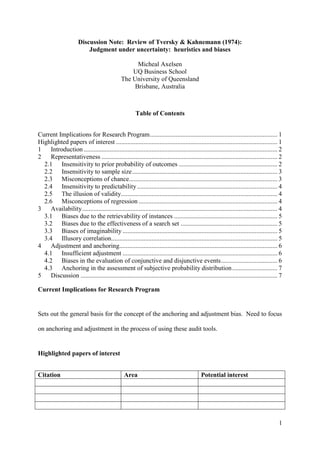
Discussion Note: Review of Tversky & Kahnemann (1974):
                           Judgment under uncertainty: heuristics and biases

                                                      Micheal Axelsen
                                                    UQ Business School
                                                The University of Queensland
                                                     Brisbane, Australia


                                                        Table of Contents


Current Implications for Research Program ............................................................................... 1
Highlighted papers of interest .................................................................................................... 1
1    Introduction ........................................................................................................................ 2
2    Representativeness ............................................................................................................. 2
  2.1 Insensitivity to prior probability of outcomes ............................................................. 2
  2.2 Insensitivity to sample size .......................................................................................... 3
  2.3 Misconceptions of chance............................................................................................ 3
  2.4 Insensitivity to predictability ....................................................................................... 4
  2.5 The illusion of validity................................................................................................. 4
  2.6 Misconceptions of regression ...................................................................................... 4
3    Availability ......................................................................................................................... 4
  3.1 Biases due to the retrievability of instances ................................................................ 5
  3.2 Biases due to the effectiveness of a search set ............................................................ 5
  3.3 Biases of imaginability ................................................................................................ 5
  3.4 Illusory correlation....................................................................................................... 5
4    Adjustment and anchoring.................................................................................................. 6
  4.1 Insufficient adjustment ................................................................................................ 6
  4.2 Biases in the evaluation of conjunctive and disjunctive events ................................... 6
  4.3 Anchoring in the assessment of subjective probability distribution ............................ 7
5    Discussion .......................................................................................................................... 7

Current Implications for Research Program


Sets out the general basis for the concept of the anchoring and adjustment bias. Need to focus

on anchoring and adjustment in the process of using these audit tools.


Highlighted papers of interest


Citation                                         Area                                         Potential interest


                                                                                                                                           1
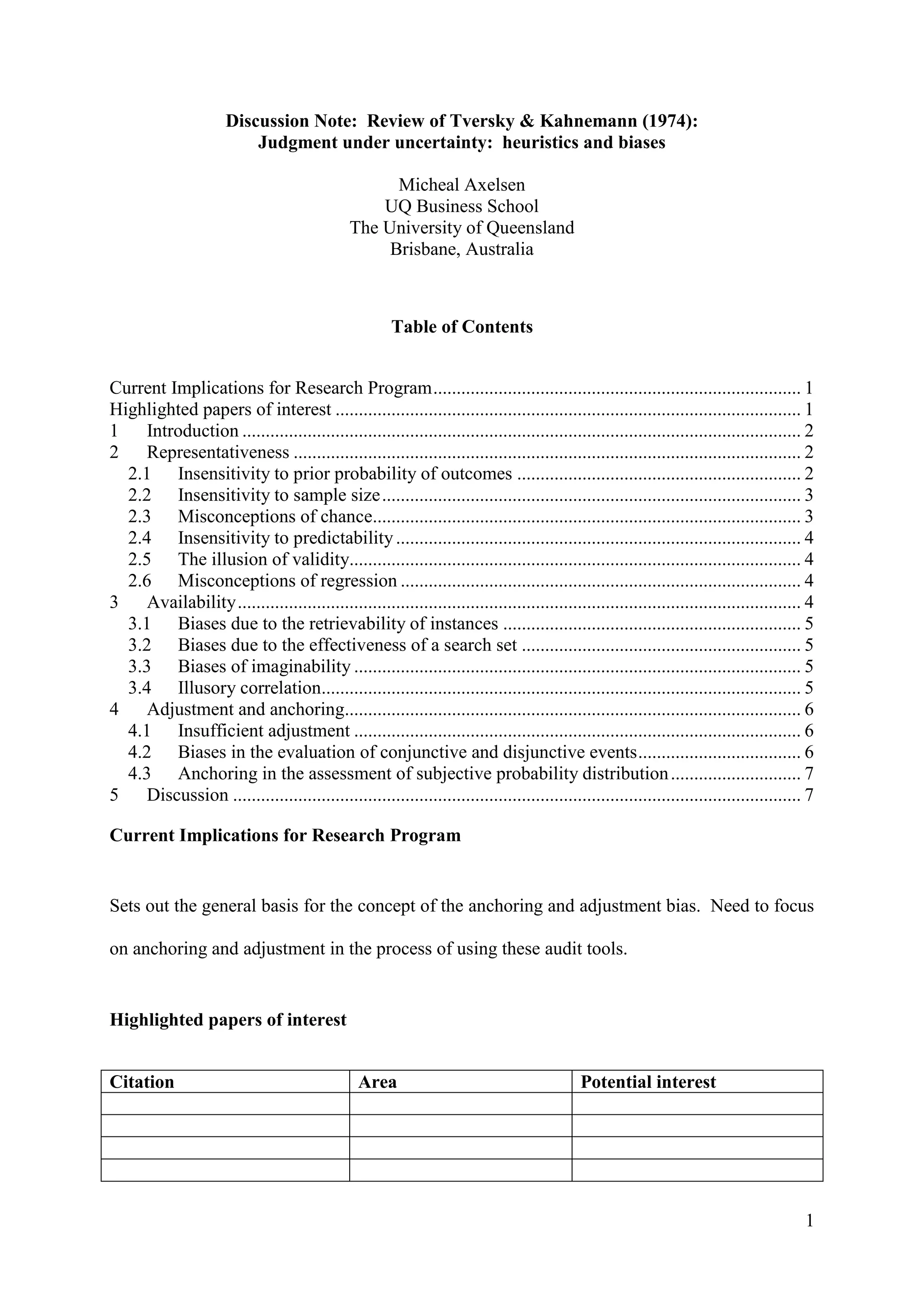
1     Introduction


People rely on a limited number of heuristic principles which reduce the complex tasks of

assessing probabilities and predicting values to simpler judgmental operations.


These heuristics can lend to systematic errors, even though they are quite useful.


There are at least three heuristics employed to assess probabilities and to predict values.

These are Representativeness, Availability, and Adjustment and anchoring.


2     Representativeness


Representativeness occurs where probabilities are evaluated by the degree to which A is

representative of B.


There is a match to a stereotype of this item, and it is more to do with similarity rather than

probability as such.     So – rather than assess an individual as their true probabilistic

membership of a group, we look to find a group with characteristics that match the major

group.


Kahnemann & Tversky (1973, p4) found that people order occupations of groups of people by

probability and similarity in exactly the same way. When applied to a question of probability,

serious errors will result as several factors that affect probability are ignored.


2.1    Insensitivity to prior probability of outcomes


For our example of occupations, the known base rate of an occupation might be ignored – we

can’t all be librarians, for example.


                                                                                             2
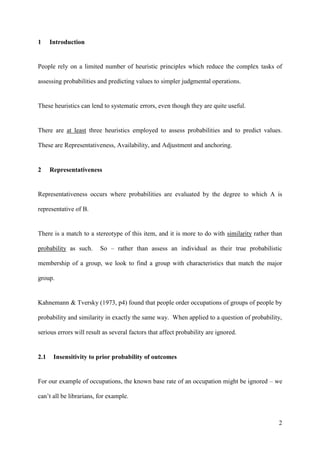
If people evaluate probability by representativeness, prior probabilities will be neglected.


This is supported by Kahmemann & Tversky (1973, 4).


In doing this, our estimator ignores Beyesian rules.


When no specific evidence is given, prior probabilities are properly utilised. When worthless

evidence is given, prior probabilities are ignored (Kahnemann & Tversky 1973).


2.2   Insensitivity to sample size


The judged probability of a sample statistic will be essentially independent of sample size.

That is, they ignore n.


This is supported by the research given in Kahnemann & Tversky (1972b, 3).


2.3   Misconceptions of chance


People expect that a sequence of events generated by a random process will represent the

essential characteristics of that process even when the sequence is short.


People expect what is true globally to also be true in its parts.


Chance is commonly viewed as a self-correcting process in which a deviation in one direction

induces a deviation in the opposite direction to restore the equilibrium.


Tversky & Kahnemann (1971, p2) shows that misconceptions of chance are not limited to

naïve subjcts – this is the gambler’s fallacy.


                                                                                               3
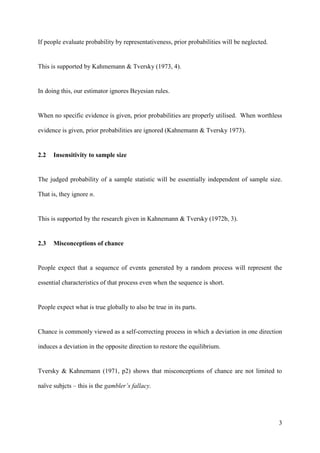
2.4    Insensitivity to predictability


We often make predictions about the future based on representativeness.


Intuitive predictions use the description (which has little worthwhile information) to predict

an outcome based on this description (Kahnemann & Tversky 1973, p4).


2.5    The illusion of validity


This occurs where confidence is placed in evidence that produces a good fit between the

presented outcome and the input information, even when the information is scanty, unreliable

or outdated.


2.6    Misconceptions of regression


Discusses some points about regression to the mean and the fact most people don’t understand

the nuances of regression. Intuitively, people don’t understand it.


Note the discussion to the effect that saying ‘good job’ may lead to a bad try next time, and

vice versa – refer to the anecdote of flight instructors and their students).


3     Availability


Availability is another heuristic we use to evaluate a possibility based on the example

instances (or scenarios) that e have available. The example given is an assessment of the risk

of heart attacks among middle-aged people by recalling such occurrences among one’s

acquaintenances.


                                                                                            4
Since the instances you have available to you are clearly not representative, there will be a

resultant predictive bias.


3.1   Biases due to the retrievability of instances


So a class whose instances are easily retrieved will appear more numerous than a class of

equal frequency (but not so easily retrieved).


Factors include familiarity and salience – for example, seeing a house burn down has more

impact and is therefore more likely to be retrieved than if it was simply read about in the

paper.


3.2   Biases due to the effectiveness of a search set


The example her is ‘is it more likely that a randomly selected word on a page will start with

‘r’ or instead that ‘r’ is the third letter?’.   People will find it easier to recall a word starting

with ‘r’ than a word where the ‘r’ is the third letter.


This is supported by Galbraite and Underwood (1973).


3.3   Biases of imaginability


As it is biased depending on how many people or situations can be imagined.


3.4   Illusory correlation


Things only seem to be correlated.


                                                                                                   5
4     Adjustment and anchoring


Again this is another heuristic. Here, people make estimates by starting from an initial value

that is adjusted to yield the final answer.


The initial value or starting point may be suggested by the formulation of the problem, or it

may be the result of a partial computation.


Anyway the adjustments made thereafter are usually insufficient (Slovic & Lichtenstein

1971).


4.1    Insufficient adjustment


In this paper (Tversky & Kahmenann 1974) the wheel of fortune was used to select an

unrelated number and then the estimate of African nations in the UN was made. Even though

unrelated, it still biased their estimate.


Even payoffs for accuracy did not help.


4.2    Biases in the evaluation of conjunctive and disjunctive events


People tend to overestimate the probability of conjunctive events (Cohen, Chesnick & Haran

1972 p24) and to underestimate the probability of disjunctive events.


So – people’s rules of thumb for assessing probability are generally biased.


                                                                                            6
4.3    Anchoring in the assessment of subjective probability distribution


Subjects state overly narrow confidence intervals which reflect more certainty than is justified

by their knowledge about the assessed quantities.


5     Discussion


Sophisticated individuals still make biased assessments – with the exception of elementary

errors.


                                                                                              7

Judgment Under Uncertainty: Anchoring and Adjustment Bias

  • 1.
    Discussion Note: Reviewof Tversky & Kahnemann (1974): Judgment under uncertainty: heuristics and biases Micheal Axelsen UQ Business School The University of Queensland Brisbane, Australia Table of Contents Current Implications for Research Program ............................................................................... 1 Highlighted papers of interest .................................................................................................... 1 1 Introduction ........................................................................................................................ 2 2 Representativeness ............................................................................................................. 2 2.1 Insensitivity to prior probability of outcomes ............................................................. 2 2.2 Insensitivity to sample size .......................................................................................... 3 2.3 Misconceptions of chance............................................................................................ 3 2.4 Insensitivity to predictability ....................................................................................... 4 2.5 The illusion of validity................................................................................................. 4 2.6 Misconceptions of regression ...................................................................................... 4 3 Availability ......................................................................................................................... 4 3.1 Biases due to the retrievability of instances ................................................................ 5 3.2 Biases due to the effectiveness of a search set ............................................................ 5 3.3 Biases of imaginability ................................................................................................ 5 3.4 Illusory correlation....................................................................................................... 5 4 Adjustment and anchoring.................................................................................................. 6 4.1 Insufficient adjustment ................................................................................................ 6 4.2 Biases in the evaluation of conjunctive and disjunctive events ................................... 6 4.3 Anchoring in the assessment of subjective probability distribution ............................ 7 5 Discussion .......................................................................................................................... 7 Current Implications for Research Program Sets out the general basis for the concept of the anchoring and adjustment bias. Need to focus on anchoring and adjustment in the process of using these audit tools. Highlighted papers of interest Citation Area Potential interest 1
  • 2.
    1 Introduction People rely on a limited number of heuristic principles which reduce the complex tasks of assessing probabilities and predicting values to simpler judgmental operations. These heuristics can lend to systematic errors, even though they are quite useful. There are at least three heuristics employed to assess probabilities and to predict values. These are Representativeness, Availability, and Adjustment and anchoring. 2 Representativeness Representativeness occurs where probabilities are evaluated by the degree to which A is representative of B. There is a match to a stereotype of this item, and it is more to do with similarity rather than probability as such. So – rather than assess an individual as their true probabilistic membership of a group, we look to find a group with characteristics that match the major group. Kahnemann & Tversky (1973, p4) found that people order occupations of groups of people by probability and similarity in exactly the same way. When applied to a question of probability, serious errors will result as several factors that affect probability are ignored. 2.1 Insensitivity to prior probability of outcomes For our example of occupations, the known base rate of an occupation might be ignored – we can’t all be librarians, for example. 2
  • 3.
    If people evaluateprobability by representativeness, prior probabilities will be neglected. This is supported by Kahmemann & Tversky (1973, 4). In doing this, our estimator ignores Beyesian rules. When no specific evidence is given, prior probabilities are properly utilised. When worthless evidence is given, prior probabilities are ignored (Kahnemann & Tversky 1973). 2.2 Insensitivity to sample size The judged probability of a sample statistic will be essentially independent of sample size. That is, they ignore n. This is supported by the research given in Kahnemann & Tversky (1972b, 3). 2.3 Misconceptions of chance People expect that a sequence of events generated by a random process will represent the essential characteristics of that process even when the sequence is short. People expect what is true globally to also be true in its parts. Chance is commonly viewed as a self-correcting process in which a deviation in one direction induces a deviation in the opposite direction to restore the equilibrium. Tversky & Kahnemann (1971, p2) shows that misconceptions of chance are not limited to naïve subjcts – this is the gambler’s fallacy. 3
  • 4.
    2.4 Insensitivity to predictability We often make predictions about the future based on representativeness. Intuitive predictions use the description (which has little worthwhile information) to predict an outcome based on this description (Kahnemann & Tversky 1973, p4). 2.5 The illusion of validity This occurs where confidence is placed in evidence that produces a good fit between the presented outcome and the input information, even when the information is scanty, unreliable or outdated. 2.6 Misconceptions of regression Discusses some points about regression to the mean and the fact most people don’t understand the nuances of regression. Intuitively, people don’t understand it. Note the discussion to the effect that saying ‘good job’ may lead to a bad try next time, and vice versa – refer to the anecdote of flight instructors and their students). 3 Availability Availability is another heuristic we use to evaluate a possibility based on the example instances (or scenarios) that e have available. The example given is an assessment of the risk of heart attacks among middle-aged people by recalling such occurrences among one’s acquaintenances. 4
  • 5.
    Since the instancesyou have available to you are clearly not representative, there will be a resultant predictive bias. 3.1 Biases due to the retrievability of instances So a class whose instances are easily retrieved will appear more numerous than a class of equal frequency (but not so easily retrieved). Factors include familiarity and salience – for example, seeing a house burn down has more impact and is therefore more likely to be retrieved than if it was simply read about in the paper. 3.2 Biases due to the effectiveness of a search set The example her is ‘is it more likely that a randomly selected word on a page will start with ‘r’ or instead that ‘r’ is the third letter?’. People will find it easier to recall a word starting with ‘r’ than a word where the ‘r’ is the third letter. This is supported by Galbraite and Underwood (1973). 3.3 Biases of imaginability As it is biased depending on how many people or situations can be imagined. 3.4 Illusory correlation Things only seem to be correlated. 5
  • 6.
    4 Adjustment and anchoring Again this is another heuristic. Here, people make estimates by starting from an initial value that is adjusted to yield the final answer. The initial value or starting point may be suggested by the formulation of the problem, or it may be the result of a partial computation. Anyway the adjustments made thereafter are usually insufficient (Slovic & Lichtenstein 1971). 4.1 Insufficient adjustment In this paper (Tversky & Kahmenann 1974) the wheel of fortune was used to select an unrelated number and then the estimate of African nations in the UN was made. Even though unrelated, it still biased their estimate. Even payoffs for accuracy did not help. 4.2 Biases in the evaluation of conjunctive and disjunctive events People tend to overestimate the probability of conjunctive events (Cohen, Chesnick & Haran 1972 p24) and to underestimate the probability of disjunctive events. So – people’s rules of thumb for assessing probability are generally biased. 6
  • 7.
    4.3 Anchoring in the assessment of subjective probability distribution Subjects state overly narrow confidence intervals which reflect more certainty than is justified by their knowledge about the assessed quantities. 5 Discussion Sophisticated individuals still make biased assessments – with the exception of elementary errors. 7