
‘  Balance Score Card Corporate Performance Management-CPM  KPI – Key Performance Indicators Business Intelligence  for Emerging Enterprise’
Diapers and Beer  Wal-Mart , the world’s largest retailer, supposedly found out that there are certain times at which beer and diapers sell particularly well together - when on Friday evenings young men make a last dash to the supermarket to get beer and their wives call after them, “Pick up some diapers, too, honey!”  “ Some of the ways Wal-Mart managers found to exploit their findings are legendary. One such legend is the story, “diapers and beer”. Wal-Mart discovered through data mining that the sales of diapers and beer were correlated on Friday nights. It determined that the correlation was based on working men who had been asked to pick up diapers on their way home from work. On Fridays the men figured they deserved a six-pack of beer for their trouble; hence the connection between beer and diapers. By moving these two items closer together, Wal-Mart reportedly saw the sales of both items increase geometrically.”  A version with a slightly different view of the roles involved suggests that the men are sent to the supermarket for the diapers and, because there’s no time left to go to a bar, take beer home with them.  In all versions of the story, Wal-Mart then puts the diapers closer to the beer and makes a fortune.
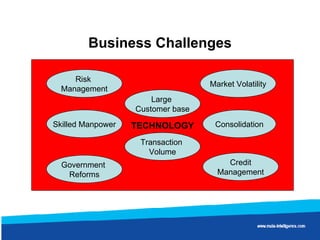
Business Challenges TECHNOLOGY Transaction  Volume Market Volatility Consolidation Credit Management Government  Reforms Large  Customer base Skilled Manpower Risk  Management
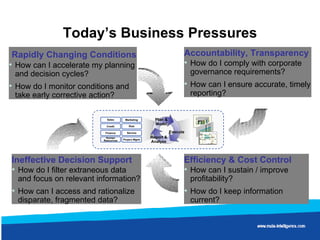
Today’s Business Pressures Marketing Risk Service Sales Project Mgmt Human Resources Credit Finance Plan & Model Execute Report & Analyze Rapidly Changing Conditions How can I accelerate my planning and decision cycles? How do I monitor conditions and take early corrective action? Accountability, Transparency How do I comply with corporate governance requirements? How can I ensure accurate, timely reporting? Ineffective Decision Support How do I filter extraneous data and focus on relevant information? How can I access and rationalize disparate, fragmented data? Efficiency & Cost Control How can I sustain / improve profitability? How do I keep information current?
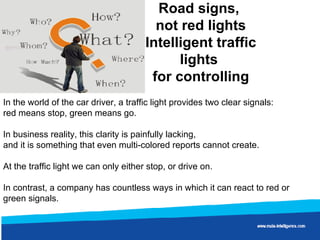
Road signs,  not red lights Intelligent traffic lights  for controlling In the world of the car driver, a traffic light provides two clear signals:  red means stop, green means go.  In business reality, this clarity is painfully lacking,  and it is something that even multi-colored reports cannot create.  At the traffic light we can only either stop, or drive on.  In contrast, a company has countless ways in which it can react to red or green signals.
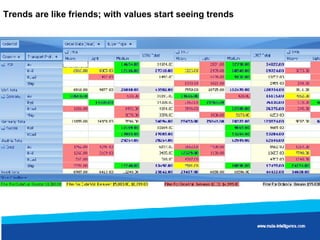
Trends are like friends; with values start seeing trends
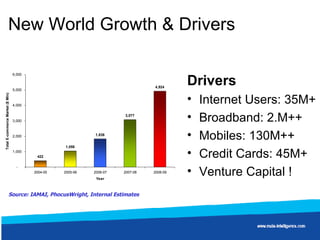
New World Growth & Drivers Drivers Internet Users: 35M+ Broadband: 2.M++ Mobiles: 130M++ Credit Cards: 45M+  Venture Capital ! Source: IAMAI, PhocusWright, Internal Estimates
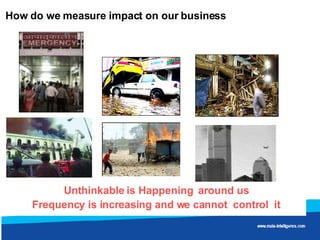
Unthinkable is Happening  around us Frequency is increasing and we cannot  control  it How do we measure impact on our business
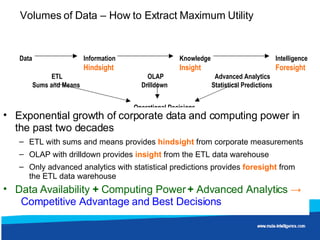
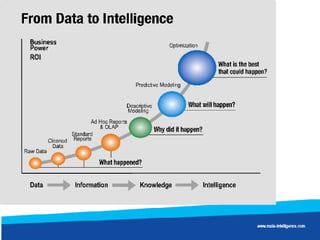
Volumes of Data – How to Extract Maximum Utility Exponential growth of corporate data and computing power in the past two decades ETL with sums and means provides  hindsight  from corporate measurements OLAP with drilldown provides  insight  from the ETL data warehouse Only advanced analytics with statistical predictions provides  foresight  from the ETL data warehouse Data Availability  +  Computing Power  +  Advanced Analytics   ->   Competitive Advantage and Best Decisions Data Information Knowledge Intelligence Hindsight Insight Foresight ETL OLAP   Advanced Analytics Sums and Means   Drilldown  Statistical Predictions Operational Decisions
 
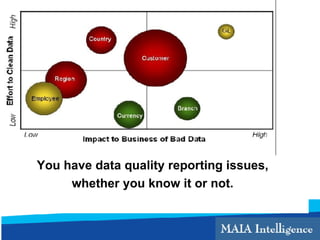
You have data quality reporting issues,  whether you know it or not.
 
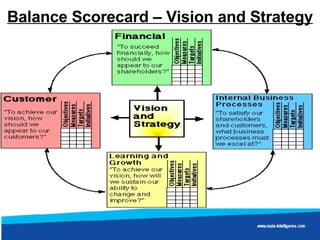
Balanced Scorecard In 1992, Robert S. Koplan and David Norton  introduced the balanced scorecard, a concept for measuring a company's activities in terms of its vision and strategies, to give managers a comprehensive view of the performance of a business.  The key new element is focusing not only on financial outcomes but also on the human issues that drive those outcomes, so that organizations focus on the future and act in their long-term best interest.  The stratagic management system forces managers to focus on the important performance metrics that drive success. It balances a financial perspective with customer, process, and employee perspectives.  Measures are often indicators of future performance.
Implementing Balanced Scorecard Implementing the scorecard typically includes four processes: Translating the vision into operational goals;  Communicate the vision and link it to individual performance;  Business planning;  Feedback and learning and adjusting the strategy accordingly.
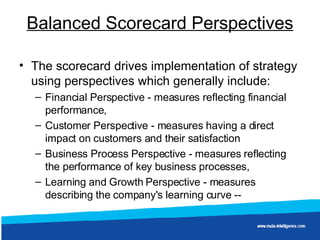
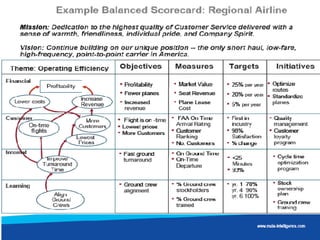
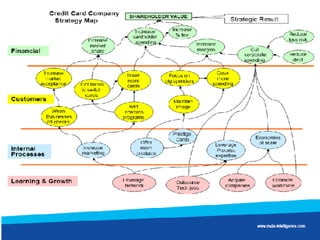
Balanced Scorecard Perspectives The scorecard drives implementation of strategy using perspectives which generally include: Financial Perspective - measures reflecting financial performance,  Customer Perspective - measures having a direct impact on customers and their satisfaction Business Process Perspective - measures reflecting the performance of key business processes,  Learning and Growth Perspective - measures describing the company's learning curve --
Balance Scorecard – Vision and Strategy
 
 
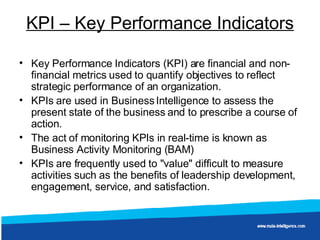
KPI – Key Performance Indicators Key Performance Indicators (KPI) are financial and non-financial metrics used to quantify objectives to reflect strategic performance of an organization.  KPIs are used in Business Intelligence to assess the present state of the business and to prescribe a course of action.  The act of monitoring KPIs in real-time is known as Business Activity Monitoring (BAM) KPIs are frequently used to "value" difficult to measure activities such as the benefits of leadership development, engagement, service, and satisfaction.
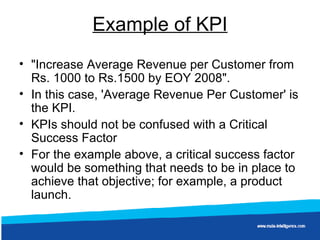
Example of KPI "Increase Average Revenue per Customer from Rs. 1000 to Rs.1500 by EOY 2008".  In this case, 'Average Revenue Per Customer' is the KPI. KPIs should not be confused with a Critical Success Factor For the example above, a critical success factor would be something that needs to be in place to achieve that objective; for example, a product launch.
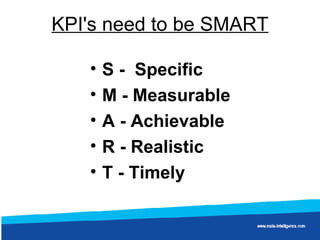
KPI's need to be SMART S -  Specific  M - Measurable  A - Achievable  R - Realistic  T - Timely
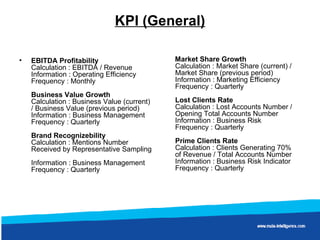
KPI (General) EBITDA Profitability Calculation : EBITDA / Revenue  Information : Operating Efficiency  Frequency : Monthly  Business Value Growth Calculation : Business Value (current) / Business Value (previous period)  Information : Business Management Frequency : Quarterly  Brand Recognizebility Calculation : Mentions Number Received by Representative Sampling  Information : Business Management Frequency : Quarterly  Market Share Growth Calculation : Market Share (current) / Market Share (previous period)  Information : Marketing Efficiency Frequency : Quarterly  Lost Clients Rate Calculation : Lost Accounts Number / Opening Total Accounts Number  Information : Business Risk  Frequency : Quarterly  Prime Clients Rate Calculation : Clients Generating 70% of Revenue / Total Accounts Number  Information : Business Risk Indicator  Frequency : Quarterly
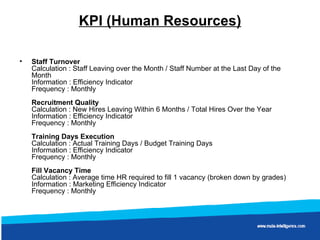
KPI (Human Resources) Staff Turnover Calculation : Staff Leaving over the Month / Staff Number at the Last Day of the Month  Information : Efficiency Indicator  Frequency : Monthly  Recruitment Quality Calculation : New Hires Leaving Within 6 Months / Total Hires Over the Year  Information : Efficiency Indicator  Frequency : Monthly  Training Days Execution Calculation : Actual Training Days / Budget Training Days  Information : Efficiency Indicator  Frequency : Monthly  Fill Vacancy Time Calculation : Average time HR required to fill 1 vacancy (broken down by grades)  Information : Marketing Efficiency Indicator  Frequency : Monthly
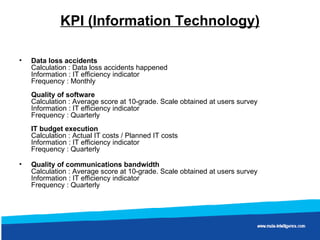
KPI (Information Technology) Data loss accidents Calculation : Data loss accidents happened  Information : IT efficiency indicator  Frequency : Monthly  Quality of software Calculation : Average score at 10-grade. Scale obtained at users survey  Information : IT efficiency indicator  Frequency : Quarterly  IT budget execution Calculation : Actual IT costs / Planned IT costs  Information : IT efficiency indicator  Frequency : Quarterly  Quality of communications bandwidth Calculation : Average score at 10-grade. Scale obtained at users survey  Information : IT efficiency indicator  Frequency : Quarterly
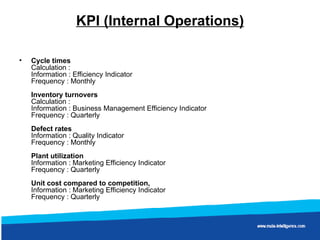
KPI (Internal Operations) Cycle times Calculation :  Information : Efficiency Indicator  Frequency : Monthly  Inventory turnovers Calculation :  Information : Business Management Efficiency Indicator  Frequency : Quarterly  Defect rates Information : Quality Indicator  Frequency : Monthly  Plant utilization Information : Marketing Efficiency Indicator  Frequency : Quarterly  Unit cost compared to competition, Information : Marketing Efficiency Indicator  Frequency : Quarterly
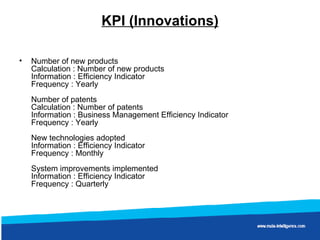
KPI (Innovations) Number of new products Calculation : Number of new products Information : Efficiency Indicator  Frequency : Yearly  Number of patents Calculation : Number of patents Information : Business Management Efficiency Indicator  Frequency : Yearly  New technologies adopted Information : Efficiency Indicator  Frequency : Monthly  System improvements implemented Information : Efficiency Indicator  Frequency : Quarterly
Corporate Performance Management ‘ Corporate Performance Management (CPM)  is the area of  Business Intelligence (BI)   involved with monitoring and managing an  organization's performance, according to  Key Performance Indicators (KPIs)
CPM Significance Marketing Departments can develop better products & services, assess the results of campaigns, better understand their target market, cross sell, upsell…  Credit Departments can leverage CPM for collaborative analysis and slicing and dicing data in new and creative ways Human Resource Departments can use it extensively to analyze the workforce and the impact of salary and related decisions Executives can get real-time access to key performance indicators, and would be able to interact and drill-down on data as against a static number  Portfolio & Fund Departments can analyse patterns for effective and faster investment decisions
What CPM enables? Make the right investments in products, people, projects and processes Continuously assess operational performance based on key performance indicators and historical trends Adjust & re-align strategies as needed to achieve organizational goals  Deliver consistent information to all levels within the organization for collaborative performance Visualise enterprise-wide planning and budgeting in a single model Analyze customer, product and services profitability in real-time  Consolidate financial data from disparate sources across the entire enterprise Standardise on data communication, data comprehension & data control Optimise IT resources and infrastructure Single version of the truth
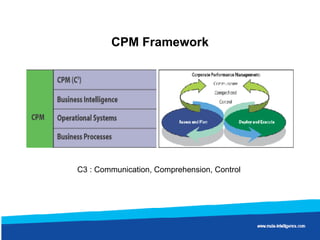
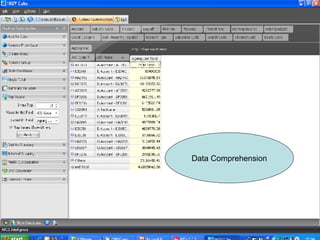
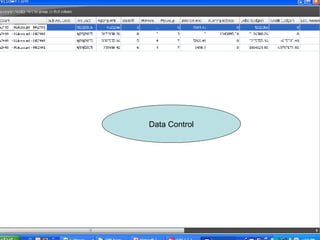
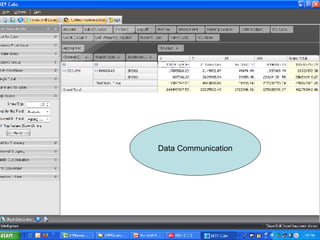
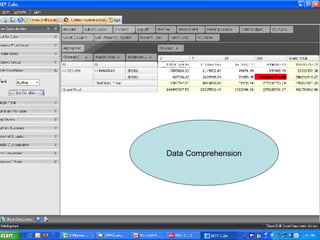
CPM Framework C3 : Communication, Comprehension, Control
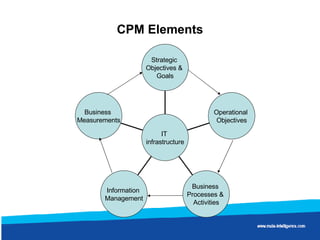
CPM Elements Business  Measurements Information  Management Business  Processes &  Activities Operational  Objectives Strategic  Objectives &  Goals IT  infrastructure
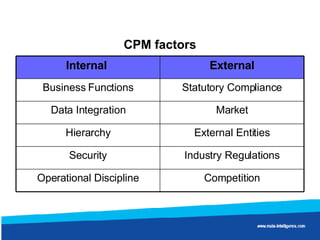
CPM factors Competition Operational Discipline Industry Regulations Security External Entities Hierarchy Market Data Integration Statutory Compliance Business Functions External Internal
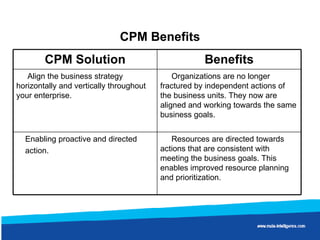
CPM Benefits Resources are directed towards actions that are consistent with meeting the business goals. This enables improved resource planning and prioritization. Enabling proactive and directed  action. Organizations are no longer fractured by independent actions of the business units. They now are aligned and working towards the same business goals. Align the business strategy horizontally and vertically throughout your enterprise. Benefits CPM Solution
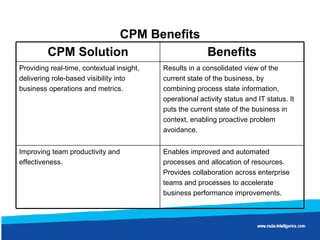
CPM Benefits Enables improved and automated processes and allocation of resources. Provides collaboration across enterprise teams and processes to accelerate business performance improvements. Improving team productivity and effectiveness. Results in a consolidated view of the current state of the business, by combining process state information, operational activity status and IT status. It puts the current state of the business in context, enabling proactive problem avoidance. Providing real-time, contextual insight, delivering role-based visibility into business operations and metrics. Benefits CPM Solution
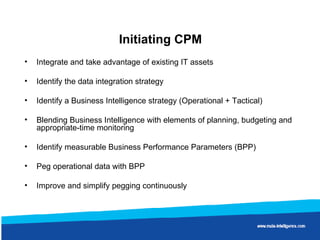
Initiating CPM Integrate and take advantage of existing IT assets Identify the data integration strategy Identify a Business Intelligence strategy (Operational + Tactical) Blending Business Intelligence with elements of planning, budgeting and appropriate-time monitoring Identify measurable Business Performance Parameters (BPP) Peg operational data with BPP Improve and simplify pegging continuously
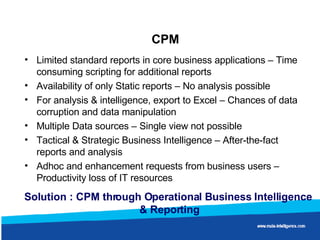
CPM Limited standard reports in core business applications – Time consuming scripting for additional reports Availability of only Static reports – No analysis possible For analysis & intelligence, export to Excel – Chances of data corruption and data manipulation Multiple Data sources – Single view not possible Tactical & Strategic Business Intelligence – After-the-fact reports and analysis Adhoc and enhancement requests from business users – Productivity loss of IT resources Solution : CPM through Operational Business Intelligence  & Reporting
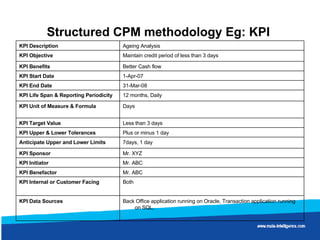
Structured CPM methodology Eg: KPI  Back Office application running on Oracle, Transaction application running on SQL,  KPI Data Sources Both KPI Internal or Customer Facing Mr. ABC KPI Benefactor Mr. ABC KPI Initiator Mr. XYZ KPI Sponsor 7days, 1 day Anticipate Upper and Lower Limits Plus or minus 1 day KPI Upper & Lower Tolerances Less than 3 days KPI Target Value Days KPI Unit of Measure & Formula 12 months, Daily KPI Life Span & Reporting Periodicity 31-Mar-08 KPI End Date 1-Apr-07 KPI Start Date Better Cash flow  KPI Benefits Maintain credit period of less than 3 days KPI Objective Ageing Analysis KPI Description
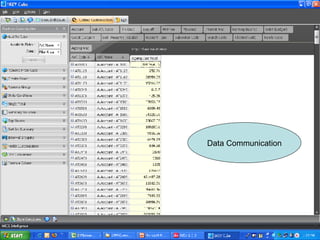
Data Communication
Data Comprehension
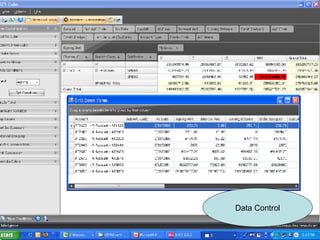
Data Control
Data Communication
Data Comprehension
Data Control
Summary  CPM is not a technology, but a Business Strategy Core concept for CPM : C3  (Communication, Comprehension & Control) Business Intelligence is an Intelligent first step in incorporating CPM
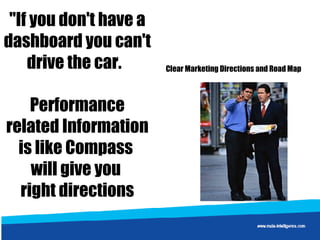
"If you don't have a dashboard you can't drive the car.  Performance related Information is like Compass  will give you  right directions Clear Marketing Directions and Road Map
Thank You!

CPM Presentation

  • 1.
  • 2.
    ‘ BalanceScore Card Corporate Performance Management-CPM KPI – Key Performance Indicators Business Intelligence for Emerging Enterprise’
  • 3.
    Diapers and Beer Wal-Mart , the world’s largest retailer, supposedly found out that there are certain times at which beer and diapers sell particularly well together - when on Friday evenings young men make a last dash to the supermarket to get beer and their wives call after them, “Pick up some diapers, too, honey!” “ Some of the ways Wal-Mart managers found to exploit their findings are legendary. One such legend is the story, “diapers and beer”. Wal-Mart discovered through data mining that the sales of diapers and beer were correlated on Friday nights. It determined that the correlation was based on working men who had been asked to pick up diapers on their way home from work. On Fridays the men figured they deserved a six-pack of beer for their trouble; hence the connection between beer and diapers. By moving these two items closer together, Wal-Mart reportedly saw the sales of both items increase geometrically.” A version with a slightly different view of the roles involved suggests that the men are sent to the supermarket for the diapers and, because there’s no time left to go to a bar, take beer home with them. In all versions of the story, Wal-Mart then puts the diapers closer to the beer and makes a fortune.
  • 4.
    Business Challenges TECHNOLOGYTransaction Volume Market Volatility Consolidation Credit Management Government Reforms Large Customer base Skilled Manpower Risk Management
  • 5.
    Today’s Business PressuresMarketing Risk Service Sales Project Mgmt Human Resources Credit Finance Plan & Model Execute Report & Analyze Rapidly Changing Conditions How can I accelerate my planning and decision cycles? How do I monitor conditions and take early corrective action? Accountability, Transparency How do I comply with corporate governance requirements? How can I ensure accurate, timely reporting? Ineffective Decision Support How do I filter extraneous data and focus on relevant information? How can I access and rationalize disparate, fragmented data? Efficiency & Cost Control How can I sustain / improve profitability? How do I keep information current?
  • 6.
    Road signs, not red lights Intelligent traffic lights for controlling In the world of the car driver, a traffic light provides two clear signals: red means stop, green means go. In business reality, this clarity is painfully lacking, and it is something that even multi-colored reports cannot create. At the traffic light we can only either stop, or drive on. In contrast, a company has countless ways in which it can react to red or green signals.
  • 7.
    Trends are likefriends; with values start seeing trends
  • 8.
    New World Growth& Drivers Drivers Internet Users: 35M+ Broadband: 2.M++ Mobiles: 130M++ Credit Cards: 45M+ Venture Capital ! Source: IAMAI, PhocusWright, Internal Estimates
  • 9.
    Unthinkable is Happening around us Frequency is increasing and we cannot control it How do we measure impact on our business
  • 10.
    Volumes of Data– How to Extract Maximum Utility Exponential growth of corporate data and computing power in the past two decades ETL with sums and means provides hindsight from corporate measurements OLAP with drilldown provides insight from the ETL data warehouse Only advanced analytics with statistical predictions provides foresight from the ETL data warehouse Data Availability + Computing Power + Advanced Analytics -> Competitive Advantage and Best Decisions Data Information Knowledge Intelligence Hindsight Insight Foresight ETL OLAP Advanced Analytics Sums and Means Drilldown Statistical Predictions Operational Decisions
  • 11.
  • 12.
    You have dataquality reporting issues, whether you know it or not.
  • 13.
  • 14.
    Balanced Scorecard In1992, Robert S. Koplan and David Norton introduced the balanced scorecard, a concept for measuring a company's activities in terms of its vision and strategies, to give managers a comprehensive view of the performance of a business. The key new element is focusing not only on financial outcomes but also on the human issues that drive those outcomes, so that organizations focus on the future and act in their long-term best interest. The stratagic management system forces managers to focus on the important performance metrics that drive success. It balances a financial perspective with customer, process, and employee perspectives. Measures are often indicators of future performance.
  • 15.
    Implementing Balanced ScorecardImplementing the scorecard typically includes four processes: Translating the vision into operational goals; Communicate the vision and link it to individual performance; Business planning; Feedback and learning and adjusting the strategy accordingly.
  • 16.
    Balanced Scorecard PerspectivesThe scorecard drives implementation of strategy using perspectives which generally include: Financial Perspective - measures reflecting financial performance, Customer Perspective - measures having a direct impact on customers and their satisfaction Business Process Perspective - measures reflecting the performance of key business processes, Learning and Growth Perspective - measures describing the company's learning curve --
  • 17.
    Balance Scorecard –Vision and Strategy
  • 18.
  • 19.
  • 20.
    KPI – KeyPerformance Indicators Key Performance Indicators (KPI) are financial and non-financial metrics used to quantify objectives to reflect strategic performance of an organization. KPIs are used in Business Intelligence to assess the present state of the business and to prescribe a course of action. The act of monitoring KPIs in real-time is known as Business Activity Monitoring (BAM) KPIs are frequently used to "value" difficult to measure activities such as the benefits of leadership development, engagement, service, and satisfaction.
  • 21.
    Example of KPI"Increase Average Revenue per Customer from Rs. 1000 to Rs.1500 by EOY 2008". In this case, 'Average Revenue Per Customer' is the KPI. KPIs should not be confused with a Critical Success Factor For the example above, a critical success factor would be something that needs to be in place to achieve that objective; for example, a product launch.
  • 22.
    KPI's need tobe SMART S - Specific M - Measurable A - Achievable R - Realistic T - Timely
  • 23.
    KPI (General) EBITDAProfitability Calculation : EBITDA / Revenue Information : Operating Efficiency Frequency : Monthly Business Value Growth Calculation : Business Value (current) / Business Value (previous period) Information : Business Management Frequency : Quarterly Brand Recognizebility Calculation : Mentions Number Received by Representative Sampling Information : Business Management Frequency : Quarterly Market Share Growth Calculation : Market Share (current) / Market Share (previous period) Information : Marketing Efficiency Frequency : Quarterly Lost Clients Rate Calculation : Lost Accounts Number / Opening Total Accounts Number Information : Business Risk Frequency : Quarterly Prime Clients Rate Calculation : Clients Generating 70% of Revenue / Total Accounts Number Information : Business Risk Indicator Frequency : Quarterly
  • 24.
    KPI (Human Resources)Staff Turnover Calculation : Staff Leaving over the Month / Staff Number at the Last Day of the Month Information : Efficiency Indicator Frequency : Monthly Recruitment Quality Calculation : New Hires Leaving Within 6 Months / Total Hires Over the Year Information : Efficiency Indicator Frequency : Monthly Training Days Execution Calculation : Actual Training Days / Budget Training Days Information : Efficiency Indicator Frequency : Monthly Fill Vacancy Time Calculation : Average time HR required to fill 1 vacancy (broken down by grades) Information : Marketing Efficiency Indicator Frequency : Monthly
  • 25.
    KPI (Information Technology)Data loss accidents Calculation : Data loss accidents happened Information : IT efficiency indicator Frequency : Monthly Quality of software Calculation : Average score at 10-grade. Scale obtained at users survey Information : IT efficiency indicator Frequency : Quarterly IT budget execution Calculation : Actual IT costs / Planned IT costs Information : IT efficiency indicator Frequency : Quarterly Quality of communications bandwidth Calculation : Average score at 10-grade. Scale obtained at users survey Information : IT efficiency indicator Frequency : Quarterly
  • 26.
    KPI (Internal Operations)Cycle times Calculation : Information : Efficiency Indicator Frequency : Monthly Inventory turnovers Calculation : Information : Business Management Efficiency Indicator Frequency : Quarterly Defect rates Information : Quality Indicator Frequency : Monthly Plant utilization Information : Marketing Efficiency Indicator Frequency : Quarterly Unit cost compared to competition, Information : Marketing Efficiency Indicator Frequency : Quarterly
  • 27.
    KPI (Innovations) Numberof new products Calculation : Number of new products Information : Efficiency Indicator Frequency : Yearly Number of patents Calculation : Number of patents Information : Business Management Efficiency Indicator Frequency : Yearly New technologies adopted Information : Efficiency Indicator Frequency : Monthly System improvements implemented Information : Efficiency Indicator Frequency : Quarterly
  • 28.
    Corporate Performance Management‘ Corporate Performance Management (CPM) is the area of Business Intelligence (BI) involved with monitoring and managing an organization's performance, according to Key Performance Indicators (KPIs)
  • 29.
    CPM Significance MarketingDepartments can develop better products & services, assess the results of campaigns, better understand their target market, cross sell, upsell… Credit Departments can leverage CPM for collaborative analysis and slicing and dicing data in new and creative ways Human Resource Departments can use it extensively to analyze the workforce and the impact of salary and related decisions Executives can get real-time access to key performance indicators, and would be able to interact and drill-down on data as against a static number Portfolio & Fund Departments can analyse patterns for effective and faster investment decisions
  • 30.
    What CPM enables?Make the right investments in products, people, projects and processes Continuously assess operational performance based on key performance indicators and historical trends Adjust & re-align strategies as needed to achieve organizational goals Deliver consistent information to all levels within the organization for collaborative performance Visualise enterprise-wide planning and budgeting in a single model Analyze customer, product and services profitability in real-time Consolidate financial data from disparate sources across the entire enterprise Standardise on data communication, data comprehension & data control Optimise IT resources and infrastructure Single version of the truth
  • 31.
    CPM Framework C3: Communication, Comprehension, Control
  • 32.
    CPM Elements Business Measurements Information Management Business Processes & Activities Operational Objectives Strategic Objectives & Goals IT infrastructure
  • 33.
    CPM factors CompetitionOperational Discipline Industry Regulations Security External Entities Hierarchy Market Data Integration Statutory Compliance Business Functions External Internal
  • 34.
    CPM Benefits Resourcesare directed towards actions that are consistent with meeting the business goals. This enables improved resource planning and prioritization. Enabling proactive and directed action. Organizations are no longer fractured by independent actions of the business units. They now are aligned and working towards the same business goals. Align the business strategy horizontally and vertically throughout your enterprise. Benefits CPM Solution
  • 35.
    CPM Benefits Enablesimproved and automated processes and allocation of resources. Provides collaboration across enterprise teams and processes to accelerate business performance improvements. Improving team productivity and effectiveness. Results in a consolidated view of the current state of the business, by combining process state information, operational activity status and IT status. It puts the current state of the business in context, enabling proactive problem avoidance. Providing real-time, contextual insight, delivering role-based visibility into business operations and metrics. Benefits CPM Solution
  • 36.
    Initiating CPM Integrateand take advantage of existing IT assets Identify the data integration strategy Identify a Business Intelligence strategy (Operational + Tactical) Blending Business Intelligence with elements of planning, budgeting and appropriate-time monitoring Identify measurable Business Performance Parameters (BPP) Peg operational data with BPP Improve and simplify pegging continuously
  • 37.
    CPM Limited standardreports in core business applications – Time consuming scripting for additional reports Availability of only Static reports – No analysis possible For analysis & intelligence, export to Excel – Chances of data corruption and data manipulation Multiple Data sources – Single view not possible Tactical & Strategic Business Intelligence – After-the-fact reports and analysis Adhoc and enhancement requests from business users – Productivity loss of IT resources Solution : CPM through Operational Business Intelligence & Reporting
  • 38.
    Structured CPM methodologyEg: KPI Back Office application running on Oracle, Transaction application running on SQL, KPI Data Sources Both KPI Internal or Customer Facing Mr. ABC KPI Benefactor Mr. ABC KPI Initiator Mr. XYZ KPI Sponsor 7days, 1 day Anticipate Upper and Lower Limits Plus or minus 1 day KPI Upper & Lower Tolerances Less than 3 days KPI Target Value Days KPI Unit of Measure & Formula 12 months, Daily KPI Life Span & Reporting Periodicity 31-Mar-08 KPI End Date 1-Apr-07 KPI Start Date Better Cash flow KPI Benefits Maintain credit period of less than 3 days KPI Objective Ageing Analysis KPI Description
  • 39.
  • 40.
  • 41.
  • 42.
  • 43.
  • 44.
  • 45.
    Summary CPMis not a technology, but a Business Strategy Core concept for CPM : C3 (Communication, Comprehension & Control) Business Intelligence is an Intelligent first step in incorporating CPM
  • 46.
    "If you don'thave a dashboard you can't drive the car. Performance related Information is like Compass will give you right directions Clear Marketing Directions and Road Map
  • 47.