CHAPTER  An Overview of Internet and Its Applications
Chapter Objectives Define the different architectures of the Internet Highlight some of the communication applications on the Internet
Chapter Modules Internet, Intranet and Extranet Messaging E-Commerce Voice Over IP and Internet Telephony
Chapter Modules ( Continued)  Virtual Private Network (VPN) WAN and Access Technologies Audio and Video Streaming Video Conferencing
Web Research Audio and Video streaming www.calstatele.edu/ats/real www.microsoft.com Extranet e-server in a box Internet appliance VPN www.cisco.com www.lucent.com Overcoming latency in TCP/IP
MODULE Internet Architectures
Architectures  Internet The global  Intranet An Internet restricted to the company’s own perimeter Extranet Intranet extended to include outside organizations dealing with a particular  organization
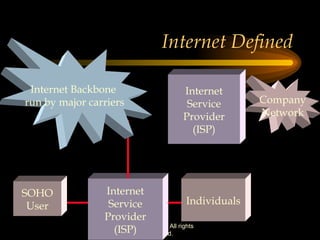
Internet Defined Internet Backbone  run by major carriers Individuals SOHO User Company Network Internet Service Provider (ISP) Internet Service Provider (ISP)
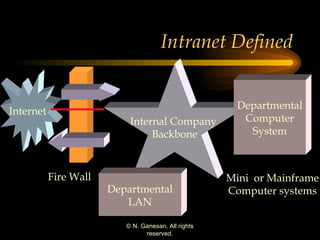
Intranet Defined Internal Company  Backbone Departmental LAN Fire Wall Mini  or Mainframe Computer systems Departmental Computer System Internet
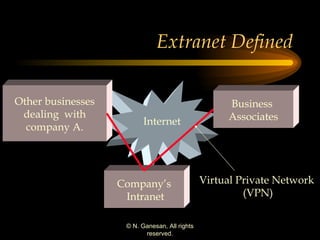
Extranet Defined Internet Company’s Intranet Business  Associates Other businesses dealing  with company A. Virtual Private Network  (VPN)
END OF MODULE
MODULE Email and Messaging
Email Messages exchanged among Internet subscribers Vary from a simple text based messages to one that carries different attachments Word, PowerPoint documents Any computer file Video and audio clippings etc.
Messaging Email expanded to include a number of other functions and services Document sharing and collaboration  Whiteboard applications Scheduling of group activities Etc.
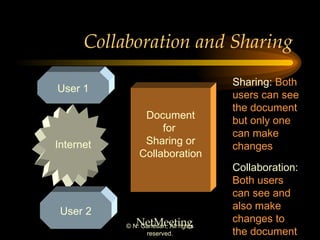
Collaboration and Sharing Internet User 1 User 2 Document for  Sharing or Collaboration Sharing:  Both users can see the document but only one can make changes  Collaboration:  Both users can see and also make changes to the document  NetMeeting
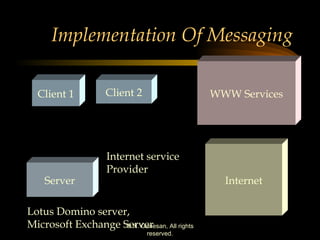
Implementation Of Messaging Lotus Domino server, Microsoft Exchange Server  Server Client 1 Client 2 Internet Internet service Provider WWW Services
Major Messaging Products Microsoft Exchange Server Outlook and Outlook Express Clients Lotus Domino Server cc:Mail Lotus Notes (Client) Netscape ???
END OF MODULE
MODULE E-Commerce
Web Research e-server in a box IBM’s web site
END OF MODULE
MODULE Voice Over IP and Internet Telephony
Voice Over IP and Internet Telephony Defined The use of the internet to transmit voice in real-time Transmission of digitized voice using the Internet Protocol Internet Telephony is an example Usage of the Internet to transmit telephone calls
Internet Telephony Defined Using the Internet (TCP/IP) for largely the telephone related applications Termination of voice traffic
Voice over IP Prospects and Challenges Voice transmission over the Internet has been identified as one of the largest growth areas Companies will in the future use the Internet extensively for voice communications Current IP is not well suited for voice transmission Latency being the biggest drawback Bandwidth restrictions also hamper voice transmission IP is being improved to carry voice
Internet Telephony A growing market  Further information http://www.internettelephony.com/ Current Products (???) Net meeting (Microsoft) ICQ Cooltalk (Netscape) etc. Long-term focus is on regularly using the Internet as a viable alternative to the Plain Old Telephone Service (POTS) H.323 is the prominent standard for Internet telephony
Sample Telephony Applications Source:  Vocaltech Computer-to-Computer Calling  Computer-to-Phone Calling:  Requires  ITSP service  in addition to regular ISP service www.dialpad.com Phone-to-phone Using TCP/IP Live Motion Video Video Conferencing Whiteboarding:  Share and edit photos, documents and drawings with others in real time.  Voice Mail:  Record  compressed voice files and sending them as attachments.
END OF MODULE
MODULE Virtual Private Networks (VPN)
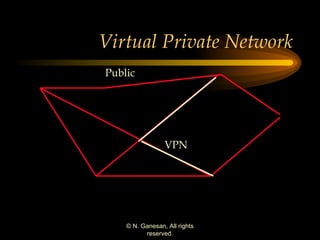
VPN Defined A private network that uses the public network infrastructure A secured web of tunnels that links various nodes to form the Virtual Private Network
Virtual Private Network Public VPN
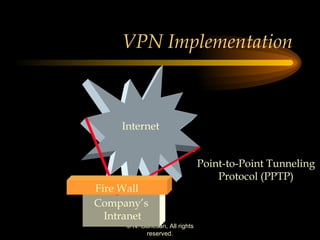
VPN Implementation Internet Company’s Intranet Point-to-Point Tunneling Protocol (PPTP) Fire Wall
VPN Past and Present Past Based on PSTN (Public Switched Telephone Network) Present Based on next generation public network technologies  Source:  VPNWorx , VPN Quick Reference Guide
Base Technologies for VPN Carrier IP PPTP Frame Relay ATM
Areas of Applications All major business organizations that require a secured Extranet
END OF MODULE
MODULE WAN and Access Technologies
WAN Scope Enterprise-wide Metropolitan and National Global Underlying network infrastructure for the Internet Fastest growing network Growth is appreciable in the area of Virtual Private Network
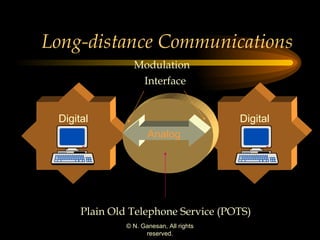
The Early Days of Communications and Computing  Telecommunication Centered on analog technology Data communication needs Centered around digital technology Digital to analog interface For long distance communications
Long-distance Communications Modulation Digital Digital Plain Old Telephone Service (POTS) Analog Interface
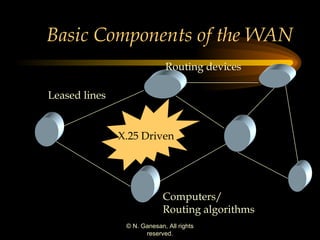
Initial WANs Introduced to overcome the limitations of general purpose analog telephone lines used Better conditioned lines such as leased lines were used  Driven by a collection of computers for routing the data traffic from source to destination Arpanet was the first WAN to be created X.25 was the initial communication technology used X.21 was used in Europe
Basic Components of the WAN Computers/ Routing algorithms X.25 Driven Leased lines Routing devices
Present Status of WANs Information is carried in digitized form in many segments of the WAN Digital communication lines Over copper wire Over fiber-optics Telecommunications and computer communications are merging in terms of deploying digital technology
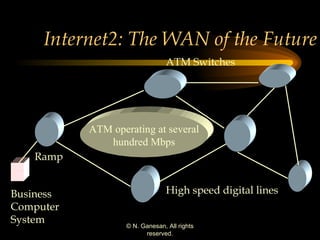
WANs: Present and Future Move towards digital technology Technologies Frame Relay ATM Point-to-point digital communication will become widely used in the future The WAN of the future will be designed to meet with the increasing bandwidth demands of the Internet Internet2
Internet2: The WAN of the Future ATM operating at several hundred Mbps Ramp Business Computer  System ATM Switches High speed digital lines
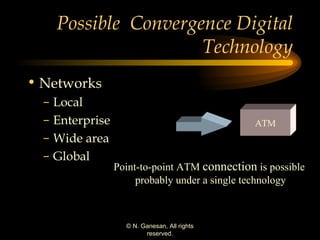
Possible  Convergence Digital Technology Networks Local Enterprise Wide area Global Point-to-point ATM  connection  is possible  probably under a single technology ATM
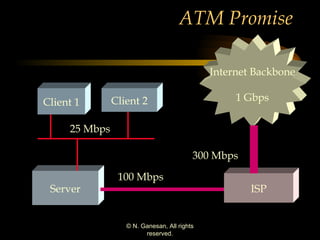
ATM Promise Server Client 1 Client 2 25 Mbps ISP 100 Mbps Internet Backbone 1 Gbps 300 Mbps
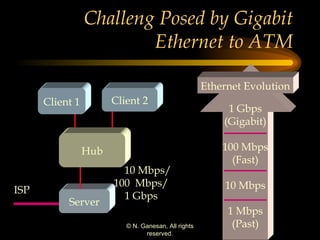
Challeng Posed by Gigabit Ethernet to ATM 1 Gbps (Gigabit) 100 Mbps (Fast) 10 Mbps 1 Mbps (Past) Ethernet Evolution Client 2 10 Mbps/ 100  Mbps/ 1 Gbps Server ISP Client 1 Hub
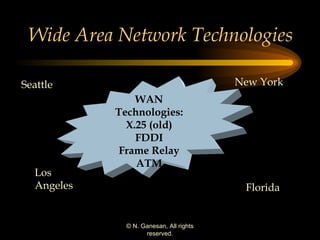
Wide Area Network Technologies WAN Technologies: X.25 (old) FDDI Frame Relay ATM Los Angeles Seattle New York Florida
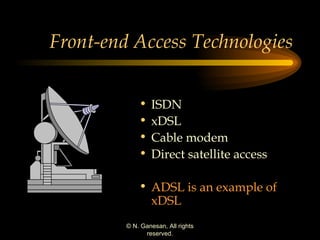
Front-end Access Technologies ISDN xDSL  Cable modem Direct satellite access ADSL is an example of xDSL
Access Speeds Fastest speed of an analog modem is around 56K bps Newer technologies operate at faster speeds Newer technologies have made a significant contribution in increasing the speed of communication
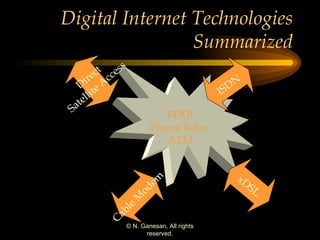
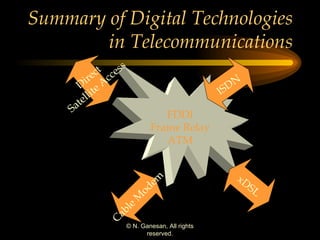
Digital Internet Technologies Summarized FDDI Frame Relay ATM Cable Modem Direct Satellite Access xDSL ISDN
END OF MODULE
MODULE Audio and Video Streaming
Audio and Video Streaming Deliver continuous audio and video streams over a low bandwidth connection Packet switching networks do no guarantee real-time and continuous delivery of data packets Streaming involves compression and decompression (CODEC)
Application Areas Dissemination of multimedia information on the web Training and education Etc.
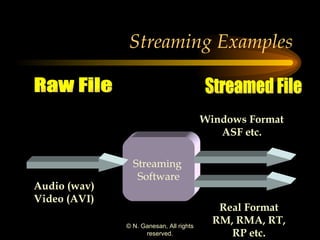
Streaming Examples Streaming  Software Audio (wav) Video (AVI) Real Format RM, RMA, RT, RP etc. Windows Format ASF etc. Raw File Streamed File
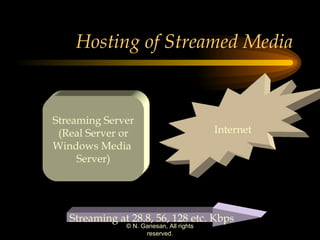
Hosting of Streamed Media Streaming Server (Real Server or Windows Media  Server) Internet Streaming at 28.8, 56, 128 etc. Kbps
Method of Delivery Unicasting Multicasting Broadcasting
Major Streaming Technologies Real Microsoft Windows Media Technologies
END OF MODULE
MODULE Video Conferencing
Video Conferencing The exchanging of audio and video information while engaged in conferencing
Major Types of Video Conferencing Dedicated video conferencing Telecommunication lines are used solely for the purpose of setting up a video conferencing facility Desktop video conferencing Video conferencing conducted from a computer connected to the Internet
Video Conferencing Standard H.232 Series of standards
Sample Desktop Video Conferencing Products CU-SeeMee Intel ProShare Microsoft NetMeeting PictureTel
END OF MODULE
Keywords Intranet, Extranet, Internet VPN, PPTP Real Media and Windows Media Network appliance and Internet Appliance Sharing, Collaboration  Messaging Server and Messaging Client
Keywords  SMTP, POP3, IMAP VoIP, H.323, IPv6 X.25, ATM, Frame Relay, FDDI T1, T3, OC1, OC2  ISDN, xDSL, Cable Modem, Satellite Unicasting, Multicasting and Broadcasting
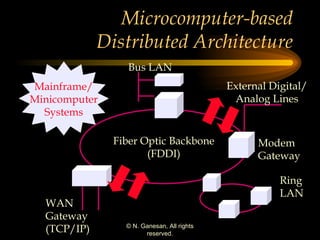
Microcomputer-based Distributed Architecture Fiber Optic Backbone (FDDI) Mainframe/ Minicomputer Systems Bus LAN Ring LAN WAN  Gateway (TCP/IP) Modem Gateway External Digital/ Analog Lines
END OF MODULE
Microcomputers Widespread usage Serious business computer Dramatic increase in power Comparable to mainframes of the past Declining cost Affordable to use in all levels of business Communication device Access services and resources on the Internet
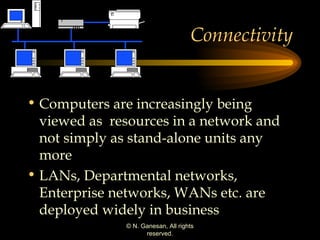
Connectivity Computers are increasingly being viewed as  resources in a network and not simply as stand-alone units any more LANs, Departmental networks, Enterprise networks, WANs etc. are deployed widely in business
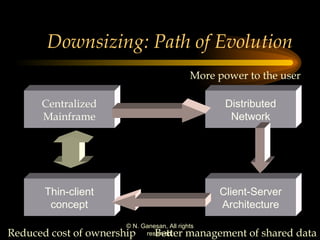
Downsizing: Path of Evolution Centralized Mainframe More power to the user Better management of shared data Reduced cost of ownership  Distributed Network Client-Server Architecture Thin-client concept
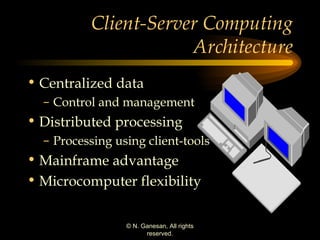
Client-Server Computing Architecture Centralized data Control and management Distributed processing Processing using client-tools Mainframe advantage Microcomputer flexibility
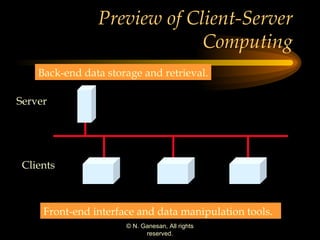
Preview of Client-Server Computing Back-end data storage and retrieval. Front-end interface and data manipulation tools.  Server Clients
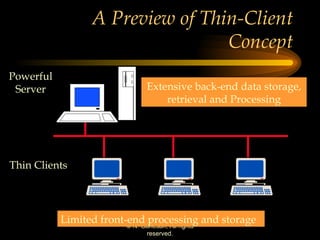
A Preview of Thin-Client Concept Limited front-end processing and storage  Extensive back-end data storage, retrieval and Processing Powerful Server Thin Clients
Digitization Of Telecom Network Mode (ATM)
Front-end Access Technologies ISDN xDSL  Cable modem Direct satellite access ADSL is an example of xDSL
Access Speeds Fastest speed of an analog modem is around 56K bps Newer technologies operate at faster speeds In the Mbps region Newer technologies have made a significant contribution in increasing the speed of communication
Summary of Digital Technologies in Telecommunications FDDI Frame Relay ATM Cable Modem Direct Satellite Access xDSL ISDN
END OF MODULE
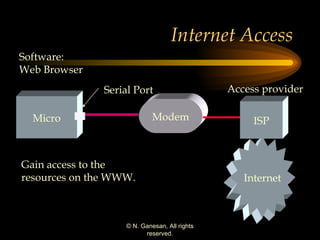
Internet Access Gain access to the  resources on the WWW. Software:  Web Browser Micro Modem Serial Port Internet Access provider ISP
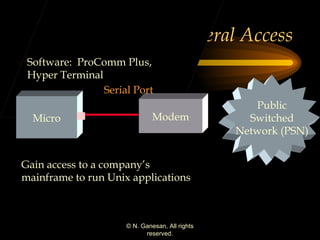
General Access Software:  ProComm Plus, Hyper Terminal Public Switched Network (PSN) Gain access to a company’s mainframe to run Unix applications Micro Modem Serial Port
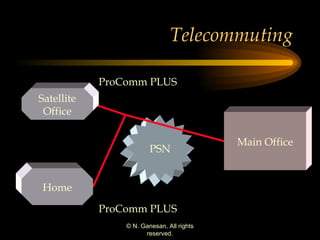
Telecommuting Main Office PSN Satellite Office Home ProComm PLUS ProComm PLUS
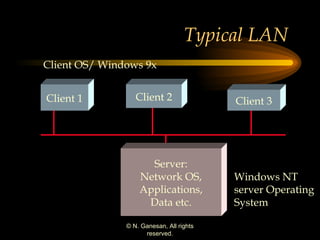
Typical LAN  Client OS/ Windows 9x Client 1 Client 2 Client 3 Server: Network OS, Applications, Data etc. Windows NT  server Operating  System
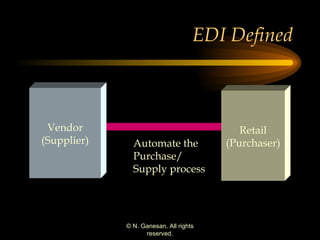
EDI Defined Vendor (Supplier) Automate the Purchase/ Supply process Retail (Purchaser)
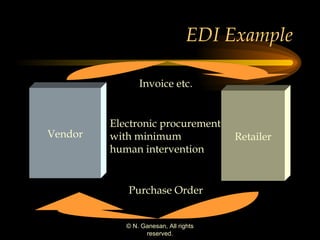
EDI Example Vendor Retailer Electronic procurement  with minimum  human intervention Purchase Order Invoice etc.
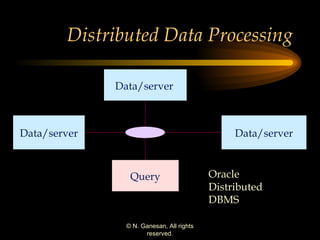
Distributed Data Processing Data/server Data/server Query Data/server Oracle  Distributed DBMS
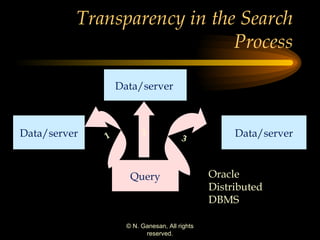
Transparency in the Search Process Data/server Data/server Query Data/server Oracle  Distributed DBMS 1 3 2
END OF MODULE   END OF CHAPTER

Overview of Internet.ppt

  • 1.
    CHAPTER AnOverview of Internet and Its Applications
  • 2.
    Chapter Objectives Definethe different architectures of the Internet Highlight some of the communication applications on the Internet
  • 3.
    Chapter Modules Internet,Intranet and Extranet Messaging E-Commerce Voice Over IP and Internet Telephony
  • 4.
    Chapter Modules (Continued) Virtual Private Network (VPN) WAN and Access Technologies Audio and Video Streaming Video Conferencing
  • 5.
    Web Research Audioand Video streaming www.calstatele.edu/ats/real www.microsoft.com Extranet e-server in a box Internet appliance VPN www.cisco.com www.lucent.com Overcoming latency in TCP/IP
  • 6.
  • 7.
    Architectures InternetThe global Intranet An Internet restricted to the company’s own perimeter Extranet Intranet extended to include outside organizations dealing with a particular organization
  • 8.
    Internet Defined InternetBackbone run by major carriers Individuals SOHO User Company Network Internet Service Provider (ISP) Internet Service Provider (ISP)
  • 9.
    Intranet Defined InternalCompany Backbone Departmental LAN Fire Wall Mini or Mainframe Computer systems Departmental Computer System Internet
  • 10.
    Extranet Defined InternetCompany’s Intranet Business Associates Other businesses dealing with company A. Virtual Private Network (VPN)
  • 11.
  • 12.
  • 13.
    Email Messages exchangedamong Internet subscribers Vary from a simple text based messages to one that carries different attachments Word, PowerPoint documents Any computer file Video and audio clippings etc.
  • 14.
    Messaging Email expandedto include a number of other functions and services Document sharing and collaboration Whiteboard applications Scheduling of group activities Etc.
  • 15.
    Collaboration and SharingInternet User 1 User 2 Document for Sharing or Collaboration Sharing: Both users can see the document but only one can make changes Collaboration: Both users can see and also make changes to the document NetMeeting
  • 16.
    Implementation Of MessagingLotus Domino server, Microsoft Exchange Server Server Client 1 Client 2 Internet Internet service Provider WWW Services
  • 17.
    Major Messaging ProductsMicrosoft Exchange Server Outlook and Outlook Express Clients Lotus Domino Server cc:Mail Lotus Notes (Client) Netscape ???
  • 18.
  • 19.
  • 20.
    Web Research e-serverin a box IBM’s web site
  • 21.
  • 22.
    MODULE Voice OverIP and Internet Telephony
  • 23.
    Voice Over IPand Internet Telephony Defined The use of the internet to transmit voice in real-time Transmission of digitized voice using the Internet Protocol Internet Telephony is an example Usage of the Internet to transmit telephone calls
  • 24.
    Internet Telephony DefinedUsing the Internet (TCP/IP) for largely the telephone related applications Termination of voice traffic
  • 25.
    Voice over IPProspects and Challenges Voice transmission over the Internet has been identified as one of the largest growth areas Companies will in the future use the Internet extensively for voice communications Current IP is not well suited for voice transmission Latency being the biggest drawback Bandwidth restrictions also hamper voice transmission IP is being improved to carry voice
  • 26.
    Internet Telephony Agrowing market Further information http://www.internettelephony.com/ Current Products (???) Net meeting (Microsoft) ICQ Cooltalk (Netscape) etc. Long-term focus is on regularly using the Internet as a viable alternative to the Plain Old Telephone Service (POTS) H.323 is the prominent standard for Internet telephony
  • 27.
    Sample Telephony ApplicationsSource: Vocaltech Computer-to-Computer Calling Computer-to-Phone Calling: Requires ITSP service in addition to regular ISP service www.dialpad.com Phone-to-phone Using TCP/IP Live Motion Video Video Conferencing Whiteboarding: Share and edit photos, documents and drawings with others in real time. Voice Mail: Record compressed voice files and sending them as attachments.
  • 28.
  • 29.
    MODULE Virtual PrivateNetworks (VPN)
  • 30.
    VPN Defined Aprivate network that uses the public network infrastructure A secured web of tunnels that links various nodes to form the Virtual Private Network
  • 31.
  • 32.
    VPN Implementation InternetCompany’s Intranet Point-to-Point Tunneling Protocol (PPTP) Fire Wall
  • 33.
    VPN Past andPresent Past Based on PSTN (Public Switched Telephone Network) Present Based on next generation public network technologies Source: VPNWorx , VPN Quick Reference Guide
  • 34.
    Base Technologies forVPN Carrier IP PPTP Frame Relay ATM
  • 35.
    Areas of ApplicationsAll major business organizations that require a secured Extranet
  • 36.
  • 37.
    MODULE WAN andAccess Technologies
  • 38.
    WAN Scope Enterprise-wideMetropolitan and National Global Underlying network infrastructure for the Internet Fastest growing network Growth is appreciable in the area of Virtual Private Network
  • 39.
    The Early Daysof Communications and Computing Telecommunication Centered on analog technology Data communication needs Centered around digital technology Digital to analog interface For long distance communications
  • 40.
    Long-distance Communications ModulationDigital Digital Plain Old Telephone Service (POTS) Analog Interface
  • 41.
    Initial WANs Introducedto overcome the limitations of general purpose analog telephone lines used Better conditioned lines such as leased lines were used Driven by a collection of computers for routing the data traffic from source to destination Arpanet was the first WAN to be created X.25 was the initial communication technology used X.21 was used in Europe
  • 42.
    Basic Components ofthe WAN Computers/ Routing algorithms X.25 Driven Leased lines Routing devices
  • 43.
    Present Status ofWANs Information is carried in digitized form in many segments of the WAN Digital communication lines Over copper wire Over fiber-optics Telecommunications and computer communications are merging in terms of deploying digital technology
  • 44.
    WANs: Present andFuture Move towards digital technology Technologies Frame Relay ATM Point-to-point digital communication will become widely used in the future The WAN of the future will be designed to meet with the increasing bandwidth demands of the Internet Internet2
  • 45.
    Internet2: The WANof the Future ATM operating at several hundred Mbps Ramp Business Computer System ATM Switches High speed digital lines
  • 46.
    Possible ConvergenceDigital Technology Networks Local Enterprise Wide area Global Point-to-point ATM connection is possible probably under a single technology ATM
  • 47.
    ATM Promise ServerClient 1 Client 2 25 Mbps ISP 100 Mbps Internet Backbone 1 Gbps 300 Mbps
  • 48.
    Challeng Posed byGigabit Ethernet to ATM 1 Gbps (Gigabit) 100 Mbps (Fast) 10 Mbps 1 Mbps (Past) Ethernet Evolution Client 2 10 Mbps/ 100 Mbps/ 1 Gbps Server ISP Client 1 Hub
  • 49.
    Wide Area NetworkTechnologies WAN Technologies: X.25 (old) FDDI Frame Relay ATM Los Angeles Seattle New York Florida
  • 50.
    Front-end Access TechnologiesISDN xDSL Cable modem Direct satellite access ADSL is an example of xDSL
  • 51.
    Access Speeds Fastestspeed of an analog modem is around 56K bps Newer technologies operate at faster speeds Newer technologies have made a significant contribution in increasing the speed of communication
  • 52.
    Digital Internet TechnologiesSummarized FDDI Frame Relay ATM Cable Modem Direct Satellite Access xDSL ISDN
  • 53.
  • 54.
    MODULE Audio andVideo Streaming
  • 55.
    Audio and VideoStreaming Deliver continuous audio and video streams over a low bandwidth connection Packet switching networks do no guarantee real-time and continuous delivery of data packets Streaming involves compression and decompression (CODEC)
  • 56.
    Application Areas Disseminationof multimedia information on the web Training and education Etc.
  • 57.
    Streaming Examples Streaming Software Audio (wav) Video (AVI) Real Format RM, RMA, RT, RP etc. Windows Format ASF etc. Raw File Streamed File
  • 58.
    Hosting of StreamedMedia Streaming Server (Real Server or Windows Media Server) Internet Streaming at 28.8, 56, 128 etc. Kbps
  • 59.
    Method of DeliveryUnicasting Multicasting Broadcasting
  • 60.
    Major Streaming TechnologiesReal Microsoft Windows Media Technologies
  • 61.
  • 62.
  • 63.
    Video Conferencing Theexchanging of audio and video information while engaged in conferencing
  • 64.
    Major Types ofVideo Conferencing Dedicated video conferencing Telecommunication lines are used solely for the purpose of setting up a video conferencing facility Desktop video conferencing Video conferencing conducted from a computer connected to the Internet
  • 65.
    Video Conferencing StandardH.232 Series of standards
  • 66.
    Sample Desktop VideoConferencing Products CU-SeeMee Intel ProShare Microsoft NetMeeting PictureTel
  • 67.
  • 68.
    Keywords Intranet, Extranet,Internet VPN, PPTP Real Media and Windows Media Network appliance and Internet Appliance Sharing, Collaboration Messaging Server and Messaging Client
  • 69.
    Keywords SMTP,POP3, IMAP VoIP, H.323, IPv6 X.25, ATM, Frame Relay, FDDI T1, T3, OC1, OC2 ISDN, xDSL, Cable Modem, Satellite Unicasting, Multicasting and Broadcasting
  • 70.
    Microcomputer-based Distributed ArchitectureFiber Optic Backbone (FDDI) Mainframe/ Minicomputer Systems Bus LAN Ring LAN WAN Gateway (TCP/IP) Modem Gateway External Digital/ Analog Lines
  • 71.
  • 72.
    Microcomputers Widespread usageSerious business computer Dramatic increase in power Comparable to mainframes of the past Declining cost Affordable to use in all levels of business Communication device Access services and resources on the Internet
  • 73.
    Connectivity Computers areincreasingly being viewed as resources in a network and not simply as stand-alone units any more LANs, Departmental networks, Enterprise networks, WANs etc. are deployed widely in business
  • 74.
    Downsizing: Path ofEvolution Centralized Mainframe More power to the user Better management of shared data Reduced cost of ownership Distributed Network Client-Server Architecture Thin-client concept
  • 75.
    Client-Server Computing ArchitectureCentralized data Control and management Distributed processing Processing using client-tools Mainframe advantage Microcomputer flexibility
  • 76.
    Preview of Client-ServerComputing Back-end data storage and retrieval. Front-end interface and data manipulation tools. Server Clients
  • 77.
    A Preview ofThin-Client Concept Limited front-end processing and storage Extensive back-end data storage, retrieval and Processing Powerful Server Thin Clients
  • 78.
    Digitization Of TelecomNetwork Mode (ATM)
  • 79.
    Front-end Access TechnologiesISDN xDSL Cable modem Direct satellite access ADSL is an example of xDSL
  • 80.
    Access Speeds Fastestspeed of an analog modem is around 56K bps Newer technologies operate at faster speeds In the Mbps region Newer technologies have made a significant contribution in increasing the speed of communication
  • 81.
    Summary of DigitalTechnologies in Telecommunications FDDI Frame Relay ATM Cable Modem Direct Satellite Access xDSL ISDN
  • 82.
  • 83.
    Internet Access Gainaccess to the resources on the WWW. Software: Web Browser Micro Modem Serial Port Internet Access provider ISP
  • 84.
    General Access Software: ProComm Plus, Hyper Terminal Public Switched Network (PSN) Gain access to a company’s mainframe to run Unix applications Micro Modem Serial Port
  • 85.
    Telecommuting Main OfficePSN Satellite Office Home ProComm PLUS ProComm PLUS
  • 86.
    Typical LAN Client OS/ Windows 9x Client 1 Client 2 Client 3 Server: Network OS, Applications, Data etc. Windows NT server Operating System
  • 87.
    EDI Defined Vendor(Supplier) Automate the Purchase/ Supply process Retail (Purchaser)
  • 88.
    EDI Example VendorRetailer Electronic procurement with minimum human intervention Purchase Order Invoice etc.
  • 89.
    Distributed Data ProcessingData/server Data/server Query Data/server Oracle Distributed DBMS
  • 90.
    Transparency in theSearch Process Data/server Data/server Query Data/server Oracle Distributed DBMS 1 3 2
  • 91.
    END OF MODULE END OF CHAPTER
  • 92.
    END OF MODULE END OF CHAPTER