Chapter 9 Communications and Networks
Chapter 9 Objectives Discuss the components required for successful communications Identify various sending and receiving devices Describe uses of computer communications List advantages of using a network Differentiate among client/server, peer-to-peer, and P2P networks Describe the various network communications technologies Explain the purpose of communications software Describe various types of lines for communications over the telephone network Describe commonly used communications devices Discuss different ways to set up a home network Identify various physical and wireless transmission media Next
Communications What are computer   communications ? p. 460 Fig. 9-1 Process in which two or more computers or devices transfer data, instructions, and information Next set-top boxes mainframe computers smart phones notebook computers servers Web-enabled PDAs desktop computers Tablet PCs GPS  receivers
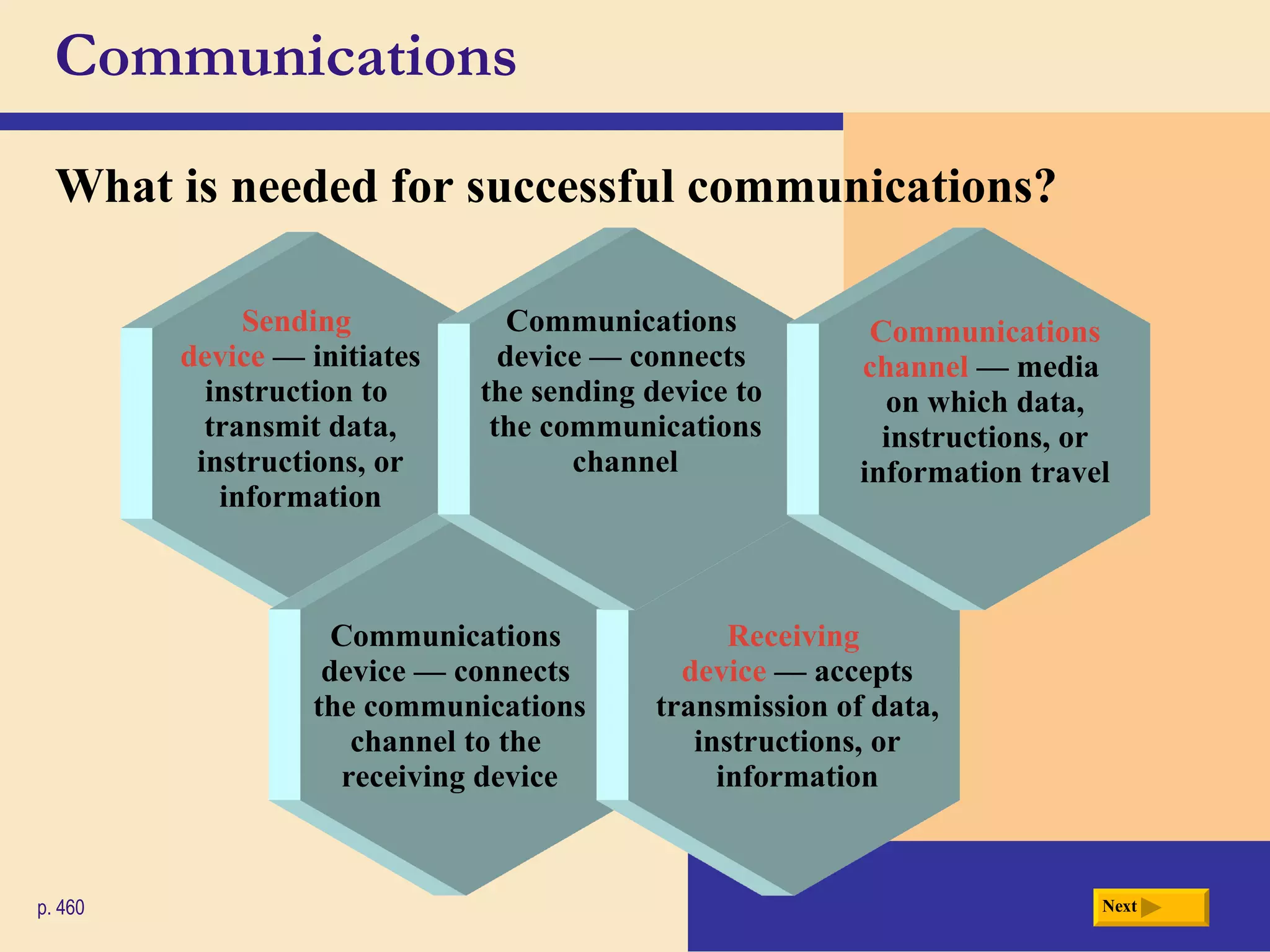
What is needed for successful communications? Communications p. 460 Sending  device  — initiates instruction to  transmit data, instructions, or information Next Communications  device   — connects  the communications channel to the  receiving device Receiving  device  — accepts transmission of data, instructions, or information Communications  device   — connects  the sending device to  the communications channel Communications channel  — media  on which data, instructions, or information travel
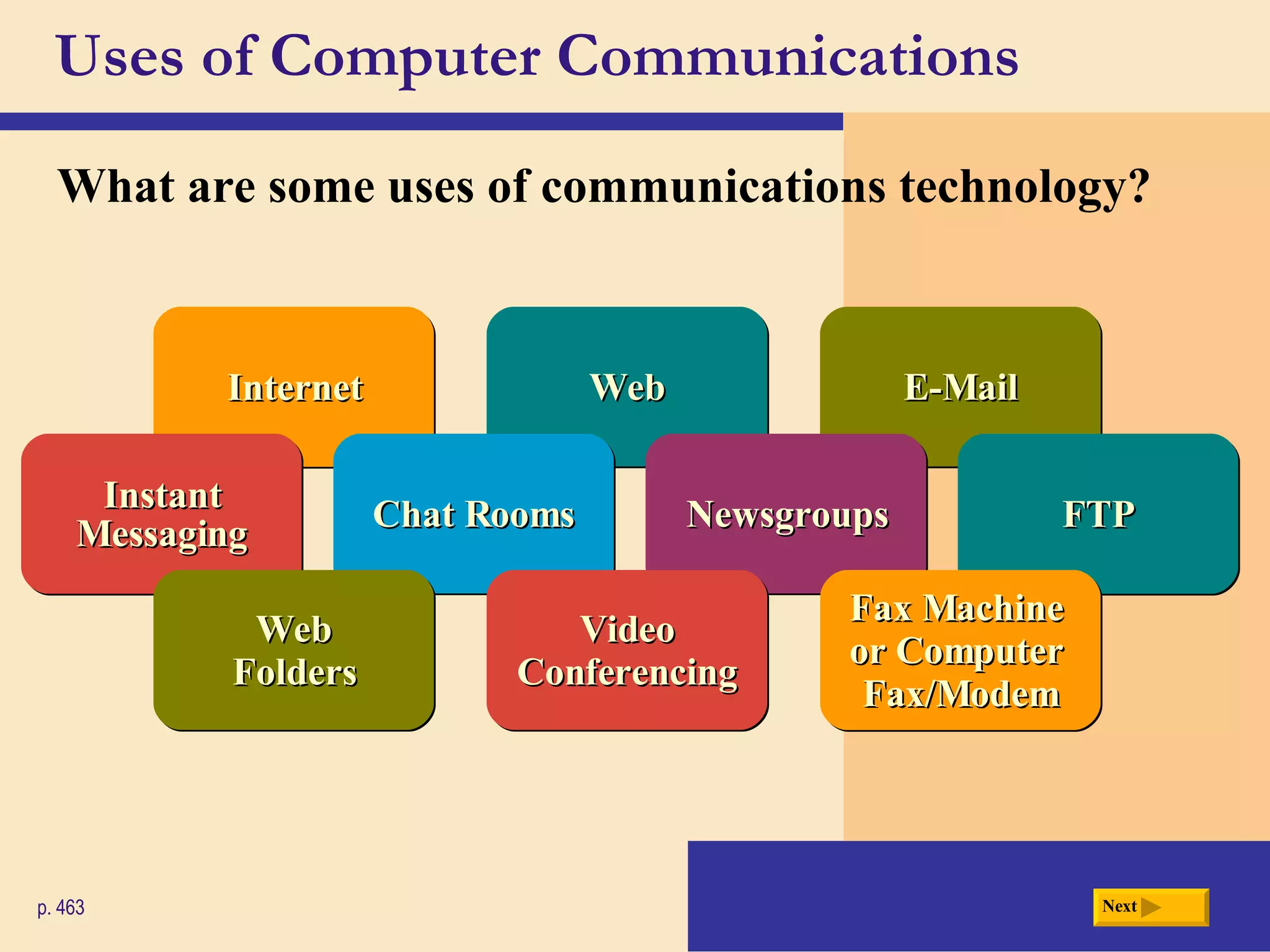
Uses of Computer Communications What are some uses of communications technology? p. 463 Web Internet E-Mail Instant Messaging FTP Newsgroups Chat Rooms Web Folders Fax Machine  or Computer  Fax/Modem Video Conferencing Next
Uses of Computer Communications What are  Internet telephony  and  Internet printing ? p. 464 Next Internet printing  allows you to print to network printer from anywhere in the world Internet telephony   enables you to talk to other people over the Internet Sometimes called   Voice over IP
Uses of Computer Communications What are  Web services ? p. 464 Fig. 9-4 Software that enables programmers to create applications that communicate with other remote computers Next
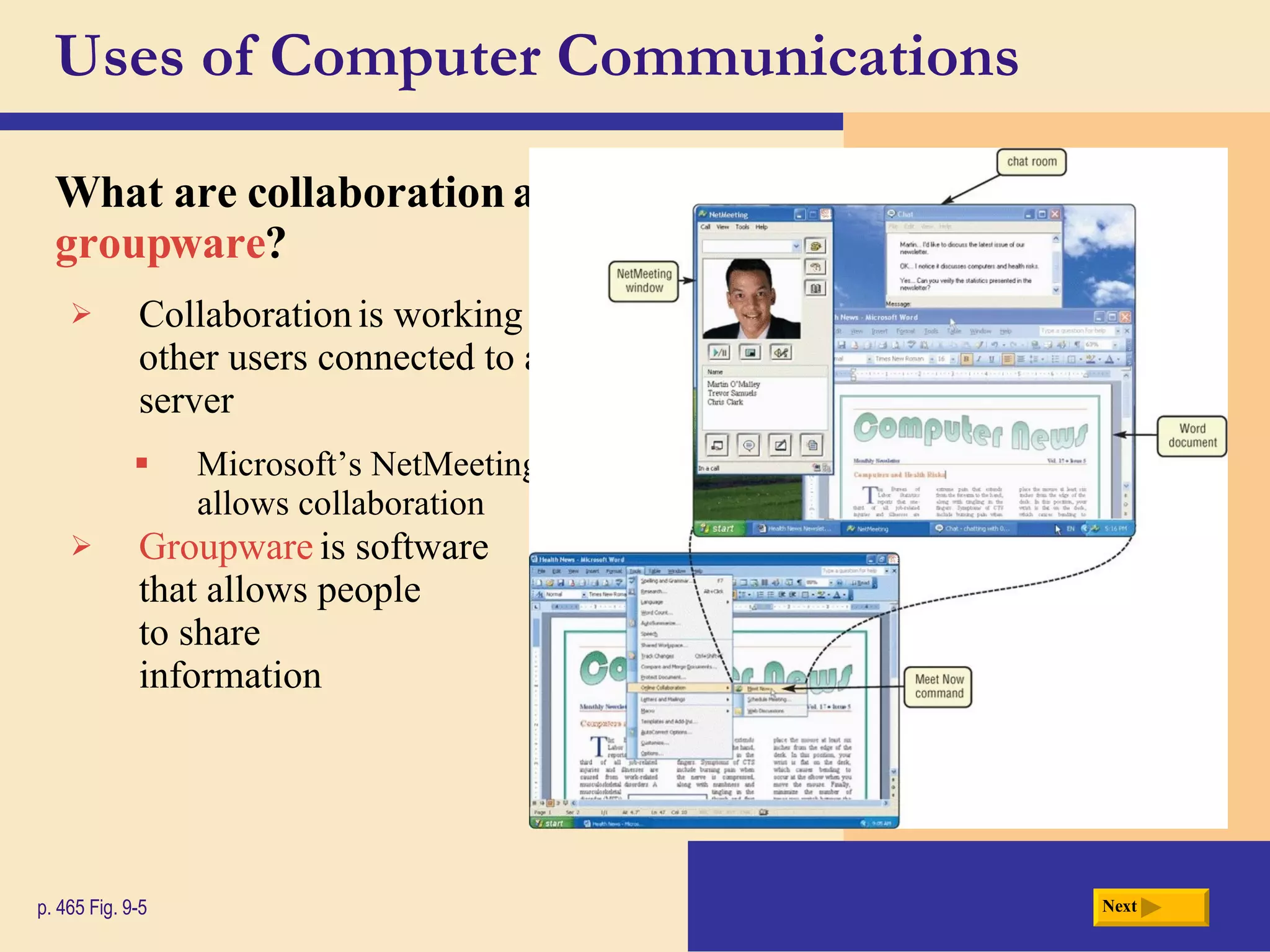
Uses of Computer Communications What are  collaboration  and  groupware ? p. 465 Fig. 9-5 Microsoft’s NetMeeting allows collaboration Groupware  is software that allows people to share information Collaboration   is working with other users connected to a server Next
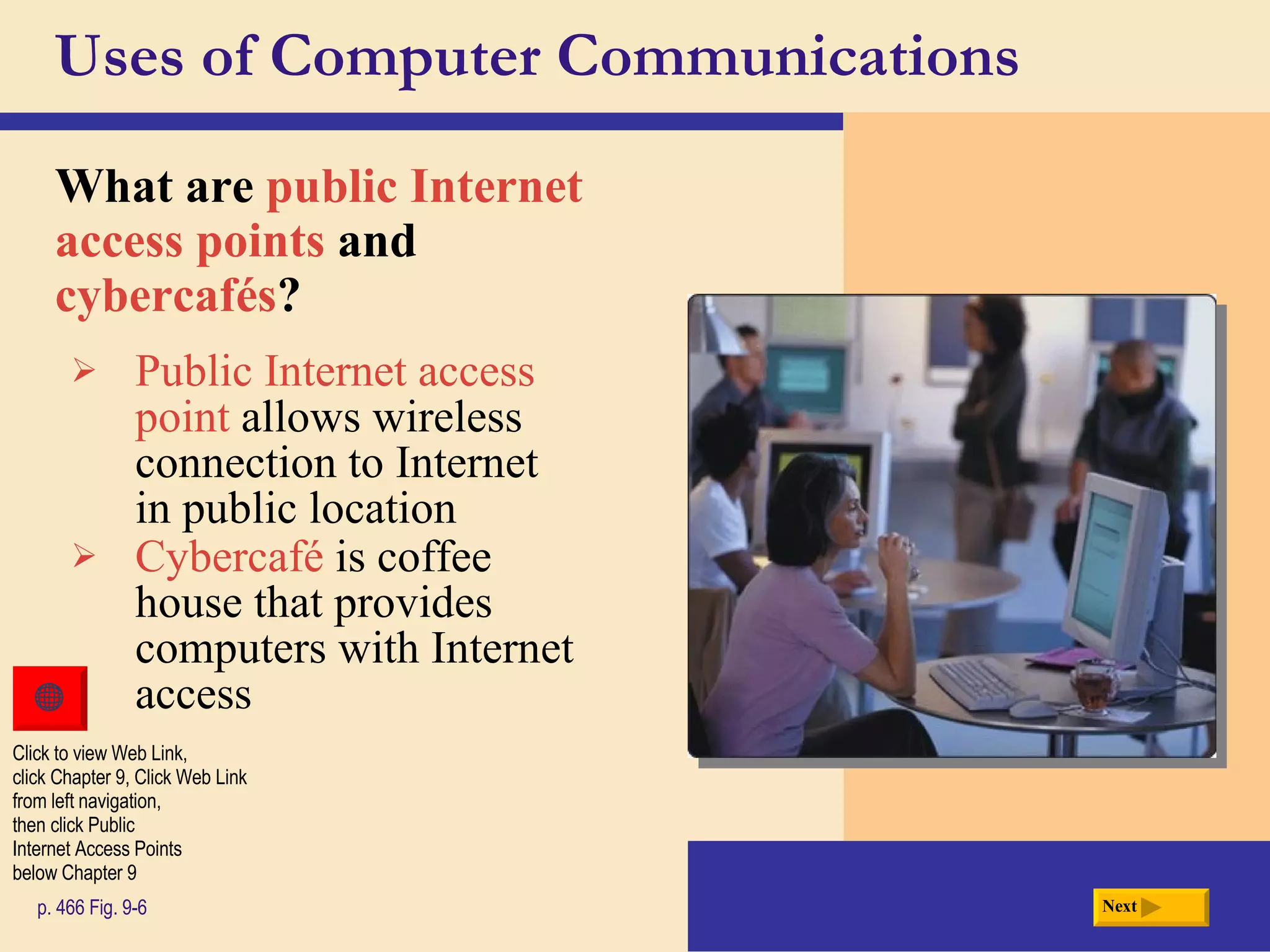
Uses of Computer Communications What are  public Internet access points  and  cybercafés ? p. 466 Fig. 9-6 Public Internet access point  allows wireless connection to Internet in public location Cybercafé  is coffee house that provides computers with Internet access Next Click to view Web Link, click Chapter 9, Click Web Link from left navigation,  then click Public  Internet Access Points below Chapter 9
Uses of Computer Communications What is a  global positioning system (GPS) ? p. 464 Fig. 9-7 Step 1. GPS satellites orbit Earth. Every thousandth of a second, each satellite sends a signal that indicates its current position to the GPS server. Step 2. A GPS receiver (such as in a car, a PDA, a watch, a handheld device, or a collar) determines its location on Earth by analyzing at least 3 separate satellite signals from the 24 satellites in orbit. Next Click to view Web Link, click Chapter 9, Click Web Link from left navigation,  then click GPS below Chapter 9 Click to view video
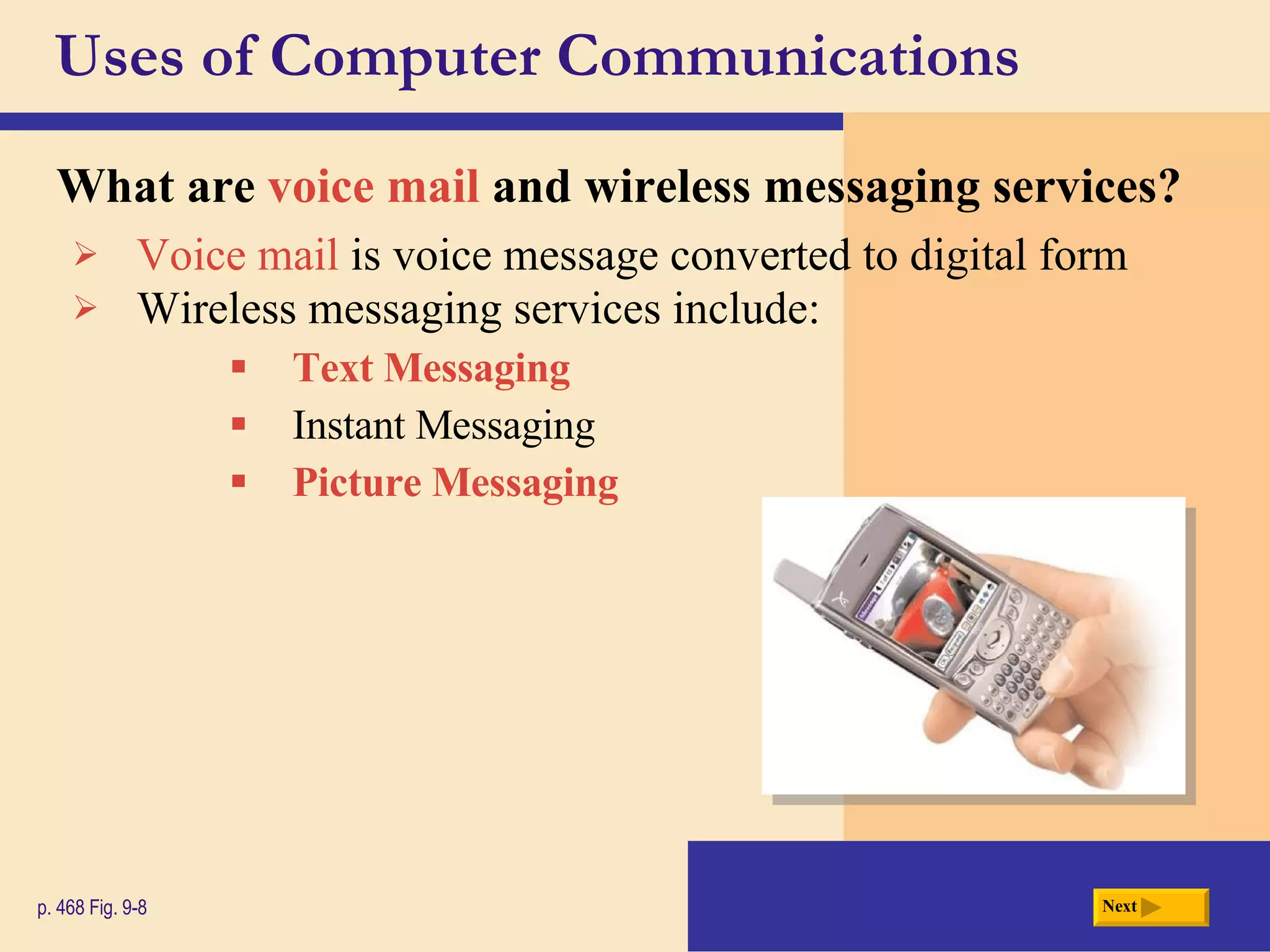
Uses of Computer Communications What are  voice mail  and  wireless messaging services ? p. 468 Fig. 9-8 Voice mail  is voice message converted to digital form Wireless messaging services include: Text Messaging Instant Messaging Picture Messaging Next
Networks What is a  network ? p. 469 Fig. 9-9 Collection of computers and devices connected via communications devices and transmission media Next
Networks What is a  local area network (LAN) ? p. 471 Fig. 9-10 Network in limited geographical area such as home or office building Metropolitan area network (MAN) connects LANs in city or town Next Click to view Web Link, click Chapter 9, Click Web Link from left navigation,  then click LAN below Chapter 9
Networks What is a  wide area network (WAN) ? p. 472 Fig. 9-11 Network that covers large geographic area using many types of media Internet is world’s largest WAN Next
Networks What is a  client/server network ? p. 472 Fig. 9-12 One or more computers act as  server  and other computers, or  clients , access server Next
Networks What is a  peer-to-peer network ? p. 473 Fig. 9-13 Simple network that connects fewer than 10 computers Each computer, or peer, has equal capabilities Next
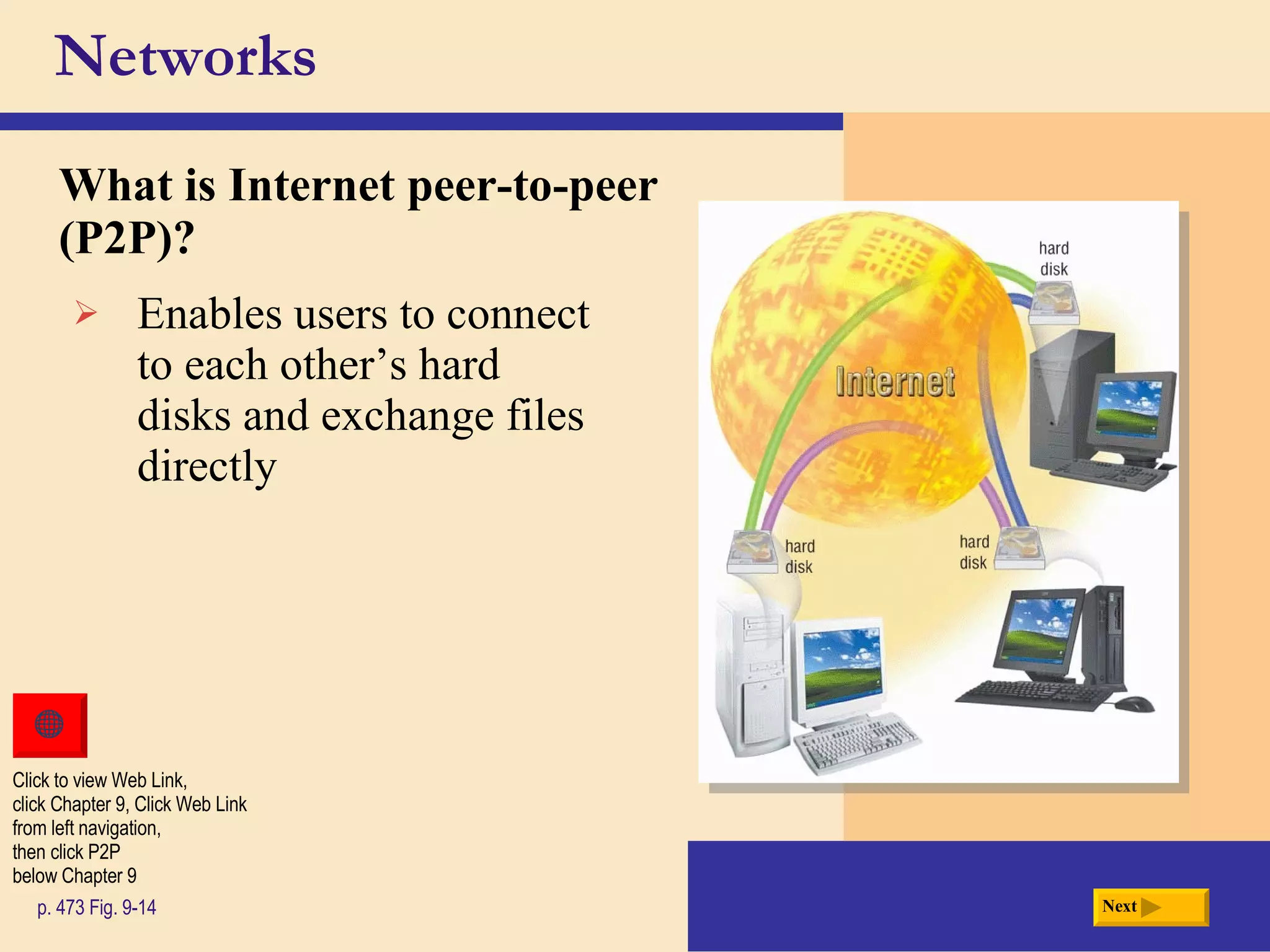
Networks What is  Internet peer-to-peer (P2P)? p. 473 Fig. 9-14 Enables users to connect to each other’s hard disks and exchange files directly Next Click to view Web Link, click Chapter 9, Click Web Link from left navigation,  then click P2P below Chapter 9
Networks What is a  bus network ? p. 474 Fig. 9-15 All computers and devices connect to central cable, or bus Example of  network topology  (layout of devices in network) Popular topologies are bus, ring, and star Next
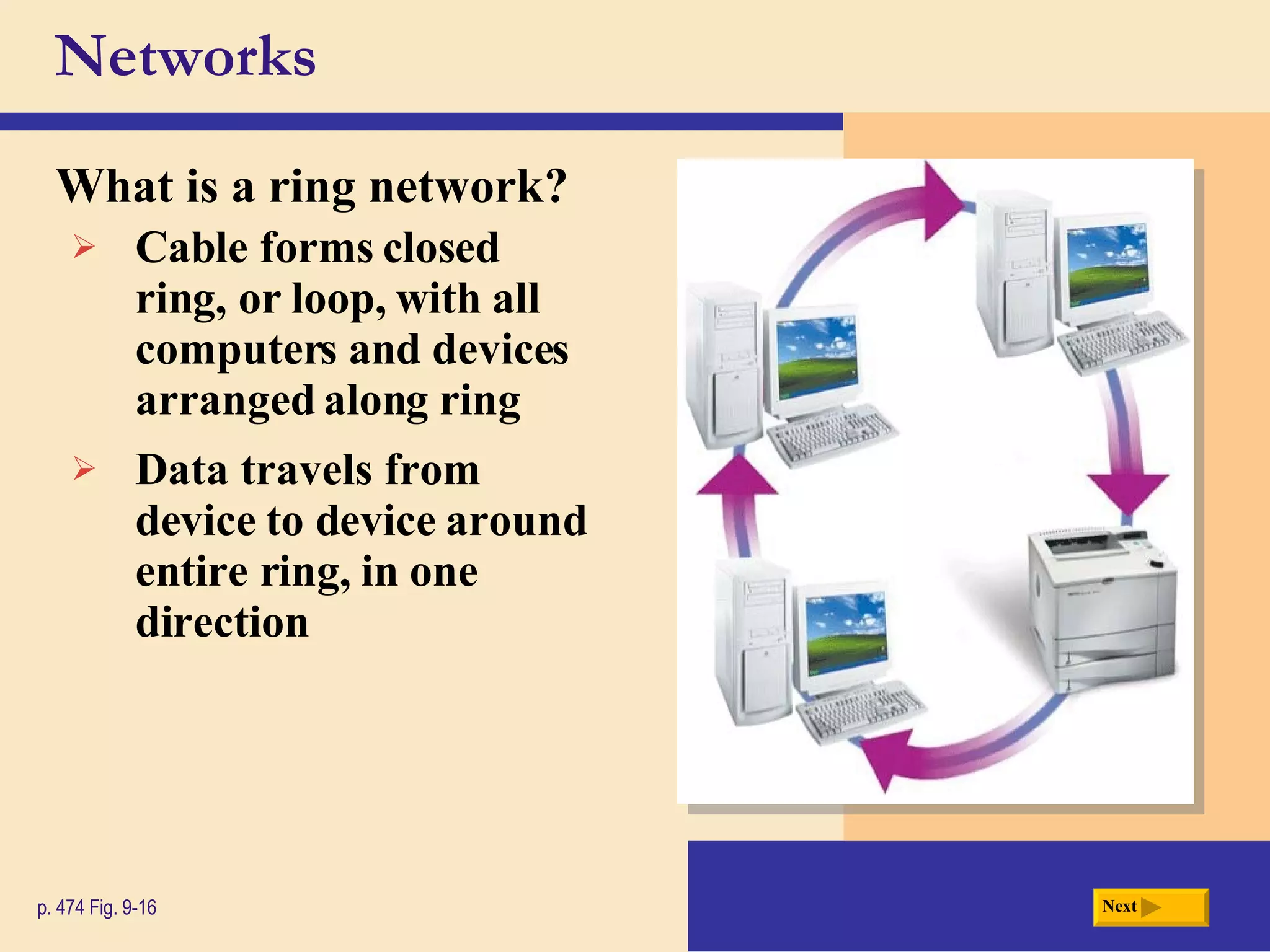
Networks What is a  ring network ? p. 474 Fig. 9-16 Cable forms closed ring, or loop, with all computers and devices arranged along ring Data travels from device to device around entire ring, in one direction Next
Networks What is a  star network ? p. 475 Fig. 9-17 All devices connect to a central device, called hub All data transferred from one computer to another passes through hub Next
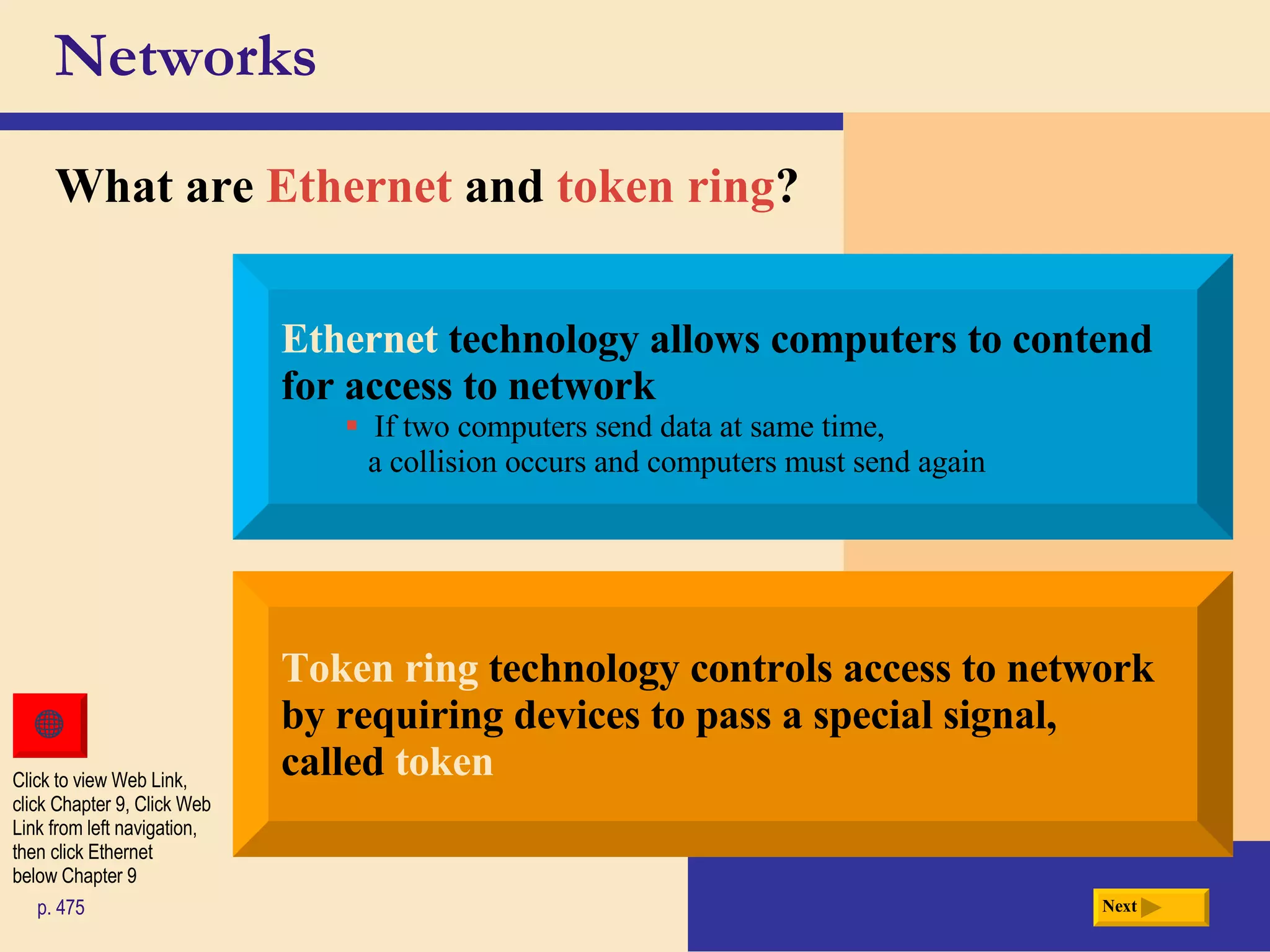
Networks What are  Ethernet  and  token ring ? p. 475 Ethernet  technology allows computers to contend  for access to network If two computers send data at same time,    a collision occurs and computers must send again Token ring  technology controls access to network  by requiring devices to pass a special signal,  called   token Next Click to view Web Link, click Chapter 9, Click Web  Link from left navigation,  then click Ethernet below Chapter 9
Networks What are  TCP/IP  and  802.11 ? p. 476 Fig. 9-18 TCP/IP  ( T ransmission  C ontrol  P rotocol/ I nternet  P rotocol) technology transmits data by breaking it up into small pieces, or packets Commonly used for Internet transmissions 802.11  is family of standards for wireless LANs Next
Networks What is  Bluetooth ? p. 476 Fig. 9-19 Short-range radio waves transmit data between Bluetooth devices Next
Networks What are  IrDA ,  RFID ,  and  Wireless Applications Protocol (WAP) ? p. 476 IrDA specification allows  data to be transferred  wirelessly via infrared  light waves Wireless Applications  Protocol (WAP)   allow wireless mobile devices  to access Internet Radio Frequency  Identification (RFID)   uses radio signals to communicate with a tag placed in an object Next Click to view Web Link, click Chapter 9, Click Web Link from left navigation,  then click WAP below Chapter 9 Click to view video
Networks What is an  intranet ? p. 478 Next Extranet  allows customers or suppliers to access  part of company’s intranet Typically includes connection to Internet Makes information accessible to employees Internal network that uses Internet technologies
Communications Software What is  communications software ? p. 478 Next Programs that help users  establish connection to  Internet, other network,  or another computer Programs that help users  manage transmission of  data, instructions,  and information Programs that provide an  interface for users to  communicate with one  another
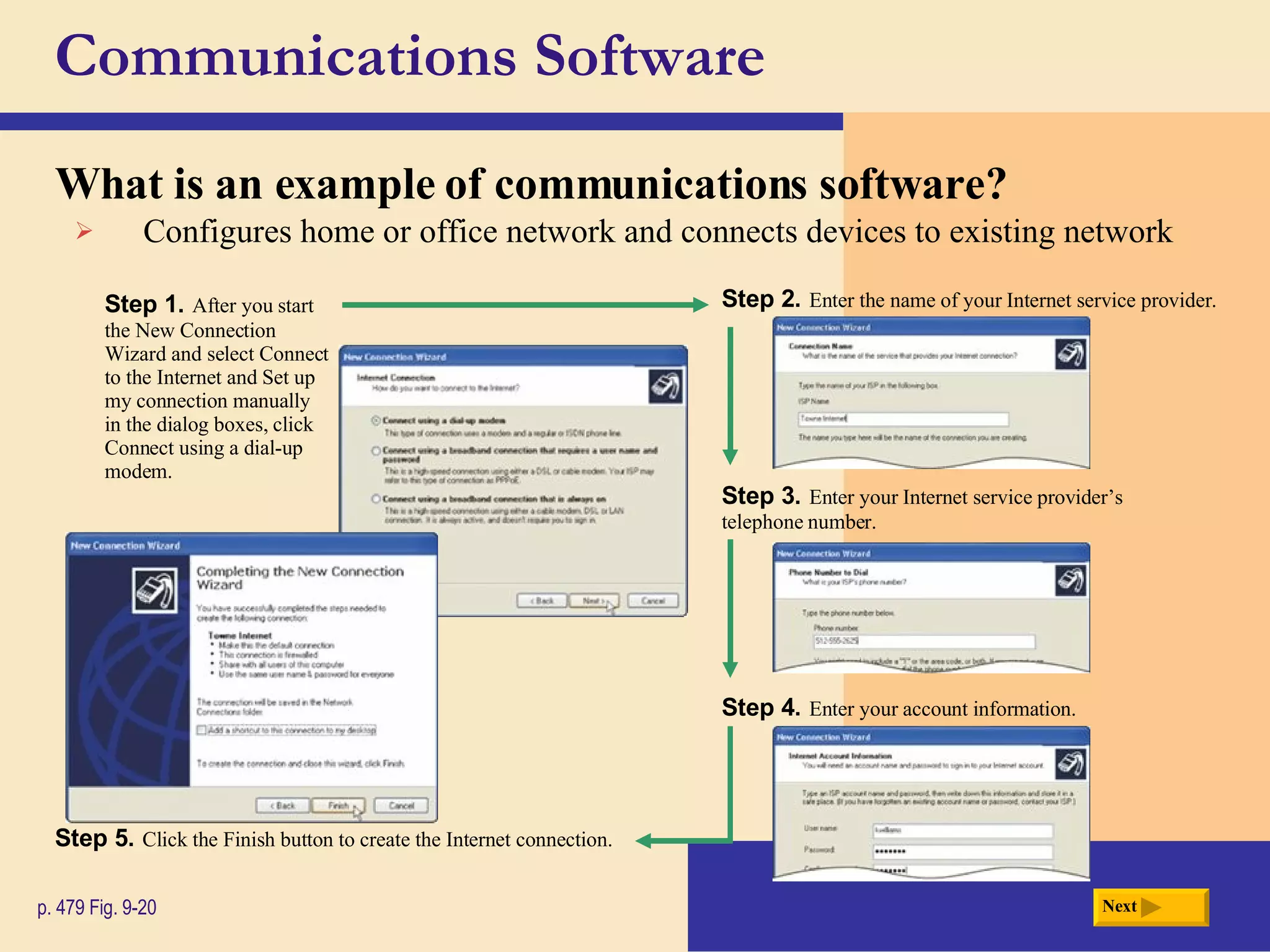
Communications Software What is an example of communications software? p. 479 Fig. 9-20 Step 1.   After you start the New Connection Wizard and select Connect to the Internet and Set up my connection manually in the dialog boxes, click Connect using a dial-up modem. Step 2.   Enter the name of your Internet service provider. Step 3.   Enter your Internet service provider’s telephone number. Step 4.   Enter your account information. Step 5.   Click the Finish button to create the Internet connection. Configures home or office network and connects devices to existing network Next
Communications Over the Telephone Network What is the  public switched telephone network (PSTN)? p. 480 Fig. 9-22 Worldwide telephone system that handles voice-oriented telephone calls Next
Communications Over the Telephone Network What is a  dial-up line ? p. 480 Fig. 9-23 Temporary connection using telephone line for communications Costs no more than making regular call Computers at any two locations can establish a connection using modems and telephone network Next
Communications Over the Telephone Network What is a  dedicated line ? p. 481 Fig. 9-24 Four types are ISDN line, DSL, T-carrier line, and ATM Always-on connection between two communications devices Next
Communications Over the Telephone Network What is an  ADSL (asymmetric digital subscriber line )? p. 482 Fig. 9-25 Popular type of DSL (Digital Subscriber Line) Faster when receiving data than when sending data Ideal for Internet access Next Click to view Web Link, click Chapter 9, Click Web Link from left navigation,  then click DSL below Chapter 9
Communications Devices What are examples of  communications devices ? p. 482 Next Common types are dial-up modems, ISDN and DSL modems, cable modems, network cards, wireless access points, routers, and hubs ISDN and DSL modems send and receive data from ISDN and DSL lines
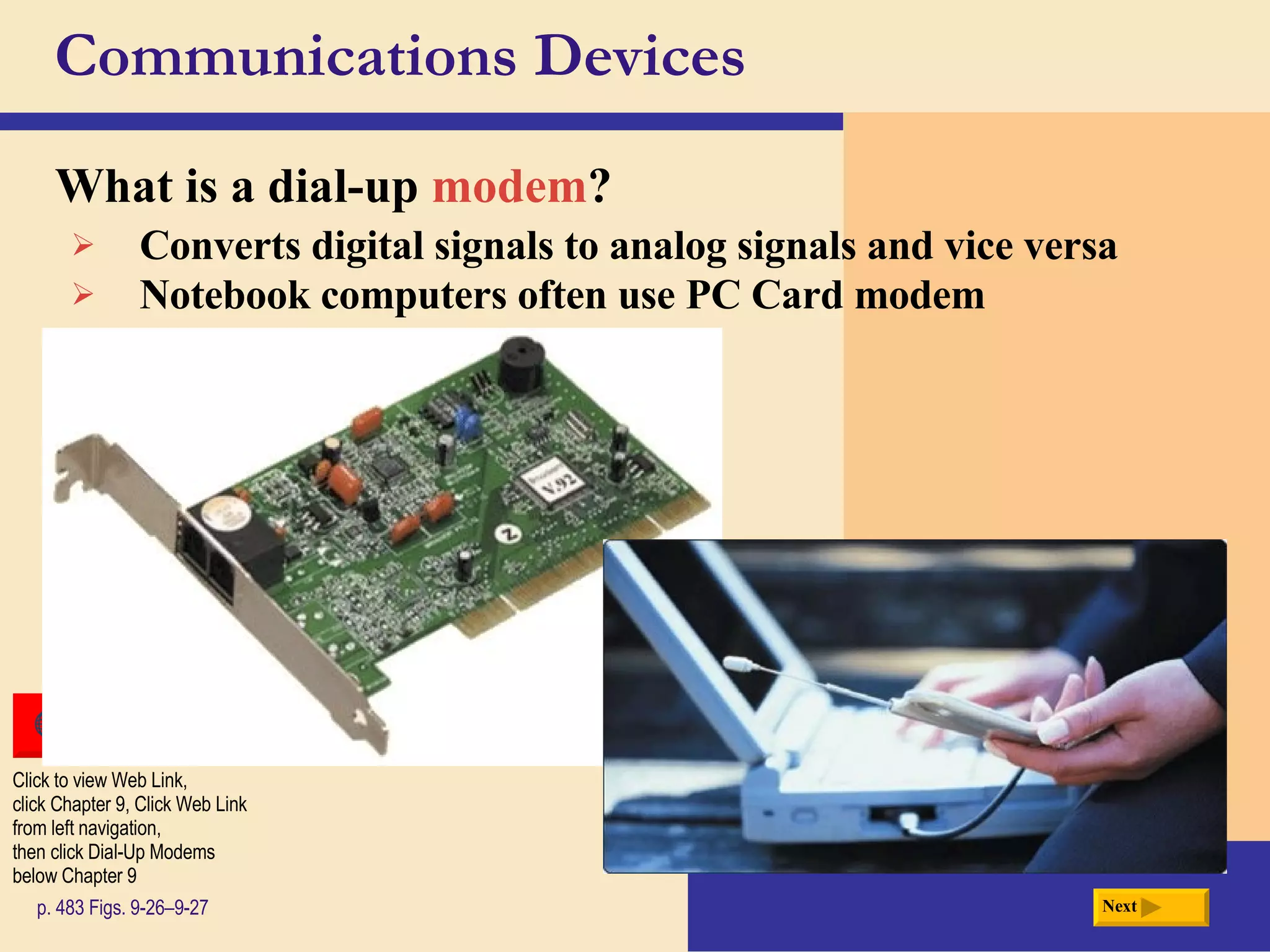
Communications Devices What is a  dial-up  modem ? p. 483 Figs. 9-26–9-27 Converts digital signals to analog signals and vice versa Notebook computers often use PC Card modem Next Click to view Web Link, click Chapter 9, Click Web Link from left navigation,  then click Dial-Up Modems below Chapter 9
Communications Devices What are  ISDN  and  DSL modems ? p. 484 Communications devices that send and  receive digital ISDN and DSL signals Usually external devices in which one  end connects to a telephone line and the other  end connects to a port on the system unit Next
Communications Devices What is a  cable modem ? p. 484 Fig. 9-28 Sends and receives data over cable television network Much faster than dial-up modem or ISDN Sometimes called a broadband modem Next
Communications Devices What is a  network card ? p. 485 Fig. 9-29 Adapter card, PC Card, or compact flash card that enables computer or device to access network Sometimes called network interface card (NIC) Next
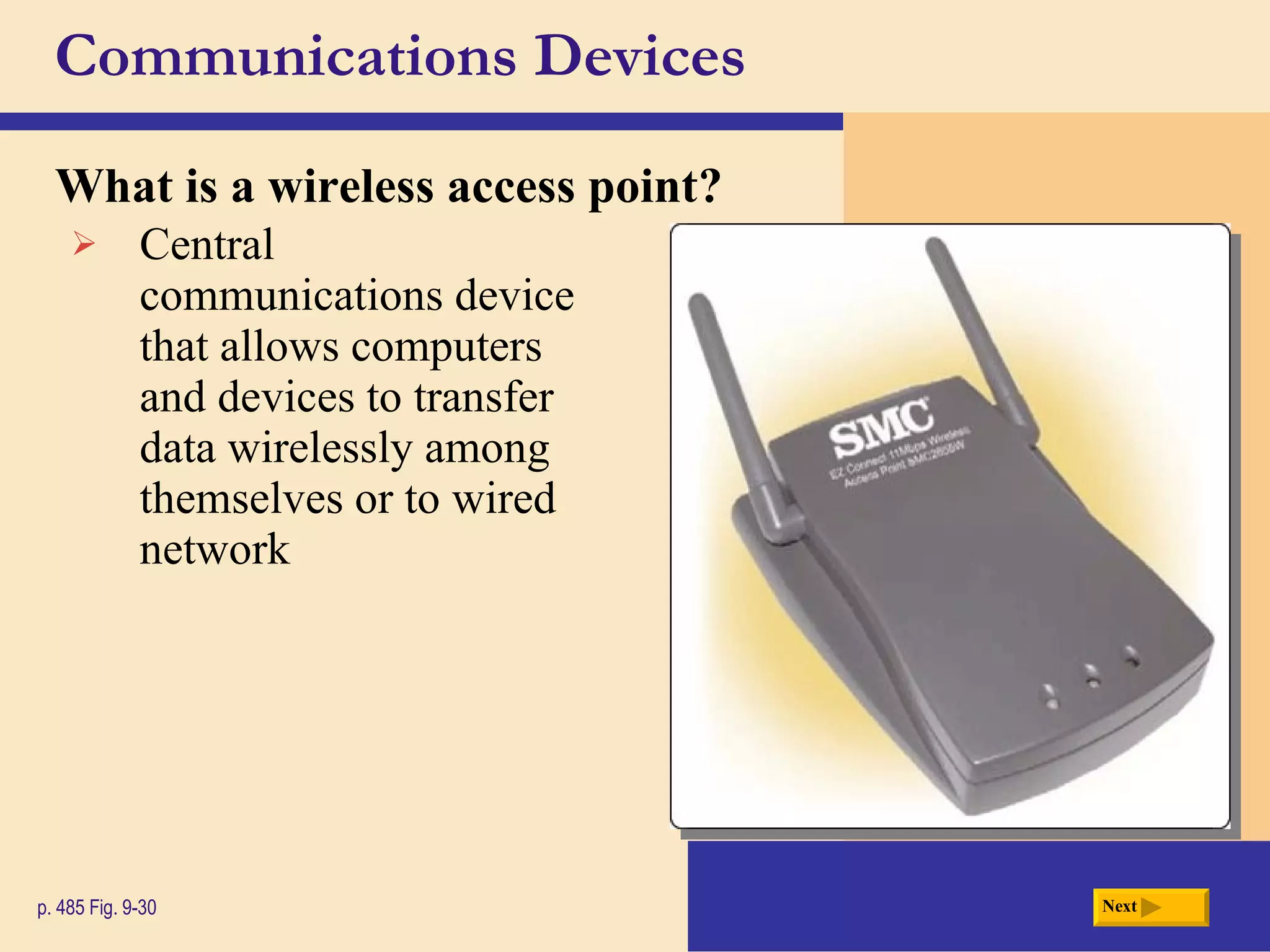
Communications Devices What is a  wireless access point ? p. 485 Fig. 9-30 Central communications device that allows computers and devices to transfer data wirelessly among themselves or to wired network Next
Communications Devices What is a  router ? p. 486 Fig. 9-31 Connects computers and transmits data to correct destination on network Routers forward data on Internet using fastest available path Next Click to view Web Link, click Chapter 9, Click Web Link from left navigation,  then click Routers below Chapter 9
Communications Devices What is a  hub ? p. 486 Fig. 9-32 Device that provides central point for cables in network Next Click to view animation
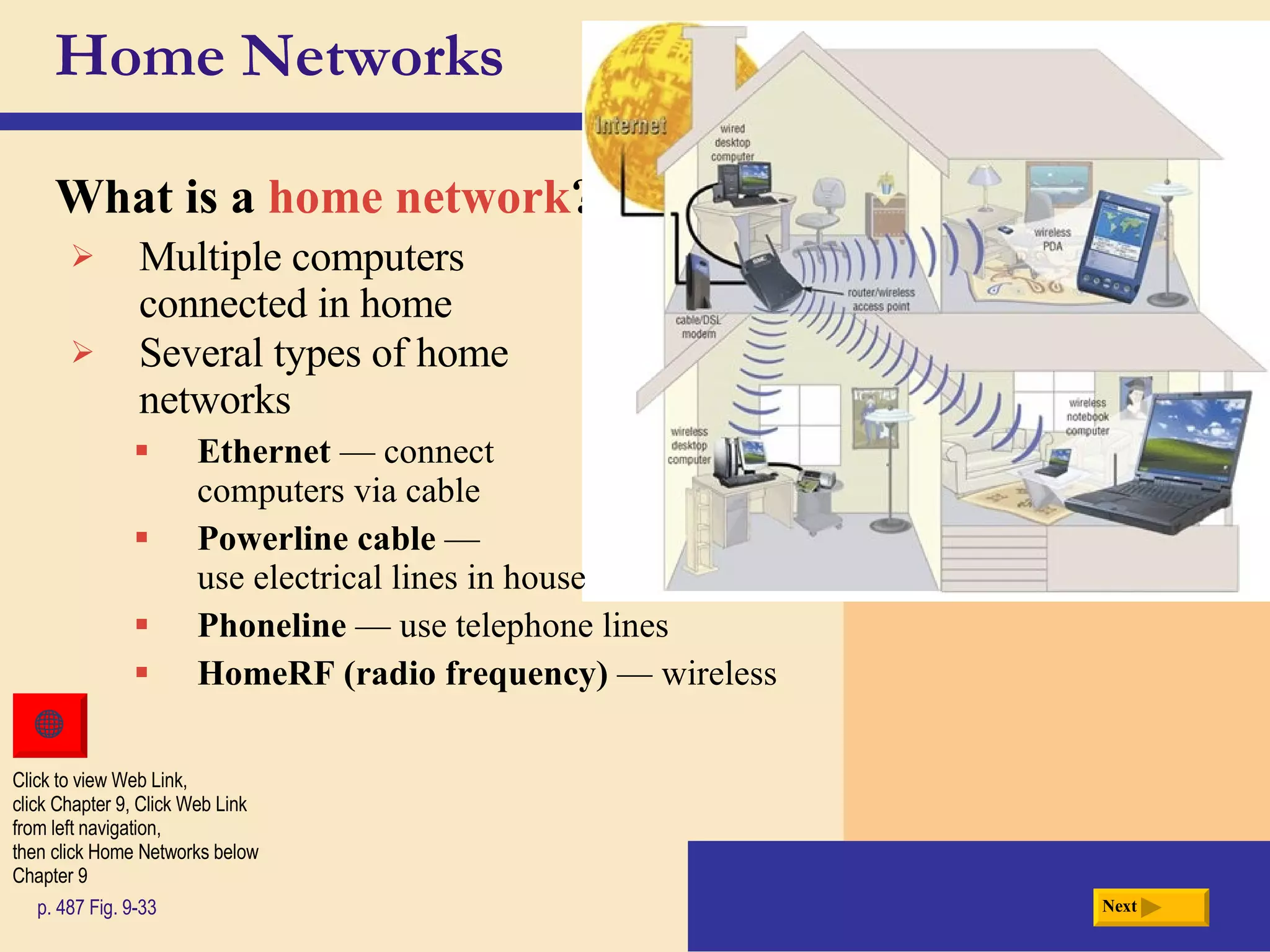
Home Networks What is a  home network ? p. 487 Fig. 9-33 Multiple computers  connected in home Several types of home  networks Ethernet   — connect  computers via cable Powerline cable   —  use electrical lines in house Phoneline   — use telephone lines HomeRF (radio frequency)   — wireless Next Click to view Web Link, click Chapter 9, Click Web Link from left navigation,  then click Home Networks below Chapter 9
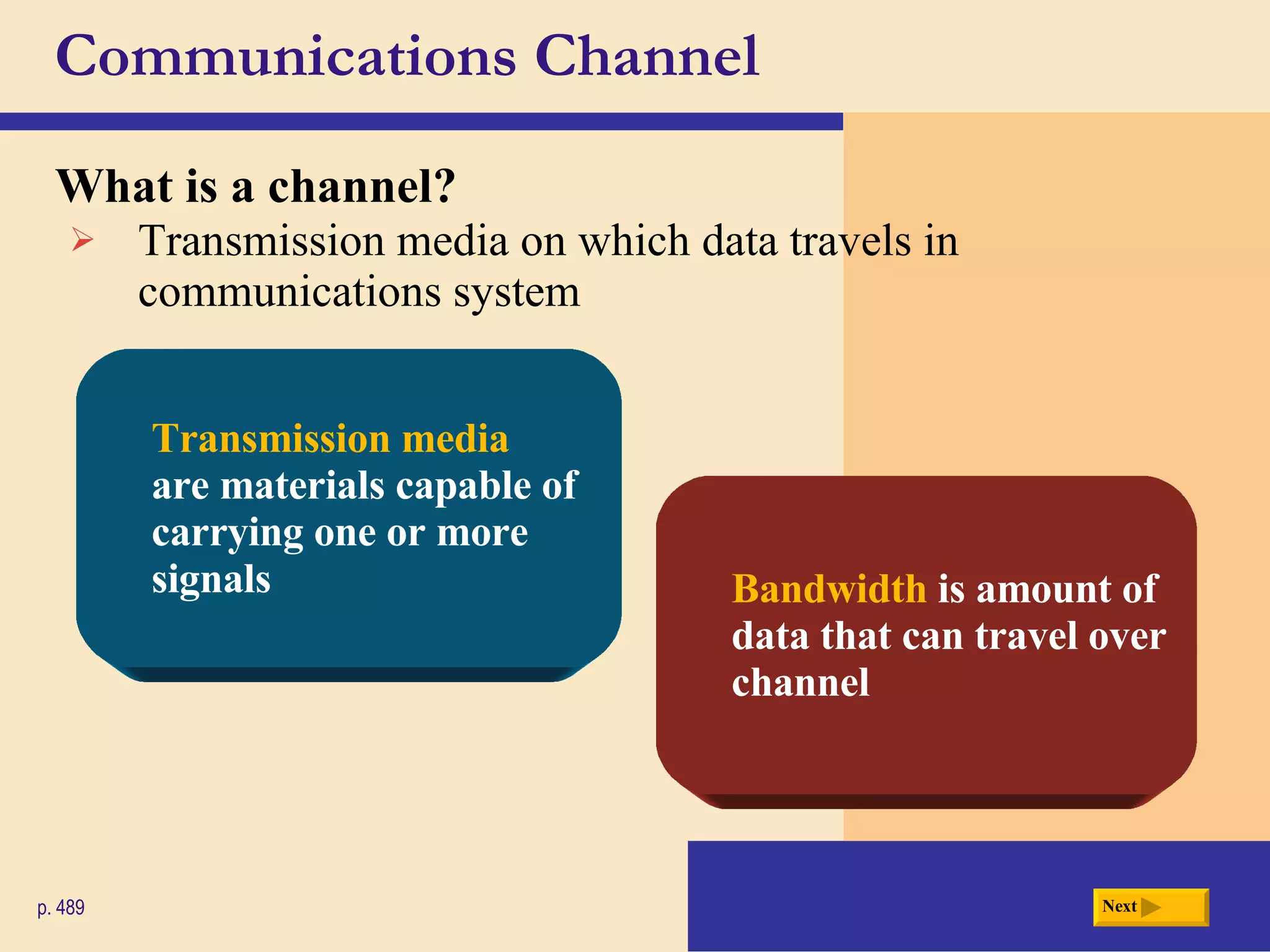
Communications Channel What is a  channel ? p. 489 Transmission media on which data travels in communications system Bandwidth   is amount of data that can travel over channel Transmission media   are materials capable of carrying one or more signals Next
Communications Channel How is a request sent over the Internet using a communications channel? p. 489 Fig. 9-34 Step 1.   The sending device requests information using either  a physical transmission media  or a wireless transmission media. Step 2.   When the request leaves  the ISP, it travels over T1 lines, microwave stations, earth-based stations, and communications satellites until it reaches the Internet backbone. Step 3.   The request travels over T3 lines along the Internet backbone. Step 4.   The Request travels over T1 lines until it reaches the destination network server. Next
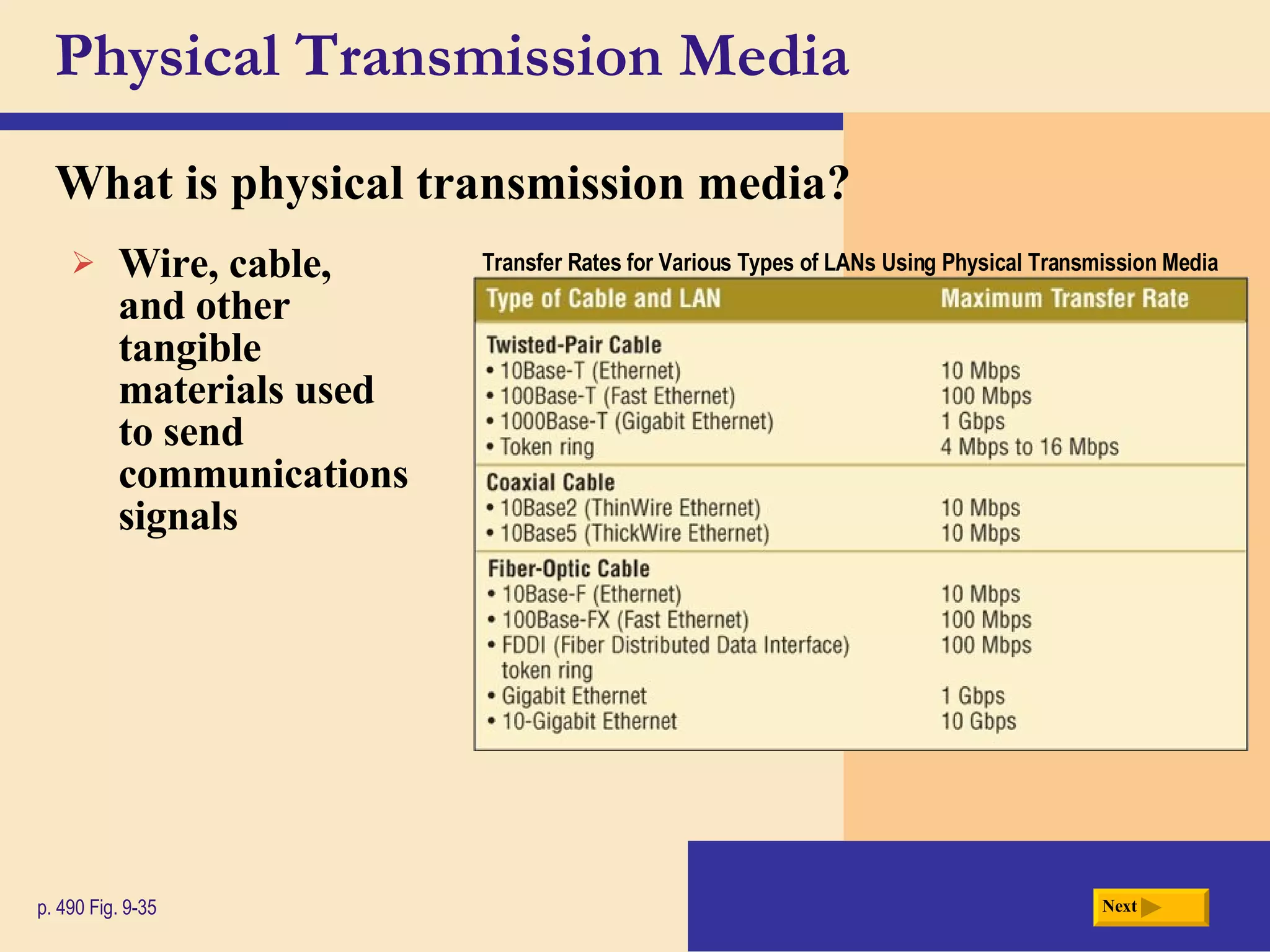
Physical Transmission Media What is  physical transmission media ? p. 490 Fig. 9-35 Wire, cable,  and other tangible materials used  to send communications signals Next Transfer Rates for Various Types of LANs Using Physical Transmission Media
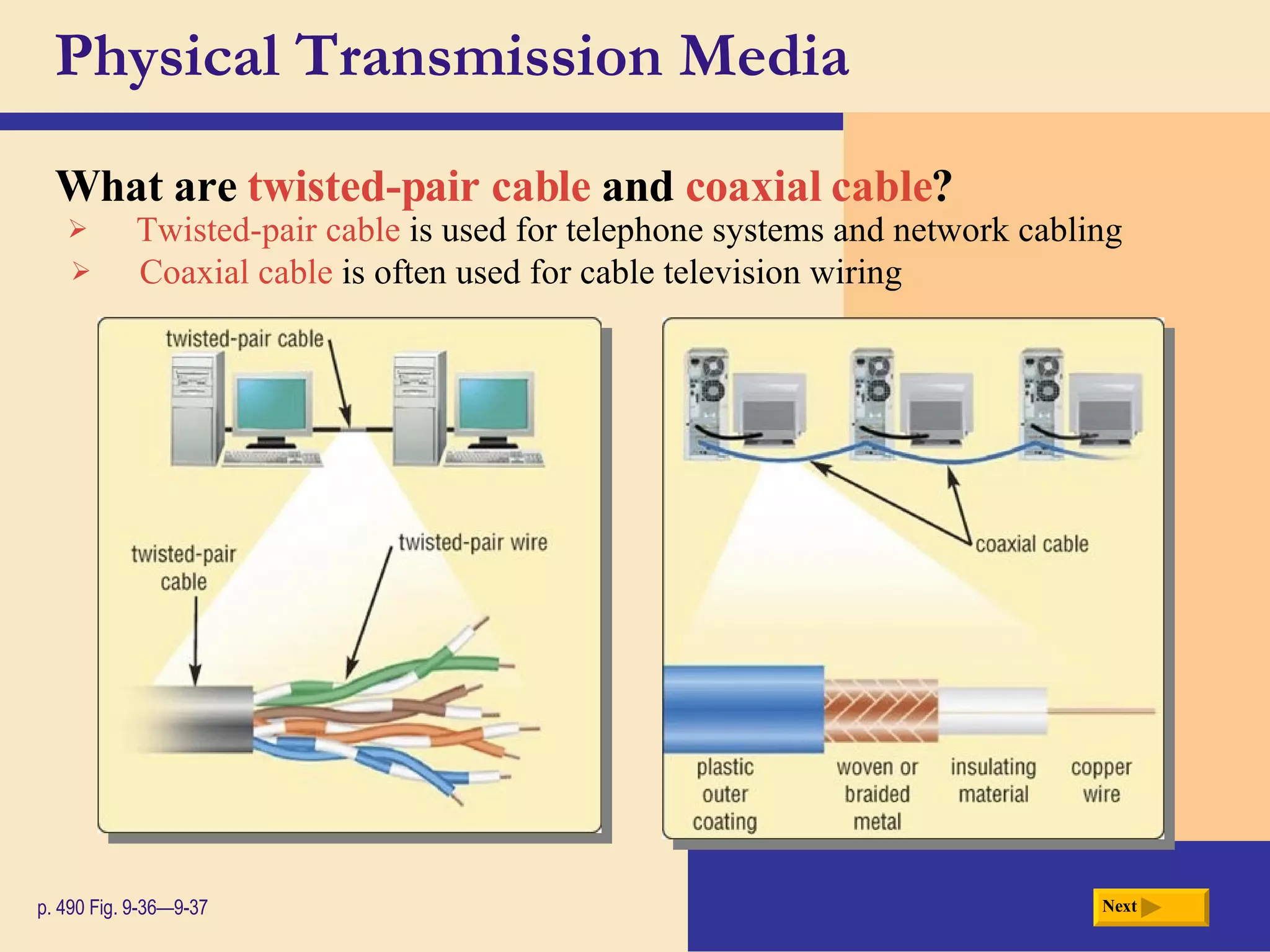
Physical Transmission Media What are  twisted-pair cable  and  coaxial cable ? p. 490 Fig. 9-36—9-37 Twisted-pair cable  is used for telephone systems and network cabling Coaxial cable  is often used for cable television wiring Next
Physical Transmission Media What is  fiber-optic cable ? p. 491 Fig. 9-38 Capable of carrying  significantly more  data at faster speeds  than wire cables Less susceptible  to interference  (noise) and, therefore,  more secure Smaller size (thinner  and lighter) Next
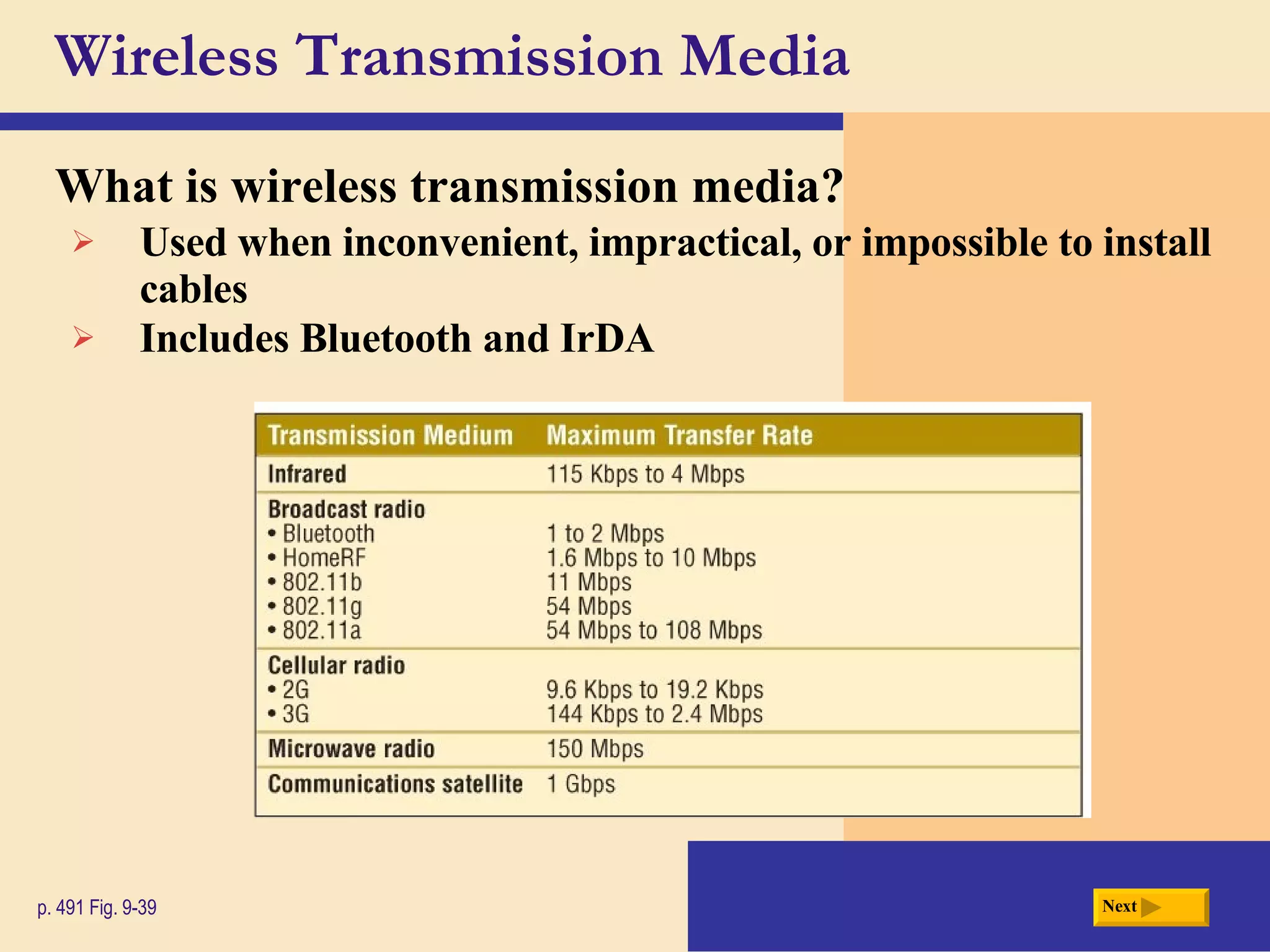
Wireless Transmission Media What is  wireless transmission media ? p. 491 Fig. 9-39 Used when inconvenient, impractical, or impossible to install cables Includes Bluetooth and IrDA Next
Wireless Transmission Media What are  broadcast radio  and  cellular radio ? p. 492 Fig. 9-40 Broadcast radio distributes radio signals over long and short distances Cellular radio  is form of broadcast radio used for mobile communications Next Click to view Web Link, click Chapter 9, Click Web Link from left navigation,  then click Cellular Communications  below Chapter 9
Wireless Transmission Media What is a  microwave station ? p. 493 Fig. 9-41 Earth-based reflective  dish used for microwave communications Must transmit in straight line with no obstructions Next
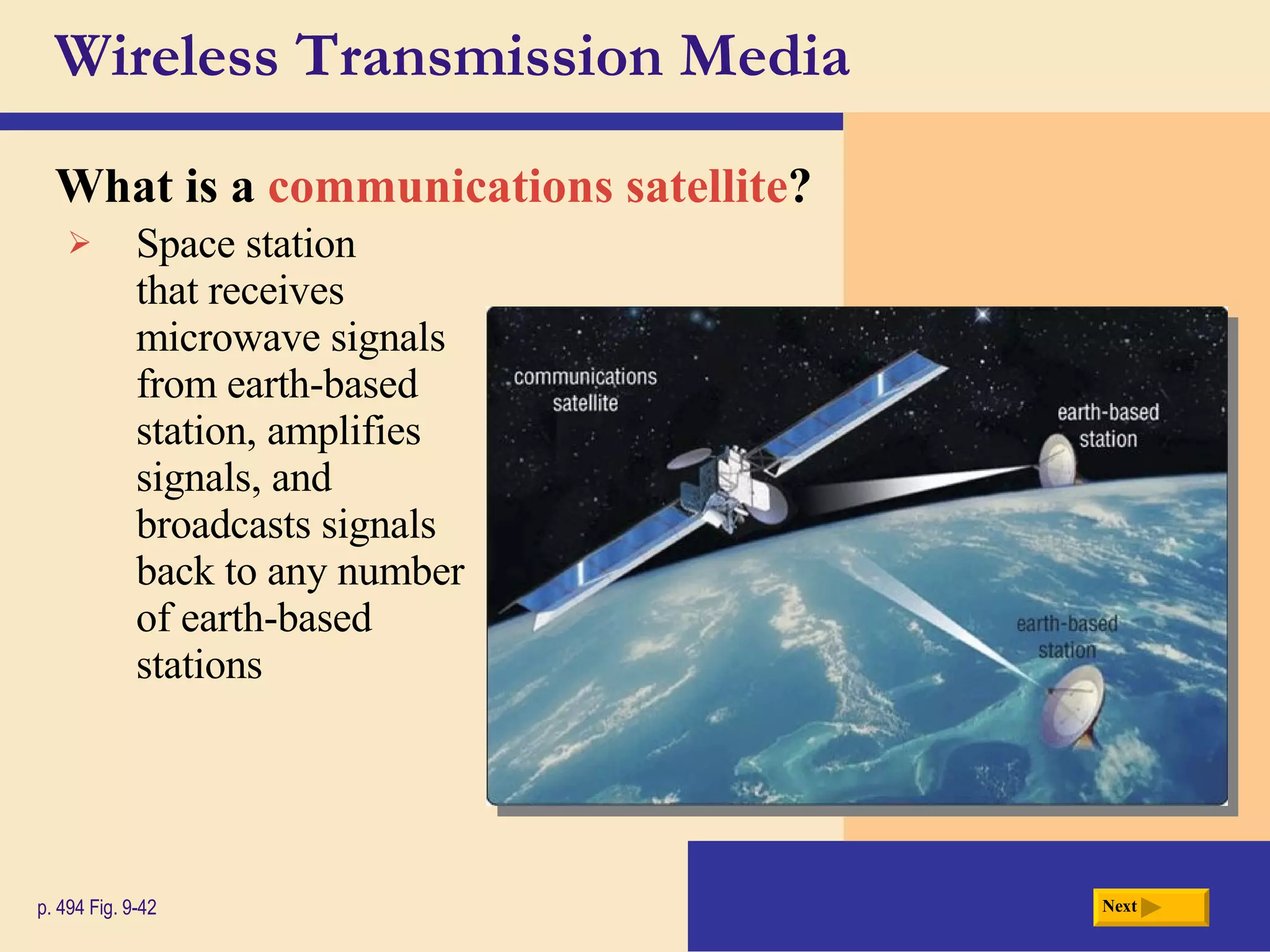
Wireless Transmission Media What is a  communications satellite ? p. 494 Fig. 9-42 Space station  that receives microwave signals from earth-based station, amplifies signals, and broadcasts signals back to any number of earth-based stations Next
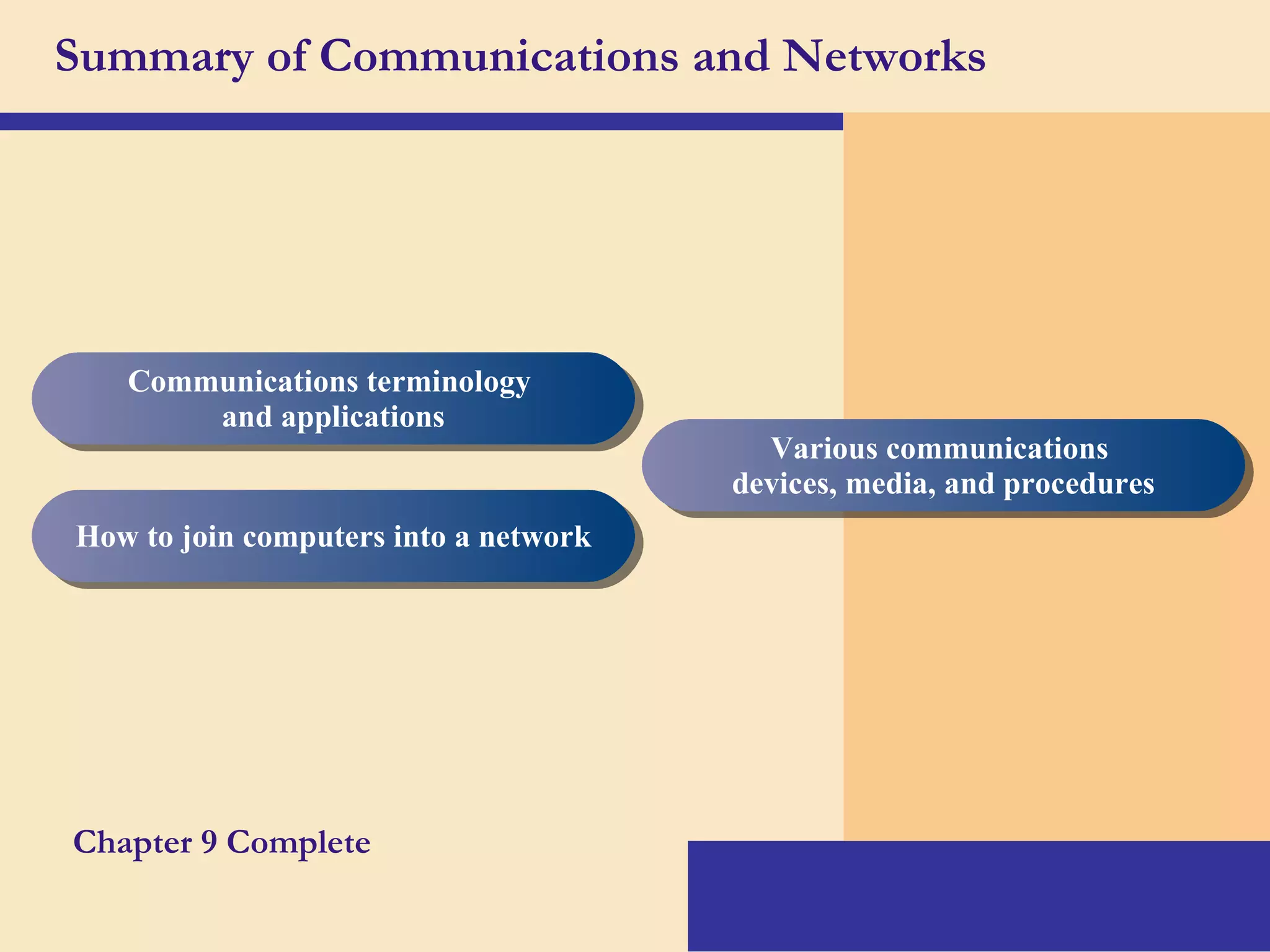
Summary of Communications and Networks Chapter 9 Complete Communications terminology  and applications How to join computers into a network Various communications  devices, media, and procedures

Chapter09

  • 1.
  • 2.
    Chapter 9 ObjectivesDiscuss the components required for successful communications Identify various sending and receiving devices Describe uses of computer communications List advantages of using a network Differentiate among client/server, peer-to-peer, and P2P networks Describe the various network communications technologies Explain the purpose of communications software Describe various types of lines for communications over the telephone network Describe commonly used communications devices Discuss different ways to set up a home network Identify various physical and wireless transmission media Next
  • 3.
    Communications What arecomputer communications ? p. 460 Fig. 9-1 Process in which two or more computers or devices transfer data, instructions, and information Next set-top boxes mainframe computers smart phones notebook computers servers Web-enabled PDAs desktop computers Tablet PCs GPS receivers
  • 4.
    What is neededfor successful communications? Communications p. 460 Sending device — initiates instruction to transmit data, instructions, or information Next Communications device — connects the communications channel to the receiving device Receiving device — accepts transmission of data, instructions, or information Communications device — connects the sending device to the communications channel Communications channel — media on which data, instructions, or information travel
  • 5.
    Uses of ComputerCommunications What are some uses of communications technology? p. 463 Web Internet E-Mail Instant Messaging FTP Newsgroups Chat Rooms Web Folders Fax Machine or Computer Fax/Modem Video Conferencing Next
  • 6.
    Uses of ComputerCommunications What are Internet telephony and Internet printing ? p. 464 Next Internet printing allows you to print to network printer from anywhere in the world Internet telephony enables you to talk to other people over the Internet Sometimes called Voice over IP
  • 7.
    Uses of ComputerCommunications What are Web services ? p. 464 Fig. 9-4 Software that enables programmers to create applications that communicate with other remote computers Next
  • 8.
    Uses of ComputerCommunications What are collaboration and groupware ? p. 465 Fig. 9-5 Microsoft’s NetMeeting allows collaboration Groupware is software that allows people to share information Collaboration is working with other users connected to a server Next
  • 9.
    Uses of ComputerCommunications What are public Internet access points and cybercafés ? p. 466 Fig. 9-6 Public Internet access point allows wireless connection to Internet in public location Cybercafé is coffee house that provides computers with Internet access Next Click to view Web Link, click Chapter 9, Click Web Link from left navigation, then click Public Internet Access Points below Chapter 9
  • 10.
    Uses of ComputerCommunications What is a global positioning system (GPS) ? p. 464 Fig. 9-7 Step 1. GPS satellites orbit Earth. Every thousandth of a second, each satellite sends a signal that indicates its current position to the GPS server. Step 2. A GPS receiver (such as in a car, a PDA, a watch, a handheld device, or a collar) determines its location on Earth by analyzing at least 3 separate satellite signals from the 24 satellites in orbit. Next Click to view Web Link, click Chapter 9, Click Web Link from left navigation, then click GPS below Chapter 9 Click to view video
  • 11.
    Uses of ComputerCommunications What are voice mail and wireless messaging services ? p. 468 Fig. 9-8 Voice mail is voice message converted to digital form Wireless messaging services include: Text Messaging Instant Messaging Picture Messaging Next
  • 12.
    Networks What isa network ? p. 469 Fig. 9-9 Collection of computers and devices connected via communications devices and transmission media Next
  • 13.
    Networks What isa local area network (LAN) ? p. 471 Fig. 9-10 Network in limited geographical area such as home or office building Metropolitan area network (MAN) connects LANs in city or town Next Click to view Web Link, click Chapter 9, Click Web Link from left navigation, then click LAN below Chapter 9
  • 14.
    Networks What isa wide area network (WAN) ? p. 472 Fig. 9-11 Network that covers large geographic area using many types of media Internet is world’s largest WAN Next
  • 15.
    Networks What isa client/server network ? p. 472 Fig. 9-12 One or more computers act as server and other computers, or clients , access server Next
  • 16.
    Networks What isa peer-to-peer network ? p. 473 Fig. 9-13 Simple network that connects fewer than 10 computers Each computer, or peer, has equal capabilities Next
  • 17.
    Networks What is Internet peer-to-peer (P2P)? p. 473 Fig. 9-14 Enables users to connect to each other’s hard disks and exchange files directly Next Click to view Web Link, click Chapter 9, Click Web Link from left navigation, then click P2P below Chapter 9
  • 18.
    Networks What isa bus network ? p. 474 Fig. 9-15 All computers and devices connect to central cable, or bus Example of network topology (layout of devices in network) Popular topologies are bus, ring, and star Next
  • 19.
    Networks What isa ring network ? p. 474 Fig. 9-16 Cable forms closed ring, or loop, with all computers and devices arranged along ring Data travels from device to device around entire ring, in one direction Next
  • 20.
    Networks What isa star network ? p. 475 Fig. 9-17 All devices connect to a central device, called hub All data transferred from one computer to another passes through hub Next
  • 21.
    Networks What are Ethernet and token ring ? p. 475 Ethernet technology allows computers to contend for access to network If two computers send data at same time, a collision occurs and computers must send again Token ring technology controls access to network by requiring devices to pass a special signal, called token Next Click to view Web Link, click Chapter 9, Click Web Link from left navigation, then click Ethernet below Chapter 9
  • 22.
    Networks What are TCP/IP and 802.11 ? p. 476 Fig. 9-18 TCP/IP ( T ransmission C ontrol P rotocol/ I nternet P rotocol) technology transmits data by breaking it up into small pieces, or packets Commonly used for Internet transmissions 802.11 is family of standards for wireless LANs Next
  • 23.
    Networks What is Bluetooth ? p. 476 Fig. 9-19 Short-range radio waves transmit data between Bluetooth devices Next
  • 24.
    Networks What are IrDA , RFID , and Wireless Applications Protocol (WAP) ? p. 476 IrDA specification allows data to be transferred wirelessly via infrared light waves Wireless Applications Protocol (WAP) allow wireless mobile devices to access Internet Radio Frequency Identification (RFID) uses radio signals to communicate with a tag placed in an object Next Click to view Web Link, click Chapter 9, Click Web Link from left navigation, then click WAP below Chapter 9 Click to view video
  • 25.
    Networks What isan intranet ? p. 478 Next Extranet allows customers or suppliers to access part of company’s intranet Typically includes connection to Internet Makes information accessible to employees Internal network that uses Internet technologies
  • 26.
    Communications Software Whatis communications software ? p. 478 Next Programs that help users establish connection to Internet, other network, or another computer Programs that help users manage transmission of data, instructions, and information Programs that provide an interface for users to communicate with one another
  • 27.
    Communications Software Whatis an example of communications software? p. 479 Fig. 9-20 Step 1. After you start the New Connection Wizard and select Connect to the Internet and Set up my connection manually in the dialog boxes, click Connect using a dial-up modem. Step 2. Enter the name of your Internet service provider. Step 3. Enter your Internet service provider’s telephone number. Step 4. Enter your account information. Step 5. Click the Finish button to create the Internet connection. Configures home or office network and connects devices to existing network Next
  • 28.
    Communications Over theTelephone Network What is the public switched telephone network (PSTN)? p. 480 Fig. 9-22 Worldwide telephone system that handles voice-oriented telephone calls Next
  • 29.
    Communications Over theTelephone Network What is a dial-up line ? p. 480 Fig. 9-23 Temporary connection using telephone line for communications Costs no more than making regular call Computers at any two locations can establish a connection using modems and telephone network Next
  • 30.
    Communications Over theTelephone Network What is a dedicated line ? p. 481 Fig. 9-24 Four types are ISDN line, DSL, T-carrier line, and ATM Always-on connection between two communications devices Next
  • 31.
    Communications Over theTelephone Network What is an ADSL (asymmetric digital subscriber line )? p. 482 Fig. 9-25 Popular type of DSL (Digital Subscriber Line) Faster when receiving data than when sending data Ideal for Internet access Next Click to view Web Link, click Chapter 9, Click Web Link from left navigation, then click DSL below Chapter 9
  • 32.
    Communications Devices Whatare examples of communications devices ? p. 482 Next Common types are dial-up modems, ISDN and DSL modems, cable modems, network cards, wireless access points, routers, and hubs ISDN and DSL modems send and receive data from ISDN and DSL lines
  • 33.
    Communications Devices Whatis a dial-up modem ? p. 483 Figs. 9-26–9-27 Converts digital signals to analog signals and vice versa Notebook computers often use PC Card modem Next Click to view Web Link, click Chapter 9, Click Web Link from left navigation, then click Dial-Up Modems below Chapter 9
  • 34.
    Communications Devices Whatare ISDN and DSL modems ? p. 484 Communications devices that send and receive digital ISDN and DSL signals Usually external devices in which one end connects to a telephone line and the other end connects to a port on the system unit Next
  • 35.
    Communications Devices Whatis a cable modem ? p. 484 Fig. 9-28 Sends and receives data over cable television network Much faster than dial-up modem or ISDN Sometimes called a broadband modem Next
  • 36.
    Communications Devices Whatis a network card ? p. 485 Fig. 9-29 Adapter card, PC Card, or compact flash card that enables computer or device to access network Sometimes called network interface card (NIC) Next
  • 37.
    Communications Devices Whatis a wireless access point ? p. 485 Fig. 9-30 Central communications device that allows computers and devices to transfer data wirelessly among themselves or to wired network Next
  • 38.
    Communications Devices Whatis a router ? p. 486 Fig. 9-31 Connects computers and transmits data to correct destination on network Routers forward data on Internet using fastest available path Next Click to view Web Link, click Chapter 9, Click Web Link from left navigation, then click Routers below Chapter 9
  • 39.
    Communications Devices Whatis a hub ? p. 486 Fig. 9-32 Device that provides central point for cables in network Next Click to view animation
  • 40.
    Home Networks Whatis a home network ? p. 487 Fig. 9-33 Multiple computers connected in home Several types of home networks Ethernet — connect computers via cable Powerline cable — use electrical lines in house Phoneline — use telephone lines HomeRF (radio frequency) — wireless Next Click to view Web Link, click Chapter 9, Click Web Link from left navigation, then click Home Networks below Chapter 9
  • 41.
    Communications Channel Whatis a channel ? p. 489 Transmission media on which data travels in communications system Bandwidth is amount of data that can travel over channel Transmission media are materials capable of carrying one or more signals Next
  • 42.
    Communications Channel Howis a request sent over the Internet using a communications channel? p. 489 Fig. 9-34 Step 1. The sending device requests information using either a physical transmission media or a wireless transmission media. Step 2. When the request leaves the ISP, it travels over T1 lines, microwave stations, earth-based stations, and communications satellites until it reaches the Internet backbone. Step 3. The request travels over T3 lines along the Internet backbone. Step 4. The Request travels over T1 lines until it reaches the destination network server. Next
  • 43.
    Physical Transmission MediaWhat is physical transmission media ? p. 490 Fig. 9-35 Wire, cable, and other tangible materials used to send communications signals Next Transfer Rates for Various Types of LANs Using Physical Transmission Media
  • 44.
    Physical Transmission MediaWhat are twisted-pair cable and coaxial cable ? p. 490 Fig. 9-36—9-37 Twisted-pair cable is used for telephone systems and network cabling Coaxial cable is often used for cable television wiring Next
  • 45.
    Physical Transmission MediaWhat is fiber-optic cable ? p. 491 Fig. 9-38 Capable of carrying significantly more data at faster speeds than wire cables Less susceptible to interference (noise) and, therefore, more secure Smaller size (thinner and lighter) Next
  • 46.
    Wireless Transmission MediaWhat is wireless transmission media ? p. 491 Fig. 9-39 Used when inconvenient, impractical, or impossible to install cables Includes Bluetooth and IrDA Next
  • 47.
    Wireless Transmission MediaWhat are broadcast radio and cellular radio ? p. 492 Fig. 9-40 Broadcast radio distributes radio signals over long and short distances Cellular radio is form of broadcast radio used for mobile communications Next Click to view Web Link, click Chapter 9, Click Web Link from left navigation, then click Cellular Communications below Chapter 9
  • 48.
    Wireless Transmission MediaWhat is a microwave station ? p. 493 Fig. 9-41 Earth-based reflective dish used for microwave communications Must transmit in straight line with no obstructions Next
  • 49.
    Wireless Transmission MediaWhat is a communications satellite ? p. 494 Fig. 9-42 Space station that receives microwave signals from earth-based station, amplifies signals, and broadcasts signals back to any number of earth-based stations Next
  • 50.
    Summary of Communicationsand Networks Chapter 9 Complete Communications terminology and applications How to join computers into a network Various communications devices, media, and procedures