Overview	
  of	
  Global	
  and	
  
National	
  (Philippines)
Energy	
  Outlook	
  
Atty. Fernando S. Penarroyo	


Asian	
  Ins(tute	
  of	
  Technology	


Design	
  and	
  Delivery	
  of	
  a	
  Professional	
  
Development	
  Course	
  on	
  Effec9ve	
  Nego9a9on	
  
and	
  Strategic	
  Management	
  for	
  Gas,	
  Oil	
  and	
  
Coal	
  Industries	


Manila,	
  Philippines	
  22	
  January	
  2015	


Puno	
  &	
  Peñarroyo	
  Law	
  Of@ices	
  
Contents	
  
•  Recent	
  Global	
  Trends	
  
•  Energy	
  Resources	
  Industry	
  Philippine	
  Update	


  -­‐	
  oil,	
  natural	
  gas,	
  coal,	
  renewables,	
  power	
  
•  Developments	
  in	
  the	
  Philippine	
  Resources	
  Industry	
  
•  Development	
  Constraints	
  
•  Conclusion	
  
RECENT	
  TRENDS	
  IN	
  THE	
  RESOURCES	
  
INDUSTY	
  
Recent	
  Trends	
  in	
  the	
  Resources	
  
Industry	
  
China	
  
•  Despite	
  a	
  slowing	
  economy,	
  China	
  remains	
  Asia’s	
  
largest	
  and	
  one	
  of	
  its	
  fastest-­‐growing	
  economies.	
  	
  
•  China’s	
  rapid	
  economic	
  growth	
  has	
  posi(oned	
  it	
  as	
  
the	
  world’s	
  second	
  largest	
  economy	
  and	
  it	
  is	
  likely	
  to	
  
overtake	
  the	
  US	
  around	
  2021	
  to	
  become	
  the	
  world’s	
  
largest	
  economy	
  (The	
  Economist,	
  2014)	
  
•  The	
  “old”	
  China	
  of	
  low-­‐cost	
  labor,	
  low-­‐value-­‐
intensive	
  industries	
  and	
  a	
  coastal-­‐based	
  export	
  
economy	
  is	
  fading	
  away	
  
•  China’s	
  goal	
  is	
  to	
  shiT	
  away	
  from	
  an	
  investment-­‐led	
  
model	
  of	
  growth	
  to	
  a	
  more	
  stable	
  model	
  driven	
  by	
  
domes(c	
  consump(on,	
  advanced	
  technology	
  and	
  
environmental	
  efficiency.	
  
Recent	
  Trends	
  in	
  the	
  Resources	
  
Industry	
  
China	
  
•  China	
  has	
  recently	
  become	
  the	
  world’s	
  largest	
  
importer	
  of	
  oil	
  but	
  its	
  per	
  capita	
  oil	
  consump(on	
  
lags	
  behind	
  the	
  levels	
  of	
  the	
  developed	
  world.	
  
•  As	
  China’s	
  consump(on	
  of	
  oil	
  ballooned,	
  it’s	
  state-­‐
owned	
  oil	
  and	
  gas	
  enterprises	
  have	
  developed	
  into	
  
global	
  players	
  	
  in	
  tapping	
  unconven(onal	
  resources	
  
by	
  collabora(ng	
  with	
  other	
  interna(onal	
  firms.	
  
•  China’s	
  climb	
  in	
  the	
  global	
  value	
  chain	
  assures	
  
steady	
  rise	
  in	
  demand	
  for	
  mineral	
  products	
  and	
  
advanced	
  mining	
  technologies.	
  
Recent	
  Trends	
  in	
  the	
  Resources	
  
Industry	
  
China	
  
•  Chinese	
  companies	
  are	
  also	
  increasingly	
  becoming	
  
one	
  of	
  the	
  industry’s	
  leading	
  sources	
  of	
  capital.	
  	
  
Chinese	
  acquisi(ons	
  make	
  headlines	
  and	
  Chinese	
  
companies	
  are	
  some	
  of	
  the	
  more	
  ac(ve	
  deal	
  makers	
  
in	
  the	
  industry.	
  
•  In	
  addi(on	
  to	
  direct	
  equity	
  acquisi(ons,	
  Chinese	
  
companies	
  are	
  also	
  inves(ng	
  in	
  resources	
  
development	
  and	
  construc(on	
  and	
  suppor(ng	
  
infrastructure.	
  
•  According	
  to	
  the	
  China	
  Mining	
  Associa(on,	
  up	
  to	
  
80%	
  of	
  China’s	
  overseas	
  mining	
  investments	
  since	
  
2005	
  has	
  failed.	
  
Recent	
  Trends	
  in	
  the	
  Resources	
  
Industry	
  
Petroleum	
  new	
  fron1ers	
  
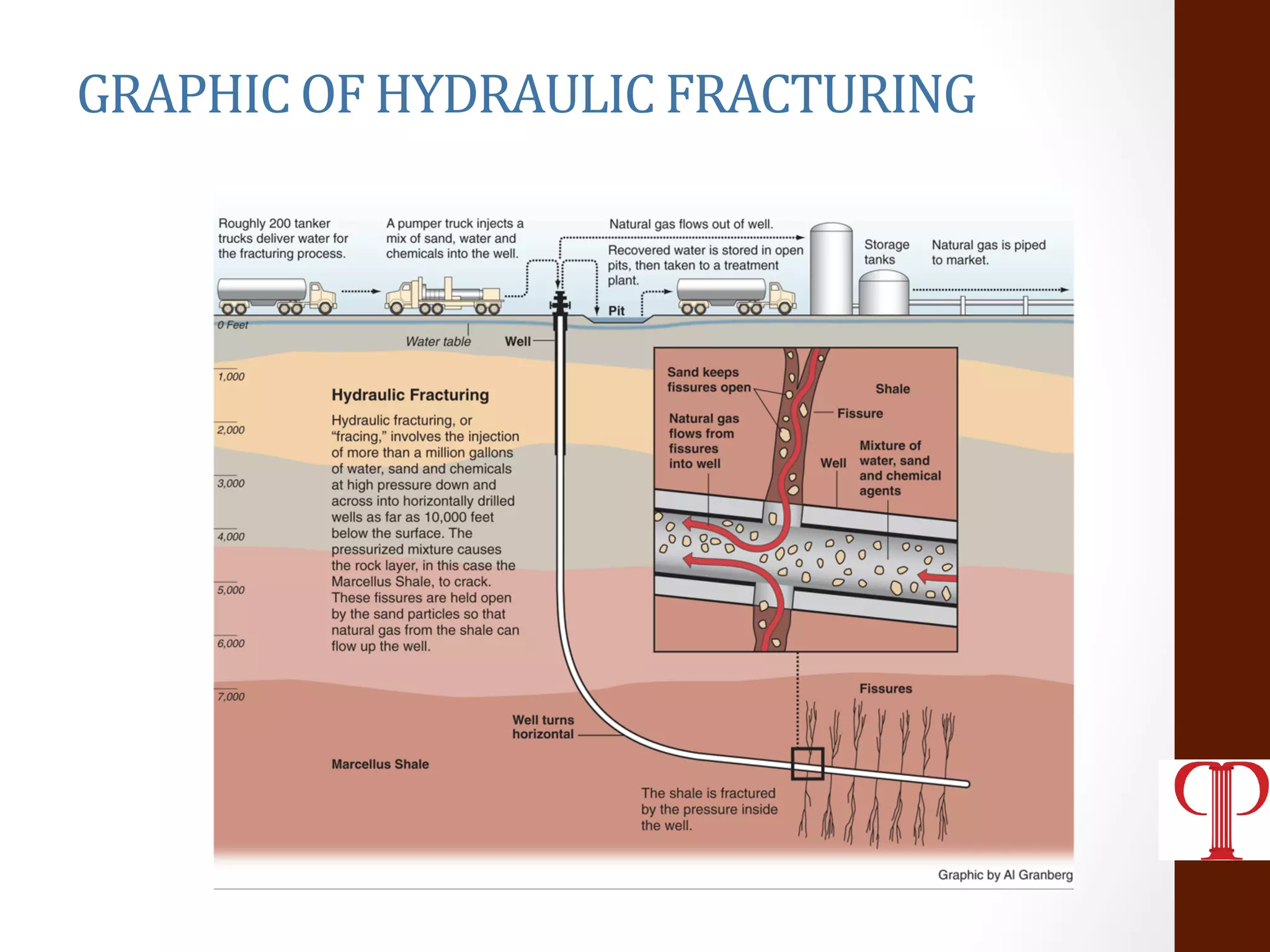
•  Tight	
  oil	
  	
  -­‐	
  hydraulic	
  fracturing	
  (US)	
  	
  
hZp://youtu.be/VY34PQUiwOQ	
  
•  Arc(c	
  offshore	
  
•  Presalt	
  deepwater	
  	
  (Brazil)	
  
•  Oil	
  shale	
  –	
  shale	
  contains	
  kerogen	
  that	
  has	
  to	
  be	
  
mined	
  and	
  then	
  reheated	
  to	
  separate	
  oil	
  from	
  
shale	
  (US)	
  
•  Oil	
  sands	
  –	
  loose	
  sand	
  or	
  sandstone	
  saturated	
  
with	
  bitumen	
  that	
  are	
  exploited	
  through	
  open	
  
pit	
  mines	
  (Alberta,	
  Canada)	
  
Recent	
  Trends	
  in	
  the	
  Resources	
  
Industry	
  
Unconven1onal	
  gas	
  resources	
  
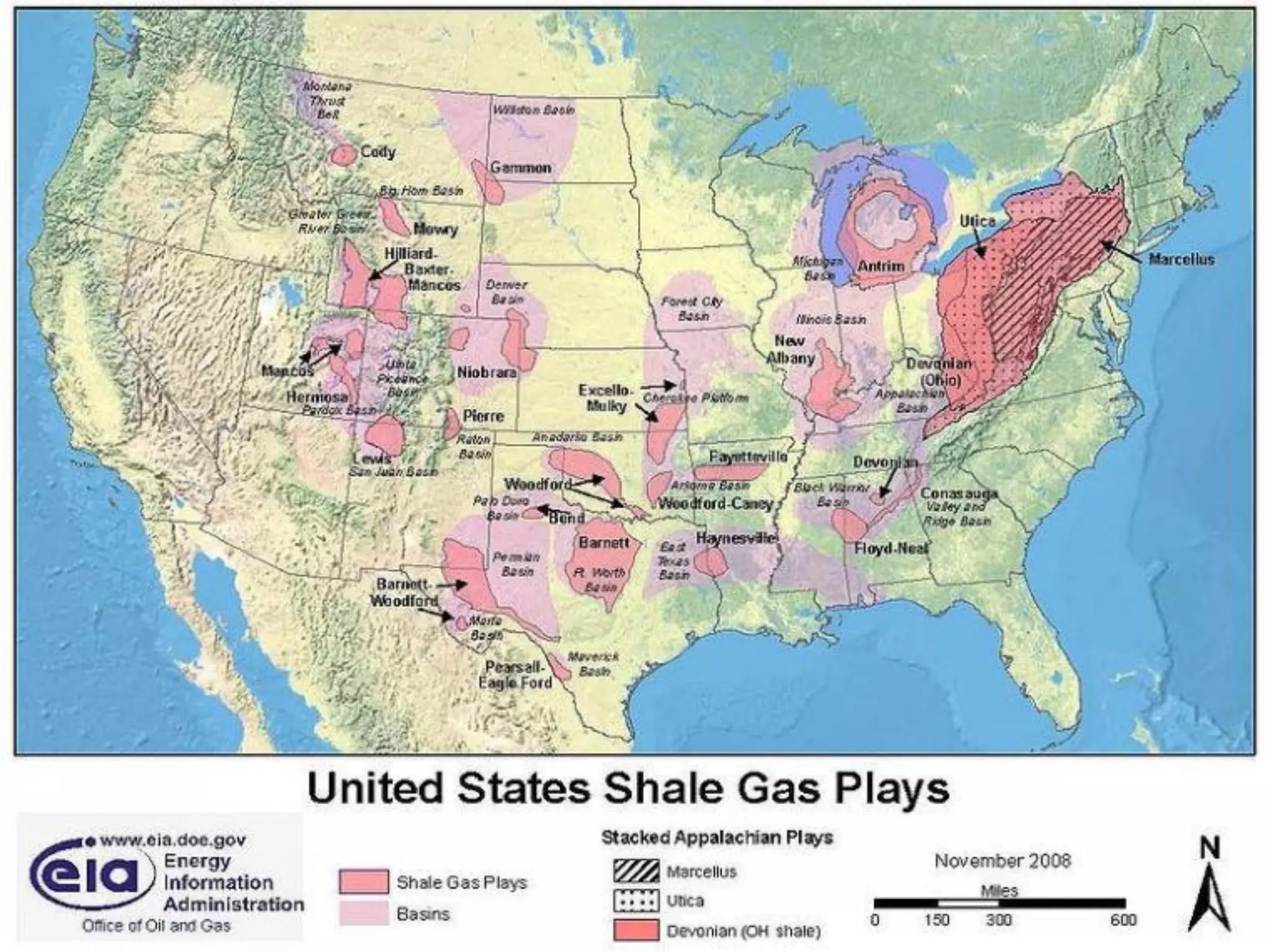
•  Shale	
  gas	
  –	
  natural	
  gas	
  contained	
  in	
  low	
  
permeability	
  shale	
  forma(ons;	
  gas	
  that	
  has	
  
remained	
  trapped	
  in,	
  or	
  close	
  to,	
  its	
  source	
  rock	
  
•  Coalbed	
  methane	
  –	
  coal	
  seam	
  gas,	
  natural	
  gas	
  
contained	
  in	
  coal	
  beds	
  
•  Tight	
  gas	
  –	
  low	
  permeability	
  gas	
  reservoirs	
  that	
  
cannot	
  be	
  produced	
  economically	
  without	
  the	
  
use	
  of	
  technologies	
  to	
  s(mulate	
  flow	
  of	
  the	
  gas	
  
towards	
  the	
  well,	
  such	
  as	
  hydraulic	
  fracturing	
  
GRAPHIC	
  OF	
  HYDRAULIC	
  FRACTURING	
  
Recent	
  Trends	
  in	
  the	
  Resources	
  
Industry	
  
World	
  Energy	
  Outlook	
  (IEA,	
  2013)	
  
•  China	
  dominates	
  the	
  picture	
  within	
  Asia,	
  before	
  
India	
  takes	
  over	
  from	
  2020	
  as	
  the	
  principal	
  engine	
  of	
  
growth.	
  
•  China	
  is	
  about	
  to	
  become	
  the	
  largest	
  oil-­‐impor(ng	
  
country	
  and	
  India	
  becomes	
  the	
  largest	
  importer	
  of	
  
coal	
  by	
  the	
  early	
  2020s.	
  The	
  United	
  States	
  moves	
  
steadily	
  towards	
  mee(ng	
  all	
  of	
  its	
  energy	
  needs	
  
from	
  domes(c	
  resources	
  by	
  2035.	
  
•  Unconven(onal	
  gas	
  accounts	
  for	
  nearly	
  half	
  of	
  the	
  
increase	
  in	
  global	
  gas	
  produc(on	
  to	
  2035,	
  with	
  most	
  
of	
  the	
  increase	
  coming	
  from	
  China,	
  the	
  United	
  States	
  
and	
  Australia.	
  
Recent	
  Trends	
  in	
  the	
  Resources	
  
Industry	
  
World	
  Energy	
  Outlook	
  (IEA,	
  2013)	
  
•  The	
  role	
  of	
  OPEC	
  countries	
  in	
  quenching	
  the	
  world’s	
  
thirst	
  for	
  oil	
  is	
  reduced	
  temporarily	
  over	
  the	
  next	
  ten	
  
years	
  by	
  rising	
  output	
  from	
  the	
  United	
  States,	
  from	
  
oil	
  sands	
  in	
  Canada,	
  from	
  deep-­‐water	
  produc(on	
  in	
  
Brazil	
  and	
  from	
  natural	
  gas	
  liquids	
  from	
  all	
  over	
  the	
  
world.	
  But,	
  by	
  the	
  mid-­‐2020s,	
  non-­‐OPEC	
  produc(on	
  
starts	
  to	
  fall	
  back	
  and	
  countries	
  in	
  the	
  Middle	
  East	
  
provide	
  most	
  of	
  the	
  increase	
  in	
  global	
  supply.	
  
Overall,	
  na(onal	
  oil	
  companies	
  and	
  their	
  host	
  
governments	
  control	
  some	
  80%	
  of	
  the	
  world’s	
  
proven-­‐plus-­‐probable	
  oil	
  reserves.	
  
Recent	
  Trends	
  in	
  the	
  Resources	
  
Industry	
  
World	
  Energy	
  Outlook	
  (IEA,	
  2014)	
  
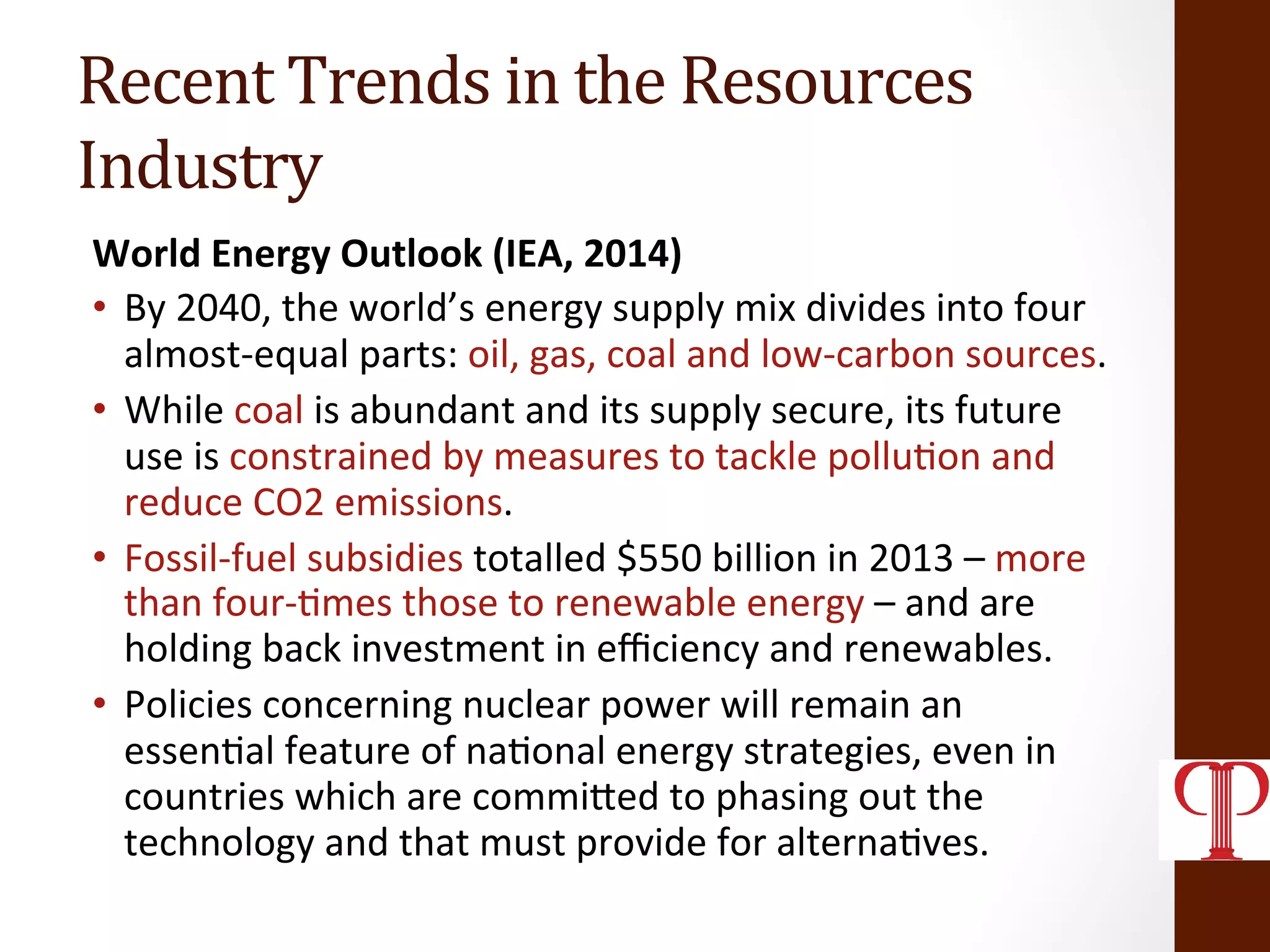
•  By	
  2040,	
  the	
  world’s	
  energy	
  supply	
  mix	
  divides	
  into	
  four	
  
almost-­‐equal	
  parts:	
  oil,	
  gas,	
  coal	
  and	
  low-­‐carbon	
  sources.	
  	
  
•  While	
  coal	
  is	
  abundant	
  and	
  its	
  supply	
  secure,	
  its	
  future	
  
use	
  is	
  constrained	
  by	
  measures	
  to	
  tackle	
  pollu(on	
  and	
  
reduce	
  CO2	
  emissions.	
  	
  
•  Fossil-­‐fuel	
  subsidies	
  totalled	
  $550	
  billion	
  in	
  2013	
  –	
  more	
  
than	
  four-­‐(mes	
  those	
  to	
  renewable	
  energy	
  –	
  and	
  are	
  
holding	
  back	
  investment	
  in	
  efficiency	
  and	
  renewables.	
  	
  
•  Policies	
  concerning	
  nuclear	
  power	
  will	
  remain	
  an	
  
essen(al	
  feature	
  of	
  na(onal	
  energy	
  strategies,	
  even	
  in	
  
countries	
  which	
  are	
  commiZed	
  to	
  phasing	
  out	
  the	
  
technology	
  and	
  that	
  must	
  provide	
  for	
  alterna(ves.	
  	
  
Recent	
  Trends	
  in	
  the	
  Resources	
  
Industry	
  
BP	
  Sta1s1cal	
  Review	
  of	
  World	
  Energy	
  2014	
  
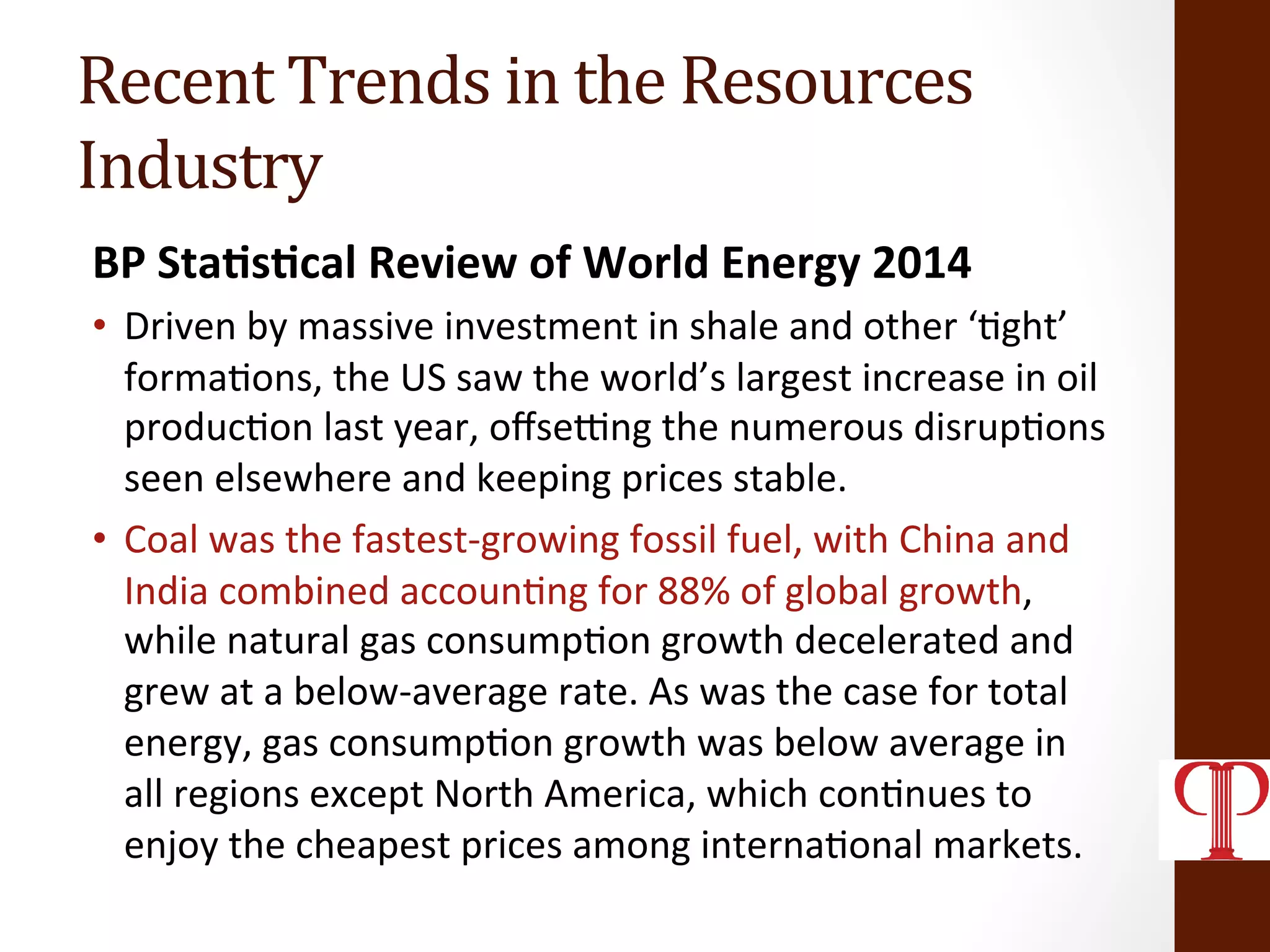
•  Driven	
  by	
  massive	
  investment	
  in	
  shale	
  and	
  other	
  ‘(ght’	
  
forma(ons,	
  the	
  US	
  saw	
  the	
  world’s	
  largest	
  increase	
  in	
  oil	
  
produc(on	
  last	
  year,	
  offselng	
  the	
  numerous	
  disrup(ons	
  
seen	
  elsewhere	
  and	
  keeping	
  prices	
  stable.	
  	
  
•  Coal	
  was	
  the	
  fastest-­‐growing	
  fossil	
  fuel,	
  with	
  China	
  and	
  
India	
  combined	
  accoun(ng	
  for	
  88%	
  of	
  global	
  growth,	
  
while	
  natural	
  gas	
  consump(on	
  growth	
  decelerated	
  and	
  
grew	
  at	
  a	
  below-­‐average	
  rate.	
  As	
  was	
  the	
  case	
  for	
  total	
  
energy,	
  gas	
  consump(on	
  growth	
  was	
  below	
  average	
  in	
  
all	
  regions	
  except	
  North	
  America,	
  which	
  con(nues	
  to	
  
enjoy	
  the	
  cheapest	
  prices	
  among	
  interna(onal	
  markets.	
  
Recent	
  Trends	
  in	
  the	
  Resources	
  
Industry	
  
Resource	
  Governance	
  Index	
  	
  
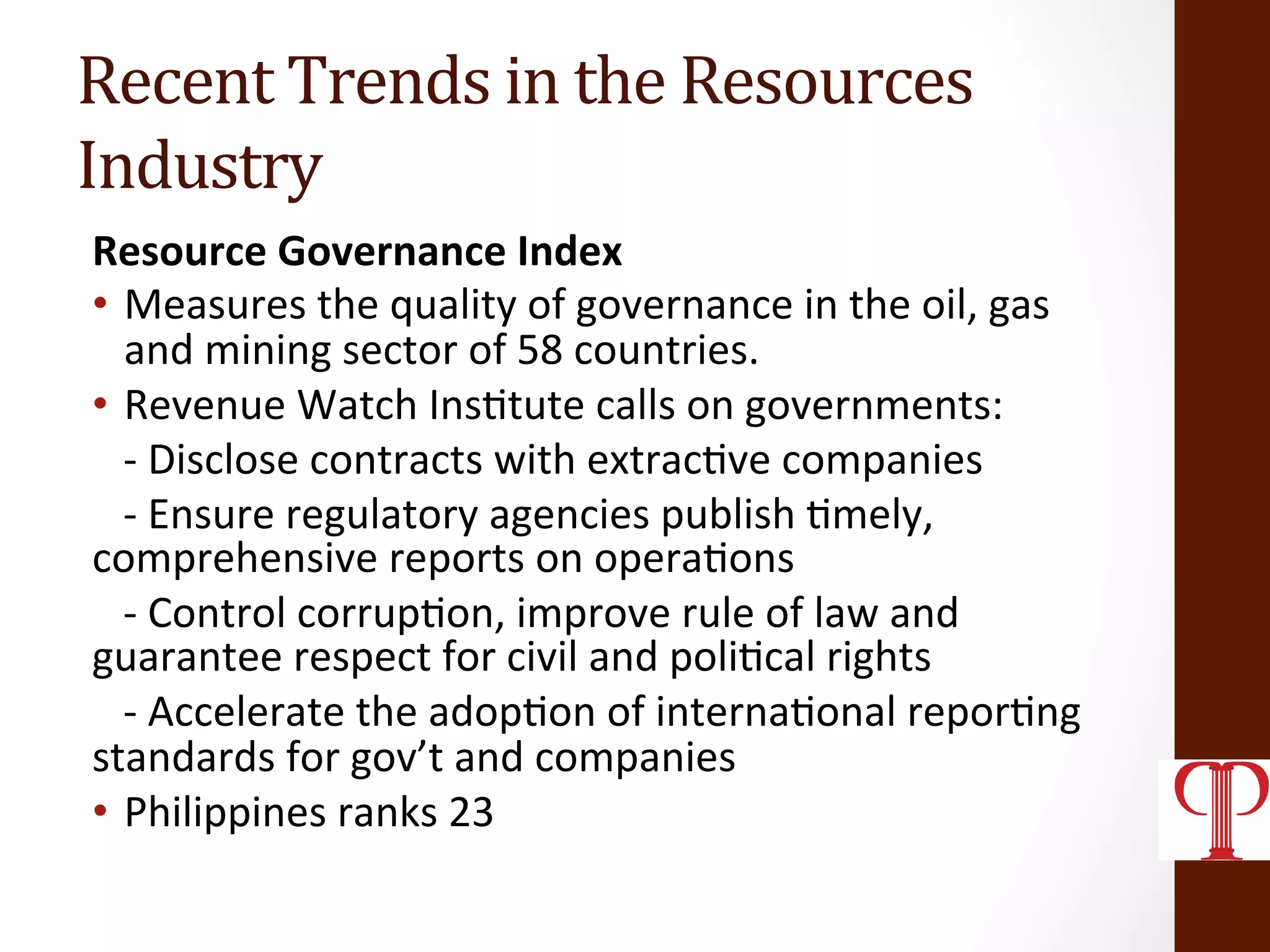
•  Measures	
  the	
  quality	
  of	
  governance	
  in	
  the	
  oil,	
  gas	
  
and	
  mining	
  sector	
  of	
  58	
  countries.	
  	
  
•  Revenue	
  Watch	
  Ins(tute	
  calls	
  on	
  governments:	


  -­‐	
  Disclose	
  contracts	
  with	
  extrac(ve	
  companies	


  -­‐	
  Ensure	
  regulatory	
  agencies	
  publish	
  (mely,	
  
comprehensive	
  reports	
  on	
  opera(ons	


  -­‐	
  Control	
  corrup(on,	
  improve	
  rule	
  of	
  law	
  and	
  
guarantee	
  respect	
  for	
  civil	
  and	
  poli(cal	
  rights	


  -­‐	
  Accelerate	
  the	
  adop(on	
  of	
  interna(onal	
  repor(ng	
  
standards	
  for	
  gov’t	
  and	
  companies	
  
•  Philippines	
  ranks	
  23	
  
Emerging	
  Challenges	
  
Oil	
  and	
  Gas	
  Report,	
  Ernst	
  and	
  Young	
  (2013)	
  
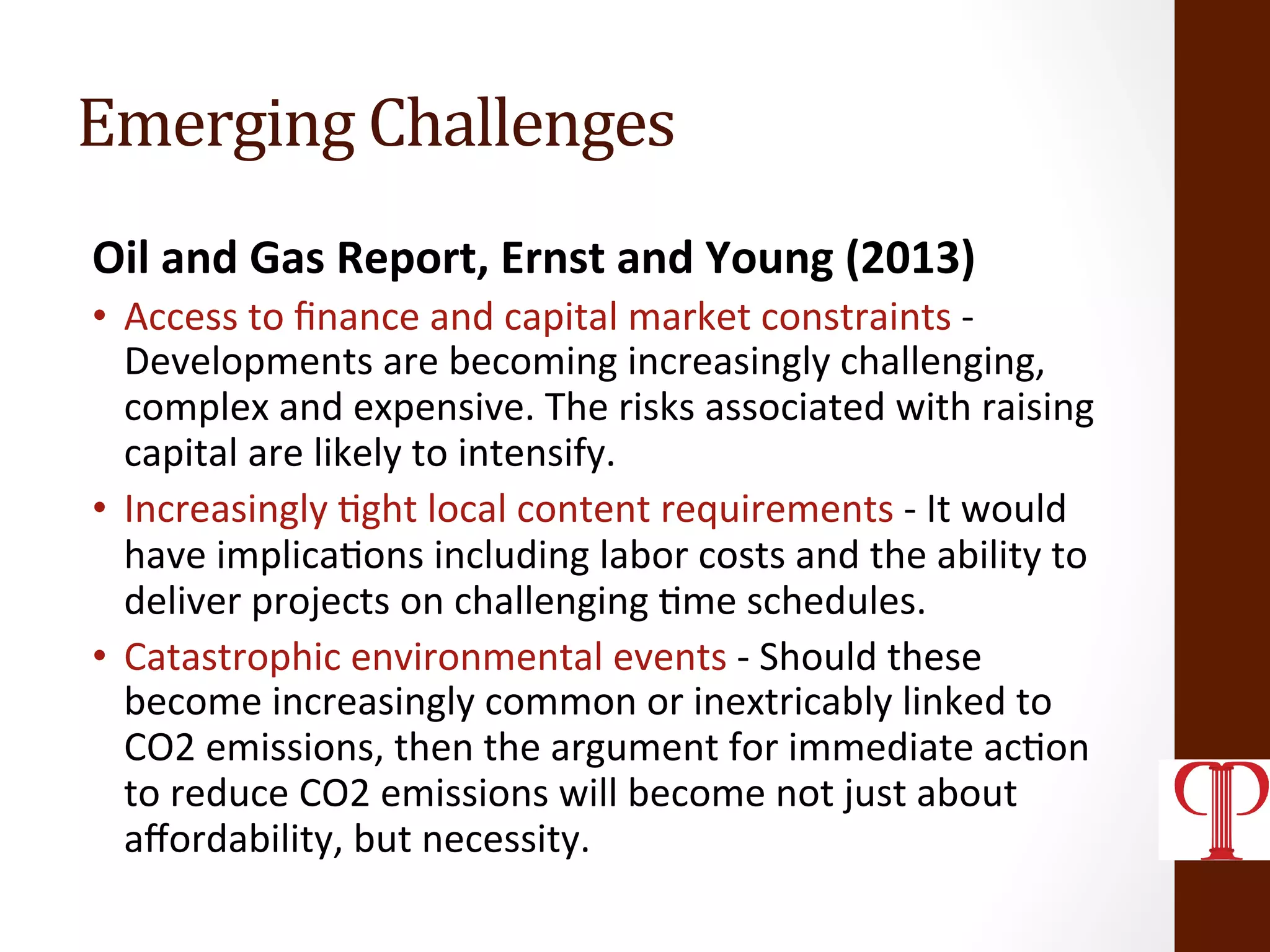
•  Access	
  to	
  finance	
  and	
  capital	
  market	
  constraints	
  -­‐	
  
Developments	
  are	
  becoming	
  increasingly	
  challenging,	
  
complex	
  and	
  expensive.	
  The	
  risks	
  associated	
  with	
  raising	
  
capital	
  are	
  likely	
  to	
  intensify.	
  
•  Increasingly	
  (ght	
  local	
  content	
  requirements	
  -­‐	
  It	
  would	
  
have	
  implica(ons	
  including	
  labor	
  costs	
  and	
  the	
  ability	
  to	
  
deliver	
  projects	
  on	
  challenging	
  (me	
  schedules.	
  
•  Catastrophic	
  environmental	
  events	
  -­‐	
  Should	
  these	
  
become	
  increasingly	
  common	
  or	
  inextricably	
  linked	
  to	
  
CO2	
  emissions,	
  then	
  the	
  argument	
  for	
  immediate	
  ac(on	
  
to	
  reduce	
  CO2	
  emissions	
  will	
  become	
  not	
  just	
  about	
  
affordability,	
  but	
  necessity.	
  
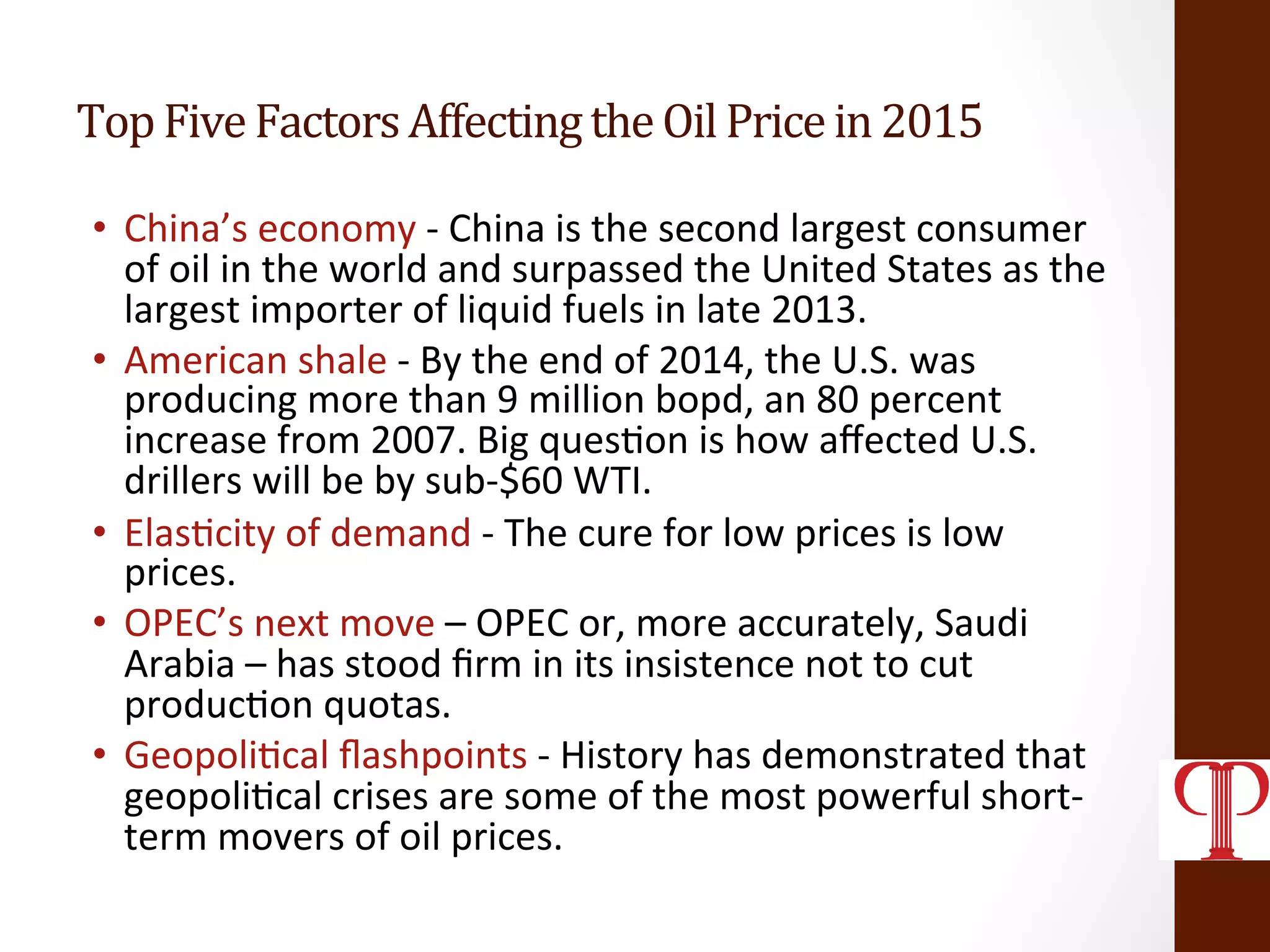
Top	
  Five	
  Factors	
  Affecting	
  the	
  Oil	
  Price	
  in	
  2015	
  	
  
•  China’s	
  economy	
  -­‐	
  China	
  is	
  the	
  second	
  largest	
  consumer	
  
of	
  oil	
  in	
  the	
  world	
  and	
  surpassed	
  the	
  United	
  States	
  as	
  the	
  
largest	
  importer	
  of	
  liquid	
  fuels	
  in	
  late	
  2013.	
  	
  
•  American	
  shale	
  -­‐	
  By	
  the	
  end	
  of	
  2014,	
  the	
  U.S.	
  was	
  
producing	
  more	
  than	
  9	
  million	
  bopd,	
  an	
  80	
  percent	
  
increase	
  from	
  2007.	
  Big	
  ques(on	
  is	
  how	
  affected	
  U.S.	
  
drillers	
  will	
  be	
  by	
  sub-­‐$60	
  WTI.	
  	
  
•  Elas(city	
  of	
  demand	
  -­‐	
  The	
  cure	
  for	
  low	
  prices	
  is	
  low	
  
prices.	
  	
  
•  OPEC’s	
  next	
  move	
  –	
  OPEC	
  or,	
  more	
  accurately,	
  Saudi	
  
Arabia	
  –	
  has	
  stood	
  firm	
  in	
  its	
  insistence	
  not	
  to	
  cut	
  
produc(on	
  quotas.	
  	
  
•  Geopoli(cal	
  flashpoints	
  -­‐	
  History	
  has	
  demonstrated	
  that	
  
geopoli(cal	
  crises	
  are	
  some	
  of	
  the	
  most	
  powerful	
  short-­‐
term	
  movers	
  of	
  oil	
  prices.	
  
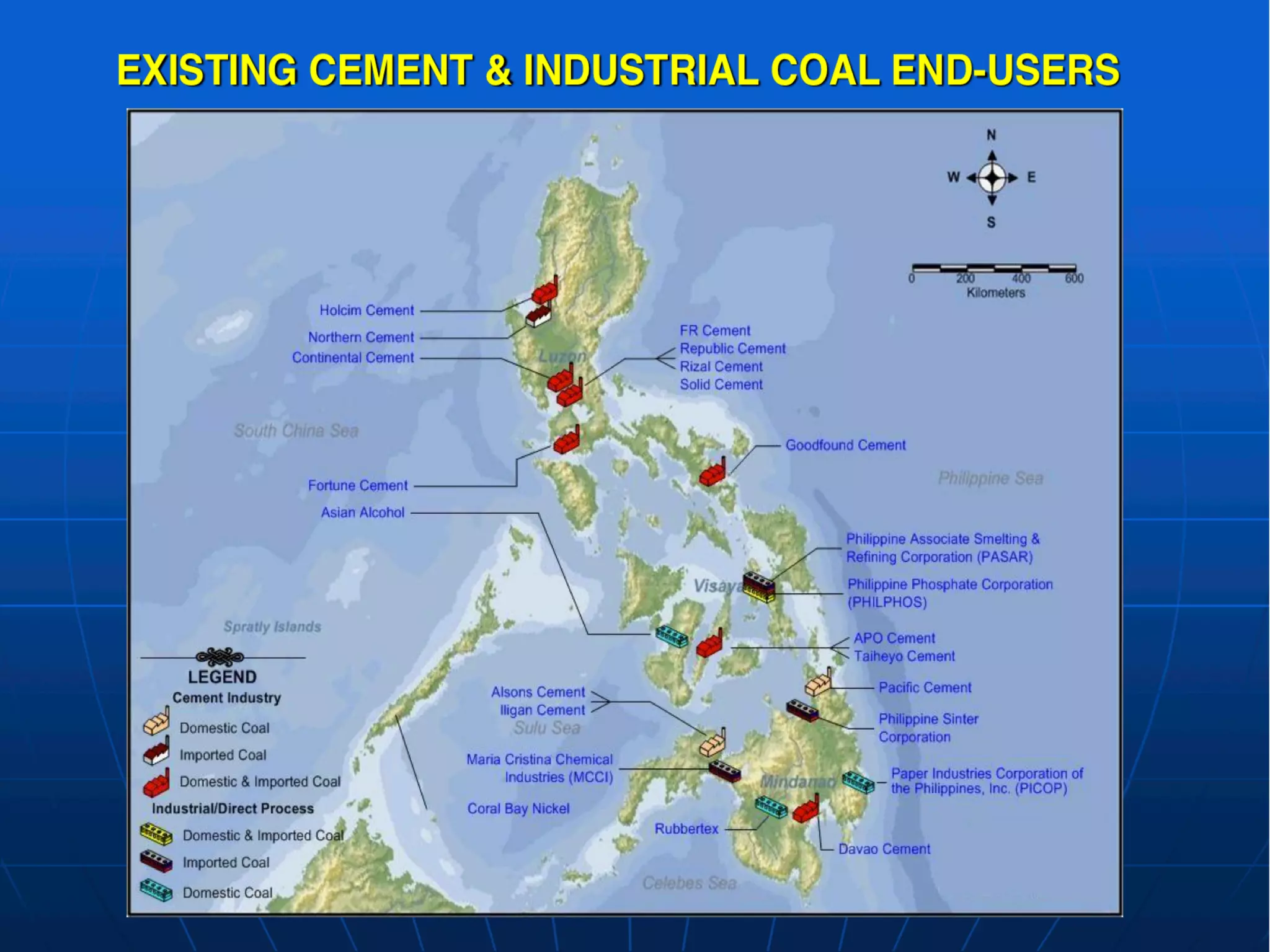
RESOURCES	
  INDUSTRY	
  PHILIPPINES	
  
UPDATE	
  
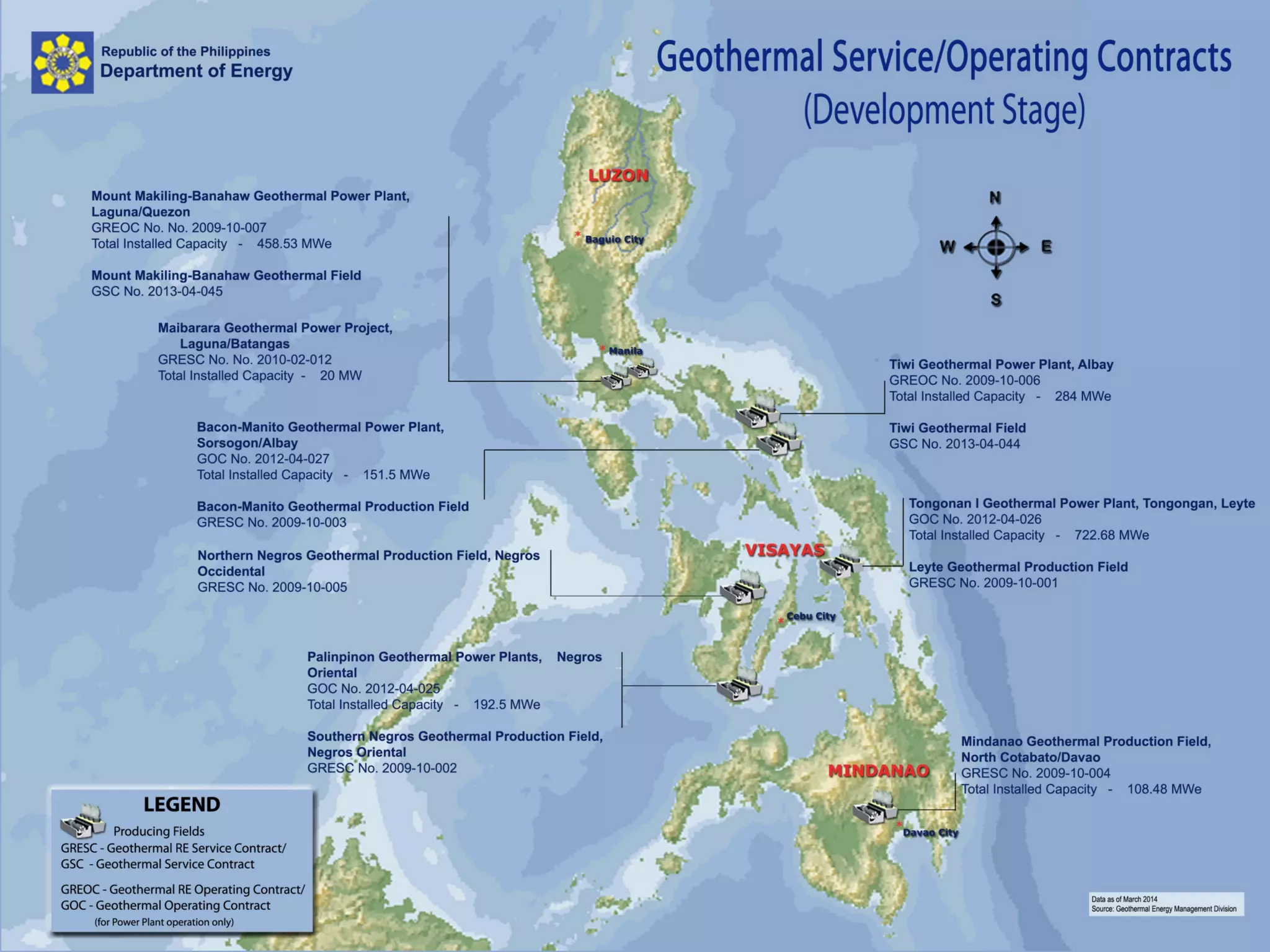
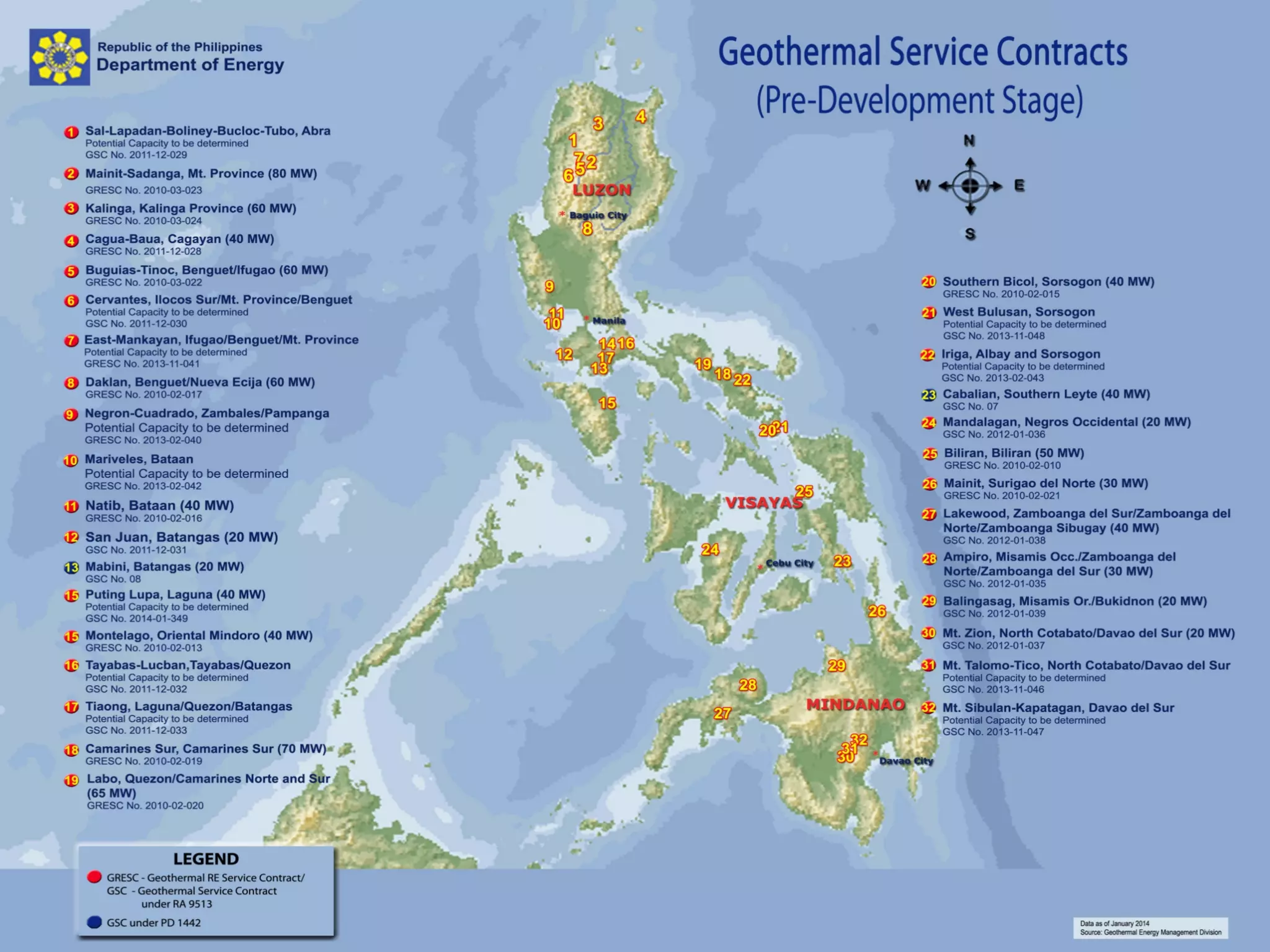
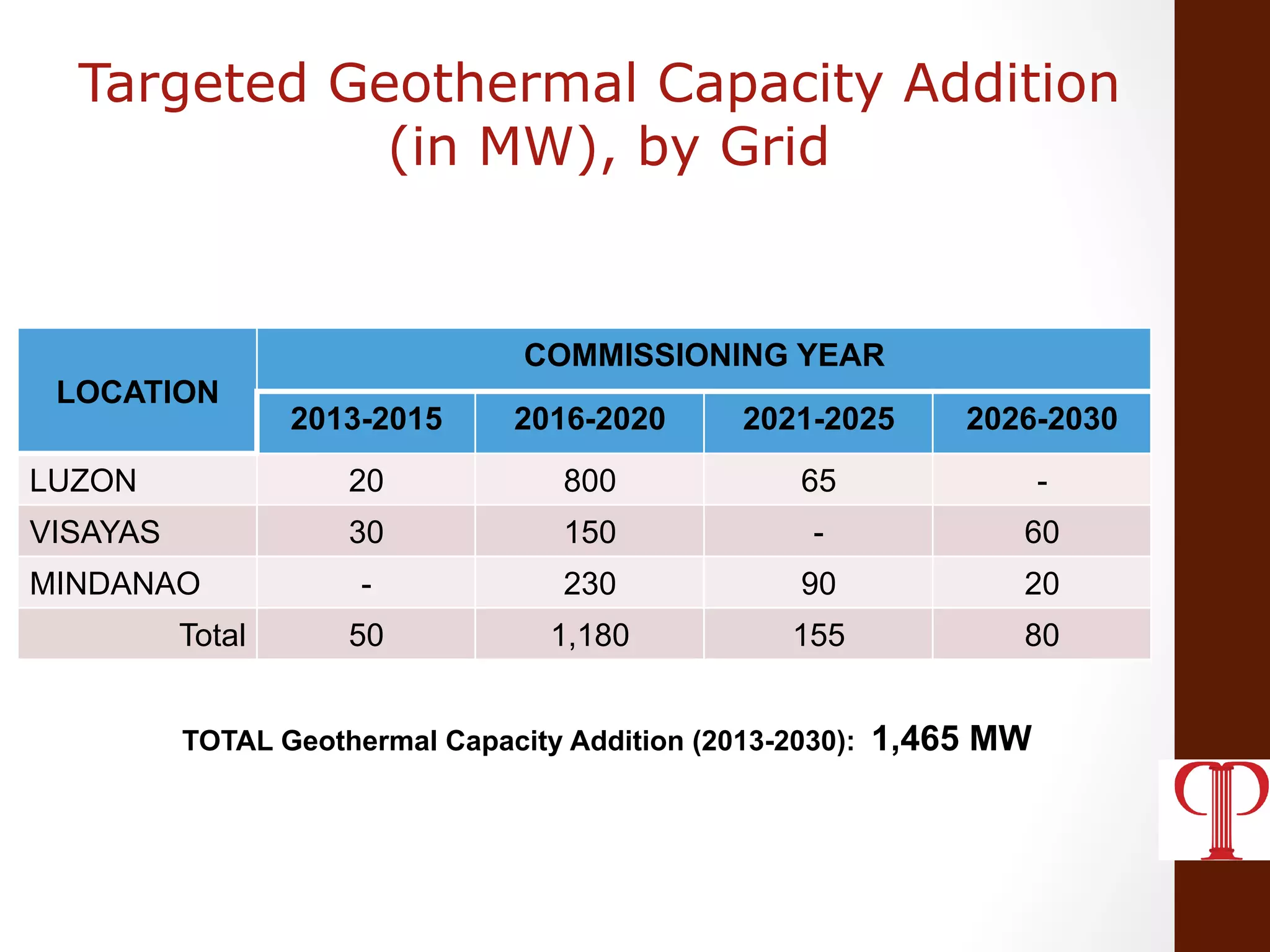
LOCATION
COMMISSIONING YEAR
2013-2015 2016-2020 2021-2025 2026-2030
LUZON 20 800 65 -
VISAYAS 30 150 - 60
MINDANAO - 230 90 20
Total 50 1,180 155 80
TOTAL Geothermal Capacity Addition (2013-2030): 1,465 MW
Targeted Geothermal Capacity Addition
(in MW), by Grid
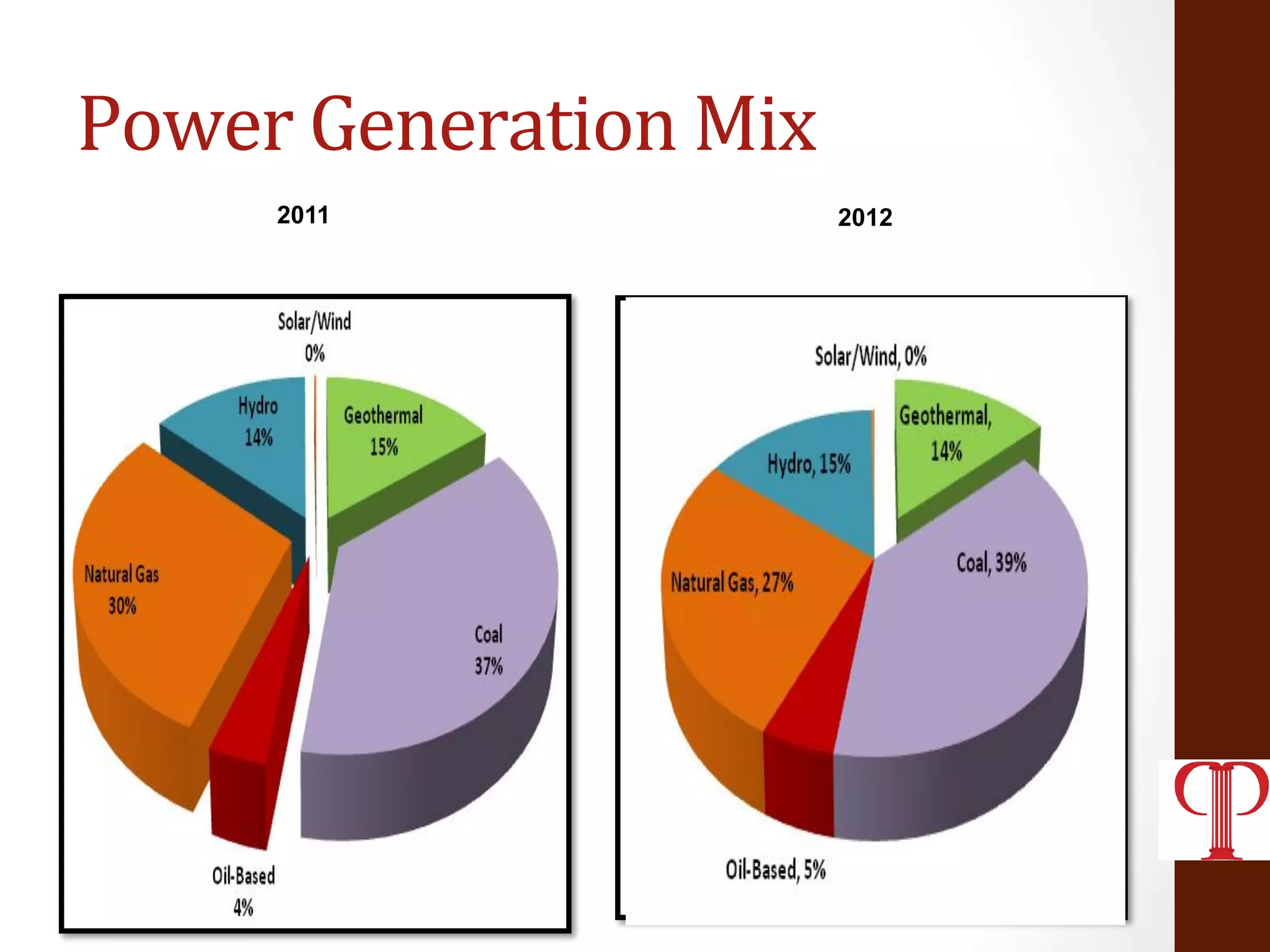
Power	
  Generation	
  Mix	
  
2011 2012
Developments	
  in	
  the	
  Philippine	
  	
  
Resources	
  Industry	
  
•  West	
  Philippine	
  Sea	
  conflict	
  
•  Benham	
  Rise	
  
•  Framework	
  Agreement	
  of	
  Bangsamoro	
  
•  Extrac(ve	
  Industries	
  Transparency	
  Ini(a(ve	
  
•  Resource	
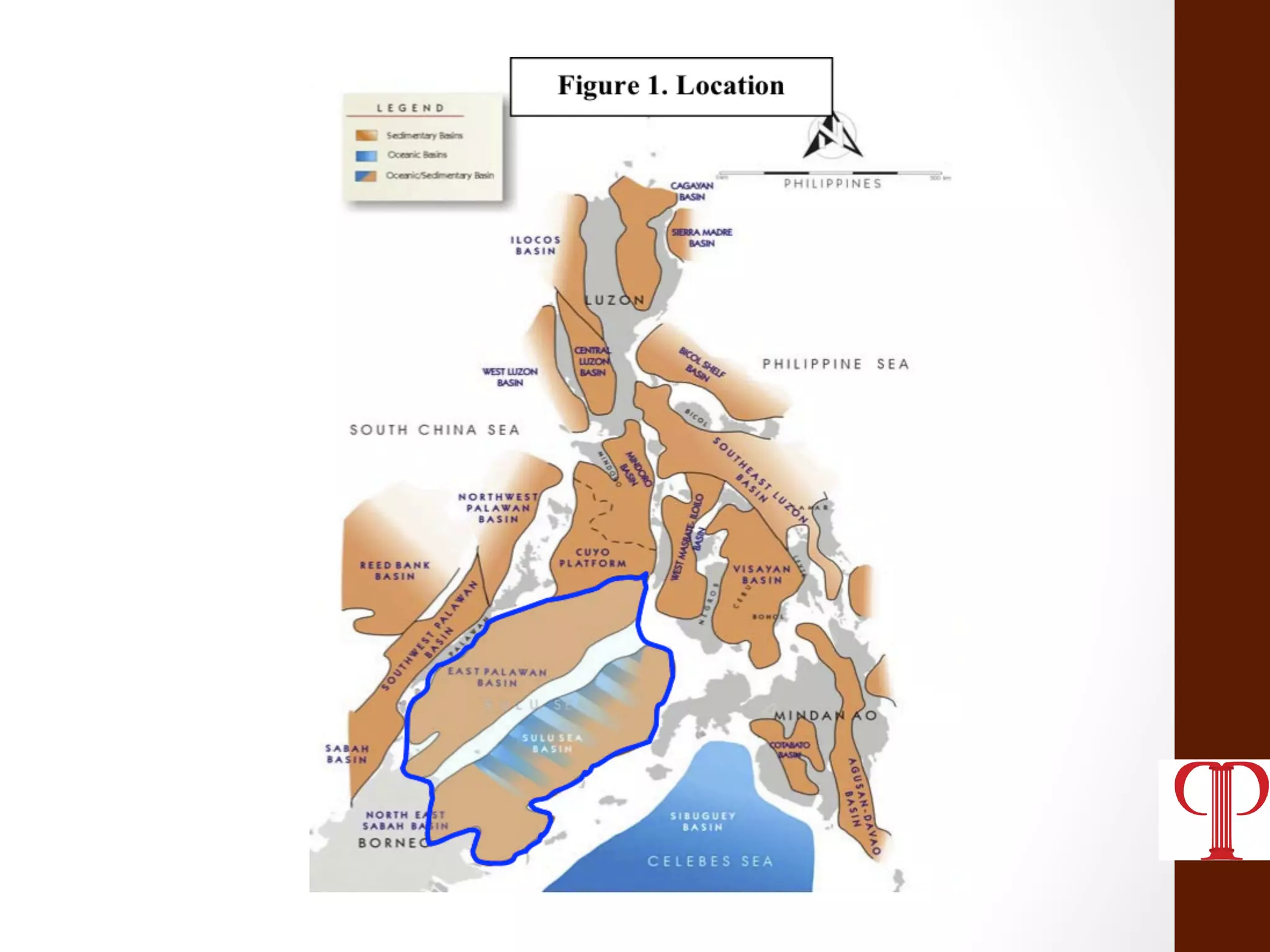
  Na(onalism	


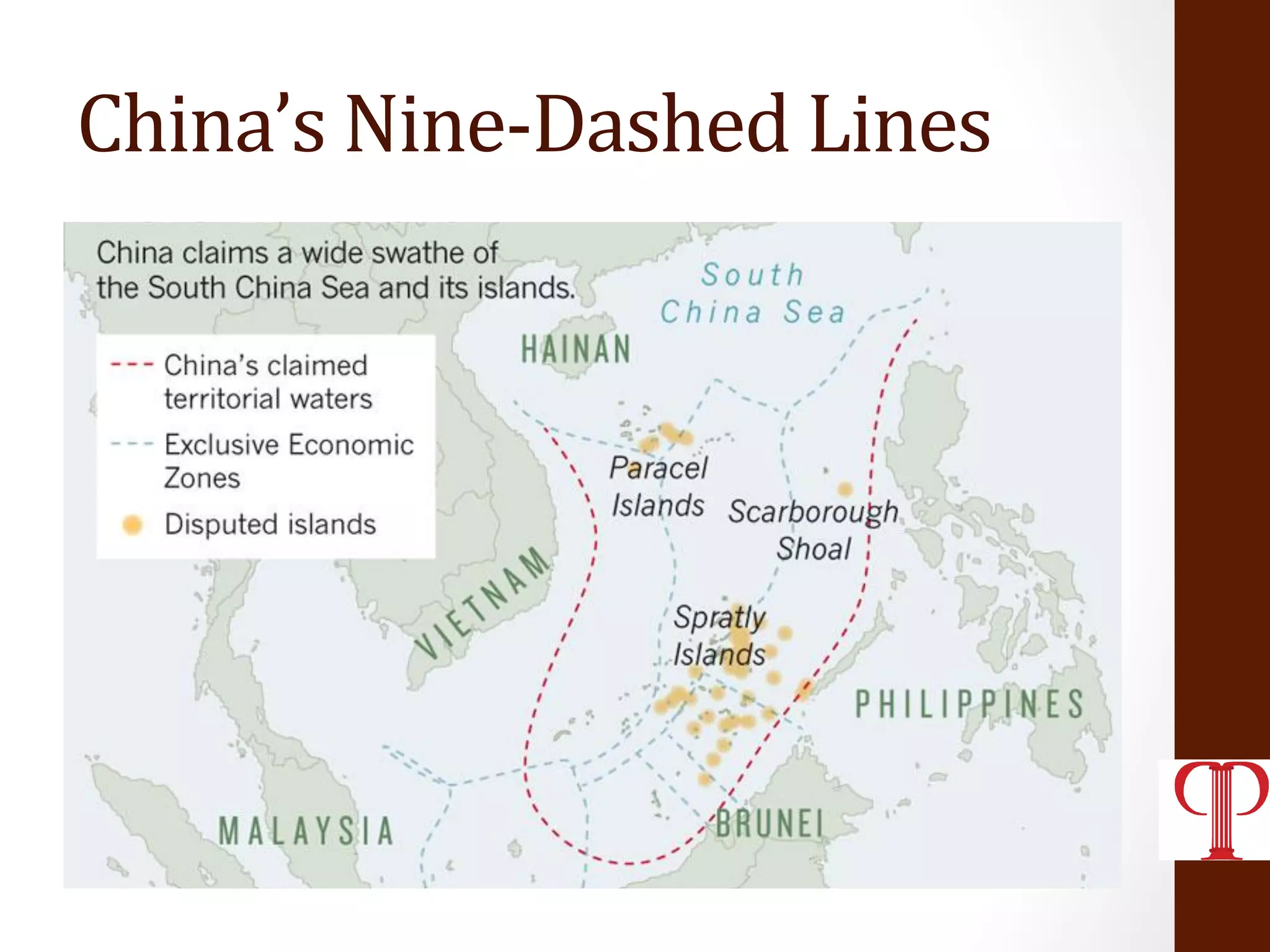
China’s	
  Nine-­‐Dashed	
  Lines	
  
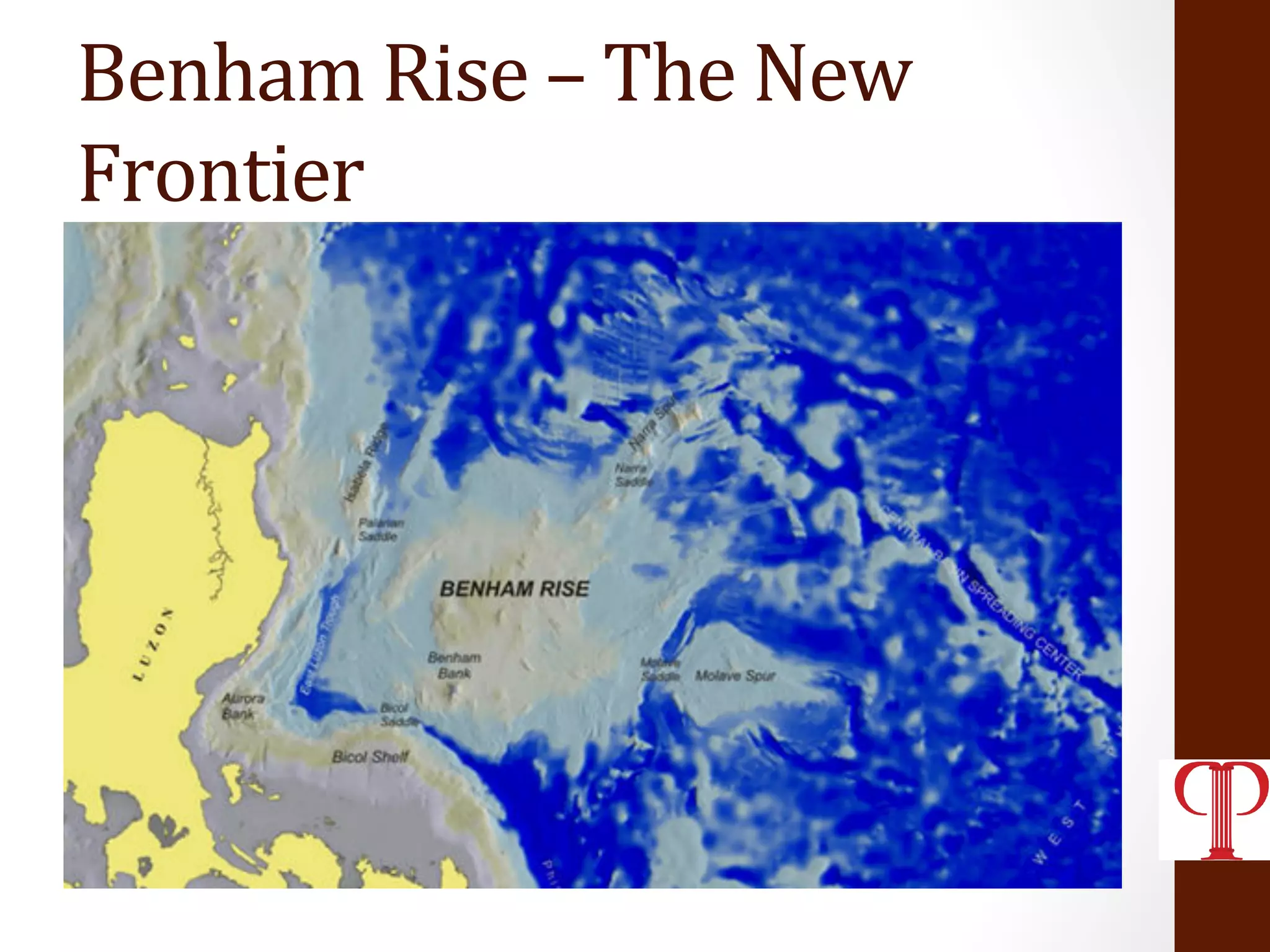
Benham	
  Rise	
  –	
  The	
  New	
  
Frontier	
  
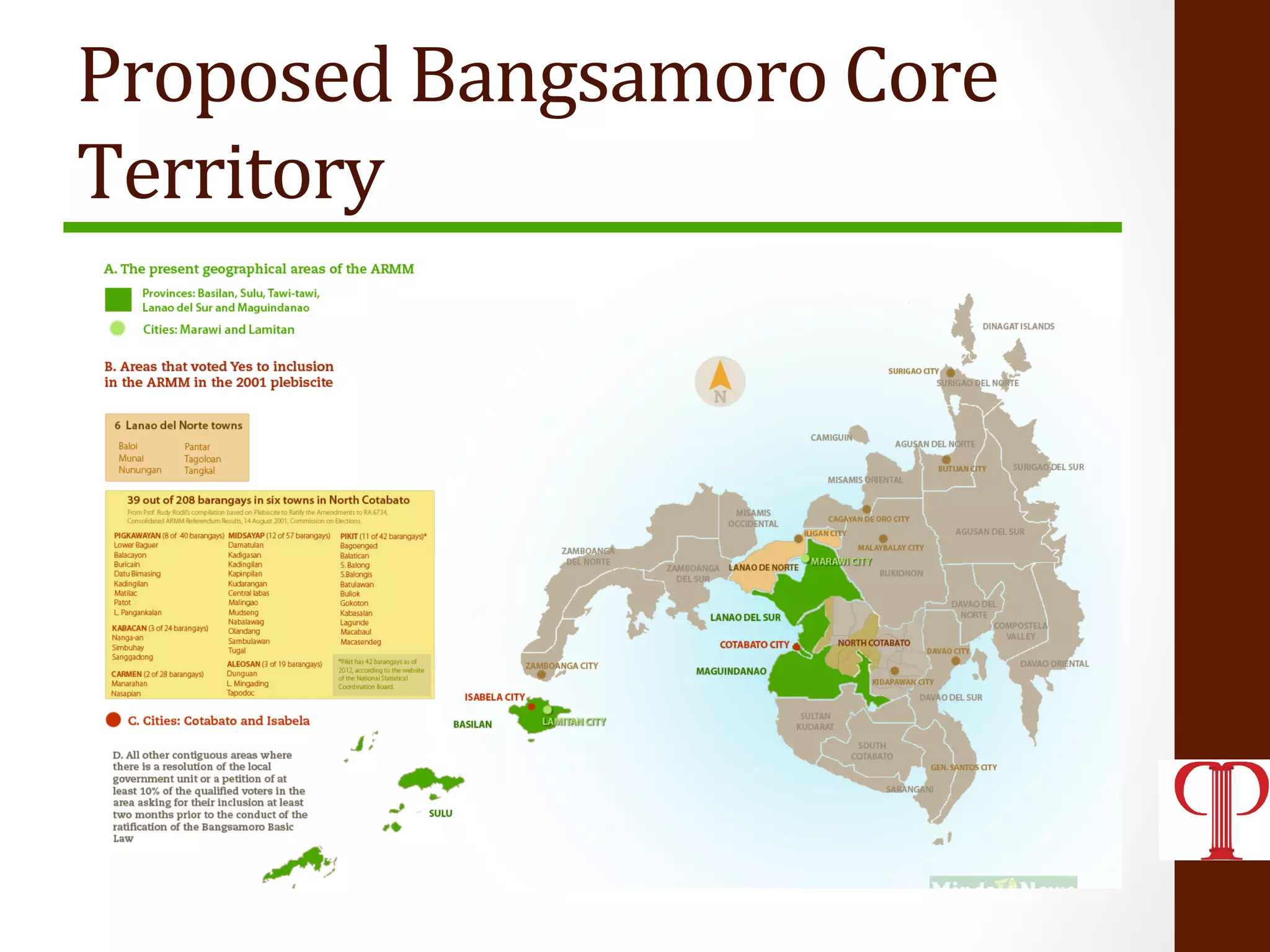
Proposed	
  Bangsamoro	
  Core	
  
Territory	
  
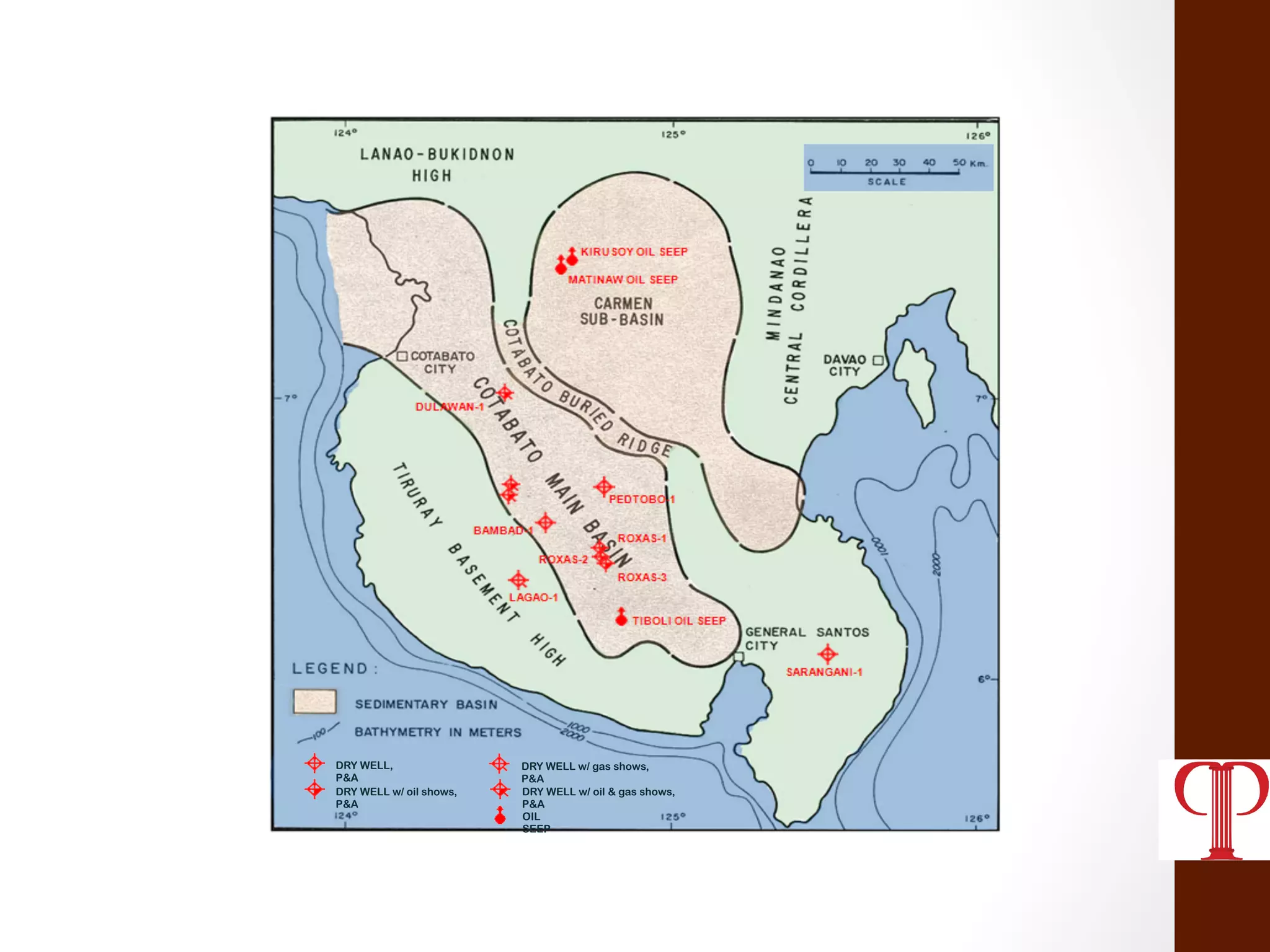
DRY WELL,
P&A	

DRY WELL w/ oil shows,
P&A	

DRY WELL w/ gas shows,
P&A	

DRY WELL w/ oil & gas shows,
P&A	

OIL
SEEP
Developments	
  in	
  the	
  Philippine	
  	
  
Resources	
  Industry	
  
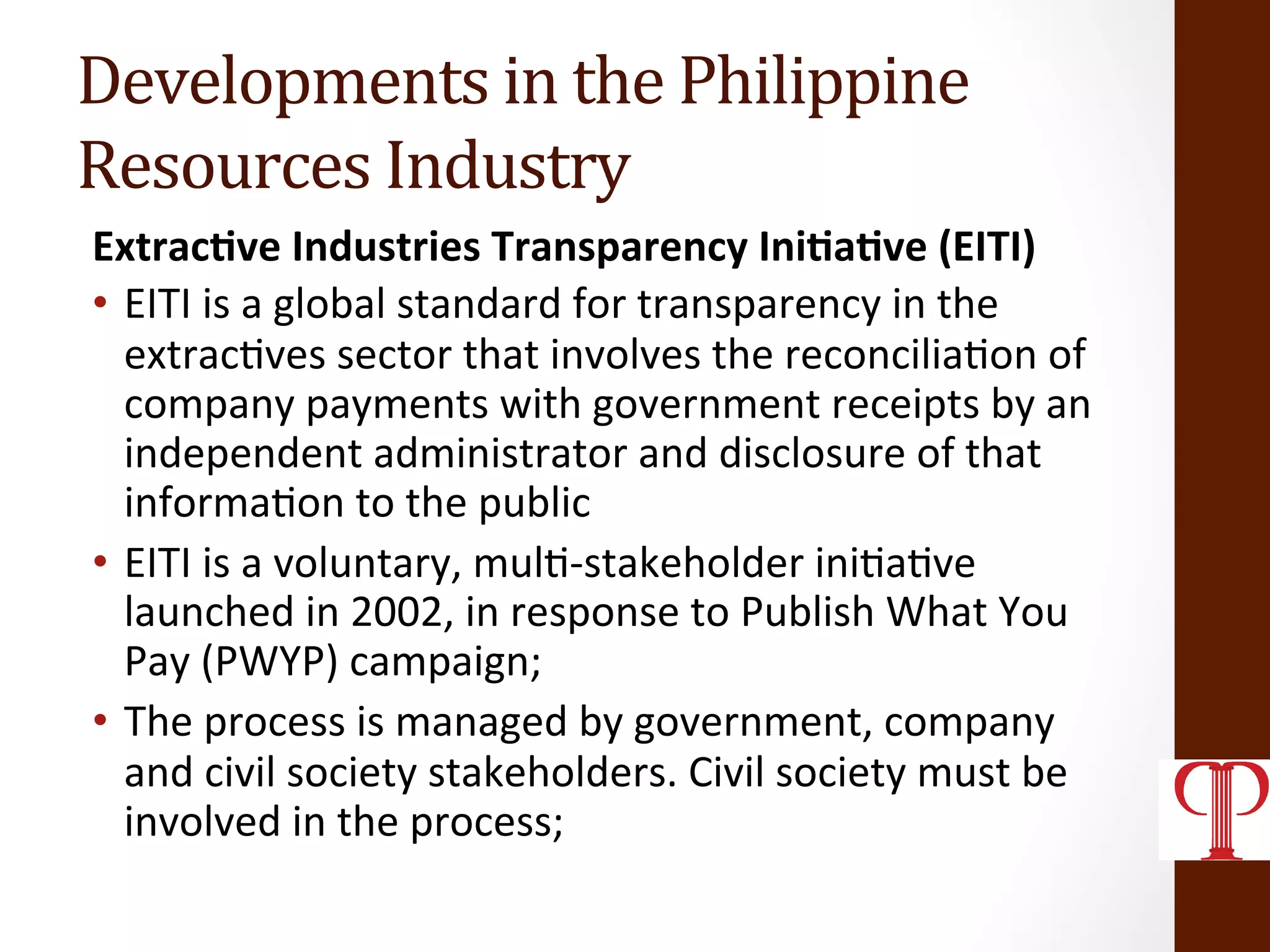
Extrac1ve	
  Industries	
  Transparency	
  Ini1a1ve	
  (EITI)	
  
•  EITI	
  is	
  a	
  global	
  standard	
  for	
  transparency	
  in	
  the	
  
extrac(ves	
  sector	
  that	
  involves	
  the	
  reconcilia(on	
  of	
  
company	
  payments	
  with	
  government	
  receipts	
  by	
  an	
  
independent	
  administrator	
  and	
  disclosure	
  of	
  that	
  
informa(on	
  to	
  the	
  public	
  
•  EITI	
  is	
  a	
  voluntary,	
  mul(-­‐stakeholder	
  ini(a(ve	
  
launched	
  in	
  2002,	
  in	
  response	
  to	
  Publish	
  What	
  You	
  
Pay	
  (PWYP)	
  campaign;	
  
•  The	
  process	
  is	
  managed	
  by	
  government,	
  company	
  
and	
  civil	
  society	
  stakeholders.	
  Civil	
  society	
  must	
  be	
  
involved	
  in	
  the	
  process;	
  
Developments	
  in	
  the	
  Philippine	
  	
  
Resources	
  Industry	
  
Extrac1ve	
  Industries	
  Transparency	
  Ini1a1ve	
  (EITI)	
  
•  The	
  Philippine	
  and	
  Bri(sh	
  Governments,	
  along	
  with	
  
NGO	
  Bantay	
  Kita,	
  are	
  embarking	
  on	
  a	
  partnership	
  
that	
  will	
  push	
  the	
  Philippine	
  agenda	
  on	
  
strengthening	
  transparency	
  and	
  accountability	
  in	
  
extrac(ve	
  industries.	
  
•  The	
  collabora(on	
  will	
  help	
  the	
  Philippine	
  
Government	
  fulfill	
  its	
  ini(a(ve	
  as	
  a	
  candidate	
  
country	
  to	
  the	
  EITI	
  by	
  working	
  together	
  with	
  Bantay	
  
Kita	
  in	
  the	
  PH-­‐EITI	
  mul(-­‐stakeholder	
  group	
  with	
  
support	
  from	
  the	
  Bri(sh	
  Government.	


Developments	
  in	
  the	
  Philippine	
  	
  
Resources	
  Industry	
  
Extrac1ve	
  Industries	
  Transparency	
  Ini1a1ve	
  (EITI)	
  
•  Aquino	
  III	
  recently	
  announced	
  its	
  commitment	
  to	
  join	
  
the	
  EITI	
  through	
  EO	
  79.	
  The	
  Philippines	
  was	
  accepted	
  as	
  
an	
  EITI	
  candidate	
  country	
  at	
  the	
  EITI’s	
  global	
  mee(ng	
  in	
  
Sydney	
  on	
  22	
  May.	
  
•  MOU	
  was	
  signed	
  on	
  14	
  June	
  2013	
  between	
  the	
  
Philippine	
  Government	
  and	
  Bantay	
  Kita,	
  which	
  
formalizes	
  the	
  agreement	
  between	
  the	
  par(es	
  to	
  carry	
  
out	
  ac(vi(es	
  that	
  will	
  reinforce	
  the	
  country’s	
  work	
  plan	
  
to	
  increase	
  accountability	
  and	
  transparency	
  in	
  sectors	
  
such	
  as	
  mining	
  and	
  oil	
  and	
  gas.	
  	
  
•  Bantay	
  Kita	
  has	
  undertaken	
  a	
  separate	
  agreement	
  with	
  
the	
  Bri(sh	
  Embassy	
  that	
  will	
  provide	
  funding	
  for	
  these	
  
ac(vi(es	
  through	
  the	
  Bri(sh	
  Government’s	
  Prosperity	
  
Programme.	
  
Developments	
  in	
  the	
  Philippine	
  
Resources	
  Industry	
  
Resource	
  Na1onalism	
  
•  Governments	
  are	
  now	
  looking	
  at	
  different	
  strategies	
  to	
  
extract	
  a	
  greater	
  share	
  of	
  the	
  value	
  from	
  mining	
  
opera(ons.	
  
•  Strategies	
  include	
  increasing	
  taxes	
  and	
  royal(es	
  to	
  
restric(ng	
  foreign	
  ownerships.	
  
•  Requiring	
  in-­‐country	
  processing	
  or	
  beneficia(on	
  prior	
  to	
  
export	
  is	
  another	
  form.	
  
•  Encouraging	
  in-­‐country	
  processing	
  can	
  also	
  be	
  achieved	
  
indirectly	
  by	
  imposing	
  export	
  restric(ons	
  and	
  increasing	
  
export	
  levies	
  on	
  unrefined	
  ores.	
  
•  Con(nued	
  resource	
  na(onalism	
  from	
  governments	
  
makes	
  the	
  countries	
  less	
  aZrac(ve	
  for	
  mining	
  
investment.	
  
Development	
  Constraints	
  
•  Full	
  foreign	
  ownership	
  
•  Availability	
  of	
  geo-­‐scien(fic	
  informa(on	
  and	
  
professionals	
  
•  Area	
  status	
  and	
  clearance,	
  conflict	
  with	
  other	
  
land	
  use,	
  surface/land	
  ownership	
  
•  Procedural	
  efficiency	
  and	
  clarity	
  between	
  
government	
  agencies	
  
•  Environmental	
  issues	
  -­‐	
  Judicial	
  interven(on	
  	
  
•  Tax	
  issues	
  
•  Cheap	
  shale	
  gas	
  in	
  the	
  US	
  and	
  its	
  wide	
  use	
  for	
  
power	
  genera(on	
  -­‐	
  coal	
  producers	
  to	
  export	
  
more	
  to	
  Asia	
  at	
  cheaper	
  prices.	
  
Conclusion	
  
•  Philippine	
  government	
  will	
  con(nue	
  to	
  ensure	
  
energy	
  security	
  by	
  op(mizing	
  the	
  use	
  of	
  indigenous	
  
energy	
  by	
  investment	
  promo(ons	
  and	
  iden(fica(on	
  
and	
  implementa(on	
  of	
  sector	
  reforms	
  	
  
•  BUT:	
  Regulatory	
  framework	
  should	
  be	
  long	
  term,	
  
transparent,	
  predictable	
  and	
  independently	
  
administered	
  
•  Need	
  to	
  address	
  environmental	
  and	
  social	
  
acceptability	
  issues	
  by	
  harmonizing	
  the	
  permilng	
  
process	
  and	
  intensifying	
  efforts	
  to	
  increase	
  the	
  level	
  
of	
  awareness	
  for	
  indigenous	
  energy	
  	
  
Overview	
  of	
  Global	
  
and	
  National	
  
(Philippines)Energy	
  
Outlook	
  
Atty. Fernando S. Penarroyo
Asian	
  Ins(tute	
  of	
  Technology	
  
About	
  the	
  Lecturer	
  
•  BS	
  Geo,	
  Bachelor	
  of	
  Laws	
  (UP),	
  Master	
  of	
  Laws	
  (Univ.	
  
of	
  Melbourne)	
  
•  Managing	
  Partner,	
  Puno	
  and	
  Penarroyo	
  Law	
  
(www.punopenalaw.com)	
  
•  Trustee	
  and	
  Secretary,	
  Philippine	
  Mineral	
  Explora(on	
  
Associa(on	
  
•  Trustee,	
  Na(onal	
  Geothermal	
  Associa(on	
  of	
  the	
  
Philippines	
  
•  Director,	
  Interna(onal	
  Geothermal	
  Associa(on	
  
•  Professorial	
  Lecturer,	
  De	
  La	
  Salle-­‐FEU	
  MBA-­‐Law	
  
Program,	
  UP	
  Na(onal	
  Ins(tute	
  of	
  Geological	
  
Sciences	
  
•  hZp://www.philippine-­‐resources.com/	
  

Overview of Global and Philippine Energy Outlook

  • 1.
    Overview  of  Global  and   National  (Philippines) Energy  Outlook   Atty. Fernando S. Penarroyo     Asian  Ins(tute  of  Technology     Design  and  Delivery  of  a  Professional   Development  Course  on  Effec9ve  Nego9a9on   and  Strategic  Management  for  Gas,  Oil  and   Coal  Industries     Manila,  Philippines  22  January  2015     Puno  &  Peñarroyo  Law  Of@ices  
  • 2.
    Contents   •  Recent  Global  Trends   •  Energy  Resources  Industry  Philippine  Update        -­‐  oil,  natural  gas,  coal,  renewables,  power   •  Developments  in  the  Philippine  Resources  Industry   •  Development  Constraints   •  Conclusion  
  • 3.
    RECENT  TRENDS  IN  THE  RESOURCES   INDUSTY  
  • 4.
    Recent  Trends  in  the  Resources   Industry   China   •  Despite  a  slowing  economy,  China  remains  Asia’s   largest  and  one  of  its  fastest-­‐growing  economies.     •  China’s  rapid  economic  growth  has  posi(oned  it  as   the  world’s  second  largest  economy  and  it  is  likely  to   overtake  the  US  around  2021  to  become  the  world’s   largest  economy  (The  Economist,  2014)   •  The  “old”  China  of  low-­‐cost  labor,  low-­‐value-­‐ intensive  industries  and  a  coastal-­‐based  export   economy  is  fading  away   •  China’s  goal  is  to  shiT  away  from  an  investment-­‐led   model  of  growth  to  a  more  stable  model  driven  by   domes(c  consump(on,  advanced  technology  and   environmental  efficiency.  
  • 5.
    Recent  Trends  in  the  Resources   Industry   China   •  China  has  recently  become  the  world’s  largest   importer  of  oil  but  its  per  capita  oil  consump(on   lags  behind  the  levels  of  the  developed  world.   •  As  China’s  consump(on  of  oil  ballooned,  it’s  state-­‐ owned  oil  and  gas  enterprises  have  developed  into   global  players    in  tapping  unconven(onal  resources   by  collabora(ng  with  other  interna(onal  firms.   •  China’s  climb  in  the  global  value  chain  assures   steady  rise  in  demand  for  mineral  products  and   advanced  mining  technologies.  
  • 6.
    Recent  Trends  in  the  Resources   Industry   China   •  Chinese  companies  are  also  increasingly  becoming   one  of  the  industry’s  leading  sources  of  capital.     Chinese  acquisi(ons  make  headlines  and  Chinese   companies  are  some  of  the  more  ac(ve  deal  makers   in  the  industry.   •  In  addi(on  to  direct  equity  acquisi(ons,  Chinese   companies  are  also  inves(ng  in  resources   development  and  construc(on  and  suppor(ng   infrastructure.   •  According  to  the  China  Mining  Associa(on,  up  to   80%  of  China’s  overseas  mining  investments  since   2005  has  failed.  
  • 7.
    Recent  Trends  in  the  Resources   Industry   Petroleum  new  fron1ers   •  Tight  oil    -­‐  hydraulic  fracturing  (US)     hZp://youtu.be/VY34PQUiwOQ   •  Arc(c  offshore   •  Presalt  deepwater    (Brazil)   •  Oil  shale  –  shale  contains  kerogen  that  has  to  be   mined  and  then  reheated  to  separate  oil  from   shale  (US)   •  Oil  sands  –  loose  sand  or  sandstone  saturated   with  bitumen  that  are  exploited  through  open   pit  mines  (Alberta,  Canada)  
  • 8.
    Recent  Trends  in  the  Resources   Industry   Unconven1onal  gas  resources   •  Shale  gas  –  natural  gas  contained  in  low   permeability  shale  forma(ons;  gas  that  has   remained  trapped  in,  or  close  to,  its  source  rock   •  Coalbed  methane  –  coal  seam  gas,  natural  gas   contained  in  coal  beds   •  Tight  gas  –  low  permeability  gas  reservoirs  that   cannot  be  produced  economically  without  the   use  of  technologies  to  s(mulate  flow  of  the  gas   towards  the  well,  such  as  hydraulic  fracturing  
  • 10.
  • 11.
    Recent  Trends  in  the  Resources   Industry   World  Energy  Outlook  (IEA,  2013)   •  China  dominates  the  picture  within  Asia,  before   India  takes  over  from  2020  as  the  principal  engine  of   growth.   •  China  is  about  to  become  the  largest  oil-­‐impor(ng   country  and  India  becomes  the  largest  importer  of   coal  by  the  early  2020s.  The  United  States  moves   steadily  towards  mee(ng  all  of  its  energy  needs   from  domes(c  resources  by  2035.   •  Unconven(onal  gas  accounts  for  nearly  half  of  the   increase  in  global  gas  produc(on  to  2035,  with  most   of  the  increase  coming  from  China,  the  United  States   and  Australia.  
  • 12.
    Recent  Trends  in  the  Resources   Industry   World  Energy  Outlook  (IEA,  2013)   •  The  role  of  OPEC  countries  in  quenching  the  world’s   thirst  for  oil  is  reduced  temporarily  over  the  next  ten   years  by  rising  output  from  the  United  States,  from   oil  sands  in  Canada,  from  deep-­‐water  produc(on  in   Brazil  and  from  natural  gas  liquids  from  all  over  the   world.  But,  by  the  mid-­‐2020s,  non-­‐OPEC  produc(on   starts  to  fall  back  and  countries  in  the  Middle  East   provide  most  of  the  increase  in  global  supply.   Overall,  na(onal  oil  companies  and  their  host   governments  control  some  80%  of  the  world’s   proven-­‐plus-­‐probable  oil  reserves.  
  • 13.
    Recent  Trends  in  the  Resources   Industry   World  Energy  Outlook  (IEA,  2014)   •  By  2040,  the  world’s  energy  supply  mix  divides  into  four   almost-­‐equal  parts:  oil,  gas,  coal  and  low-­‐carbon  sources.     •  While  coal  is  abundant  and  its  supply  secure,  its  future   use  is  constrained  by  measures  to  tackle  pollu(on  and   reduce  CO2  emissions.     •  Fossil-­‐fuel  subsidies  totalled  $550  billion  in  2013  –  more   than  four-­‐(mes  those  to  renewable  energy  –  and  are   holding  back  investment  in  efficiency  and  renewables.     •  Policies  concerning  nuclear  power  will  remain  an   essen(al  feature  of  na(onal  energy  strategies,  even  in   countries  which  are  commiZed  to  phasing  out  the   technology  and  that  must  provide  for  alterna(ves.    
  • 14.
    Recent  Trends  in  the  Resources   Industry   BP  Sta1s1cal  Review  of  World  Energy  2014   •  Driven  by  massive  investment  in  shale  and  other  ‘(ght’   forma(ons,  the  US  saw  the  world’s  largest  increase  in  oil   produc(on  last  year,  offselng  the  numerous  disrup(ons   seen  elsewhere  and  keeping  prices  stable.     •  Coal  was  the  fastest-­‐growing  fossil  fuel,  with  China  and   India  combined  accoun(ng  for  88%  of  global  growth,   while  natural  gas  consump(on  growth  decelerated  and   grew  at  a  below-­‐average  rate.  As  was  the  case  for  total   energy,  gas  consump(on  growth  was  below  average  in   all  regions  except  North  America,  which  con(nues  to   enjoy  the  cheapest  prices  among  interna(onal  markets.  
  • 15.
    Recent  Trends  in  the  Resources   Industry   Resource  Governance  Index     •  Measures  the  quality  of  governance  in  the  oil,  gas   and  mining  sector  of  58  countries.     •  Revenue  Watch  Ins(tute  calls  on  governments:        -­‐  Disclose  contracts  with  extrac(ve  companies        -­‐  Ensure  regulatory  agencies  publish  (mely,   comprehensive  reports  on  opera(ons        -­‐  Control  corrup(on,  improve  rule  of  law  and   guarantee  respect  for  civil  and  poli(cal  rights        -­‐  Accelerate  the  adop(on  of  interna(onal  repor(ng   standards  for  gov’t  and  companies   •  Philippines  ranks  23  
  • 16.
    Emerging  Challenges   Oil  and  Gas  Report,  Ernst  and  Young  (2013)   •  Access  to  finance  and  capital  market  constraints  -­‐   Developments  are  becoming  increasingly  challenging,   complex  and  expensive.  The  risks  associated  with  raising   capital  are  likely  to  intensify.   •  Increasingly  (ght  local  content  requirements  -­‐  It  would   have  implica(ons  including  labor  costs  and  the  ability  to   deliver  projects  on  challenging  (me  schedules.   •  Catastrophic  environmental  events  -­‐  Should  these   become  increasingly  common  or  inextricably  linked  to   CO2  emissions,  then  the  argument  for  immediate  ac(on   to  reduce  CO2  emissions  will  become  not  just  about   affordability,  but  necessity.  
  • 17.
    Top  Five  Factors  Affecting  the  Oil  Price  in  2015     •  China’s  economy  -­‐  China  is  the  second  largest  consumer   of  oil  in  the  world  and  surpassed  the  United  States  as  the   largest  importer  of  liquid  fuels  in  late  2013.     •  American  shale  -­‐  By  the  end  of  2014,  the  U.S.  was   producing  more  than  9  million  bopd,  an  80  percent   increase  from  2007.  Big  ques(on  is  how  affected  U.S.   drillers  will  be  by  sub-­‐$60  WTI.     •  Elas(city  of  demand  -­‐  The  cure  for  low  prices  is  low   prices.     •  OPEC’s  next  move  –  OPEC  or,  more  accurately,  Saudi   Arabia  –  has  stood  firm  in  its  insistence  not  to  cut   produc(on  quotas.     •  Geopoli(cal  flashpoints  -­‐  History  has  demonstrated  that   geopoli(cal  crises  are  some  of  the  most  powerful  short-­‐ term  movers  of  oil  prices.  
  • 18.
  • 37.
    LOCATION COMMISSIONING YEAR 2013-2015 2016-20202021-2025 2026-2030 LUZON 20 800 65 - VISAYAS 30 150 - 60 MINDANAO - 230 90 20 Total 50 1,180 155 80 TOTAL Geothermal Capacity Addition (2013-2030): 1,465 MW Targeted Geothermal Capacity Addition (in MW), by Grid
  • 40.
  • 42.
    Developments  in  the  Philippine     Resources  Industry   •  West  Philippine  Sea  conflict   •  Benham  Rise   •  Framework  Agreement  of  Bangsamoro   •  Extrac(ve  Industries  Transparency  Ini(a(ve   •  Resource  Na(onalism    
  • 43.
  • 44.
    Benham  Rise  –  The  New   Frontier  
  • 45.
  • 47.
    DRY WELL, P&A DRY WELLw/ oil shows, P&A DRY WELL w/ gas shows, P&A DRY WELL w/ oil & gas shows, P&A OIL SEEP
  • 48.
    Developments  in  the  Philippine     Resources  Industry   Extrac1ve  Industries  Transparency  Ini1a1ve  (EITI)   •  EITI  is  a  global  standard  for  transparency  in  the   extrac(ves  sector  that  involves  the  reconcilia(on  of   company  payments  with  government  receipts  by  an   independent  administrator  and  disclosure  of  that   informa(on  to  the  public   •  EITI  is  a  voluntary,  mul(-­‐stakeholder  ini(a(ve   launched  in  2002,  in  response  to  Publish  What  You   Pay  (PWYP)  campaign;   •  The  process  is  managed  by  government,  company   and  civil  society  stakeholders.  Civil  society  must  be   involved  in  the  process;  
  • 49.
    Developments  in  the  Philippine     Resources  Industry   Extrac1ve  Industries  Transparency  Ini1a1ve  (EITI)   •  The  Philippine  and  Bri(sh  Governments,  along  with   NGO  Bantay  Kita,  are  embarking  on  a  partnership   that  will  push  the  Philippine  agenda  on   strengthening  transparency  and  accountability  in   extrac(ve  industries.   •  The  collabora(on  will  help  the  Philippine   Government  fulfill  its  ini(a(ve  as  a  candidate   country  to  the  EITI  by  working  together  with  Bantay   Kita  in  the  PH-­‐EITI  mul(-­‐stakeholder  group  with   support  from  the  Bri(sh  Government.      
  • 50.
    Developments  in  the  Philippine     Resources  Industry   Extrac1ve  Industries  Transparency  Ini1a1ve  (EITI)   •  Aquino  III  recently  announced  its  commitment  to  join   the  EITI  through  EO  79.  The  Philippines  was  accepted  as   an  EITI  candidate  country  at  the  EITI’s  global  mee(ng  in   Sydney  on  22  May.   •  MOU  was  signed  on  14  June  2013  between  the   Philippine  Government  and  Bantay  Kita,  which   formalizes  the  agreement  between  the  par(es  to  carry   out  ac(vi(es  that  will  reinforce  the  country’s  work  plan   to  increase  accountability  and  transparency  in  sectors   such  as  mining  and  oil  and  gas.     •  Bantay  Kita  has  undertaken  a  separate  agreement  with   the  Bri(sh  Embassy  that  will  provide  funding  for  these   ac(vi(es  through  the  Bri(sh  Government’s  Prosperity   Programme.  
  • 51.
    Developments  in  the  Philippine   Resources  Industry   Resource  Na1onalism   •  Governments  are  now  looking  at  different  strategies  to   extract  a  greater  share  of  the  value  from  mining   opera(ons.   •  Strategies  include  increasing  taxes  and  royal(es  to   restric(ng  foreign  ownerships.   •  Requiring  in-­‐country  processing  or  beneficia(on  prior  to   export  is  another  form.   •  Encouraging  in-­‐country  processing  can  also  be  achieved   indirectly  by  imposing  export  restric(ons  and  increasing   export  levies  on  unrefined  ores.   •  Con(nued  resource  na(onalism  from  governments   makes  the  countries  less  aZrac(ve  for  mining   investment.  
  • 52.
    Development  Constraints   • Full  foreign  ownership   •  Availability  of  geo-­‐scien(fic  informa(on  and   professionals   •  Area  status  and  clearance,  conflict  with  other   land  use,  surface/land  ownership   •  Procedural  efficiency  and  clarity  between   government  agencies   •  Environmental  issues  -­‐  Judicial  interven(on     •  Tax  issues   •  Cheap  shale  gas  in  the  US  and  its  wide  use  for   power  genera(on  -­‐  coal  producers  to  export   more  to  Asia  at  cheaper  prices.  
  • 53.
    Conclusion   •  Philippine  government  will  con(nue  to  ensure   energy  security  by  op(mizing  the  use  of  indigenous   energy  by  investment  promo(ons  and  iden(fica(on   and  implementa(on  of  sector  reforms     •  BUT:  Regulatory  framework  should  be  long  term,   transparent,  predictable  and  independently   administered   •  Need  to  address  environmental  and  social   acceptability  issues  by  harmonizing  the  permilng   process  and  intensifying  efforts  to  increase  the  level   of  awareness  for  indigenous  energy    
  • 54.
    Overview  of  Global   and  National   (Philippines)Energy   Outlook   Atty. Fernando S. Penarroyo Asian  Ins(tute  of  Technology  
  • 55.
    About  the  Lecturer   •  BS  Geo,  Bachelor  of  Laws  (UP),  Master  of  Laws  (Univ.   of  Melbourne)   •  Managing  Partner,  Puno  and  Penarroyo  Law   (www.punopenalaw.com)   •  Trustee  and  Secretary,  Philippine  Mineral  Explora(on   Associa(on   •  Trustee,  Na(onal  Geothermal  Associa(on  of  the   Philippines   •  Director,  Interna(onal  Geothermal  Associa(on   •  Professorial  Lecturer,  De  La  Salle-­‐FEU  MBA-­‐Law   Program,  UP  Na(onal  Ins(tute  of  Geological   Sciences   •  hZp://www.philippine-­‐resources.com/