OVERTURENETWORKS.COM
Carrier Class Orchestration
for SDN & NFV
Prayson Pate
Chief Technologist
Overture Networks
Carrier Orchestration is Different!
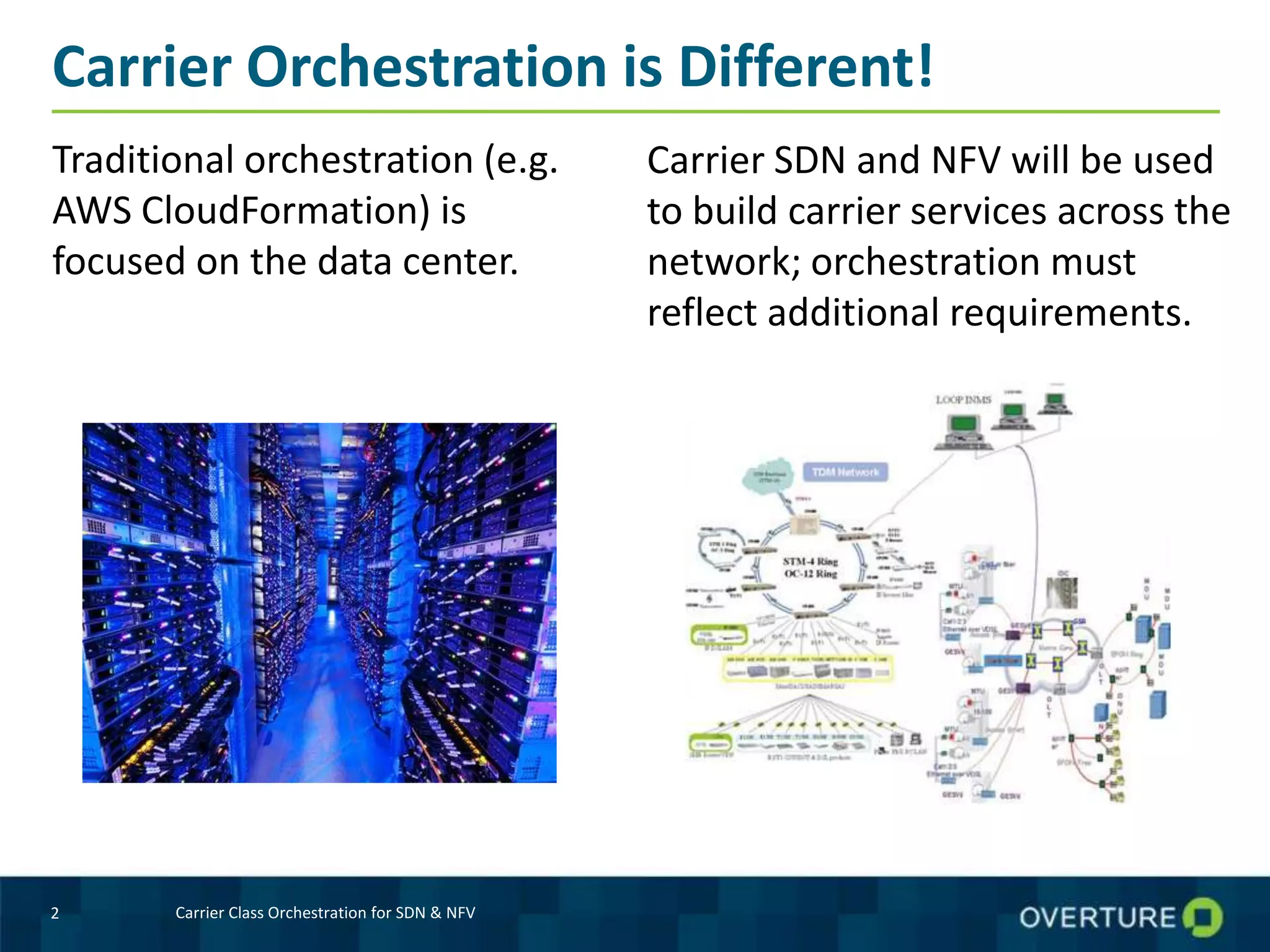
Traditional orchestration (e.g.
AWS CloudFormation) is
focused on the data center.
2 Carrier Class Orchestration for SDN & NFV
Carrier SDN and NFV will be used
to build carrier services across the
network; orchestration must
reflect additional requirements.
Resource Acquisition, Assignment & Span
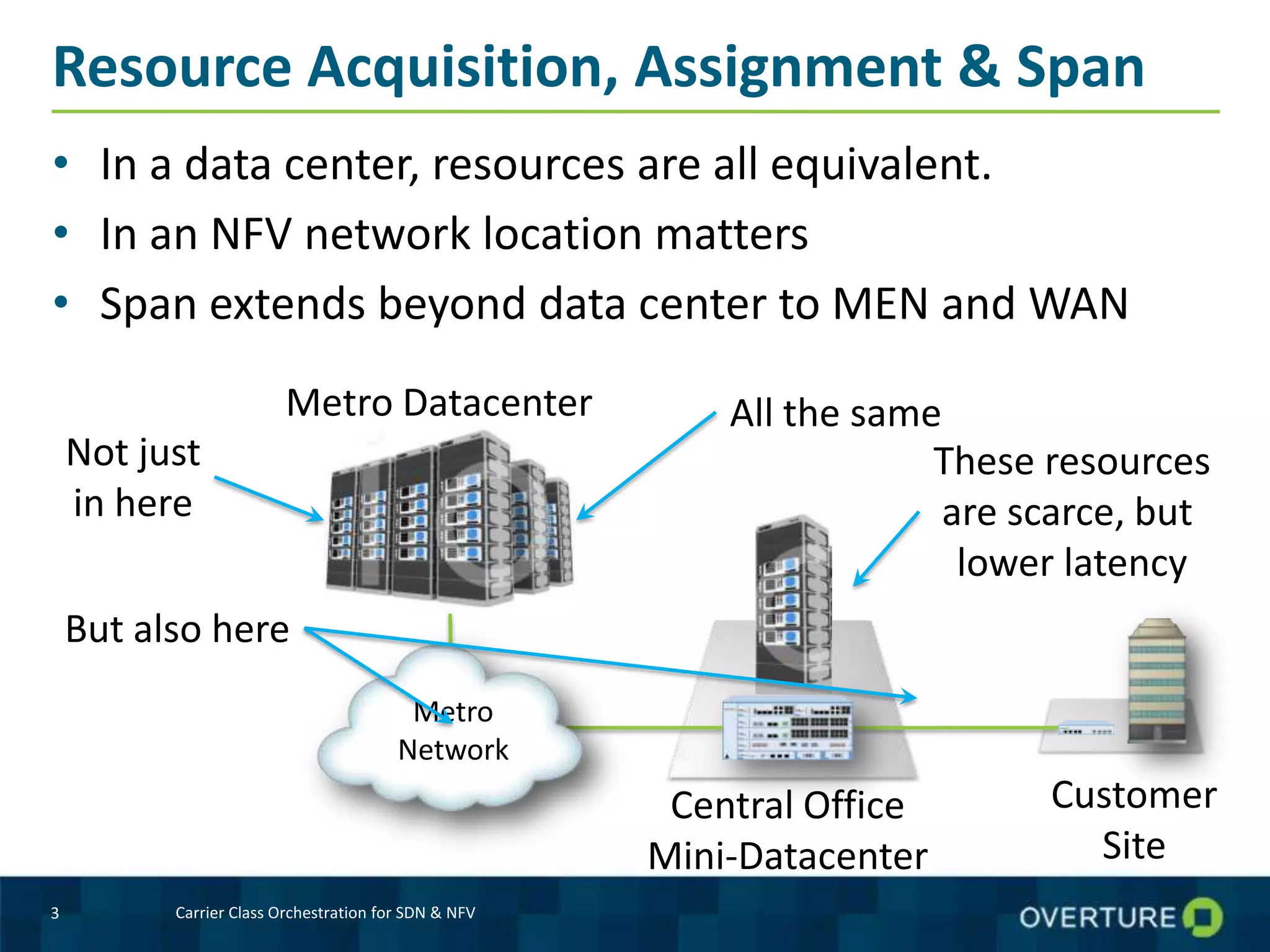
• In a data center, resources are all equivalent.
• In an NFV network location matters
• Span extends beyond data center to MEN and WAN
3 Carrier Class Orchestration for SDN & NFV
Customer
Site
Central Office
Mini-Datacenter
Metro Datacenter
Metro
Network
All the same
These resources
are scarce, but
lower latency
Not just
in here
But also here
Lifecycle and Work Flow
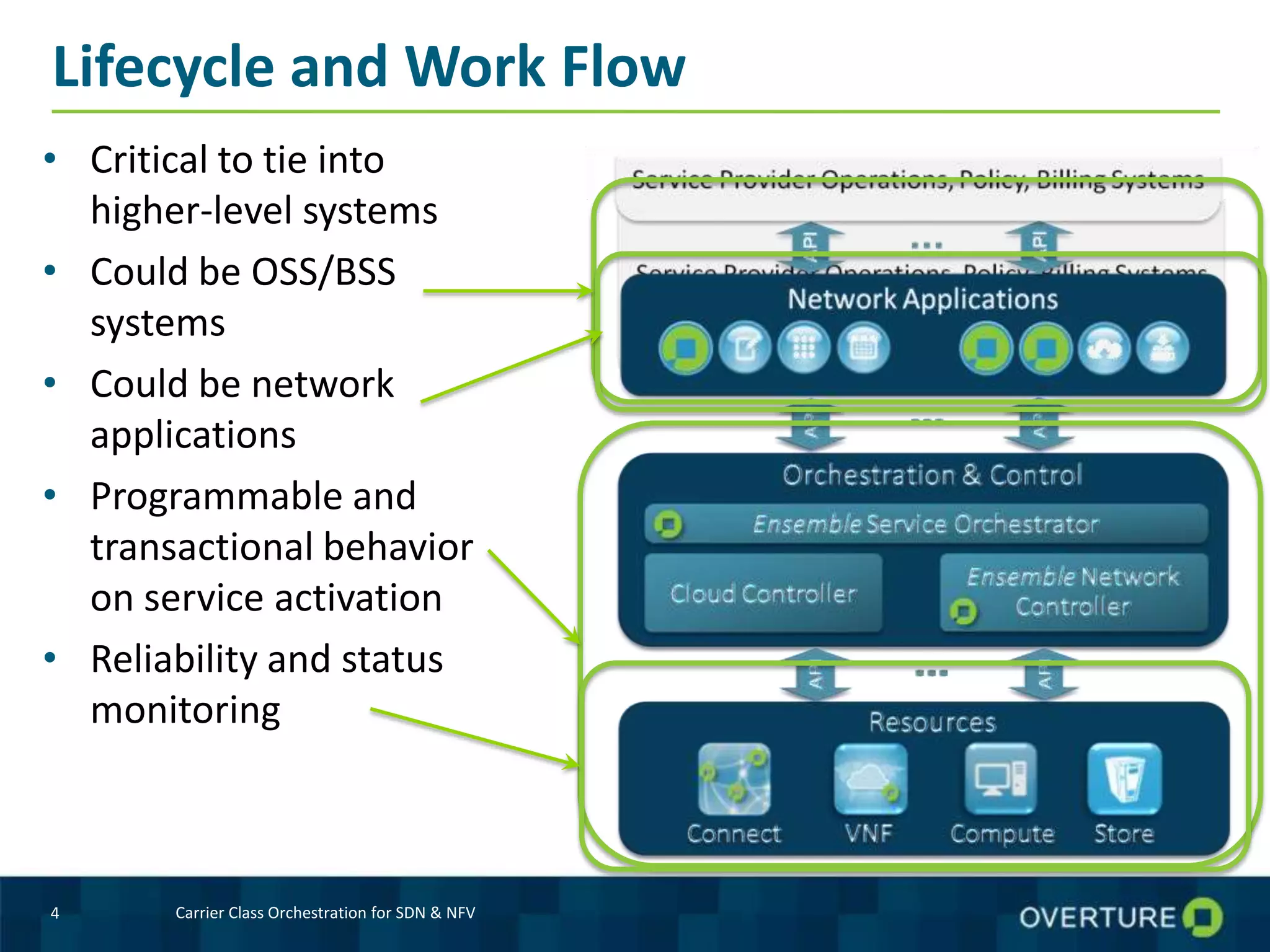
• Critical to tie into
higher-level systems
• Could be OSS/BSS
systems
• Could be network
applications
• Programmable and
transactional behavior
on service activation
• Reliability and status
monitoring
4 Carrier Class Orchestration for SDN & NFV
Service Elasticity and Orchestrator Scalability
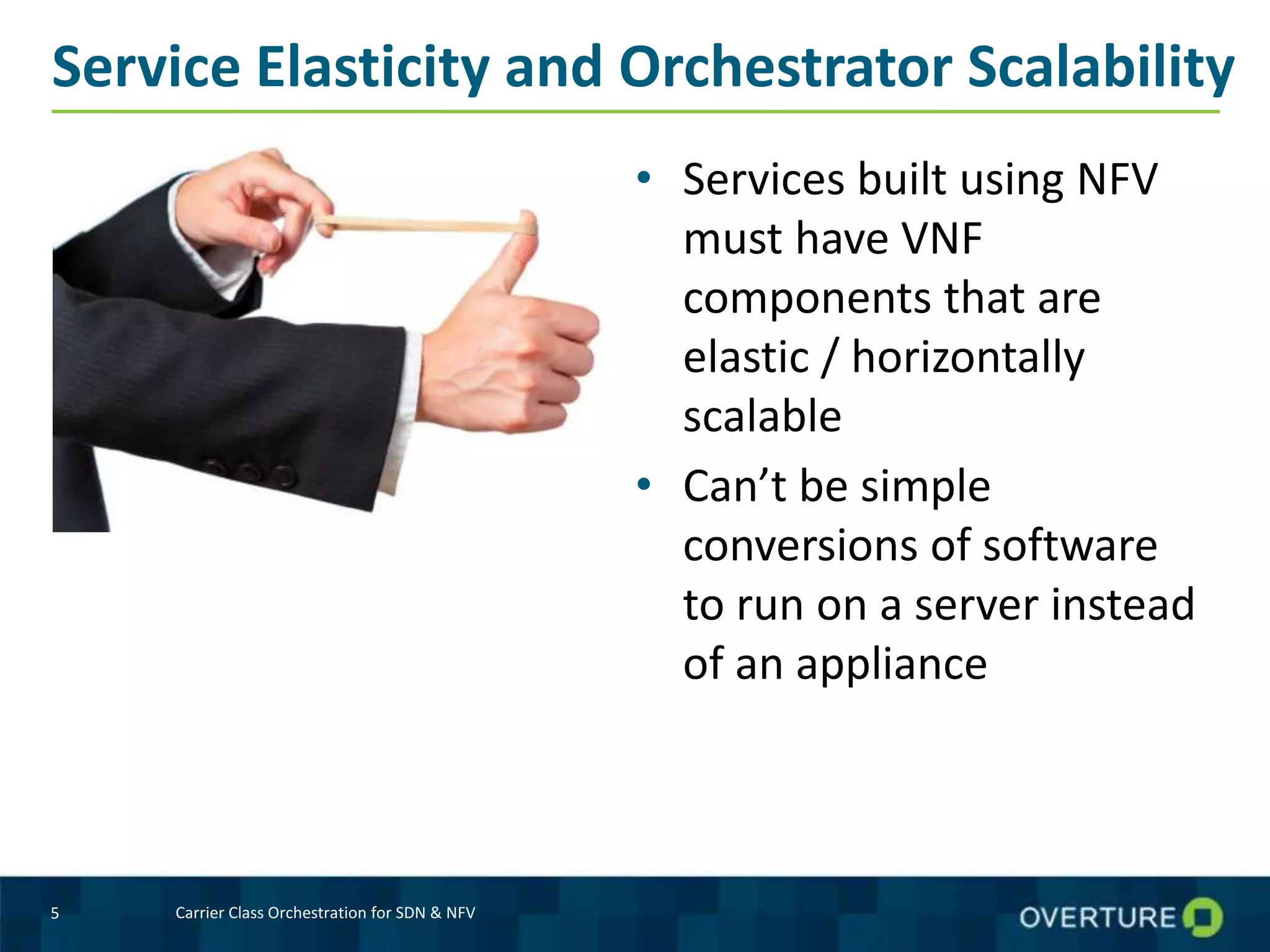
• Services built using NFV
must have VNF
components that are
elastic / horizontally
scalable
• Can’t be simple
conversions of software
to run on a server instead
of an appliance
5 Carrier Class Orchestration for SDN & NFV
Orchestrator Multi-Tenancy
• Wikipedia: “Multi-tenancy refers to a principle in
software architecture where a single instance of the
software runs on a server, serving multiple client-
organizations (tenants)”
• Different from “virtualization where components are
abstracted enabling each customer application to
appear to run on a separate physical machine.”
• Orchestrator multi-tenancy simplifies system design
and integration into higher level systems.
6 Carrier Class Orchestration for SDN & NFV
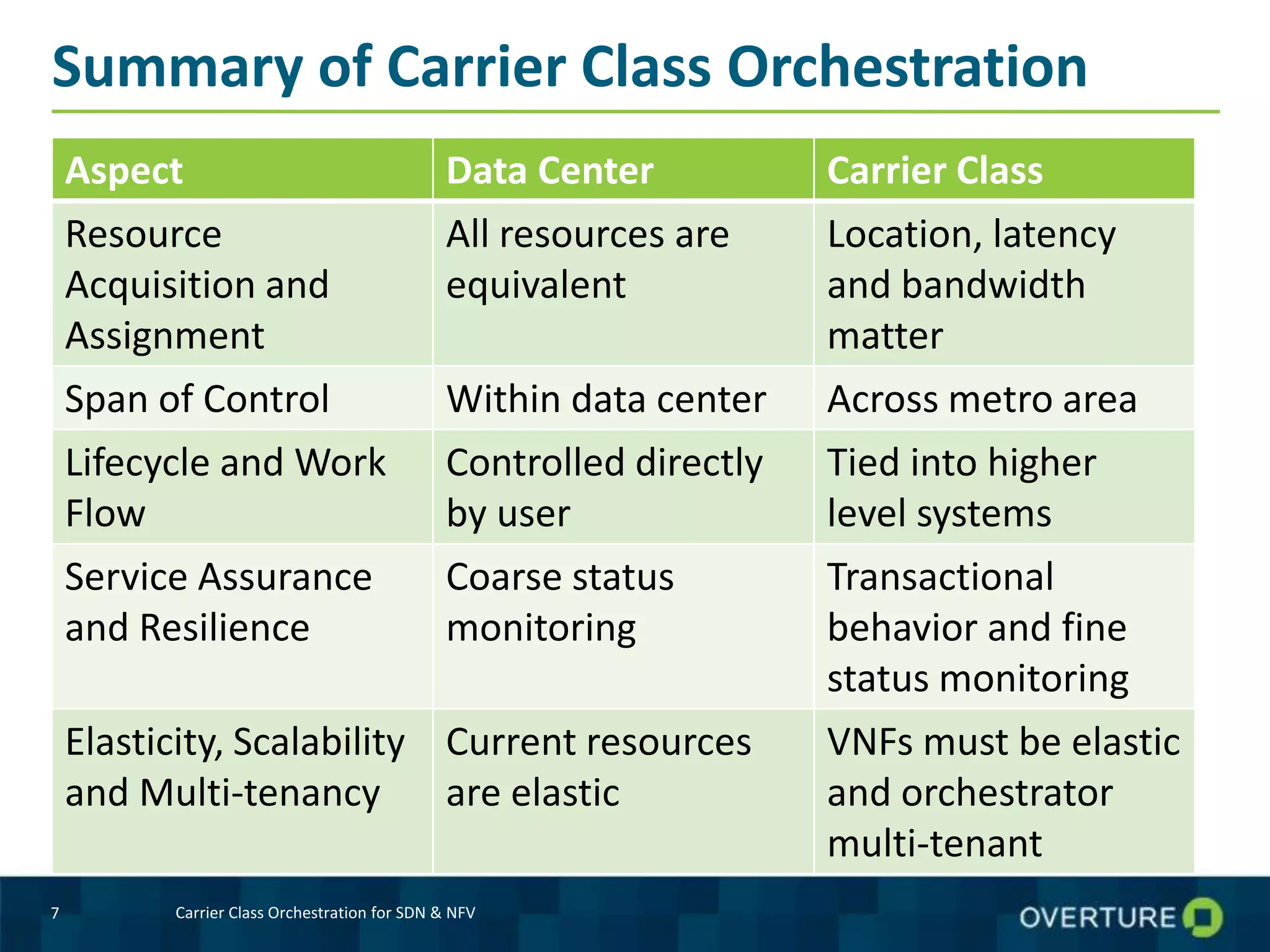
Summary of Carrier Class Orchestration
Aspect Data Center Carrier Class
Resource
Acquisition and
Assignment
All resources are
equivalent
Location, latency
and bandwidth
matter
Span of Control Within data center Across metro area
Lifecycle and Work
Flow
Controlled directly
by user
Tied into higher
level systems
Service Assurance
and Resilience
Coarse status
monitoring
Transactional
behavior and fine
status monitoring
Elasticity, Scalability
and Multi-tenancy
Current resources
are elastic
VNFs must be elastic
and orchestrator
multi-tenant
7 Carrier Class Orchestration for SDN & NFV
OVERTURENETWORKS.COM
Thank You!
An Entrance to a Smarter Network
prayson.pate@overturenetworks.com

Overture carrier classorchestration_sd_nandnfv_ctopraysonpate_10-2013

  • 1.
    OVERTURENETWORKS.COM Carrier Class Orchestration forSDN & NFV Prayson Pate Chief Technologist Overture Networks
  • 2.
    Carrier Orchestration isDifferent! Traditional orchestration (e.g. AWS CloudFormation) is focused on the data center. 2 Carrier Class Orchestration for SDN & NFV Carrier SDN and NFV will be used to build carrier services across the network; orchestration must reflect additional requirements.
  • 3.
    Resource Acquisition, Assignment& Span • In a data center, resources are all equivalent. • In an NFV network location matters • Span extends beyond data center to MEN and WAN 3 Carrier Class Orchestration for SDN & NFV Customer Site Central Office Mini-Datacenter Metro Datacenter Metro Network All the same These resources are scarce, but lower latency Not just in here But also here
  • 4.
    Lifecycle and WorkFlow • Critical to tie into higher-level systems • Could be OSS/BSS systems • Could be network applications • Programmable and transactional behavior on service activation • Reliability and status monitoring 4 Carrier Class Orchestration for SDN & NFV
  • 5.
    Service Elasticity andOrchestrator Scalability • Services built using NFV must have VNF components that are elastic / horizontally scalable • Can’t be simple conversions of software to run on a server instead of an appliance 5 Carrier Class Orchestration for SDN & NFV
  • 6.
    Orchestrator Multi-Tenancy • Wikipedia:“Multi-tenancy refers to a principle in software architecture where a single instance of the software runs on a server, serving multiple client- organizations (tenants)” • Different from “virtualization where components are abstracted enabling each customer application to appear to run on a separate physical machine.” • Orchestrator multi-tenancy simplifies system design and integration into higher level systems. 6 Carrier Class Orchestration for SDN & NFV
  • 7.
    Summary of CarrierClass Orchestration Aspect Data Center Carrier Class Resource Acquisition and Assignment All resources are equivalent Location, latency and bandwidth matter Span of Control Within data center Across metro area Lifecycle and Work Flow Controlled directly by user Tied into higher level systems Service Assurance and Resilience Coarse status monitoring Transactional behavior and fine status monitoring Elasticity, Scalability and Multi-tenancy Current resources are elastic VNFs must be elastic and orchestrator multi-tenant 7 Carrier Class Orchestration for SDN & NFV
  • 8.
    OVERTURENETWORKS.COM Thank You! An Entranceto a Smarter Network prayson.pate@overturenetworks.com