www.isocore.com/mpls2013
Realizing a Multi-Layer Transport SDN:
Practical Considerations and
Implementation Experiences
Chris Liou
Infinera
cliou@infinera.com
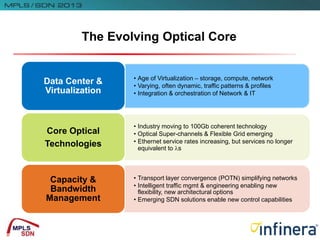
The Evolving Optical Core
• Age of Virtualization – storage, compute, network
• Varying, often dynamic, traffic patterns & profiles
• Integration & orchestration of Network & IT
Data Center &
Virtualization
• Industry moving to 100Gb coherent technology
• Optical Super-channels & Flexible Grid emerging
• Ethernet service rates increasing, but services no longer
equivalent to ls
Core Optical
Technologies
• Transport layer convergence (POTN) simplifying networks
• Intelligent traffic mgmt & engineering enabling new
flexibility, new architectural options
• Emerging SDN solutions enable new control capabilities
Capacity &
Bandwidth
Management
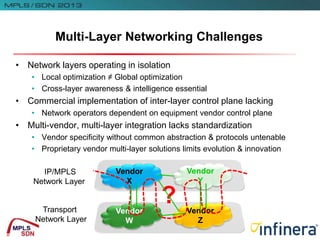
Multi-Layer Networking Challenges
• Network layers operating in isolation
• Local optimization ≠ Global optimization
• Cross-layer awareness & intelligence essential
• Commercial implementation of inter-layer control plane lacking
• Network operators dependent on equipment vendor control plane
• Multi-vendor, multi-layer integration lacks standardization
• Vendor specificity without common abstraction & protocols untenable
• Proprietary vendor multi-layer solutions limits evolution & innovation
Vendor
W
Vendor
Z
Vendor
X
Vendor
Y
Transport
Network Layer
IP/MPLS
Network Layer
?
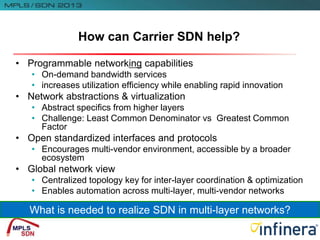
How can Carrier SDN help?
• Programmable networking capabilities
• On-demand bandwidth services
• increases utilization efficiency while enabling rapid innovation
• Network abstractions & virtualization
• Abstract specifics from higher layers
• Challenge: Least Common Denominator vs Greatest Common
Factor
• Open standardized interfaces and protocols
• Encourages multi-vendor environment, accessible by a broader
ecosystem
• Global network view
• Centralized topology key for inter-layer coordination & optimization
• Enables automation across multi-layer, multi-vendor networks
What is needed to realize SDN in multi-layer networks?
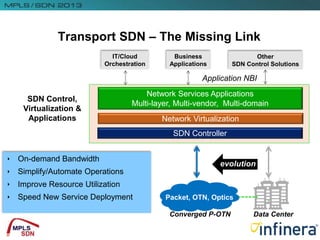
Transport SDN – The Missing Link
Network Services Applications
Multi-layer, Multi-vendor, Multi-domain
SDN Controller
Network Virtualization
IT/Cloud
Orchestration
Business
Applications
Other
SDN Control Solutions
Application NBI
 On-demand Bandwidth
 Simplify/Automate Operations
 Improve Resource Utilization
 Speed New Service Deployment
SDN Control,
Virtualization &
Applications
Data CenterConverged P-OTN
Packet, OTN, Optics
evolution
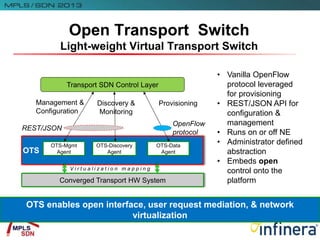
• Vanilla OpenFlow
protocol leveraged
for provisioning
• REST/JSON API for
configuration &
management
• Runs on or off NE
• Administrator defined
abstraction
• Embeds open
control onto the
platform
Open Transport Switch
Light-weight Virtual Transport Switch
OTS-Mgmt
Agent
OTS-Discovery
Agent
OTS-Data
AgentOTS
Management &
Configuration
Discovery &
Monitoring
Provisioning
Transport SDN Control Layer
REST/JSON
OpenFlow
protocol
Converged Transport HW System
V i r t u a l i z a t i o n m a p p i n g
OTS enables open interface, user request mediation, & network
virtualization
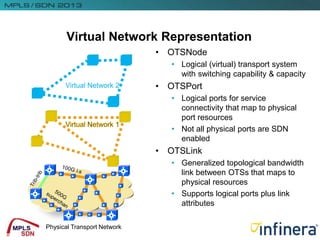
Virtual Network Representation
• OTSNode
• Logical (virtual) transport system
with switching capability & capacity
• OTSPort
• Logical ports for service
connectivity that map to physical
port resources
• Not all physical ports are SDN
enabled
• OTSLink
• Generalized topological bandwidth
link between OTSs that maps to
physical resources
• Supports logical ports plus link
attributes
Virtual Network 2
Physical Transport Network
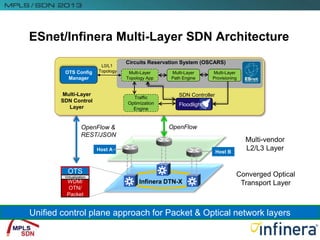
ESnet/Infinera Multi-Layer SDN Architecture
OpenFlow &
REST/JSON
OpenFlow
OTS Config
Manager
L0/L1
Topology Multi-Layer
Path Engine
Multi-Layer
Provisioning
Multi-Layer
Topology App
Circuits Reservation System (OSCARS)
SDN Controller
Floodlight
Traffic
Optimization
Engine
WDM/
OTN/
Packet
OTS
Virtualization
Multi-Layer
SDN Control
Layer
Infinera DTN-X
Host A Host B
Unified control plane approach for Packet & Optical network layers
Multi-vendor
L2/L3 Layer
Converged Optical
Transport Layer
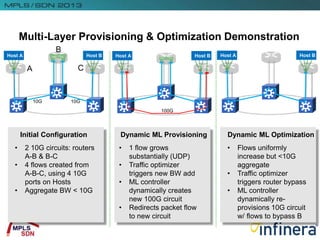
Multi-Layer Provisioning & Optimization Demonstration
Host A Host B Host A Host B
100G
Host A Host B
Initial Configuration
10G 10G
• 2 10G circuits: routers
A-B & B-C
• 4 flows created from
A-B-C, using 4 10G
ports on Hosts
• Aggregate BW < 10G
A
B
C
Dynamic ML Provisioning
• 1 flow grows
substantially (UDP)
• Traffic optimizer
triggers new BW add
• ML controller
dynamically creates
new 100G circuit
• Redirects packet flow
to new circuit
Dynamic ML Optimization
• Flows uniformly
increase but <10G
aggregate
• Traffic optimizer
triggers router bypass
• ML controller
dynamically re-
provisions 10G circuit
w/ flows to bypass B
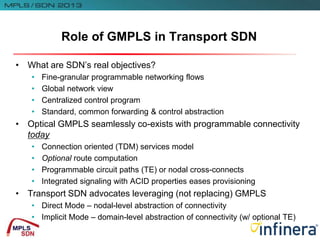
• What are SDN’s real objectives?
• Fine-granular programmable networking flows
• Global network view
• Centralized control program
• Standard, common forwarding & control abstraction
• Optical GMPLS seamlessly co-exists with programmable connectivity
today
• Connection oriented (TDM) services model
• Optional route computation
• Programmable circuit paths (TE) or nodal cross-connects
• Integrated signaling with ACID properties eases provisioning
• Transport SDN advocates leveraging (not replacing) GMPLS
• Direct Mode – nodal-level abstraction of connectivity
• Implicit Mode – domain-level abstraction of connectivity (w/ optional TE)
Role of GMPLS in Transport SDN
• Virtualization & multi-tenancy apply well to transport layer, but
requires different modeling
• E.g., addressing, hierarchy, resource tracking, logical port
alignment
• OpenFlow protocol compatible but requires extensions
• Transport layer topology discovery likely vendor & domain specific
• ACID properties across southbound API important in transport
• Synchronization capabilities needed between logical & physical layers
• Lifecycle management & resilience important for deployability
• Co-existence with GMPLS requires “full disclosure” to OpenFlow
What We’ve Learned
• Carrier SDN has significant benefits:
• Multi-layer, multi-domain operation
• Operationalizes transport layer’s flexibility & agility
• Virtualization of network resources
• OTS & GMPLS play key roles
• Open programmability & transport abstraction
• GMPLS facilitates higher level abstraction & carrier migration
• Transport platform & SDN requirements must harmonize
• Service-ready capacity
• Deterministic digital operations
Closing Remarks

Realizing a Multi-Layer Transport SDN: Practical Considerations and Implementation Experiences

  • 1.
    www.isocore.com/mpls2013 Realizing a Multi-LayerTransport SDN: Practical Considerations and Implementation Experiences Chris Liou Infinera cliou@infinera.com
  • 2.
    The Evolving OpticalCore • Age of Virtualization – storage, compute, network • Varying, often dynamic, traffic patterns & profiles • Integration & orchestration of Network & IT Data Center & Virtualization • Industry moving to 100Gb coherent technology • Optical Super-channels & Flexible Grid emerging • Ethernet service rates increasing, but services no longer equivalent to ls Core Optical Technologies • Transport layer convergence (POTN) simplifying networks • Intelligent traffic mgmt & engineering enabling new flexibility, new architectural options • Emerging SDN solutions enable new control capabilities Capacity & Bandwidth Management
  • 3.
    Multi-Layer Networking Challenges •Network layers operating in isolation • Local optimization ≠ Global optimization • Cross-layer awareness & intelligence essential • Commercial implementation of inter-layer control plane lacking • Network operators dependent on equipment vendor control plane • Multi-vendor, multi-layer integration lacks standardization • Vendor specificity without common abstraction & protocols untenable • Proprietary vendor multi-layer solutions limits evolution & innovation Vendor W Vendor Z Vendor X Vendor Y Transport Network Layer IP/MPLS Network Layer ?
  • 4.
    How can CarrierSDN help? • Programmable networking capabilities • On-demand bandwidth services • increases utilization efficiency while enabling rapid innovation • Network abstractions & virtualization • Abstract specifics from higher layers • Challenge: Least Common Denominator vs Greatest Common Factor • Open standardized interfaces and protocols • Encourages multi-vendor environment, accessible by a broader ecosystem • Global network view • Centralized topology key for inter-layer coordination & optimization • Enables automation across multi-layer, multi-vendor networks What is needed to realize SDN in multi-layer networks?
  • 5.
    Transport SDN –The Missing Link Network Services Applications Multi-layer, Multi-vendor, Multi-domain SDN Controller Network Virtualization IT/Cloud Orchestration Business Applications Other SDN Control Solutions Application NBI  On-demand Bandwidth  Simplify/Automate Operations  Improve Resource Utilization  Speed New Service Deployment SDN Control, Virtualization & Applications Data CenterConverged P-OTN Packet, OTN, Optics evolution
  • 6.
    • Vanilla OpenFlow protocolleveraged for provisioning • REST/JSON API for configuration & management • Runs on or off NE • Administrator defined abstraction • Embeds open control onto the platform Open Transport Switch Light-weight Virtual Transport Switch OTS-Mgmt Agent OTS-Discovery Agent OTS-Data AgentOTS Management & Configuration Discovery & Monitoring Provisioning Transport SDN Control Layer REST/JSON OpenFlow protocol Converged Transport HW System V i r t u a l i z a t i o n m a p p i n g OTS enables open interface, user request mediation, & network virtualization
  • 7.
    Virtual Network Representation •OTSNode • Logical (virtual) transport system with switching capability & capacity • OTSPort • Logical ports for service connectivity that map to physical port resources • Not all physical ports are SDN enabled • OTSLink • Generalized topological bandwidth link between OTSs that maps to physical resources • Supports logical ports plus link attributes Virtual Network 2 Physical Transport Network
  • 8.
    ESnet/Infinera Multi-Layer SDNArchitecture OpenFlow & REST/JSON OpenFlow OTS Config Manager L0/L1 Topology Multi-Layer Path Engine Multi-Layer Provisioning Multi-Layer Topology App Circuits Reservation System (OSCARS) SDN Controller Floodlight Traffic Optimization Engine WDM/ OTN/ Packet OTS Virtualization Multi-Layer SDN Control Layer Infinera DTN-X Host A Host B Unified control plane approach for Packet & Optical network layers Multi-vendor L2/L3 Layer Converged Optical Transport Layer
  • 9.
    Multi-Layer Provisioning &Optimization Demonstration Host A Host B Host A Host B 100G Host A Host B Initial Configuration 10G 10G • 2 10G circuits: routers A-B & B-C • 4 flows created from A-B-C, using 4 10G ports on Hosts • Aggregate BW < 10G A B C Dynamic ML Provisioning • 1 flow grows substantially (UDP) • Traffic optimizer triggers new BW add • ML controller dynamically creates new 100G circuit • Redirects packet flow to new circuit Dynamic ML Optimization • Flows uniformly increase but <10G aggregate • Traffic optimizer triggers router bypass • ML controller dynamically re- provisions 10G circuit w/ flows to bypass B
  • 10.
    • What areSDN’s real objectives? • Fine-granular programmable networking flows • Global network view • Centralized control program • Standard, common forwarding & control abstraction • Optical GMPLS seamlessly co-exists with programmable connectivity today • Connection oriented (TDM) services model • Optional route computation • Programmable circuit paths (TE) or nodal cross-connects • Integrated signaling with ACID properties eases provisioning • Transport SDN advocates leveraging (not replacing) GMPLS • Direct Mode – nodal-level abstraction of connectivity • Implicit Mode – domain-level abstraction of connectivity (w/ optional TE) Role of GMPLS in Transport SDN
  • 11.
    • Virtualization &multi-tenancy apply well to transport layer, but requires different modeling • E.g., addressing, hierarchy, resource tracking, logical port alignment • OpenFlow protocol compatible but requires extensions • Transport layer topology discovery likely vendor & domain specific • ACID properties across southbound API important in transport • Synchronization capabilities needed between logical & physical layers • Lifecycle management & resilience important for deployability • Co-existence with GMPLS requires “full disclosure” to OpenFlow What We’ve Learned
  • 12.
    • Carrier SDNhas significant benefits: • Multi-layer, multi-domain operation • Operationalizes transport layer’s flexibility & agility • Virtualization of network resources • OTS & GMPLS play key roles • Open programmability & transport abstraction • GMPLS facilitates higher level abstraction & carrier migration • Transport platform & SDN requirements must harmonize • Service-ready capacity • Deterministic digital operations Closing Remarks