


Multi-Cloud Global Server Load
Balancing (GSLB)
Ashwin Manekar, Avi Networks
Sr. Product Manager
Mittali Chawla, Avi Networks
Technical Marketing Engineer
Agenda
GSLB Overview
Use Cases
1. Multi-Cloud deployments
2. Cloud bursting
3. Failure handling
Demo: config / policy / analytics
GSLB Overview
- Pre-requisites: basic understanding of DNS and GSLB
- Why Multi-Cloud GSLB and health monitoring
- Requirements of enterprise-grade GSLB
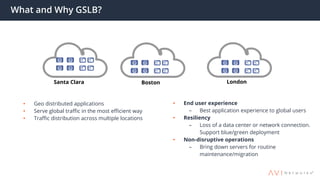
What and Why GSLB?
• Geo distributed applications
• Serve global traffic in the most efficient way
• Traffic distribution across multiple locations
Santa Clara Boston London
• End user experience
– Best application experience to global users
• Resiliency
– Loss of a data center or network connection.
Support blue/green deployment
• Non-disruptive operations
– Bring down servers for routine
maintenance/migration
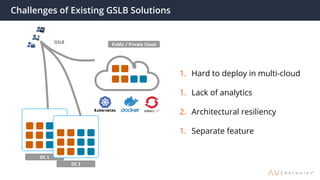
Challenges of Existing GSLB Solutions
DC 1
Public / Private Cloud
DC 2
GSLB
1. Hard to deploy in multi-cloud
1. Lack of analytics
2. Architectural resiliency
1. Separate feature
BARE METAL VIRTUALIZED CONTAINERSON PREMISES PUBLIC CLOUDVIRTUALIZED CONTAINERS
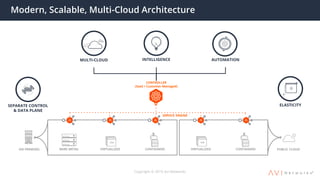
Modern, Scalable, Multi-Cloud Architecture
Copyright © 2019 Avi Networks
CONTROLLER
(SaaS / Customer-Managed)
SERVICE ENGINE
SEPARATE CONTROL
& DATA PLANE
ELASTICITY
INTELLIGENCE AUTOMATIONMULTI-CLOUD
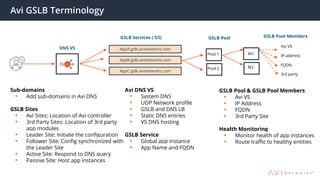
Avi GSLB Terminology
Sub-domains
• Add sub-domains in Avi DNS
GSLB Sites
• Avi Sites: Location of Avi controller
• 3rd Party Sites: Location of 3rd party
app modules
• Leader Site: Initiate the configuration
• Follower Site: Config synchronized with
the Leader Site
• Active Site: Respond to DNS query
• Passive Site: Host app instances
AppA.gslb.avinetworks.com
AppB.gslb.avinetworks.com
AppC.gslb.avinetworks.com
GSLB Services ( GS)
DNS VS
GSLB Pool GSLB Pool Members
Pool 1
Pool 2
M1
M2
Avi VS
3rd party
IP address
FQDN
Avi DNS VS
• System DNS
• UDP Network profile
• GSLB and DNS LB
• Static DNS entries
• VS DNS hosting
GSLB Service
• Global app instance
• App Name and FQDN
GSLB Pool & GSLB Pool Members
• Avi VS
• IP Address
• FQDN
• 3rd Party Site
Health Monitoring
• Monitor health of app instances
• Route traffic to healthy entities
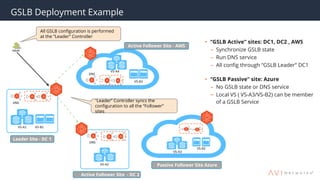
GSLB Deployment Example
• “GSLB Active” sites: DC1, DC2 , AWS
– Synchronize GSLB state
– Run DNS service
– All config through “GSLB Leader” DC1
• “GSLB Passive” site: Azure
– No GSLB state or DNS service
– Local VS ( VS-A3/VS-B2) can be member
of a GSLB Service
Leader Site - DC 1
VS-A1 VS-B1
DNS
VS-A4
DNS
All GSLB configuration is performed
at the “Leader” Controller
“Leader” Controller syncs the
configuration to all the “Follower”
sites
Active Follower Site - AWS
Admin
VS-B3
Active Follower Site - DC 2
VS-A2
DNS
Passive Follower Site Azure
VS-B2
VS-A3
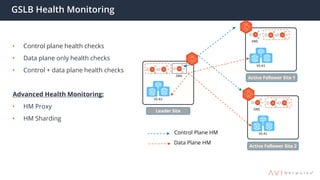
GSLB Health Monitoring
• Control plane health checks
• Data plane only health checks
• Control + data plane health checks
Advanced Health Monitoring:
• HM Proxy
• HM Sharding
Leader Site
VS-A1
DNS
Active Follower Site 2
VS-A1
DNS
VS-A1
DNS
Active Follower Site 1
Control Plane HM
Data Plane HM
Use Cases
- Multi-cloud deployments
- Cloud bursting
- Failure handling / recovery
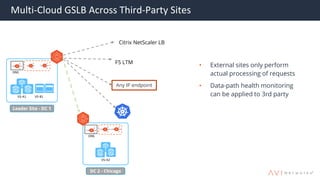
Multi-Cloud GSLB Across Third-Party Sites
• External sites only perform
actual processing of requests
• Data-path health monitoring
can be applied to 3rd party
Leader Site - DC 1
VS-A1 VS-B1
DNS
Citrix NetScaler LB
F5 LTM
DC 2 - Chicago
VS-A2
DNS
Any IP endpoint
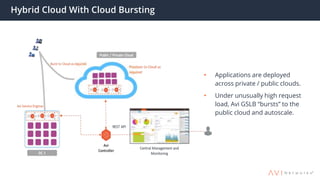
Hybrid Cloud With Cloud Bursting
• Applications are deployed
across private / public clouds.
• Under unusually high request
load, Avi GSLB “bursts” to the
public cloud and autoscale.
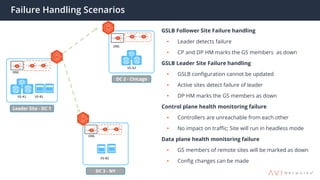
Failure Handling Scenarios
GSLB Follower Site Failure handling
• Leader detects failure
• CP and DP HM marks the GS members as down
GSLB Leader Site Failure handling
• GSLB configuration cannot be updated
• Active sites detect failure of leader
• DP HM marks the GS members as down
Control plane health monitoring failure
• Controllers are unreachable from each other
• No impact on traffic; Site will run in headless mode
Data plane health monitoring failure
• GS members of remote sites will be marked as down
• Config changes can be made
Leader Site - DC 1
VS-A1 VS-B1
DNS
DC 3 - NY
DNS
DC 2 - Chicago
VS-A2
DNS
VS-B2
Demo
- Configuration
- GSLB policy
- Analytics & visibility
Summary
• Resilient to the loss of a data center or network connectivity
• Support non-disruptive operations by allowing maintenance/migration
• Easy to deploy in multi-cloud
• Real-time health monitoring
• Distributed architecture provides better failure handling
• Not a separate feature
Next Steps
- Schedule a custom demo
- GSLB whitepaper
- Contact us for anything “Multi-
Cloud”

Multi-Cloud Global Server Load Balancing (GSLB)

  • 1.
    Multi-Cloud Global ServerLoad Balancing (GSLB) Ashwin Manekar, Avi Networks Sr. Product Manager Mittali Chawla, Avi Networks Technical Marketing Engineer
  • 2.
    Agenda GSLB Overview Use Cases 1.Multi-Cloud deployments 2. Cloud bursting 3. Failure handling Demo: config / policy / analytics
  • 3.
    GSLB Overview - Pre-requisites:basic understanding of DNS and GSLB - Why Multi-Cloud GSLB and health monitoring - Requirements of enterprise-grade GSLB
  • 4.
    What and WhyGSLB? • Geo distributed applications • Serve global traffic in the most efficient way • Traffic distribution across multiple locations Santa Clara Boston London • End user experience – Best application experience to global users • Resiliency – Loss of a data center or network connection. Support blue/green deployment • Non-disruptive operations – Bring down servers for routine maintenance/migration
  • 5.
    Challenges of ExistingGSLB Solutions DC 1 Public / Private Cloud DC 2 GSLB 1. Hard to deploy in multi-cloud 1. Lack of analytics 2. Architectural resiliency 1. Separate feature
  • 6.
    BARE METAL VIRTUALIZEDCONTAINERSON PREMISES PUBLIC CLOUDVIRTUALIZED CONTAINERS Modern, Scalable, Multi-Cloud Architecture Copyright © 2019 Avi Networks CONTROLLER (SaaS / Customer-Managed) SERVICE ENGINE SEPARATE CONTROL & DATA PLANE ELASTICITY INTELLIGENCE AUTOMATIONMULTI-CLOUD
  • 7.
    Avi GSLB Terminology Sub-domains •Add sub-domains in Avi DNS GSLB Sites • Avi Sites: Location of Avi controller • 3rd Party Sites: Location of 3rd party app modules • Leader Site: Initiate the configuration • Follower Site: Config synchronized with the Leader Site • Active Site: Respond to DNS query • Passive Site: Host app instances AppA.gslb.avinetworks.com AppB.gslb.avinetworks.com AppC.gslb.avinetworks.com GSLB Services ( GS) DNS VS GSLB Pool GSLB Pool Members Pool 1 Pool 2 M1 M2 Avi VS 3rd party IP address FQDN Avi DNS VS • System DNS • UDP Network profile • GSLB and DNS LB • Static DNS entries • VS DNS hosting GSLB Service • Global app instance • App Name and FQDN GSLB Pool & GSLB Pool Members • Avi VS • IP Address • FQDN • 3rd Party Site Health Monitoring • Monitor health of app instances • Route traffic to healthy entities
  • 8.
    GSLB Deployment Example •“GSLB Active” sites: DC1, DC2 , AWS – Synchronize GSLB state – Run DNS service – All config through “GSLB Leader” DC1 • “GSLB Passive” site: Azure – No GSLB state or DNS service – Local VS ( VS-A3/VS-B2) can be member of a GSLB Service Leader Site - DC 1 VS-A1 VS-B1 DNS VS-A4 DNS All GSLB configuration is performed at the “Leader” Controller “Leader” Controller syncs the configuration to all the “Follower” sites Active Follower Site - AWS Admin VS-B3 Active Follower Site - DC 2 VS-A2 DNS Passive Follower Site Azure VS-B2 VS-A3
  • 9.
    GSLB Health Monitoring •Control plane health checks • Data plane only health checks • Control + data plane health checks Advanced Health Monitoring: • HM Proxy • HM Sharding Leader Site VS-A1 DNS Active Follower Site 2 VS-A1 DNS VS-A1 DNS Active Follower Site 1 Control Plane HM Data Plane HM
  • 10.
    Use Cases - Multi-clouddeployments - Cloud bursting - Failure handling / recovery
  • 11.
    Multi-Cloud GSLB AcrossThird-Party Sites • External sites only perform actual processing of requests • Data-path health monitoring can be applied to 3rd party Leader Site - DC 1 VS-A1 VS-B1 DNS Citrix NetScaler LB F5 LTM DC 2 - Chicago VS-A2 DNS Any IP endpoint
  • 12.
    Hybrid Cloud WithCloud Bursting • Applications are deployed across private / public clouds. • Under unusually high request load, Avi GSLB “bursts” to the public cloud and autoscale.
  • 13.
    Failure Handling Scenarios GSLBFollower Site Failure handling • Leader detects failure • CP and DP HM marks the GS members as down GSLB Leader Site Failure handling • GSLB configuration cannot be updated • Active sites detect failure of leader • DP HM marks the GS members as down Control plane health monitoring failure • Controllers are unreachable from each other • No impact on traffic; Site will run in headless mode Data plane health monitoring failure • GS members of remote sites will be marked as down • Config changes can be made Leader Site - DC 1 VS-A1 VS-B1 DNS DC 3 - NY DNS DC 2 - Chicago VS-A2 DNS VS-B2
  • 14.
    Demo - Configuration - GSLBpolicy - Analytics & visibility
  • 15.
    Summary • Resilient tothe loss of a data center or network connectivity • Support non-disruptive operations by allowing maintenance/migration • Easy to deploy in multi-cloud • Real-time health monitoring • Distributed architecture provides better failure handling • Not a separate feature
  • 16.
    Next Steps - Schedulea custom demo - GSLB whitepaper - Contact us for anything “Multi- Cloud”