Spring cloud
What is spring cloud
Spring Cloud provides tools for developers to quickly build
some of the common patterns in distributed systems (e.g.
configuration management, service discovery, circuit
breakers, intelligent routing, micro-proxy, control bus, one-
time tokens, global locks, leadership election, distributed
sessions, cluster state).

They will work well in any distributed environment, including
the developer’s own laptop, bare metal data centres, and
managed platforms such as Cloud Foundry.
Why Spring cloud
• Cloud native apps are good thing but not easy.

• It is easy for big companies to put lot of resources to
succeed in cloud native but what about little guys.

• Why do we want to reinvent wheels when somebody
wants to build a cloud native apps?

• Follows spring boot model providing defaults for cloud
native app with ability to easy to configure them.
Spring cloud components
• Configuration

• Service discovery

• Circuit breakers

• Routing and messaging

• API Gateway

• Tracing

• CI Pipelines and testing.

• Growing….
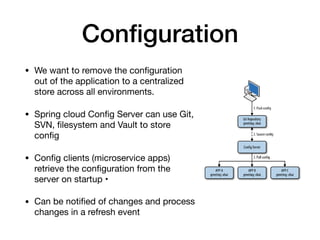
Configuration
• We want to remove the configuration
out of the application to a centralized
store across all environments.

• Spring cloud Config Server can use Git,
SVN, filesystem and Vault to store
config

• Config clients (microservice apps)
retrieve the configuration from the
server on startup • 

• Can be notified of changes and process
changes in a refresh event
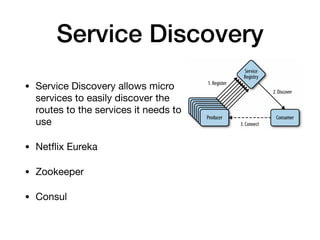
Service Discovery
• Service Discovery allows micro
services to easily discover the
routes to the services it needs to
use

• Netflix Eureka 

• Zookeeper 

• Consul
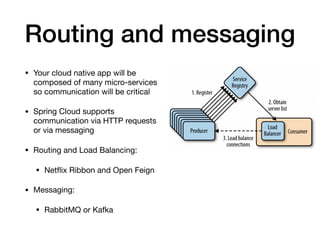
Routing and messaging
• Your cloud native app will be
composed of many micro-services
so communication will be critical

• Spring Cloud supports
communication via HTTP requests
or via messaging

• Routing and Load Balancing:

• Netflix Ribbon and Open Feign

• Messaging:

• RabbitMQ or Kafka
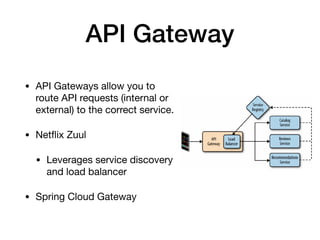
API Gateway
• API Gateways allow you to
route API requests (internal or
external) to the correct service.

• Netflix Zuul

• Leverages service discovery
and load balancer

• Spring Cloud Gateway
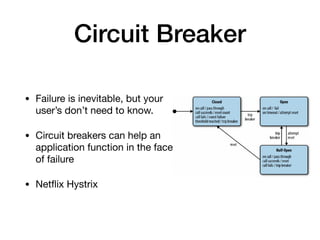
Circuit Breaker
• Failure is inevitable, but your
user’s don’t need to know.

• Circuit breakers can help an
application function in the face
of failure

• Netflix Hystrix
Tracing
• A single request to get data from your application may
result in an exponentially larger number of requests to
various micro-services

• Tracing these requests through the application is critical
when debugging issues

• Spring Cloud Sleuth and Zipkin
CI Pipeline and Testing
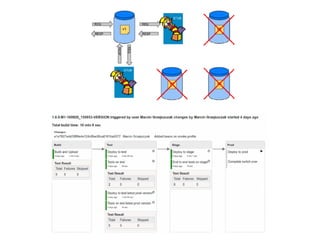
• Building, testing, and deploying the various services is
critical to having a successful cloud native application

• Spring Cloud Pipelines is an opinionated pipeline for
Jenkins or Concourse that will automatically create
pipelines for your apps

• Spring Cloud Contract allows you to accurately mock
dependencies between services using published
contracts.
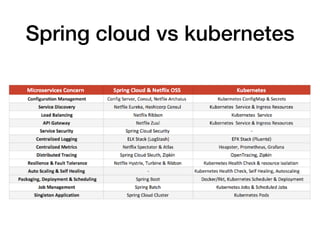
Spring cloud vs kubernetes
Take away
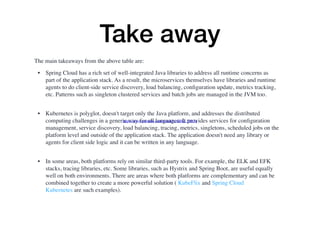
The main takeaways from the above table are:
• Spring Cloud has a rich set of well-integrated Java libraries to address all runtime concerns as
part of the application stack. As a result, the microservices themselves have libraries and runtime
agents to do client-side service discovery, load balancing, configuration update, metrics tracking,
etc. Patterns such as singleton clustered services and batch jobs are managed in the JVM too.

• Kubernetes is polyglot, doesn't target only the Java platform, and addresses the distributed
computing challenges in a generic way for all languages. It provides services for configuration
management, service discovery, load balancing, tracing, metrics, singletons, scheduled jobs on the
platform level and outside of the application stack. The application doesn't need any library or
agents for client side logic and it can be written in any language.

• In some areas, both platforms rely on similar third-party tools. For example, the ELK and EFK
stacks, tracing libraries, etc. Some libraries, such as Hystrix and Spring Boot, are useful equally
well on both environments. There are areas where both platforms are complementary and can be
combined together to create a more powerful solution ( KubeFlix and Spring Cloud
Kubernetes are such examples).

https://www.youtube.com/watch?v=Q0kj_34dr3g
References
• https://spring.io/projects/spring-cloud

• https://dzone.com/articles/deploying-microservices-
spring-cloud-vs-kubernetes

• https://www.youtube.com/watch?v=aO3W-lYnw-
o&t=1918s

Spring cloud

  • 1.
  • 2.
    What is springcloud Spring Cloud provides tools for developers to quickly build some of the common patterns in distributed systems (e.g. configuration management, service discovery, circuit breakers, intelligent routing, micro-proxy, control bus, one- time tokens, global locks, leadership election, distributed sessions, cluster state). They will work well in any distributed environment, including the developer’s own laptop, bare metal data centres, and managed platforms such as Cloud Foundry.
  • 3.
    Why Spring cloud •Cloud native apps are good thing but not easy. • It is easy for big companies to put lot of resources to succeed in cloud native but what about little guys. • Why do we want to reinvent wheels when somebody wants to build a cloud native apps? • Follows spring boot model providing defaults for cloud native app with ability to easy to configure them.
  • 4.
    Spring cloud components •Configuration • Service discovery • Circuit breakers • Routing and messaging • API Gateway • Tracing • CI Pipelines and testing. • Growing….
  • 5.
    Configuration • We wantto remove the configuration out of the application to a centralized store across all environments. • Spring cloud Config Server can use Git, SVN, filesystem and Vault to store config • Config clients (microservice apps) retrieve the configuration from the server on startup • • Can be notified of changes and process changes in a refresh event
  • 6.
    Service Discovery • ServiceDiscovery allows micro services to easily discover the routes to the services it needs to use • Netflix Eureka • Zookeeper • Consul
  • 7.
    Routing and messaging •Your cloud native app will be composed of many micro-services so communication will be critical • Spring Cloud supports communication via HTTP requests or via messaging • Routing and Load Balancing: • Netflix Ribbon and Open Feign • Messaging: • RabbitMQ or Kafka
  • 8.
    API Gateway • APIGateways allow you to route API requests (internal or external) to the correct service. • Netflix Zuul • Leverages service discovery and load balancer • Spring Cloud Gateway
  • 9.
    Circuit Breaker • Failureis inevitable, but your user’s don’t need to know. • Circuit breakers can help an application function in the face of failure • Netflix Hystrix
  • 10.
    Tracing • A singlerequest to get data from your application may result in an exponentially larger number of requests to various micro-services • Tracing these requests through the application is critical when debugging issues • Spring Cloud Sleuth and Zipkin
  • 11.
    CI Pipeline andTesting • Building, testing, and deploying the various services is critical to having a successful cloud native application • Spring Cloud Pipelines is an opinionated pipeline for Jenkins or Concourse that will automatically create pipelines for your apps • Spring Cloud Contract allows you to accurately mock dependencies between services using published contracts.
  • 13.
    Spring cloud vskubernetes
  • 14.
    Take away The maintakeaways from the above table are: • Spring Cloud has a rich set of well-integrated Java libraries to address all runtime concerns as part of the application stack. As a result, the microservices themselves have libraries and runtime agents to do client-side service discovery, load balancing, configuration update, metrics tracking, etc. Patterns such as singleton clustered services and batch jobs are managed in the JVM too.
 • Kubernetes is polyglot, doesn't target only the Java platform, and addresses the distributed computing challenges in a generic way for all languages. It provides services for configuration management, service discovery, load balancing, tracing, metrics, singletons, scheduled jobs on the platform level and outside of the application stack. The application doesn't need any library or agents for client side logic and it can be written in any language.
 • In some areas, both platforms rely on similar third-party tools. For example, the ELK and EFK stacks, tracing libraries, etc. Some libraries, such as Hystrix and Spring Boot, are useful equally well on both environments. There are areas where both platforms are complementary and can be combined together to create a more powerful solution ( KubeFlix and Spring Cloud Kubernetes are such examples).
 https://www.youtube.com/watch?v=Q0kj_34dr3g
  • 15.