Overall concept of statistics
Submitted to: Nasrin Zahan
Course name: Introduction to
statistics
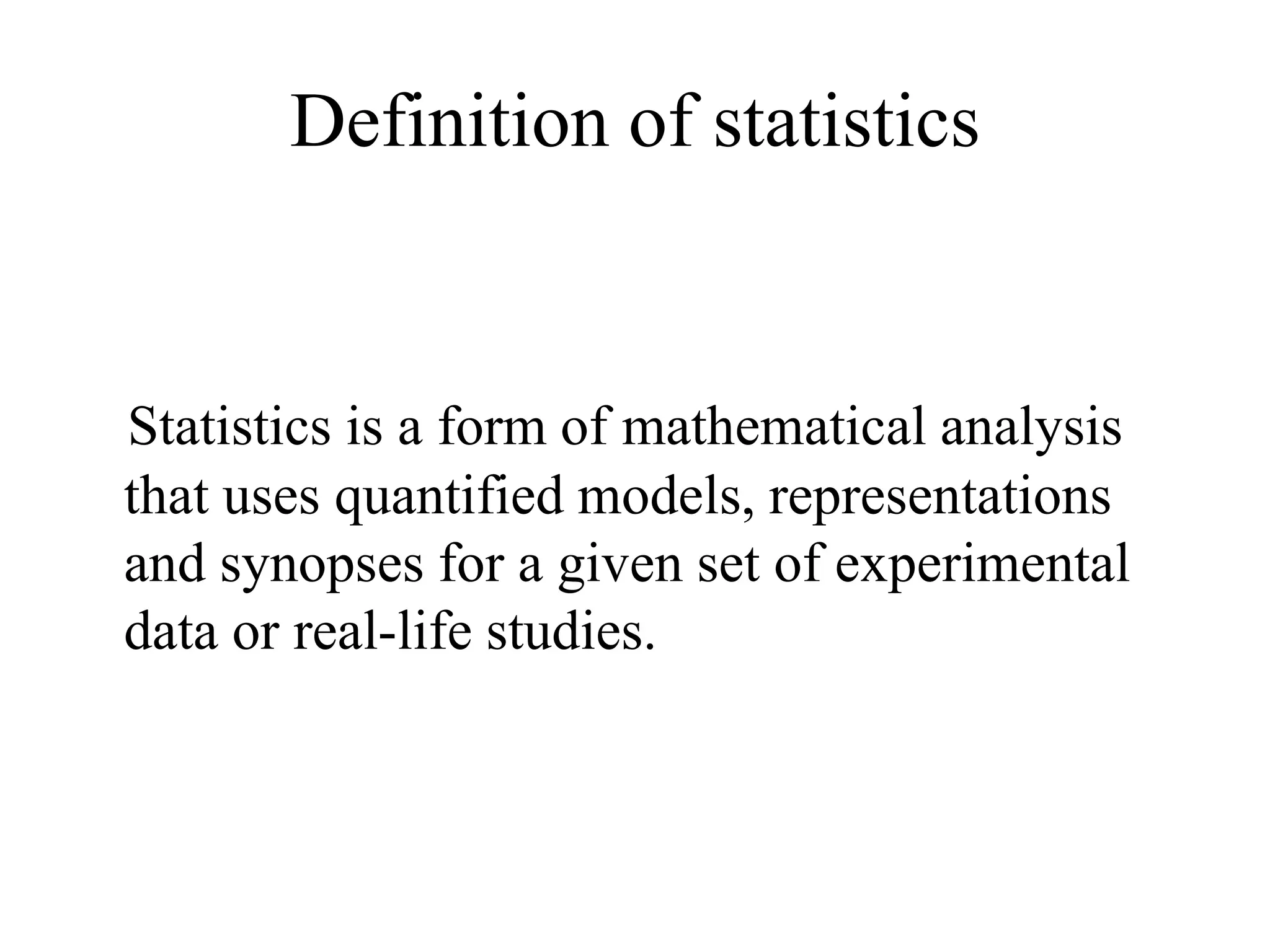
Definition of statistics
Statistics is a form of mathematical analysis
that uses quantified models, representations
and synopses for a given set of experimental
data or real-life studies.
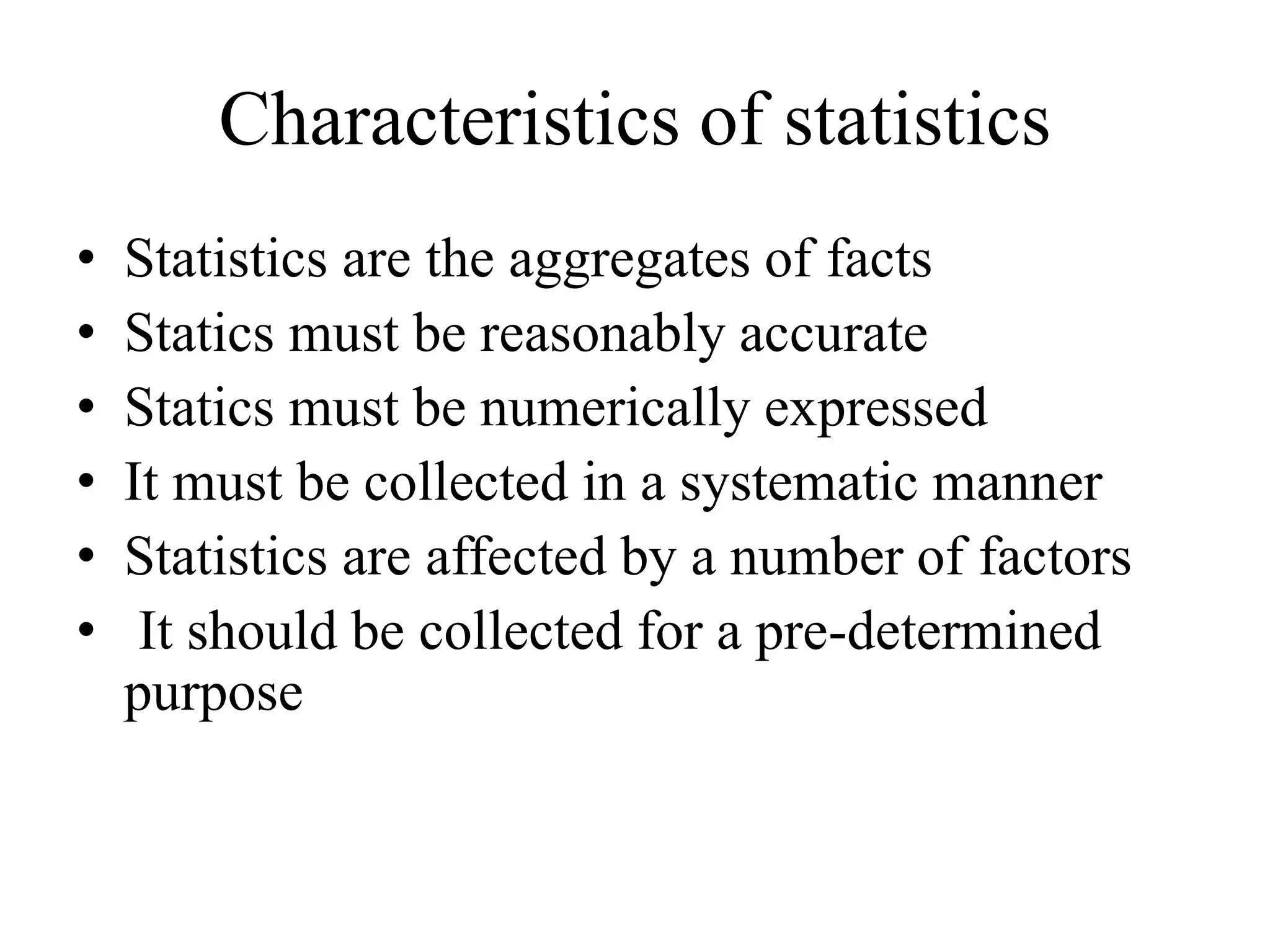
Characteristics of statistics
• Statistics are the aggregates of facts
• Statics must be reasonably accurate
• Statics must be numerically expressed
• It must be collected in a systematic manner
• Statistics are affected by a number of factors
• It should be collected for a pre-determined
purpose
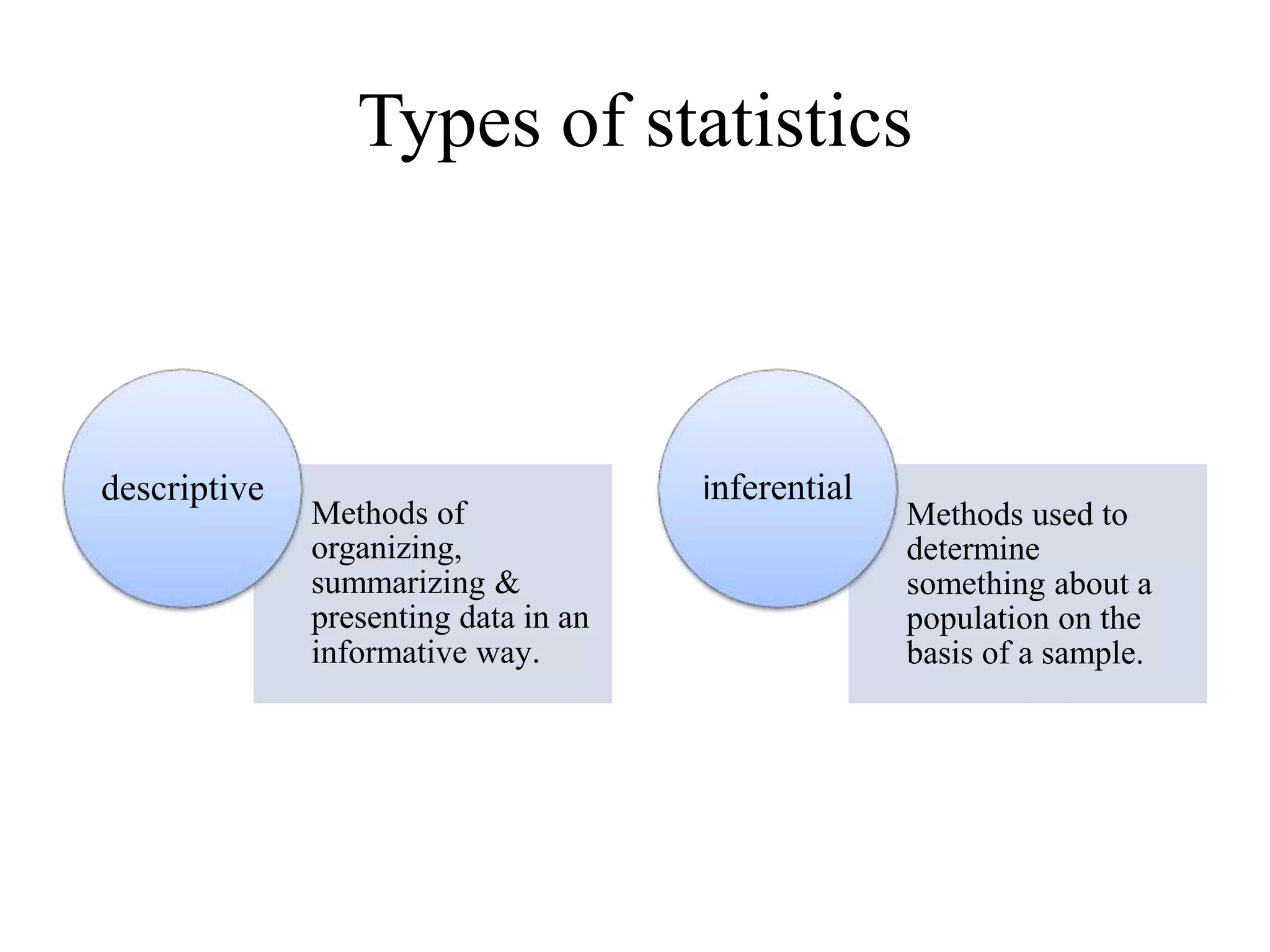
Types of statistics
Methods of
organizing,
summarizing &
presenting data in an
informative way.
descriptive
Methods used to
determine
something about a
population on the
basis of a sample.
inferential
History of statistics
The history of statistics can be said to start
around 1749 although, over time, there have
been changes to the interpretation of the
word statistics.
By the 18th century, the term "statistics"
designated the systematic
collection of demographic and economic data
by states
Data
In computing, data is information that has been
translated into a form that is efficient for
movement or processing. Relative to
today's computers and transmission media, data is
information converted into binary digital form. It
is acceptable for data to be used as a singular
subject or a plural subject. Raw data is a term
used to describe data in its most basic digital
format.
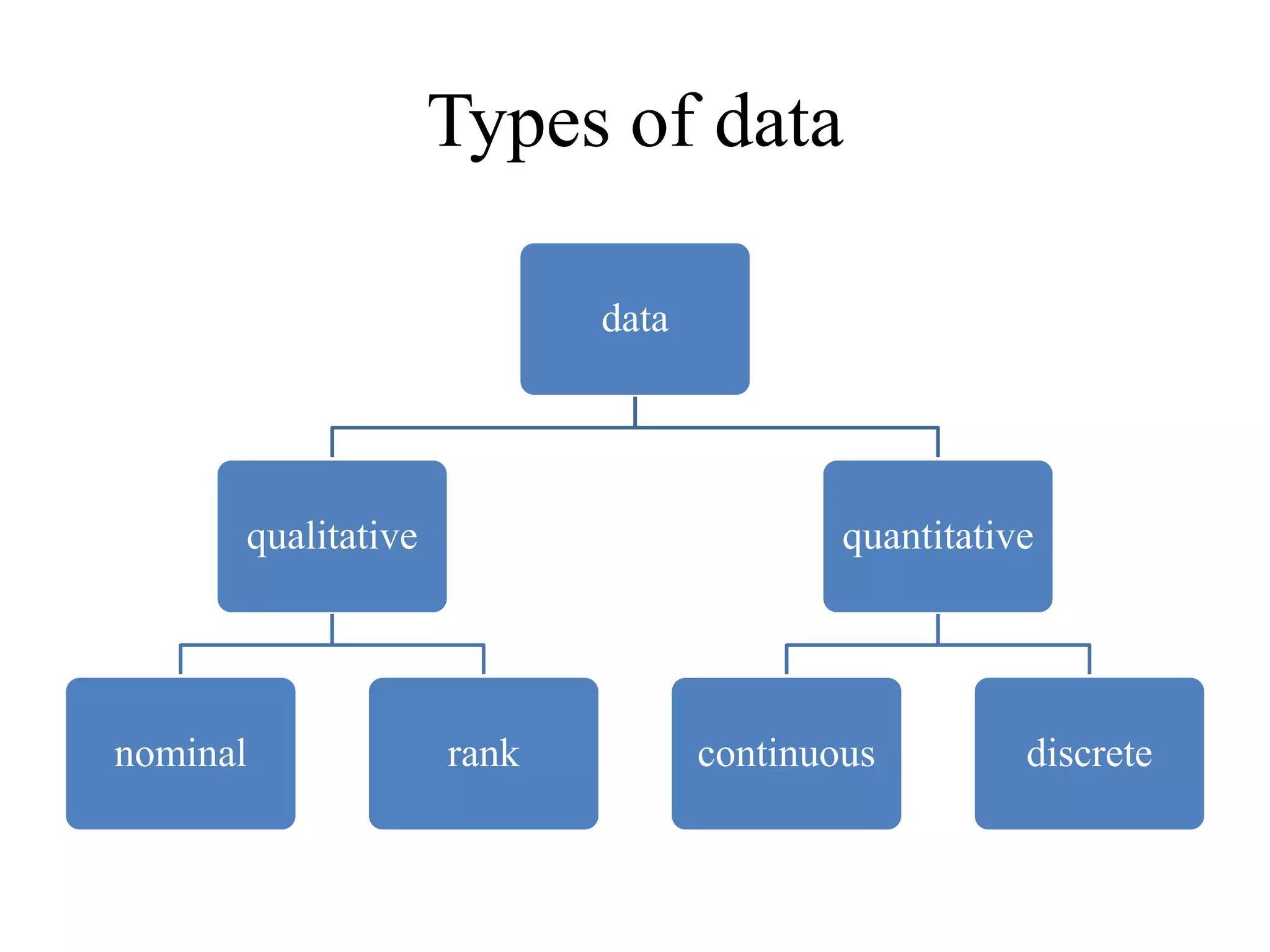
Types of data
data
qualitative
nominal rank
quantitative
continuous discrete
variables
Any object subject phenomenon or activity
that generates data through this process is
termed as a variable.
Or, a variable is that shows a degree of
variability when successive measurements are
recorded.
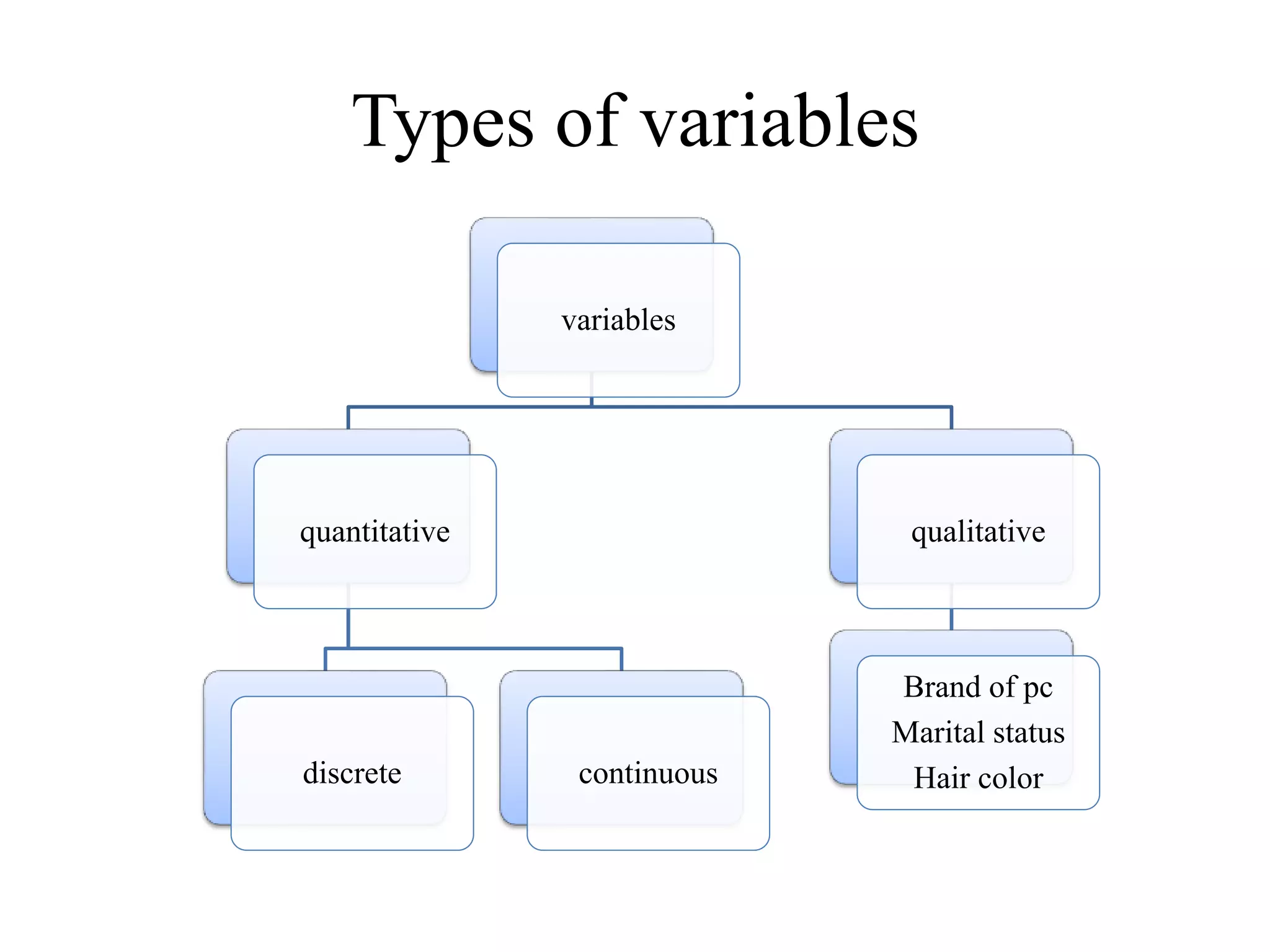
Types of variables
variables
quantitative
discrete continuous
qualitative
Brand of pc
Marital status
Hair color
Scope of statistics
• Statistics in the state
• Statistics in Business
• Statistics in Economics
• Statistics in Physical Sciences
• Statistics in Research
• Statistics are useful to banker, insurance
companies, social workers, labour unions, trade
associations, chambers and to the politicians.
Importance of statistics
• Business
• Mathematics
• Economics
• Banking
• Management
• Astronomy
• Natural and Social Sciences
Limitation of statistics
• Laws of statistics are true only in the long run
• Statistics is applicable only in quantitative
study
• Since statistics are collected for a particular
purpose such data may not be relevant or
useful in other situation or cases.
• Statistical methods provides only one approach
to the study of phenomenon.
Thank you

Overall concept of statistics

  • 1.
    Overall concept ofstatistics Submitted to: Nasrin Zahan Course name: Introduction to statistics
  • 2.
    Definition of statistics Statisticsis a form of mathematical analysis that uses quantified models, representations and synopses for a given set of experimental data or real-life studies.
  • 3.
    Characteristics of statistics •Statistics are the aggregates of facts • Statics must be reasonably accurate • Statics must be numerically expressed • It must be collected in a systematic manner • Statistics are affected by a number of factors • It should be collected for a pre-determined purpose
  • 4.
    Types of statistics Methodsof organizing, summarizing & presenting data in an informative way. descriptive Methods used to determine something about a population on the basis of a sample. inferential
  • 5.
    History of statistics Thehistory of statistics can be said to start around 1749 although, over time, there have been changes to the interpretation of the word statistics. By the 18th century, the term "statistics" designated the systematic collection of demographic and economic data by states
  • 6.
    Data In computing, datais information that has been translated into a form that is efficient for movement or processing. Relative to today's computers and transmission media, data is information converted into binary digital form. It is acceptable for data to be used as a singular subject or a plural subject. Raw data is a term used to describe data in its most basic digital format.
  • 7.
    Types of data data qualitative nominalrank quantitative continuous discrete
  • 8.
    variables Any object subjectphenomenon or activity that generates data through this process is termed as a variable. Or, a variable is that shows a degree of variability when successive measurements are recorded.
  • 9.
    Types of variables variables quantitative discretecontinuous qualitative Brand of pc Marital status Hair color
  • 10.
    Scope of statistics •Statistics in the state • Statistics in Business • Statistics in Economics • Statistics in Physical Sciences • Statistics in Research • Statistics are useful to banker, insurance companies, social workers, labour unions, trade associations, chambers and to the politicians.
  • 11.
    Importance of statistics •Business • Mathematics • Economics • Banking • Management • Astronomy • Natural and Social Sciences
  • 12.
    Limitation of statistics •Laws of statistics are true only in the long run • Statistics is applicable only in quantitative study • Since statistics are collected for a particular purpose such data may not be relevant or useful in other situation or cases. • Statistical methods provides only one approach to the study of phenomenon.
  • 13.