Prepared By:
Dipesh Kashinath Pabrekar
 Introduction: - India is the largest provider of generic drugs globally.
Indian pharmaceutical sector supplies over 50 per cent of global demand
for various vaccines, 40 per cent of generic demand in the US and 25 per
cent of all medicine in the UK.
 India enjoys an important position in the global pharmaceuticals sector. The
country also has a large pool of scientists and engineers with a potential to
steer the industry ahead to greater heights.
 Market Size: - Indian pharmaceutical sector is expected to grow to US$
100 billion, while medical device market is expected to grow US$ 25 billion
by 2025. India’s domestic pharmaceutical market turnover reached Rs 1.4
lakh crore (US$ 20.03 billion) in 2019, up 9.8 per cent y-o-y from Rs
129,015 crore (US$ 18.12 billion) in 2018.
 The Indian pharmaceuticals market is the third largest in terms of volume
and the 13th largest in terms of value. It has established itself as a global
manufacturing and a research hub.
 India plans to set up a nearly Rs.1 lakh crore (US$ 1.3 billion) fund to boost
companies to manufacture pharmaceutical ingredients domestically by
2023.
Export and Advantage India
 Pharmaceuticals* export from India stood at US$ 20.70 billion in 2019-20.
 India is expected to rank among the top three pharmaceutical markets in
terms of incremental growth by 2020.
 India is the largest supplier of generic medicines globally (20 to 22 per cent
of the global export volume)
 India has one of the lowest manufacturing costs in the world. It is lower than
that of USA and almost half of Europe.
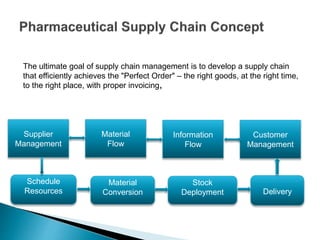
The ultimate goal of supply chain management is to develop a supply chain
that efficiently achieves the "Perfect Order" – the right goods, at the right time,
to the right place, with proper invoicing,
Supplier
Management
Customer
Management
Schedule
Resources
Material
Conversion
Stock
Deployment Delivery
Material
Flow
Information
Flow
Mother Warehouse
C & F Agent
Redistributor
Wholesalers
Rural RetailersUrban Retailers
Consumer
Strength
•State of art infrastructure
•Better understanding of
suppliers
•Strong customer
relationship management
•Financial Support
Weakness
•Bringing consensus with
internal stakeholders to
agree on forecast.
•In case of epidemic
break out global demand
for certain medicines
shoots up exponentially.
Opportunity
•Growing Pharmaceutical
sector in India
•Growing awareness of
patient and medicines
•Inclination towards
branded drugs and
company.
•3PL support
Threat
•Handling of drug expiration ,
drug returns/recall .
•The recall process is
complex and expensive
where products needs to be
tracked and shipped back
•Temp Controlled products
• Review, monitor and validate processes and system.
• Strengthening drug procurement and supply chain management.
• Additional drug requirement to meet unforeseen situations.
• Emerging technologies can mitigate many of the issues.
• Awareness of various schemes to retailers/distributors.
• Channel of communication should be clear.
Thank you

Pharmaceutical Supply Chain Management

  • 1.
  • 2.
     Introduction: -India is the largest provider of generic drugs globally. Indian pharmaceutical sector supplies over 50 per cent of global demand for various vaccines, 40 per cent of generic demand in the US and 25 per cent of all medicine in the UK.  India enjoys an important position in the global pharmaceuticals sector. The country also has a large pool of scientists and engineers with a potential to steer the industry ahead to greater heights.  Market Size: - Indian pharmaceutical sector is expected to grow to US$ 100 billion, while medical device market is expected to grow US$ 25 billion by 2025. India’s domestic pharmaceutical market turnover reached Rs 1.4 lakh crore (US$ 20.03 billion) in 2019, up 9.8 per cent y-o-y from Rs 129,015 crore (US$ 18.12 billion) in 2018.
  • 4.
     The Indianpharmaceuticals market is the third largest in terms of volume and the 13th largest in terms of value. It has established itself as a global manufacturing and a research hub.  India plans to set up a nearly Rs.1 lakh crore (US$ 1.3 billion) fund to boost companies to manufacture pharmaceutical ingredients domestically by 2023. Export and Advantage India  Pharmaceuticals* export from India stood at US$ 20.70 billion in 2019-20.  India is expected to rank among the top three pharmaceutical markets in terms of incremental growth by 2020.  India is the largest supplier of generic medicines globally (20 to 22 per cent of the global export volume)  India has one of the lowest manufacturing costs in the world. It is lower than that of USA and almost half of Europe.
  • 6.
    The ultimate goalof supply chain management is to develop a supply chain that efficiently achieves the "Perfect Order" – the right goods, at the right time, to the right place, with proper invoicing, Supplier Management Customer Management Schedule Resources Material Conversion Stock Deployment Delivery Material Flow Information Flow
  • 9.
    Mother Warehouse C &F Agent Redistributor Wholesalers Rural RetailersUrban Retailers Consumer
  • 10.
    Strength •State of artinfrastructure •Better understanding of suppliers •Strong customer relationship management •Financial Support Weakness •Bringing consensus with internal stakeholders to agree on forecast. •In case of epidemic break out global demand for certain medicines shoots up exponentially. Opportunity •Growing Pharmaceutical sector in India •Growing awareness of patient and medicines •Inclination towards branded drugs and company. •3PL support Threat •Handling of drug expiration , drug returns/recall . •The recall process is complex and expensive where products needs to be tracked and shipped back •Temp Controlled products
  • 11.
    • Review, monitorand validate processes and system. • Strengthening drug procurement and supply chain management. • Additional drug requirement to meet unforeseen situations. • Emerging technologies can mitigate many of the issues. • Awareness of various schemes to retailers/distributors. • Channel of communication should be clear.
  • 12.

Editor's Notes

  • #7 Information source - www.ibef.org