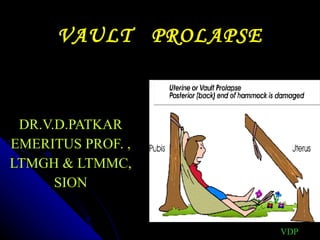
VAULT  PROLAPSE DR.V.D.PATKAR EMERITUS PROF. , LTMGH & LTMMC, SION VDP
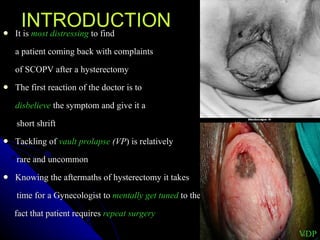
INTRODUCTION It is  most distressing  to find  a patient coming back with complaints  of SCOPV after a hysterectomy  The first reaction of the doctor is to  disbelieve  the symptom and give it a  short shrift  Tackling of  vault prolapse  (VP ) is relatively  rare and uncommon  Knowing the aftermaths of hysterectomy it takes time for a Gynecologist to  mentally get tuned  to the  fact that patient requires  repeat surgery   VDP
The dilemma faced is whether to go abdominally  or vaginally ( million dollar question.) Pelvic floor disorders continue to become even   more prevalent as women lead longer lives. Lifetime  risk  of surgery for pelvic organ prolapse is  11%.   Re-operation  rate for failure is  29%. Thorough understanding of the pelvic  anatomy and  relationship of vagina  is imperative.  VDP
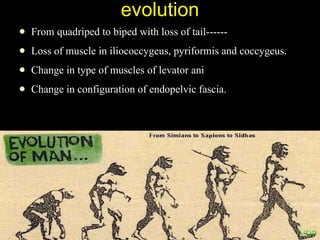
evolution From quadriped to biped with loss of tail------ Loss of muscle in iliococcygeus, pyriformis and coccygeus. Change in type of muscles of levator ani Change in configuration of endopelvic fascia. VDP
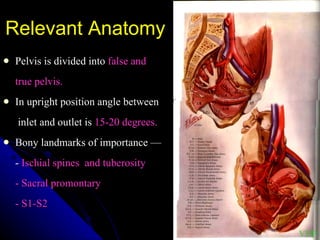
Relevant Anatomy   Pelvis is divided into  false and  true pelvis. In upright position angle between   inlet and outlet is  15-20 degrees. Bony landmarks of importance — -  Ischial spines  and tuberosity  - Sacral promontary - S1-S2 VDP
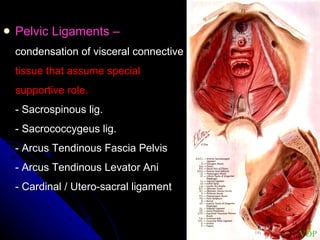
Pelvic Ligaments – condensation of visceral connective  tissue that assume special  supportive role. - Sacrospinous lig. - Sacrococcygeus lig.  - Arcus Tendinous Fascia Pelvis - Arcus Tendinous Levator Ani - Cardinal / Utero-sacral ligament VDP
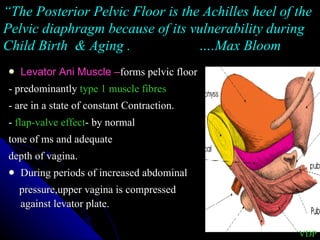
Levator Ani Muscle – forms pelvic floor - predominantly  type 1 muscle fibres - are in a state of constant Contraction. -  flap-valve effect - by normal  tone of ms and adequate  depth of vagina.  During periods of increased abdominal  pressure,upper vagina is compressed against levator plate. “ The Posterior Pelvic Floor is the Achilles heel of the Pelvic diaphragm because of its vulnerability during Child Birth  & Aging .  ….Max Bloom VDP
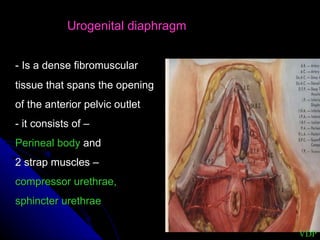
Urogenital diaphragm - Is a dense fibromuscular  tissue that spans the opening  of the anterior pelvic outlet - it consists of – Perineal body  and  2 strap muscles –  compressor urethrae, sphincter urethrae VDP
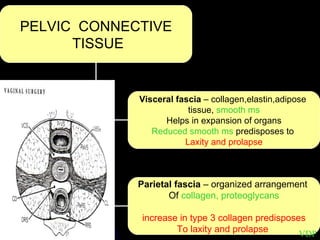
VDP PELVIC  CONNECTIVE TISSUE Visceral fascia  – collagen,elastin,adipose  tissue,  smooth ms Helps in expansion of organs Reduced smooth ms  predisposes to  Laxity and prolapse Parietal fascia  – organized arrangement  Of  collagen, proteoglycans increase in type 3 collagen predisposes  To laxity and prolapse
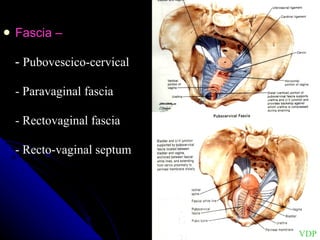
Fascia –  -  Pubovescico-cervical  - Paravaginal fascia - Rectovaginal fascia - Recto-vaginal septum VDP
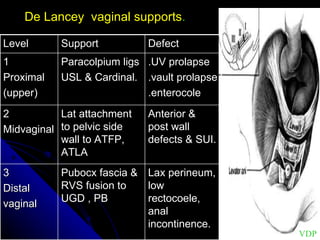
De Lancey  vaginal supports . VDP Level Support Defect 1 Proximal (upper) Paracolpium ligs USL & Cardinal. .UV prolapse .vault prolapse .enterocole 2 Midvaginal Lat attachment to pelvic side wall to ATFP, ATLA Anterior & post wall defects & SUI. 3 Distal vaginal Pubocx fascia & RVS fusion to UGD , PB Lax perineum, low rectocoele, anal incontinence.
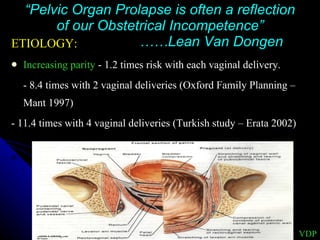
“ Pelvic Organ Prolapse is often a reflection of our Obstetrical Incompetence”   ……Lean Van Dongen ETIOLOGY:   Increasing parity  - 1.2 times risk with each vaginal delivery. - 8.4 times with 2 vaginal deliveries (Oxford Family Planning – Mant 1997) - 11.4 times with 4 vaginal deliveries (Turkish study – Erata 2002) VDP
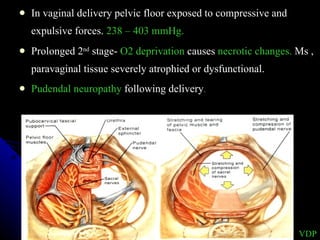
In vaginal delivery pelvic floor exposed to compressive and expulsive forces.  238 – 403 mmHg. Prolonged 2 nd  stage-  O2 deprivation  causes  necrotic changes.  Ms , paravaginal tissue severely atrophied or dysfunctional. Pudendal neuropathy  following delivery . VDP
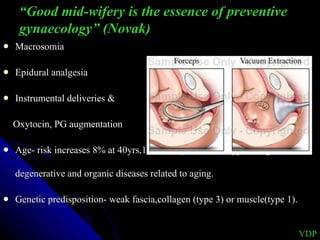
Macrosomia Epidural analgesia Instrumental deliveries &  Oxytocin, PG augmentation  Age- risk increases 8% at 40yrs,11% at 50yrs. Due to hypoestrogenism, degenerative and organic diseases related to aging.  Genetic predisposition- weak fascia,collagen (type 3) or muscle(type 1). VDP “ Good mid-wifery is the essence of preventive gynaecology” (Novak)
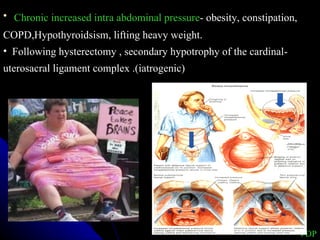
Chronic increased intra abdominal pressure - obesity, constipation, COPD,Hypothyroidsism, lifting heavy weight. Following hysterectomy ,   secondary hypotrophy of the cardinal- uterosacral ligament complex .(iatrogenic)  VDP
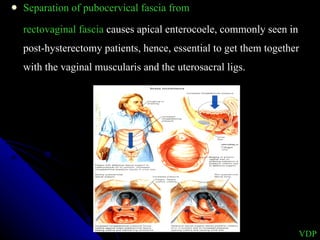
Separation of pubocervical fascia from  rectovaginal fascia  causes apical enterocoele, commonly seen in post-hysterectomy patients, hence, essential to get them together with the vaginal muscularis and the uterosacral ligs. VDP
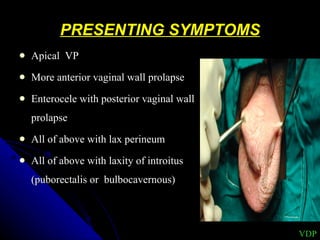
PRESENTING SYMPTOMS Apical  VP More anterior vaginal wall prolapse Enterocele with posterior vaginal wall prolapse  All of above with lax perineum All of above with laxity of introitus (puborectalis or  bulbocavernous) VDP
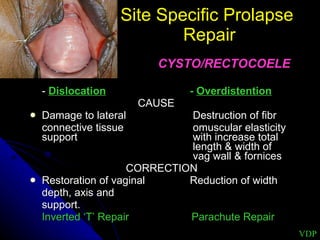
Site Specific Prolapse  Repair CYSTO/RECTOCOELE -  Dislocation -  Overdistention   CAUSE Damage to lateral  Destruction of fibr connective tissue   omuscular elasticity support    with increase total     length & width of   vag wall & fornices CORRECTION Restoration of vaginal    Reduction of width depth, axis and  support. Inverted ‘T’ Repair  Parachute Repair VDP
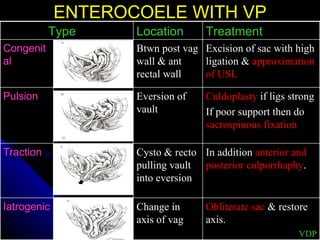
ENTEROCOELE WITH VP VDP Type Location Treatment Congenital Btwn post vag wall & ant rectal wall Excision of sac with high ligation &  approximation of USL Pulsion Eversion of vault Culdoplasty  if ligs strong If poor support then do  sacrospinous fixation Traction Cysto & recto pulling vault into eversion In addition  anterior and posterior colporrhaphy . Iatrogenic Change in axis of vag Obliterate sac  & restore axis.
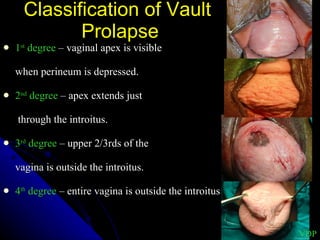
Classification of Vault  Prolapse 1 st  degree  – vaginal apex is visible  when perineum is depressed. 2 nd  degree  – apex extends just   through the introitus. 3 rd  degree  – upper 2/3rds of the  vagina is outside the introitus. 4 th  degree  – entire vagina is outside the introitus  VDP
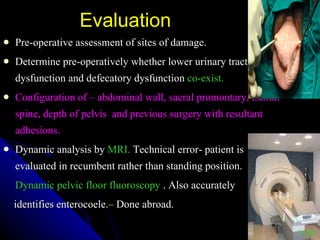
Evaluation Pre-operative assessment of sites of damage. Determine pre-operatively whether lower urinary tract dysfunction and defecatory dysfunction  co-exist. Configuration of – abdominal wall, sacral promontary, ischial spine, depth of pelvis  and previous surgery with resultant adhesions. Dynamic analysis by  MRI.  Technical error- patient is evaluated in recumbent rather than standing position. Dynamic pelvic floor fluoroscopy  . Also accurately identifies enterocoele.– Done abroad. VDP
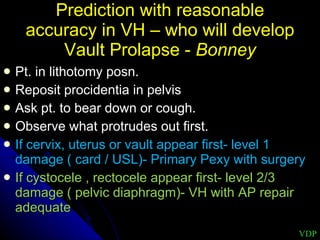
Prediction with reasonable accuracy in VH – who will develop Vault Prolapse -  Bonney Pt. in lithotomy posn.  Reposit procidentia in pelvis Ask pt. to bear down or cough. Observe what protrudes out first. If cervix, uterus or vault appear first- level 1 damage ( card / USL)- Primary Pexy with surgery If cystocele , rectocele appear first- level 2/3 damage ( pelvic diaphragm)- VH with AP repair adequate  VDP
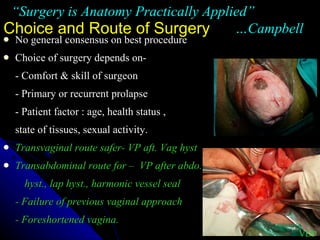
Choice and Route of Surgery No general consensus on best procedure Choice of surgery depends on- - Comfort & skill of surgeon - Primary or recurrent prolapse - Patient factor : age, health status ,  state of tissues, sexual activity. Transvaginal route safer- VP aft. Vag hyst  Transabdominal route for –  VP after abdo. hyst., lap hyst., harmonic vessel seal - Failure of previous vaginal approach - Foreshortened vagina. “ Surgery is Anatomy Practically Applied”  …Campbell VDP
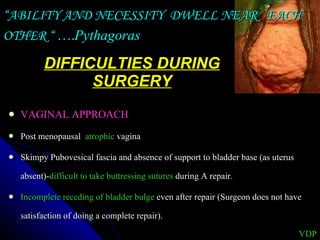
DIFFICULTIES DURING SURGERY VAGINAL APPROACH Post menopausal  atrophic  vagina  Skimpy Pubovesical fascia and absence of support to bladder base (as uterus absent)- difficult to take buttressing sutures  during A repair. Incomplete receding of bladder bulge  even after repair (Surgeon does not have satisfaction of doing a complete repair). “ ABILITY AND NECESSITY  DWELL NEAR  EACH OTHER “ …. Pythagoras VDP
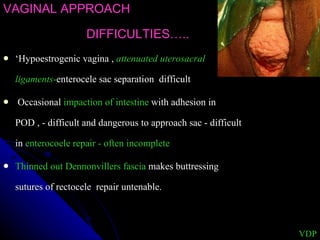
VAGINAL APPROACH DIFFICULTIES….. ‘ Hypoestrogenic vagina ,  attenuated uterosacral   ligaments - enterocele sac separation  difficult  Occasional  impaction of intestine  with adhesion in POD , - difficult and dangerous to approach sac - difficult in  enterocoele repair - often incomplete  Thinned out Dennonvillers fascia  makes buttressing sutures of rectocele  repair untenable. VDP
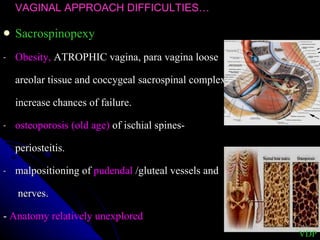
VAGINAL APPROACH DIFFICULTIES… Sacrospinopexy  Obesity,  ATROPHIC vagina, para vagina loose areolar tissue and coccygeal sacrospinal complex– increase chances of failure. osteoporosis (old age)  of ischial spines-  periosteitis. malpositioning of  pudendal  /gluteal vessels and   nerves. -  Anatomy relatively unexplored VDP
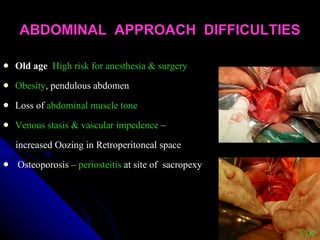
ABDOMINAL  APPROACH  DIFFICULTIES Old age   High risk for anesthesia & surgery Obesity , pendulous abdomen Loss of  abdominal muscle tone  Venous stasis & vascular impedence  –  increased Oozing in Retroperitoneal space Osteoporosis –   periosteitis  at site of  sacropexy VDP
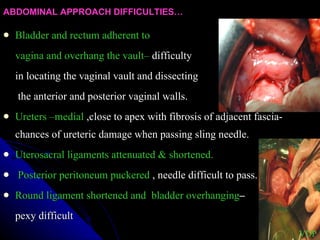
ABDOMINAL APPROACH DIFFICULTIES… Bladder and rectum adherent to  vagina and overhang the vault–  difficulty  in locating the vaginal vault and dissecting   the anterior and posterior vaginal walls.  Ureters –medial  ,close to apex with fibrosis of adjacent fascia-chances of ureteric damage when passing sling needle. Uterosacral ligaments attenuated & shortened. Posterior peritoneum puckered  , needle difficult to pass. Round ligament shortened and  bladder overhanging –  pexy difficult VDP
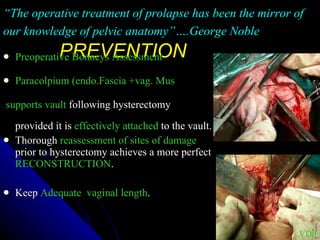
PREVENTION Preoperative Bonneys Assessment Paracolpium (endo.Fascia +vag. Mus supports vault  following hysterectomy  provided it is  effectively attached  to the vault. Thorough  reassessment of sites of damage  prior to hysterectomy achieves a more perfect  RECONSTRUCTION . Keep  Adequate  vaginal length . “ The operative treatment of prolapse has been the mirror of our knowledge of pelvic anatomy”….George Noble VDP
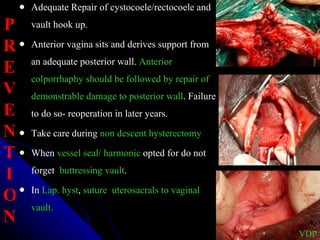
Adequate Repair of cystocoele/rectocoele and vault hook up. Anterior vagina sits and derives support from an adequate posterior wall.  Anterior colporrhaphy should be followed by repair of demonstrable damage to posterior wall . Failure to do so- reoperation in later years. Take care during  non descent hysterectomy When  vessel seal/ harmonic  opted for do not forget  buttressing vault . In  Lap. hyst ,  suture  uterosacrals   to vaginal  vault. VDP P R E V E N T I O N
SURGERIES  FOR  VAULT  PROLAPSE VDP
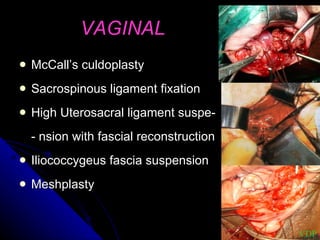
VAGINAL McCall’s culdoplasty Sacrospinous ligament fixation High Uterosacral ligament suspe- - nsion with fascial reconstruction Iliococcygeus fascia suspension Meshplasty VDP
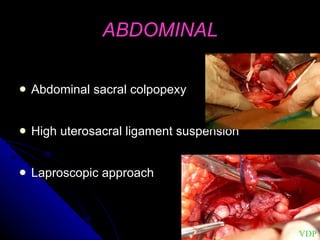
ABDOMINAL Abdominal sacral colpopexy High uterosacral ligament suspension Laproscopic approach VDP
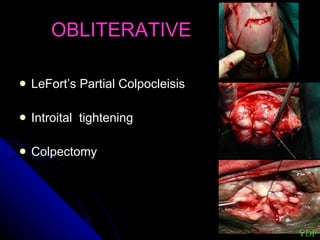
OBLITERATIVE LeFort’s Partial Colpocleisis Introital  tightening Colpectomy VDP
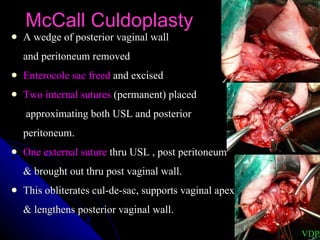
McCall Culdoplasty A wedge of posterior vaginal wall  and peritoneum removed Enterocole sac freed  and excised Two internal sutures  (permanent) placed   approximating both USL and posterior  peritoneum. One external suture  thru USL , post peritoneum  & brought out thru post vaginal wall. This obliterates cul-de-sac, supports vaginal apex  & lengthens posterior vaginal wall. VDP
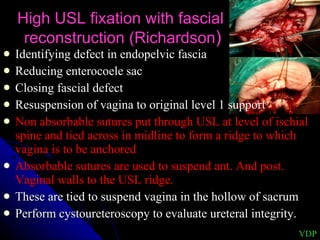
High USL fixation with fascial  reconstruction (Richardson ) Identifying defect in endopelvic fascia Reducing enterocoele sac Closing fascial defect Resuspension of vagina to original level 1 support Non absorbable sutures put through USL at level of ischial spine and tied across in midline to form a ridge to which vagina is to be anchored Absorbable sutures are used to suspend ant. And post. Vaginal walls to the USL ridge.  These are tied to suspend vagina in the hollow of sacrum Perform cystoureteroscopy to evaluate ureteral integrity. VDP
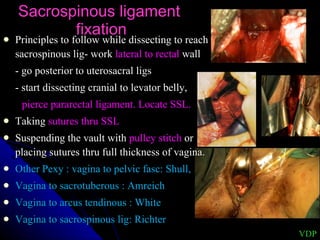
Sacrospinous ligament  fixation Principles to follow while dissecting to reach sacrospinous lig- work  lateral to rectal  wall - go posterior to uterosacral ligs - start dissecting cranial to levator belly, pierce pararectal ligament. Locate SSL. Taking  sutures thru SSL Suspending the vault with  pulley stitch  or placing sutures thru full thickness of vagina. Other Pexy : vagina to pelvic fasc: Shull, Vagina to sacrotuberous : Amreich Vagina to arcus tendinous : White Vagina to sacrospinous lig: Richter VDP
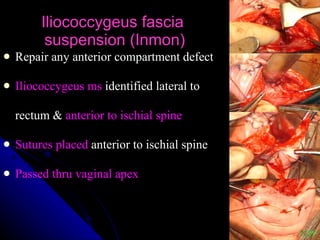
Iliococcygeus fascia  suspension (Inmon) Repair any anterior compartment defect  Iliococcygeus ms  identified lateral to  rectum &  anterior to ischial spine Sutures placed  anterior to ischial spine  Passed thru vaginal apex VDP
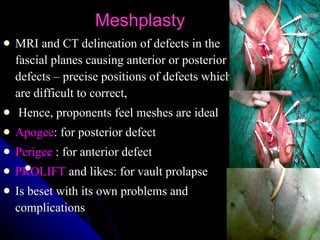
Meshplasty MRI and CT delineation of defects in the fascial planes causing anterior or posterior defects – precise positions of defects which are difficult to correct, Hence, proponents feel meshes are ideal Apogee : for posterior defect Perigee  : for anterior defect PROLIFT  and likes: for vault prolapse Is beset with its own problems and complications VDP
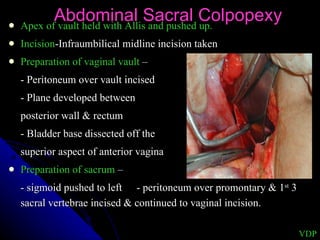
Apex of vault held with Allis and pushed up. Incision -Infraumbilical midline incision taken  Preparation of vaginal vault  – - Peritoneum over vault incised - Plane developed between  posterior wall & rectum  - Bladder base dissected off the  superior aspect of anterior vagina Preparation of sacrum  – - sigmoid pushed to left - peritoneum over promontary & 1 st  3 sacral vertebrae incised & continued to vaginal incision. Abdominal Sacral Colpopexy VDP
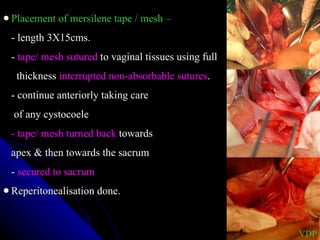
Placement of mersilene tape / mesh – - length 3X15cms. -  tape/ mesh sutured  to vaginal tissues using full  thickness  interrupted non-absorbable sutures . - continue anteriorly taking care   of any cystocoele - tape/ mesh turned back  towards  apex & then towards the sacrum -  secured to sacrum Reperitonealisation done. VDP
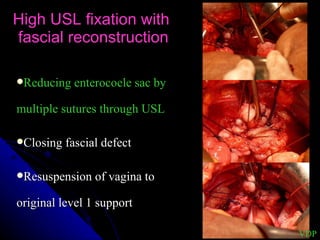
High USL fixation with  fascial reconstruction Reducing enterocoele sac by multiple sutures through USL Closing fascial defect Resuspension of vagina to original level 1 support VDP
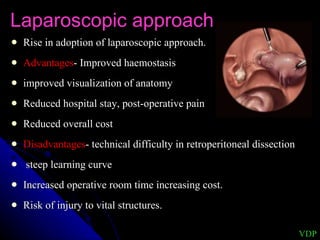
Laparoscopic approach Rise in adoption of laparoscopic approach. Advantages - Improved haemostasis  improved visualization of anatomy  Reduced hospital stay, post-operative pain Reduced overall cost Disadvantages - technical difficulty in retroperitoneal dissection steep learning curve Increased operative room time increasing cost. Risk of injury to vital structures. VDP
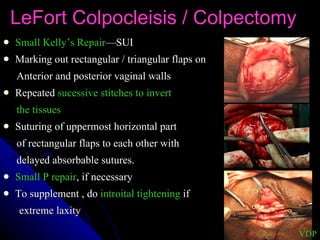
LeFort Colpocleisis / Colpectomy Small Kelly’s Repair —SUI Marking out rectangular / triangular flaps on  Anterior and posterior vaginal walls Repeated  sucessive stitches to invert  the tissues Suturing of uppermost horizontal part  of rectangular flaps to each other with  delayed absorbable sutures. Small P repair , if necessary To supplement , do  introital tightening  if extreme laxity VDP
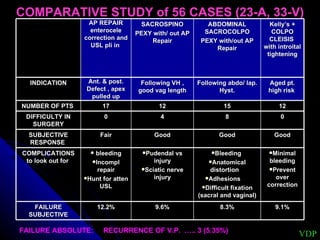
COMPARATIVE STUDY of 56 CASES (23-A, 33-V) VDP FAILURE ABSOLUTE:  RECURRENCE OF V.P.  ….. 3 (5.35%) AP REPAIR enterocele correction and USL pli in  SACROSPINO PEXY with/ out AP Repair ABDOMINAL SACROCOLPO PEXY with/out AP Repair Kelly’s + COLPO CLEISIS  with introital tightening INDICATION Ant. & post. Defect , apex pulled up Following VH , good vag length Following abdo/ lap. Hyst. Aged pt. high risk  NUMBER OF PTS  17 12 15 12 DIFFICULTY IN SURGERY 0 4 8 0 SUBJECTIVE RESPONSE  Fair Good Good Good COMPLICATIONS to look out for  bleeding Incompl repair Hunt for atten USL Pudendal vs injury Sciatic nerve injury Bleeding  Anatomical distortion  Adhesions  Difficult fixation (sacral and vaginal) Minimal bleeding Prevent over correction FAILURE SUBJECTIVE 12.2% 9.6% 8.3% 9.1%
Pointers to successful surgery Age Proper counselling High risk factors  Previous surgeries performed No. of attempts at repair Symptoms and signs Type of vault prolapse Defects in supports identified Skill, knowledge and experience of surgeon Comfort, confidence with particular surgery VDP
THE  BEST  DEFENCE  IS A GOOD  SURGICAL  OFFENSE No stereotyping patients, - INDIVIDUALISATION  - the NEED ! SURGERY  SHOULD  FIT  THE  PATIENT  , THE  PATIENT  SHOULD  NOT  FIT  THE SURGERY. -  Michael Smith VDP THANK YOU

Figo vault prolapse - dr vivekpatkar

  • 1.
    VAULT PROLAPSEDR.V.D.PATKAR EMERITUS PROF. , LTMGH & LTMMC, SION VDP
  • 2.
    INTRODUCTION It is most distressing to find a patient coming back with complaints of SCOPV after a hysterectomy The first reaction of the doctor is to disbelieve the symptom and give it a short shrift Tackling of vault prolapse (VP ) is relatively rare and uncommon Knowing the aftermaths of hysterectomy it takes time for a Gynecologist to mentally get tuned to the fact that patient requires repeat surgery VDP
  • 3.
    The dilemma facedis whether to go abdominally or vaginally ( million dollar question.) Pelvic floor disorders continue to become even more prevalent as women lead longer lives. Lifetime risk of surgery for pelvic organ prolapse is 11%. Re-operation rate for failure is 29%. Thorough understanding of the pelvic anatomy and relationship of vagina is imperative. VDP
  • 4.
    evolution From quadripedto biped with loss of tail------ Loss of muscle in iliococcygeus, pyriformis and coccygeus. Change in type of muscles of levator ani Change in configuration of endopelvic fascia. VDP
  • 5.
    Relevant Anatomy Pelvis is divided into false and true pelvis. In upright position angle between inlet and outlet is 15-20 degrees. Bony landmarks of importance — - Ischial spines and tuberosity - Sacral promontary - S1-S2 VDP
  • 6.
    Pelvic Ligaments –condensation of visceral connective tissue that assume special supportive role. - Sacrospinous lig. - Sacrococcygeus lig. - Arcus Tendinous Fascia Pelvis - Arcus Tendinous Levator Ani - Cardinal / Utero-sacral ligament VDP
  • 7.
    Levator Ani Muscle– forms pelvic floor - predominantly type 1 muscle fibres - are in a state of constant Contraction. - flap-valve effect - by normal tone of ms and adequate depth of vagina. During periods of increased abdominal pressure,upper vagina is compressed against levator plate. “ The Posterior Pelvic Floor is the Achilles heel of the Pelvic diaphragm because of its vulnerability during Child Birth & Aging . ….Max Bloom VDP
  • 8.
    Urogenital diaphragm -Is a dense fibromuscular tissue that spans the opening of the anterior pelvic outlet - it consists of – Perineal body and 2 strap muscles – compressor urethrae, sphincter urethrae VDP
  • 9.
    VDP PELVIC CONNECTIVE TISSUE Visceral fascia – collagen,elastin,adipose tissue, smooth ms Helps in expansion of organs Reduced smooth ms predisposes to Laxity and prolapse Parietal fascia – organized arrangement Of collagen, proteoglycans increase in type 3 collagen predisposes To laxity and prolapse
  • 10.
    Fascia – - Pubovescico-cervical - Paravaginal fascia - Rectovaginal fascia - Recto-vaginal septum VDP
  • 11.
    De Lancey vaginal supports . VDP Level Support Defect 1 Proximal (upper) Paracolpium ligs USL & Cardinal. .UV prolapse .vault prolapse .enterocole 2 Midvaginal Lat attachment to pelvic side wall to ATFP, ATLA Anterior & post wall defects & SUI. 3 Distal vaginal Pubocx fascia & RVS fusion to UGD , PB Lax perineum, low rectocoele, anal incontinence.
  • 12.
    “ Pelvic OrganProlapse is often a reflection of our Obstetrical Incompetence” ……Lean Van Dongen ETIOLOGY: Increasing parity - 1.2 times risk with each vaginal delivery. - 8.4 times with 2 vaginal deliveries (Oxford Family Planning – Mant 1997) - 11.4 times with 4 vaginal deliveries (Turkish study – Erata 2002) VDP
  • 13.
    In vaginal deliverypelvic floor exposed to compressive and expulsive forces. 238 – 403 mmHg. Prolonged 2 nd stage- O2 deprivation causes necrotic changes. Ms , paravaginal tissue severely atrophied or dysfunctional. Pudendal neuropathy following delivery . VDP
  • 14.
    Macrosomia Epidural analgesiaInstrumental deliveries & Oxytocin, PG augmentation Age- risk increases 8% at 40yrs,11% at 50yrs. Due to hypoestrogenism, degenerative and organic diseases related to aging. Genetic predisposition- weak fascia,collagen (type 3) or muscle(type 1). VDP “ Good mid-wifery is the essence of preventive gynaecology” (Novak)
  • 15.
    Chronic increased intraabdominal pressure - obesity, constipation, COPD,Hypothyroidsism, lifting heavy weight. Following hysterectomy , secondary hypotrophy of the cardinal- uterosacral ligament complex .(iatrogenic) VDP
  • 16.
    Separation of pubocervicalfascia from rectovaginal fascia causes apical enterocoele, commonly seen in post-hysterectomy patients, hence, essential to get them together with the vaginal muscularis and the uterosacral ligs. VDP
  • 17.
    PRESENTING SYMPTOMS Apical VP More anterior vaginal wall prolapse Enterocele with posterior vaginal wall prolapse All of above with lax perineum All of above with laxity of introitus (puborectalis or bulbocavernous) VDP
  • 18.
    Site Specific Prolapse Repair CYSTO/RECTOCOELE - Dislocation - Overdistention CAUSE Damage to lateral Destruction of fibr connective tissue omuscular elasticity support with increase total length & width of vag wall & fornices CORRECTION Restoration of vaginal Reduction of width depth, axis and support. Inverted ‘T’ Repair Parachute Repair VDP
  • 19.
    ENTEROCOELE WITH VPVDP Type Location Treatment Congenital Btwn post vag wall & ant rectal wall Excision of sac with high ligation & approximation of USL Pulsion Eversion of vault Culdoplasty if ligs strong If poor support then do sacrospinous fixation Traction Cysto & recto pulling vault into eversion In addition anterior and posterior colporrhaphy . Iatrogenic Change in axis of vag Obliterate sac & restore axis.
  • 20.
    Classification of Vault Prolapse 1 st degree – vaginal apex is visible when perineum is depressed. 2 nd degree – apex extends just through the introitus. 3 rd degree – upper 2/3rds of the vagina is outside the introitus. 4 th degree – entire vagina is outside the introitus VDP
  • 21.
    Evaluation Pre-operative assessmentof sites of damage. Determine pre-operatively whether lower urinary tract dysfunction and defecatory dysfunction co-exist. Configuration of – abdominal wall, sacral promontary, ischial spine, depth of pelvis and previous surgery with resultant adhesions. Dynamic analysis by MRI. Technical error- patient is evaluated in recumbent rather than standing position. Dynamic pelvic floor fluoroscopy . Also accurately identifies enterocoele.– Done abroad. VDP
  • 22.
    Prediction with reasonableaccuracy in VH – who will develop Vault Prolapse - Bonney Pt. in lithotomy posn. Reposit procidentia in pelvis Ask pt. to bear down or cough. Observe what protrudes out first. If cervix, uterus or vault appear first- level 1 damage ( card / USL)- Primary Pexy with surgery If cystocele , rectocele appear first- level 2/3 damage ( pelvic diaphragm)- VH with AP repair adequate VDP
  • 23.
    Choice and Routeof Surgery No general consensus on best procedure Choice of surgery depends on- - Comfort & skill of surgeon - Primary or recurrent prolapse - Patient factor : age, health status , state of tissues, sexual activity. Transvaginal route safer- VP aft. Vag hyst Transabdominal route for – VP after abdo. hyst., lap hyst., harmonic vessel seal - Failure of previous vaginal approach - Foreshortened vagina. “ Surgery is Anatomy Practically Applied” …Campbell VDP
  • 24.
    DIFFICULTIES DURING SURGERYVAGINAL APPROACH Post menopausal atrophic vagina Skimpy Pubovesical fascia and absence of support to bladder base (as uterus absent)- difficult to take buttressing sutures during A repair. Incomplete receding of bladder bulge even after repair (Surgeon does not have satisfaction of doing a complete repair). “ ABILITY AND NECESSITY DWELL NEAR EACH OTHER “ …. Pythagoras VDP
  • 25.
    VAGINAL APPROACH DIFFICULTIES…..‘ Hypoestrogenic vagina , attenuated uterosacral ligaments - enterocele sac separation difficult Occasional impaction of intestine with adhesion in POD , - difficult and dangerous to approach sac - difficult in enterocoele repair - often incomplete Thinned out Dennonvillers fascia makes buttressing sutures of rectocele repair untenable. VDP
  • 26.
    VAGINAL APPROACH DIFFICULTIES…Sacrospinopexy Obesity, ATROPHIC vagina, para vagina loose areolar tissue and coccygeal sacrospinal complex– increase chances of failure. osteoporosis (old age) of ischial spines- periosteitis. malpositioning of pudendal /gluteal vessels and nerves. - Anatomy relatively unexplored VDP
  • 27.
    ABDOMINAL APPROACH DIFFICULTIES Old age High risk for anesthesia & surgery Obesity , pendulous abdomen Loss of abdominal muscle tone Venous stasis & vascular impedence – increased Oozing in Retroperitoneal space Osteoporosis – periosteitis at site of sacropexy VDP
  • 28.
    ABDOMINAL APPROACH DIFFICULTIES…Bladder and rectum adherent to vagina and overhang the vault– difficulty in locating the vaginal vault and dissecting the anterior and posterior vaginal walls. Ureters –medial ,close to apex with fibrosis of adjacent fascia-chances of ureteric damage when passing sling needle. Uterosacral ligaments attenuated & shortened. Posterior peritoneum puckered , needle difficult to pass. Round ligament shortened and bladder overhanging – pexy difficult VDP
  • 29.
    PREVENTION Preoperative BonneysAssessment Paracolpium (endo.Fascia +vag. Mus supports vault following hysterectomy provided it is effectively attached to the vault. Thorough reassessment of sites of damage prior to hysterectomy achieves a more perfect RECONSTRUCTION . Keep Adequate vaginal length . “ The operative treatment of prolapse has been the mirror of our knowledge of pelvic anatomy”….George Noble VDP
  • 30.
    Adequate Repair ofcystocoele/rectocoele and vault hook up. Anterior vagina sits and derives support from an adequate posterior wall. Anterior colporrhaphy should be followed by repair of demonstrable damage to posterior wall . Failure to do so- reoperation in later years. Take care during non descent hysterectomy When vessel seal/ harmonic opted for do not forget buttressing vault . In Lap. hyst , suture uterosacrals to vaginal vault. VDP P R E V E N T I O N
  • 31.
    SURGERIES FOR VAULT PROLAPSE VDP
  • 32.
    VAGINAL McCall’s culdoplastySacrospinous ligament fixation High Uterosacral ligament suspe- - nsion with fascial reconstruction Iliococcygeus fascia suspension Meshplasty VDP
  • 33.
    ABDOMINAL Abdominal sacralcolpopexy High uterosacral ligament suspension Laproscopic approach VDP
  • 34.
    OBLITERATIVE LeFort’s PartialColpocleisis Introital tightening Colpectomy VDP
  • 35.
    McCall Culdoplasty Awedge of posterior vaginal wall and peritoneum removed Enterocole sac freed and excised Two internal sutures (permanent) placed approximating both USL and posterior peritoneum. One external suture thru USL , post peritoneum & brought out thru post vaginal wall. This obliterates cul-de-sac, supports vaginal apex & lengthens posterior vaginal wall. VDP
  • 36.
    High USL fixationwith fascial reconstruction (Richardson ) Identifying defect in endopelvic fascia Reducing enterocoele sac Closing fascial defect Resuspension of vagina to original level 1 support Non absorbable sutures put through USL at level of ischial spine and tied across in midline to form a ridge to which vagina is to be anchored Absorbable sutures are used to suspend ant. And post. Vaginal walls to the USL ridge. These are tied to suspend vagina in the hollow of sacrum Perform cystoureteroscopy to evaluate ureteral integrity. VDP
  • 37.
    Sacrospinous ligament fixation Principles to follow while dissecting to reach sacrospinous lig- work lateral to rectal wall - go posterior to uterosacral ligs - start dissecting cranial to levator belly, pierce pararectal ligament. Locate SSL. Taking sutures thru SSL Suspending the vault with pulley stitch or placing sutures thru full thickness of vagina. Other Pexy : vagina to pelvic fasc: Shull, Vagina to sacrotuberous : Amreich Vagina to arcus tendinous : White Vagina to sacrospinous lig: Richter VDP
  • 38.
    Iliococcygeus fascia suspension (Inmon) Repair any anterior compartment defect Iliococcygeus ms identified lateral to rectum & anterior to ischial spine Sutures placed anterior to ischial spine Passed thru vaginal apex VDP
  • 39.
    Meshplasty MRI andCT delineation of defects in the fascial planes causing anterior or posterior defects – precise positions of defects which are difficult to correct, Hence, proponents feel meshes are ideal Apogee : for posterior defect Perigee : for anterior defect PROLIFT and likes: for vault prolapse Is beset with its own problems and complications VDP
  • 40.
    Apex of vaultheld with Allis and pushed up. Incision -Infraumbilical midline incision taken Preparation of vaginal vault – - Peritoneum over vault incised - Plane developed between posterior wall & rectum - Bladder base dissected off the superior aspect of anterior vagina Preparation of sacrum – - sigmoid pushed to left - peritoneum over promontary & 1 st 3 sacral vertebrae incised & continued to vaginal incision. Abdominal Sacral Colpopexy VDP
  • 41.
    Placement of mersilenetape / mesh – - length 3X15cms. - tape/ mesh sutured to vaginal tissues using full thickness interrupted non-absorbable sutures . - continue anteriorly taking care of any cystocoele - tape/ mesh turned back towards apex & then towards the sacrum - secured to sacrum Reperitonealisation done. VDP
  • 42.
    High USL fixationwith fascial reconstruction Reducing enterocoele sac by multiple sutures through USL Closing fascial defect Resuspension of vagina to original level 1 support VDP
  • 43.
    Laparoscopic approach Risein adoption of laparoscopic approach. Advantages - Improved haemostasis improved visualization of anatomy Reduced hospital stay, post-operative pain Reduced overall cost Disadvantages - technical difficulty in retroperitoneal dissection steep learning curve Increased operative room time increasing cost. Risk of injury to vital structures. VDP
  • 44.
    LeFort Colpocleisis /Colpectomy Small Kelly’s Repair —SUI Marking out rectangular / triangular flaps on Anterior and posterior vaginal walls Repeated sucessive stitches to invert the tissues Suturing of uppermost horizontal part of rectangular flaps to each other with delayed absorbable sutures. Small P repair , if necessary To supplement , do introital tightening if extreme laxity VDP
  • 45.
    COMPARATIVE STUDY of56 CASES (23-A, 33-V) VDP FAILURE ABSOLUTE: RECURRENCE OF V.P. ….. 3 (5.35%) AP REPAIR enterocele correction and USL pli in SACROSPINO PEXY with/ out AP Repair ABDOMINAL SACROCOLPO PEXY with/out AP Repair Kelly’s + COLPO CLEISIS with introital tightening INDICATION Ant. & post. Defect , apex pulled up Following VH , good vag length Following abdo/ lap. Hyst. Aged pt. high risk NUMBER OF PTS 17 12 15 12 DIFFICULTY IN SURGERY 0 4 8 0 SUBJECTIVE RESPONSE Fair Good Good Good COMPLICATIONS to look out for bleeding Incompl repair Hunt for atten USL Pudendal vs injury Sciatic nerve injury Bleeding Anatomical distortion Adhesions Difficult fixation (sacral and vaginal) Minimal bleeding Prevent over correction FAILURE SUBJECTIVE 12.2% 9.6% 8.3% 9.1%
  • 46.
    Pointers to successfulsurgery Age Proper counselling High risk factors Previous surgeries performed No. of attempts at repair Symptoms and signs Type of vault prolapse Defects in supports identified Skill, knowledge and experience of surgeon Comfort, confidence with particular surgery VDP
  • 47.
    THE BEST DEFENCE IS A GOOD SURGICAL OFFENSE No stereotyping patients, - INDIVIDUALISATION - the NEED ! SURGERY SHOULD FIT THE PATIENT , THE PATIENT SHOULD NOT FIT THE SURGERY. - Michael Smith VDP THANK YOU